
Quick Answer
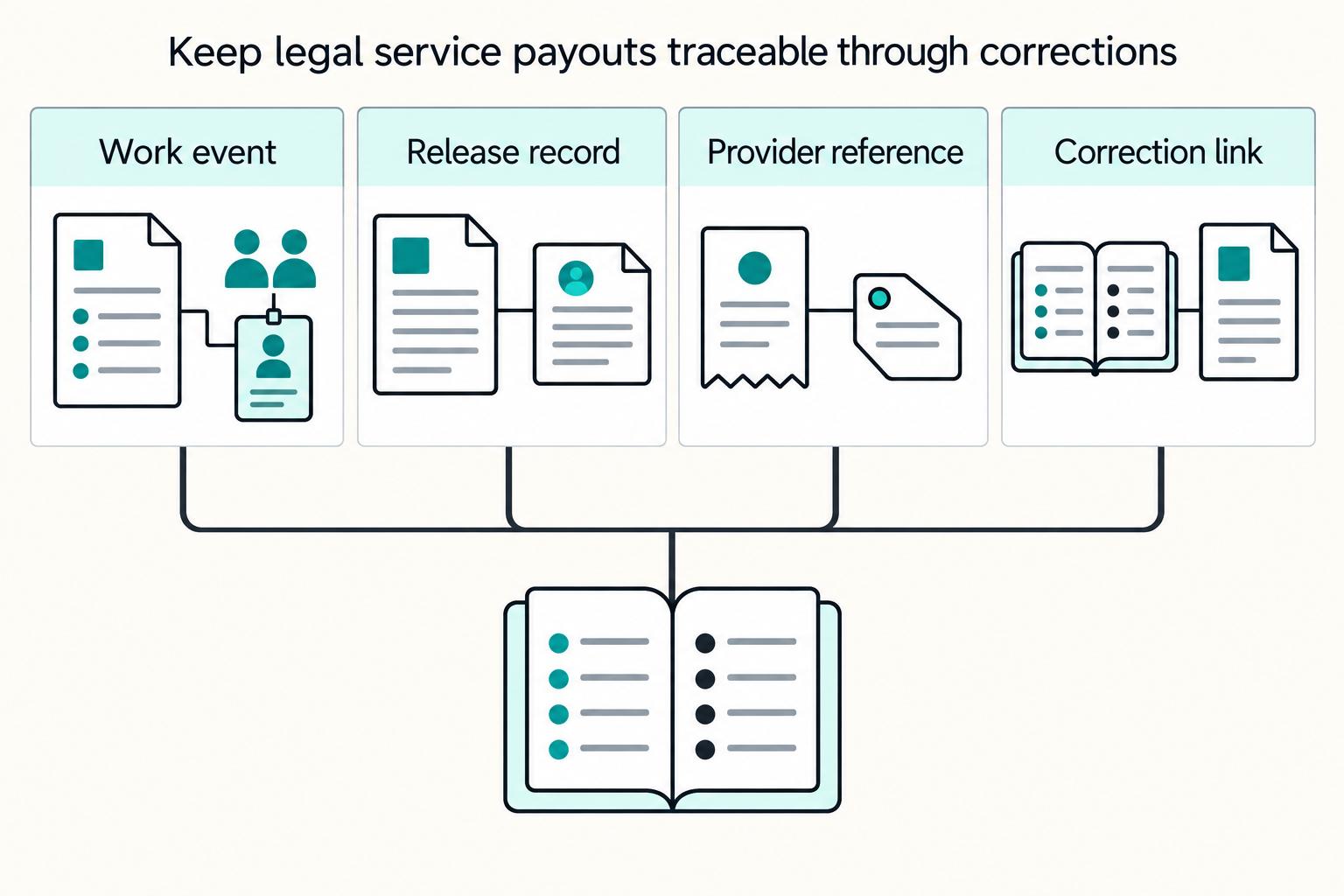
Legal-services platforms should pay interpreters and court reporters through separate role and event lanes, collect tax records before release, classify worker models by jurisdiction, and store every payout against a ledger event that supports reporting and corrections. Narrow the first pilot to one market and one role mix before expanding.
Why paying interpreters and court reporters is a platform-design problem#
If you are launching a legal-services payout workflow in 2026, the hard part is not sending money. The hard part is classifying the role, collecting the right tax record, deciding which payout state is releasable, and preserving enough evidence to defend those choices later.
That is why this topic should not be reduced to pay anecdotes or recruiting copy. Your sources already show the gap. IRS materials cover W-9 intake, information return reporting, backup withholding, and the split between 1099 forms. A Federal Register item addresses employee-versus-contractor classification analysis. Court-system and workforce materials show that role structure and market conditions vary. None of that looks like a simple "set one rate and pay everybody" workflow.
You need an operating model that survives mixed roles, mixed jurisdictions, and mixed tax outcomes. If your platform cannot separate those lanes cleanly, your reporting burden will grow faster than your payout volume.
The first question to answer#
Ask one question before you design anything else: what exactly is the platform paying for in each lane? Scheduled interpreting, appearance time, cancellation fees, overrun time, transcript work, expedited delivery, and admin adjustments should not all inherit the same rules automatically.
Why role detail matters#
A court interpreter and a court reporter can appear in the same matter and still create different operational records. Your outline artifacts already point to separate tracks such as digital reporter, voice writer, stenographer, and court interpreter. That separation is useful because payout, tax handling, and documentation can diverge once work types diverge.
Related reading: translation and localization platform payouts, music royalty tax classification, and automated W-9 collection.
Map the real work types and payment events before you choose a payout model#
You should build your ledger from events, not from people labels. A platform that stores only "vendor paid" loses the context that later determines correction, reporting, and dispute handling.
Start with a clean event map for each role lane. Scheduled session, overtime, cancellation, no-show, expedited transcript, mileage, or rescheduling fee can all require different posting logic. If you collapse them into one generic compensation field, you make later tax and audit decisions harder than they need to be.
A practical event map#
- Scheduled assignment completed
- Session extended or overtime approved
- Late cancellation
- No-show or stand-by fee
- Transcript or deliverable surcharge
- Manual correction or post-session adjustment
Why this matters for finance#
Finance does not just need a total. Finance needs a reason. If a payout return, reporting correction, or worker dispute appears later, your team will need to prove which event created the money movement and which policy state approved it.
Work-event table#
| Role lane | Common payment events | Why it needs a separate record |
|---|---|---|
| Court interpreter | Appearance, overtime, cancellation, no-show | Court scheduling changes often affect pay logic |
| Court reporter | Appearance, transcript, expedited delivery, correction | Deliverable-linked fees can diverge from appearance fees |
| Digital reporter | Session work plus technology-supported deliverables | Mixed service components complicate standardization |
| Voice writer or stenographer | Session work, transcript, revision work | Downstream output can affect pricing and review |
Related reading: contractor self-service payment status and bulk payment processing for platforms.
Choose worker classification lane by lane, not brand by brand#
You should not assume that one workforce model scales across every court-adjacent market. What's referenced here includes IRS classification materials and a Federal Register item on employee-or-independent-contractor classification under the Fair Labor Standards Act. That is enough to justify a cautious approach: treat worker classification as a lane decision with legal review, not as a single company preference.
Your own research notes also point to divergence across contexts. The legal-services evidence mentions employee-versus-contractor options and differences between state and federal court-adjacent paths. That is a warning sign against one universal rule.
A better way to decide#
- Define the jurisdiction first.
- Define the role track second.
- Define the compensation model third.
- Document the classification rationale before launch.
- Pause the lane if evidence is weak.
Classification comparison table#
| Lane question | Contractor-heavy path | Employee-heavy path |
|---|---|---|
| Onboarding speed | Usually faster | Usually slower |
| Benefits and payroll burden | Lower for the platform | Higher for the platform |
| Tax reporting handling | Usually 1099-oriented if facts support it | Wage and payroll handling |
| Control requirement | Strong contract and tax intake discipline | Strong payroll and HR process discipline |
| Risk if facts are unclear | Misclassification exposure | Overbuilt cost structure |
What you should not do#
Do not let go-to-market urgency decide worker classification implicitly. If your evidence is incomplete, the correct move is to slow that lane down, not to launch and clean it up later.
Related reading: platform misclassification risk at scale and global compliance certifications for payment platforms.
Build tax document collection before the first disbursement#
Tax document collection should be a release control, not a year-end housekeeping project. IRS guidance across W-9, 1099 reporting, and backup withholding makes that clear enough for operators: the tax record belongs in the front of the process, not the back.
If you are paying independent-contractor lanes, collect the payee tax profile before money moves. If the tax record is incomplete, inconsistent, or subject to additional review, the cleanest rule is to hold the lane until the record is corrected.
Minimum tax-profile fields to collect#
- Legal name
- Tax classification data needed for the lane
- TIN or certification status where applicable
- Address and country context
- Payment-routing details tied to the same payee record
Release rules tied to tax state#
You should prevent first payout when the tax profile is still incomplete. You should also route possible backup-withholding cases into a named queue instead of leaving operations to guess in the moment. The goal is to remove avoidable ambiguity before release, not to turn every payout analyst into a tax expert.
Tax collection table#
| Control | Why it matters | Good release state |
|---|---|---|
| W-9 or equivalent payee tax intake | Supports correct reporting setup | Completed and validated for the lane |
| TIN or certification status | Reduces correction risk | Recorded and reviewable |
| Role-to-form mapping | Keeps service types separated | Determined before payout batch |
| Exception queue for tax issues | Prevents ad hoc decisions | Named owner and documented outcome |
Related reading: contractor tax-document portal design and 1099-NEC automation at scale.
Separate 1099-NEC, 1099-MISC, and correction logic before money moves#
For this topic, the platform habit you want is classification before payout. IRS sources on Form 1099-NEC, Form 1099-MISC, and independent-contractor reporting all reinforce the same operational point: reporting output depends on how the underlying payment is characterized.
You do not need to turn this article into a tax treatise to act on that principle. You do need separate earning lines, separate review logic, and a clear owner for corrections when a payout was routed into the wrong reporting lane.
Operator rules that reduce year-end pain#
- Classify each earning line before batching.
- Keep different payment bases in different ledger buckets.
- Do not blend corrected and uncorrected records silently.
- Require a documented reason when a reporting lane changes.
Why correction workflows matter#
Corrections are expensive because they consume more than filing time. They consume trust between operations, finance, and the workers you pay. The cleaner your front-end classification logic is, the less likely you are to create year-end scramble around a small set of avoidable mistakes.
Related reading: music-royalty 1099 lane design if you want another example of how mixed payment types force separate reporting logic.
Do not let noisy market-rate signals decide your payout policy#
Your research artifacts are especially useful here because they show conflicting evidence quality. A Reddit snippet suggests anecdotal interpreter day rates. A ZipRecruiter page for Burlington, Kentucky shows no jobs found in the scraped state even though the search snippet implied pay data. A Facebook group reference hints at agency fee behavior without providing stable evidence. That is not enough to set payout policy responsibly.
You can still use those sources, but only in the right way. Use them as weak signals that something may vary by market. Do not use them as a single-source answer for launch pricing or classification.
A better market-data hierarchy#
- Primary guidance: direct tax and reporting sources that affect control design
- Program or court-system materials: helpful for role structure and process context
- Association or workforce studies: useful for market shape and differences
- Job boards and social snippets: weak signals only
Source-confidence table#
| Source type | What it can help with | What it should not decide alone |
|---|---|---|
| IRS pages and instructions | Tax intake and reporting design | Market-rate policy by itself |
| Court-system or reimbursement program materials | Role structure and process nuance | National pricing assumptions |
| Workforce or association analysis | Market differences and staffing context | One universal payout model |
| Job boards, Reddit, Facebook snippets | Questions to investigate | Compensation policy or compliance decisions |
Use a rate-card review instead of one blended payout schedule#
However, the practical pricing decision still has to happen somewhere. A cleaner approach is to review one lane at a time: interpreter appearance pay, interpreter cancellation handling, reporter appearance pay, transcript-related work, and any expedited or corrected-deliverable fees. That gives you a structure that finance, operations, and go-to-market can revisit without reopening the full compliance design each time.
For example, you can approve one narrow rate-card version for a pilot jurisdiction, watch how often operators need overrides, and then decide whether the commercial policy is stable enough for wider publication. In practice, that is better than publishing one blended schedule and discovering later that one role lane needs a different exception policy.
- Review rate-card logic by role lane, not by department owner.
- Track override frequency separately from payout success rate.
- Treat repeated manual adjustments as a pricing-design signal, not just an operations issue.
Related reading: buy now, pay later for B2B services platforms if your pricing team also needs a framework for separating commercial policy from operational control policy.
Make ledger and audit trail quality non-negotiable#
If your ledger cannot explain who was paid, why they were paid, which policy state allowed release, and how a later correction connects to the original event, then you do not really have payout control. You have a payment output with weak memory.
For legal-services platforms, that weakness becomes visible quickly because disputes can involve timing, attendance, overtime, cancellation handling, or tax setup. A strong ledger does not remove every dispute. It shortens the path from question to answer.
Minimum fields every payout record should carry#
- Role lane
- Work-event type
- Approver or release state
- Tax-profile state
- Provider or bank reference
- Internal event ID
- Correction linkage if changed later
Why audit exports matter#
You should test audit exports before scale, not after a problem appears. A clean export should let finance and operations answer basic questions without rebuilding the payout story from email threads.
Ledger-control table#
| Control field | Why finance needs it |
|---|---|
| Event ID | Ties payout to the original work event |
| Release approver | Shows who accepted the decision |
| Tax-profile state | Explains why the payout was eligible |
| Provider reference | Supports bank or processor reconciliation |
| Correction link | Prevents orphaned adjustments |
Related reading: real-time ledger versus batch settlement and payment-platform observability for payout services.
Pilot one jurisdiction and one role mix first#
You will learn faster if your first pilot is narrow enough to explain. Start with one jurisdiction, a defined mix such as court interpreters plus digital reporters, and one settlement pattern. That lets you test role mapping, tax intake, release logic, and reconciliation without mixing too many external variables.
A narrow pilot also makes your no-go decision more honest. If exception closure is messy in one lane, it will not become cleaner by adding three more.
Pilot checkpoints worth tracking#
- Tax profile completion before first payout
- Payout success rate by lane
- Return or correction rate
- Time to close a hold or exception
- Ability to reconcile month-end totals from ledger exports
Pilot scoreboard#
| Checkpoint | Healthy result | Escalation signal |
|---|---|---|
| Tax intake | Complete before first disbursement | Corrections discovered after payout prep |
| Classification lane | Approved before launch | Legal uncertainty still unresolved |
| Payout execution | Clean release and settlement trail | Duplicate, retry, or return ambiguity |
| Exception handling | Named owner and closed loop | Open tickets after money movement |
| Reconciliation | Month-end totals tie cleanly | Manual spreadsheet-only rebuild required |
Related reading: mass payout architecture for affiliates and partners if you are planning to widen the model after the pilot.
Define escalation paths for holds, returns, and disputes#
You should assume that some payouts will hold, some will return, and some will be disputed. The question is whether your escalation path is explicit enough to keep those events from becoming custom policy on the fly.
Write a tiered response for tax holds, payout returns, beneficiary mismatches, and worker disputes. Every escalation should reference the same core record set: event type, lane, tax state, release owner, and provider status.
Good escalation design looks like this#
- Auto-resolve only low-risk operational retries
- Route tax-state issues to a named compliance or finance owner
- Require evidence before manual release changes
- Document every reversal or correction against the original event
What to review after each material incident#
If a hold or dispute exposed a weak field, a weak workflow, or a weak owner boundary, update the template after the event. Incident review is where mature payout policy usually gets built.
Lock the first 30 days before you add another market#
The strongest launch pattern is not the broadest one. It is the one that proves the core path from work event to payout to reconciliation without hiding risk in manual side channels.
If you can classify the lane before money moves, collect the tax profile before release, and explain the payout in the ledger after settlement, you have a scalable starting point. If you cannot, the answer is not more complexity. The answer is a tighter pilot.
Final 30-day checklist#
- Define role tracks separately for interpreters, reporters, and related lanes.
- Approve classification by jurisdiction before launch.
- Make tax-document collection a release control.
- Separate reporting lanes before batching payouts.
- Track payout events in a ledger that supports corrections.
- Pilot one market and one role mix before you expand.
Frequently Asked Questions
How should a legal-services platform pay interpreters and court reporters across multiple markets?
Start by separating role lanes, work events, classification decisions, and tax intake states before you batch payouts. Then pilot one jurisdiction and one role mix so you can prove the release and reconciliation model before expanding.
What is the operational difference between paying a court interpreter and a court reporter?
The roles can share surface similarities, but they often involve different event types, deliverable patterns, and correction paths. That is why they should not be treated as one blended vendor category in the ledger.
When should we use a contractor model instead of an employee model?
That is a lane-level legal and operational decision, not a default growth shortcut. If the classification evidence is weak for a jurisdiction or role, pause that lane until legal review is complete.
What minimum controls should exist before the first payout?
At minimum, you need a complete payee tax record, a clear classification lane, a releasable work-event record, and a ledger trail that can explain the payout later. If any of those are missing, hold the lane.
Can we trust job-board or social pay data when setting payout policy?
Not by itself. Job boards and social snippets can help you ask better questions, but they are weak inputs for compliance design, classification, or final payout policy.
What is the clearest sign that our first rollout scope is too broad?
If your team cannot explain one standard event map, one standard tax-intake rule, and one standard correction path for the pilot, the scope is too broad. Narrow first, then expand.
Researched and edited by the Gruv editorial team. Gruv builds cross-border billing, payouts, and finance-operations software for global businesses.
Sources
- ca1.uscourts.gov/sites/ca1/files/AccesstoJusticeDistrictSubco...trusted
- cacd.uscourts.gov/sites/default/files/CACD%20CJA%20Billing%20G...trusted
- courts.ca.gov/system/filestrusted
- courts.wa.gov/content/Financial%20Services/documents/2025_...trusted
- federalregister.gov/documents/2024/01/10/2024-00067/employee-or-...trusted
- irs.gov/irm/part5/irm_05-001-018rtrusted
- irs.gov/taxtopics/tc762trusted
- languageaccess.courts.ca.gov/system/files/2026-01/lr-2025-ca-interpreter-...trusted
Educational content only. Not legal, tax, or financial advice.
Related Posts

The Freelance Payment Penalty: A Modeled Audit of Platform Fees, FX Spreads, and Payout Delays
The money rarely disappears through a single, easy-to-spot fee. The real loss is stacked. A marketplace takes its commission, a processor adds a charge for international cards, a bank or payment company converts the currency at a spread, a platform holds the funds before release, and a wire sheds a little to intermediaries on the way in. Each layer looks defensible on its own, but the worker feels the combined result as a smaller deposit and a later payday.

How to Respond to a Subpoena for Business Records
Move fast, but do not produce records on instinct. If you need to **respond to a subpoena for business records**, your immediate job is to control deadlines, preserve records, and make any later production defensible.

A US Expat's Guide to Investing in UCITS ETFs to Avoid PFIC Issues
The real problem is a two-system conflict. U.S. tax treatment can punish the wrong fund choice, while local product-access constraints can block the funds you want to buy in the first place. For **us expat ucits etfs**, the practical question is not "Which product is best?" It is "What can I access, report, and keep doing every year without guessing?" Use this four-part filter before any trade: