
Quick Answer
Assign accountable owners first, then automate in sequence. For a 1099-NEC automation platform, tie each stage to one decision-maker: Form W-9 intake, TIN checks, form mapping, transmission, and corrections. During filing season, lock the population, run final validation, file electronically through IRIS when required, and reconcile accepted and rejected records back to payout and accounting totals before close.
Why 1099-NEC automation fails at scale unless ownership is explicit#
1099-NEC automation usually breaks at scale for a simple reason: no one owns the controls that make filing data reliable. A platform can generate forms, but it cannot fix missing Form W-9s, bad Taxpayer Identification Number data, or unclear form mapping unless those issues already have a named owner and an escalation path.
This guide is not a vendor feature roundup. It is about running Form 1099-NEC at volume with clear control owners, exception triggers, and audit-ready records so filing season does not turn into a scramble of rejected submissions, late penalties, and manual repairs.
Step 1. Assign ownership to the failure points#
The first job is to name where scale actually fails. In practice, the weak spots are usually the same: recipient identity collection, correct form and box selection, payout-to-tax-data reconciliation, and filing follow-up when something is rejected or disputed. If those steps are split across Payments Ops, Finance, Compliance, and Legal without one accountable decision-maker, the errors do not disappear. They show up later, when they are harder to fix.
Use a direct check here. Can you point to one owner for each of these questions right now? Who makes sure Form W-9 collection happens before volume builds? Who verifies the recipient's proper name and TIN? Who signs off that payments are reported on the correct form and in the right box? Who handles exceptions once filing starts? If any answer is "it depends," you do not have automation yet. You have a year-end sequence.
Step 2. Reduce error without building something brittle#
The tradeoff is real. You want less manual handling and less filing exposure without a process that becomes fragile every time payout logic changes. The practical answer is to automate the repeatable checks and keep judgment calls visible.
Collect required tax details early, not at year end, and keep operational records aligned with accounting records so your support file stays audit-ready. At the same time, do not try to encode every edge case on day one. If a payment flow is uncommon or classification is unsettled, route it for review instead of burying it in rigid rules nobody revisits.
A good checkpoint at this stage is simple. You should be able to trace any paid recipient back to three things without hunting through email or spreadsheets: the stored Form W-9, the verified name and TIN used for filing, and the form path selected for that payment type.
Step 3. Keep the scope on U.S. information return operations#
Keep the scope tight at the start: U.S. information return operations in your current 1099-NEC workflow. That matters because risk is rarely limited to one clean payment stream. Many teams have multiple payment flows and manual adjustments living side by side, and inconsistent handling is where form mapping and filing follow-up start to break.
If your payout model mixes those cases, do not start by shopping features. Start by defining ownership boundaries, your source of truth for tax identity, and the records you will retain to support what was filed. The software choice comes after that.
For music and royalty reporting edge cases, see Music Royalty Tax Compliance: How Platforms Handle 1099-MISC vs. 1099-NEC for Artist Payments.
Choose the right operating model before buying software#
Choose your operating model before you choose a vendor, because platform categories solve different operational problems. Start from your payout architecture and control requirements, then evaluate software.
Step 1. Match the tool category to your payout reality#
Start by comparing categories: Payment-Driven platforms, Payment Processors, and Tax-Only Tools. The practical differences show up in Form W-9 capture, TIN validation timing, IRS e-filing support, and how easily you can keep audit-ready records without spreadsheet stitching.
| Platform category | Form W-9 capture | TIN validation timing | IRS e-filing support | Audit-ready records |
|---|---|---|---|---|
| Payment-Driven platforms | Usually built into onboarding or payout setup | Earlier in the payout flow, often before year end | Typically part of the same tax workflow | Stronger when payment tracking and tax data live together |
| Payment Processors | May collect some payee details, but depth varies | May happen later or depend on separate tax steps | Can support filing, but controls may sit outside your payout logic | Mixed if tax evidence and payout evidence are split |
| Tax-Only Tools | Commonly depend on imported payee and payment data | Often triggered near filing season or at upload time | Focused on form generation and filing | Weaker unless you keep separate reconciliation and approval records |
If mass payouts and tax compliance run through one path, a payment-driven model is often the better fit because W-9 collection, TIN validation, payment tracking, and filing stay connected. If you need API-level control and want less spreadsheet dependence, prioritize API-first platforms over year-end upload tools.
A simple warning sign: if the tool mainly activates in January, it probably is not controlling the failure points that create January issues.
Step 2. Require reconciliation before any filing leaves the building#
When payouts and tax data live in different systems, reconciliation is mandatory before any IRS e-filing. Fragmented W-9 collection, TIN checks, and payment data are where manual workflows fail at scale, so you need an explicit control that ties the filing population back to the payout population.
| Artifact | Specific requirement |
|---|---|
| Payout source export | The export used for filing totals |
| Tax platform import or sync confirmation | Confirmation of the import or sync used for filing |
| Variance report | By payee ID and dollar total |
| Exception list | Missing Form W-9 or unresolved TIN mismatches |
| Approval and transmission records | Records showing approval and transmission |
Your minimum evidence pack should include:
- the payout source export used for filing totals
- the tax platform import or sync confirmation
- a variance report by payee ID and dollar total
- an exception list for missing Form W-9 or unresolved TIN mismatches
- approval and transmission records
Run a direct test: for any filed contractor, show the stored Form W-9 status, latest TIN validation result, payment total used for the form, and filing acceptance or rejection record in one review. If that still requires email threads and spreadsheet merges, your operating model is too loose.
For a step-by-step walkthrough, see Choosing Creator Platform Monetization Models for Real-World Operations.
Gather prerequisites and assign accountable owners#
Lock ownership and recordkeeping before filing work starts. If responsibility or evidence is vague, the gaps usually appear when a filing is rejected or corrected.
Step 1. Lock the RACI#
Assign one accountable owner for each stage of Form 1099-NEC handling: preparation, approval, filing, and corrections. Many teams split this across Compliance, Legal, Finance, and Payments Ops, but one named person should still be accountable at each stage. Use a rejected-filing scenario as a test: if triage, correction approval, and payee communication are unclear, your RACI is not locked.
Step 2. Define the system-of-record boundary#
Set clear boundaries for payee onboarding, W-8/W-9 collection status, and the final payment amounts used for filing and accounting sync. Onboarding can capture required tax details, including Form W-9 data, but one system should hold the final accepted record for each control point. If multiple tools can edit tax identity, payee type, or payment totals, reconciliation risk rises and spreadsheet-heavy workflows can break at scale.
Step 3. Confirm the evidence pack now#
Decide upfront which artifacts you will require if the IRS reviews a filing cycle: tax form status from onboarding, exports used for filing totals, accounting sync or import confirmations, pre-filing approvals, and acceptance, rejection, and correction logs. You should be able to trace one payee from collected tax details through filing outcome without relying on email threads. For uncertain classifications or filing decisions, consult a certified tax professional.
Related reading: the Fair Credit Billing Act guide to disputing billing errors.
Step 1 build clean tax identity at onboarding#
Make Form W-9 collection part of onboarding, not a year-end repair task. At scale, delayed W-9 collection and TIN mismatches are common failure points in manual 1099 workflows, so in your process, no contractor should move into normal paid status without a linked tax identity record.
1. Require Form W-9 at intake#
Collect Form W-9 during payee onboarding, and give incomplete submissions a clear retry path. Keep each retry tied to the same payee record so you can show what was submitted, what failed, and what was accepted.
Handle TIN data conservatively. Show masked values by default and restrict full-value access to the small group that needs it for review or support.
2. Run TIN validation early and assign ownership#
Run TIN validation early, not at year-end. Upfront collection and year-round tracking are easier to control than trying to reconstruct records in January.
Route mismatches, missing fields, and failed checks into a tracked exception queue with one named owner and response targets. An exception queue without clear ownership is where unresolved tax identity risk accumulates until filing season.
3. Add risk-based payout gates and verify coverage#
Where your stack supports it, use policy gates so high-risk payout states pause when tax identity is missing or invalid. That adds some onboarding friction, but it is usually lower risk than discovering unresolved records right before e-filing.
Your checkpoint is simple: prove every paid contractor is linked to all three in one audit-ready record.
- Form W-9 status
- TIN validation status
- Submission, review, and resolution history
If you cannot produce that proof quickly from one report or joined export, this control is still too loose.
For non-resident payee handling, see How to Handle a US-Sourced 1099 as a Non-Resident Alien.
Step 2 classify payment flows and map the right form#
Classification should be driven by payment facts, not product labels. Do not let engineering hard-code a form based on tags like "creator" or "seller." Map the flow first, then require Legal and Tax sign-off whenever more than one reporting path is plausible.
1. Build a matrix from payment facts, not team labels#
Your matrix is only useful if it reflects what actually happened in the payment, who was paid, and what role the platform played. That is what keeps classification stable when payout models evolve.
Capture these fields for each flow before production logic is finalized:
- payee type from onboarding
- payment context (services, content, royalties, rent, prizes, settlements, marketplace activity)
- platform role (direct payer for work vs settlement agent in a third-party transaction)
- domestic vs cross-border status
- candidate path to review: Form 1099-NEC, Form 1099-MISC, Form 1099-K, or Form 1042-S
- named Tax approver and named Legal approver
| Flow example | What to verify first | Candidate path to review | Why misclassification risk is high |
|---|---|---|---|
| Contractor services | Is this direct payment for services? | Form 1099-NEC | Service payments can be mislabeled in product data |
| Creator payout | Is this services, royalties, or another content-related right? | Form 1099-NEC or Form 1099-MISC | "Creator" is a segment label, not a tax category |
| Seller settlement | Is the platform settling buyer-seller transactions rather than paying for work? | Form 1099-K | Settlements can be confused with contractor compensation |
| Foreign payee flow | Is this cross-border and outside normal U.S. person handling? | Form 1042-S or another reviewed path | Cross-border facts can change the reporting track |
Control check: sample your live flows by product line and confirm each classification traces to payout facts, not account tags.
2. Stress test scenarios where one payee has multiple earning contexts#
Misclassification risk is highest when one payee can earn in different ways. If a payee record can produce multiple payment contexts, classify at the transaction or earnings-code level, not just at the profile level.
Automation helps only when earnings and settlement codes are clean. If ledger coding is vague, automation just scales that vagueness.
If a flow can reasonably fit more than one path, stop release and require written Legal and Tax approval. Keep an evidence packet with flow description, sample transactions, ledger mapping, payee assumptions, and the dated approval note with owner.
3. Add a cross-border escalation lane before exceptions pile up#
Cross-border cases need a dedicated escalation lane because they may raise reporting issues beyond form classification. Form 8938 is used to report specified foreign financial assets. Under FATCA, certain U.S. taxpayers with foreign financial assets generally report those assets to the IRS using Form 8938.
The IRS says Form 8938 must be attached to the taxpayer's annual tax return, notes exceptions may apply, and states that reportability is generally tied to an aggregate value above $50,000. The IRS also notes a person may need to file FinCEN Form 114 (FBAR) and provides a comparison table for Form 8938, FBAR, or both.
That does not mean your platform should decide a user's Form 8938 or FBAR obligation. It means foreign-asset or foreign-account fact patterns should be routed to specialist Tax and Legal review. IRS materials also note potential Form 8938 penalties, including $10,000, continued-failure penalties up to $50,000 after IRS notification, and a 40 percent substantial understatement penalty in some cases.
Practical rule: when a payout involves a non-U.S. payee, offshore rail, or foreign-account structure that your core matrix does not clearly resolve, route it out of standard operations for review.
Related: When Platforms File 1099-K and 1099-NEC.
Step 3 run filing season with controlled execution checkpoints#
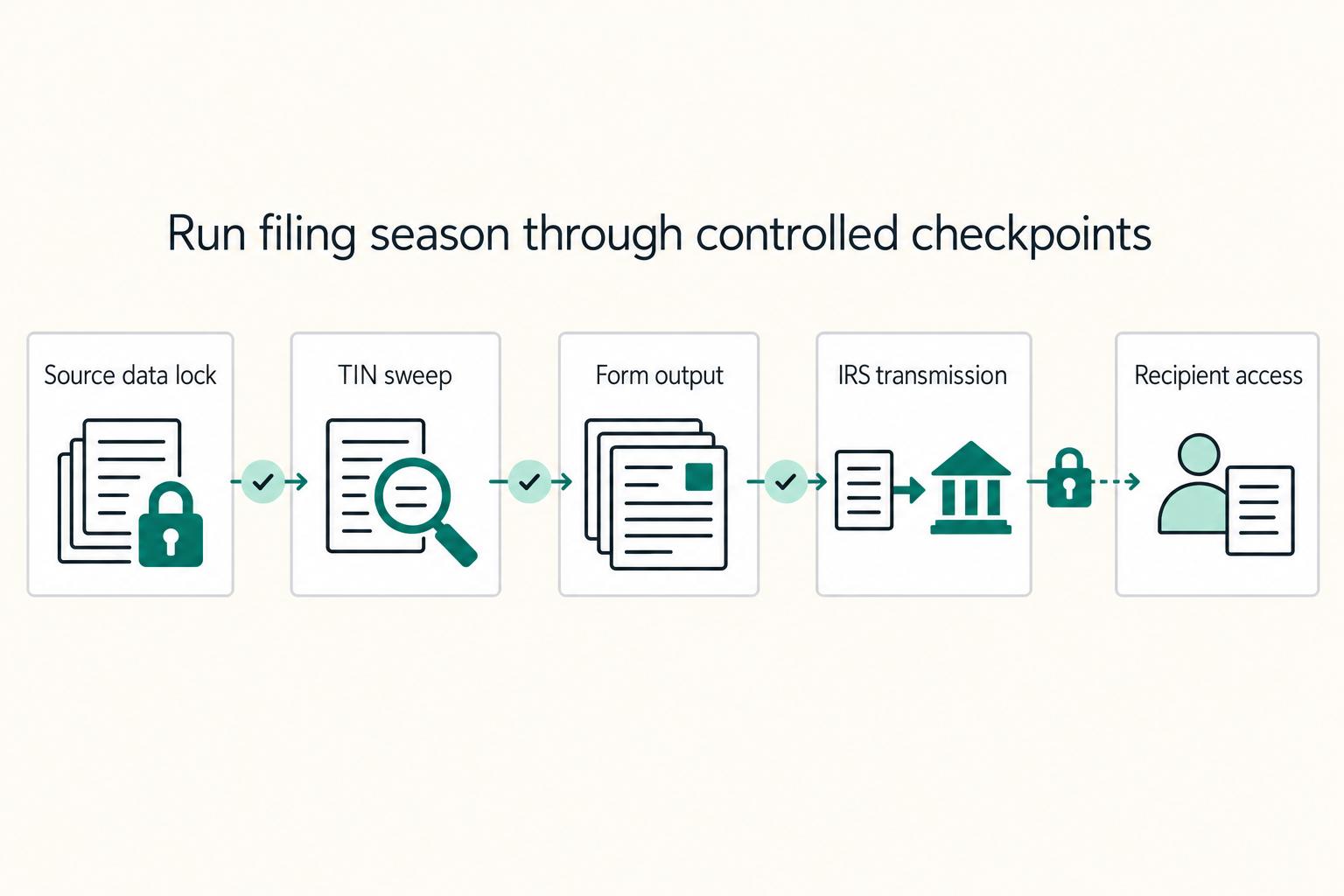
After classification is approved, filing season should run in a fixed order: lock source data, run a final TIN/identity sweep, generate Form 1099-NEC outputs, transmit to the IRS, then release recipient access. Sending recipient copies before the filing file is locked and transmitted is a common, avoidable mismatch.
1. Lock source data and run the final validation sweep#
Start with a hard lock on the filing population. After extraction, do not allow silent edits to payee names, addresses, Form W-9 status, TIN fields, earnings-code mappings, or reportable totals. Route late changes through an exception path with approval.
Before file generation, run one last checkpoint on the items that usually trigger rework:
- confirm each included payee has linked Form W-9 status and a final TIN validation result
- confirm each excluded payee has a documented reason (for example, wrong form path or unresolved identity issue under review)
- confirm filing-extract totals match the frozen payout ledger for the same period and population
Choose your transmission method at this point. The IRS states that if you have 10 or more information returns, you must file electronically. At platform scale, that typically means IRS e-filing through IRIS (Information Returns Intake System) directly or through a provider. If you file Form 1099-NEC on paper, the IRS says you must include Form 1096.
2. Generate the filing output and control the transmit step#
Generate the final Form 1099-NEC output only after lock and validation are complete. Before you transmit, require dual approval: one operations owner for population completeness and one compliance/tax owner for filing readiness.
Keep an immutable filing snapshot. At minimum, retain the exact output file, population count, aggregate reportable total, approval record, extraction timestamp, and source query/report ID. If you cannot reproduce what was submitted, later reconciliation and exception handling become unreliable.
If you use the IRIS Taxpayer Portal, the IRS states it is available to businesses of any size and can provide alerts for input errors and missing information. Treat those alerts as blocking until you resolve them or formally accept them as exceptions.
3. Reconcile transmission results and close only after post-submit checks#
Do not treat submission as closure. Reconcile transmitted records against IRS received, accepted, and rejected statuses on a defined cadence until the batch is closed.
The IRS says IRIS can provide receipt confirmation in as little as 48 hours, but that is not a guaranteed SLA and does not replace operational reconciliation. Keep post-submit controls explicit:
- reconcile accepted and rejected statuses across the full transmitted population
- assign a rejection-triage SLA with a named owner
- document cause, fix, and resubmission steps for each rejected record or batch
- use IRIS correction capability when a filed return must be corrected
Before close, reconcile filing totals to both the payout ledger and the accounting integration output. If filing totals match the submission file but not accounting outputs, the control cycle is still open. Close only when all three views align, or when any variance is documented, approved, and traceable to a specific exception.
For document retention workflow design, see Document Management for Accounting Firms: Secure Intake, Retrieval, Retention, and Automation.
Handle exceptions before they become penalties#
Open exceptions should be treated as active risk, not future cleanup. The issues that most often lead to avoidable 1099 trouble are usually visible early: missing Form W-9s, unresolved TIN mismatches, late post-lock data changes, and repeated e-filing rejection patterns.
Step 1. Escalate the exceptions that should never sit quietly#
Define hard escalation triggers before the next Form 1099-NEC cycle. At minimum, escalate any filing population with a missing Form W-9, an unresolved TIN mismatch after your normal retry path, late changes to locked filing data, or repeated IRS e-filing rejections tied to the same root cause.
| Trigger | Condition | Report view |
|---|---|---|
| Missing Form W-9 | Any filing population with a missing Form W-9 | Show owner, status, and whether payout or filing is blocked |
| Unresolved TIN mismatch | Still unresolved after the normal retry path | Show owner, status, and whether payout or filing is blocked |
| Late changes to locked filing data | Any late change to locked filing data | Show owner, status, and whether payout or filing is blocked |
| Repeated IRS e-filing rejections | Rejections tied to the same root cause | Show owner, status, and whether payout or filing is blocked |
Prioritize severity over queue age. A minor one-off correction is not the same as known identity or TIN defects across paid contractors. For every open exception, your report should show owner, status, and whether payout or filing is blocked.
If teams are working around issues in spreadsheets while the system of record still shows missing W-9 or failed TIN validation, the exception is still open.
Step 2. Tie escalation to penalty risk, including Intentional Disregard#
Known control failures that remain unaddressed should be escalated. Intentional Disregard is a penalty category tied to known filing requirements that are not addressed.
An industry summary for tax year 2025 describes penalties from $60 per form (within 30 days) up to $630 per form for intentional disregard, with no annual cap in that category. Use that as a risk signal, not as a replacement for current IRS guidance.
If your team knows a filing population is wrong, or knows the same rejection pattern is recurring and still proceeds without documented remediation, escalate.
Step 3. Keep a correction log and pause when volume shows control failure#
Maintain a correction log for each material exception and filed correction. Include owner, affected filing cycle, root cause, resolution date, whether a process control changed, and the submitted file reference or extract ID.
If correction volume spikes, pause noncritical payout changes and run a focused remediation sprint before the next filing window. The goal is evidence that upstream controls changed, not just a lower open-ticket count.
For the 1099-K side of payment-app reporting, see A Guide to Form 1099-K for Freelancers Using Payment Apps.
Avoid the mistakes competitors gloss over#
The fastest way to cut preventable failures is to enforce ownership, controls, and case history before you scale automation.
| Mistake | Recovery |
|---|---|
| Treating year-end uploads as automation | Move tax form collection and identity checks into onboarding, and require status tracking before records move downstream. |
| No owner for rejected filings | Assign one accountable queue owner and define when Legal steps in for repeated rejections or recurring defects. |
| Trusting marketing claims without evidence | Run a pilot cohort and require audit-ready records, not screenshots. |
| Overbuilding too early | Start with minimum viable controls your team can run consistently, then add automation depth only where failure patterns justify it. |
Final actions and copy-paste checklist#
Use this sequence to confirm your setup is controlled before filing at scale.
- Confirm your operating model.
Treat Payment-Driven platforms, Payment Processors, and Tax-Only Tools as practical categories, not legal ones. They serve different operational needs, so choose based on where onboarding, payment data, and IRS e-filing responsibility actually sit. If you are still chasing late Form W-9s or merging fragmented payout exports in spreadsheets, your model is likely mismatched to your volume.
- Verify nonnegotiable prerequisites.
Confirm a named owner matrix for preparation, approvals, rejection handling, and corrections; working Form W-9 capture; TIN validation; and one accountable IRS e-filing path. Validate this on one payee record: you should see W-9 status, TIN validation result and date, form classification, and filing status in one place.
- Run three checkpoints before filing closes.
Check onboarding identity quality first, including linked tax records and TIN protection (last four digits) where forms are printed or shared internally. Check classification accuracy next, including any 1099-liable flags and vendor 1099 codes in source records. Then reconcile the filing population to payouts and accounting, and confirm recipient copies go out on or before the last day of January.
- Document exceptions and corrections with an audit trail.
Track the same high-risk events every time: missing Form W-9s, TIN mismatches, late payee updates, IRS e-filing rejections, and corrected forms. For each event, keep the owner, open date, filed-or-held decision, resolution date, and approval artifact. The risk is not only the exception itself, but losing traceability after a manual fix.
- Reassess scope quarterly.
Recheck whether your tools still connect onboarding, payment data, threshold tracking, and IRS e-filing as your payout complexity grows. If exceptions are rising faster than filings, simplify the payout path or upgrade your operating model before the next cycle.
For workflow design around finance automation, see A Freelancer's Guide to Business Process Automation (BPA).
Want a quick next step related to "1099-NEC automation platform"? Try the W-2 vs 1099 calculator.
Frequently Asked Questions
What does a 1099-NEC automation platform actually automate end to end?
End-to-end coverage varies by platform. In practice, teams usually look for support across W-9 collection, TIN validation, payment classification, form generation, recipient delivery, IRS e-filing, rejection handling, and corrections. A practical check is to pick one paid contractor and confirm you can see key workflow status in one record (for example, W-9 status, form type, filing status, and any resubmission history).
What controls are mandatory before filing Form 1099-NEC at scale?
There is no one-size-fits-all control checklist, but you should define clear ownership, run a final validation sweep, reconcile filed totals back to payout/accounting records, and retain what was filed plus transmission confirmations. One date is explicit in the grounding: recipient copies for Form 1099-NEC and Form 1099-MISC are due by January 31, and Form 1099-K recipients must also receive a copy by January 31.
When should a platform file Form 1099-NEC instead of Form 1099-K or Form 1099-MISC?
Use Form 1099-NEC for payments to nonemployees for services. Use Form 1099-MISC for miscellaneous payments such as rent, medical payments, prizes, and royalties. Form 1099-K reports payments received for goods or services from payment cards and third party settlement organizations, including payment apps and online marketplaces. If one payout flow mixes service compensation with marketplace settlement logic, pause and review classification before production, or read 1099-NEC vs. 1099-K: Which Tax Form Does Your Platform Need to File?.
What should trigger escalation to legal or specialist tax counsel?
Escalate when form classification is ambiguous or when your team cannot confidently map a payment flow to one reporting path. If the filing path is still unclear near deadline, move the case to specialist review before the run closes.
Can Tax-Only Tools work for high-volume mass payout workflows?
They can, especially when payout data is clean, stable, and reconcilable to the tax record outside the tool. If onboarding, payouts, and corrections are fragmented across systems, manual cleanup risk increases at year end.
What evidence should we retain to be audit-ready if the IRS questions a filing cycle?
Retain documentation that lets you trace each recipient from tax profile and form classification through filing/delivery status and any corrections. Keep reconciliation records tying filed totals back to payout and accounting outputs for that cycle. If you cannot trace one recipient record to the submission population and review trail, your evidence is likely insufficient.
Try a related tool
Researched and edited by the Gruv editorial team. Gruv builds cross-border billing, payouts, and finance-operations software for global businesses.
Sources
- ag.ny.gov/sites/default/files/2026-01/rfp-25-007-enter...trusted
- congress.gov/107/chrg/CHRG-107hhrg72654/CHRG-107hhrg72654...trusted
- courts.ca.gov/system/files/file/tcfmac-20171013-material.pdftrusted
- energy.gov/documents/annrep02pdftrusted
- fincen.gov/report-foreign-bank-and-financial-accountstrusted
- irs.gov/businesses/corporations/fatca-information-fo...trusted
- irs.gov/newsroom/file-form-1099-series-information-r...trusted
- lewistonmaine.gov/DocumentCenter/View/9790trusted
Educational content only. Not legal, tax, or financial advice.
Related Posts
Music Royalty Tax Compliance: How Platforms Handle 1099-MISC vs. 1099-NEC for Artist Payments
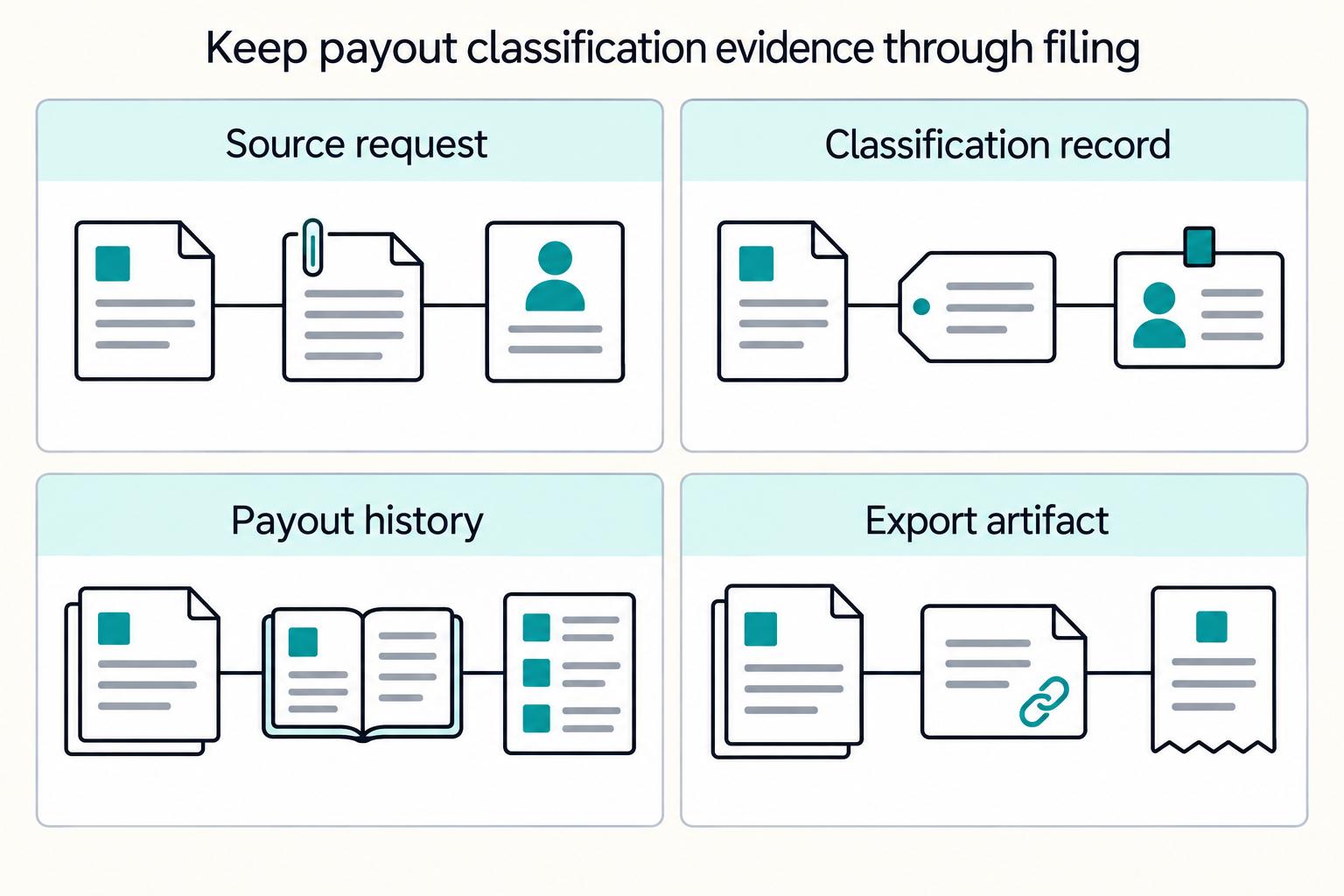
This is an operating-model decision, not a year-end form choice. A team can ship quickly and still end up with misclassified payouts, correction cycles, and filing risk if the classification logic is weak. If you run creator payouts, you need the classification rule before your first batch, not after your first correction cycle.
1099-NEC vs 1099-K Platform Filing Starts With Settlement Path
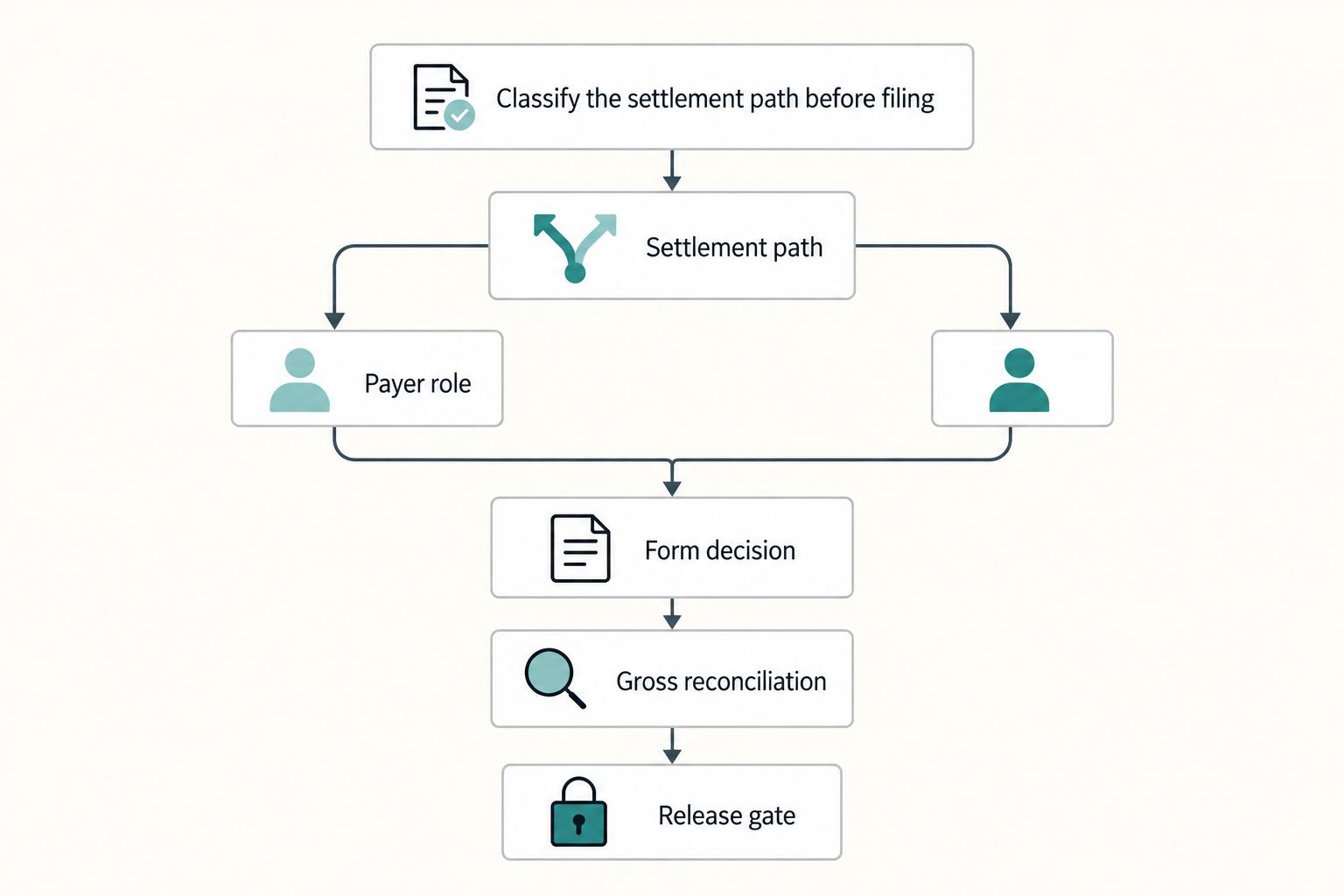
Start your filing analysis with the payment flow, not the worker label. The practical question is whether a transaction belongs in the `Form 1099-K` lane, whether another form in the 1099 series, including `Form 1099-NEC`, may apply, whether both might appear across different flows for the same payee, or whether form assignment needs further review.
When Platforms File 1099-K and 1099-NEC
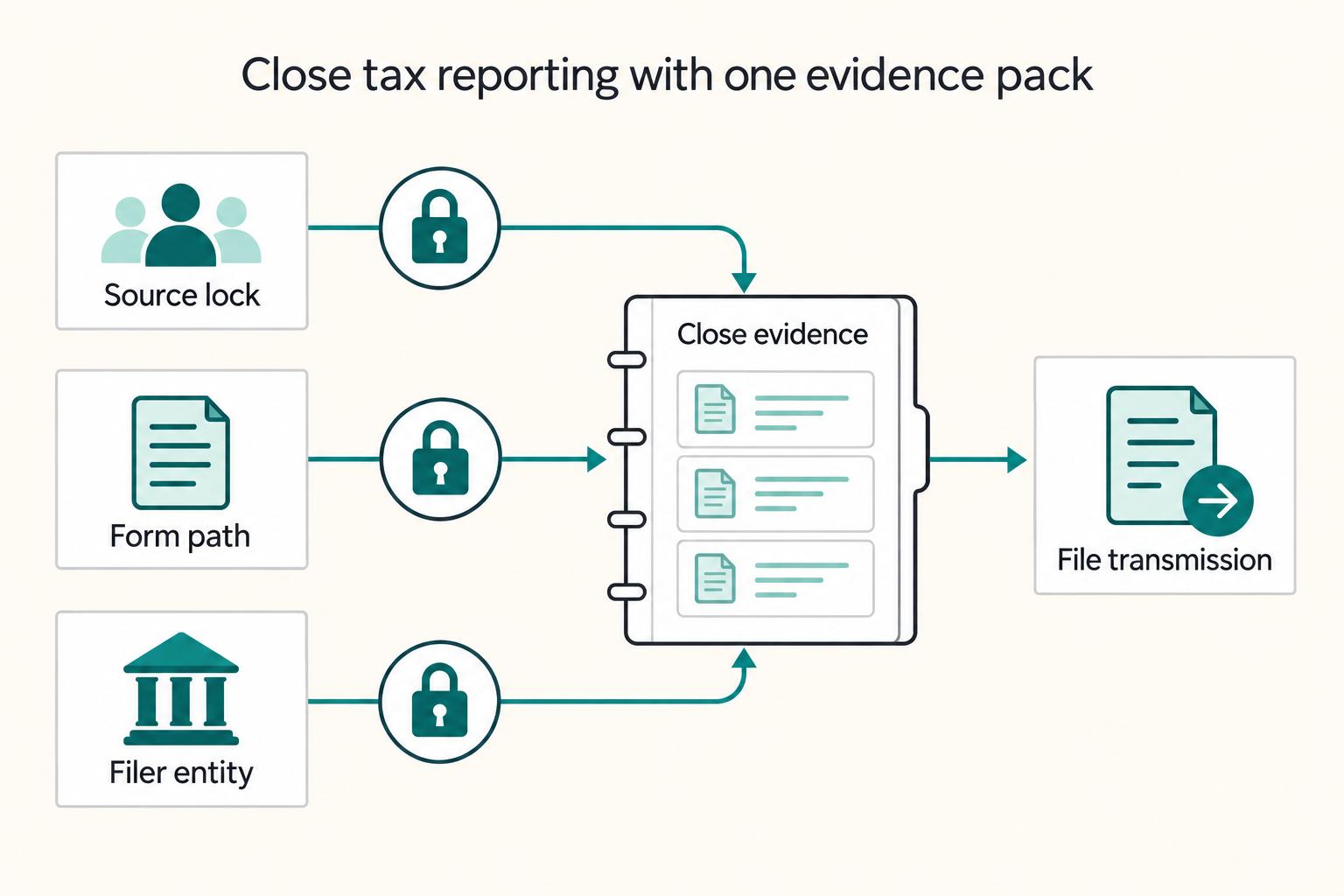
If you are trying to decide when platforms file **Form 1099-K** and where other forms may apply, the real job is not memorizing form names. It is assigning filing ownership by payment path, proving that choice before filing season, and catching cases that can create duplicate reporting or missed filings. That is the operator view this piece takes.