
Quick Answer
A U.S. client does not make your service income U.S.-sourced: the general source rule follows where you physically worked. For a nonresident individual working entirely abroad, document foreign status and work location and ask the payer to review an inconsistent 1099. U.S.-performed services need a separate withholding and reporting review; W-8BEN is not the form for claiming a treaty withholding exemption on those services.
A U.S. client may issue a 1099 because its vendor file treats you as a U.S. payee. That reporting choice does not decide your tax liability. Start with your tax status and where you physically performed the services, then ask finance to correct any record that conflicts with those facts.
Short version: verify status and work location, provide the appropriate payee documentation and request correction of inconsistent reporting. Track your own tax deadlines while the payer reviews its file.
This is a practical playbook, not a tax law treatise. Work in order: Diagnose, Document, and Direct. If you handle those three steps in sequence, you cut confusion, avoid preventable errors, and show up as a capable global partner from the first invoice onward.
Part 1: Check Your Status and Income Source#
Do not send a form or answer AP from memory. First decide your status, then verify work location. Those decisions connect, but they are not the same.
Start with status first#
Start with status, not invoicing. For U.S. federal income tax purposes, an alien is someone who is not a U.S. citizen. Begin with the green card and substantial presence tests, then review applicable exceptions and any treaty residence position before settling the documentation. Meeting the numerical presence test does not always determine the final treatment: qualifying closer-connection relief can preserve nonresident status, and a treaty can produce a different residence result. Keep the evidence and required claim or filing review with your status decision.
| What to check | Evidence to gather | Decision it drives |
|---|---|---|
| Green card test | Copy of Form I-551 or other proof of lawful permanent resident status during the year | If yes, this points to resident-alien status |
| Substantial presence minimum | Travel log with U.S. entry/exit dates for the current year | If you have at least 31 days in the current year, move to the weighted count |
| Weighted 3-year count | Current-year log + prior 2 years of dates + notes on excluded days | Count current-year days + 1/3 of first prior year + 1/6 of second prior year. If the total reaches 183 days, that points toward resident-alien status, subject to excluded-day treatment |
| Excluded-day review | Transit notes, commuting pattern notes, and other potentially excludable days | Finalizes the count; review applicable exceptions before making the status decision |
| Exception and treaty review | Closer-connection facts, treaty residence support and required claim/filing records | Resolve applicable relief and documentation with qualified advice before choosing payee forms |
Quality check: do not rely on memory or passport stamps alone. Tie the count to exact dates. For this test, United States does not include U.S. territories or U.S. airspace. Some days can be excluded, including certain transit stays of less than 24 hours.
Review where the work was performed#
Once status is clear, review where services were physically performed, by date and deliverable. The IRS source-of-income rules generally source personal-service compensation to the place of performance. A U.S. client, payment currency or bank account does not by itself make work performed abroad U.S.-sourced. Mixed-location work may require allocation.
- All work outside the U.S.: Document that clearly and keep your contract scope, invoices, and records consistent.
- Mixed-location work: Pause and split the work by date and deliverable before you give a definitive payer response.
- Any work performed in the U.S.: Route this to the exception track later in this article, and isolate exactly what you did in the U.S., when, and on which invoice lines.
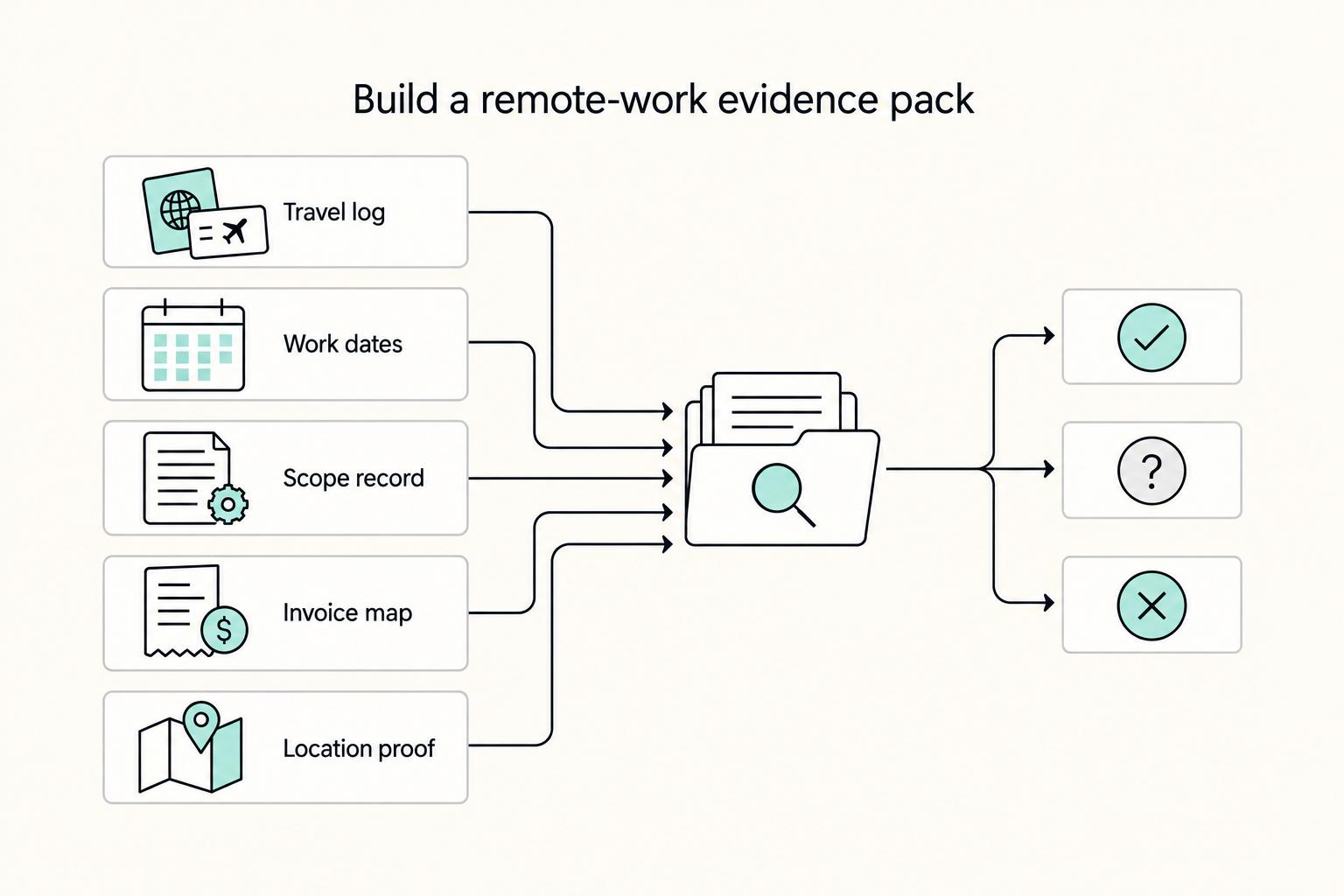
Build a minimum evidence pack#
Build a minimum evidence pack now so later decisions stay tied to facts instead of assumptions.
| Evidence | Detail |
|---|---|
| Travel log | Entry/exit dates |
| Work dates | By project or deliverable |
| Scope record | Contract, SOW, or other scope record |
| Invoice mapping | Tied to work dates |
| Location proof | Calendar entries, timesheets, flight records, or accommodation records |
Escalate early if you have unclear presence-day treatment, closer-connection relief or a treaty residence position, inconsistent location records, a status change during the year, or a payer challenge to your classification. The goal at this stage is simple: a documented status view and a documented work-location branch before you touch the next form.
Part 2: Give Finance One Coherent Payee File#
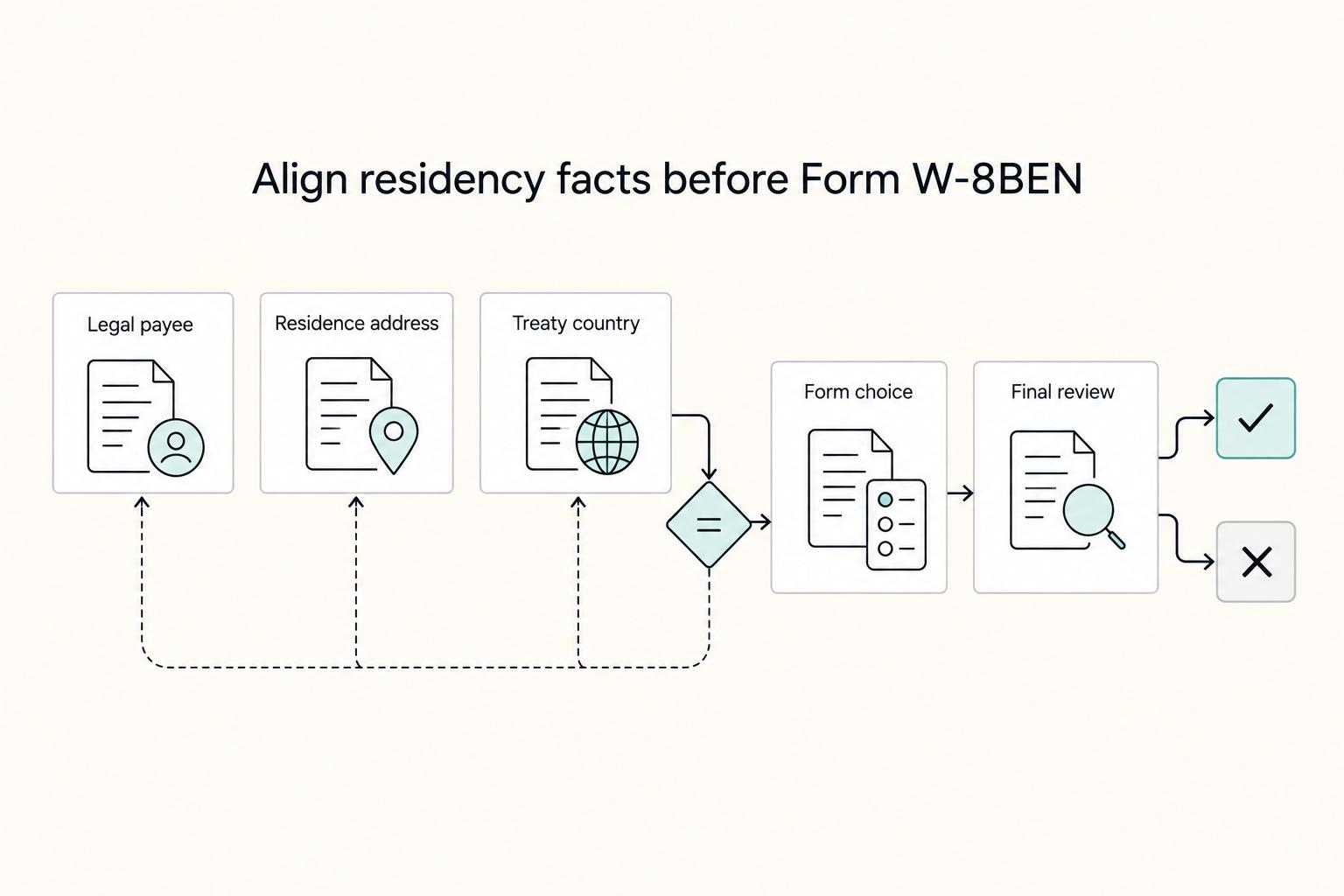
Payment problems can come from messy payer records, not just from the form itself. After you confirm your status and work-location branch, your job is to give finance one coherent payee file they can process without guesswork.
For a foreign individual, W-8BEN can document foreign status to the payer. Give it to the requester, not the IRS. It is not the form to claim a withholding exemption for personal services performed in the United States: the IRS instructions direct that situation to Form 8233 or W-4 as appropriate. Foreign entities use W-8BEN-E. Use the correct form for the payment and status rather than making every case a W-8BEN submission.
| Item | Why it matters | Common mismatch | Fix before submission |
|---|---|---|---|
| Final signed payee form | Keeps finance from using an outdated version | Multiple drafts are circulating across email or portal uploads | Mark older copies superseded and resend one final version |
| Status and work-location records | Support what you are certifying | Your supporting records are incomplete or conflict with each other | Resolve the conflict first, then submit |
| Submission channel record | Confirms what was actually delivered | File sent by email is not the same file uploaded to the payment portal | Use one dated final file across all channels |
| Finance/AP receipt confirmation | Confirms the right team received the right file | A business contact acknowledges receipt, but AP/finance does not | Request written confirmation from finance or AP |
| Archive bundle | Preserves defensibility if questions come later | You saved the form, but not the submission trail | Save the final form, submission proof, and written confirmation together |
Once your packet is ready, use this submission sequence every time:
- Prepare and freeze one final packet.
- Submit through the client's actual payment or onboarding channel.
- Get written confirmation from finance or AP that they received it and will use that record for payment processing.
- Archive the exact submitted file and the confirmation trail.
- If records still conflict, pause payment processing until the file is aligned.
On the payer reporting side, businesses submitting 10 or more information returns must file electronically. When an original return had to be e-filed, corrected returns must also be e-filed. With Tax Year 2026 / Filing Season 2027 as the targeted transition point for FIRE retirement and IRIS intake, many payer teams are tightening intake and record controls before payment runs.
Use short scripts that force written clarity:
- Initial submission: "Attached is my completed payee documentation for finance review. Please confirm receipt and confirm this is the record your AP team will use for payment processing."
- Mismatched W-9 request: "My verified status does not match Form W-9. Please confirm in writing which payee document your finance team requires so I can provide the correct record."
If you cannot support your certifications, stop. Do the same if your records conflict across documents or payer instructions contradict your verified status. Escalate to a qualified advisor before funds are processed.
If you want a deeper dive, read Digital Nomad Taxes in 2026 With a Defensible Filing Plan.
Part 3: Direct the Process When a Client Errs#
When a payer record conflicts with your file, treat it as a correction job, not a debate. Identify the mismatch, send a narrow written request to finance or tax, and keep the case open until you have proof the record was corrected.
Identify the mismatch and assign ownership#
Compare the client request or recipient statement against your locked payee file from Part 2, including the final submitted documentation, submission proof, and finance or AP receipt confirmation. Then route by scenario.
| Scenario | Trigger | Owner | Required output | Closure condition |
|---|---|---|---|---|
| Mismatched payee-form request | You receive a payee-form request that conflicts with documentation already on file | Finance or AP | Written confirmation of which payee document they require and whether your vendor profile was validated or updated | Finance or AP written confirmation is in hand |
| Incorrect 1099-type recipient statement | You receive a recipient statement that appears inconsistent with your documented file | Finance or tax | Correction review under the General Instructions for Certain Information Returns, plus corrected recipient documentation or written correction confirmation | Corrected recipient statement or written correction confirmation is in hand |
If you cannot point to one exact conflicting item, pause and isolate it first.
Send a narrow written request#
Keep the request short. You want record review, not a side argument about classification before anyone checks the file.
For a mismatched payee-form request:
Thanks for sending this. The requested payee form does not appear to match the documentation already submitted for my vendor file.
Please have finance or AP review my record against the submitted documentation and confirm in writing which payee document your team will use for payment processing.
For an incorrect recipient statement:
I received a recipient statement that appears inconsistent with the documentation and facts already provided.
Please have your finance or tax team review the filing record under the General Instructions for Certain Information Returns, including corrected and void returns and statements to recipients, and send the corrected recipient statement or written confirmation of the correction when completed.
Require correction evidence before closure#
Use one rule: keep the case open until the output matches the scenario. "Received" or "should be fine" is not closure evidence.
Ask the payer to use the General Instructions for Certain Information Returns for correction of the filed return and recipient statement. Identify the form, tax year, reported amount and specific status or sourcing error. A written acknowledgment starts the review; obtain the corrected statement or confirmation of what was corrected in the filing record. Keep your own tax-return deadline in view if the payer has not finished.
Escalate when facts remain disputed#
Escalate after documented follow-up if any of these apply:
- Classification is still disputed instead of record review being completed.
- The payer repeats reporting errors after a prior documented fix.
- Finance or tax refuses to correct records or confirm what is on file.
- Sourcing facts remain unresolved after you provided work-location records and engagement documents.
If sourcing confusion is tied to day-count myths, review 183-Day Rule Explained: Stop the Tax Myths Before They Cost You before you respond.
Keep a defensibility file standard#
Store each correction case in one dated folder in your compliance archive, plus a backup copy you control. Save:
| Archive item | Detail |
|---|---|
| Mismatch artifact | The conflicting request or recipient statement |
| Payee documentation | Exact payee documentation previously submitted |
| Submission proof | A portal record or sent email with attachment |
| Correction trail | Your requests and all finance or tax responses |
| Final correction artifact | A corrected recipient statement or written correction confirmation from finance or tax |
Acceptable proof is documentation showing the record was corrected or validated, not verbal assurance.
Before you send a correction email to AP, consolidate your travel dates and tax-residency evidence in the tax residency tracker.
Part 4: The Critical Exception: Managing U.S.-Sourced Income#
This is where routine handling stops. If any service work was physically performed in the United States, move out of the standard foreign-services flow and run a pre-payment review before funds are released.
Any services physically performed in the U.S. trigger a separate review of allocation, worker classification, withholding and reporting. Publication 515 covers the payer’s obligations for payments to foreign persons. Its different reporting branches are conditional, not interchangeable choices. Ask the withholding team to identify the branch supported by your facts and the appropriate documentation.
Route the payment before release#
| Service location facts | What to confirm before payment release | Who must confirm it | Reporting question to close |
|---|---|---|---|
| All services performed outside the U.S. | Foreign-status documentation is on file and you are not coded as a U.S. payee | Finance or AP | Does the documented foreign-service payment require any U.S. information reporting under the applicable rules? |
| Mixed-location services | Dates and deliverables tied to U.S. vs non-U.S. work, plus payer classification approach | Finance and tax | Does withholding apply to any portion, and what year-end form is expected? |
| Any services performed in the U.S. | Classification, withholding treatment, and reporting path confirmed in writing before payment | Tax or withholding team, not only AP | Is this being handled on a Forms 1042/1042-S track or another payer-determined track? |
If facts are mixed, or if any work happened in the U.S., do not close based on onboarding assumptions or verbal replies.
Build one pre-payment evidence pack#
Send one dated file with what the payer needs to decide. Include the engagement document, invoice, travel and work-location records, prior submitted payee documentation, and a short note stating where services were physically performed.
This helps avoid releasing payment before withholding or reporting decisions are documented.
Require a written withholding/reporting decision#
Get written confirmation of all three: classification, withholding treatment, and expected year-end form.
If the payment is reportable on Form 1042-S, monitor that form rather than assuming a 1099 is appropriate. The 2026 Form 1042-S instructions give March 15, 2027 as the usual filing and recipient-copy deadline and require IRIS for electronic filing of 2026 forms. Whether e-filing is required depends on the filer’s applicable rules; the form itself still depends on the payment’s classification.
Treat treaty relief as conditional#
Treat treaty relief as documentation-dependent, not automatic. Keep three categories of proof:
- Residency and treaty-eligibility support
- The appropriate treaty-claim documentation; for U.S.-performed personal services, do not substitute W-8BEN for the required Form 8233 or W-4 process.
- A written withholding decision stating whether treaty treatment was accepted
If a payer raises article-level or threshold tests, do not guess. Record the item as pending verification until the live rule is confirmed.
Close only when all outputs exist#
Close this exception path only when all five are complete:
| Required output | Required state |
|---|---|
| Location evidence | Validated |
| Payer classification | Confirmed |
| Withholding treatment | Documented |
| Reporting form expectation | Documented |
| Archived file | Submission proof and final written confirmation |
Escalate before payment if facts stay mixed, updated documentation is rejected, or classification and withholding conclusions are still unresolved. At that point, defensibility is the priority.
You might also find this useful: Canada Non-Resident Tax for Freelancers Working With Canadian Clients.
Keep Your Facts, Documents, and the Payer Record Aligned#
Here is the operating rule that ties everything together: keep your facts, your documents, and the payer record aligned before you treat anything as done.
Diagnose status and sourcing facts#
Diagnose your status and sourcing facts. Trigger this at onboarding, before payment, when a form request conflicts with your status, or when your work location changed during the year.
Required inputs:
- Residency checkpoint under the green card and substantial presence tests, including applicable exceptions and treaty residence positions
- Whether you are engaged (or considered engaged) in a U.S. trade or business
- Contract or SOW
- Invoice
- Dated record of where services were physically performed
Done means you can state, in one short note, your status, where the work happened, and what is still unconfirmed. If your classification and sourcing facts conflict, stop and escalate. If you need a residency refresher before you proceed, use 183-Day Rule Explained: Stop the Tax Myths Before They Cost You.
Document the file the payer will actually use#
Document the file the payer will actually use. Trigger this once the facts are clear, or when finance asks for setup documents.
What you send:
- Submitted status form
- Contract or SOW
- Invoice
- Work-location support
- Short facts note
Done means you have a dated submission trail and written confirmation of receipt. If you need to rebuild your form file, use How to Fill Out Form W-8BEN for a Foreign Freelancer.
Direct the next move with a strict if/then flow#
| Signal | Your Next Move | What You Send | What Confirms Closure |
|---|---|---|---|
| Facts clear and aligned | Proceed | Full evidence pack | Written confirmation payer records match your file |
| Facts clear but payer records misaligned | Request correction before payment or year-end reporting | Correction note plus supporting file | Written correction or updated record confirmation |
| Facts unclear | Escalate | Travel log, contracts, invoices, prior filings if relevant, open questions | Written conclusion from payer tax team or advisor |
| Potential U.S.-source income | Route to pre-payment review | Location evidence and request for withholding or reporting decision | Written withholding treatment and expected reporting path |
For a potential U.S.-source amount, establish the applicable treatment with the payer’s withholding team and your own return preparer. Their responsibilities differ:
- U.S.-source FDAP income that is not effectively connected is generally taxed at 30% of gross income, subject to applicable exemptions or treaty rates.
- Effectively connected income is generally taxed on net income after allowable deductions; the payer’s withholding obligations need a separate check.
A nonresident alien engaged or considered engaged in a U.S. trade or business generally must file a U.S. return, with applicable exceptions described in IRS guidance. A person outside that category may also need to file when withholding does not satisfy the U.S. liability. File by your applicable deadline using supported facts; a pending 1099 correction does not suspend it.
If classification or sourcing facts still conflict, do not close the file until you escalate and get a written conclusion.
If you want a cleaner handoff before client onboarding, prepare your form inputs in the W-8 form generator.
Frequently Asked Questions
Do you owe U.S. tax just because a client issued a 1099?
No. A 1099 reports the payer’s treatment of a payment. Your tax result depends on residency, income type and the relevant source rules. Personal-service income generally follows where services were performed, so a U.S. client alone does not make work performed abroad U.S.-sourced.
What should you send a client when their 1099 setup is wrong?
Send the appropriate status form, a short facts note, contract or SOW, invoice and work-location support. W-8BEN can document a foreign individual’s status, but a treaty withholding exemption for U.S.-performed personal services requires a different form process. Ask finance to review and correct both its filing and recipient statement where needed.
When should you escalate a 1099 issue before payment is released?
Request a pre-payment withholding review when work was performed in the U.S., source allocation is unresolved or payer instructions conflict with your verified status. Keep the review specific to the affected payment. If a 1099 correction remains pending at filing time, address your own return deadline separately.
Researched and edited by the Gruv editorial team. Gruv builds cross-border billing, payouts, and finance-operations software for global businesses.
Sources
- federalregister.gov/documents/2024/06/03/2024-11116/regulation-s...trusted
- irs.gov/taxtopics/tc851trusted
- irs.gov/pub/irs-pdf/p1220.pdftrusted
- moffatcounty.colorado.gov/sites/moffatcounty/files/Dec30_Docs_0.pdftrusted
- odu.edu/sites/default/files/documents/p519-irs-resou...trusted
- ohiosos.gov/assets/2026-02_fulleom.pdftrusted
- sec.gov/files/rules/final/2024/34-100155.pdftrusted
- treasurer.nebraska.gov/tm/documents/credit-and-debit-processing/Mer...trusted
Educational content only. Not legal, tax, or financial advice.
Related Posts

Digital Nomad Taxes in 2026 With a Defensible Filing Plan
With digital nomad taxes, the first move is not optimization. It is figuring out where you may be taxable, where filings may be required, and what proof supports that position.

183-Day Rule Tax Myths That Trigger Residency Filing Mistakes
If you are a mobile freelancer or consultant, start here: the "183 day rule tax" idea is not a single universal test. It is a shortcut phrase people use for different residency rules that do not ask the same question. If you mix federal and non-federal residency logic, you can create filing risk even when your travel calendar looks clean.
How to Fill Out Form W-8BEN for a Foreign Freelancer
Form W-8BEN lets a non-U.S. individual document foreign status to a payer and, where eligible, claim treaty benefits. For a freelancer, the first decisions are who owns the income, where the services were performed, and whether this is the right certificate. A U.S. client does not by itself make your work U.S.-source income.