
Quick Answer
Music platforms generally route rights-based royalty payments to Form 1099-MISC and nonemployee service payments to Form 1099-NEC, while card and third-party network settlements belong in a separate 1099-K lane. To avoid filing errors, classify each earning line before payout, collect the right W-9 or W-8 data, and keep mixed royalty and service income separate all the way to filing output.
Why this decision is harder than picking a 1099 form#
This is an operating-model decision, not a year-end form choice. A team can ship quickly and still end up with misclassified payouts, correction cycles, and filing risk if the classification logic is weak. If you run creator payouts, you need the classification rule before your first batch, not after your first correction cycle.
The real question is whether your payout system can classify income before funds move and store the right tax record for each payee. It also has to keep working when creators have mixed income types, different payment rails, or foreign addresses.
The form split is simple, operations are not#
At a high level, the IRS split is clear. Form 1099-MISC covers categories that include royalties, with a reporting trigger of at least $10 in royalties. Form 1099-NEC generally applies to nonemployee compensation at $600 or more. Those thresholds create different control pressure, especially because royalty reporting can start at much lower amounts.
The complication is how payouts behave in production. One creator may be paid for rights-based income, another for services, and another through card or third-party network rails. That last group belongs in a 1099-K lane rather than 1099-MISC or 1099-NEC.
Audit readiness starts before launch#
Before you scale, classify payouts correctly, reduce misclassification in live operations, and test whether your stack is audit-ready. A useful pre-launch test is whether each sample payout has one traceable evidence chain:
- Earnings basis
- Payee tax profile, such as Form W-9 on file where applicable
- Payment rail
- Reporting lane decision
- Payout record tied to filing output
If that chain breaks, reporting usually turns into a manual year-end exercise.
Deadline and scale risk are part of the design#
Different forms bring different workflow deadlines. Form 1099-NEC is generally due January 31. Form 1099-MISC is due February 28 for paper or March 31 for electronic filing in the cited instructions. The e-file threshold is also lower now: 10 aggregated information returns, effective January 1, 2024. That brings smaller operators into e-file requirements much sooner.
| Item | Timing | Note |
|---|---|---|
| Form 1099-NEC | January 31 | Generally due |
| Form 1099-MISC | February 28 | Paper filing |
| Form 1099-MISC | March 31 | Electronic filing in the cited instructions |
| Aggregated information-return e-file threshold | 10 returns | Effective January 1, 2024 |
Where teams usually get hurt#
If you classify late, make off-ledger decisions, or rely on spreadsheet-only logic after payouts are already blended, reporting errors follow. That is how royalty and service income end up mixed, or foreign-address payouts get treated as domestic 1099 cases when a Form 1042-S lane may apply.
Penalty exposure is operational, not theoretical. The cited IRS guidance includes penalty levels up to $340 per return, and IRS states there is no maximum for intentional disregard.
This is operator guidance, not legal advice. For mixed-payment, edge-case, or cross-border scenarios, route unresolved decisions to tax counsel before you expand scope.
For a step-by-step walkthrough, see How to Launch a Legal Compliance Platform for Freelancers and Handle Their Payments.
At a glance how 1099-MISC and 1099-NEC differ for music payouts#
Use this as the default starting point. Rights-based payouts often map to Form 1099-MISC. Service payouts often map to Form 1099-NEC. Payment card or third-party network settlement belongs in a separate Form 1099-K lane. If you are training ops, use this split before you let a new payout batch move.
| Payment type | Likely form | Trigger logic | Typical intake fields | Common failure mode | Control owner |
|---|---|---|---|---|---|
| IP royalties tied to copyrights or similar rights | Form 1099-MISC | Royalties are explicitly listed for 1099-MISC, with reporting at least $10 in royalties | Contract or rights basis, payee legal name, tax profile, W-9 or W-8 status, payout record tied to earning event | Royalty and service income are blended, then forced into one filing lane | Compliance defines rules; Product and Ops enforce at payout level |
| Rights-based sync licensing payout pattern | Can be Form 1099-MISC, pending contract review | If payment is for rights usage rather than labor, it is a royalty candidate; "sync" label alone is not enough | License type, rights granted, usage basis, payee tax profile, W-9 or W-8 status | Team assumes every sync payment is royalty without checking service elements in the deal | Compliance review, with counsel escalation for edge cases |
| Nonemployee service compensation | Form 1099-NEC | NEC applies to nonemployee services; Rev. April 2025 instructions show $600 or more, and IRS FAQ guidance also references $2,000 for payments after December 31, 2025, so tax-year validation is required | Service basis, such as contract, SOW, or invoice; service description; payee legal name; tax profile; W-9 or W-8 status | One creator has royalties and services, but earnings are tracked in one bucket and reported on the wrong form | Product owns classification logic; Ops handles exceptions; Compliance validates thresholds |
| Payment card or third-party network settlement | Form 1099-K, not 1099-MISC or 1099-NEC | Reportable payment transactions are reported on 1099-K, not MISC or NEC in that flow | Payment rail, settlement party, seller or merchant record, identified payment settlement entity | Team builds one 1099 engine and treats payer-side MISC or NEC logic as universal | Payments and payment settlement entity, with Compliance oversight |
| Mixed royalty and service payout, or unclear entity-type exception | Verify with counsel before mapping | Public summaries do not fully resolve all mixed-payment or entity cases | Full contract, line-item earnings detail, payee entity or tax classification, tax form on file, reviewer decision log | One invoice, one payout, one form, with no line-level support if challenged | Tax counsel with Compliance ownership |
The category split can look straightforward, but contract structure still drives classification. If you cannot point to clear contract language showing whether earnings came from rights usage or from services, stop and resolve classification before funds move. If you cannot show your ops team that language, you should not let them guess.
Keep 1099-K as a separate architecture decision. It is tied to reportable payment transactions and payment settlement entity responsibility, not an alternate way to report the same payout logic used for MISC or NEC. If you need a deeper breakdown, see 1099-NEC vs. 1099-K: Which Tax Form Does Your Platform Need to File?.
The operating rule is simple: default rights-based royalties to 1099-MISC, default nonemployee services to 1099-NEC, keep 1099-K logic separate, and escalate mixed or unclear cases before payout execution.
For a deeper dive, read Gig Worker Tax Compliance at Scale: How Platforms Handle 1099s W-8s and DAC7 for 50000+ Contractors.
Classify each payout before money moves#
As a control, make the classification decision before a payout enters a batch. 1099 treatment generally follows what the payment is for, not what makes the payout file easier to assemble. Lock the payment type before you assemble the batch file.
Use the same split from the prior section. Rights-based earnings are Form 1099-MISC candidates. Nonemployee service earnings are Form 1099-NEC candidates. Blended or unclear items should pause for review. Keep this separate from Form 1099-K, which covers payment card or third-party network payments reported by the payment settlement entity.
| Earning classification | Primary decision cue | Key metadata before release (operational) | Default action |
|---|---|---|---|
| Royalty candidate | Payment is tied to the right to use intangible property or usage rights | Contract or rights basis, payee legal name, tax profile, W-9 or relevant W-8 status | Route to 1099-MISC review path |
| Service candidate | Payment is tied to nonemployee personal services | Service basis, such as contract, SOW, or invoice; payee legal name; tax profile; W-9 or relevant W-8 status | Route to 1099-NEC review path |
| Mixed or unclear | Agreement appears to include both rights usage and services, or language is unclear | Full agreement, service documentation, line-item detail, payee tax profile, reviewer note | Hold in exception review before payout |
Treat these intake fields as control points, not admin overhead. Form W-9 is used to provide a correct TIN for information returns. Form W-8BEN establishes foreign status for individuals, and Form W-8BEN-E is the entity version furnished to the payer or withholding agent. Missing or incorrect TIN handling can trigger 24 percent backup withholding in some cases.
Keep the rule defensible: if payment terms tie compensation to rights usage, mark it as a royalty candidate. If they tie compensation to personal services, mark it as a service candidate. Treat both as candidates until the document basis is clear.
Who owns what#
This ownership split is operational, not an IRS mandate:
- Product defines classification logic and required fields in the earnings model.
- Compliance approves rules and exception criteria, including when counsel review is needed.
- Ops monitors the exception queue and blocks release when agreement basis or W-9/W-8 status is incomplete.
If your process is "we'll sort it out at filing time," the control is missing, and corrections are likely later.
For more on this, see 1099-NEC Automation for Platforms to File at Scale Without Manual Errors.
Handle mixed earnings without creating reporting errors#
A common risk case is one creator earning both royalties and service income in the same period. The same payee can legitimately map to both Form 1099-MISC and Form 1099-NEC based on what each earning line is for.
That is why blended payouts are risky by default. Form 1099-MISC royalty reporting starts at $10, while IRS FAQ language for Form 1099-NEC describes service reporting at $600, with $2,000 for payments made after December 31, 2025. If rights and services are merged into one undifferentiated amount, year-end mapping and correction handling get much harder.
| Treatment | How earnings are stored | Form mapping outcome | Main risk |
|---|---|---|---|
| Blended payout | One combined earning line for the payee | Manual reclassification between 1099-MISC and 1099-NEC later | Misreporting, correction churn, threshold mistakes |
| Split-ledger treatment | Separate royalty and service earning lines, even for the same payee in the same cycle | Each line maps to its own reporting path | More intake discipline, fewer downstream corrections |
| Hold for exception review | Block release until unclear items are separated | No mapping until basis is documented | Slower release, lower filing risk |
Use split-ledger treatment by default: separate earning lines first, then aggregate cash movement if needed. The payout rail can be shared, but the earning basis should stay distinct.
Set a release control for bundled invoices or statements: when rights and services are combined, require line-level decomposition before payout release. If the amounts are not split into rights-based and service-based lines, hold the item in exception review.
A practical approval check is that each earning line has one contract basis, one payee tax profile, and one form path. Tax profile collection, including W-9/W-8 data, helps, but it does not resolve mixed classification by itself. Keep Form 1099-K outside this branch unless the payment is in the card or third-party network reporting regime.
For mixed-payment exceptions, keep a small audit packet so you can defend and reconstruct the decision for at least 3 years, for example:
- Contract excerpt or invoice lines supporting split or hold
- Classification decision note
- Reviewer name or ID
- Decision timestamp
One payee can have two reporting paths, but one earning line should not.
Related: How to handle 'royalty income' on your US tax return.
Set tax profile intake that prevents year-end surprises#
Reliable year-end reporting starts with release controls. If required tax data is missing, route the payout to review or hold release under your policy.
Capture the minimum that drives form routing#
For U.S. payees, start with Form W-9. IRS guidance for independent-contractor flows treats W-9 collection as the first step, and the form is used to request the correct name and TIN. At minimum, capture legal name, TIN, a U.S. vs. foreign marker, and tax-form state: W-9 received, W-8BEN received, or missing.
| Form | Who it covers | Article detail |
|---|---|---|
| Form W-9 | U.S. payees | Used to request the correct name and TIN; keep records for four years |
| Form W-8BEN | Foreign beneficial owners | Use when requested by the payer or withholding agent, whether or not a treaty reduction is being claimed |
| Form W-8BEN-E | Entity version | Furnished to the payer or withholding agent |
For foreign beneficial owners, use Form W-8BEN when requested by the payer or withholding agent, whether or not a treaty reduction is being claimed.
For W-9 records, IRS guidance says to keep them for four years.
Tie payout eligibility to profile state#
There is no universal IRS rule that says "no profile, no payout," but release gating is still a defensible risk control. If a payee is in a reportable nonemployee compensation flow and W-9 or TIN data is missing, escalate before release. IRS guidance also states backup withholding of 24% can apply to reportable nonemployee compensation to U.S. persons.
Add cross-border support flags before tickets pile up#
Cross-border readiness here is about support accuracy, not assuming every payee is in scope. Your help and support workflows should flag when FATCA, Form 8938, or FBAR context may apply.
Keep the distinctions explicit. Form 8938 can apply to certain U.S. taxpayers above applicable thresholds, for example $50,000 / $75,000 for unmarried individuals living in the U.S., and it does not replace FBAR. FBAR is FinCEN Form 114, filed with FinCEN rather than the IRS, with a trigger that includes $10,000 aggregate foreign account value during the year. It is due April 15 with an automatic extension to October 15.
Run a monthly operator checkpoint#
Before peak payout periods, run a monthly completeness report by cohort: royalty candidates, service candidates, and foreign payees. Review payout-eligible accounts first, then clear missing W-9s, missing W-8s, and unresolved U.S. or foreign status before volume spikes.
Design your ledger and evidence trail for IRS defensibility#
Your ledger should explain each payout from tax-profile intake through filing export. IRS rules do not require one specific technical architecture, but they do require records sufficient to establish what was reported, and they place the burden of proof on the filer.
Electronic records are not a lower bar. IRS guidance applies the same recordkeeping standard to electronic and paper records, while allowing any system that clearly shows income and expenses. In practice, your records should show why one payment was routed to Form 1099-MISC, another to Form 1099-NEC, and another was excluded because it belongs in a Form 1099-K flow.
Build the evidence chain around the payout, not around the filing season#
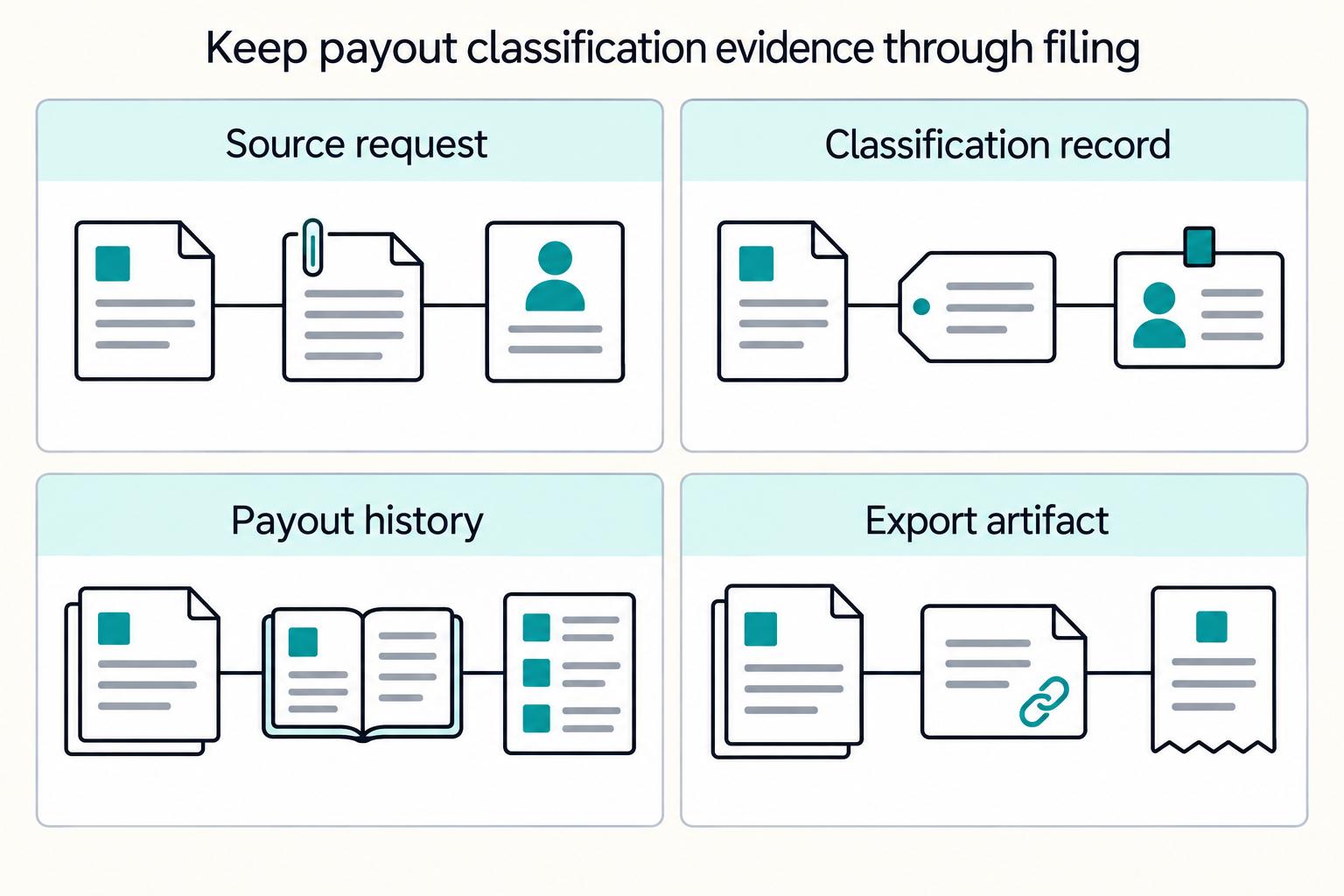
Keep a linked chain that starts at earning request creation and stays intact through export. Use controls that preserve evidence, not just neat architecture.
| Stage | Minimum record to keep | What to verify | Common break |
|---|---|---|---|
| Request creation | Source request ID, payee ID, contract or invoice reference, amount, date, W-9 or W-8 status | Source document supports the event and payee identity | Payout exists with no tied source document or tax-profile state |
| Classification event | Royalty, service, or mixed decision; rule version; timestamp; reviewer or automated marker | Decision matches contract language and reporting logic | Later overwrite removes the original basis |
| Payout execution | Batch ID, ledger entry IDs, release or hold status, payment amount, payment date, retry history | Paid amount matches approved classified amount, with no duplicate release | Retries create duplicate disbursements or duplicate ledger rows |
| Export artifact | Filing-cycle totals, mapped form type, export timestamp, correction link, submission proof when applicable | Export totals reconcile to ledger totals and form mapping | Export edited outside the ledger and no longer traceable |
Use Gruv-style controls where they solve real audit problems#
Idempotent retries can help prevent one business event from creating duplicate payout outcomes. Keeping ledger records append-only preserves history when classification or release status changes instead of hiding it with in-place edits. Batch-level reconciliation can keep each export tied to specific payout batches rather than ad hoc date-filtered files.
Payments-compliance guidance frames this as audit readiness: unified, consistent, immutable financial records and an auditable back office.
Keep a filing-cycle packet, not just a final form file#
For each filing cycle, keep an evidence packet that explains both inclusion and exclusion decisions:
| Packet item | Included details |
|---|---|
| Classification logs | event ID, decision, rule version, timestamp, reviewer or automated source |
| Form mapping snapshots | why the record was routed to Form 1099-MISC, Form 1099-NEC, or excluded to a Form 1099-K path |
| Correction logs | original-to-corrected link, reason, operator, approval, and date |
| Approval records | manual overrides, exceptions, and filing signoff |
Two filing details are easy to miss. For paper corrections, IRS instructions say not to check the VOID box, because that correction will not be entered into IRS records. And with the aggregated information-return e-file threshold reduced to 10 returns effective January 1, 2024, keep the submitted export version and filing acknowledgment, not only a regenerated report.
Keep supporting documents joined to ledger events as well. IRS examples include invoices, receipts, deposit slips, and canceled checks. In platform operations, that can map to contract references, invoice lines, payout confirmations, and tax-form status at release time. We covered this in detail in Healthcare Staffing Platform Payments Compliance for Safer Rollouts.
Build policy gates for onboarding and payout release#
Separate identity and risk controls from tax-document controls, then enforce both again before payout release. If you gate only at onboarding, you can miss profile changes that affect reporting and risk decisions.
These controls answer different questions. Identity and risk checks focus on verifying who the payee is, whether an entity and its beneficial ownership are verified, and whether activity still fits the risk profile through ongoing monitoring. Tax-document controls focus on whether you have the tax identity and status needed to route reporting correctly. That includes whether a payment maps to Form 1099-NEC, Form 1099-MISC, or another path such as Form 1042-S for certain nonresident compensation.
Keep the policy layers separate#
| Policy layer | Core question | Typical evidence | When to block release | Common miss |
|---|---|---|---|---|
| Identity and risk | Is this payee or entity verified, and does current activity still fit the risk profile? | Identity-verification data (including CIP-style records where applicable), entity records, beneficial ownership checks, ongoing monitoring/update flags | If identity is unverified, beneficial ownership is unresolved for an entity, or risk alerts require review | Team verifies once at onboarding and never rechecks after profile or behavior changes |
| Tax-document readiness | Do you have the tax form and matching payee details needed for reporting and withholding decisions? | Form W-9, Form W-8BEN, legal name, tax classification, TIN status | If no valid tax form is on file or profile data no longer matches payout facts | Team stores a form image but does not validate name and TIN consistency or foreign status |
| Earnings classification | What kind of payment is this for reporting purposes? | Contract terms, rights basis, invoice lines, classification decision log | If the earning is unclassified or mixed income has not been split | Team assumes one creator profile means one form type for every payout |
Use a simple split: identity and risk controls answer whether you should pay this party. Tax controls answer how that payment should be documented and reported.
Use a release sequence that matches the real decision points#
A practical sequence is: onboard, verify identity, collect tax profile, classify earnings, then release payout. That order is an operator choice, but it matches the facts you need before funds move.
Before release, confirm tax profile completeness. For U.S. payees, confirm Form W-9 is on file with the legal name and TIN used by the requester. For foreign beneficial owners, collect the applicable Form W-8 before payout review, not after payout issues appear.
Then classify the payment type. Service payments may require Form 1099-NEC reporting. Royalty payments may require Form 1099-MISC reporting, including the $10 royalty reporting threshold. If payee status or income type changes, force re-review instead of carrying forward an older assumption.
Recheck at payout time, not just signup#
Run a second gate at payout release and on meaningful profile updates. Onboarding approval alone is not enough when customer profile details or payment type changes during the year.
This is where ongoing monitoring matters. If tax status, ownership, or risk signals changed since the last approved payout, hold release until the new state is reviewed.
Keep override controls tight: require reason code, approver, and expiration date for every override. That is a control choice, not a statutory requirement here. It helps prevent temporary exceptions from becoming permanent bypasses. Tie each override to the payout batch, prior profile snapshot, and supporting document so corrections, holds, and audit questions are defensible later.
For the full breakdown, read How to Write a Payments and Compliance Policy for Your Gig Platform.
Choose rollout scope by market and entity complexity#
Choose scope by the compliance complexity you can run reliably, not by headline market size. In practice, that often means launching U.S.-only creators first unless cross-border growth is immediate and you are ready to build withholding and exception handling before volume scales.
| Segment | Launch first | Why this is the cleanest start | Hidden cost later |
|---|---|---|---|
| US-only creators | Strict Form 1099-MISC vs Form 1099-NEC routing with Form W-9 collection | IRS form logic is clear: royalties can trigger Form 1099-MISC at $10, while nonemployee service compensation routes to Form 1099-NEC | Correction work when royalty and service earnings are blended |
| Cross-border creators | Tax-profile intake, Form W-8 collection, withholding controls, and exception tooling before scale | Nonresident compensation can move to Form 1042-S, and U.S.-source income can face 30% withholding unless reduced | Manual review burden rises when treaty documentation is missing or outdated |
| Mixed entity types | Entity-specific intake and routing before broader launch | Different payee/entity types do not share one document path; foreign entities may require Form W-8BEN-E | Correction risk increases when one profile model is stretched across all entity types |
| Marketplace-style high-volume cohorts | Filing operations and exception triage capacity before opening volume | At 10 aggregated information returns, e-filing applies to Forms 1099 series, Form 1042-S, and Form W-2 filings required on or after January 1, 2024 | Higher filing-vendor dependency, tighter correction response windows, and larger impact from mapping errors |
If you are launching one US-heavy niche#
Ship strict form logic first. Collect a valid Form W-9 and classify each earning line before payout. Keep royalties separate from services, and route card or third-party network flows through a separate Form 1099-K decision lane instead of forcing MISC or NEC logic.
A common failure mode is blended payout design: one creator receives royalties and service income in the same stream, then year-end correction work follows.
If cross-border expansion is immediate#
Prioritize tax-profile completeness and exception handling before volume. Require the applicable Form W-8 for treaty-rate claims, and hold payout when documentation is missing instead of patching after funds move. Expect operations to shift from basic form questions to payout-hold and withholding explanations that require document-aware review.
Where rollout plans need hard validation#
Treat mixed-entity and EU-facing expansion as validation-heavy. DAC7 entered into force on January 1, 2023 and places reporting obligations on platform operators, including cross-border and non-cross-border activity, but scope still depends on activity, entity setup, and local implementation.
Use a hard rule: when source coverage is thin for a country-specific point, validate jurisdiction by jurisdiction before launch. UK guidance noting limits on partner-jurisdiction data use is a practical reminder that cross-border reporting is not one uniform answer.
Spot failure modes early with monthly control checks#
Use monthly controls to catch classification and filing drift early, before corrections compound at year end. Treat correction volume and override behavior as leading indicators, not cleanup work. If one cohort starts producing avoidable fixes, consider pausing new volume in that lane while you identify the cause.
| Signal | What it usually points to | What to check this month |
|---|---|---|
| Rising exception queue | Intake or classification logic is not matching real payout patterns | Which exceptions are new, and whether they cluster around royalties, services, or payment rail type |
| Late tax-profile completion | Payouts are moving forward without reliable payee tax data | Missing or incorrect TINs on Form W-9, since backup withholding risk applies when a payee has not provided a TIN or has provided an incorrect TIN |
| Form correction volume | Mapping or filing output is failing after payout instead of before it | Whether corrections are concentrated in Form 1099-MISC or Form 1099-NEC and whether the same source field is wrong |
| Classification override rate | Default routing logic is weak or operators are bypassing it too often | Which contracts or earning types trigger manual overrides and whether override decisions are consistent |
A monthly sample can cover both Form 1099-MISC and Form 1099-NEC cohorts, and it should verify evidence completeness. For each sampled payout, confirm the classification note, supporting contract language or rights basis, valid Form W-9 status, and the exact mapping snapshot used at payout time. Also confirm that card or third-party network transactions did not enter MISC or NEC routing, since those belong in a separate Form 1099-K lane.
Include pre-filing name and TIN validation in that routine. IRS TIN Matching lets you validate name and TIN combinations before information returns are submitted, which helps surface onboarding-data problems earlier.
Set an escalation trigger: if corrections cluster in one payout type, consider freezing new rollout scope for that lane until the root cause is fixed. Common causes are royalty lines routed into the services lane, one onboarding path producing bad TIN data, or correction handling errors. A correction submitted with the VOID box checked, for example, will not be entered into IRS records.
Decide build vs buy for tax reporting operations#
For many platforms, the practical split is to keep classification controls in-house and buy some or all filing rails. If rules are still shifting, that split can reduce filing-operations burden while preserving control over classification logic.
Use your monthly control signals to decide what to own. If exceptions cluster in classification, invest there. If the pain clusters in schema changes, submission mechanics, and corrections, that is usually the part to buy.
| Model | Speed to launch | Control depth | Maintenance burden | Audit readiness |
|---|---|---|---|---|
| In-house engine | Can be slower when you need software-based filing | Highest control over classification, evidence capture, payout timing, and form mapping | Highest; software filing means ongoing IRS schema and business-rule maintenance | Strong only if you also maintain durable logs, correction workflows, and payee-statement controls |
| Filing vendor | Can be faster for submission and year-end form workflows | Lowest direct control over filing behavior; you still own classification quality | Lower burden on IRS channel changes and submission operations | Good when source records are complete before handoff |
| Hybrid model | Can be faster than full build, with more control than full outsource | High control over classification and evidence, lower control over the final filing rail | Moderate; internal logic plus outsourced submission mechanics | Can be strong when evidence stays internal and filing mechanics are specialized |
What changes the answer#
The IRS electronic filing trigger is now 10 returns in a calendar year, calculated in the aggregate across almost all information return types. That can make informal year-end processes less viable.
If you build filing yourself, you are also choosing and operating an IRS channel. IRS defines two IRIS intake paths: the IRIS Taxpayer Portal and IRIS Application to Application (A2A). A2A introduces formal schemas and business rules, and IRS notes multiple versions can be active at the same time. Access to schemas and business rules requires an IRIS Transmitter Control Code (TCC).
When pure build is worth it#
Pure build may be justified when your product edge depends on complex payout classification and orchestration, not just filing output. That includes cases where you must reliably separate royalties, nonemployee compensation, and a separate Form 1099-K lane in your payment flows.
Even then, a common split is to build classification, evidence capture, and correction review, while buying submission, form production, and payee delivery.
Red flags before you commit#
Validate IRS operating limits before you commit to a portal-heavy or fully internal design. Current materials show 100 returns at a time in one IRIS source and 250 forms per CSV file in Publication 5717, so do not assume a single universal batch limit across workflows.
Correction exposure is also a deciding factor. IRS applies separate penalties for filing failures and payee-statement failures, and interest accrues until paid. For 2026, published per-return tiers are $60, $130, $340, and $680. If your process cannot consistently produce clean classification evidence and correction history, full build concentrates risk in the hardest part of the stack.
For more on expansion decisions, see Creator Platform Tax Reporting for 1099 and W-8 Expansion Decisions.
Use this 90-day execution checklist before committing GTM spend#
Do not scale GTM until your classification logic, tax intake, and filing outputs pass a realistic dry run. If you cannot explain why a payout lands on Form 1099-MISC versus Form 1099-NEC and show the supporting record, keep expansion gated.
| Window | What you need in place | Verification checkpoint | Common failure mode |
|---|---|---|---|
| Week 1-2 | Final payout taxonomy, required intake fields, named owner for exceptions | For each earning type, confirm whether it is royalty, service, mixed, or out of scope. Require Form W-9 for U.S. payees and appropriate W-8 documentation (for example, W-8BEN-E for foreign entities) before payout eligibility. | Blended categories that hide mixed earnings, or treating Form 1099-K transactions as the same reporting lane |
| Week 3-6 | Policy gates, evidence logging, reconciliation exports | Every override should include a reason code, approver, and timestamp. Exports should tie request, classification event, payout batch, and form mapping into one traceable record. | Missing audit trail when Ops fixes records outside the system of record |
| Week 7-10 | Dry-run filing simulations for MISC and NEC cohorts | Test separate cohorts and validate thresholds by payment type before hardcoding rules. IRS materials show $10 for royalties on 1099-MISC, while other business or service thresholds are described differently in current 2026 guidance, so do not assume one universal trigger. | One rule table applied to all payment types, causing false positives or missed filings |
| Week 11-13 | Limited launch with expansion gate | Track exception rate, correction rate, and late tax-profile completion by cohort before approving broader rollout. | Expanding after a clean payout test but before a clean reporting test |
Make the dry run match actual filing cadence. 1099-NEC is due by January 31, while 1099-MISC deadlines depend on method: February 28 for paper and March 31 for electronic filing. If you expect to cross the 10 returns aggregate e-file threshold, test exports as electronic-first.
One correction control should be explicit: do not use VOID as a correction path. IRS instructions state a correction is not entered into IRS records if VOID is checked, so keep the expansion gate closed until your team can produce clean corrections, not just clean originals.
Related reading: What Is Know Your Artist (KYA)? How Music Platforms Stop Streaming Fraud Before It Starts. Before expanding beyond your pilot cohort, map each checklist item to a concrete control and runbook in the Gruv docs.
The practical takeaway for founders and operators#
Classify first, gate release second, and keep an evidence trail you can produce later. Better help text alone does not reduce reporting risk.
Use one blunt readiness test. Can your team explain any payout from intake to form mapping with records, timestamps, and a clear reason it landed on Form 1099-MISC, Form 1099-NEC, Form 1099-K, or outside those lanes? If not, you are not ready to expand.
| Decision area | Weak approach | Durable approach | What to verify |
|---|---|---|---|
| Payout classification | Decide form type after payout or in side files | Classify earning events before payout as royalty, service, or flag for fact-specific review | Basis for classification, reviewer, timestamp |
| Tax profile intake | Collect tax data only at year end | Require taxpayer documentation status before release where applicable | Legal name, TIN or certification status, profile completeness |
| Threshold logic | One annual rule for all payouts | Use date-aware, payout-type-aware rules | Royalties at $10; nonemployee compensation at $600 for 2025 and $2,000 for payments made after December 31, 2025 |
| Filing architecture | Blend all creator payments into one lane | Keep 1099-MISC, 1099-NEC, and 1099-K logic separate | Settlement type, payee type, payment source |
| Corrections and retention | Fix errors ad hoc with thin records | Preserve logs, snapshots, approvals, and correction history | Classification logs, export artifacts, correction records, retention coverage |
The first row drives most downstream accuracy. IRS materials tie royalties to Form 1099-MISC with a $10 trigger, while nonemployee compensation follows Form 1099-NEC thresholds that differ by payment year. Worker status and form mapping are fact-dependent, so classification should happen when the earning is created, not only at year end.
The next control is release gating. A properly completed and signed Form W-9 can be relied upon to avoid backup withholding, so missing or stale tax intake is a payout risk. For foreign payees, treat readiness as a separate decision: some U.S.-source nonemployee compensation to nonresident aliens is reported on Form 1042-S.
What operators should watch most closely#
Run two recurring checks. First, sample royalty and service payouts and confirm the full evidence chain exists: intake record, classification event, payout execution, and export artifact. Second, monitor correction handling closely, because IRS instructions state that checking the VOID box can prevent a correction from being entered into IRS records.
Also watch filing scale. Since January 1, 2024, the aggregated e-file threshold for information returns is 10. Programs can cross that line quickly when forms are counted across return types.
The clear recommendation#
Set rollout scope by control depth, not confidence. If you cannot keep records as long as needed to support return positions and plan around the general 3-year assessment window, pause expansion until controls are in place. Late or incorrect information returns can trigger penalties, and IRS instructions direct filers to monitor post-publication updates, so threshold logic should be maintained, not hardcoded and ignored.
Before rollout, validate form coverage, tax-document requirements, correction handling, and market-specific constraints with product, ops, finance, and tax stakeholders. If your team needs to confirm market coverage and rollout fit for compliance-gated payouts and tax workflows, contact Gruv.
Frequently Asked Questions
When should a music payout be treated as Form 1099-MISC instead of Form 1099-NEC?
Use Form 1099-MISC when the payment is a royalty tied to rights usage. Use Form 1099-NEC when the payment is for nonemployee services. If the deal mixes rights and services or the contract basis is unclear, pause and review before payout.
How should a platform handle one artist who receives both royalty and service payments?
Keep royalty and service amounts separate from intake through filing output. Use separate earning lines, separate classification events, and separate form mapping even for the same artist in the same period. If a contract or invoice bundles both, hold release until you have line-level support or tax-counsel review.
What is the royalty reporting trigger, and why does it change platform monitoring design?
Royalty reporting on Form 1099-MISC starts at $10, so monitoring should be payout-type specific from the start. Form 1099-NEC threshold language differs by payment year, including $600 and $2,000 for payments made after December 31, 2025. A single year-end threshold rule across all payout types can miss reportable royalty activity.
Can an artist still owe taxes if no 1099 is issued?
Yes. Income is still reportable even if no information form is received. Support workflows should not imply that no form means no tax.
Where does Form 1099-K fit when a platform also handles creator payments?
Form 1099-K is a separate reporting lane for payment card and third-party network settlement transactions filed by a payment settlement entity. Those transactions are not reported on 1099-MISC or 1099-NEC. Keep 1099-K logic separate from royalty and service classification.
What platform workflow causes the most 1099 errors in music payouts?
There is no IRS ranking for a single most common cause. One clear risk pattern is reclassifying blended payouts after disbursement, especially outside the system of record. A safer workflow is end-to-end traceability from request to classification event to payout batch to export.
Which items should be marked “confirm with tax counsel” before expanding to new markets?
Flag cases where payment type or worker classification is not clear from the record. Escalate foreign payee cases, mixed-payment arrangements, and situations where reporting may shift to Form 1042-S. Valid W-8 documentation can affect withholding and Form 1099 handling.
Researched and edited by the Gruv editorial team. Gruv builds cross-border billing, payouts, and finance-operations software for global businesses.
Sources
Educational content only. Not legal, tax, or financial advice.
Related Posts

The Freelance Payment Penalty: A Modeled Audit of Platform Fees, FX Spreads, and Payout Delays
The money rarely disappears through a single, easy-to-spot fee. The real loss is stacked. A marketplace takes its commission, a processor adds a charge for international cards, a bank or payment company converts the currency at a spread, a platform holds the funds before release, and a wire sheds a little to intermediaries on the way in. Each layer looks defensible on its own, but the worker feels the combined result as a smaller deposit and a later payday.

How to Respond to a Subpoena for Business Records
Move fast, but do not produce records on instinct. If you need to **respond to a subpoena for business records**, your immediate job is to control deadlines, preserve records, and make any later production defensible.
A US Expat's Guide to Investing in UCITS ETFs to Avoid PFIC Issues
The real problem is a two-system conflict. U.S. tax treatment can punish the wrong fund choice, while local product-access constraints can block the funds you want to buy in the first place. For **us expat ucits etfs**, the practical question is not "Which product is best?" It is "What can I access, report, and keep doing every year without guessing?" Use this four-part filter before any trade: