
Quick Answer
Classify each royalty stream by activity first: use Schedule E for default ownership royalties and Schedule C when the work is part of your self-employed business. Treat Form 1099-MISC as supporting evidence, not the rule for picking a schedule. Then reconcile contracts, payer statements, deposits, and books before amounts hit Form 1040. If Schedule C applies and net self-employment earnings reach $400, add Schedule SE; for foreign taxes, evaluate FEIE and Form 1116 in separate lanes.
Step 1: CLASSIFY - Is Your Royalty Income a Passive Asset or an Active Business?#
Start here: classify your royalties based on what you actually did, not the label on the payment. The IRS default is to report royalties on Schedule E, but if you are in business as a self-employed creator, such as a writer, inventor, or artist, the IRS directs you to Schedule C instead. That choice affects self-employment tax, expense treatment, and whether net self-employment earnings can support self-employed retirement contributions.
Gather facts before choosing a schedule#
Build the file before you classify. Pull license agreements, royalty statements, Form 1099-MISC if issued, invoices, platform and marketing costs, and notes or calendar records showing your ongoing activity.
For 2025 royalties, payers generally issue Form 1099-MISC when payments are $10 or more, typically by January 31, 2026. Treat that form as evidence, not the decision-maker. IRS instructions note that amounts reported there may still be subject to self-employment tax.
Match your situation to the likely lane#
| Your situation | Likely lane | Tax treatment signal | Keep these records |
|---|---|---|---|
| You created the IP and manage it with ongoing, regular business activity, for example repeated promotion, negotiations, updates, or distribution work | Schedule C | Business income, may be subject to self-employment tax, supports business-expense reporting, net self-employment earnings may support SEP-IRA contributions | Agreements, work logs, invoices, expense records, royalty statements, 1099-MISC |
| You inherited royalty rights and mostly collect payments, with limited operational activity | Schedule E (often) | Default royalty lane, generally not subject to self-employment tax | Transfer or probate documents, ownership records, royalty statements, 1099-MISC |
| You purchased rights as an investment and do not materially participate in operations | Schedule E (often) | Passive-ownership profile, generally not subject to self-employment tax | Purchase documents, basis records, royalty statements, 1099-MISC |
| Your facts are mixed, with some business activity and some passive-ownership signals | Facts-dependent | Borderline case, classification should follow the strongest facts, not the preferred tax outcome | Full file above plus a short written classification memo |
Use a defensible checklist (all factors together)#
No single fact decides this. Weigh the whole pattern and keep support for the call you make.
| Factor | Business signal | Caution |
|---|---|---|
| Role in the IP | Creating the work as part of your profession points toward Schedule C | Owning rights through purchase or inheritance often points toward Schedule E when ongoing activity is limited |
| Operational involvement | Ongoing operational work supports business treatment | Light monitoring alone may not |
| Continuity and regularity | IRS trade-or-business framing looks for profit motive plus continuity and regularity | No single fact decides this |
| Expense pattern | Recurring business expenses can support Schedule C | Expenses alone do not prove business status |
- Role in the IP: Creating the work as part of your profession points toward Schedule C. Owning rights through purchase or inheritance often points toward Schedule E when ongoing activity is limited.
- Operational involvement: Ongoing operational work supports business treatment. Light monitoring alone may not.
- Continuity and regularity: IRS trade-or-business framing looks for profit motive plus continuity and regularity.
- Expense pattern: Recurring business expenses can support Schedule C, but expenses alone do not prove business status.
What changes after classification#
This is where the choice starts to matter. If you file on Schedule C, you are treating royalties as sole-proprietor business income. Net self-employment earnings of $400 or more generally trigger Schedule SE, and those net earnings are also relevant to SEP-IRA contribution calculations. Verify the current contribution cap before you rely on it.
If you file on Schedule E, you stay in the default royalty lane, and that royalty income is generally not subject to self-employment tax.
Important exception: royalties from a working interest in extraction operations are treated differently and can be subject to self-employment tax with Schedule C reporting.
If facts are borderline, document and choose conservatively#
When the facts point both ways, write a short memo for your files. Note what produced the income, what you did during the year, how continuity and regularity apply, and why you chose Schedule C or Schedule E. Organize records by year and by income and expense type so the return entries are supportable.
The conservative move is simple: do not choose a path just because it gives a better tax result. If the facts are mixed or the dollars are meaningful, escalate to a qualified tax professional before filing. Keep records long enough to defend the choice. The general IRS assessment window is 3 years, and it can extend to 6 years if omitted income exceeds 25% of gross income shown on the return.
You might also find this useful: How to Report Foreign Rental Income on a U.S. Tax Return.
Step 2: OPTIMIZE - Maximize Your Return and Minimize Global Tax Liability#
Once you know what each royalty stream is, you can decide how to handle cross-border tax relief. The right approach is a sequence, not a guess: classify the income, test whether any part is foreign earned income, then decide between FEIE, FTC, or a coordinated use across different income streams where allowed.
Choose the path before you touch the forms#
Start with what generated the payment. For FEIE, the core test is income for personal services you performed in a foreign country, plus meeting either the bona fide residence test or the physical presence test (330 full days in 12 months). Royalties are fact-dependent, so do not assume they are always earned or always passive.
If a payment is tied to your services performed abroad, FEIE may apply. If it is mainly a return from owning or licensing an intangible, FEIE may not apply.
FTC addresses double taxation on foreign-source income. For patents, copyrights, and similar intangibles, sourcing turns on where the property is used. You can coordinate FEIE and FTC across different income streams, but you cannot claim FTC on income you exclude.
| Factor | FEIE | FTC |
|---|---|---|
| Eligibility signal | Income for personal services performed in a foreign country, plus residence or presence test | Foreign taxes on foreign-source income |
| Typical use case | Service-linked creator income that qualifies; an annual exclusion limit applies | Foreign tax on foreign-source royalties or other non-excluded foreign-source income |
| Key tradeoff | Can reduce regular income tax, excluded self-employment income does not reduce self-employment tax | Limited to U.S. tax on foreign-source income, not allowed on excluded income |
| Required records | Residence or presence support, service-linked contracts, work logs, FEIE support file | Country-level tax records, proof of payment or withholding, sourcing workpapers, category workpapers, carryover file |
Run Form 1116 like an operator checklist#
Most Form 1116 problems start before the form itself. If sourcing, category, and support are sloppy, the filing will be too.
| Check | Action | Watchout |
|---|---|---|
| Source income | For intangibles, focus on where the IP is used | Sourcing, category, and support should not be sloppy |
| Tax character | Confirm the foreign tax is on income | Do not assume VAT, sales, or property-type taxes qualify |
| Category | Royalties commonly sit in the passive category | Do not combine categories |
| Countries | Keep country-level separation in the Form 1116 columns when multiple countries are involved | Separate countries when needed |
| Carryovers | Track carryovers on Schedule B and keep the reconciliation current | Older carryovers can expire |
| Tie-out | Keep country, category, tax amounts, and definitely related expense allocations consistent, including required Part IV completion | Reconcile worksheets to return entries |
- Source the royalty income first. For intangibles, focus on where the IP is used.
- Confirm tax character. FTC applies to creditable foreign taxes on income; do not assume VAT, sales, or property-type taxes qualify.
- Match category correctly. Royalties commonly sit in the passive category. Do not combine categories.
- Separate countries when needed. If multiple countries are involved, keep country-level separation in the Form 1116 columns.
- Track carryovers on Schedule B. Keep the reconciliation current, because older carryovers can expire.
- Reconcile worksheets to return entries. Keep country, category, tax amounts, and definitely related expense allocations consistent, including required Part IV completion.
Deduct what is usually defensible#
The safest approach is also the simplest: keep deductions factual, connected to the income, and easy to explain. The baseline standard is ordinary and necessary business expense treatment, and personal, living, or family costs are generally not deductible.
By lane:
- Schedule C: if this activity is reported as a business, prioritize expenses clearly tied to creating, producing, marketing, and administering royalty-generating activity.
- Schedule E: if this activity is reported on Schedule E, keep to costs directly tied to owning, protecting, administering, or collecting the royalty asset.
For mixed-use costs, allocate conservatively and document the method. Do not over-allocate personal travel, home, phone, or software costs.
Structure contracts for cleaner tax reporting later#
A good contract can prevent a messy filing. When you negotiate agreements, focus on clauses that reduce ambiguity later:
| Clause area | What to address |
|---|---|
| Tax withholding language | Whether withholding applies and at what rate, and request year-end withholding statements where available |
| Rights geography | Where the IP may be used, since usage location drives sourcing analysis |
| Payment type separation | Break out service fees, advances, and royalties instead of one blended amount |
| Documentation obligations | Require statements showing gross pay, tax withheld, and territory or country detail where available |
Escalate to a qualified tax professional when the facts are mixed, treaty rate expectations do not match withholding, or one IP stream runs through multiple countries or categories. In cross-border royalty cases, complexity by itself is a review trigger.
If you want a deeper dive, read Digital Nomad Taxes in 2026 With a Defensible Filing Plan.
Step 3: REPORT - Trace Each Dollar and Reconcile Before Filing#
At this stage, your job is to trace each royalty dollar from the payer record to the correct schedule and then to Form 1040. If any amount does not reconcile line by line, stop and fix it before filing.
1. Gather source documents first#
Do not start with the return. Collect payer statements, your bookkeeping records, and foreign tax records first. A U.S. payer may issue Form 1099-MISC for royalties, generally at $10 or more. A foreign payer may not issue an IRS information form. You still report worldwide taxable income.
If a statement is wrong and you cannot get it corrected in time, report the correct amount and attach an explanation. Keep the contract, payment detail, and bank support to show why your filed amount differs from the payer form.
2. Route income based on your Step 1 classification#
This is the point where many returns drift off course. Do not let the payer form choose the schedule for you.
If your Step 1 result is Schedule E (Form 1040), report royalties there. In applicable cases, that amount flows to Schedule 1, line 5, then to Form 1040, line 8. If your Step 1 result is Schedule C (Form 1040), report the income and related expenses there.
If Schedule C applies and your net earnings from self-employment are $400 or more, add Schedule SE. If you are in the business of renting personal property, IRS instructions direct you to Schedule C.
3. Run this pre-file validation table#
Before you file, run one last reconciliation pass. This is where you catch the avoidable problems.
| What to verify | Why it matters | Evidence to keep |
|---|---|---|
| Gross royalties reconcile across payer statements, books, and deposits | Helps keep reported amounts consistent and avoid duplicate reporting | 1099-MISC, foreign payer statements, ledger, bank records |
| Schedule C vs Schedule E still matches your Step 1 decision | Drives downstream forms, including potential Schedule SE | Contracts, rights terms, work logs, classification memo |
| If claiming FTC, Form 1116 ties through Schedule 3 | Incorrect flow can leave the credit claim incomplete | Foreign tax receipts, withholding proof, Form 1116 workpapers |
| FBAR threshold test completed ($10,000 aggregate at any time) | FBAR is separate from the tax return and easy to miss | Highest-balance worksheet, account statements |
| Form 8938 threshold test completed (thresholds vary by filing status and whether you live in or outside the U.S.) | Form 8938 and FBAR can both apply | Foreign asset list, year-end and peak-value support |
4. Separate tax-return filings from Treasury/information filings, then run a state nexus check#
Treat these as two separate lanes. Form 1116 and Form 8938 are tax-return filings. FBAR (FinCEN Form 114) is a Treasury filing, not filed with the IRS return. It is due April 15 with an automatic extension to October 15. Use Schedule B Part III as your foreign-account and trust checkpoint.
Escalate to a qualified tax professional if account ownership or signature authority is unclear, because those facts can change filing obligations.
Then run a state nexus check before you file:
- Domicile and residency facts: where you continue to maintain meaningful ties during the year.
- Day-count and abode exposure: whether a state can apply tests tied to days and a permanent place of abode.
- Move documentation: records that support when and how your residence changed.
Use a conservative default when facts are mixed. For example, New York can still treat you as a resident if you maintained a permanent place of abode for more than eleven months and spent 184 days there, and California applies a temporary-or-transitory analysis with additional factors.
Related: Do I Have to Pay State Taxes While Living Abroad as a Digital Nomad?.
Before you file, capture your classification decision and residency notes in the Tax Residency Tracker so your records are easier to defend later.
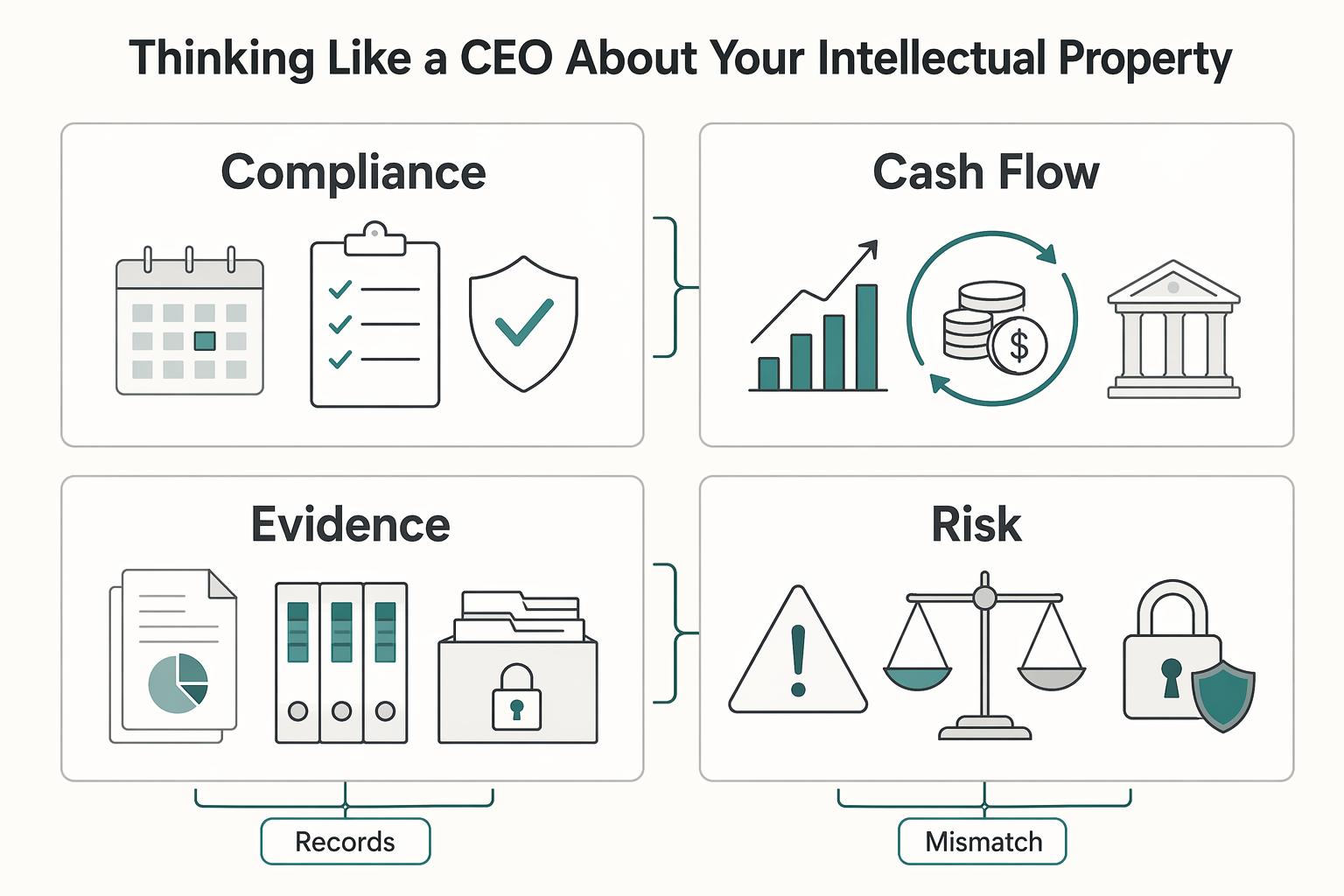
Beyond the Forms: Manage Each Royalty Stream as an Asset#
Each royalty stream is a managed asset — it generates recurring income, carries ongoing compliance obligations, and benefits from year-round decisions rather than filing-season reactions. In practice, a "CEO mindset" here just means making deliberate decisions about income activity that is regular, continuous, and profit-seeking.
An IP asset is the thing generating royalties, such as a copyright, patent, or trademark. In this tax-and-compliance context, "asset protection" means keeping the records that substantiate income, deductions, and credits.
Use one operating cycle for each stream: classify -> optimize -> report -> review.
- Classify
In most cases, royalties are reported on Schedule E (Form 1040). If the royalty activity is part of a self-employed trade or business, use Schedule C (Form 1040). Use Form 1099-MISC as one input, not the only rule for classification.
- Optimize
If the stream is self-employed business activity, apply the ordinary-and-necessary standard to expenses. If foreign tax applies, evaluate the Form 1116 lane, and do not claim FTC on income excluded under FEIE. If rights were acquired, check whether Section 197 amortization treatment applies.
- Report
Reconcile contracts, payer statements, deposits, and books before filing. If a 1099-MISC is incorrect, contact the payer. If you filed incorrectly, correct it with Form 1040-X.
- Review
Choose a practical next move for that stream: maintain, reinvest, renegotiate, or exit, based on compliance burden, documentation quality, and after-tax reliability.
| Focus area | Concrete action | Expected outcome |
|---|---|---|
| Compliance | Reconfirm Schedule C vs Schedule E, and check Form 1116 and FBAR applicability | Fewer classification mistakes and potentially lower penalty exposure |
| Cash flow | If withholding is limited, plan estimated payments during the year and track paid-in progress toward the IRS 90% benchmark | Fewer filing-season cash surprises |
| Documentation | Keep contracts, 1099-MISC support, receipts, foreign tax records, and reconciliations | Strong substantiation for income, deductions, and credits |
| Risk control | Correct bad payer forms, amend with 1040-X when needed, and monitor FBAR when foreign accounts exceed $10,000 (due April 15, automatic extension to October 15) | Issues are fixed early instead of compounding |
Talk to a pro when one payment stream mixes services and ownership rights, when the same royalty stream is taxed in multiple countries, when acquired IP raises Section 197 treatment questions, or when foreign-account reporting duties may apply.
For a step-by-step walkthrough, see How to Handle a Tax Audit When Your Income is Paid Through Deel or Remote.
If you want a cleaner year-round process for royalty-tax prep, explore the Gruv tools hub for workflow support.
Frequently Asked Questions
How do you decide between Schedule C and Schedule E for royalties?
Usually, you report royalties on Schedule E (Form 1040), and you use Schedule C (Form 1040) when the royalty is part of your self-employed creator business, such as work done as a writer, inventor, or artist. Why it matters: this classification drives the core treatment, with Schedule C tied to active business facts and Schedule E as the standard non-self-employment path. What to do next: base the decision on your contract, rights terms, and work records, and do not let Form 1099-MISC decide the schedule for you.
Are royalties always earned income for FEIE?
No. Royalties are not automatically earned income, and only amounts paid for your personal services fit the FEIE earned-income definition. Why it matters: for 2026, FEIE can exclude up to $132,900 per person when you qualify, including the 330 full days in 12 months route, but treatment depends on the underlying facts. What to do next: separate service-based royalties from ownership-based royalties before filing, and escalate to a qualified tax professional if one payment stream mixes both.
How do you report foreign royalties as a U.S. citizen or resident alien?
You still report foreign royalties because you are taxed on worldwide income. Why it matters: reporting income and claiming relief are separate steps, so you first report royalties on Schedule C or Schedule E, then evaluate Form 1116 for foreign tax credit treatment. What to do next: keep payer statements, withholding support, foreign tax receipts, and deposit reconciliations, and get professional help early if the same royalties are taxed in multiple countries.
Should you use FEIE or the foreign tax credit for foreign royalties?
Use FEIE for qualifying foreign earned income, and use the foreign tax credit path for foreign taxes on income you did not exclude. Why it matters: these are separate elections with different mechanics — FEIE can reduce regular income tax but does not reduce self-employment tax, and you cannot claim a foreign tax credit on excluded income. What to do next: map each royalty stream to the right election before filing and escalate if your facts are mixed.
Can you deduct expenses against royalty income?
It depends on your facts and reporting path, with Schedule C for self-employed business activity and Schedule E as the standard royalty route. Why it matters: your classification controls how the royalty activity is treated, so your records need to match that treatment. What to do next: keep invoices, payment proof, and a short allocation note when a cost is shared across uses, and escalate if your classification is unclear.
What form should you expect from the payer?
A U.S. payer may issue Form 1099-MISC when it pays at least $10 in royalties. In nonresident withholding scenarios, you may see Form 1042-S even when treaty benefits reduce withholding to 0%. Why it matters: payer forms are evidence, not the rule for choosing Schedule C versus Schedule E. What to do next: reconcile payer statements to your books and deposits, and if a form appears inconsistent with your records, keep support and escalate early.
Do you owe self-employment tax on royalties?
Generally, royalties fall into the self-employment-tax lane only when they belong on Schedule C as part of your active self-employed business. Why it matters: Schedule E is the standard path for royalties not subject to self-employment tax, and Schedule SE generally applies when net self-employment earnings are $400 or more. What to do next: recheck your classification before filing, and remember that FEIE does not remove self-employment tax.
What if you are a nonresident alien receiving U.S. source royalties?
U.S.-source royalties are generally FDAP income with a default 30% withholding framework. Why it matters: withholding and treaty documentation are separate from return reporting, so you generally provide Form W-8BEN to support foreign status and treaty claims, may still receive Form 1042-S even at 0% treaty withholding, and report non-ECI FDAP royalties on Schedule NEC (Form 1040-NR). What to do next: if residency, treaty article, or ECI status is uncertain, stop and use a qualified tax professional because treaty tables are summaries, not a complete authority.
Try a related tool
Researched and edited by the Gruv editorial team. Gruv builds cross-border billing, payouts, and finance-operations software for global businesses.
Sources
Educational content only. Not legal, tax, or financial advice.
Related Posts

Digital Nomad Taxes in 2026 With a Defensible Filing Plan
With digital nomad taxes, the first move is not optimization. It is figuring out where you may be taxable, where filings may be required, and what proof supports that position.

Do I Have to Pay State Taxes While Living Abroad as a Digital Nomad?
Living abroad does not end `state income tax` exposure by itself. The first decision is practical: choose a filing position your facts can support, then build records that support the same story all year.

The Freelance Payment Penalty: A Modeled Audit of Platform Fees, FX Spreads, and Payout Delays
The money rarely disappears through a single, easy-to-spot fee. The real loss is stacked. A marketplace takes its commission, a processor adds a charge for international cards, a bank or payment company converts the currency at a spread, a platform holds the funds before release, and a wire sheds a little to intermediaries on the way in. Each layer looks defensible on its own, but the worker feels the combined result as a smaller deposit and a later payday.