
Quick Answer
Choose a hybrid by default for real-time ledger vs batch settlement architecture platform volume decisions. Use real-time ledger posting where immediate internal certainty and policy checks matter, then keep scheduled release where approvals, settlement windows, and close controls drive risk. The practical test is traceability: each accepted request should link to a ledger journal, provider reference, and settlement evidence without manual stitching.
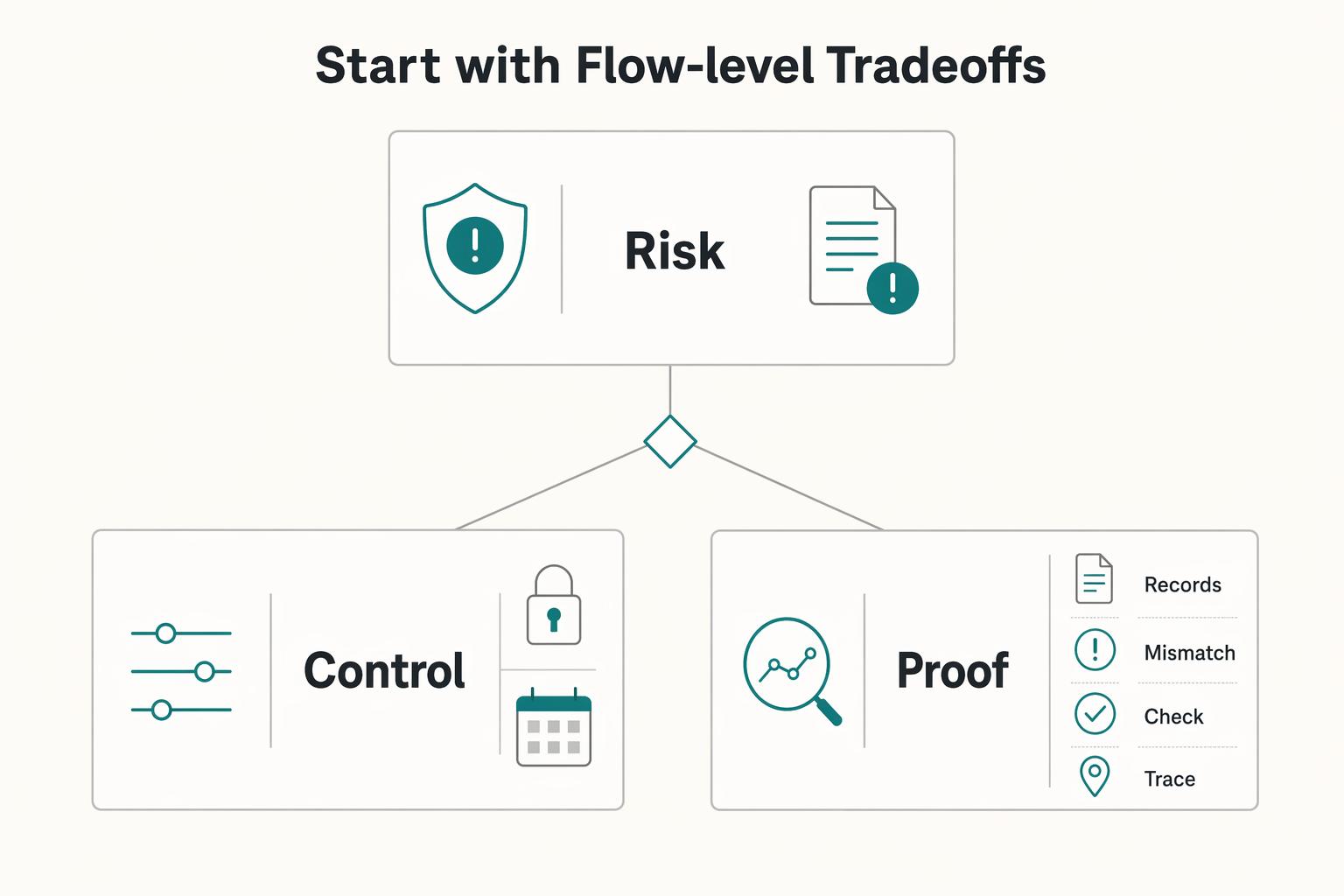
Start With Flow-Level Tradeoffs#
The useful decision is rarely "real-time everywhere" versus "batch forever." For platform teams, the real choice is often which payment flows need immediate handling and which are better served by scheduled release. If you treat this as a speed contest, you can accelerate the wrong step and make cash flow management and internal workflows harder.
That distinction matters because batch processing and real-time processing solve different problems. Batch groups transactions and processes them at scheduled intervals. Real-time handles transactions continuously and can move almost instantly, often within seconds. These are not just technical patterns. They change risk exposure, customer experience, internal operations, and how finance manages approvals and liquidity.
In practice, a mixed design is often a practical option. You may want immediate feedback for some customer-facing flows, while keeping payout release on a structured cycle so finance can review, approve, and release payments with clear ownership. You may also route different transactions across different rails instead of forcing one rail to do everything. That is the more honest comparison: not which model sounds more modern, but which operating constraint shows up first as volume rises.
If you are working through this decision, start by mapping each flow across three checkpoints: authorization, internal ledger update, and external settlement or payout release. Then verify who owns each checkpoint, what evidence exists for it, and how exceptions get resolved. If you cannot quickly tie a transaction to its approval record, ledger entry, and settlement confirmation, the problem is not speed. It is control.
The biggest early mistake is treating a faster ledger as a substitute for operational discipline. A faster ledger can improve visibility, but poor ledger design carries direct trust, fund-safety, and regulatory risk. Batch is not "legacy" by default either. Scheduled windows can be exactly what you want when release controls, predictable funding, and review gates matter more than immediate completion.
Ask a harder set of questions. Where do matching queues grow first? Where does liquidity planning get tighter when releases become more continuous? Which flows truly need a customer-facing answer within seconds, and which benefit from deliberate approval cycles? Finance, ops, and product owners can make clearer tradeoffs when they answer those questions flow by flow instead of forcing one architecture across authorization, settlement, and every payout batch.
At-a-glance comparison for real-time ledger and batch settlement#
Choose by failure tolerance and control requirements, not by pressure to be real-time. If you need immediate internal certainty, use a real-time ledger or hybrid design; if release control and close discipline matter more, keep settlement on a batch cadence.
| Decision point | Real-time ledger | Batch settlement | Hybrid payment architecture |
|---|---|---|---|
| Authorization timing | Continuous decisioning with immediate internal posting and policy checks | Commonly aligned to scheduled processing and release review steps | Immediate for customer-facing decisions, scheduled where release approvals are required |
| Settlement window | Internal state updates immediately; external settlement still follows rail/provider timing | Grouped release windows; batch-reconciled transfers can take up to a full day | Real-time internal state with selective batch release externally |
| Reconciliation burden | Lighter reconstruction when ledger ownership is centralized, but provider/bank matching still required | Heavier end-of-cycle matching across internal records and external files/statements | Split burden, but easier to isolate by flow when ownership is explicit |
| Operational risk controls | Strong when authorization control and policy enforcement are core requirements | Strong when approvals, cutoffs, and release gates are the primary controls | Strong when you need both real-time policy control and deliberate release controls |
| Liquidity management | Requires more continuous monitoring as state updates throughout the day | More predictable funding and release planning around known windows | Keeps real-time visibility where needed while preserving staged release planning |
| ACH context | Useful for immediate internal visibility, without assuming rail-level immediacy | Natural fit for scheduled, batch-reconciled transfer operations | Common when internal status is immediate but external release remains controlled |
| RTP network context | Closest fit for on-demand confirmation and always-on availability (24x7x365) | Usually a poor fit if treated as an end-of-day queue | Useful when only some flows require immediate confirmation |
| FedNow Service context | Evaluate per bank/provider implementation before promising immediacy | Batch can still be appropriate when your controls depend on scheduled release | Practical when only selected flows justify rail-level immediacy |
| Hidden operational cost | More pressure on continuous event/state handling and exception control | More pressure on end-of-cycle matching and close operations | Inherits both patterns; clearer flow ownership contains risk |
| Recommendation | Choose by failure tolerance and control requirements, not by pressure to be real-time | Choose by failure tolerance and control requirements, not by pressure to be real-time | Choose by failure tolerance and control requirements, not by pressure to be real-time |
The row that usually decides this is authorization control, not raw speed. When policy enforcement is part of the product, immediate internal decisioning often matters more than a faster-sounding settlement label, and centralized ledger ownership can simplify reconciliation and reporting.
Before redesigning, test one representative day of volume and verify each transaction against four records: authorization/approval evidence, internal ledger entry, provider reference, and settlement evidence. Keep internal confirmation and external settlement as separate states in operations and support, or keep release controlled and scheduled until that distinction is operationally clear. For cross-border marketplace flows, see Stablecoin Settlement for Marketplace Platforms: Real-Time Cross-Border Payments Without FX Fees.
Where real-time ledger adds value even when money settles later#
A real-time ledger still adds operational value when external money movement remains batch, because your internal state can be confirmed immediately while settlement evidence arrives later on rail timing.
- What you can confirm now: your platform received, validated, and posted the transaction.
- What can still arrive later: provider/acquirer outcomes and final settlement evidence, often in scheduled batch windows.
- Why this split matters: ops, support, and finance can work from a clear internal truth instead of waiting for end-of-window files.
Treat the ledger journal as the first hard checkpoint in the flow, not just a downstream log. In practice, set a clear posting rule so retries or out-of-order events do not create conflicting internal states.
Event-driven architecture is useful here because it gives immediate internal confirmation, while external clearing still follows the payment rail and provider process. Real-time processing is continuous and can be within seconds on some rails, but your customer-facing and internal labels should still keep "posted internally" separate from "settled externally."
Use a simple daily check to confirm the design is working: each transaction should tie to a ledger journal entry, a provider or acquirer reference, and later settlement evidence (such as PSP files or bank statement outputs). Related: Real-Time Payment Use Cases for Gig Platforms: When Instant Actually Matters.
Where batch settlement is still the right default#
Keep Batch settlement as the default when controlled release matters more than immediate confirmation. Scheduled batch jobs aggregate, validate, and finalize transactions at predefined intervals, often hourly or daily, which supports lanes that depend on review steps and release windows before funds move.
| Decision signal | Keep batch as the default | Move that slice to real-time first |
|---|---|---|
| Approval path | Multi-step review and release only after checks complete | Single-step acceptance where waiting adds little value |
| Customer impact | The outcome can wait for the next run window | The outcome depends on immediate confirmation or status |
| Finance control | You need a defined Settlement window for planning and execution control | You can operate continuous posting and faster exception handling |
| Evidence model | Evidence is packaged per release window | Evidence must be available immediately, event by event |
Use a practical rule: keep batch where approval flow and release timing are the control point, and move only customer-critical slices to real-time first. That split is usually more accurate than treating every lane as if instant clearing confirmation and near-continuous operation are always available.
Batch also supports finance discipline through bounded release windows, but it comes with tradeoffs. Batch-oriented pipelines can introduce operational latency and delayed reconciliation cycles, so avoid hiding customer-critical states behind a timer just because batch is easier to run.
Hybrid does not reduce rigor on the batch side. Keep each lane auditable with clear records of approved totals, release artifacts, settlement window assignment, and explicit exception ownership after handoff. A reliable check is to reconcile counts and amounts across approval records, internal ledger totals, and settlement evidence. Related reading: Berlin vs Munich for Expats Who Need a Real Move Plan.
Map each payment flow to the right architecture by volume and risk#
Choose architecture by flow behavior and control risk, not by pressure to make everything instant. If volume is continuous and exception cost is high, use a Real-time ledger with external settlement on its own window. If volume is periodic and approval-heavy, keep Batch settlement.
Use the same lens the OCC payment-systems booklet uses: transaction and settlement flow, payment type, risk areas, and control design (including internal controls and policies/procedures across ACH and Real-Time Payments). For each flow, decide based on three questions: how often it runs, what breaks when it fails, and how much policy or approval logic must happen before release.
| Flow type | Volume shape | Failure impact | Control complexity | Recommended architecture |
|---|---|---|---|---|
| Checkout | Continuous, user-driven spikes | High customer-visible failure cost | Moderate, usually status-heavy rather than approval-heavy | Real-time ledger plus external settlement on provider timing |
| Refunds | Continuous but irregular | Medium to high, especially for duplicates or missing credits | Moderate, often needs provider status tracking | Real-time internal state, batch where rail or finance release rules still apply |
| Wallet transfers | Continuous, often high event count | High if balances are wrong | Lower external dependency if internal only | Real-time ledger first; external settlement only when funds leave the platform |
| Payouts | Periodic, cutoff-driven, often bulk release | High financial and compliance impact | High due to approvals and policy gating | Keep batch release, even if pre-validation and status tracking are real-time |
| Cross-border conversion | Bursty and exception-prone | High due to amount accuracy and timing sensitivity | High because quote validity and provider confirmation matter | Real-time decisioning with strict checks, without forcing real-time release before controls are ready |
What to do by flow type#
If a flow must return an immediate accepted/failed state, post internally first and reconcile external provider or bank outcomes after. That pattern fits checkout, wallet transfers, and Gruv-style Virtual account inflows.
| Flow | Recommended handling | Condition |
|---|---|---|
| Checkout | Post internally first and reconcile external provider or bank outcomes after | Must return an immediate accepted/failed state |
| Wallet transfers | Post internally first and reconcile external provider or bank outcomes after | Must return an immediate accepted/failed state |
| Gruv-style Virtual account inflows | Post internally first and reconcile external provider or bank outcomes after | Must return an immediate accepted/failed state |
| Compliance-gated payouts | Keep release in batch | Until screening, approvals, and funding checks are complete |
| Refunds | Use status-driven retries with Idempotency | Delayed or duplicate PSP responses do not create duplicate outcomes |
If release depends on policy gates before funds move, keep release in batch. This is usually the right pattern for compliance-gated payouts until screening, approvals, and funding checks are complete.
For refunds, use status-driven retries with Idempotency so delayed or duplicate PSP responses do not create duplicate outcomes.
Constraint checkpoints that change the answer#
- FX quote risk: verify FX quote validity at release time, not only at request creation.
- Asynchronous Webhook arrivals: design for late Webhook confirmations, reference matching, and duplicate suppression.
- Policy gating before release: where controls and policies govern release, separate initial ledger posting from release execution; this matters for payout flows and obligations tied to payment-system membership requirements (including 12 CFR 7.1026 where relevant).
Evidence pack for each decision#
Require the same proof set for each flow decision:
| Evidence | Requirement |
|---|---|
| Failure logs | Tie to request, ledger posting, and provider reference |
| Reconciliation deltas | Compare internal totals and PSP/bank outputs |
| Provider confirmation artifacts | Include Payment service provider (PSP) confirmation plus bank settlement evidence where applicable |
- Failure logs tied to request, ledger posting, and provider reference.
- Reconciliation deltas between internal totals and PSP/bank outputs.
- Provider confirmation artifacts from the Payment service provider (PSP) plus bank settlement evidence where applicable.
If this evidence pack is slow or incomplete, the lane is not ready to move regardless of architecture preference.
Order of operations that keeps hybrid flows auditable#
Use one fixed sequence and define the source of truth at each step. Hybrid flows stay auditable when fast authorization and slower settlement are separated on purpose, then synchronized before close.
Allow speed at Authorization, but enforce control from accepted intent to booked value. In card-style patterns, authorization can happen in under one second while settlement still runs in daily batch cycles. That split is workable only when internal ledger state and external settlement state stay synchronized.
| Step | Primary source of truth | Eventual consistency allowed | Hard block before moving on |
|---|---|---|---|
| Request intake | Request record with stable request ID | No, duplicates should be stopped here | Yes, if request identity is unclear or duplicated |
| Authorization | Authorization result | Limited, only while decision is in flight | Yes, no accepted payment should post without an auth decision |
| Ledger posting | Internal Ledger journal | No for accepted customer state | Yes, do not call the provider if the journal entry failed or posted twice |
| Provider handoff | Payment gateway or PSP acknowledgment and provider reference | Yes, final provider outcome may arrive later | Yes, if no provider reference is captured for an accepted handoff |
| Settlement window close | PSP settlement output and cash movement evidence | No at window close | Yes, reporting should wait if the window is incomplete |
| Matching and close proof | Matched ledger, PSP, and Bank statement totals | No for finance close | Yes, unresolved deltas must stay out of final reporting |
| Reporting | Finance reporting layer | No, this is the downstream view only | Yes, only publish closed and matched states |
Set delay tolerance by audience. Customer-facing state can tolerate delayed provider confirmation if internal posting is correct and traceable. Finance-facing state should not carry ambiguity past the settlement window.
Keep three verification checkpoints explicit:
- every accepted provider handoff has a matched provider reference tied to the journaled payment
- duplicate control proves one and only one ledger entry for the accepted request
- close is complete only when internal totals balance to PSP outputs and the Bank statement for that window
Escalate unmatched states by age and close impact:
- Pending too long: if a payment is still pending after its expected settlement cycle, move it into exception review before reporting picks it up.
- Out-of-order callbacks: if a late callback conflicts with the current state, compare against the provider reference instead of blindly overwriting the ledger view.
- Reversals before close: post the reversal as a linked correcting entry and keep it in the same exception pack before finance close.
Make matched-close evidence the reporting gate, not a cleanup task after reporting.
Failure modes that break first at higher platform volume#
At higher platform volume, reconciliation discipline usually breaks before processing speed does. The pressure points are duplicate transactions, data latency, schema variability, and asynchronous system updates across multiple systems. When daily streams reach millions of records, small coordination gaps become visible mismatches between your Ledger journal, provider outputs, and close evidence.
Idempotency is an early control to harden because duplicates are a known high-volume reconciliation challenge. If retries, replays, or reprocessing can produce multiple posted outcomes for one accepted request, your reporting integrity is at risk. A practical check is whether each accepted request can be traced to one journaled outcome and one linked provider record.
Pub/sub messaging can fail differently: events are valid, but updates land out of order. In asynchronous flows, late or reordered messages can create state conflicts unless consumers reconcile by stable identifiers instead of last-write-wins behavior. Treat this as a reconciliation design issue, not just a transport issue.
Two incidents that look similar but need different handling#
| Incident | What the customer sees | What finance sees | First check | Recommended action |
|---|---|---|---|---|
| Fast Authorization with delayed settlement mismatch | Payment appears accepted quickly | Settlement evidence is missing or delayed for the expected window | Verify the provider reference is linked to the journaled payment, then review settlement output and Bank statement evidence for that window | Keep out of final reporting until the window is complete and matched |
| Settlement success with missing ledger update | External payment may be successful while internal status is incomplete | Provider or cash evidence exists, but no matching Ledger journal entry | Start from provider evidence, then trace back to request identity and posting records | Create a linked correcting entry, keep a clear exception trail, and investigate ordering or posting gaps before replay |
Dashboard signals worth acting on early#
Escalate before close when you see:
| Area | Escalate when |
|---|---|
| Manual adjustments | Rising manual adjustments for duplicate or missing posting outcomes |
| Unresolved exceptions | Unresolved exceptions aging past the expected settlement cycle |
| Provider files vs internal Ledger journal | Widening lag between provider files and the internal Ledger journal |
If these trends rise, tighten the settlement-window evidence pack: journal extract, provider settlement output, cash or bank movement evidence, and the unresolved exception list for that same window. That gives you a cleaner audit trail for reporting integrity, fraud prevention, and decision-quality at scale. For the close process behind that pack, see Month-End Close Checklist for Payment Platforms: Reconciling PSP Settlements Bank Statements and Ledger.
Decision checklist before changing any settlement architecture#
Only change settlement architecture after four items are documented and approved: exact scope, control ownership, technical proof, and rollback conditions. If any one is vague, pause the change and close the evidence gap first.
| Checkpoint | What you need in writing | Verification detail | Red flag |
|---|---|---|---|
| Scope | Which flows are changing, which rails apply per flow, and who can approve or reverse | List each flow separately, then tag the rail used for that flow (for example, ACH, RTP network, or FedNow Service) | "We are moving payouts" with no split by flow, entity, or rail |
| Controls | Operational risk controls, audit export requirements, and documented reconciliation steps | Pull a sample audit export and confirm finance can trace request ID to journal entry, provider reference, and bank evidence | Auditability depends on manual spreadsheet joins or undocumented team knowledge |
| Technical readiness | Webhook handling, replay-safe Idempotency, and failover behavior in Event-driven architecture | Re-run the same accepted request and confirm one posted outcome, then test late or duplicated callbacks on the same request ID | Success depends on callbacks arriving in a "normal" order |
| Launch gates | Pilot cohort, rollback trigger, and named approvers from finance, ops, and product | Define the metric that pauses launch (for example, unresolved exceptions or missing ledger updates above agreed tolerance) | No clear stop rule and no single rollback owner |
Scope usually fails first in practice. A checkout confirmation flow on RTP network is a different decision from a scheduled ACH payout batch, even when both touch the same ledger. Assign approval rights and rollback authority by legal entity and flow, not only by product team.
Treat outside architecture material as directional, not launch proof. POLARIS Version 3.0 is presented as a submission to the SEC (dated January 12, 2026), and one other source explicitly states it is not peer-reviewed. Use those sources for ideas; use internal evidence to launch: deltas, callback logs, journal extracts, a sample audit export, and a written rollback rule.
For a step-by-step walkthrough, see Choosing Creator Platform Monetization Models for Real-World Operations.
Conclusion#
The right choice is the one that reduces operational failure risk without giving up control, close discipline, or an audit trail you can actually use. In many platforms, that is neither a pure real-time design nor a pure batch model. It is a deliberate hybrid payment architecture: real-time where state certainty matters immediately, batch where structured approval and release cycles still do useful work.
That follows how the two models behave. Batch processing groups transactions and executes them at scheduled intervals, which is why it remains common for payroll, vendor payments, and recurring disbursements where predictability and oversight matter. Real-time processing handles transactions individually and continuously, which is useful when customer actions or regulatory requirements require immediate responses. If your team is still arguing this as a speed debate, you are probably looking at the wrong variable.
A better rule is simple. If the cost of stale balances, delayed status, or unclear outcomes is high, favor real-time ledger posting and continuous processing. If the flow is approval-heavy, release-gated, or tightly tied to liquidity planning, keep batch settlement first and make the controls explicit. That pattern is often the practical answer in production, not on a whiteboard.
Your next move should be narrow and evidence-led, not a broad migration:
- Classify flows separately. Checkout, refunds, wallet transfers, payouts, and recurring disbursement lanes should be evaluated on volume shape, failure impact, and approval complexity.
- Run the decision checklist on each flow, especially ownership of approval, rollback, and close matching.
- Validate with evidence before rollout. Request records, provider references, ledger journals, and reconciliation outputs should line up for the same transaction path.
One checkpoint matters more than architecture claims: can you trace one accepted request from provider handoff to ledger journal entry, settlement result, and close evidence without manual spreadsheet stitching? If not, do not scale the real-time slice yet. Faster rails do not remove operational risk; controls still need to hold under load.
So the recommendation is straightforward. Keep the ledger and audit trail strong enough to support immediate internal truth, but do not force every money movement into continuous handling when scheduled control is the real requirement. Pilot by flow, prove matching under load, and expand only after the evidence pack holds up. If close discipline is your weak point, the next useful step is often tightening that process first, not chasing faster settlement.
Frequently Asked Questions
Is a real-time ledger better than batch settlement for every platform volume?
No. A hybrid payment architecture can be the better fit because immediate internal state and external money movement solve different problems. A real-time ledger gives you a current financial truth, while external settlement can still follow provider processes and timing windows.
Can you run real-time authorization with batch settlement?
Yes. Your payment gateway can authorize and route transaction data right away, while the ledger records the state change and settlement can close in a later window. The checkpoint that matters is traceability: you should be able to follow a transaction from authorization to ledger entries and final reconciliation artifacts.
When is batch settlement the better choice?
Choose batch when operations are easier to control in scheduled releases and control steps are tied to those windows. If the business already works around a known settlement window, forcing everything into instant handling often adds complexity without removing the real control steps.
What does a real-time ledger add if settlement is still batch?
It improves visibility before external clearing finishes. A well-designed ledger is treated as the single source of truth, with atomic updates and consistently maintained balances. That can help you spot exceptions earlier and export every credit, debit, and balance change for review. In practice, that can mean fewer blind spots between customer confirmation and finance close review.
What usually breaks first at scale?
Failure risk often appears in badly handled retries, weak duplicate-posting controls, and gaps between internal records and provider outputs, especially when transaction spikes hit. If you want one quick test, replay the same accepted request and confirm you still get one posted outcome only. If that fails, scale will make it expensive.
How should teams choose by platform volume?
Do not choose once for the whole platform. Segment by flow type, frequency, and failure impact, then assign each flow to real-time, batch, or hybrid with explicit checkpoints for matching and rollback. If a flow has continuous volume and missed state changes are costly, use the ledger in real time and let settlement follow later. If a flow is periodic and approval-gated, keep it batch first.
What evidence should you review before deciding?
Use evidence, not architecture claims alone. Review callback logs, reconciliation deltas, journal extracts, and audit exports. If manual spreadsheet joins are still required to explain a posted payment, the architecture choice is not your main problem yet.
Try a related tool
Researched and edited by the Gruv editorial team. Gruv builds cross-border billing, payouts, and finance-operations software for global businesses.
Sources
Includes 1 external source outside the trusted-domain allowlist.
- ecb.europa.eu/paym/target/t2/prouse/shared/pdf/RTGS_UDFS_R...trusted
- occ.gov/publications-and-resources/publications/comp...trusted
- pmc.ncbi.nlm.nih.gov/articles/PMC11082361trusted
- sec.gov/files/ctf-written-payments-settlement-operat...trusted
- sec.gov/Archives/edgar/data/776901/00007769011500007...trusted
- moderntreasury.com/journal/a-builder-s-guide-to-multi-rail-mone...external
Educational content only. Not legal, tax, or financial advice.
Related Posts
Stablecoin Settlement for Marketplace Platforms Without Hidden FX Leakage
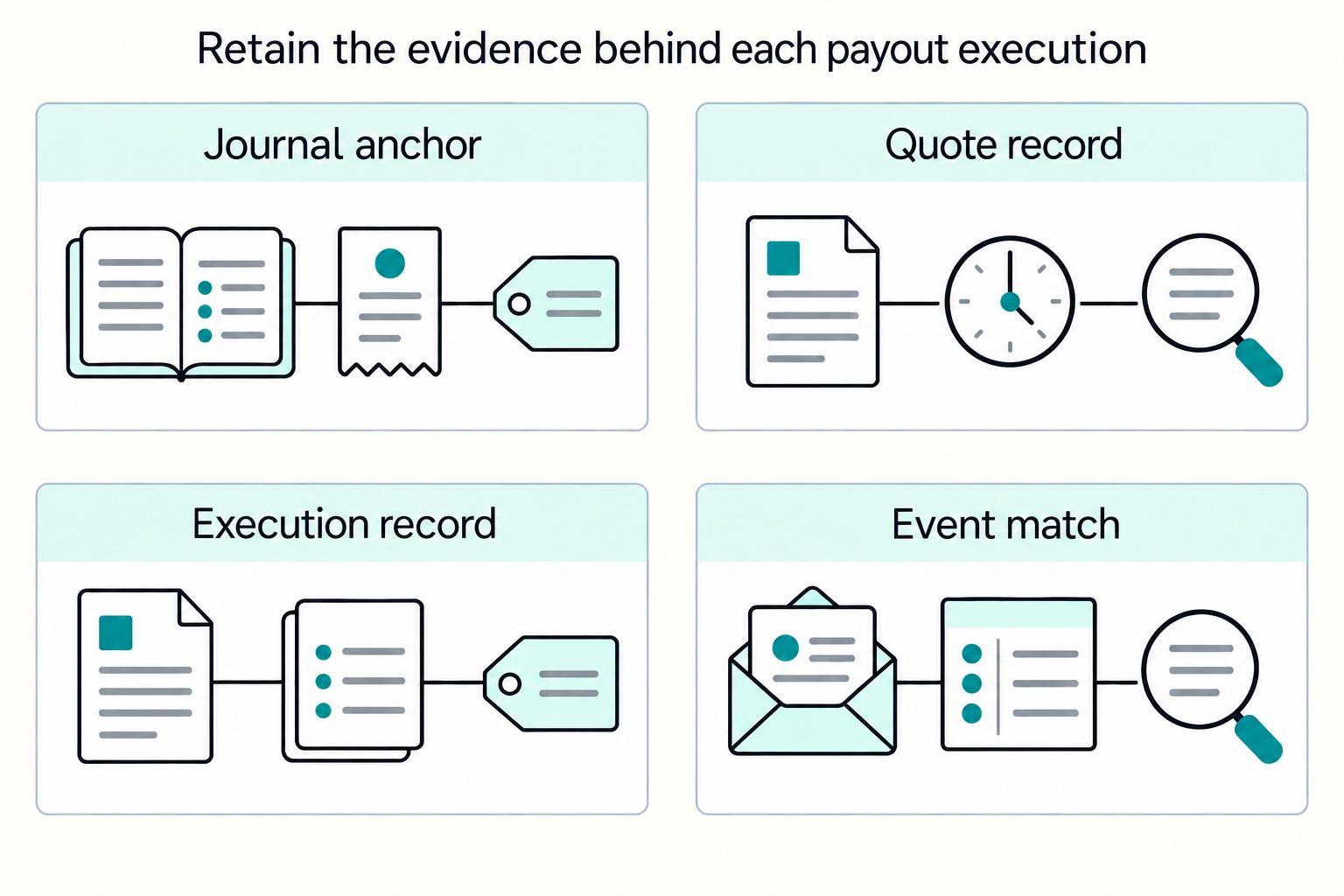
Stablecoin settlement is an operating-model decision, not a speed demo. If you are a founder, Payments Ops lead, finance owner, or engineering owner evaluating stablecoin settlement marketplace platforms for cross-border payouts, start with one question. Do funds arrive in a usable form, with clear compliance evidence and clean reconciliation, at a lower total cost than your current payout mix?
When Instant Payout Matters for Gig Platform Payments
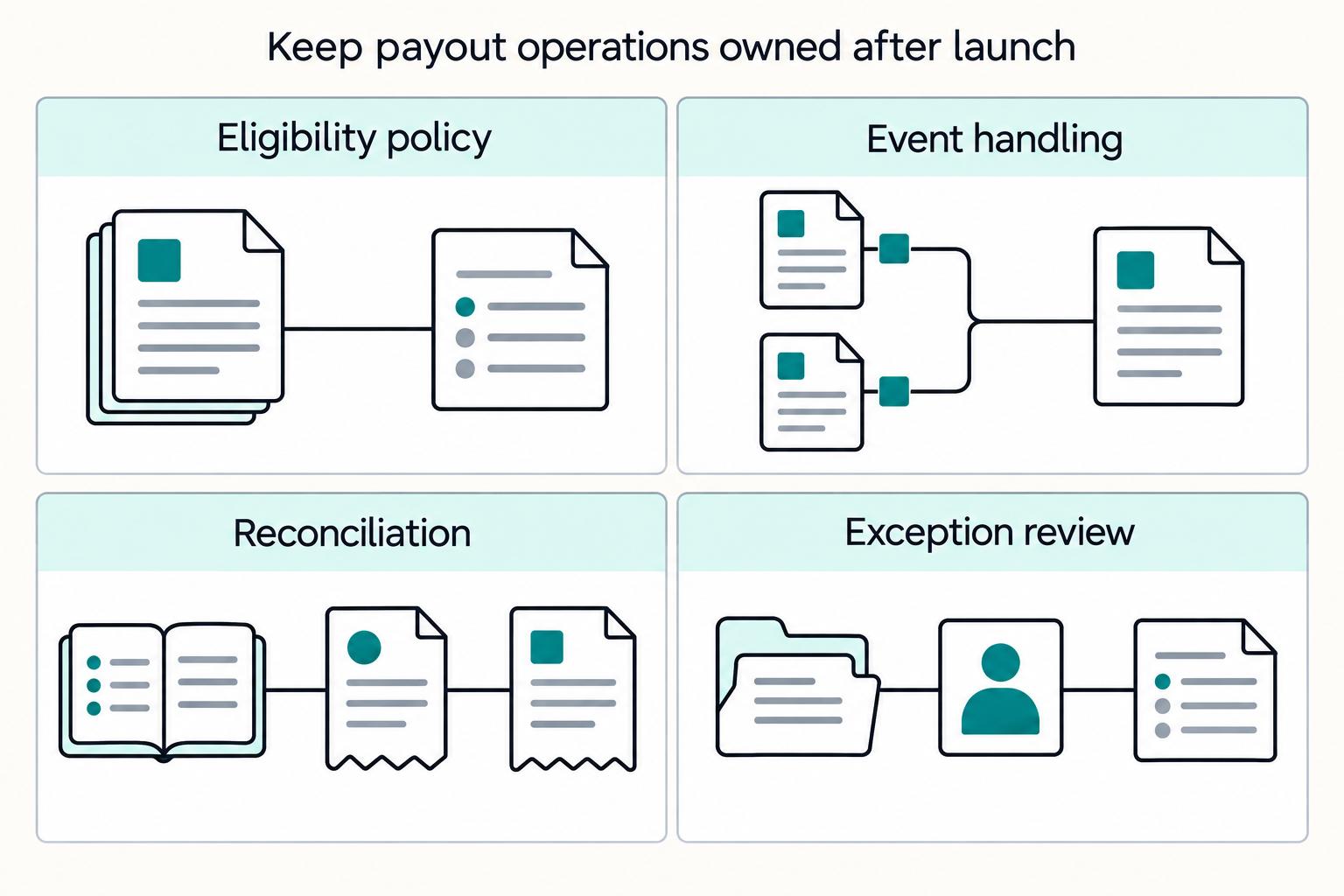
Instant payout is a tool, not the goal. The real operating decision is where instant timing creates measurable value, where batch timing is enough, and where both should run side by side.

Month-End Close for Payment Platforms with PSP Settlement Control
Month-end close often breaks down when PSP settlement is treated as a side reconciliation. For payment platforms, settlement is often the clearest record of what cash should have moved, so it should drive the close rather than being checked after journals are drafted. If you run close across multiple PSPs, you need that settlement record to lead the review before your team starts defending journal entries.