
Quick Answer
Choose instant payout only for flows where a missed window breaks fulfillment or trust; keep ACH or other scheduled batches for routine payouts. The practical split is urgent lanes on RTP or FedNow and planned releases on batch cycles with clear ETAs. Before go-live, confirm KYC/KYB/AML gating, idempotent retry behavior, and traceability from payout request ID to provider reference and ledger posting, since real-time settlement is final once sent.
Why instant payout is not the goal and good payout timing is#
Instant payout is a tool, not the goal. The real operating decision is where instant timing creates measurable value, where batch timing is enough, and where both should run side by side.
That matters because real-time rails can deliver funds within seconds and operate 24/7/365, but each send also carries operational risk because payments are final once sent. Better payout timing is not the fastest possible timing. It is the timing promise you can keep reliably for each payout flow.
- Choose timing by urgency, not optics.
Use instant timing where delay creates real operational damage. If a delay only moves receipt from tonight to the next batch window, batch payouts are often the better default.
The broader payout environment is moving from periodic batch flows toward more continuous, transaction-driven flows, which makes faster timing more relevant. But "within seconds" only matters when the payee or workflow actually depends on it.
- Make the tradeoff explicit before rollout.
RTP- and FedNow-style payments settle individually and continuously. Same Day ACH still runs on scheduled batches. That difference changes risk handling and day-to-day operations, not just speed.
Finality is the key control point. Once a real-time payment is sent, reversal may not be available. Before you enable instant payout, verify provider API quality, settlement behavior, payee experience, and compliance support. Also confirm idempotency protection and tax-compliance automation, since many platforms do not include those by default.
- Scope promises by rail, market, and program.
Do not treat "instant" as a blanket feature. Treat it as a route-level capability that you verify for the specific rail, bank, market, and program you are running.
In practice, RTP, FedNow, and ACH represent different timing models and should be evaluated as distinct options. Outside the U.S., teams may evaluate local rails, but coverage and eligibility can still vary. Set ETA messaging to actual routing behavior so your timing promise matches what the system can deliver.
How to choose the right payout timing model for your platform#
Choose payout timing based on operational impact, not on making every payout instant. If late funds damage trust or operations, prioritize an instant lane. If predictability and finance control matter more, keep scheduled batches as your default.
| Signal | Timing implication | Grounding |
|---|---|---|
| Missed timing breaks fulfillment or trust | Prioritize instant payments | Real-time rails can settle within seconds and operate 24/7, including holidays |
| Delay creates inconvenience but not operational damage | Scheduled payouts are often enough | Local bank transfer schemes are not always instant, and cut-off timing varies by scheme and bank |
| Repeated status questions or higher-frequency flows | Check whether the issue is lateness, payout visibility, or inconsistent schedule adherence before changing rails | Higher-frequency flows may need different timing from lower-frequency flows |
| Corridor mix or current operating constraints are still unclear | Keep a conservative baseline with scheduled batches and add instant only where the business case is clear | Real-time availability is often domestic rather than broadly cross-border |
This guide is for operator teams running contractor, creator, and marketplace payouts, not personal finance advice for freelancers. The unit of decision is your payout program: the promise you make, the rail you route through, and what your team can reliably run when issues happen.
- Start with urgency, not optics
If missing the promised window causes operational issues or visible trust damage, prioritize instant payments. Real-time rails can settle within seconds and operate 24/7, including holidays. That is useful when your supply side needs faster access to earnings.
If lateness creates inconvenience but not operational damage, scheduled payouts are often enough. Local bank transfer schemes are not always instant, and cut-off timing varies by scheme and bank. A default choice can be a weak fit for time-sensitive or high-churn workforces.
- Use support pressure and payout frequency as signals
Repeated status questions can be a sign that the payout method is a poor fit. Poor payout-method fit can drive delayed payments and higher support costs, so higher-frequency flows may need different timing from lower-frequency flows.
Check what is actually failing before you change rails: lateness, payout visibility, or inconsistent schedule adherence. Choosing a payout schedule is necessary, and tracking payouts after setup matters just as much.
- Apply one core decision rule
If missed timing breaks fulfillment or trust, lead with instant payments and design controls around them. If predictable cadence and operational stability dominate, prefer scheduled payout batches.
Real-time account-to-account transfers are fast, but they are final and irrevocable once sent. Include webhook reliability and API failure handling in your risk review before you scale instant lanes.
- Do not decide until you confirm core operating inputs
Confirm your corridor mix and current payout operating constraints before you lock the model. Those inputs help you decide whether speed is truly required or mostly symbolic.
Corridor mix matters because real-time availability is often domestic rather than broadly cross-border. If key inputs are still unclear, keep a conservative baseline with scheduled batches and add instant only where the business case is clear. Related: Payment Status Visibility: How Real-Time Payout Tracking Reduces Support Load.
Compare the five timing patterns before you implement anything#
Use the timing pattern your team can release, support, and reconcile consistently when something goes wrong. Rail labels matter less than operational fit.
| Timing pattern | Best-for scenario | Rails / route reality | Worker experience impact | Cost-to-serve | Fraud / compliance exposure | Operational burden | Hard constraints | Recommendation |
|---|---|---|---|---|---|---|---|---|
| 1. Instant payout at job completion | High-urgency work where delayed funds can quickly affect fulfillment or trust | Real-time payment rails where your program supports them | Strongest "paid now" experience: funds can be available within seconds with immediate confirmation | Depends on payout frequency and program design | Highest consequence of errors because real-time settlement is final and irrevocable | Can be high if you are effectively operating a 24/7, year-round payout promise | Irreversible settlement leaves little recovery room | Conditional |
| 2. Wallet balance with on-demand cash-out | Recurring earners who want flexibility without instant release on every completed task | Internal balance first, then withdrawal via available rails (instant where available, ACH where used) | Better than fixed-cycle waiting; not identical to automatic post-job payout | Depends on internal-ledger complexity and withdrawal mix | Release controls still matter, and instant withdrawals inherit irrevocable-settlement risk | Can be high due to balance logic, release controls, and dispute handling | Release rules and rail readiness determine what can release now | Conditional |
| 3. Scheduled daily payout batches | Moderate urgency with tighter margin control and predictable release windows | If routed to ACH, daily release does not mean instant receipt, and ACH typically processes over several business days | Acceptable when cutoffs and ETA messaging are clear | Can be lower than always-on instant in some setups | Lower finality risk than instant release, but operational errors still create risk | Medium when batch monitoring and reconciliation are disciplined | Money-availability timing is rail-dependent, not just platform schedule | Conditional |
| 4. Weekly ACH default with instant exception lane | Programs where most payees tolerate cadence, but some events need speed | ACH baseline plus selective instant routing where available | Baseline feels slower, but exception speed can protect urgent cases | Can be cost-disciplined if exception use stays controlled | Risk depends on exception governance and release controls | Medium to high due to policy ownership, approvals, and audits of exception use | Exception criteria and release controls must be explicit | Default |
| 5. Corridor-aware split routing for cross-border payouts | Mixed domestic and international corridors where one timing promise is unrealistic | Use supported routes by corridor; timing can differ across routes and payout paths | Works when ETA communication is honest by corridor and route | Varies with routing complexity | More routing branches can increase error and delay risk | Often high due to routing, messaging, and reconciliation complexity | Corridor and program constraints can force asynchronous steps | Conditional |
Most teams should not start with instant everywhere. A controlled ACH baseline plus a narrow instant lane can be easier to operate, and you can widen instant access where timing failures clearly hurt fulfillment or trust.
The non-negotiable risk is finality. Real-time payments can complete within seconds, run 24/7 year-round, and are final once sent. That improves worker experience, but it also raises the cost of release mistakes.
Before you launch, validate each segment in live conditions: route readiness and your release controls at the exact moment funds would be sent. If those checks are not reliable, keep that segment on a scheduled lane and provide a clear ETA.
Use case 1 instant payout at job completion for high-urgency supply#
Use this pattern only for the narrow, high-urgency segment where delayed funds create immediate friction after task completion. That restraint matters.
In instant delivery work, a D.C.-region report found variable wages, opaque pay structures, and unpaid work. It also described cases where workers spent half of their work-time waiting unpaid. In that context, paying right after verified completion can signal reliability more clearly than a delayed payout promise.
Where this fits#
This pattern fits best when work units are short, frequent, and operationally urgent, as in on-demand delivery models where workers are dispatched through smartphone technology.
Start where you already see delay-driven complaints or payout exceptions. A 2024 study of 354 gig workers in digital food delivery found a significant positive relationship between digital food delivery and job engagement. The effect was stronger for brands with stronger reputations. That does not prove payout timing causes engagement, but it supports treating trust signals as operationally meaningful.
Why operators use it#
The main benefit is immediate access to earnings once work is actually complete. That can matter in workflows where workers depend on frequent payout cycles.
It also makes payout reliability visible. If you promise immediate release and it lands right after verified completion, that event can reinforce trust. Treat any re-engagement upside as a hypothesis to test by segment, not as a default outcome.
What can go wrong fast#
A common failure point is release timing. If release happens before fulfillment and pay state are truly final, later adjustments can still lead to underpayment or no-payment outcomes.
The same D.C.-region report is a useful warning signal: 49% of surveyed workers reported underpayment or no payment for jobs. Even without assuming that rate applies everywhere, it is enough to prioritize payout correctness alongside speed.
A concrete release pattern#
- Release only after server-side fulfillment checks pass, payout amount is final, and no hold is open.
- If required internal eligibility checks are incomplete, route that case to a scheduled lane instead of instant release.
- Keep the trigger at a point that cannot still be reversed. If completion can still change, the trigger is too early.
If instant payout is part of your retention strategy, our guide on How Gig Platforms Can Use Earned Wage Access (EWA) as a Contractor Retention Tool explains when EWA is the better fit.
Use case 2 wallet balance with on-demand cash-out controls#
When paying out after every job is too costly or brittle, move the speed decision to withdrawal. A wallet with on-demand cash-out lets you credit earnings continuously, then use instant payout only when a user asks for it.
The key tradeoff is separating earning from cash movement. Workers get flexibility, and your team can avoid hitting the RTP Network on every earning event. Preference data supports offering this option. 57% of recipients who receive an instant payment go on to make it their most-used payout method, up from 39% in 2020. That does not prove retention impact on its own, but it supports making fast withdrawal available when timing matters.
Where this fits#
Use this model when earnings are frequent but urgency is uneven, such as creator platforms, task marketplaces, and contractor networks with many small earning events.
A practical checkpoint: if settlement often takes more than 48 hours, this pattern is worth testing. Timing is a trust issue, not just a finance workflow.
Why teams choose it#
Teams use this model to reduce instant-rail sends while preserving fast access when needed. Instead of initiating RTP on every earning event, you maintain an internal balance and let users withdraw on demand.
It also gives finance and ops more control over routing and timing. You can reserve instant payout for eligible withdrawal requests while handling lower-urgency flows in other lanes.
What gets hard fast#
Manual handling makes this worse: manual errors increase support overhead, and currency-conversion delays can slow settlement in cross-border flows.
If your wallet touches those flows, keep withdrawal-state language clear for users and support teams. Compliance is also part of withdrawal control, not just onboarding. Centralizing KYC and AML checks can help reduce audit risk.
A concrete withdrawal pattern#
- Orchestrate payout flows through a single API connection where possible.
- Keep wallet crediting and payout timing as separate decisions so instant rails are used when speed is needed.
- At cash-out request time, confirm current KYC and AML status.
- Send eligible withdrawals through the RTP Network and keep transaction-level visibility so finance can reconcile wallet debits, payout sends, and exceptions.
If you cannot trace each withdrawal cleanly from approval decision to payout event, fix reconciliation before you scale this model.
For cross-border programs, When Platforms Should Use Wires vs Local Rails for Cross-Border Payouts explains where instant payout expectations hold up and where local rails matter more.
Use case 3 scheduled same-day payout batches for cost discipline#
Scheduled same-day payout batches fit when users can accept defined payout windows and you need predictable payout operations. This model sets timing by schedule instead of sending every approved earning as an instant payment.
Best fit#
Use this where daily earning cycles are clear and getting paid in a known window matters more than getting paid within seconds. It matches batch-oriented rails like ACH, while real-time rails operate 24/7, including holidays, and settle within seconds. Keep the product promise aligned to that rail behavior: scheduled windows, not instant availability.
Why teams choose it#
The main advantage is operational control. You group approved earnings into payout runs and reconcile each run as a discrete event, instead of managing continuous one-off sends.
This can give finance and ops a clearer structure for approvals, rejects, and retries at the batch level. Cost outcomes can vary by rail and provider, so treat this as an operations choice rather than an assumed savings rule.
Where the tradeoff shows up#
The tradeoff is speed. Real-time payments make funds immediately available, while scheduled batches require waiting for the next window, and traditional rails can take several business days to settle.
Instant rails also have a different failure profile. Once sent, transfers are final and irrevocable. If your workflow depends on immediate liquidity after each job, a scheduled model will feel weaker.
A concrete operating pattern#
A practical pattern is to define scheduled payout windows and process approved earnings in batches with batch-level reconciliation. Treat the exact cadence as an implementation choice, not a universal best practice.
- Define each payout window and freeze the included payouts before processing.
- Recheck final eligibility before release.
- Create a batch record of included payouts for reconciliation.
- Track outcomes at the batch level so exceptions are visible.
- Resolve rejected payouts before the next cycle when possible.
Use this model when instant availability is not required for every payout, and keep an exception path for cases where waiting for the next batch is not acceptable.
Use case 4 weekly ACH default with instant exception lane#
A weekly default payout cadence with a narrow instant exception lane can work when most workers can wait, but specific payout delays would otherwise damage trust and fulfillment. The goal is not speed everywhere. It is a clear baseline pay cadence with a controlled fast path for defined cases.
Best fit#
Use this model when weekly pay is acceptable for most of your workforce and only a small set of scenarios need faster payout handling. Late pay can trigger panic, support spikes, and unfilled shifts, so define where delay is operationally risky and reserve speed for those cases.
Before setting weekly as the default, validate the compliance requirements that apply to your workforce. Payout frequency and wage timing rules are part of compliance, so cadence cannot be treated as a pure cost setting.
The evidence also supports not stretching cadence too far. Weekly-paid households borrowed from credit cards 30-40% less than monthly-paid households in the cited research. Workers with increased pay frequency were 77% more likely to work harder and pick up extra shifts. That does not make weekly universally correct, but it is a practical guardrail.
Why teams choose it#
Teams use this model for controlled flexibility: one predictable weekly payout motion, plus a bounded faster-payment lane for approved exceptions. This reflects a broader tradeoff in faster payments. Faster can improve pay experience in some cases, but it can also add scam risk and margin pressure.
Where the model usually breaks#
A common failure mode is policy drift: if exception rules are vague or approvals are ad hoc, the fast lane can expand until it behaves like the default.
A second failure is skipping compliance review because the baseline feels "safe." It is still a payout policy, and frequency obligations still apply. Use this launch rule: if you cannot name the trigger, approval owner, and required evidence, do not launch it.
Sample exception policy table#
| Exception trigger | Approval owner | Required evidence |
|---|---|---|
| Verified late or failed payout that blocked access to funds | Payout operations owner | Original payout ID, failure or delay event, corrected or revalidated payout details |
| Documented risk of missed shift or trust-impacting delay | Named policy owner | Work record or schedule impact evidence, identity/compliance checks passed, verified payout method |
| Other pre-defined policy exception with explicit compliance check | Policy and compliance owners | Written eligibility rule, approval record, no active hold |
A concrete operating pattern#
Set a weekly default payout cadence in product and policy. Allow faster payout only for approved triggers, assign one owner per trigger, and log a reason code for every exception.
Run eligibility checks at exception time, not only at onboarding. For late- or failed-payout exceptions, verify the underlying event directly before release.
Review exceptions on a fixed cadence to compare volume by trigger and owner and inspect overrides. If one trigger dominates, either the baseline cadence is wrong for that segment or the trigger is too loose.
If urgent access is needed for a large share of workers every week, this pattern is likely the wrong default. It only works when the exception lane stays exceptional.
Use case 5 corridor-aware split routing for cross-border payouts#
Use corridor-aware split routing when your cross-border payout promise spans countries with different rail realities. In practice, "instant" is a corridor decision, not a universal product setting.
Cross-border payments still lag domestic payments on speed, cost, access, and transparency, so route-level variance is expected. The World Bank remittance dataset covers 367 country corridors across 48 sending countries and 105 receiving countries. That is a practical reminder to design payout promises by route, not by slogan.
Best fit#
This model fits when some destinations can support near-instant local payout and others cannot. The goal is to match each payout to corridor capability while keeping reconciliation and FX handling clean.
A practical pattern is to collect into Virtual Bank Accounts (VBAs) where available and use those identifiers to automate reconciliation. Then run your conversion controls and route to the best local method for that destination. This can improve reconciliation and routing clarity without claiming every payout is immediate.
What makes this model worth the complexity#
The main benefit is operational honesty. Route behavior can differ sharply by market. If your provider supports local payout through Pix in Brazil, that route can behave very differently from corridors without supported instant local rails.
Split routing can also isolate handoffs before final delivery across collection, conversion, beneficiary setup, and reconciliation, not only at the last rail.
Cost pressure matters too. The World Bank cites a 6.49% global average remittance cost, which reinforces why "send fast everywhere" can be a weak default strategy for cross-border payouts.
Concrete operating pattern#
| Corridor type | Route choice | What to verify before release | User-facing promise |
|---|---|---|---|
| Receiving market with supported local instant rail (for example, Brazil with Pix) | Collect to VBA where available, complete FX step, route to supported local instant rail | Beneficiary details validated, funding matched to correct VBA, FX amount confirmed, no active hold | "Processing on a fast local route; track status in app." |
| Corridor where one side is fast but local payout timing is not reliably instant | Collect and convert, then send via best supported local method or scheduled transfer | Local method availability, cut-off behavior, provider status, fallback path ready | "Expected within the delivery window shown in app." |
| Corridor with uncertain reliability or limited local options | Prioritize delivery and reconciliation; use fallback route when needed | Destination bank data rechecked, conversion completed, support status mapping in place | "Sent for processing; follow ETA updates in app." |
If your team cannot document this matrix by corridor, you are not ready to market instant cross-border payout.
Where teams usually get burned#
The common failure is one global product promise that ignores corridor variance. When one country receives funds much faster than another, users can read that gap as unfair unless your product language sets expectations clearly.
A second failure is assuming U.S. real-time rails solve the full path. RTP and FedNow support always-on domestic instant behavior in the U.S., but that does not make mixed-corridor cross-border delivery instant end to end.
What to check before you launch#
Keep two layers in place: verification and communication.
For verification, maintain a corridor inventory with receiving country, payout method, settlement currency, conversion step, expected status transitions, and fallback route. Review outcomes by corridor, not only by provider-wide metrics.
For communication, do not promise instant unless that corridor repeatedly performs that way in production. When reliability is uncertain, predictable ETA messaging is better than speed claims.
Choose payment rails by reliability and controllability not by hype#
Choose the rail you can verify, monitor, and reconcile, not the one with the strongest marketing claim. Score each option on controls your team actually owns: availability window, confirmation behavior, reversal risk, send and receive readiness, and ledger fit.
| Rail | Availability window | Confirmation behavior | Reversal posture | Send and receive readiness | Reconciliation fit | When not to use |
|---|---|---|---|---|---|---|
| RTP Network | Described as 24/7, year-round and can complete within seconds | Immediate confirmation is part of the operating model | Treat payouts as final and irrevocable once sent | Validate both sides before promising instant; do not assume universal readiness | Strong when provider references and payout status events are captured at send time | Avoid when beneficiary data is unresolved, duplicate-send controls are weak, or mistaken releases are unacceptable |
| FedNow | Treat as an instant rail only where your operating path is actually ready | Confirmation is useful only if ops and finance can see and act on it | Define error-response and exception handling before go-live | Verify institution readiness case by case; it launched in late July 2023, and one launch snapshot reported fewer than 1 percent of banks signed up | Works when confirmations map cleanly to finance records, not just UI status | Avoid blanket rollout when send or receive readiness is inconsistent across your bank/provider path |
| ACH | Typically a slower path that can take several business days | Not an instant-confirmation experience | Not the rail to choose when you need instant payout outcomes | Use when payout-timing expectations can tolerate delay | Can align with scheduled accounting flows when speed is not the primary requirement | Avoid when payout timing directly affects worker trust, fulfillment, or re-engagement |
| PIX | Evaluate as a corridor and provider-specific rail, not a universal default | Use only if your provider exposes clear status signals for this route | Do not assume reversal behavior without provider confirmation | Confirm route-level send and receive support before committing to instant messaging | Useful when references and beneficiary checks are explicit in your flow | Avoid when provider support, beneficiary requirements, or fallback behavior are not clearly documented |
Before you launch, run a simple gate: confirm both-side readiness, confirm the exact status event ops will receive, and confirm that event posts cleanly to your ledger. Risk rises when payouts are labeled "instant" but reconciliation still depends on delayed or incomplete records.
If you need deeper implementation detail on the two U.S. instant rails, read FedNow vs. RTP: What Real-Time Payment Rails Mean for Gig Platforms and Contractor Payouts.
For a step-by-step walkthrough, see Tipping and Gratuity Features on Gig Platforms: Payment and Tax Implications.
Minimum controls before enabling instant payout in production#
Do not enable instant payout in production until four controls are live: pre-send policy gates, traceable payout records, tax and compliance evidence paths, and named launch ownership. That bar is practical, not conservative, because RTP and FedNow are positioned as final and irrevocable rails, so post-send recovery is limited.
| Control area | What must be live | Examples |
|---|---|---|
| Pre-send policy gates | Resolve KYC/KYB (where required) and AML checks before payout creation | Use RBAC plus dual-control approval for high-risk changes |
| Traceable payout and retry evidence | Keep payout request ID, provider reference, ledger posting reference, and retry trace | Retry with the same idempotency key and retain the first stored result; capture pacs.002 messages for RTP flows |
| Tax and compliance evidence paths | Build document collection and validation into onboarding and payout eligibility | W-9, W-8BEN, 1099 workflow mapping; 1099-NEC filing and recipient furnishing by January 31 |
| Launch checkpoints and named ownership | Set failure-rate and reconciliation objectives before rollout | Assign incident ownership across product, engineering, and finance |
- Pre-send policy gates
Treat eligibility as a hard gate, not a post-launch patch. For covered financial institutions, CIP sits inside AML, and beneficial-owner identification applies when onboarding legal-entity customers, so KYC/KYB (where required) and AML checks should be resolved before payout creation. For high-risk changes, use RBAC plus dual-control approval instead of single-operator release.
- Traceable payout and retry evidence
If finance cannot reconstruct a payout end to end, you are not production ready. Keep, at minimum:
- payout request ID (your app)
- provider reference
- ledger posting reference
- retry trace proving idempotency
On timeout or no-response, retry with the same idempotency key and retain the first stored result. For RTP flows, capture immediate status responses, including pacs.002 messages, and link them to ledger records so payout state and reconciliation keys stay aligned.
- Tax and compliance evidence paths
Instant payout does not remove payer reporting obligations. Build document collection and validation into onboarding and payout eligibility:
W-9for TIN/certification workflowsW-8BENfor foreign beneficial-owner status1099workflow mapping for your payer model
Operationally, keep these checkpoints explicit: 1099-NEC filing and recipient furnishing by January 31, and electronic filing when submitting 10 or more information returns. For EU flows, VIES is useful validation input but not legal proof of VAT exemption by itself; store the VAT number, validation result, and source. In the UK checker flow, use the VAT number directly, with no name-only lookup.
- Launch checkpoints and named ownership
Set measurable launch gates before rollout: failure-rate and reconciliation objectives as SLO-style targets tied to your rail mix and operating capacity. Assign incident ownership across product, engineering, and finance before the first live payout, and document who decides when duplicate sends, missing provider references, or ledger and bank mismatches occur.
For implementation details, see Webhook Payment Automation for Platforms: Production-Safe Vendor Criteria. Before you launch, turn your control checklist into an implementation spec with retries, status transitions, and approval gates in Gruv docs.
Operating model for product, engineering, and finance after launch#
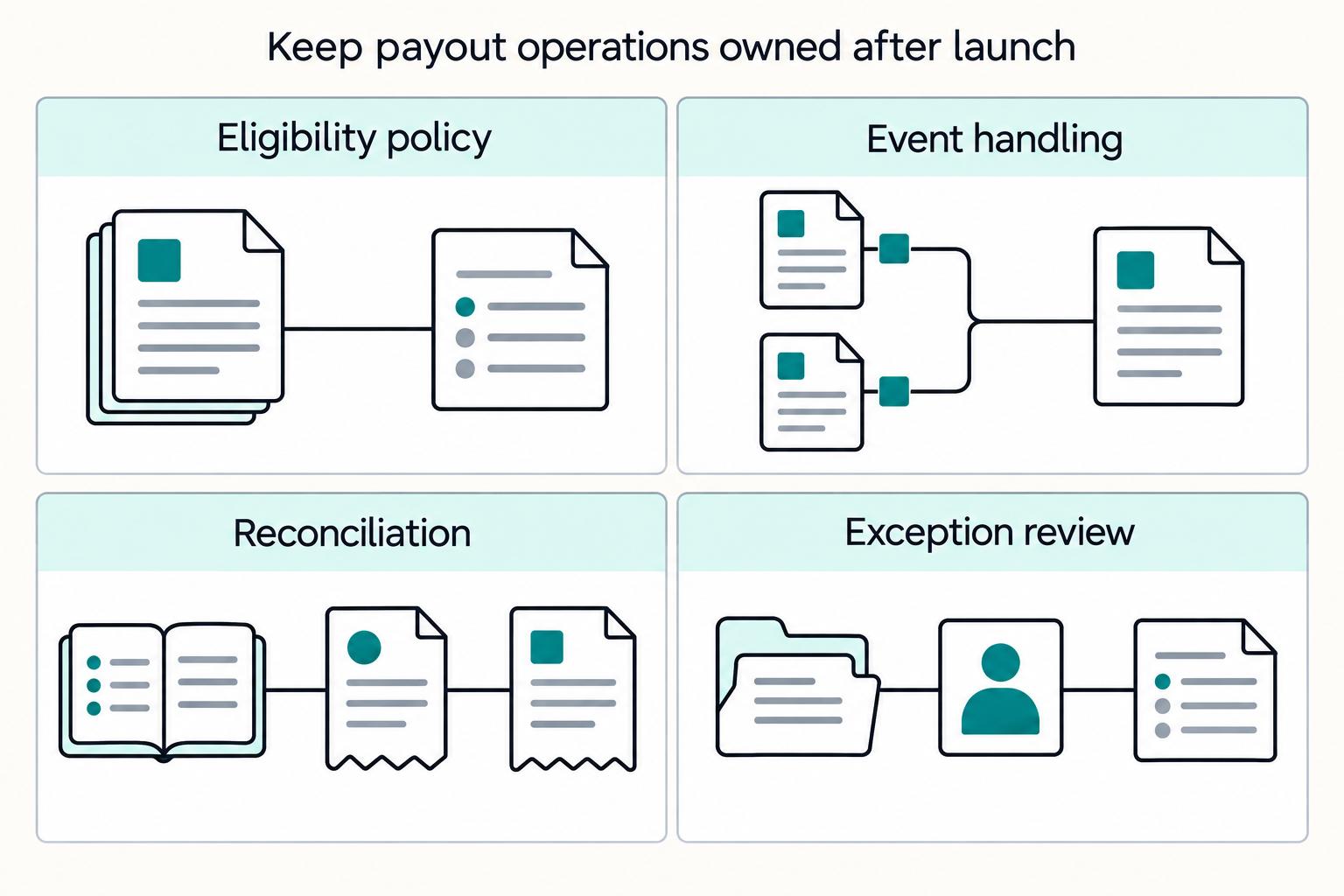
After launch, treat ownership as an operating requirement. Instant-payment rails are designed to be always on and irrevocable, so teams need named owners, active exception handling, and a regular review cycle.
| Team | Primary ownership | Key operational focus |
|---|---|---|
| Product | Payout eligibility | Who gets instant payout, when it is offered, and which cases require manual approval |
| Engineering | Rail routing and webhooks | Map provider events to internal payout state; use duplicate-safe processing and idempotency |
| Finance | Reconciliation and exception governance | Prioritize unresolved exceptions, retry or timeout cases, and payout states that cannot be traced to a ledger posting |
1. Product owns payout eligibility#
Product should own eligibility rules for who gets instant payout, when it is offered, and which cases require manual approval. Keep the focus on pre-send control, because loose rules can create errors you cannot reverse after funds are sent.
Review rule changes against real exceptions on a regular cadence. If a change drives more manual releases or failed sends, tighten it or roll it back quickly.
2. Engineering owns rail routing and webhooks#
Engineering should own rail routing and webhook handling that maps provider events to internal payout state. Instant-payment workflows confirm quickly, but webhook delivery is asynchronous and can be retried for up to three days, so duplicate-safe processing and idempotency are required.
Design for this failure mode: one money movement, duplicate event processing. Monitor delivery states (Delivered, Pending, Failed), and when an event is already processed, return success so retries stop.
3. Finance owns reconciliation and exception governance#
Finance should own ongoing reconciliation and exception governance, not only month-end reporting. Prioritize unresolved exceptions, retry or timeout cases, and any payout state that cannot be traced to a ledger posting.
Work exception queues continuously, then run a monthly review pack with exception trends, instant-payment adoption, and overall operating impact.
Pick timing models that match risk and economics not just worker demand#
Instant payout is a targeted tool, not a universal default. "Faster payments" includes both true instant payments and speed improvements like Same Day ACH. Many platforms will need a mix of timing models instead of an all-in switch.
- Start with one high-urgency segment, not every payout type.
Pick a single use case where faster access is operationally important, and prove it with one rail path and clear eligibility checks before send. Keep rollout order tied to actual use cases, then expand over time.
Coverage checks should be endpoint-level, not marketing-level. The RTP Network reports reach to 71% of U.S. demand deposit accounts, and FedNow reported over 1,500 participants, but that still does not guarantee every receiver endpoint is ready. Validate sender readiness, receiver readiness, and account or program eligibility before promising instant funds.
- Scale only when one rail set and one control model are stable.
Run the first rollout narrow: one use case, one instant rail choice, or fixed rail set, and one approval policy. FedNow is designed for 24x7x365 processing, and RTP settlement is final and irrevocable. FedNow materials also describe instant payments as final and irrevocable. That means pre-send controls and reconciliation should gate expansion.
Keep ACH as a deliberate default where batched, recurring payouts fit the economics and control model, with instant lanes for approved cases. ACH remains a core rail for batched recurring payments, and Same Day ACH's expanded processing window has been in effect since March 19, 2021. If retry handling or reconciliation exceptions are still routine, hold scope.
- Map each payout segment to timing, corridor, and compliance fit.
Group payouts by urgency, geography, payout size, and delay tolerance, then assign one timing pattern per segment. Example: one segment may stay on scheduled ACH with an exception lane, while another may prioritize instant rails where corridor and rail readiness support it, for example Pix availability in Brazil.
Apply the same segment logic to policy gates. U.S. AML expectations include risk-based ongoing customer due diligence, and sanctions controls should be risk-based across products, customers, transactions, and geographies. For cross-border or conversion-heavy segments, keep ETA promises and approval rules conservative.
Next step: build a segment map and launch only where four checks are already true: timing pattern selected, rail coverage validated, settlement behavior understood, and policy gates defined.
For the broader operating model, see Mass Payouts for Gig Platforms That Teams Can Actually Operate.
When you are ready to pilot one segment and one exception lane, evaluate Gruv Payouts for policy-gated routing, batch support, and operational visibility where enabled.
Frequently Asked Questions
Do all gig platform payouts need to be real-time?
No. FedNow operates alongside other payment services, and it is not presented as a replacement for every payout path. ACH remains a batch, store-and-forward system, so scheduled payouts are still a valid default when immediate funding is not the core requirement.
When is scheduled payout better than instant payout?
Scheduled payout can be better when cost discipline, predictable operations, and simpler reconciliation matter most. ACH is built for batch processing, and Federal Reserve ACH services are positioned as efficient, low-cost batched payments. If your team can run clear cutoff windows consistently, scheduled cycles can be easier to control than always-on instant.
What are the minimum controls required before turning on instant payouts?
Start with pre-send identity and risk checks, a clear approval path for higher-risk cases, and proof that every payout can be reconciled end to end. If your structure makes you a money services business, 31 CFR 1022.210 requires an AML program, including verifying customer identification. Operationally, keep a request ID, provider reference, ledger entry, and retry trace so duplicate events do not create duplicate money movement.
What changes operationally when payouts are irreversible?
The main control point shifts to before send. FedNow instant payments are described as final, irrevocable, and always on, and RTP credit transfers are also final and irrevocable at settlement. In practice, this means tighter eligibility rules and faster exception handling, because bad releases are usually exception cases, not reversal cases.
Can real-time payouts reduce support tickets in practice?
They can help when support volume is driven by payout uncertainty or delayed access, but instant rails alone are not a guaranteed fix. Clear status visibility, expected timing, and understandable failure states still matter. If most tickets are "where is my money," better payout tracking can matter as much as faster rails.
How should teams divide ownership between product, engineering, and finance?
There is no regulator-mandated ownership split for this. One practical model is: product owns eligibility and exception policy, engineering owns rail routing and webhook processing, and finance owns reconciliation and exception closure. Keep named owners for each queue so unresolved payout states are treated as same-day operational exceptions, not deferred reporting work.
How do cross-border routes affect instant payout availability and ETA promises?
They are corridor-dependent, not universal. FedNow is available to depository institutions in the United States, while Pix is Brazil’s instant payment scheme and supports transfers in seconds at any time. ETA promises should stay conservative because cross-border speed and transparency remain active industry gaps, and Same Day ACH excludes IAT transactions.
Try a related tool
Where Gruv fits
Researched and edited by the Gruv editorial team. Gruv builds cross-border billing, payouts, and finance-operations software for global businesses.
Sources
- csrc.nist.gov/glossary/term/role_based_access_controltrusted
- ecfr.gov/current/title-31/subtitle-B/chapter-X/part-1...trusted
- ecfr.gov/current/title-31/subtitle-B/chapter-X/part-1...trusted
- federalreserve.gov/paymentsystems/fednow_about.htmtrusted
- federalreserve.gov/paymentsystems/files/interest_on_rtp_joint_b...trusted
- finance.ky.gov/eProcurement/PassportResponse/SKY%20Technica...trusted
- govinfo.gov/content/pkg/CRPT-116srpt236/html/CRPT-116srp...trusted
- irs.gov/forms-pubs/about-form-w-9trusted
Educational content only. Not legal, tax, or financial advice.
Related Posts

FedNow vs RTP for Gig Platform Contractor Payouts
You are not choosing a payments theory memo. You are choosing the institution-backed rail path your bank and provider can actually run for contractor payouts now: FedNow, RTP, or one first and the other after validation.
How Platforms Are Using AI to Automate Payment Operations: Use Cases and ROI
Start narrower than your ambition. In payment operations, early ROI often comes from improving one high-volume process with a measurable baseline, not from trying to automate everything at once.

Real-Time Payout Tracking for Platforms That Reduces Support Load
Faster rails do not fix unclear payout state. Payout tracking matters when each payout can be followed from authorization through reconciliation, not when disbursement is merely faster.