
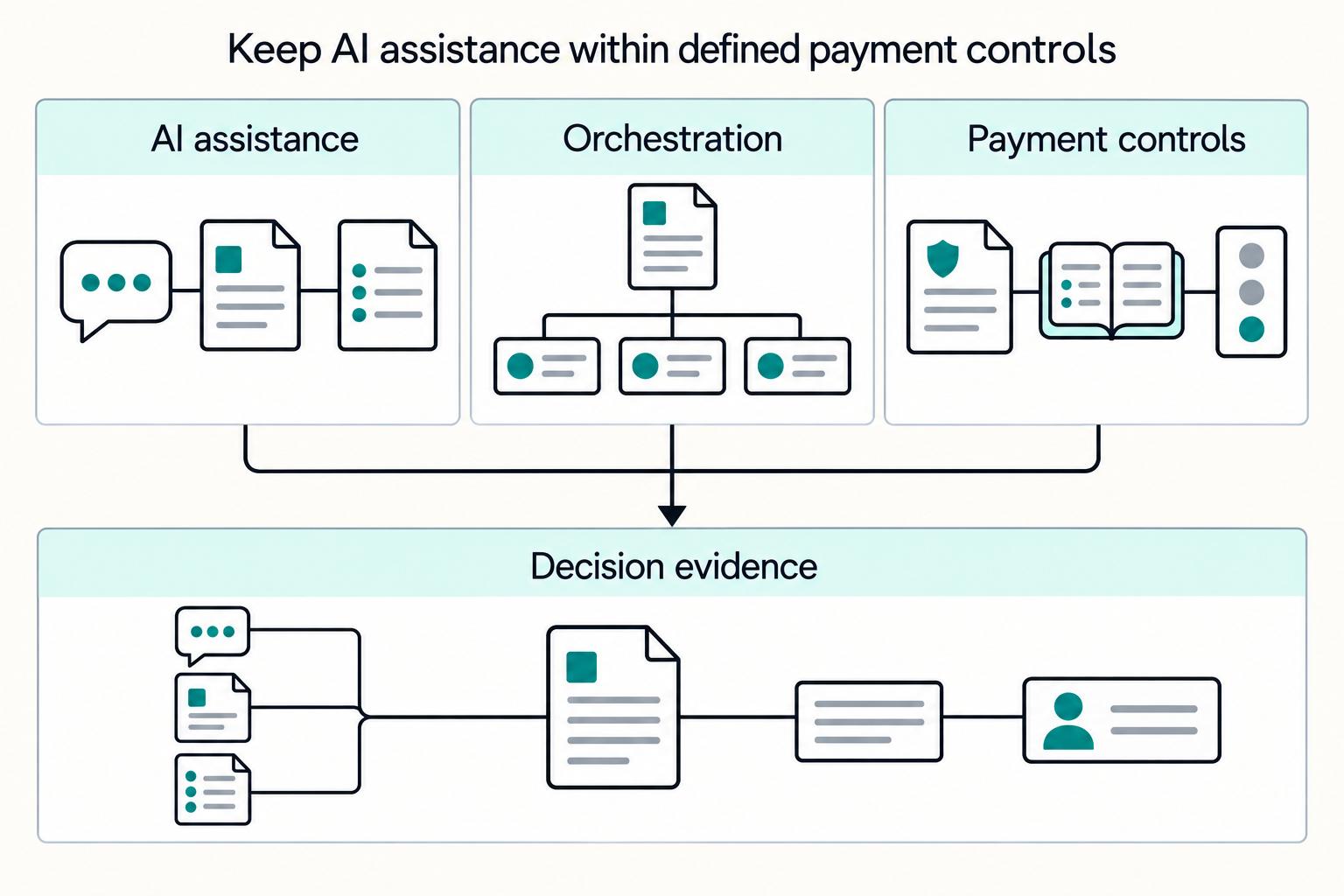
Quick Answer
Start with one measurable AP, AR or reconciliation workflow. Baseline handling time, exception cost and cycle time, then test AI against comparable cases. Count setup, software and review costs in payback, and keep payment execution behind established approval and duplicate controls.
Where AI Fits in Payment Operations#
Start narrower than your ambition. In payment operations, early ROI often comes from improving one high-volume process with a measurable baseline, not from trying to automate everything at once.
Focus on one visible failure point#
Pick one operating lane where gaps are already visible. Choose a process that is expensive, repetitive, and easy to measure. Practical first lanes can be Accounts Payable (AP), including invoice processing, or Accounts Receivable (AR) and collections. They combine manual work, large data volume, and outcomes you can track.
A technically impressive feature can still miss financially if it does not move a business KPI. If you cannot tie the use case to a concrete result, treat that as a red flag.
Capture a baseline before demos#
Baseline the current process before you evaluate tools. Fast-payback use cases often share three traits: high workflow volume, a measurable baseline KPI, and clear integration into existing operations.
Capture, at minimum:
- labor cost
- error rate
- end-to-end time consumed
- the business outcome tied to the process
If Finance and Ops cannot align on baseline numbers, pause tool evaluation until they can.
Pilot one narrow workflow#
Run a narrow pilot built for a quick, measurable win. The first project should improve one painful motion in AP or AR. It should prove measurable impact and fit normal operations without adding unnecessary process overhead.
AP can be the practical starting point when invoice handling and approvals are the bottleneck. AR can be better when collections throughput is the immediate constraint. In both cases, choose the lane where change will be easiest to measure.
Keep audit evidence in scope#
Keep control evidence in scope from day one. Speed is not a win if your team cannot explain what happened. Your pilot should preserve complete audit trails across actions and data touches, especially in regulated workflows.
Set the scope before you evaluate tools#
Set scope before demos. Define each payment domain and lock one system of record for each flow before you evaluate tool claims.
Separate the domains#
Split payment operations into explicit domains, not one "finance automation" bucket. Use separate lanes for Invoice Processing, Reconciliation, and Compliance Reporting.
For each lane, confirm three boundaries: one triggering event, one expected output, and one exception queue. If a vendor says it covers AP, AR, and reconciliation but those boundaries are unclear, fix the scoping problem first.
Define accountability and one system of record#
Assign clear accountability per domain and one system of record per flow. Keep accountability explicit for the live process.
Keep the data foundation anchored in the ledger or ERP layer as the source of truth. Also verify that audit trail logging is clear for each flow. Systems of record store and structure financial data, but they are not decision engines by default. Without explicit decision workflows, manual bottlenecks usually stay in place.
Separate generation from execution#
Treat answer generation and action execution as different jobs. An LLM generates answers. An AI Agent executes workflows across connected systems.
If you use labels like Decision Intelligence or Orchestration Agents, keep them as internal categories tied to a specific job and approval boundary in plain English. This matters for ROI discipline. In a March 2025 BCG survey of over 280 finance executives, median reported ROI was 10%, and one-third reported limited or no gains.
Related: Gateway Routing for Platforms: How to Use Multiple Payment Gateways to Maximize Approval Rates.
Prepare the evidence pack before market selection#
Build the evidence pack before you pick a market or shortlist vendors, so you compare options against real AP, AR, and close constraints instead of assumptions.
Build a current-state baseline#
For AP, track invoice-to-pay time, cost per invoice, and days payable outstanding (DPO) where useful. For AR, track cash-application time, collections effort, and days sales outstanding (DSO). For financial reporting, track days to close and its main delay drivers.
| Lane | What to track |
|---|---|
| Accounts Payable (AP) | invoice-to-pay; cost-per-invoice |
| Accounts Receivable (AR) | cash-application and collections timing; DSO where relevant |
| Financial Reporting | days-to-close; main delay drivers |
Use the same source systems and the same time window you will use for pilot measurement. If metrics come from mixed systems and ad hoc exports, treat the baseline as incomplete.
Map compliance as release decisions#
Capture compliance requirements as release decisions, not appendix notes. For each target market, map required compliance checks to an owner, a source, and a decision point in the finance flow.
If you cannot say where a requirement is enforced, such as onboarding or exception handling, leave it marked unresolved. Implementation risk often hides behind vague assumptions that "the provider handles compliance."
List end-to-end integrations#
List integrations that must execute end to end across your stack. At minimum, include ERP, banking, and CRM dependencies for each flow. For each flow, document the trigger event, status destination, and final reconciliation location.
Pressure-test with real exceptions, not only happy paths. If IDs, amounts, or statuses fail to align across ERP, banking, and CRM systems, expected reconciliation and reporting gains are probably overstated.
Set non-negotiable controls#
Set non-negotiable controls before market selection. Require audit-ready controls with immutable logs tied to approvals and thresholds. Ensure each key decision is traceable from request through final outcome.
Define how exceptions are handled and what evidence is retained when manual intervention occurs. A practical check is whether you can reconstruct a transaction path end to end without relying on ad hoc exports.
For a step-by-step walkthrough, see Account Reconciliation for Payment Platforms: How to Automate the Match Between Payouts and GL Entries.
Choose expansion lanes by market friction and operational fit#
Choose lanes with the lowest operational uncertainty, not just the biggest demand story. If two options look similar commercially, prioritize the one you can execute with cleaner payouts, reconciliation, and support handling.
Market choice can change both costs and controls. Compare the actual payment path, support burden, and reconciliation effort for each candidate rather than using broad industry fraud or adoption figures as a forecast.
Use one lane-selection table#
Use the table to compare five operational criteria for each candidate market or workflow. Record the requirement, verification point and red flag for each.
| Column | What to record | Verification point | Red flag |
|---|---|---|---|
| Compliance burden | Required compliance checks and where they trigger | You can name owner, source, and decision point for each check | "Provider handles it" with no clear hold or release logic |
| Payout rail readiness | Confirmed payout method, status events, and fallback handling | You have sample status payloads and a known reconciliation destination | Coverage exists on paper, but statuses are late, partial, or inconsistent |
| Reconciliation complexity | Match path from request to settlement records | You can reconstruct a real transaction end to end | Unclear status states or unmatched outcomes |
| Tax document burden | Required tax-document steps in your flow | You know when documents are collected, stored, masked, and validated | Collection is deferred until after onboarding or release |
| Support load | Expected exception and payout support touchpoints | You can map queue ownership and required evidence per issue | Support depends on ad hoc finance or engineering reconstruction |
Break ties with execution quality#
When upside is close, use execution quality as the tie-breaker. Pick the lane with cleaner exception handling and a shorter, auditable reconciliation path.
That is the practical choice when ROI is uncertain, because immature setups often shift cost into exception handling and support instead of removing work.
Set the no-go rule before launch#
Set an internal launch threshold before rollout. If you cannot produce a reliable audit trail from request through settlement records, treat the lane as high risk and delay launch.
A simple checkpoint is to trace ten recent or simulated transactions per candidate lane using only intended tooling and logs. If teams need spreadsheets, inbox threads, or tribal knowledge to finish the trace, score that lane down.
Mark conditional coverage explicitly#
Mark conditional coverage explicitly, and do not score assumptions as availability. For capabilities like Virtual Accounts and Stablecoin Rails, label status as conditional unless you have program-level confirmation.
Related reading: Why CFOs Modernize Financial Operations in Payment Platforms.
Choose the first automation use case by failure cost#
Start with the use case where manual failure already costs you the most, not the one with the best demo. Then confirm that the data and control path are strong enough for production.
Score failure cost and readiness#
Score each candidate on two axes: failure cost and readiness. Failure cost shows where pain is real. Readiness shows whether automation will reduce work instead of creating new exceptions.
| Use case | Start first when this is the most expensive pain | Readiness checkpoint | Business outcome | Risk outcome |
|---|---|---|---|---|
| Invoice Processing (AP) | High invoice volume, backlog, missed approvals, or manual entry errors | Source documents are consistent and can be tied to approvals and financial records | Shorter invoice cycle time | Fewer manual entry mistakes before approval |
| Collections and Dispute Triage (AR) | Delayed collections or dispute queues are the biggest operational drag | Payment status, dispute signals, and ownership are visible in one workflow | Faster follow-up and resolution | Fewer missed disputes or stale cases |
| Other high-volume, document-heavy workflow | The queue is large and manual handling is the highest-cost pain | Inputs and handoffs are clear enough to automate with controlled exceptions | Lower handling time | Fewer repeat processing errors |
Start with AR or AP based on the pain#
Choose Accounts Receivable (AR) first when delayed collections are your clearest financial problem. Keep scope narrow at first.
Choose Accounts Payable (AP) first when invoice backlog, missed approvals, and manual entry errors are the dominant pain. In that case, Invoice Processing is often a better first target than broad finance automation, especially in document-heavy workflows.
Reject demo-first use cases with weak data#
Reject demo-friendly use cases when operational data is fragmented across systems. Disconnected tools, manual stitching, and governance gaps are common reasons automation underperforms in production.
Before you commit to the first launch candidate, verify three controls:
- Source events arrive consistently enough to support action, not just reporting.
- Exceptions can be handed to a human reviewer with enough context to approve, reject, or correct.
- Final financial records remain traceable to original events.
For high-stakes or low-confidence decisions, keep a human approval step.
Define outcomes before tool selection#
Define one business outcome and one risk outcome before tool selection. "Efficiency" alone is too vague. Then pressure-test vendor claims against your exact scope:
- Ask for average payback period for businesses your size, with specific ranges such as
2 months,6 months, or12 months. - Ask for three comparable customers in your industry with a similar use case.
- Prefer a trial long enough to test real workloads (
14+ days) instead of sample-only demos.
Choose the first use case because failure already costs enough to matter, readiness is verifiable, and outcomes can be measured.
If you want a deeper dive, read Real-Time Payment Use Cases for Gig Platforms: When Instant Actually Matters.
Keep applicable controls in the payment path#
An AI recommendation should pass through the same applicable authorization, verification, and payment controls as a manual action. Define which check can block each action and who resolves the exception.
| Decision | Evidence to retain | Responsible function |
|---|---|---|
| Approve an invoice | Source invoice, matched payee and approval | AP owner |
| Release a payment | Applicable control results and authorized instruction | Payments operations |
| Resolve an exception | Reason, supporting evidence and disposition | Named control owner |
Record three items in one place: the payee record, the payout request, and the evidence used for the release decision. If those artifacts are split across tickets or inbox threads, blocked or released outcomes become hard to explain.
Make gate status explicit before release#
For programs that use KYC, KYB, or AML controls, define the gate status before release as an internal control and keep it explicit: cleared, pending, or blocked. The goal is operational clarity. A payout decision should be traceable from the system record, not reconstructed from side channels.
Collect only the tax documents required for the payment and your role. Document who checks them and which withholding or reporting treatment follows. A payee’s personal tax-return election or foreign-account filing is a separate responsibility, rather than a general payout-release condition.
For an invoice-processing pilot, AI might extract a payee name and invoice amount. It should not decide that the payee is tax-exempt or that a payment is authorized. Route uncertain identity or payment data to the existing reviewer before creating the payment instruction.
Record an exception reason and next action when a required control fails. Distinguish a temporary review hold from a legally prohibited payment; a model confidence score cannot override either the approval policy or the applicable legal restriction.
A retry must preserve the payment’s identity and check its current status. If the first attempt has an unknown outcome, resolve that uncertainty before sending a new payment instruction.
Assign each exception to the person authorized to resolve it. Retain the request, control result, supporting evidence, approval and final payment outcome in one linked record.
Need the full breakdown? Read What Is RegTech? How Compliance Technology Helps Payment Platforms Automate Regulatory Reporting.
Design the system boundary before adding AI behavior#
Set the boundary first: use adaptive AI for ambiguous work, and keep structured payment operations in predictable systems. That split helps keep decisions easier to explain and govern as you scale.
Keep journal logic structured#
Keep Ledger Journals authoritative by treating journal-impacting work as structured, rule-driven automation. AI can still help with recommendation, classification, and evidence assembly, while posting logic stays in mapped steps with explicit validations.
Use auditability as the check. Finance should be able to review a journal-affecting action and see the inputs, policy applied, and rationale in system records, not only in chat history.
Separate orchestration from conversation#
A common boundary is to separate Orchestration Agents and Conversational Agents before assigning authority. Let orchestration coordinate multi-step tool workflows, and keep conversational agents focused on operator support such as retrieval, summarization, and draft action prep. This can keep chat from becoming an implicit control plane and preserve your existing release and approval paths.
Define idempotency in your own architecture#
API retries and webhook replays need different duplicate controls. Retain a durable payment identity, use the provider’s idempotency contract for repeated requests, and deduplicate events before posting. Stripe’s webhook guidance covers duplicate and out-of-order deliveries. Validate both paths against the final payment state.
Constrain multi-agent setups#
Constrain Multi-Agent Systems with explicit handoffs and clear guardrails, adding approval points where financial risk warrants them. Agentic AI can coordinate multistep work across systems, but larger setups add cost, complexity, and governance burden.
Start small, then expand only when the scope justifies it. Keep the evidence trail strong by logging validations, exceptions, and approvals with inputs, policy, and rationale, and keep reconciliation to the chart of accounts straightforward.
Define ROI with confidence bands not vanity claims#
Treat ROI as unproven until you can link automation outcomes to labor saved, money protected, or control risk reduced. Track results in three buckets, and report early outcomes as ranges with explicit unknowns.
Track throughput, quality, and control strength#
Track three ROI buckets from day one: throughput, quality, and control strength. Throughput is cycle-time reduction. Quality is error-rate or exception-rate improvement. Control strength is whether Financial Reporting still has a complete, reviewable audit trail after automation touches the workflow.
Use these as one scorecard, not three separate stories. Vanity metrics can look impressive while still lacking a defensible link to budget decisions. A practical checkpoint is live dashboard monitoring so teams can see cycle time, exceptions, and audit completeness during the pilot and intervene early.
Convert metrics into money outcomes#
Convert operating metrics into money outcomes. Faster handling is not enough on its own. Show what changed in effort, exposure, or rework.
Worked example: suppose a pilot handles 10,000 invoices a month and reduces handling from 6 minutes to 4, including exception review. That releases about 333 staff hours. At an assumed loaded cost of $30 an hour, the monthly capacity value is about $10,000. With $4,000 in monthly software and support costs, net recurring capacity value is about $6,000. If the full $10,000 is realized as lower spending or additional contribution, a $24,000 setup cost would take about four months to recover. Without that realization, this is a capacity case rather than cash payback. These are illustrative assumptions; report redeployed capacity and actual cash savings separately.
Publish confidence bands#
Publish confidence bands, not single-point promises. Early payment operations results can be noisy, so report ranges with named assumptions instead of fixed ROI claims.
State uncertainty plainly, including implementation cost, integration effort, and failure-recovery load. That is more credible than declaring full payback before the operating model is stable. Also avoid manual ROI tracking where possible, since it adds delay, error risk, admin burden, and weak visibility.
Use matched baselines#
Use matched pre- and post-pilot baselines. Compare the same market, use case, and operational scope to avoid false comparisons.
Before launch, lock baseline definitions, measurement windows, and owners. Then review the same cuts at 30/60/90-day checkpoints. This helps reduce distortion from fragmented data and makes the ROI case easier to defend when budget owners ask what changed, what it is worth, and what remains uncertain.
You might also find this useful: Tail-End Spend Management: How Platforms Can Automate Long-Tail Contractor Payments.
Plan the 90-day pilot with explicit go and no-go rules#
A 90-day window can be a useful planning option for a KPI-led pilot. Choose a duration that covers representative workloads and review cycles. Keep scope narrow and conditions comparable, then make scale decisions from measured results and control checks.
Lock scope and scoring#
Lock scope and scoring before launch. Choose the pilot duration and review points, then define success metrics for outcomes, integrations, governance and total cost. Record scope changes separately so the comparison remains meaningful.
Test on live data under fixed conditions#
Run an apples-to-apples test on live data. Use the same inputs and scoring logic throughout the pilot so results stay comparable. Focus on whether outcomes improve under real operating conditions, and watch for failure patterns that a feature matrix can hide: fragmented data, brittle workflows, brand safety lapses, and hidden costs.
Apply go or no-go rules#
Apply clear go or no-go rules before scaling. Go only if the live-data scorecard meets the pre-agreed success metrics and still holds under comparable conditions. No-go if the team starts evaluating features over outcomes, integrations, and governance, or if scope drift breaks the apples-to-apples comparison.
Need a concrete implementation checklist for pilot gates and status handling? Use the Gruv docs to map each checkpoint to real API events.
Avoid common rollout mistakes and recover quickly#
If a pilot misses a checkpoint, do not hide it by widening scope. Recovery usually comes from tighter phase discipline, clearer retry boundaries, and cleaner measurement.
Keep phase gates intact#
Use readiness gates rather than a fixed implementation calendar: complete integrations, test recommendations on historical cases, compare the pilot with the baseline, then authorize narrowly supervised live actions. Each gate needs a result and an owner before progression.
A failed gate should narrow the next step. Missing identifiers call for integration repair; high exception rates call for input or classification changes. A shorter cycle time does not justify skipping approval or reconciliation controls.
Separate retryable failures from customer-action failures#
Separate retryable failures from customer-action failures. Another common mistake is applying one retry rule to every decline. Soft declines, for example insufficient funds, can be retried automatically, while hard declines, for example stolen card, need customer intervention.
A fixed 24-hour retry loop is often too blunt for global operations. Recovery is to tune retry timing to time zones, issuer behavior, and regional banking differences, and validate that policy before broader rollout.
Reset ROI measurement when conditions change#
If inputs or operating conditions change mid-pilot, record the change and separate the measurement periods. Include setup costs and ongoing support in the ROI calculation rather than selecting only a favorable go-live window.
Keep reporting split by rollout phase so setup and go-live results are not mixed. Treat benchmark outcomes as directional, not guaranteed, before calling the rollout repeatable.
Scale from one lane to a portfolio#
A practical way to scale is to prove repeatable value in one workflow, then expand only where the same controls and measurement still hold. The goal is not to add lanes quickly. It is to avoid adding complexity faster than ROI.
Stabilize one lane first#
Stabilize one lane with measurable finance outcomes before expanding. Keep KPI ownership explicit and tie outcomes to finance measures you can defend, not a generic productivity narrative. Use baseline-matched measurement with 30/60/90-day deltas, and check whether escalations, logs, and manual touch points are actually decreasing.
Add only adjacent lanes with reusable controls#
Add another lane only when control reuse is clear. A practical next lane shares similar ownership, exception handling, and governance needs. That lets you reuse escalation logic and operating controls instead of rebuilding from scratch. If expansion requires a new integration pattern, separate security or governance handling, and new manual reconciliation, treat it as a new pilot with its own total cost of ownership.
De-scope optional capabilities that do not pay off#
Gate optional capabilities and de-scope what does not pay off. If you introduce additional capabilities, apply the same ROI and governance discipline rather than layering them onto an unstable base. Keep a regular de-scope review cadence, and remove or pause automations that increase onboarding overhead, manual work, or governance risk without measurable ROI.
Conclusion and operator checklist#
Choose one process where the baseline and exception cost are visible. Keep the financial action inside its existing approval boundary, then use the pilot to test whether AI removes work without moving cleanup into reconciliation.
Teams that get this right usually do two things at once: reduce manual work in one high-friction process and make exceptions easier to explain and recover. If intake gets faster but reconciliation or compliance cleanup stays manual, backlog risk usually just moves downstream.
Choose one market lane#
Pick one market lane first, then document its constraints before evaluating features.
Keep this as a short decision note: one target market, one payment path, and the constraints that can slow or block release. The test is whether Ops, Finance, and Engineering describe the same lane without caveats. Treat compliance review as core work, since manual risk and compliance handling can become slower, more expensive, and backlog-prone as volume grows.
Choose the first use case#
Choose one first use case based on failure cost and data readiness.
If bottlenecks are approvals and document handling, start there. If the bigger issue is delayed collection and disputes, start there. Avoid demo-first choices when records are fragmented or ownership is unclear.
Define the audit trace#
Define the audit trace and evidence required before you claim expansion readiness.
Be explicit about which records prove what happened across success and failure paths. The practical test is simple: can a reviewer reconstruct one transaction end to end without offline screenshots or ad hoc exports? If a vendor or internal tool touches sensitive review steps, gather evidence early, for example control artifacts like SOC reports.
Set pilot go or no-go rules#
Run a pilot with clear go or no-go rules tied to ROI and control integrity.
Continue only when the measured benefit covers the ongoing cost and the control results remain sound. Report fewer manual touches and shorter cycle time alongside exception-review effort, unmatched payments and the assumptions behind payback.
Expand only after stability#
Expand only after the first lane is consistently stable.
If the lane still depends on heroics, tribal knowledge, or recurring manual cleanup, do not widen scope yet. Agents can coordinate across systems and handle exceptions, but weak boundaries increase risk. Ask one final question: if volume doubles next quarter, will this lane still be explainable end to end?
Before committing your next expansion lane, validate market coverage, payout batch constraints, and compliance assumptions in a focused implementation scoping call.
Frequently Asked Questions
What payment operations are most commonly automated first with AI?
Accounts Payable (AP) and Invoice Processing are often treated as early starting points because AP workflows are usually repetitive and well defined. Beyond AP, first targets vary by platform and market, but high-volume conversational workflows can also be practical early lanes when escalation rules are clear. If records and ownership are fragmented across tools, fix that first so automation does not just speed up intake while leaving manual cleanup in place.
What ROI should operators expect in early phases?
Expect directional improvement before a clean headline ROI number. Early proof can be handling more volume without matching headcount growth, along with better visibility into what happened and why. Confidence increases when you compare baseline and pilot results in the same lane and tie performance to explicit KPIs with ongoing optimization.
How do we start without overcommitting budget and engineering time?
Start narrow with one clearly scoped use case and explicit ownership. Use success checks tied to finance outcomes and control quality, and verify that you can produce complete records of actions and decisions. This helps you avoid underfunding foundational integration and data capabilities while AI spending increases.
Do we have reliable cross-platform ROI benchmarks for this topic?
No. Available evidence is often vendor-specific or broad AI adoption data, and it is not normalized across markets, operating models, and implementation contexts. High overall AI adoption does not provide a dependable benchmark for your specific payment operations lane.
What is still unknown before committing expansion resources?
Before expansion, resolve your own open assumptions: integration effort, exception-review time, adoption, ongoing cost, and the controls needed in the next workflow. Treat a materially different payment path as a new pilot.
Which technical capability matters most for trustworthy automation?
Prioritize the controls needed for the action you are automating: authorization before a payment, duplicate prevention during retries, and traceability through reconciliation. Keep financial actions supervised until those controls work on both success and failure paths.
Should we use AI agents directly for payment actions or keep them advisory at first?
Keep them advisory or tightly supervised first while controls are still being proven. Agentic systems can take action across APIs and internal software, so weak boundaries may amplify risk instead of reducing work. Expand autonomy only after you can consistently trace what happened, why it happened, and how each result was recorded.
Researched and edited by the Gruv editorial team. Gruv builds cross-border billing, payouts, and finance-operations software for global businesses.
Sources
Includes 1 external source outside the trusted-domain allowlist.
Educational content only. Not legal, tax, or financial advice.
Related Posts

The Freelance Payment Penalty: A Modeled Audit of Platform Fees, FX Spreads, and Payout Delays
The money rarely disappears through a single, easy-to-spot fee. The real loss is stacked. A marketplace takes its commission, a processor adds a charge for international cards, a bank or payment company converts the currency at a spread, a platform holds the funds before release, and a wire sheds a little to intermediaries on the way in. Each layer looks defensible on its own, but the worker feels the combined result as a smaller deposit and a later payday.
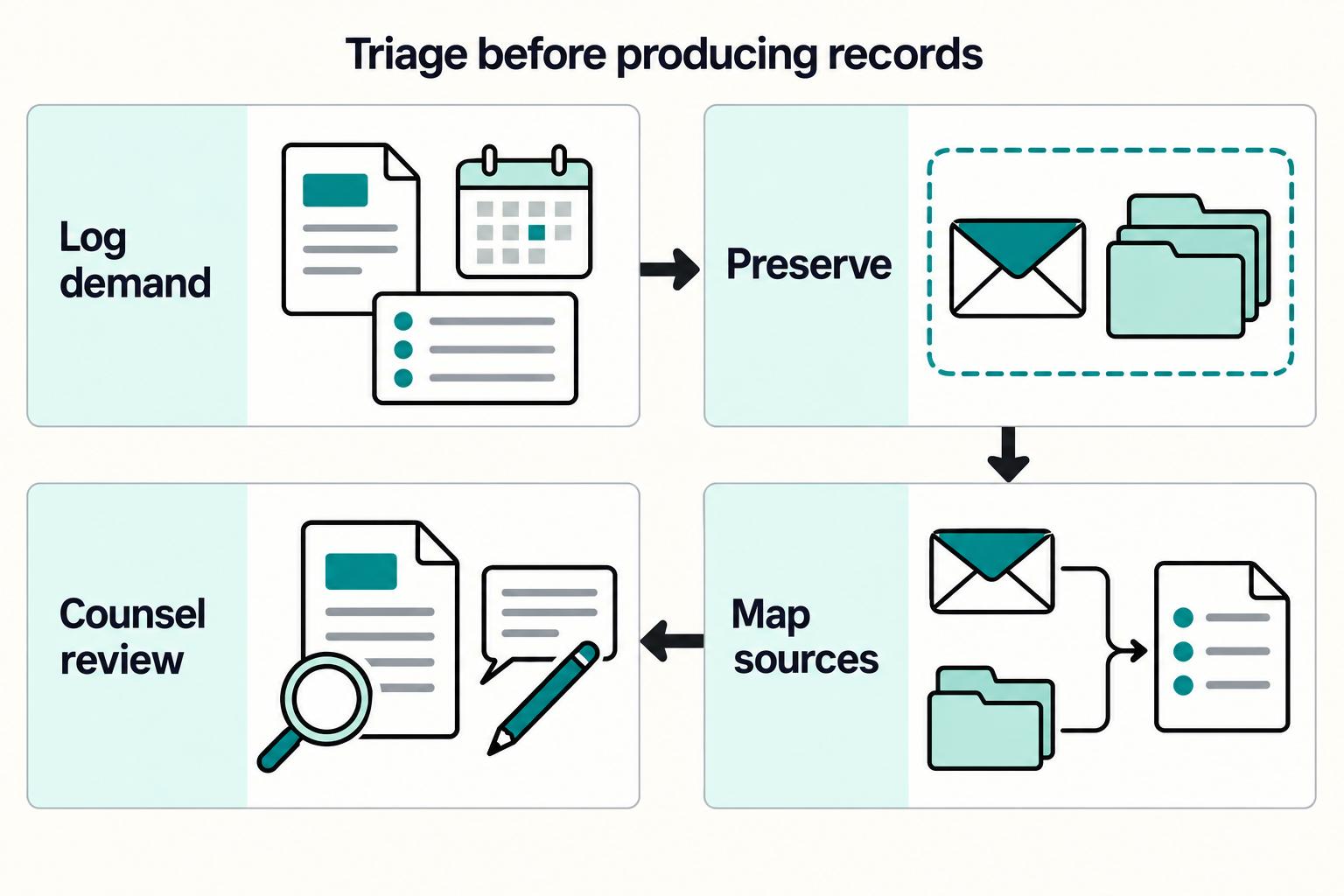
How to Respond to a Subpoena for Business Records
Move fast, but do not produce records on instinct. If you need to **respond to a subpoena for business records**, your immediate job is to control deadlines, preserve records, and make any later production defensible.
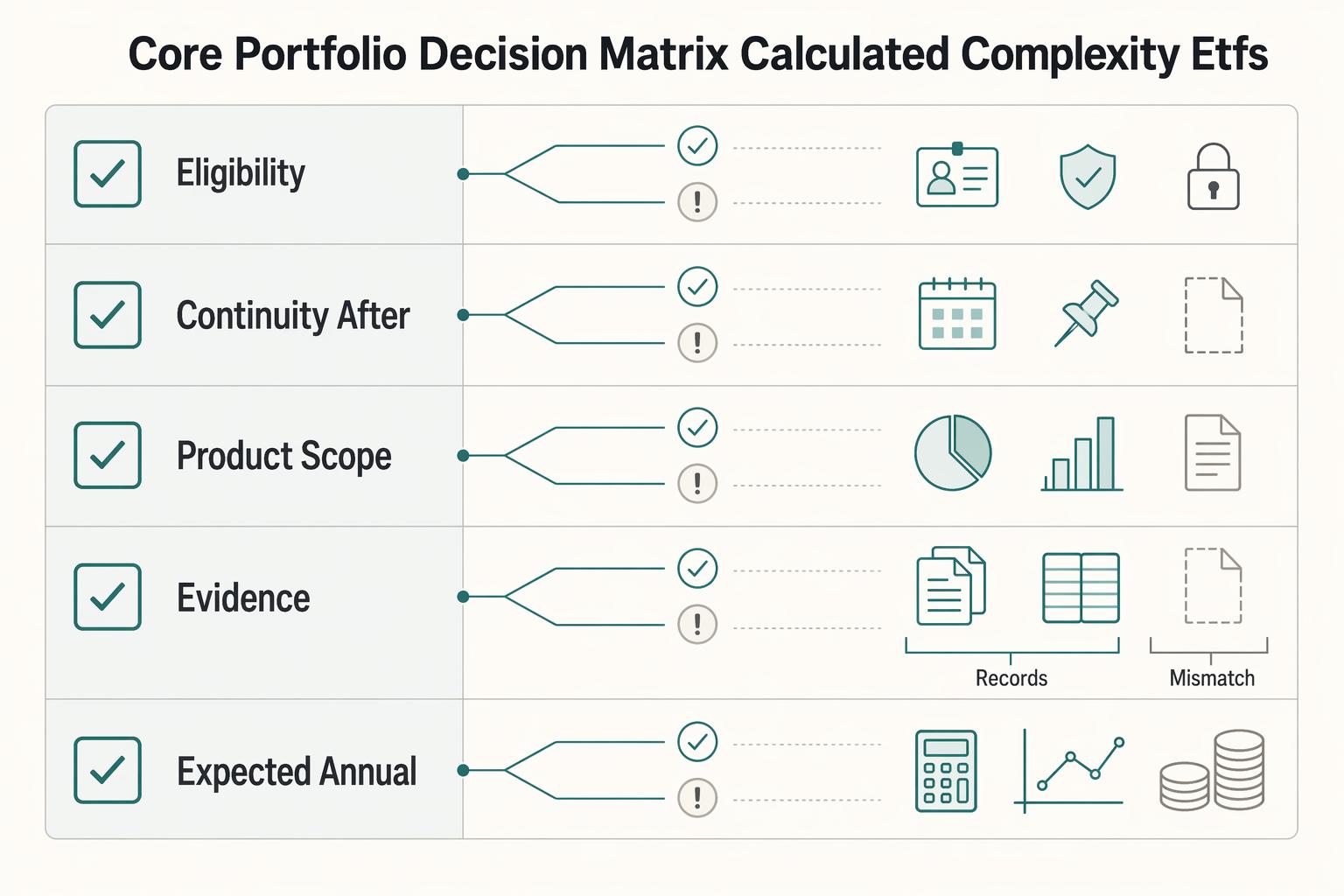
A US Expat's Guide to Investing in UCITS ETFs to Avoid PFIC Issues
The real problem is a two-system conflict. U.S. tax treatment can punish the wrong fund choice, while local product-access constraints can block the funds you want to buy in the first place. For **us expat ucits etfs**, the practical question is not "Which product is best?" It is "What can I access, report, and keep doing every year without guessing?" Use this four-part filter before any trade: