
Quick Answer
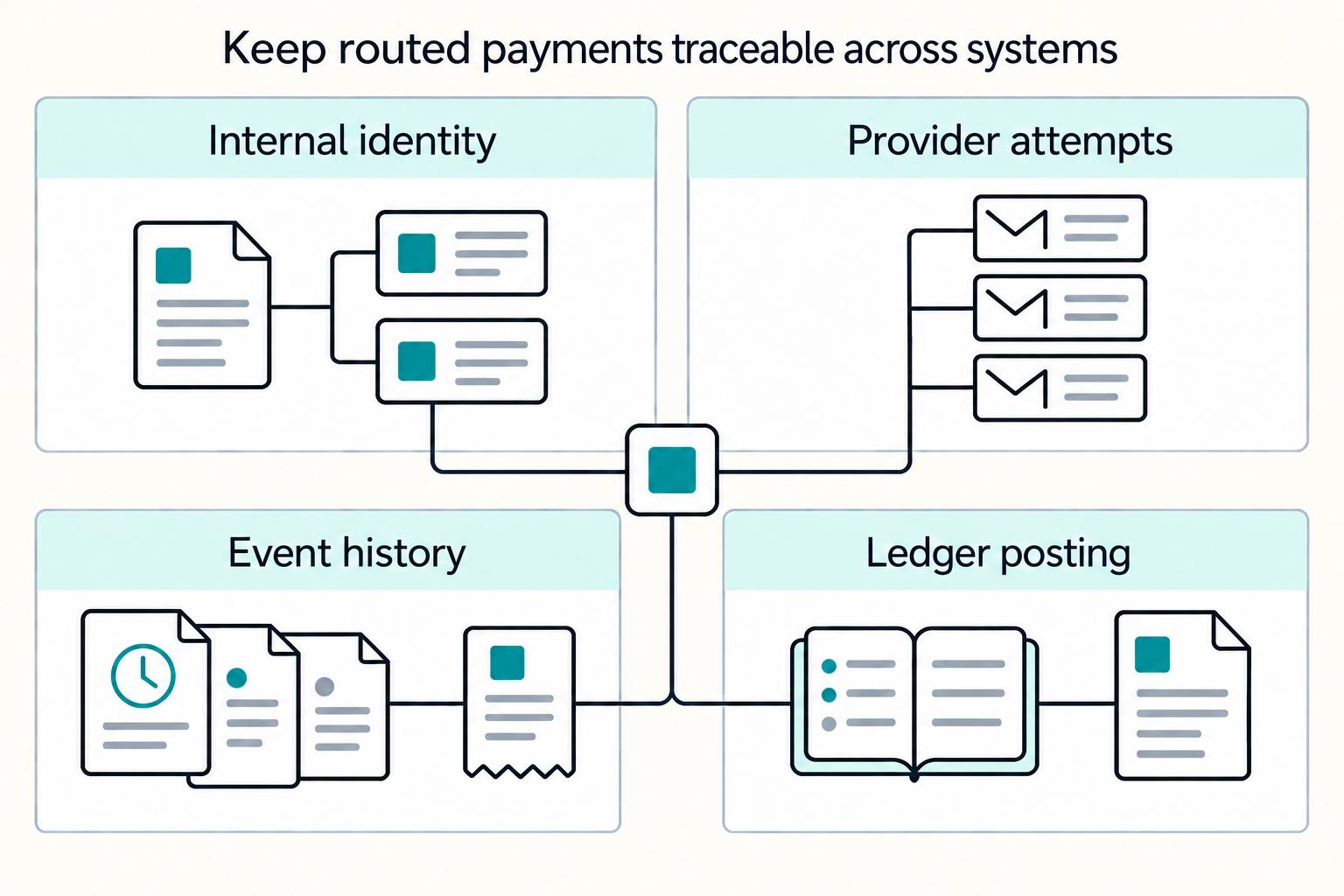
Choose a gateway from observed segment performance and test the rule against a control route. Keep cost and latency limits explicit, preserve one internal payment identity across attempts, and check an uncertain first attempt before sending the payment to another gateway. Provider idempotency keys do not deduplicate charges across gateways.
Why Platforms Route Across Multiple Payment Gateways#
Adding a second payment gateway is not the win. The win is routing each payment on purpose, then proving approvals improved without creating new latency, cost, or reconciliation problems.
A gateway carries payment requests and responses between your application and the payment infrastructure; authorization is decided through the processor and issuer. With multiple gateways, choose a path using observed approval likelihood, latency, cost and supported capabilities.
Treat routing as an operating decision, not a procurement checkbox. Stripe describes intelligent payment routing as real-time path selection based on accessibility, speed, and cost, and notes that routing decisions themselves can cause failures. That point matters because teams often assume a second provider automatically adds resilience. In practice, it adds another set of operational choices. A route can improve outcomes, but a bad route can also create new failure modes that were not there before.
The upside is real. Multiple gateways can increase flexibility, broaden reach, and improve transaction insight. The tradeoff is real too. Every added provider increases operating complexity. More providers means more webhook formats, more settlement reports, more incident paths, more payout timing differences, and more places where traceability can break if ownership is fuzzy.
Before you route anything, define ownership and traceability. Payment orchestration can centralize and automate routing across multiple gateways, but you still need clear rule ownership, rollback authority, and auditability. Someone needs to decide why a rule exists, someone needs to approve changes, and someone needs the authority to stop a route when real traffic shows harm.
Set a minimum operating standard: every routing decision should be explainable after the fact. You should be able to show where a transaction went first, what response came back, whether retry or failover occurred, and how that record maps to reconciliation. Payment reconciliation is the process of matching and verifying your records against gateway, bank, or financial institution data. If you cannot reconstruct that path, then routing has become a black box, and black boxes are expensive when approvals dip or finance cannot close cleanly.
Recurly Gateway Failover detects gateway outages and routes eligible transactions to a backup; it cannot be tested in sandbox. Its documentation also limits explicit gateway selections and auth/capture flows, with captures tied to the original authorization gateway. Confirm applicability before limited live validation.
Use provider documentation as patterns rather than production presets. Recurly supports default card-type and currency routing and explicit gateway selection, with documented precedence and failover limitations. Verify that the selected mechanism applies to your transaction before copying a rule.
Treat any expected approval gains as a hypothesis until your own traffic proves them. Stripe explicitly says optimization outcomes are estimates, not guarantees. That is the right mindset for the entire project. Routing is not a one-time setup task. It is a controlled system for deciding which provider handles which transaction, under which conditions, with which evidence, and with which rollback path. That is the frame for the rest of this guide: practical rule ownership, launch checks, outage behavior, and audit-ready reconciliation. Related reading: How to Build a Payment Sandbox for Testing Before Going Live.
What to prepare before you route live traffic#
Before you send live authorizations through new routes, lock four prerequisites first: named owners, segmented baselines, event-level traceability, and compliance gates. If any one is missing, pause the launch. Otherwise, you will not be able to prove routing improved outcomes or unwind failures cleanly.
| Prerequisite | What to lock first | Why it matters |
|---|---|---|
| Named owners | Product, payments ops, engineering, and one named rollback owner | Without clear ownership, you cannot prove routing improved outcomes or unwind failures cleanly |
| Segmented baselines | Break out performance by card type, issuing country or issuer region, currency, retry reason, approval outcome, and latency | Portfolio averages hide where the real opportunity or risk sits |
| Event-level traceability | Emit event-level webhooks, keep an immutable internal transaction ID, store the provider event ID, and retain the gateway-side reference | You should be able to prove what happened across multiple gateways |
| Compliance gates | Make KYC, KYB, or AML checks visible in routing decisions | Routing logic should not bypass a verification hold or use a path that is not enabled for that account state |
Set ownership before anyone writes rules#
Set ownership for payment orchestration before anyone writes rules. Product should own goal order and customer impact. Payments ops should own gateway behavior and incident response. Engineering should own implementation integrity, logging, and rollback execution.
That division sounds simple, but it removes one of the most common routing failure patterns: rules change, code ships, traffic moves, and no one owns the incident decision log when results get worse. Routing fails fastest when everyone assumes someone else is watching.
Make rollback authority explicit. If approvals drop or latency spikes, one named owner should be able to move a segment back to the control route immediately. Do not leave that as a team norm or an unwritten expectation. During a live issue, the practical question is not who has an opinion. It is who has authority to stop harm.
It also helps to decide how decisions will be recorded before launch. Every route change should have a reason, a segment scope, and a person accountable for the result. That does not need to be heavy, but it does need to exist. Otherwise, months later, teams end up asking why a segment was sent to a provider nobody clearly remembers choosing.
Build a baseline by segment, not by average#
Build your baseline by transaction segment, not portfolio average. At minimum, break out current gateway performance by card type, issuing country or issuer region, currency, retry reason, approval outcome, and latency.
Approval behavior varies across countries, currencies and transaction types. Portfolio averages can conceal a gain in one segment and a loss in another, so compare equivalent traffic and payment attempts before deciding a gateway performs better.
For each high-volume segment, you should be able to say which gateway currently leads on approvals, which is slower, and which soft-fail reasons appear most often. If you cannot, you are routing blind. A routing decision should come from observed behavior, not from general confidence in a provider brand.
Keep the baseline practical. You are not trying to model every possible variable on day one. You are trying to know enough about live payment behavior that your first routing rules are grounded in patterns you can already see. That usually means starting with high-volume segments where differences are large enough to matter and simple enough to observe.
Verify instrumentation before traffic moves#
Verify instrumentation before traffic moves. Each payment state change should emit event-level webhooks, keep an immutable internal transaction ID, store the provider event ID, and retain the gateway-side reference, such as a provider payment reference. Your ledger journal should map each entry back to the source subledger transaction so finance can trace the request, provider response, and posting.
This is the difference between "we think a transaction failed" and "we can prove what happened." When multiple gateways are involved, that proof matters more because two systems may report different states at different times. Your internal record has to tie them together.
Verify webhooks with each provider’s documented signing scheme. Stripe signature verification requires the original request body; Adyen Standard webhooks calculate HMAC from specified fields, while other Adyen webhook types use the body. Handle duplicate and out-of-order delivery, and record provider references before updating payment state.
That deduplication requirement is not a minor implementation detail. Delayed or repeated events are exactly how duplicate state changes, misleading timelines, and reconciliation confusion show up. If your system processes every webhook delivery like a new event, routing problems become accounting problems.
Treat compliance dependencies as launch gates#
Respect the verification and capability requirements for your account and flow. Check which processing or payout capabilities are enabled, and keep a route unavailable while its required verification is unresolved.
Determine which regulated entity has the relevant customer-due-diligence obligations in your model. Route only through accounts and capabilities enabled for the flow; moving to another provider must not bypass a required verification hold.
Compliance state must be visible to the routing layer. Keep technical availability separate from whether a particular account or payment flow is enabled.
A simple way to use this section is to ask one launch question: if a payment, payout, or account is blocked for a compliance reason, can your routing logic see that state and avoid sending it somewhere it should not go? If the answer is no, pause.
Set your routing goals and guardrails before touching code#
Once baselines and traceability are in place, decide what matters most and where the hard limits are before implementation starts. If you skip this step, teams tend to optimize for lower fees or clever failover while approvals, customer experience, or finance control quietly degrade.
Rank outcomes in the right order#
Agree an objective order and hard limits for your business. For example, put approval rate first while setting maximum acceptable latency and cost; another segment may require a different tradeoff. Write the decision down before tuning rules.
Monitor approval rate on a defined denominator, separating initial attempts from retries and unique payment requests. Compare equivalent segments against a control, then assess incremental successful payments together with latency and cost.
This ranking matters because routing debates tend to drift. One team sees fee reduction, another sees an approval drop, and a third sees a slower checkout. If you have not agreed on the order in advance, every result becomes an argument. If you have agreed, decisions get faster. A route that reduces cost but hurts authorization rate is not a win if authorization rate is first.
Lock hard stops for customer and finance impact#
Define hard stops, not loose tradeoffs: no duplicate captures, no hidden retries, and full ledger journal traceability from request through provider response and internal posting.
Use supported idempotency keys for repeated operations within each provider, and an internal payment identity and attempt lock across providers. A key sent to gateway A does not prevent gateway B from charging the same payment. Resolve an uncertain first attempt before allowing a new cross-provider attempt.
Hard stops are where routing stops being a clever optimization exercise and becomes an operating discipline. Teams can debate many things, but they should not debate duplicate captures or hidden retries after launch. Those are failure conditions, not acceptable side effects.
Define decision checkpoints before rules go live#
Set named checkpoints for changing, pausing, or reverting rules: approval drift versus control, latency spikes, and provider incident signals from webhooks. Make checkpoints segment-specific so you can adjust one path without disturbing all traffic.
Include webhook delivery health in every review, because delayed delivery can hide true payment state. Stripe can automatically resend undelivered webhook events for up to three days. The important idea is that routing should not wait for a full postmortem before it reacts. If a segment shows harm, the system should already have a known point where someone checks the data and decides whether to continue, narrow, pause, or revert.
Write stop conditions for A/B testing#
Do not run A/B testing without predefined harm guardrails. Stop conditions should be written before traffic splits and should cover both customer and finance risk, such as sustained approval decline versus control, materially slower checkout, or duplicate-operation and traceability failures.
Assign one person authority to pause the test immediately and log the reason. If stop decisions require a committee during active harm, experiments run longer than they should.
This does not mean every small fluctuation should kill a test. It means the test should have known boundaries. Without them, teams rationalize bad results because the experiment is already live. With them, you can keep the test disciplined and credible.
Before implementation, align your guardrails with concrete integration constraints so product, engineering, and finance can sign off from the same operating model in the docs.
Choose your gateway stack and orchestration model#
Choose the stack that lets you change routing rules quickly without losing transaction-to-payout evidence. In practice, that usually means optimizing for segment fit and reconciliation quality before brand familiarity.
The guardrails from the last section still apply here. Pick the model and vendors that let you test by segment, inspect failures clearly, and roll back fast.
Compare control models before you compare brands#
Start with architecture: direct multi-integration or payment orchestration. A payment gateway starts the payment process, while orchestration adds a control layer across multiple gateways, acquirers, processors, and payment methods.
If you expect frequent rule updates, orchestration deserves an early look because it can centralize routing rules, retries, provider priority, and failover behavior. Direct integration can still fit if your team wants to own each provider connection directly and is ready to operate that control layer itself.
Use three checks to make the choice concrete, then use controlled split traffic before broad rollout to compare authorization rate, latency, and provider performance under real traffic.
- Rule-change speed: how much code or config work is needed to reroute one segment?
- Observability depth: can you still access provider references, event payloads, and reconciliation artifacts after normalization?
- Failure isolation: if the routing layer degrades, can you bypass it cleanly?
The point is not that one architecture is always better. The point is that you should choose the one you can actually operate. A setup that looks flexible but hides provider evidence or makes rollback slow can cost more than a simpler approach that the team fully understands.
Score each gateway on segment fit, not logo familiarity#
Pick gateways based on your traffic mix, because approval behavior differs across countries, currencies, and transaction types. Ask each provider for evidence by issuer region, payment method, currency, and transaction type.
Then pressure-test operational support, not just sales claims. Review public status visibility, incident history, and escalation paths for checkout issues. Capture uptime metrics as evidence inputs, but do not treat status-page figures as the same thing as contractual SLA terms.
Confirm that each backup supports the method, currency, credentials and token or authentication requirements for the route it will handle. Existing authorizations and captures can be tied to the original gateway; payment-method overlap alone is insufficient.
If you are still narrowing providers, use these comparisons for context: The Best Payment Gateways for SaaS Businesses and Best International Payment Gateways for Cross-Border Businesses in 2026.
A gateway that looks strong in general can still be the wrong fit for your most valuable segment. That is why evidence by segment matters more than broad positioning. Routing is useful precisely because different providers can perform differently across different pockets of traffic.
Check MoR, payout batches, and settlement reporting before signing anyone#
A Merchant of Record is the legal seller in the relevant transaction. Its contract determines responsibility for tax, refunds and disputes; it does not automatically remove all of your PCI or data-handling obligations. Decide this operating model before evaluating routing.
Confirm each provider’s settlement schedule, batch cutoffs, reserves and payout reports. They can differ, so routing may change fund availability and reconciliation even when approvals improve.
Ask a finance-critical question before launch: can every transaction be tied to the payout it lands in? If a provider cannot provide transaction-level settlement reporting, including a Settlement details report or equivalent export, you are adding reconciliation risk before rules go live.
This is where many routing evaluations go too shallow. A provider can look operationally appealing until finance asks how the transaction appears in settlement, when funds arrive, and how a payout links back to the original payment. If you cannot answer that before launch, do not assume you can clean it up later.
Build a vendor evidence table and refuse hand-wavy answers#
Use a strict evidence table as your go or no-go screen:
| Evidence field | What to request | Verification detail | Red flag |
|---|---|---|---|
| API reliability | Public status page, incident history, incident communications | Confirm active and past incidents are visible; record uptime separately from SLA terms | Uptime claim without incident detail or SLA clarity |
| Webhook quality | Signature verification docs, retry behavior docs, sample event payloads | Confirm you can verify webhook authenticity before processing events | No clear signature-verification method |
| Dispute tooling | Dashboard walkthrough for dispute handling | Verify operators can view disputes and choose accept or defend workflows | Weak visibility or ad hoc handling only |
| Reconciliation exports | Sample payout reports, transaction-level settlement export, payout linkage fields | Confirm transaction-to-payout linkage is preserved in exports | No exportable transaction-level settlement data |
Choose the stack that wins on evidence density. If approval performance is close, prefer the option with stronger webhook verification, dispute operations, and payout-linked reconciliation exports.
That bias is practical. Close performance claims are hard to trust without your own traffic. Strong evidence handling, by contrast, usually pays off immediately because it makes routing auditable and operable from day one.
Design your first routing rules by segment not by intuition#
Start with one primary gateway per observed segment and a compatible backup for new, unattempted payments during a provider outage. For an existing attempt with an unknown result, hold a second charge until its state is resolved. Retry a definitive response only when provider and network rules permit it.
Define segments using attributes you can already observe#
Build segments from attributes your routing layer already supports, such as card country, currency, amount, and payment-method attributes. That is enough to create useful first branches without overbuilding.
Write each rule as a simple route map: trigger, conditions, action. Keep a default route outside the early segments so you can validate segment-based reliability gains before adding price logic or heavier branching.
The discipline here is to avoid building a routing maze. Early routing works best when everyone can explain the rule in one sentence and verify whether it fired. If a rule requires a long explanation to understand, it will usually be harder to validate and harder to unwind.
Write direct if X, do Y rules from observed patterns#
Base the first rules on observed segment behavior. If gateway A repeatedly has availability problems, route new, unattempted payments in that segment to a compatible gateway B. Keep existing timed-out attempts blocked from a second charge until their results are resolved.
Keep rules explicit and easy to remove. If the failure pattern fades, narrow or retire the rule instead of letting stale logic pile up.
Test deterministic routing rules and simulated failure handling in the environments your provider supports. Sandbox tests cannot establish every production behavior; Recurly Gateway Failover itself is production-only. Use a limited live validation plan for the remaining gaps.
That last point matters because routing rules tend to survive longer than anyone expects. Once they exist, teams are tempted to keep layering on exceptions. Starting with direct, readable rules makes later cleanup possible.
Separate failover from retry so declines stay visible#
Failover and retry serve different purposes. Keep them separate:
| Case | Handling | Visibility |
|---|---|---|
| Confirmed provider outage, payment not yet attempted | Route a new eligible payment to a compatible backup | Record route selection and outage evidence |
| Existing attempt timed out or response is missing | Hold another charge while retrieving or reconciling original status | Keep state unknown until resolved |
| Definitive response permits another attempt | Follow provider and network retry rules | Record reason and attempt references |
| Hard decline or Do Not Try Again | Do not retry | Preserve decline result |
That separation keeps retries from masking fraud, compliance, or true issuer refusals. It also makes your reporting cleaner. If a transaction moved because a provider path failed, that should be visible as failover. If it was retried because the response condition supported another attempt, that should be visible as retry. When teams mix the two, they lose the ability to explain what really happened.
Define rules and verification evidence together#
For each routing rule, define the evidence that will prove what happened. Do not treat observability as a later step. A rule without evidence is just an assumption in production clothing.
You can keep that evidence model simple:
| Segment inputs | Primary gateway | Fallback action | Retry rule | Expected webhooks evidence |
|---|---|---|---|---|
| Card country = US, currency = USD | Gateway A | For new unattempted payments during a confirmed outage, use compatible Gateway B; resolve an existing timeout first | Retry only when provider and network rules permit; provider keys are scoped to that provider | Status-change events showing first attempt and final outcome tied to the same transaction |
For every rule, you want to know five things after the fact:
- What inputs placed the transaction into the segment
- Which gateway received the first attempt
- Whether a fallback path was used
- Whether any retry occurred and why
- Which webhook and provider references prove the sequence
If you cannot answer those for a live transaction, the rule is not ready.
Implement idempotent transaction flow, observability, and controlled testing#
Once the first rules exist, the next job is making the transaction flow safe and readable under live conditions. This is where routing moves from a design exercise into a production system.
Make idempotency a default, not an exception#
Use provider idempotency for supported retryable operations with the same request parameters. Respect that provider’s scope and retention window. After a network timeout, repeat or query the original operation through its supported mechanism rather than assuming it failed.
Cross-provider safety requires your own coordination. Persist one payment identity, lock concurrent attempts and retain each provider reference. A timeout is an unknown result, so resolve it through status retrieval, webhook evidence or reconciliation before another gateway can create a charge.
Idempotency also needs to line up with your internal recordkeeping. Every retry and every provider attempt should still tie back to the same immutable internal transaction ID. If the external behavior changes but the internal identity fragments, the transaction becomes harder to reconcile precisely when you most need clarity.
Preserve a single transaction story from request to posting#
Each payment state change should emit event-level webhooks, keep an immutable internal transaction ID, store the provider event ID, and retain the gateway-side reference, such as a provider payment reference. Your ledger journal should map each entry back to the source subledger transaction so finance can trace the request, provider response, and posting.
Think of this as one transaction story told across multiple systems. The customer sees a checkout event. The gateway sees an authorization attempt. Your internal systems see a payment request, state changes, and accounting entries. Routing works only when those views can be connected without guesswork.
That is why internal timelines matter. When a transaction is routed, retried, failed over, captured, or reversed, those state changes should be visible in order. If the timeline is incomplete, teams start reconciling by dashboard memory and message threads instead of transaction evidence.
Get webhook handling production-safe before live routing#
Use each provider’s signing procedure, persist authenticated events, acknowledge them promptly and process them without repeating state changes. Stripe needs the original body for signature verification; Adyen Standard HMAC uses specified event fields. Handle out-of-order delivery and use status retrieval or reconciliation when evidence remains ambiguous.
This section is worth taking literally. A routing system can look correct in test environments while still failing on raw-body handling, signature verification, delayed delivery, or repeated delivery. Those failures do not just affect observability. They affect state accuracy.
A good minimum standard before launch looks like this:
- Signature verification follows the selected provider and webhook type, including Stripe original-body requirements
- Repeated webhook deliveries do not create repeated state changes
- Delayed events do not overwrite a newer known-good state incorrectly
- Provider event IDs and gateway references are retained for later review
If you cannot say yes to those points, stop and fix them before traffic expands.
Launch with controlled split traffic and explicit rollback criteria#
Use controlled split traffic before broad rollout to compare authorization rate, latency, and provider performance under real traffic. This is the safest place to turn the routing hypothesis into an operating decision.
Keep the first split narrow by segment and keep the control route intact. The goal is not to prove everything at once. It is to see whether the route behaves as expected under real conditions, with full traceability, without harming the customer path.
Your stop conditions should already exist from the earlier planning work. Use them. If a test shows sustained approval decline versus control, materially slower checkout, or duplicate-operation and traceability failures, pause it. One person should have the authority to do that immediately and log the reason.
This is also where decision checkpoints matter. Review approval drift versus control, latency spikes, provider incident signals from webhooks, and webhook delivery health. Because delayed delivery can hide true state, a test review that ignores webhook health can misread the real result.
Controlled testing is not there to make routing feel scientific. It is there to keep a new route from turning into a portfolio-wide surprise.
Handle outages and degraded modes without double charging#
Outages are where routing earns or loses trust. A normal-day route that improves approvals is useful. An outage-day route that creates duplicate charges, hidden retries, or unreadable state is not.
Define outage behavior before the outage#
Include outage behavior in your minimum operating standard. You should be able to explain where a transaction went first, what response came back, whether retry or failover occurred, and how that record maps to reconciliation.
That standard matters most when a provider is unstable. Partial failures create the most confusion because the first attempt may be uncertain, the fallback may succeed, and the evidence may arrive out of order. If the team has not already decided how to observe and record those transitions, outage response becomes guesswork.
Validate failover in controlled live conditions#
Recurly Gateway Failover detects gateway outages and routes eligible transactions to a backup; it cannot be tested in sandbox. Its documentation also limits explicit gateway selections and auth/capture flows, with captures tied to the original authorization gateway. Confirm applicability before limited live validation.
Test local routing and state handling with simulations, then validate provider behavior that is unavailable in sandbox through a limited live plan. These are different checks; neither replaces the other.
Keep failover narrow and capability-aware#
Verify method, currency, credentials, token and authentication compatibility for the specific backup route. Preserve the gateway association for an existing authorization or capture. Recurly, for example, documents limitations for auth/capture and explicit gateway selection.
Fail over new payments after detecting a provider outage, using only eligible routes. If an individual request timed out, its outcome is unknown: resolve the original attempt before another provider can charge it. Declines remain subject to the issuer and network retry rules.
The practical operating difference is this:
- A confirmed outage can justify moving new, unattempted payments to a compatible backup
- A timeout on an existing attempt remains unknown until resolved
- Hard declines and Do Not Try Again outcomes must remain declines
That separation protects both customer experience and reporting integrity.
Protect against double charging in degraded mode#
The hard stops still apply during outages: no duplicate captures, no hidden retries, and full ledger journal traceability from request through provider response and internal posting.
Keep one internal payment identity and coordinate attempts across gateways. Provider idempotency protects supported operations inside that provider; it is not a global charge lock. Query or reconcile uncertain attempts, and keep a second cross-provider charge blocked until the decision is safe.
Keep one more discipline in place during degraded modes: preserve visibility. If a transaction moved because of provider timeout, that should be visible. If a response-condition retry occurred, that should be visible. If webhook delivery is delayed, that risk should be visible. Degraded mode becomes dangerous when the route still processes payments but the team can no longer tell what the system actually did.
Align routing with compliance, finance controls, and common mistakes#
Routing can improve approvals and resilience only if it stays inside the constraints that compliance and finance actually have to operate. This is also where many approval gains die later: not because the route was bad, but because the surrounding controls were weak.
Make compliance state part of routing reality#
Respect the verification and capability requirements for your account and flow. Check which processing or payout capabilities are enabled, and keep a route unavailable while its required verification is unresolved.
Determine which regulated entity has the relevant customer-due-diligence obligations in your model. Route only through accounts and capabilities enabled for the flow; moving to another provider must not bypass a required verification hold.
The practical takeaway is simple: routing should not make a payment path available just because the technical integration exists. It also has to be enabled for the compliance state of the account or flow in question.
Protect finance with transaction-to-payout evidence#
Ask a finance-critical question before launch: can every transaction be tied to the payout it lands in? If a provider cannot provide transaction-level settlement reporting, including a Settlement details report or equivalent export, you are adding reconciliation risk before rules go live.
Record each provider’s settlement schedule, batch cutoffs, reserves and payout linkage so finance can explain how routing changes fund availability.
Your ledger journal should map each entry back to the source subledger transaction so finance can trace the request, provider response, and posting. Without that map, the route may still process money, but it will not process cleanly from an accounting perspective.
Common mistakes that kill approval gains#
Most routing problems are not dramatic architecture failures. They are avoidable operating mistakes. The patterns below come directly from the same guardrails already covered.
| Mistake | What to do instead |
|---|---|
| Routing on portfolio averages | Rebuild the baseline by card type, issuing country or issuer region, currency, retry reason, approval outcome, and latency |
| Unclear rollback authority | Name one owner who can move a segment back to the control route immediately and keep a decision log |
| Mixing failover with retry | Fail over new payments during confirmed outages; resolve unknown existing attempts before another charge |
| Launching before webhook handling is reliable | Use provider-specific signing, deduplication and event-ordering rules |
| Treating MoR as a routing detail | Decide the operating model directly and make sure routing decisions do not ignore it |
| Assuming estimated gains are guaranteed | Treat every expected gain as a hypothesis and validate it with controlled split traffic against a control route |
These are fixable mistakes, but only if the team notices them early. That is why routing needs ownership, evidence, and rollback, not just code.
Your next move and copy-paste launch checklist#
Your next move is not "add another provider." It is to make routing explainable, testable, and reversible before broad rollout. Start with one or two high-volume segments, define the route and the evidence together, launch with controlled split traffic, and keep a control route available until live results prove the change. Use this checklist before you route live traffic:
Routing launch checklist#
Ownership
- Product owns goal order and customer impact
- Payments ops owns gateway behavior and incident response
- Engineering owns implementation integrity, logging, and rollback execution
- One named owner has authority to move a segment back to the control route immediately
- Route changes and incident decisions are logged
Baseline
- Current performance is broken out by card type, issuing country or issuer region, currency, retry reason, approval outcome, and latency
- High-volume segments are identified
- For each high-volume segment, you know which gateway currently leads on approvals, which is slower, and which soft-fail reasons appear most often
Guardrails
- Objective order and latency/cost limits are agreed for the tested segment
- Hard stops are documented: no duplicate captures, no hidden retries, full ledger journal traceability
- Stop conditions for
A/B testingare written before traffic splits - One person can pause the test immediately and log the reason
Architecture and vendors
- You chose between direct multi-integration and payment orchestration intentionally
- Rule-change speed, observability depth, and failure isolation were checked
- Providers were scored on segment fit, not logo familiarity
- Public status visibility, incident history, and escalation paths were reviewed
- Capability overlap for failover was confirmed
- MoR implications were reviewed
- Payout mechanics and settlement reporting were checked
- Transaction-to-payout linkage is available in exports
Instrumentation
- Each payment state change emits event-level webhooks
- Each transaction keeps an immutable internal transaction ID
- Provider event IDs are stored
- Gateway-side payment references are retained
- The ledger journal maps back to the source subledger transaction
Webhook handling
- Signature verification follows each provider’s scheme, including Stripe original-body requirements
- Delayed deliveries do not break state handling
- Repeated deliveries are deduplicated
- Stripe and Adyen retry behavior is understood by the team
Rules
- First rules are small, explicit, and easy to reverse
- Segments use attributes your routing layer already supports
- Each rule has a trigger, conditions, and action
- A default route remains in place outside the early segments
- Failover is separated from retry
- Hard declines and issuer "Do Not Try Again" outcomes are not retried
- Unknown first-attempt results block a second cross-provider charge; an internal attempt lock coordinates providers
- Each rule has expected evidence defined in advance
Testing and rollout
- Supported sandbox or local simulations validate route selection and unknown-state handling
- Provider features unavailable in sandbox have a limited live validation plan
- Controlled split traffic is ready before broad rollout
- Review checkpoints include approval drift versus control, latency spikes, provider incident signals from webhooks, and webhook delivery health
Outages and degraded modes
- Outage behavior is defined before launch
- Provider-scoped keys plus internal attempt coordination protect against duplicate charges
- Failover is validated in controlled live conditions if it is in scope
- The team can explain whether a live transaction used primary path, retry, or failover
If you can check those items honestly, routing is no longer just an extra gateway project. It is a system you can trust.
If you want a quick coverage check on routing, compliance gates, and payout operations for your market, request a practical rollout review through contact.
Frequently Asked Questions
Is adding a second payment gateway enough?
No. Adding a second gateway is not the win. The win is routing each payment on purpose, then proving approvals improved without creating new latency, cost, or reconciliation problems.
What should I optimize first, fees, latency, or approvals?
Choose the order and hard limits for your business and segment. Approval rate may be first, with agreed latency and cost ceilings, but that ranking is a proposed operating choice rather than a universal rule.
Should I design routing rules around intuition or around segments?
Design the first rules by segment, not by intuition. Build segments from attributes your routing layer already supports, such as card country, currency, amount, and payment-method attributes, and base rules on behavior you have already observed.
When should I use failover and when should I use retry?
Use a compatible backup for new payments during a confirmed provider outage. A timeout on an existing attempt is unknown, so resolve that attempt before creating a second charge. Retry a definitive response only when provider and network rules permit; do not retry hard declines or Do Not Try Again outcomes.
Can I rely on sandbox testing for failover?
Sandbox can test local rules and state handling where supported, but it cannot prove every provider behavior. Recurly Gateway Failover is production-only. Confirm the selected feature’s limitations and use limited live validation for the remaining gaps.
What evidence should I keep for every routed transaction?
At minimum, keep an immutable internal transaction ID, the provider event ID, the gateway-side reference, event-level webhooks, and ledger journal mapping back to the source subledger transaction. You should be able to show where the transaction went first, what response came back, whether retry or failover occurred, and how the record maps to reconciliation.
Why do webhook details matter so much in routing?
Authenticity, duplicate handling and event ordering determine whether your payment state is trustworthy. Use the provider’s signing scheme: Stripe requires the original body, while Adyen Standard HMAC uses specified event fields. Retain event and payment references, and reconcile ambiguous state before taking another money-moving action.
What is the finance question to ask before launch?
Ask whether every transaction can be tied to the payout it lands in. If a provider cannot provide transaction-level settlement reporting, including a Settlement details report or equivalent export, you are taking on reconciliation risk.
Researched and edited by the Gruv editorial team. Gruv builds cross-border billing, payouts, and finance-operations software for global businesses.
Sources
Includes 3 external sources outside the trusted-domain allowlist.
- docs.stripe.com/api/idempotent_requeststrusted
- docs.stripe.com/error-low-leveltrusted
- stripe.com/resources/more/payment-routing-how-smarter-i...trusted
- stripe.com/resources/more/intelligent-payment-routingtrusted
- docs.adyen.com/development-resources/webhooks/secure-webhoo...external
- docs.recurly.com/recurly-subscriptions/docs/gateway-failoverexternal
- docs.recurly.com/recurly-subscriptions/docs/gateway-configura...external
Educational content only. Not legal, tax, or financial advice.
Related Posts

The Freelance Payment Penalty: A Modeled Audit of Platform Fees, FX Spreads, and Payout Delays
The money rarely disappears through a single, easy-to-spot fee. The real loss is stacked. A marketplace takes its commission, a processor adds a charge for international cards, a bank or payment company converts the currency at a spread, a platform holds the funds before release, and a wire sheds a little to intermediaries on the way in. Each layer looks defensible on its own, but the worker feels the combined result as a smaller deposit and a later payday.

How to Respond to a Subpoena for Business Records
Move fast, but do not produce records on instinct. If you need to **respond to a subpoena for business records**, your immediate job is to control deadlines, preserve records, and make any later production defensible.

A US Expat's Guide to Investing in UCITS ETFs to Avoid PFIC Issues
The real problem is a two-system conflict. U.S. tax treatment can punish the wrong fund choice, while local product-access constraints can block the funds you want to buy in the first place. For **us expat ucits etfs**, the practical question is not "Which product is best?" It is "What can I access, report, and keep doing every year without guessing?" Use this four-part filter before any trade: