
Quick Answer
Build a payment sandbox with separate test credentials, accounts, callbacks, and data. Define pass conditions for payment, payout, webhook, retry, and reconciliation paths, then compare your internal results with provider test results. Record which final settlement or payout steps the sandbox cannot prove, and assign a named owner to each remaining launch gate.
Why platform teams need a payment sandbox testing platform before go-live#
Platform teams need a sandbox before go-live because it lets you validate payment behavior without touching live merchants or your production account. More importantly, it keeps launch decisions from resting on a clean demo of the happy path.
Step 1: Isolate launch risk before real money is involved#
A sandbox only helps if it mirrors production closely enough to exercise real workflows while keeping live impact at zero. Payrix describes its Sandbox Portal and API as mirroring production features and supports testing the full submission-to-processing timeline without money moving.
That matters beyond engineering. Founders need confidence in launch readiness, product needs consistent state handling, and finance ops needs traceability from transaction to payout. Without a shared test surface, ownership gets fuzzy right when the business needs a clear go or no-go call.
Keep test traffic off live credentials, customer accounts, callback URLs, and payout destinations. A configuration change that routes a production checkout to a test gateway is a release defect, so verify the environment boundary before running scenarios.
Step 2: Define what must be proven before anyone says "ready"#
The point is not just to say you have a sandbox. The point is to build a test program that supports a release decision, with explicit pass conditions and sign-off gates. In practice, this guide uses a two-phase model so you can prove product logic separately from provider-dependent behavior under realistic conditions.
Start with access readiness. Some providers, including Payrix Pro, require sandbox account setup during onboarding. Confirm the provider account, test credentials, and permitted flows before writing the full test matrix.
Then ask for evidence. Use a test value documented by the provider for that sandbox, and confirm that its reference, your internal status, and the event trail reconcile. Test failure and retry handling on the same path.
Step 3: Scope launch-critical paths, including async branches#
Keep scope tight, but do not cut out the branches that change launch risk. That means card flows, payout flows, and Webhooks, including provider-dependent branches that can affect launch behavior.
Treat asynchronous behavior as launch-critical. Include delayed, failed, repeated, and out-of-order webhook delivery in the test plan wherever your provider supports those scenarios.
Set expectations early. Sandbox passes are necessary, but they are not enough on their own. Training environments usually have cleaner data than production, so the real goal is clear evidence of what is proven, what is not, and who owns each remaining risk before go-live.
If you want a deeper dive, read How to Build a Developer Portal for Your Payment Platform: Docs Sandbox and SDKs.
Choose your two-phase test model first#
Choose the two-phase model before you execute tests. Each phase should answer a different decision question, or your launch review can blur product correctness with unresolved provider assumptions.
Step 1 Separate internal product checks from provider-assumption checks#
Use phase 1 to stabilize your own product behavior: status transitions, retry handling, entitlement or payout state changes, and user-visible outcomes. Keep this phase focused on internal correctness so your records are consistent before you attach provider-specific commercial assumptions.
Use phase 2 for behavior that depends on the provider's test environment and current integration contract. Record coverage for each API, SDK, wallet, payout, and webhook path you actually ship. Note provider limits that the sandbox cannot simulate.
Step 2 Attach each phase to explicit decisions#
Each phase should close specific decisions, not just produce more test output. Define what phase 1 can settle, what phase 2 must settle, and what evidence you will keep for each.
| Decision topic | Phase 1 can close | Phase 2 must close | Evidence to retain |
|---|---|---|---|
| Product state behavior | Internal state transitions and retry outcomes behave as designed | Provider-dependent assumptions used in release paths are verified against current docs | Test logs plus provider doc checkpoints |
| Webhook handling | Event processing is idempotent and state changes are traceable | Provider test events and retries reach the intended endpoint | Event IDs, delivery attempts, and internal transition logs |
| Payout and settlement boundary | Internal payout and ledger states follow the expected model | Provider sandbox reaches the documented simulated state; untestable live states are listed | Provider status, internal posting, and limitation note |
| Integration surfaces | Internal validation and error handling are complete | Coverage for each shipped integration path is documented | Pass/fail notes by surface |
This split shows which behaviors passed in your code and which were actually exercised in the provider sandbox.
Step 3 Record provider limits and unproven live states#
For every provider test, write down the simulated status where its sandbox stops. Payrix Pro, for example, says sandbox payments remain Captured and disbursements remain Processing. Those tests can prove your handling of those states but cannot prove real settlement or final payout arrival.
Record the provider documentation date, environment, test case, expected provider response, observed response, and downstream state. Keep any untested live step as an open release condition with an owner.
Set ownership and release gates across product engineering and finance ops#
After documenting sandbox limits, assign each go-live gate one owner, one approver, and a due date. Keep the release decision tied to the evidence for that version.
Step 1 Assign named owners for setup, execution, and sign-off#
Use a practical RACI-style split so setup, execution, and sign-off are clear across engineering, payments ops, and finance. One workable split:
| Activity | Primary owner | Approver | Evidence to attach |
|---|---|---|---|
| Environment and integration setup | Engineering | Payments ops | Environment/config record and endpoint map |
| Test execution and retest across payment and payout flows | Engineering + payments ops | Product/release owner | Pass/fail logs, defect links, retest proof |
| Reconciliation and launch sign-off | Finance | Finance lead/controller delegate | Traceability output, exception summary, accepted risks |
Shared execution is fine, but each gate still needs one person accountable for closing it.
Step 2 Make gates evidence-based, not opinion-based#
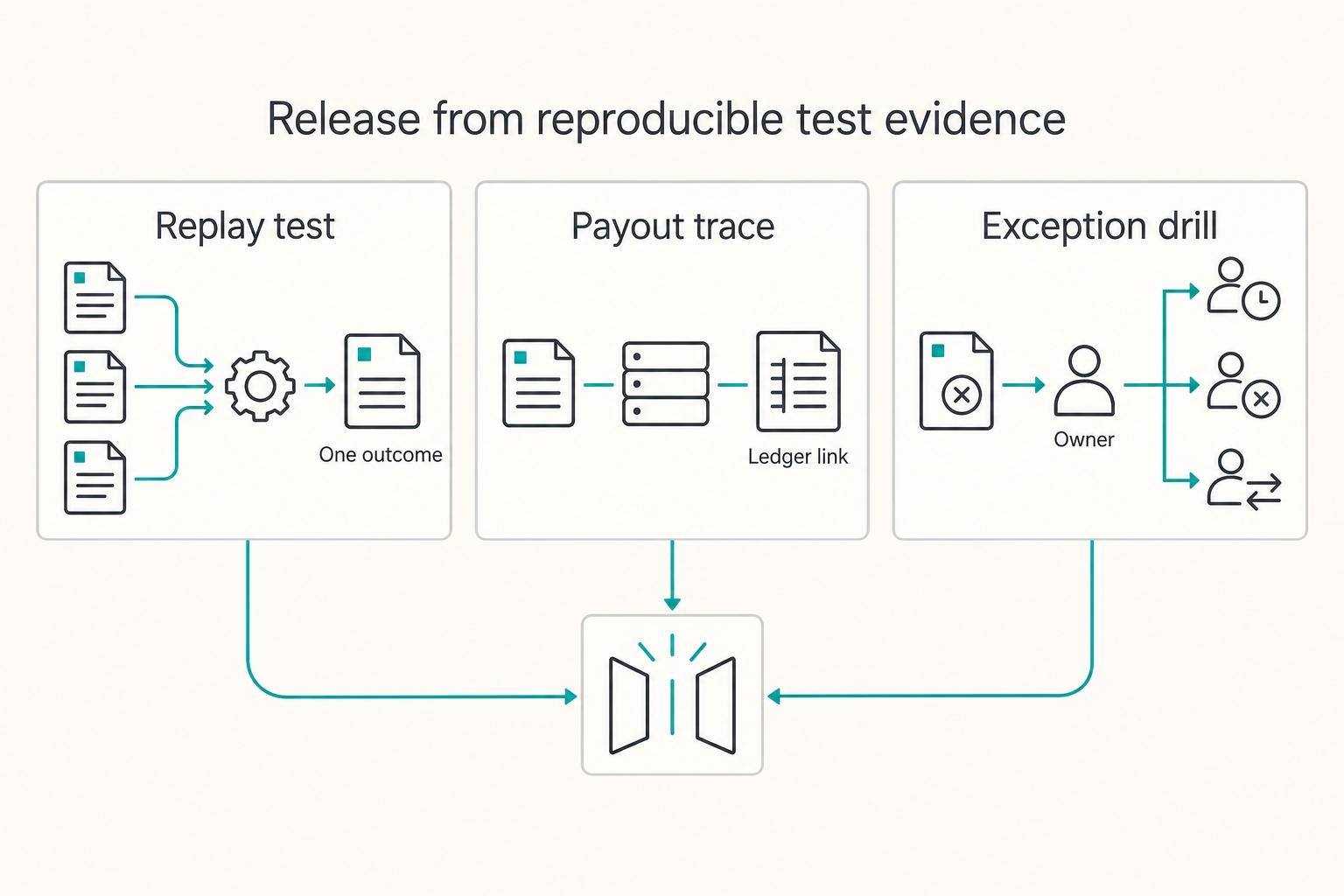
A release gate should be verifiable from artifacts alone. Cover the provider and method paths you ship, then reconcile provider status, webhook delivery, and internal postings. List any production-only behavior separately and validate it only through a provider-authorized live procedure.
| Release gate | What to confirm | Scope |
|---|---|---|
Webhooks replay check | No duplicate internal state changes or duplicate ledger effects | Replay representative events |
| Payout traceability check | A representative payout path is traceable from internal request to provider reference to the finance-facing ledger or settlement view | End-to-end payout path |
| Documented exception handling | Who responds first, what they check, and how escalation works | Delayed Webhooks, rejected payouts, or provider/internal state mismatches |
Step 3 Block release when ownership is missing#
Make this rule explicit: if any gate is missing a named owner or due date, release stays blocked until both are assigned.
For each gate, keep five fields in the launch pack: owner, approver, last execution date, artifact link, and open issue status. This helps prevent late-stage stalls where testing looks complete but sign-off responsibility is unclear.
Need a concrete reference for webhook retries, idempotent requests, and status traceability? Use the Gruv docs before you lock your release gates.
Prepare prerequisites before writing test cases#
Before you build a full test matrix, make sure the environment is actually testable. In this kind of workflow, setup gaps can create false defects quickly, especially when checkout redirects away from your site or depends on wallet integrations.
Step 1 Map prerequisites by payment path#
Create one setup record per payment path and provider environment. Track which sandbox environment is in scope and the return or redirect path for each flow.
This matters most for hosted gateway flows. If checkout leaves your page, a broken redirect path can look like an application bug even when the purchase logic is fine.
Step 2 Include third-party services in scope early#
Do not limit scope to card checkout if your live flow includes Apple Pay or other digital wallets. Payment integrations rely on third-party services, so some failures can come from external service state, not your checkout code.
A useful signal is a wallet method that fails before it can be used. Check provider-side setup before spending time debugging the app.
Step 3 Run a pre-flight before writing the full matrix#
Run a short baseline before expanding the matrix: one success, one expected failure, and one retry or repeated event for each launch-critical path.
Record what each result proves and what remains outside the sandbox. A passing simulated checkout does not prove live credentials, settlement, or payout arrival.
This pairs well with our guide on How to Choose a Merchant of Record Partner for Platform Teams.
Build strict environment boundaries and test data controls#
Lock down boundaries before you scale coverage. Keep sandbox activity fully separate from live operations, then make test scenarios and monitoring predictable enough that the team can trust what it sees.
Step 1 Isolate every test path from production#
Treat isolation as a release gate. Use provider test credentials and separate accounts, callback destinations, and data so a test request cannot be mistaken for a live transaction.
For each payment path, confirm that all three stay non-production: credentials, account or tenant, and callback or payout destination. If possible, enforce network-level separation between sandbox and production services. The checkpoint is simple: verify one request per path in logs or monitoring and store that evidence.
Step 2 Define expected test behavior up front#
Before you add volume, decide what expected behavior looks like. In sandbox, run repeated scenarios and make sure monitoring clearly shows what happened on each run.
Run two deliberate checks: execute one intended flow, then run the same flow again. Monitoring should show the intended outcomes plus a clear trace for each run. If you cannot explain the second run, fix that before you broaden coverage.
Step 3 Build scenario packs for compliance-dependent paths#
If your flow includes compliance-sensitive behavior, use scenario-based packs instead of one generic test profile. Include representative scenarios that let you verify where compliance outcomes change system behavior.
Keep each pack reusable and evidence-based: scenario name, expected status, observed status, and the logs or screenshots that prove the handoff.
Step 4 Keep non-production test data controlled across test surfaces#
Use valueless or synthetic test data in sandbox flows, and keep sandbox data separate from live customer data in logs, dashboards, exports, and support views.
Validation is straightforward: run one compliance or payment test path, then inspect downstream surfaces. If live values appear where they should not, treat that as a defect even if the transaction logic passed.
If you want deeper failure drills after these controls are in place, see Payment Sandbox Testing: Test Cards, Webhooks, and Failure Modes Before Go-Live.
Validate core money movement paths in order#
Test money movement in execution order, and treat each state change as its own checkpoint. One happy-path pass is not enough. Each step needs to stand on its own before you move on.
Step 1 Create the transaction and confirm the first state#
Start with the initiating action in your flow, such as order creation or checkout start. Do not proceed until that first state is clearly recorded in both your internal system and the provider-side test environment, with references you can trace later.
Step 2 Run the payment action and verify server-side status#
Then run the payment action, whether that is authorization, capture, or your equivalent, and verify it server-side. The critical check is status reconciliation: your backend status and the provider status should agree before you treat the payment as complete.
Pause at this checkpoint and confirm:
- the provider status matches the expected outcome
- your internal payment state changed once as intended
- your status surface reflects that same result
Step 3 Reconcile async updates before treating status as final#
For asynchronous flows, validate webhook-driven updates explicitly. In sandbox, trigger and process webhook events, then confirm they update the intended existing record rather than creating conflicting state. Treat sandbox scenario and webhook endpoints as test-only controls, not production behavior.
Your checkpoint is a three-part match:
- provider status
- webhook event processed
- internal status updated consistently
Step 4 Validate end-to-end completion#
Confirm the furthest state that the provider sandbox actually simulates, and label the result accordingly. If the sandbox stops at capture or processing, mark final settlement or payout arrival as unproven and assign it to a separate provider-authorized live validation gate.
Before you close the scenario, run at least one edge case on the same path: failure, timeout, duplicate callback, or refund or inquiry.
Test asynchronous events reconciliation and audit trail quality#
Once the core money path passes, the next gate is event evidence you can trust. Set a clear internal rule: if reconciliation still depends on manual spreadsheet stitching across Webhooks, provider exports, and internal records, treat that as a launch-readiness risk.
Step 1 Map each event to a traceable record chain#
For each tested scenario, map the fullest chain your systems expose from the original request to the provider reference to your internal posting record. Include identifiers and timestamps needed to follow that path.
The checkpoint is not just "webhook received." It is having enough linked records for auditability across request, provider event, stored event log, and internal posting.
Step 2 Reconcile expected vs received Webhooks#
Treat async validation as a comparison task. Define the sequence you expected, then compare it with what arrived and what your system accepted, retried, ignored, or marked as duplicate.
Do not assume a fixed delivery order. Document how your integration handles delayed, duplicate, and out-of-order events so QA and operations can predict the outcome.
Step 3 Produce finance-ready outputs before sign-off#
Reconciliation is strongest when ops and finance can use the outputs without engineering help. At minimum, capture:
| Output | Details |
|---|---|
| Event exception tracking | How mismatched, missing, or unresolved events are flagged and tracked |
| Retry history | Retry reason and outcome |
| Reconciliation view | Links internal IDs to provider references and posting results, where available |
If these outputs still require manual stitching, the integration still has an operational gap.
Step 4 Verify fallback handling with repeatable evidence#
Test fallback behavior, not just clean success paths. Document what you do when a capability is unavailable or an event path is incomplete, and show where those cases are reviewed.
Before launch, keep a repeatable evidence pack: one clean reconciliation output, one resolved exception, and one delayed or out-of-order event example with its handling notes.
Run failure mode drills before pre-live sign-off#
Before pre-live sign-off, run drills that prove your system can fail safely, recover cleanly, and avoid duplicate charges, not just pass the happy path.
- Run a fixed negative-path matrix.
Include invalid card details, insufficient-funds scenarios, interrupted sessions, and gateway downtime responses. The checkpoint is not only that a request fails, but that user-facing state, internal status, and records all land in the expected failure outcome.
- Use provider failure tooling where it exists.
Use provider test values and failure simulators where they exist. Capture the request or idempotency key, provider reference, surfaced error, and resulting internal state for each drill.
- Prove retry safety with idempotency tests.
Retry the same action and confirm no second charge is created. Verify transaction IDs are generated and stored correctly during these drills.
- Document recovery with clear ownership.
For each failure class, record the owner and escalation path. Make the runbook explicit about how to identify the failed transaction, whether retry is safe, and when to escalate across engineering and finance operations.
Complete provider-native pre-live checks and production boundary tests#
Provider-native sandbox evidence is necessary, but it is not the final word. Before launch, confirm key payment flows behave correctly in sandbox, then verify what still needs controlled live validation at the production boundary.
Step 1 Validate payment paths in the provider sandbox#
Run success and expected failure cases, then verify the full record chain, not just the UI result. Your user-facing status, provider reference, internal payment record, and any webhooks or async updates should all point to the same outcome.
Recheck that the sandbox environment is using the intended credentials, endpoints, certificates, and identifiers. Environment mismatch can look like a payment bug even when the core flow has not changed.
Step 2 Prove sandbox-to-live cutover is controlled and explicit#
Before sign-off, simulate the credential switch and inspect what actually changes. Confirm which differences are environment configuration and whether core handling such as checkout flow, retries, ledger posting, and status mapping stays stable or needs adjustments.
If you find sandbox-only conditionals inside core payment handling, treat that as launch risk and resolve or document it before go-live. Your evidence pack should capture config differences, secret names, webhook URLs, and the cutover approver.
Step 3 Run a controlled live validation for boundary behavior#
Sandbox and live behavior can differ. If the provider permits a production validation, use an approved small pilot and test only the remaining live boundaries, such as credential acceptance, callback reachability, and settlement or payout status. Follow the provider's live testing rules and retain the approval and rollback trigger.
Log each result with timestamp, request ID, provider reference, internal status, approver, and rollback trigger. If the live pass still requires manual stitching to explain what happened, pause launch readiness.
Avoid the mistakes that cause last-minute launch slips#
Treat go-live as a fresh checkpoint with one current evidence record, not a reuse of earlier green results.
Step 1 Require a final release checkpoint#
Keep a final sign-off step after sandbox passes. If credentials, callback URLs, payout settings, or release configuration changed, rerun the affected checks and record a fresh decision.
Record who approved, when they approved, and what evidence they used for that specific release version.
Step 2 List branch coverage explicitly#
When you document branch coverage, do not infer it from a main-path pass. Keep an explicit branch list in the launch record and mark each item as covered, not applicable, or unknown.
Mark a branch as covered only when the scenario ran and its expected provider and internal states were recorded. Mark unrun or provider-limited branches as unknown with an owner and next check.
Step 3 Track late-stage changes in the launch record#
Record late changes to provider settings, secrets, routing, webhook destinations, or payout rules. Mark which scenarios were rerun and who accepted any remaining gap.
If another reviewer cannot reconstruct what changed and why, treat that as unresolved launch risk.
Step 4 Keep one launch evidence pack#
Use one evidence pack instead of scattered tickets and messages. Track approval state, unresolved risks, and late changes in one place so the decision does not drift.
Use this launch checklist to move from testing to go-live#
Go live when you can show evidence from testing and provider setup, not because one sandbox demo looked clean.
Step 1: Close both test phases with named owners and proof#
Close internal simulation first, then provider sandbox tests for each integration you ship. List any behavior the provider sandbox cannot reach and assign its live validation gate to an owner.
For each gate, record:
- Gate name
- Owner
- Environment used
- Pass/fail outcome
- Evidence link
- Open risk if any
If a gate has no owner or no artifact, treat it as not done.
Step 2: Confirm provider setup and environment controls before live keys#
Before cutover, confirm platform account access and provider dashboard setup are complete.
| Checklist item | What to confirm |
|---|---|
| Credentials and permissions | Test and live keys are separate; the release owner can access the intended provider account |
| Allowed network paths | Required allowlists or firewall rules match the provider's current instructions |
| Enabled capabilities | Only the payment methods, payout rails, and countries in scope are enabled and tested |
| Account and destination mapping | Merchant, recipient, and payout destination references point to the intended environment |
| Webhook endpoints | Test and live callback URLs, signatures, and retry handling are mapped separately |
| Cutover approval | The owner has reviewed the live configuration diff, remaining conditions, and rollback trigger |
Any live-bound value that exists only in chat or local notes is a release blocker.
Step 3: Make the go-live decision from traceability, not a demo#
Run the checklist end to end and confirm ownership is explicit for failures, retries, and unresolved risks. The decision rule is simple: ship only when traceability and ownership are proven across completed gates. If evidence is partial, you are still in rehearsal.
Related: Testing Payment Flows in Sandbox: A Developer's Checklist.
If you want a practical review of your sandbox-to-live plan, evidence gates, and payout risk controls, talk with Gruv.
Frequently Asked Questions
What is a payment sandbox testing platform, and what does it actually replace in early development?
A payment sandbox is a provider or internal test environment for simulating payment flows without moving live funds. It can prove integration behavior up to the states that environment supports; it cannot prove final live settlement or payout arrival.
Should we use one sandbox environment or both fast simulation and provider-native sandboxes?
Use internal simulation to prove your own state and retry logic, then use each provider's sandbox for the paths you ship. Record which states and failures each environment can and cannot simulate.
What is the minimum setup needed before we can run meaningful tests?
Set up the provider test account and credentials, separate callback endpoints and test data, and a scenario list with expected provider and internal results. Confirm any method-specific setup in the provider's current documentation.
Do we still need production testing after sandbox passes?
Some live boundaries, including settlement or payout arrival, cannot be proved in a sandbox. Where the provider permits or requires it, plan a small approved live validation under its rules; do not assume live card testing is allowed.
What can sandbox testing miss even when all test cases pass?
A sandbox can miss live credentials, callback routing, provider account restrictions, settlement, and payout arrival. For example, Payrix Pro says its sandbox payments remain Captured and disbursements remain Processing.
How do we decide whether a failed test is a blocker or a monitored launch risk?
Block release when a required path fails, an exception cannot be reconciled, or a gate lacks an owner and evidence. Track provider-limited live states as explicit release conditions, with an approved validation and rollback plan.
Researched and edited by the Gruv editorial team. Gruv builds cross-border billing, payouts, and finance-operations software for global businesses.
Sources
Includes 2 external sources outside the trusted-domain allowlist.
Educational content only. Not legal, tax, or financial advice.
Related Posts

The Freelance Payment Penalty: A Modeled Audit of Platform Fees, FX Spreads, and Payout Delays
The money rarely disappears through a single, easy-to-spot fee. The real loss is stacked. A marketplace takes its commission, a processor adds a charge for international cards, a bank or payment company converts the currency at a spread, a platform holds the funds before release, and a wire sheds a little to intermediaries on the way in. Each layer looks defensible on its own, but the worker feels the combined result as a smaller deposit and a later payday.

How to Respond to a Subpoena for Business Records
Move fast, but do not produce records on instinct. If you need to **respond to a subpoena for business records**, your immediate job is to control deadlines, preserve records, and make any later production defensible.
A US Expat's Guide to Investing in UCITS ETFs to Avoid PFIC Issues
The real problem is a two-system conflict. U.S. tax treatment can punish the wrong fund choice, while local product-access constraints can block the funds you want to buy in the first place. For **us expat ucits etfs**, the practical question is not "Which product is best?" It is "What can I access, report, and keep doing every year without guessing?" Use this four-part filter before any trade: