
Quick Answer
Verify sandbox endpoints and credentials, define expected outcomes for success and failure paths, and test duplicate, delayed and missing events without creating another financial effect. Retain the scenario matrix, observed state and ledger evidence, defect owners and provider-specific sandbox limits for the go/no-go review.
Start With a Sandbox You Can Trust#
This is a release-grade payment sandbox testing checklist for engineering leads, not a generic QA list. It keeps sandbox validation focused on your PSP connection and related payment flows before controlled live validation.
The first gate is boundary control. Before you trust any test result, confirm you are actually in sandbox. With TrueLayer, that means the Console Live toggle is off and you are using https://api.truelayer-sandbox.com/ instead of https://api.truelayer.com/.
The second gate is real test access, with documented failure-path controls. TrueLayer's mock provider supports outcome-based redirect testing, including an explicit auth failure when test_authorisation_failed is used. For redirect-provider tests, capture setup requirements like provider_selection.type = user_selected, country filters such as GB, IE, or DE, and mock execution or settlement delays from no delay up to one day so results are reproducible.
Confirm the provider’s current sandbox onboarding requirements before testing. Record required merchant approvals, account access and credential issuance in the preflight checklist so setup failures are separated from integration defects.
This article uses a practical two-layer structure:
- Foundation layer: environment boundaries, credentials, and baseline scenario setup.
- Release layer: tests and proof points that should drive go or no-go decisions.
For each layer, keep explicit evidence: endpoint used, credential owner, exact test condition, and observed result. The goal is simple: separate real integration proof from sandbox theater, and keep a clear line between what sandbox can validate and what controlled live validation must still prove. For the broader operating model, read Vendor Portal Requirements Checklist for Platform Payment Ops.
What a release-grade sandbox checklist includes#
A release-grade checklist should prove more than "the API worked once." It should show that your sandbox setup includes working credentials, each scenario has a named expected outcome, and the checklist can be rerun in controlled production testing.
Start with the basics#
Start with the provider's sandbox setup. In BILL, that includes setting up a test BILL account in sandbox, generating a developer key, and generating a sync token. Then verify login with POST /v3/login using sync token information and confirm an HTTP 200 response. Record the endpoint and result so the evidence is reproducible.
From there, define scenarios with explicit setup and expected outcomes. Practical examples from the source checklists include creating one test vendor with 5 test bills, or creating two vendors with one company and one individual. Also verify parity between what your application sync pulls and what appears in the test customer organization.
Add release gating beyond sandbox completion#
Sandbox completion is a checkpoint, not final sign-off. BILL's go-live checklist requires repeating the checklist in production with trial organizations, and it also allows an optional beta pilot with a subset of customers before full release. That staged path is a practical model: prove mechanics in sandbox, then prove behavior under controlled production conditions.
We covered this in detail in How to Build a Sandbox Test Environment for Your Payment Platform.
Lock the environment boundary before any test execution#
Before you run scenarios, confirm you are in the right environment and that provider setup is complete. Passing test cases inside an unverified boundary can validate the wrong system and create downstream financial or operational issues.
1. Verify scope and boundary, not just intent#
Define boundary scope up front, including participant constraints and transaction or value limits for the test. Then confirm the environment you plan to use matches that scope before you interpret scenario results.
2. Confirm provider prerequisites before scenario work#
Complete provider prerequisites before you test the flow itself. For Apple Pay, that includes enrolling in the Apple Developer Program, creating a Merchant ID, confirming your PSP supports Apple Pay, verifying domain(s), and testing the Merchant Identity Certificate. When those prerequisites are incomplete, failures often reflect setup gaps rather than code behavior.
3. Keep a lightweight preflight artifact per PSP#
Use one short preflight record for each PSP so the team can review setup before execution. Keep it practical, for example: defined scope and limits, participant constraints, and prerequisite status. This gives you a fast audit point and makes triage easier when results look inconsistent.
4. Apply one team decision rule#
If boundary validation is incomplete or unclear, pause scenario testing and resolve setup first. That keeps the checklist trustworthy and reduces false confidence from results gathered in the wrong environment.
Build the credential and test-data matrix#
Build one matrix per rail that combines credentials, datasets, expected checkpoints, and ownership. If a credential has no owner or no last verified date, treat that rail as unready for regression.
1. Give every rail one accountable record#
Keep credentials and scenarios in the same row so you can triage failures faster. For each rail and integration path you support, record:
- test asset or credential reference
- dataset IDs tied to that asset
- expected outcome or checkpoint
- owner and backup owner
- last verified date
2. Separate positive, negative, and malformed datasets#
Each rail should map to three dataset groups on purpose: known-good, forced failure, and malformed request. That keeps "credential broke" separate from "error handling works."
Use provider-defined scenarios when available. In Tabby’s documented positive flow, select the current positive-flow test profile from its documentation rather than copying credentials into the checklist. Verify the documented API and Merchant Dashboard states, and confirm captured amount appears in captures. For negative coverage, record the named scenario and expected checkpoint, such as Background Pre-scoring Reject.
3. Include merchant-variant coverage#
Do not mark coverage complete with card-like paths alone. Split datasets when merchant configuration changes behavior.
Clover's test-merchant model is a good example. You can create multiple test merchants, vary region, time zone, currency, and permissions, and the test-merchant address can determine configured payment gateway behavior. Treat those as distinct test datasets.
4. Track freshness and environment ownership#
Add prerequisite-style fields to every credential set:
- owner
- backup owner
- where the secret or test asset is stored
- last verified date
- expiry or rotation note
- affected rails or scenarios if it fails
Clover's legacy model requiring two separate developer accounts for sandbox and production is a useful reminder that environment ownership must be explicit, not assumed. For a step-by-step walkthrough, see How to Build a Developer Portal for Your Payment Platform: Docs Sandbox and SDKs.
Build a scenario matrix that mirrors real payment behavior#
Build the matrix around end-to-end payment handoffs, not isolated test-card outcomes. A scenario row is only useful for release if it shows what the customer saw, what operators saw, which provider reference was created, and how the internal state maps to your payment record.
Use phases as a clarity model, not a universal provider mandate:
| Phase | What to prove | Evidence to keep |
|---|---|---|
| Authorization | Request is accepted or declined, transaction identifier is created, and initial internal status is set | Request ID, provider reference, customer message, internal status |
| Capture/confirmation | Payment moves to captured or confirmed state when applicable | Capture or confirmation reference, captured amount, operator-visible status |
| Failure recovery | Timeouts, declines, or gateway issues end in a clear, non-ambiguous state | Retry record, operator message, final internal status |
| Post-payment reconciliation | Final state is traceable in provider and internal records | Provider reference, internal payment ID, final internal status |
For every row, define expected outcomes explicitly: customer message, operator message, provider reference behavior, and internal status transition. Avoid vague pass or fail labels.
Make coverage reflect the real variability in your stack:
- vary card and currency paths where supported by your Payment gateway, including conversion paths where relevant
- include interruption and abandonment cases for session-based methods, for example mobile-money/USSD flows
- include gateway downtime behavior as an explicit failure path
Also add explicit duplicate-submission rows and treat duplicate charges as hard failures:
- duplicate submissions must not create duplicate charges (Idempotency)
If a scenario cannot end in a provable internal status plus a traceable provider/internal record, mark it as not covered. Related: How to Build a Payment Sandbox for Testing Before Going Live.
Test asynchronous truth and replay safety#
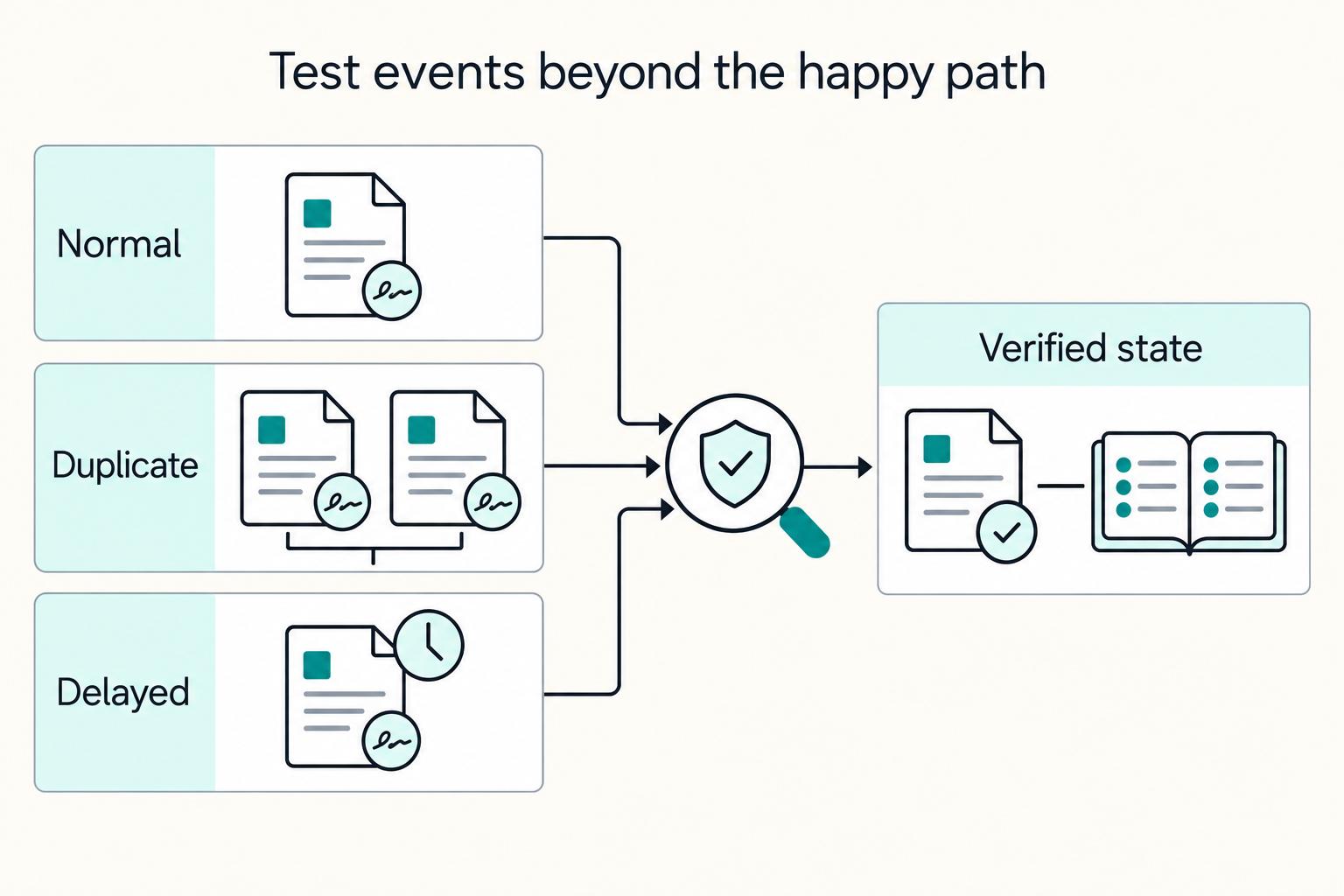
The release gate is server-verified payment state and one financial effect across delayed or replayed events. A browser callback must not finalize a payment by itself. Use verified provider webhooks and authenticated API status retrieval according to the provider’s contract; a verified event signature authenticates the message, not every inferred business outcome.
Front-end callbacks can guide customer UX, but they should not establish final payment state alone. Verify provider events server-side and use authenticated status retrieval when needed. Stripe’s webhook guidance documents duplicate and out-of-order deliveries; test that those paths converge without duplicate financial effects.
1. Prove server-verified state handling#
Start with environment hygiene: keep staging webhook endpoints separate from production, and keep sandbox credentials tied only to sandbox URLs. Mixing credentials or webhook URLs across environments is a common launch error and can create false confidence.
| Case | Expected handling | Evidence |
|---|---|---|
| Normal arrival | Webhook arrives, signature verifies server-side, and internal payment status moves as expected. | event identifier, provider reference, signature verification result, received timestamp, resulting internal status, linked internal transaction record when financial state changes occur |
| Duplicate delivery | The same webhook is delivered again. It should be acknowledged without creating a second financial effect. | event identifier, provider reference, signature verification result, received timestamp, resulting internal status, linked internal transaction record when financial state changes occur |
| Delay or disorder | Events arrive late or out of order. Use the provider’s event semantics and authenticated current-status retrieval where needed; an old event must not regress a later valid state. | event identifier, provider reference, signature verification result, received timestamp, resulting internal status, linked internal transaction record when financial state changes occur |
Then run the same payment scenario through the three cases above:
- Normal arrival
- Duplicate delivery
- Delay or disorder
For each case, keep a compact evidence chain: event identifier, provider reference, signature verification result, received timestamp, resulting internal status, and a linked internal transaction record when financial state changes occur.
2. Assert idempotent persistence, not only idempotent responses#
The requirement is not just returning a successful HTTP response on duplicates. The requirement is one canonical financial effect when provider webhooks repeat.
Resend the same event and validate persistence outcomes, not just logs. Duplicate deliveries must not create duplicate transaction effects, duplicate balance impact, or duplicate "paid" state transitions.
Use these go or no-go checks:
- Duplicate webhook creates a second financial effect: no-go.
- Duplicate is suppressed but operators cannot tell what happened: improve observability before launch.
- Signature verification fails and state still changes: no-go.
Deduplication and signature verification need to work together. One without the other is not replay-safe.
3. Test missing-event recovery and orphan handling#
Include one drill where expected webhook confirmation is delayed or absent on the first pass. The point is not provider timing guarantees. The point is your recovery behavior for retries, orphaned orders, and reconciliation.
Test this sequence: payment submitted, confirmation wait times out, authenticated status lookup or investigation begins, and the original webhook arrives later. If a submission retry is permitted, preserve the original operation’s idempotency identity and provider rules. Never issue a new money-moving operation solely because confirmation timed out.
If late events cannot be matched cleanly, or retries and late callbacks can both produce financial outcomes, treat that as a release blocker.
4. Apply the same checks to payout-side async flows#
If payout batches are in scope, apply the same discipline there: verify callback-driven status handling, replay safety, and operator visibility for stuck items.
You do not need provider-specific assumptions to test this. Confirm that payout callbacks update your internal status model consistently and do not create duplicate payout-side financial state when replayed. For stuck items, keep enough trace detail visible for operators to act quickly.
You can narrow method coverage to ship, but do not cut async truth, replay safety, or missing-event recovery. Those are the checks that prove behavior beyond the happy path. Related reading: CBUAE Instant Payment Platform: Launch Validation Checklist for UAE Marketplace Operators.
Separate what sandbox proves from what production must prove#
Use sandbox to prove integration mechanics, and use controlled production checks to prove live behavior.
| Environment | Proof point | Detail |
|---|---|---|
| Sandbox | request and response wiring, auth flow, and error handling | Use sandbox to prove integration mechanics. |
| Sandbox | environment isolation and credential routing | Sandbox and production are separate environments with separate credentials. |
| Sandbox | basic observability and traceability | In test mode, some providers return transaction ID 0 and do not store transactions. |
| Production | real transaction behavior | Use production credentials and live processing paths. |
| Production | provider-specific go-live requirements | Include verification checklists, certification or review steps, and production account setup. |
| Production | controlled live tests | Run controlled, limited live tests before full traffic cutover. |
Sandbox and production are separate environments with separate credentials, so treat them as different test surfaces from day one. If credentials are crossed, the gateway can fail deterministically, for example with Reason Code 13. That is useful for environment-mapping checks, but it is not evidence of real payment-processing outcomes.
Sandbox can prove:
- request and response wiring, auth flow, and error handling
- environment isolation and credential routing
- basic observability and traceability, with one caveat: in test mode, some providers return transaction ID
0and do not store transactions
Production must prove:
- real transaction behavior with production credentials and live processing paths
- your provider-specific go-live requirements, such as verification checklists, certification or review steps, and production account setup
- controlled, limited live tests before full traffic cutover
Use wallet sandboxes, including Apple Pay Sandbox, the same way. They are valuable for integration testing, but not enough on their own to prove production readiness with real cards and production credentials.
If you want a deeper dive, read Payment Sandbox Testing: Test Cards, Webhooks, and Failure Modes Before Go-Live.
Add compliance and policy-gate checkpoints early#
Add policy-gate tests to UAT before release sign-off, because a payment flow is not ready if compliance decisions can still change funds movement outcomes.
Treat policy checks as money-movement gates#
Use the same boundary from the previous section: sandbox validates technical flow, while release readiness also depends on gate behavior when money should and should not move. Your checklist is incomplete if it only covers technical flow events.
Your scenario matrix can include states such as pending review, rejected, missing required data, and manually approved. The key outcome is not only an API error, but whether transaction behavior matches the policy state and whether operators can see why. In AML contexts, UAT is a key checkpoint before production, and rushing it is a known failure risk, so it is better to catch these failures in testing.
Map document-dependent eligibility before it surprises you#
If your flow uses document or profile gates, include them in the test matrix early and verify your own eligibility rules explicitly. Keep the test focused on state changes and outcomes, not assumptions about universal dependency rules.
Use a checklist for each gate:
- Define trigger states: missing, pending, approved, rejected.
- Define business effects: allowed or blocked transaction outcomes.
- Define operator evidence: visible status, document state, and reason.
- Define recovery path: what unblocks the account and how that action is recorded.
A practical pattern is to start from an eligible profile, then invalidate one prerequisite at a time and confirm the block appears in both API responses and operator views.
Demand explainability, not just blocking behavior#
Do not settle for a blind block. Require a searchable event trail for each one: decision status, human review step if any, status change history, and related transaction attempt. If your logs cannot answer what blocked the account and when the state changed, testing is incomplete.
Keep UAT artifacts alongside results: dataset design, scenario matrices, policy rules, pass/fail criteria, decision trails and sign-off. If automated AML decisions are in scope, include your applicable model-review and compliance requirements explicitly.
Use a simple sign-off rule: if a policy gate can affect funds movement, require evidence in API behavior, operator tooling, and logs, including at least one blocked case and one recovered case.
Create the go-no-go evidence pack for release review#
Release review should be an evidence check, not a trust exercise. Once policy gates are in your matrix, package the proof in one place and treat missing evidence as a potential no-go.
Make the pack small but complete#
Start with four core artifacts, and make each one decision-ready:
| Artifact | Required detail |
|---|---|
| Scenario matrix | Linked to the test plan; for each scenario, show expected outcome, actual outcome, owner, and final status as pass, fail, blocked, or waived. |
| Pass/fail summary | Grouped by phase or dependency so open risk is obvious at a glance. |
| Unresolved defects list | Include business effect, containment, workaround, target fix date, and named risk owner for any waiver. |
| Dependency caveats | List dependencies that can change release posture, with required permissions, credential references, endpoint owners, readiness evidence and open limitations. |
A good pack makes unknowns explicit. A weak pack mixes passes, assumptions, and future fixes until blockers are unclear.
Require traceability that survives review pressure#
For high-risk scenarios, require a traceability chain another operator can follow without asking the original tester. At minimum, connect the test case to execution evidence, relevant logs, and the resulting decision record.
Use a quick review drill: walk one happy-path case and one failure case end to end. If reviewers cannot follow both clearly, the evidence is not ready for approval.
Add explicit no-go rules#
Write hard stop rules into the checklist:
- No go-live if any required artifact is missing or incomplete.
- No go-live if unresolved defects do not have containment, workaround, and clear ownership.
- No go-live if dependency caveats are vague or buried in generic notes.
- No go-live if temporary elevated access from testing or cutover is not removed.
- No go-live if token or endpoint ownership is undocumented.
This keeps release decisions grounded in linked evidence, named risks, and clear caveats instead of memory or optimism.
Before sign-off, map each required artifact and caveat to the relevant implementation points in the Gruv docs.
Sanity checks before go-live#
Treat this last pass as a strict readiness check: confirm current sandbox behavior, confirm failures are diagnosable, and document what sandbox results do not prove.
- Run one successful and one unsuccessful sandbox payment for each method in release scope. Confirm current sandbox endpoints, approved test assets and credential ownership before rerunning.
- Mirror sandbox setup into production configuration. Reconfirm that connector configurations established in sandbox are replicated on the production account before launch.
- Prove failure visibility before launch. Re-test Webhooks, verify handling for
4xxand5xxAPI responses, and keep request-leveltraceIdevidence so failures can be triaged quickly. - State sandbox limits explicitly in release readiness. Record that sandbox validation does not cover every live-production check.
Record provider-specific sandbox limits from its current documentation, including any simulated issuer, authentication, identity or settlement behavior. Do not assume a green sandbox result proves a live external check.
Decide minimum coverage versus hardening coverage#
Define baseline release coverage and optional hardening coverage against the flows you are shipping. Mandatory controls need current evidence; optional cases need a named risk owner and a reason for deferral.
A narrower scope can proceed on baseline evidence when the baseline checklist is current and complete. As scope and complexity increase, move additional items into hardening coverage instead of stretching baseline assumptions.
| Decision area | Baseline coverage | Hardening coverage |
|---|---|---|
| Checklist structure | Baseline checklist complete with clear pass/fail evidence | Baseline plus selected recommended controls |
| Evidence quality | Current evidence mapped to each checklist item | Same standard, plus extra evidence for deferred-risk areas |
| Release criteria | Pre-agreed objective criteria are met | Objective criteria met at a higher bar for broader scope |
Define minimum coverage in your own release criteria and the provider’s go-live requirements. Document any waiver, its financial effect, containment and approving owner; a waiver must not hide a duplicate-payment or unverified-state defect.
Conclusion#
Treat sandbox testing as an integration-risk control, not a last-mile QA task. A strong checklist should show that your setup is supported and functioning as expected, while surfacing failures that can derail checkout before launch.
Use a practical workflow, not a box-checking sprint: set clear environment boundaries and rollback readiness, run varied scenarios beyond the happy path, and stress failure behavior, including payment-failed paths and retry patterns that can create duplicate charges. Make the release call from evidence. Passing a narrow set of cases can still hide a broken setup.
For closeout, keep the evidence explicit and current:
- Confirm environment setup and rollback path.
- Validate varied scenarios and operator checkpoints, including whether matched bank accounts, mock balances, and transactions appear where expected.
- Document observed outcomes, unresolved defects, and what sandbox still does not prove about live processing.
Build the matrix and evidence pack first, then run it against the payment paths you plan to launch. Treat that as a practical confidence check, not proof of all live production behavior.
If your rollout spans multiple PSPs, regions, or payout rails, talk to Gruv to confirm policy-gate coverage and sequencing for your launch plan.
Frequently Asked Questions
What is a payment sandbox testing checklist, and how is it different from a generic QA checklist?
A payment sandbox testing checklist is release evidence from a dedicated, isolated environment that simulates transactions without moving real money. It is narrower than generic QA because it focuses on payment-specific controls such as provider credentials, environment boundaries, HTTPS transport, error handling, and failure-mode behavior.
What must be tested in sandbox versus production before go-live?
Use sandbox to verify integration mechanics: correct non-production URLs, separate sandbox credentials, success and decline flows, HTTPS transport, and expected error handling. Do not treat sandbox passes as proof of real issuer or financial-institution processing, because sandbox transactions are not submitted for real processing. Before go-live, run controlled live checks for behaviors sandbox cannot prove.
Why do official provider test credentials matter more than dummy numbers?
Official test credentials are designed for provider-specific sandbox behavior and boundary checks. In Authorize.net, mixing sandbox and production credentials returns Response Reason Code 13, which helps catch environment mistakes early. Authorize.net test card numbers are also sandbox-only, so arbitrary dummy data may mask setup errors instead of exposing them.
Which failure modes are table stakes for payment launches?
Baseline failure coverage should include declines, insufficient funds, network timeouts, invalid or missing provider events, and environment mix-ups. Verify the current endpoints and environment markers from the provider’s own documentation rather than assuming one naming convention works across integrations.
How many scenarios are enough for launch confidence on a new integration?
There is no universal scenario count that guarantees launch confidence. Enough means launch-critical paths have current pass-or-fail evidence across successful and failure outcomes for the payment flows you are shipping. If the same failure family keeps recurring across reruns, coverage is not sufficient yet.
When should a team add hardening coverage instead of shipping with minimum coverage?
Add hardening coverage when scope expands or reruns keep surfacing the same defect cluster. Raise the bar when provider setup details can create false confidence. For example, Authorize.net sandbox should use Live Mode because test mode returns a transaction ID of zero and does not persist transactions. If transactions are not stored, evidence quality is weaker for downstream verification.
What evidence should an engineering lead require in a go-no-go meeting?
Require a current scenario matrix, pass-or-fail summary, unresolved-defect list, and explicit notes on what sandbox does not prove. Ask for a verification trail that includes webhook outcomes and an error-code list with observed results. If the team cannot show clear environment-boundary and credential checks, the checklist is not ready to support a go decision.
Researched and edited by the Gruv editorial team. Gruv builds cross-border billing, payouts, and finance-operations software for global businesses.
Sources
Includes 6 external sources outside the trusted-domain allowlist.
- docs.stripe.com/webhookstrusted
- developer.apple.com/apple-pay/Apple-Pay-Merchant-Integration-Gui...external
- developer.authorize.net/hello_world/testing_guide.htmlexternal
- developer.bill.com/docs/bill-app-partner-integration-go-live-ch...external
- docs.clover.com/dev/docs/use-test-merchants-dashboardexternal
- docs.tabby.ai/testing-guidelines/testing-credentialsexternal
- docs.truelayer.com/docs/test-payments-in-sandboxexternal
Educational content only. Not legal, tax, or financial advice.
Related Posts

The Freelance Payment Penalty: A Modeled Audit of Platform Fees, FX Spreads, and Payout Delays
The money rarely disappears through a single, easy-to-spot fee. The real loss is stacked. A marketplace takes its commission, a processor adds a charge for international cards, a bank or payment company converts the currency at a spread, a platform holds the funds before release, and a wire sheds a little to intermediaries on the way in. Each layer looks defensible on its own, but the worker feels the combined result as a smaller deposit and a later payday.

How to Respond to a Subpoena for Business Records
Move fast, but do not produce records on instinct. If you need to **respond to a subpoena for business records**, your immediate job is to control deadlines, preserve records, and make any later production defensible.

A US Expat's Guide to Investing in UCITS ETFs to Avoid PFIC Issues
The real problem is a two-system conflict. U.S. tax treatment can punish the wrong fund choice, while local product-access constraints can block the funds you want to buy in the first place. For **us expat ucits etfs**, the practical question is not "Which product is best?" It is "What can I access, report, and keep doing every year without guessing?" Use this four-part filter before any trade: