
Quick Answer
Define what your payment sandbox can prove, collect the credentials and setup artifacts for the integrations in scope, and test the full path from request to asynchronous outcome. Cover payment failures, duplicate events, eligibility changes, wallet balances, FX quotes and payout returns. Record the live-only checks separately before approving production launch.
What Your Sandbox Environment Needs to Prove#
A payment sandbox is a controlled, non-production environment, so treat it as an architecture decision, not a demo setup. It lets you validate integrations with test accounts and simulated outcomes, but it does not move real funds.
Passing sandbox tests does not prove production readiness. Apple Pay sandbox testing uses test cards; production testing requires real cards. Check the processor response as well as the wallet interaction, because completing the wallet handoff does not prove that a payment was authorized or settled.
Before you start, use two rules to frame this guide.
- A sandbox proves integration behavior in a controlled test environment.
- Production launch decisions still need explicit live-environment checks.
That distinction helps teams avoid avoidable debt when moving from sandbox validation to production launch checks. We use it as a hard checkpoint before any launch review.
Treat the sandbox as an architecture choice. We start by defining what your sandbox must prove across the full payment path, not just checkout success. If a flow changes transaction status or internal reporting state, design tests so your team can trace it end to end and explain the final status with clear artifacts.
Gather prerequisites before coding. For direct Apple Pay web testing, configure the Merchant ID, required certificates, verified domain and HTTPS/TLS support. Device sandbox testing uses an App Store Connect sandbox tester account and supported test cards. A PSP-managed integration may handle some merchant setup; follow the requirements for the route you implement.
Build release evidence. Clover's legacy developer platform uses separate sandbox and production accounts. Its legacy production test merchant gateway does not validate card details or request completeness, illustrating why the environment name alone is insufficient. Record the exact test account, gateway and scenarios behind each passed result.
By the end of this guide, you should have concrete setup steps, clear failure conditions to test, and a launch checklist your engineering and operations owners can use before real money movement goes live. We want every launch packet to answer the same core questions.
Related: How to Build a Developer Portal for Your Payment Platform: Docs Sandbox and SDKs.
Define sandbox scope before writing code#
Set scope before integration work starts. If you do not, teams can confuse simulated success with launch readiness. The practical boundary is simple: document what must behave production-like, document what sandbox cannot prove, and define what still needs live checks before go-live.
1. Classify each environment as production-like, not production-equal#
For each provider sandbox (for example, PayPal Sandbox, Square Sandbox, Stripe Sandboxes, and Apple Pay Sandbox), treat it as a sandbox environment and verify its behavior directly before trusting results. A sandbox can expose production-like APIs while still using different credentials and behavior patterns. A mock server can return OpenAPI-shaped responses without proving real stateful behavior.
Use one first checkpoint across providers: confirm you can create test data, query it later, and reset it when needed. If persistent state is missing, you may be mostly validating request formatting.
2. Write non-goals before acceptance tests#
Put non-goals in the same scope document used by product, engineering, and QA. At minimum, state that sandbox results do not prove:
- real-card behavior
- real settlement timing
- full dispute lifecycle behavior
This helps prevent teams from treating "worked in test" as "ready for live money movement."
3. Set an internal release rule for money-state and payout-eligibility flows#
For flows that change user money state or payout eligibility, use a stricter internal release rule where risk warrants it. Define production-parity checks for the REST API response contract your app depends on and for the webhook status transitions your system uses to update internal state.
Capture both artifacts for each critical path: the direct API response and the webhook trail that triggered your internal update. If they conflict, investigate before release.
4. Publish one shared scope map#
Keep one scope map across payment collection, onboarding, reporting, and payouts so everyone tests the same boundaries.
| Area | Must mirror production-like behavior | Declared non-goals | Evidence to save |
|---|---|---|---|
| Payment collection | Persistent create/update/query state and internal status mapping | Real-card behavior, live settlement timing | API request/response pair, webhook event trail, final internal transaction state |
| Onboarding | Persistent merchant/applicant state and KYC / Merchant onboarding requirements paths | Full live review timing and outcomes | Test inputs, resulting status path, final onboarding state |
| Reporting | How transaction/status changes appear in internal reporting | Live volume/timing assumptions | Report snapshot tied to test transaction identifiers |
| Payouts | Eligibility/status changes driven by API + webhook state | Real payout arrival timing | Before/after eligibility state, payout status trail |
Gather prerequisites and access artifacts#
Collect access blockers before coding. Missing account ownership, domain verification steps, or approval access for required artifacts can delay a sandbox test environment payment platform build.
| Artifact or checkpoint | What to confirm | Note |
|---|---|---|
| Apple Developer Account | Developer account configured for the Apple Pay integration in scope | For Apple Pay work |
| App Store Connect sandbox tester | Create the tester account needed for device sandbox testing | Required for that Apple Pay test path; separate from unrelated in-app purchase testing |
| Apple verification file | download Apple's verification file, host it at /.well-known/apple-developer-merchantid-domain-association | part of the domain verification workflow |
| Domain status | complete verify and enable after entering the hosted domain | Treat "file is hosted" and "domain is verified and enabled" as separate checkpoints |
| HTTPS and SSL certificate | confirm your test domain has working HTTPS with a valid SSL certificate | Before browser-based Apple Pay testing |
| Callback URLs | list those URLs in the readiness checklist and verify they are reachable in the target environments | If provider flows depend on callback URLs |
| Credential ownership | Document where credentials are stored, who can replace them, and who approves changes | For each sandbox account, record who can sign in, who can issue test credentials, and who approves access changes |
Assign owners for each required account and artifact. Record who can access the developer account, issue test credentials, renew certificates and approve configuration changes.
Use an App Store Connect sandbox tester account for Apple Pay device sandbox tests. Keep test users and cards separate from production users and cards.
Collect Apple Pay web setup artifacts before implementation. For Apple Pay web setup, gather the required verification items early and confirm which Apple artifacts your specific flow needs. At minimum, include the domain verification workflow: download Apple's verification file, host it at /.well-known/apple-developer-merchantid-domain-association, then complete verify and enable after entering the hosted domain.
Treat "file is hosted" and "domain is verified and enabled" as separate checkpoints. Also plan for processor-side dependency risk, because some implementations may require your payment processor to enable the feature on your account.
Confirm transport and credential operations before test execution. Before browser-based Apple Pay testing, confirm your test domain has working HTTPS with a valid SSL certificate. If your provider flows depend on callback URLs, list those URLs in the readiness checklist and verify they are reachable in the target environments.
Document where credentials are stored, who can replace them, and who approves changes. Even when provider docs do not prescribe your internal process, capture this ownership map so access changes do not block execution.
Choose architecture seams that prevent long-term debt#
Choose the seam early. Provider sandboxes can help exercise real integration flows, and mocks can support deterministic failure testing and local speed. Keep both behind a narrow neutral contract so vendor shapes do not spread through your product.
This is a practical build-versus-buy decision about time-to-market, operational risk, and whether engineering effort goes into plumbing or differentiation. Debt can show up later when multiple teams or providers touch code that assumed one vendor model.
| Pattern | Best use | Strength | Debt risk |
|---|---|---|---|
| Direct provider sandbox integration | Early launch validation against provider flows | Closer provider flow coverage in test | Product logic can start depending on vendor-specific fields and states |
| Internal mock engine | Deterministic failures, fast local development, stable CI cases | Speed and controllability | Can drift from provider reality and create false confidence |
| Hybrid test harness | Teams that need both speed and provider checks | Balanced feedback loop | Can grow into a parallel payment stack |
Keep adapters narrow across provider interfaces. Your core system should operate on one internal payment contract, with adapters translating provider requests, responses, and events at the boundary. That reduces the fragmentation pattern where onboarding, balances, and events end up split across incompatible shapes.
If multi-provider routing is on your roadmap, define the neutral contract before adding provider two. Aim for a single source of truth for transaction state so reporting and reconciliation do not depend on vendor-specific interpretations. Also avoid forced simplicity. Extra complexity can be legitimate when operating requirements demand it, while artificial simplicity can create more problems than it solves.
Related reading: How to Build a Payment Health Dashboard for Your Platform.
Build the payment-path test sequence end to end#
Treat payment-path sandbox testing as transition verification, not just a single checkout success. The goal is to verify each state change in your flow while accounting for what each sandbox mode can and cannot validate.
1. Define your internal state sequence first#
Map one payment attempt in your own system terms before automation. Keep the expected internal truth after each transition explicit, and persist enough data to verify it, for example: internal attempt ID, provider reference, amount, currency, current status, and next allowed status.
2. Use provider sandbox modes and artifacts correctly#
Use the provider’s documented test values, sandbox accounts and simulated outcomes. Internal mocks can supply additional deterministic fixtures; label them so a mocked pass is distinguishable from a provider sandbox pass.
For PayPal through Braintree, there are 2 ways to test:
| Mode | What it gives you | Limitation |
|---|---|---|
| Mocked PayPal testing (default) | Production-like behavior for basic flow checks | Not full end-to-end; results stay in Braintree sandbox |
| Linked PayPal testing | Fuller integration checks, including reporting and receipt behavior | Requires extra setup between Braintree and PayPal sandbox accounts |
In linked PayPal tests, using a PayPal business account as the customer account can cause declines.
For Apple Pay sandbox testing, use an App Store Connect sandbox tester account and sandbox test cards. For production validation, real cards are still required. On web, the page hosting Apple Pay must run over HTTPS with TLS 1.2, and merchant setup must include required artifacts such as a Merchant ID and certificates.
3. Validate backend, client, and async callback as one path#
Where your integration includes server-side payment calls, client or wallet handoff, and asynchronous callbacks, test those steps together. Save request and response evidence for each hop so you can compare what the user saw with what the provider later finalized.
If UI and provider records diverge during sandbox runs, log that mismatch and resolve it before marking the case complete.
4. Add checkpoints and replay-safe duplicate controls#
Put a verification checkpoint after every transition, and use idempotency controls where supported. Treat idempotency as one control, not the only control.
One practical checkpoint pattern:
- Before creating a new attempt, check for an existing open or completed attempt for the same order context.
- Before irreversible internal posting, confirm that transition was not already applied.
- On callback or webhook, match the provider reference to an existing attempt and apply the transition once.
Also test failure paths directly in sandbox, including declined cards, insufficient funds, network timeouts, and webhook failures. Keep a compact evidence packet per test case so failures can be traced quickly across provider behavior, client handoff, and internal state handling.
Add onboarding and compliance gating in sandbox#
A successful payment-path test is not enough on its own. In sandbox, treat onboarding and compliance as separate release gates in your own policy model, and avoid enabling payout actions until your required gate decision is recorded and auditable.
Model compliance outcomes as test data. Define approved, pending and rejected fixtures according to your policy and vendor contract. These are internal example labels; map the actual vendor states explicitly.
Checkpoint: after onboarding, the account record should include the current decision, decision timestamp, and decision source before any payout or wallet-activation logic runs, if those are part of your policy controls.
Drive payout and wallet behavior directly from the gate state. Then verify that behavior stays consistent across backend and UI. If money is present but compliance is still pending under your policy, payout creation and wallet availability should remain blocked.
This helps catch cases where teams validate a successful pay-in and assume the account is fully operational while eligibility controls are still unresolved.
Add tax-document branching only when your platform requires it. If your policy includes paths such as W-8, W-9, or VAT validation, encode those as explicit sandbox test cases from your approved requirements, not assumptions from generic sandbox behavior. Verify that the required document path resolves correctly for the account, and that payout activation behavior matches your policy.
Persist the latest gate decision before money-out actions. Test a delayed approval, a revoked approval and a decision arriving while payout creation is in progress. Eligibility must be checked when the action executes, using the applicable current decision.
Keep a compact record per scenario: test account ID, required compliance and tax-document states, decision timestamp, attempted action and allow or block result. Where supported, test recovery or cancellation after an eligibility change. Endpoint reachability and correct authentication establish connectivity; they do not establish eligibility.
Make webhooks, retries, and audit trails first-class#
Webhook handling is a release-critical surface: treat each callback as a money-impacting input, and require validation, deduplication, and traceability before any balance or status effect.
| Control | What to persist or test | Verification point |
|---|---|---|
| Durable receipt record | Keep the provider event ID when present, plus provider name, arrival time, raw payload, selected headers, and a payload hash you compute | Write each callback to a durable receipt record before applying business effects |
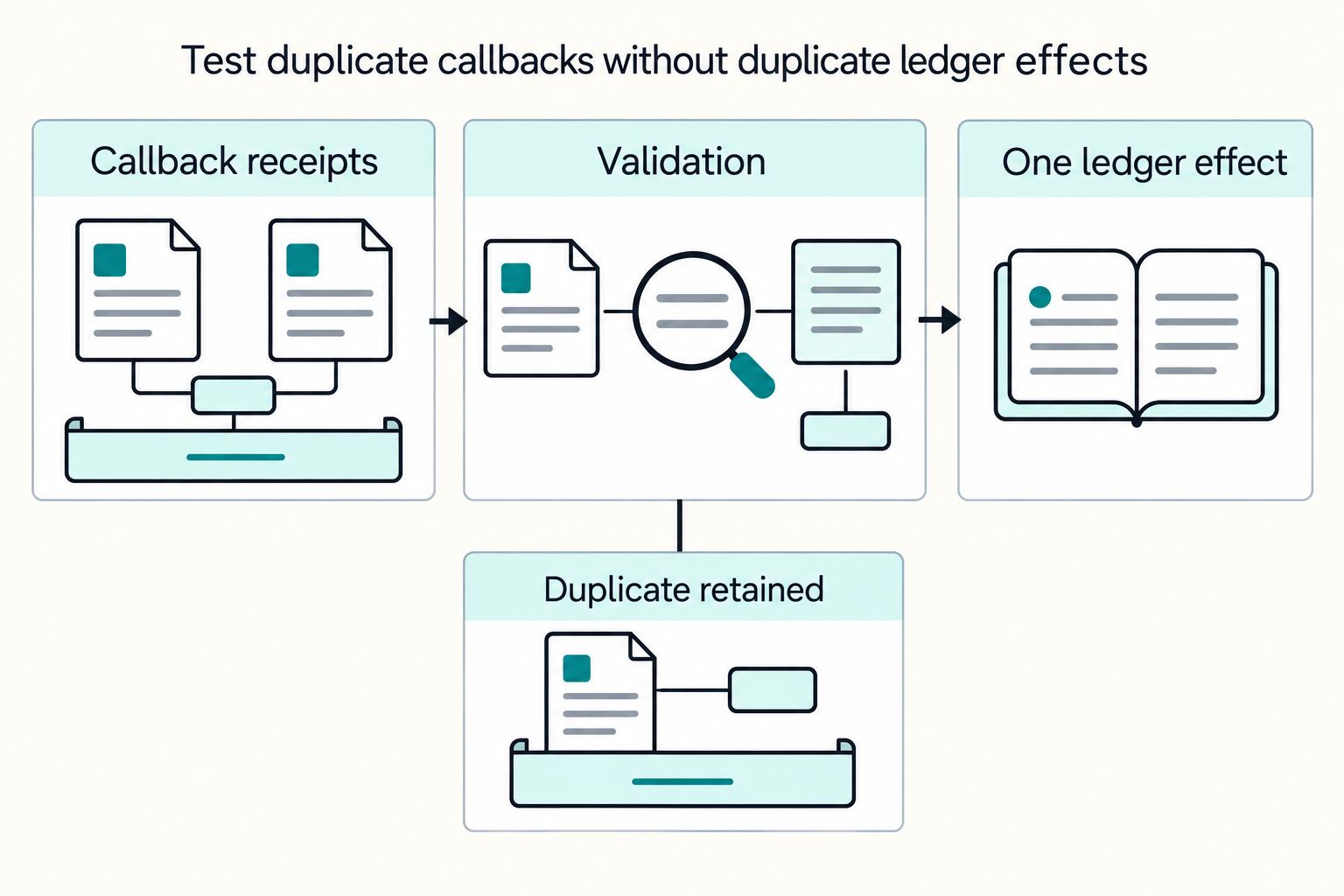
| Dedupe and validation | Use the provider’s event identifier and documented signature scheme; test invalid signatures and duplicate business effects separately | Deliver the same callback twice and confirm one ledger effect, one final resource state, and a recorded duplicate receipt |
| Receipt before ledger mutation | First validate and persist the callback, then let downstream processing attempt status or journal updates | Simulate a handler failure after a successful journal write and confirm the retry does not create a second journal entry |
| Traceability | Persist a link between your internal request reference, idempotency key, provider object reference, callback receipt, internal status transition, and any journal or balance reference | Keep an operator evidence pack per incident: request reference, webhook payload hash, idempotency key, affected resource ID, and the final resolution outcome |
| Delivery variance | Run ordering, duplicate, and delayed-delivery scenarios in your provider test environments | Replay an older event after a newer one; verify it cannot regress state or suppress a legitimate refund, dispute or payout return |
Write each callback to a durable receipt record before applying business effects. Keep the provider event ID when present, plus provider name, arrival time, raw payload, selected headers, and a payload hash you compute so retries and incident reviews stay auditable.
Verify the provider’s signature over the required raw request data before accepting business effects. Use a stable event identifier for receipt deduplication and a separate transaction or operation key for duplicate business-effect protection. An API idempotency key does not authenticate a webhook. Test concurrent duplicate processing as well as sequential replay.
Separate callback receipt from ledger mutation. First validate and persist the callback, then let downstream processing attempt status or journal updates so retries do not create duplicate money movement.
If processing succeeds but the callback response path fails, a retry should resolve as already applied rather than post again. For flows that send callbacks after a required confirmation threshold, still treat the callback as untrusted until validation passes. Verification point: simulate a handler failure after a successful journal write and confirm the retry does not create a second journal entry.
Make every callback traceable to the REST API resource state your platform exposes. For each payment-related resource change, persist a link between your internal request reference, idempotency key, provider object reference, callback receipt, internal status transition, and any journal or balance reference.
If you cannot quickly answer which callback changed a resource state, your audit trail is too thin. Keep an operator evidence pack per incident: request reference, webhook payload hash, idempotency key, affected resource ID, and the final resolution outcome, whether applied, duplicate, or rejected.
Test delivery variance deliberately, then record observed behavior. Do this instead of assuming sandbox behavior matches production. Run ordering, duplicate, and delayed-delivery scenarios in your provider test environments, and verify your adapter remains correct even when timing or order changes.
Allow only documented state transitions. An old event must not overwrite a newer state, while a legitimate refund, dispute or payout return may change a previously successful outcome. Retrieve current provider state when event order leaves the outcome ambiguous; retain the receipt and reason for applying or ignoring it.
If you are tightening operator visibility around this work, pair it with How to Build a Payment Health Dashboard for Your Platform.
Cover payout, wallet, and FX scenarios before go-live#
Exercise payout, wallet and FX behavior against your own contract and provider capabilities. Keep internal deterministic simulations separate from provider-supported scenarios, and record which settlement and bank-arrival checks still require controlled live validation.
| Scenario | Test input | Expected evidence |
|---|---|---|
| Payout eligibility | Pending verification, insufficient available funds or changed beneficiary | Creation blocked or routed to review without money movement |
| Ambiguous payout submission | Timeout after the provider may have accepted the request | Original reference reconciled before another payout is created |
| Wallet balances | Pending funds, available funds, holds and concurrent spend attempts | One documented balance effect per operation; unavailable funds cannot be spent |
| FX quote | Expired quote, currency mismatch and rounding boundary | Expired terms rejected or explicitly requoted; charged and received amounts retained |
| Payout return | Return after an earlier paid status | Return linked to the original payout and reflected once in balances and reconciliation |
For example, replay a payout-return event twice after a simulated successful payout. The return should create one compensating balance effect linked to the original operation, with both receipts retained. Do not create a replacement payout until the return and any eligibility changes are reconciled.
Run negative tests and failure injection on purpose#
Run failure injection deliberately so each negative test in your sandbox ends in a known, auditable outcome instead of a guess.
Start from the API contract before writing negative cases. Publish the OpenAPI specification and generate sandbox routes, expected fields, and response structures from it. Then map each injected failure to a defined request and response shape and expected outcome, including pending reconciliation when appropriate.
Use one compact matrix and require explicit recovery for every row.
| Failure case | How to inject it | Recovery action (retry, manual trigger, customer status) | Expected state or outcome to verify |
|---|---|---|---|
| Auth failure | Send invalid or expired credentials to a sandbox endpoint | Define whether auth errors are retried; define when to trigger manual intervention; show a clear failed or auth status to the customer | Request is rejected and final status is consistent across systems |
| Webhook timeout | Delay or drop webhook-handler response in test | Define retry handling for timeout events; define escalation to manual review; show a pending or issue status until resolved | Event reaches one final recorded outcome with traceable handling |
| Duplicate callback | Replay the same callback or event twice | Define duplicate-handling retry behavior; define when manual review is needed for conflicts; keep customer status unchanged by duplicates | Only one effective state transition is accepted and logged |
| Stale quote | Submit a payment or payout with an expired quote reference | Define retry path as re-quote and resubmit; define manual path if quote or state conflicts persist; show quote-expired or reprice-needed status | Transaction exits to a deterministic reprice or fail state |
| Compliance hold | Force a hold or review path in sandbox | Define when retries are blocked; define manual compliance intervention trigger; show on-hold or review status to the customer | Flow remains held until explicit release or decision is logged |
| Payout return | Simulate a downstream return after initiation | Define retry versus exception handling for returned payouts; define manual ops trigger; show returned or failed payout status | Payout is no longer treated as completed and final return outcome is logged |
Use each provider’s current documented failure triggers. Where the sandbox cannot produce a required case, inject it at the adapter boundary and label that test as internal simulation. Keep a separate live-validation item for behavior that depends on actual bank, issuer or settlement processing.
A negative test passes when its outcome and recovery path are known and auditable. A timeout may correctly remain pending reconciliation; do not force it into a failed terminal state while the provider could still complete the operation. Check backend state, operator records and customer-visible status against that expected outcome.
For adjacent implementation patterns, see How to Build a Partner API for Your Payment Platform: Enabling Third-Party Integrations.
Set release gates from sandbox to production#
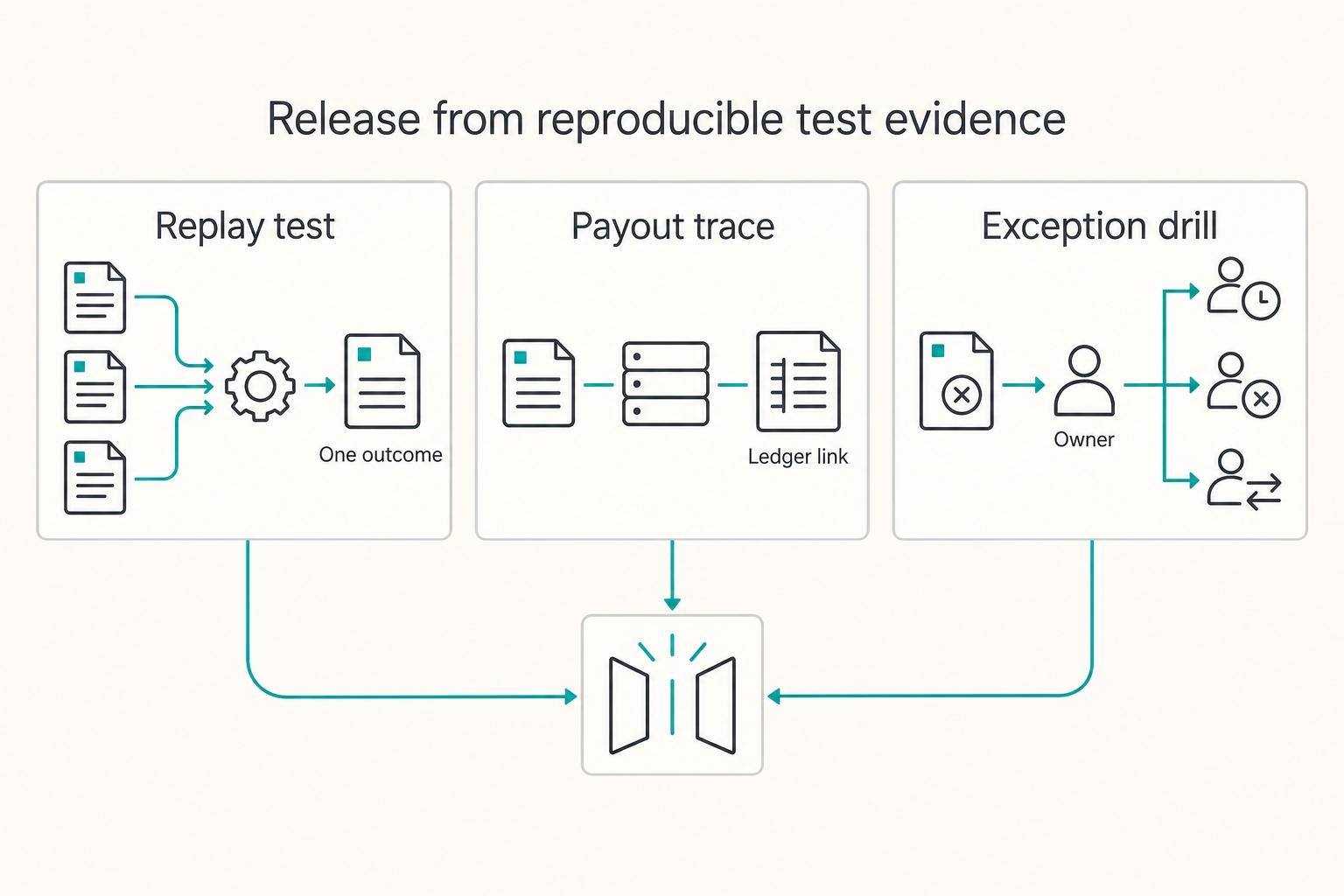
Do not move to production just because sandbox tests are green. Promote only when core flow tests pass, webhook handling is verified, and sandbox-to-production differences are documented.
Use one release checklist with auditable evidence for each gate. At minimum, include passed integration coverage for core payment flows, webhook validation results, and a parity-gap note for each provider or setup you use.
Each gate should point to an artifact, not a verbal update: for example, a test run ID, build reference, environment, and sampled request or event records. If a passed result cannot be traced to a specific build and sample, treat that gate as incomplete.
Treat webhook validation as its own release gate. Confirm your system correctly handles notifications for payment completion, refunds, and disputes, and document expected behavior for replayed events before go-live.
Keep this explicit in go-live criteria, because sandbox behavior can be similar to production while still differing in ways that affect configuration and outcomes.
Add checks for production behaviors your sandbox cannot prove. Use provider-issued test accounts and documented test inputs so expected outcomes are reproducible, then record what was actually validated versus assumed.
Also verify transaction routing from logs before release. Some setups can still send traffic to test endpoints even when environment settings appear correct.
Set a clear no-go rule. If parity gaps are undocumented, webhook coverage is incomplete, or key flow evidence is missing, delay release. A smaller launch with explicit known gaps is safer than a broad launch based on sandbox assumptions.
Before you finalize go-live gates, document your webhook replay expectations against implementation details in the Gruv docs.
Fix common mistakes before they hit production#
After you set release gates, fix the mistakes that create false confidence. If a result does not hold across environment changes and real-world data, treat it as incomplete launch evidence.
Do not treat green sandbox tests as production certainty. Sandbox runs validate behavior in an isolated test environment with test credentials and dummy data, but behavior can still break with real-world data.
Keep sandbox and production evidence separate for each launch path. Record the exact account, endpoint, and environment used, plus what was validated versus assumed. If that note is missing, hold release.
Do not blur sandbox and production configuration. Use sandbox-specific dashboards, API base URLs, and credentials in testing, and keep integrations pointed to sandbox URLs until go-live.
Do not postpone compliance checks until after launch. If AML or KYC validations are in scope, test them in sandbox with the same rigor as payment flows.
Keep checklist evidence concrete across API keys, webhooks, logs, branding, and AML or KYC validations. Also confirm cross-functional sign-off from engineering, compliance, and product before launch.
Do not ship with weak webhook and failure handling. Before release, validate webhook notifications for payment completion, refunds, and disputes, and simulate declines, insufficient funds, network timeouts, and webhook failures.
If failure scenarios are not handled cleanly, delay production and fix handling first.
For a step-by-step walkthrough, see How to Build a Partner API for Your Payment Platform: Enabling Third-Party Integrations.
Conclusion and copy-paste launch checklist#
A sandbox is successful when it reduces uncertainty for production decisions, not when it merely produces a few green test transactions. We treat that as the real signoff bar. If your team still cannot answer what happens to money state, onboarding status, payout eligibility, or reporting after a retry or delayed notification, you are not done.
1. Freeze the evidence before you argue about launch. Do not take "it worked in test" into a release meeting without artifacts. In our reviews, your go-live packet should include the scope map, known parity gaps, sample request and response traces, webhook or IPN payloads, provider request IDs or event IDs, the idempotency key used for replay, and the final internal status reached after each replay. That is strong evidence that your integration behaves predictably when notifications are duplicated or delayed.
PayPal is a clear reminder that sandbox success is not production proof. Its sandbox guide documents differences between sandbox and live. It also covers planning the types of test accounts you need, adding a funding source, and "Setting up IPN in the Sandbox." For PayPal Sandbox, signoff should state exactly what was tested in sandbox and what still requires live validation.
2. Check the real release blockers, not just the payment happy path. Onboarding and notification integrity are common launch blockers. OPP documentation calls out KYC / Merchant onboarding requirements, Idempotency, Validating Notifications (Signed Notifications), and a separate Production key checkpoint. If your product allows payouts or balance visibility, no action that moves money should depend on an unstored or unauditable onboarding state.
Our practical verification rule is simple: replay one signed notification against a completed transaction and confirm your application stores the provider event reference, blocks duplicate side effects, and keeps records consistent. A key failure mode to test for is double posting, silent status drift, or an operator having no evidence to explain why an internal state changed.
3. Paste this checklist into your launch ticket and edit the bracketed parts. Use the checklist as a gate, not a ritual. If one box is still open because provider docs are unclear, mark the gap explicitly and decide whether that gap must be closed in production testing before launch.
- Scope map completed for each provider flow in scope, with explicit non-goals and parity gaps recorded
- Sandbox prerequisites collected for integrations in scope, including credentials, environment access, endpoints, and any documented setup artifacts
- End-to-end payment and webhook/IPN traces pass, including duplicate delivery and idempotent replay without duplicate side effects
- Onboarding and compliance gates tested where enabled, including
KYCmerchant onboarding requirements - Negative-test matrix reviewed for failures you can simulate, with documented recovery action and operator-visible outcome for each case
- Production gate review completed by the owners responsible for launch risk in your organization
- Final evidence pack stored with request IDs, raw callback samples or payload hashes, idempotency keys, final resolution notes, and the checks that still must happen in production
If you want a technical review of your sandbox-to-production rollout plan, including payout and compliance gate sequencing, contact Gruv.
Frequently Asked Questions
What is a payment sandbox environment, and what should it simulate?
A payment sandbox environment is a dedicated test environment where you simulate transactions without processing real money. At minimum, it should cover payment flows and webhook handling with test credentials and dummy data. It should also include failure scenarios such as declines, insufficient funds, network timeouts, and webhook failures so you can validate failure handling before go-live.
Can sandbox testing replace production testing for payment platforms?
Sandbox testing reduces integration risk but does not replace controlled live validation. Clover's legacy production test merchant gateway does not validate card details or request completeness, so an environment labeled production can still be a test gateway. Identify the actual processing path behind each result.
What credentials and setup are required before running sandbox tests?
Use environment-specific credentials, endpoints and test accounts. Confirm the dashboard and API configuration both target sandbox. For Clover’s legacy developer platform, sandbox and production require separate developer accounts; use the instructions for the platform version your account runs on.
What is the first architecture decision to make for sandbox design?
First decide where provider-specific setup and validation behavior lives in your system. Provider docs already differ on account boundaries, sandbox endpoints, and notification validation steps, so keep your internal payment contract stable and map provider-specific requirements at the integration edge.
How do we reduce platform debt while adding more providers?
Keep one stable internal payment contract and narrow adapters that translate provider requests, responses and events. Use provider sandboxes to verify each adapter and labeled internal mocks for deterministic failure cases. Adding a provider should not require unrelated core payment-state code to adopt its field names or status model.
What should we test first for webhooks, retries, and reconciliation?
Start with signature verification, then duplicate and concurrent processing tests. OPP documents signed notifications and a retry schedule, while its successful API idempotency responses are retained for one hour. Keep durable business-effect deduplication beyond any provider key window, and check the semantics for each provider.
What details are still unknown from public docs and need direct provider validation?
Provider documentation can define retry schedules and idempotency windows, but those details differ between integrations. Check the current contract for each provider. Sandbox tests still cannot establish your actual bank-arrival time, production review outcome or every dispute and settlement path; record the remaining live checks explicitly.
Try a related tool
Researched and edited by the Gruv editorial team. Gruv builds cross-border billing, payouts, and finance-operations software for global businesses.
Sources
Includes 3 external sources outside the trusted-domain allowlist.
Educational content only. Not legal, tax, or financial advice.
Related Posts
How to Build a Payment Sandbox for Testing Before Going Live
Platform teams need a sandbox before go-live because it lets you validate payment behavior without touching live merchants or your production account. More importantly, it keeps launch decisions from resting on a clean demo of the happy path.
How to Build a Developer Portal for Your Payment Platform: Docs Sandbox and SDKs
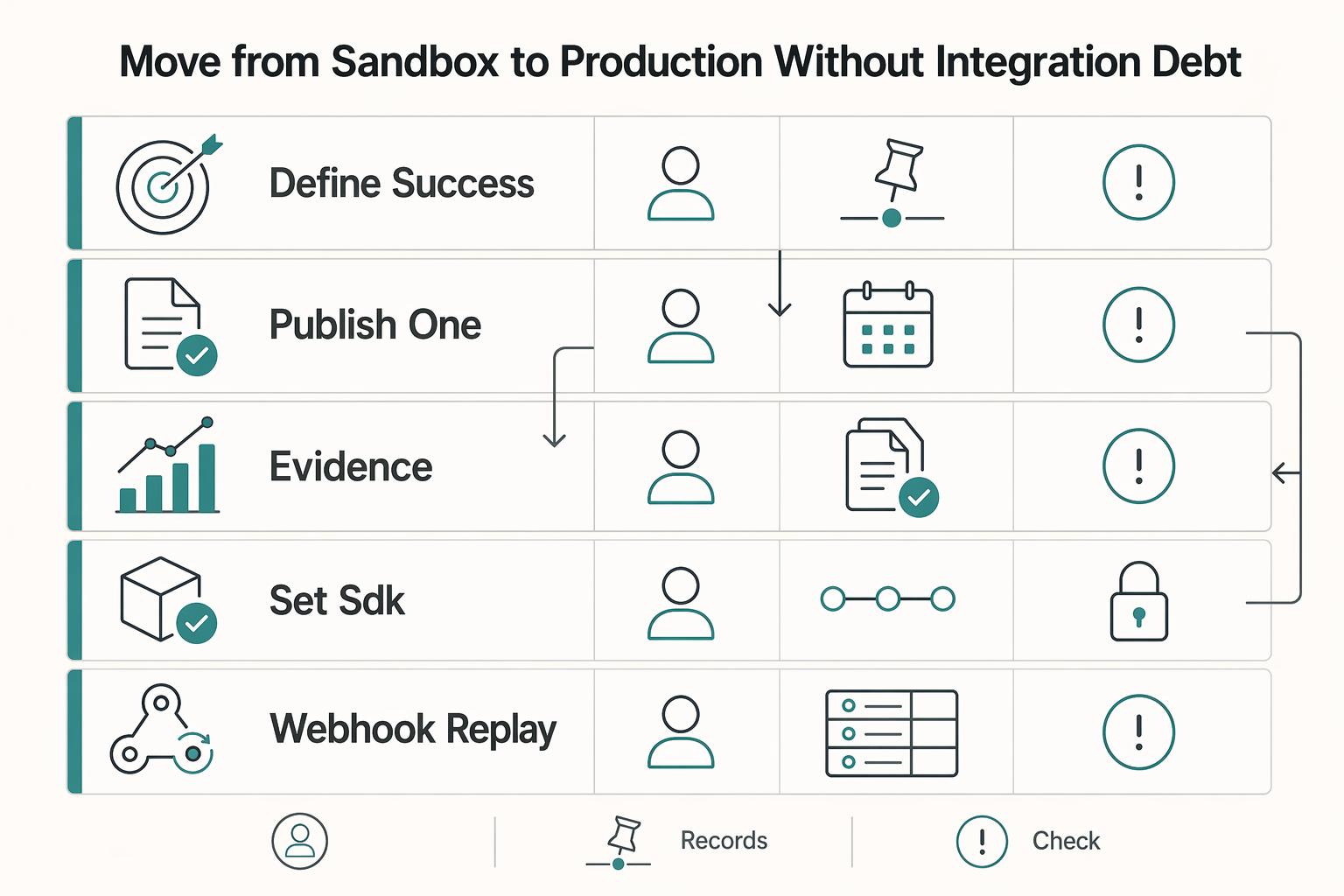
Build your portal so teams can move from the first sandbox call to production approval without guessing what comes next. The goal is speed without hidden integration debt: clear auth setup, explicit test expectations, and a defined go-live path.
How to Build a Payment Reconciliation Dashboard for Your Subscription Platform
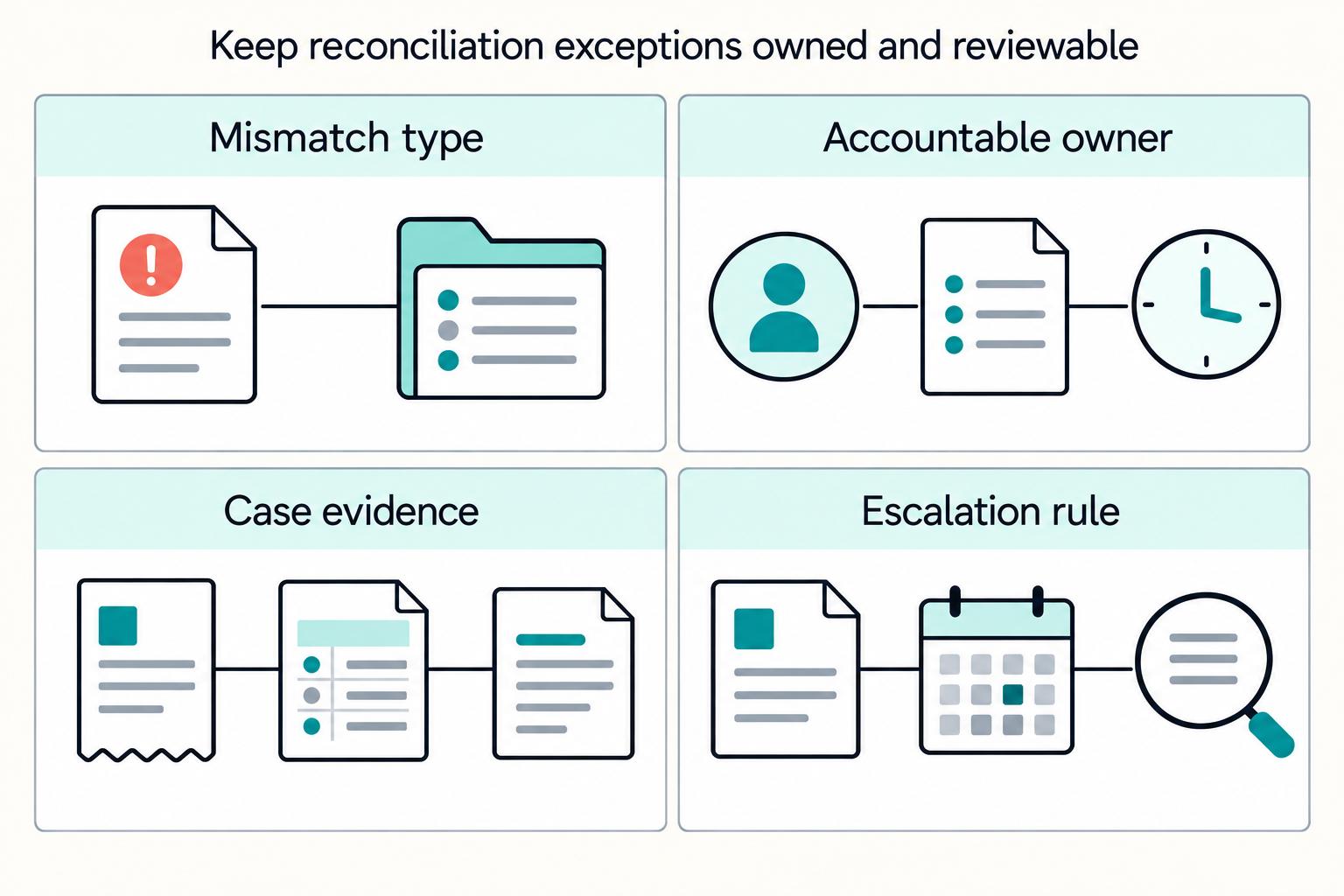
A usable dashboard is a daily control surface, not a reporting artifact. Finance, ops, and product should be able to see whether yesterday's payment movement is explainable enough to support close readiness and where exceptions are building.