
Quick Answer
Build it around one stable client-facing contract and keep provider-specific logic behind adapters. Standardize resource names, write semantics, statuses, errors, idempotency, and webhook handling early, then validate the Partner API against real provider behavior before launch. Add security, audit, reconciliation, and operator workflows so clients integrate once to your API instead of separately to each vendor.
Why Payment Platforms Need a Partner API#
Treat payment partner work as an architecture decision, not a quick integration ticket. If provider-specific objects, statuses, and errors leak into your public API, switching providers later can force client-facing changes.
Step 1 Name the decision correctly#
Start by separating API integration from third-party API integration. API integration is any connection between applications through APIs. Third-party API integration is narrower: you use a third-party tool to build and maintain that connection.
That distinction sets the ownership line. In a payment platform, clients should integrate to your contract, not a provider's raw contract. Early on, inspect a sample response from your public API. If it exposes provider enum values, provider error formats, or provider object names directly, coupling is already high.
Step 2 Standardize what must stay stable#
Delivery gets easier when you standardize a small stable core early: resource names, write semantics, status naming, and error shape. Keep partner-specific variation behind adapters.
A common failure mode in financial integrations is institution-by-institution custom coding, especially when communication protocols are not standardized. A componentized integration layer helps because teams can reuse and swap components for new integrations instead of rebuilding each one from scratch.
Use a simple boundary rule: if a provider difference would require client code changes, keep it behind your adapter. If provider references are needed for traceability, keep them in internal metadata or operator tooling.
Step 3 Verify the shape before production#
Validate contract behavior early, before implementation hardens. Request auth docs, webhook behavior, retry semantics, and status-transition examples, then test your contract against real provider outputs.
Two early checks matter most:
- Contract checkpoint
Map one end-to-end flow, such as charge creation or payout initiation, from client request to provider response. Confirm your canonical statuses still hold if provider wording changes or intermediate states are added.
- Efficiency checkpoint
For sync and backfill paths, verify whether batch or bulk retrieval is supported. Some APIs allow bundling up to 20 requests in one call, which can change polling, rate-limit handling, and recovery design.
The tradeoff is simple: a stable Partner API plus adapters reduces institution-specific coupling as partner behavior varies.
For vendor oversight, see Third-Party Risk Management for Payment Platforms: How to Vet and Monitor Your Payment Vendors.
Define the boundary you will own#
Own one stable product-facing contract, and keep provider variability behind adapters. Your Partner API is what clients integrate to. Provider-specific logic stays in your integration layer.
Step 1 Use shared terms and ownership#
Set terms early so decisions stay consistent:
- API integration: a system-to-system connection that typically requires reading docs, coding, testing for provider requirements, and ongoing maintenance as systems change.
- Third-party API integration: when an external provider powers part of your capability set.
That distinction marks your ownership line. Third-party integrations are ongoing dependencies, so governance belongs in the design from the start: versioning, SLA monitoring, observability, and change management.
Step 2 Declare what each layer owns#
Document three layers and keep responsibilities explicit:
| Layer | Role |
|---|---|
| Partner API contract | Stable client-facing interface |
| Provider adapters | Provider-specific mapping and handling |
| Fallback behavior | What your product does when provider behavior changes or service quality drops |
If you operate a system of record, keep it as the system of record. Use the integration layer for abstraction and normalization, not to blur ownership.
Step 3 Keep gateway and processor differences behind the adapter#
You do not need a universal gateway-versus-processor definition to set a good boundary. The practical rule is simpler: if a provider-specific difference would change client-facing payload shape, status language, or error language, keep it in the adapter, not your public endpoints.
Step 4 Publish a one-page non-negotiables note#
Write and circulate a short boundary note that covers:
- stable resource names
- versioning policy
- deprecation windows
Keep it short enough that product, engineering, and ops will actually use it.
Prepare the inputs before writing code#
Before you open implementation tickets, lock the prerequisites. Integration work usually slows down when access, ownership, or provider behavior details stay unclear.
Step 1 Assemble the prerequisite pack#
Build one shared pack that product, engineering, ops, compliance, and finance can review together.
| Prerequisite | What to capture |
|---|---|
| Phase-1 flows | First charge path, first payout path, or both |
| Countries and currencies | Intended countries and currencies for phase 1 |
| Feature scope | Whether Open Banking or Embedded Checkout is in scope now, later, or explicitly out of scope |
| Access state | App registration, authorization, and approval status |
| Technical setup | Required software packages, code generators, and model repositories |
| Test environment | Whether a Sandbox exists and what it supports |
| Go-live dependencies | KYC or merchant onboarding requirements |
Treat access as a hard gate. For example, SP-API requires app registration, seller authorization, and an app in draft or published state before connection is possible.
Step 2 Collect provider evidence, not summaries#
Build from primary implementation artifacts, not summaries. Gather the actual auth docs, webhook docs, and any available retry or service-term documentation your team will build against.
If signed notifications are supported, collect the exact validation guidance up front, such as documentation covering HTTP signature verification and signed notifications. Also confirm whether API key access, verification, and sandbox access depend on developer-agreement compliance, so legal and compliance review happens before coding.
Document unresolved prerequisites explicitly. Public SP-API discussion threads show how easily this becomes an operational blocker, for example, "Prep and labeling details needed." Treat community guidance as directional until official docs confirm it.
Step 3 Define phase-1 acceptance in operator terms#
Define "working" before implementation starts. Keep phase-1 acceptance narrow and testable:
- first successful charge or payout in the intended test path
- reconciliation output finance can review
- clear incident-response ownership when provider behavior breaks
Align finance and engineering on reporting outputs early so required records and identifiers are captured from day one.
Step 4 List unknowns and owners#
Do not hide unknowns inside "we'll validate in testing." Create an open list for timeout behavior, partial failures, dispute handling, and data-retention constraints.
For each unknown, record:
- current assumption
- supporting evidence, or note that evidence is missing
- owner responsible for closure
If the provider cannot answer in writing, log it as a risk instead of assuming default behavior.
Choose build vs partner by component not by ideology#
Decide build versus partner one component at a time, not once for the whole stack. Start with commodity functions, and keep differentiating logic in your core domain.
Step 1 Score each component separately#
Do not make one blanket decision for "payments." Collection, fraud, onboarding, messaging, and payouts can have different speed, control, and compliance profiles. Score each row independently before architecture hardens around one vendor.
| Component | Default starting point | Delivery speed | Control need | Compliance exposure | TCO watchpoint |
|---|---|---|---|---|---|
| Collection | Partner first for standard card or bank collection | Often fastest | Medium | Can be high | Base rates can hide channel, international, and conversion costs |
| Fraud | Keep only unique decisioning in-house | Medium | High | Can be high | Review workload and disputes can outweigh vendor line items |
| Onboarding | Partner first for standardized checks; keep orchestration and UX in-house | Medium to fast | Medium to high | Can be high | Rework cost rises if provider states leak into product logic |
| Messaging | Keep transport replaceable behind your own interface | Fast | Low for transport, high for templates and audit | Medium | Direct vendor coupling increases switching cost |
| Payouts | Partner first unless payout logic is your product edge | Medium | High | Can be high | Exceptions and reconciliation can dominate fee math |
Expected outcome: each row should have one explicit reason, not "probably easier."
Step 2 Integrate commodity collection first, then model real TCO inputs#
For standard collection, partner-first can be the fastest path, but only if you model fees with real market and surcharge detail.
Stripe publishes 2.9% + 30¢ for domestic cards, plus +0.5% for manually entered cards, +1.5% for international cards, and +1% when currency conversion is required. Stripe also lists ACH Direct Debit at 0.8% with a $5.00 cap and states there are no setup, monthly, or hidden fees.
PayPal's US business pricing page shows card processing starting at 2.89% + $0.29 per transaction, with other rails priced differently: 3.49% + $0.49 for PayPal or Venmo transactions and 4.99% + $0.49 for Pay Later. PayPal also defines domestic versus international by whether sender and receiver are in the same market, and fee applicability is market- and region-scoped, so your model must be country-specific.
Verification checkpoint: for each shortlisted provider, capture the exact fee page, relevant market, all applicable surcharges, and the page's last-updated date. For example, PayPal's US business fee page shows Last Updated: February 9, 2026.
Step 3 Require written evidence for non-collection dependencies#
For any dependency that can create long-term recovery burden, require written provider evidence before committing it to your product surface. Treat unresolved behavior as a tracked risk, not an assumption.
Apply the same rule to communications. Keep your application calling your own notification interface so provider changes stay in adapters and configuration, not product code.
Step 4 Record lock-in as an explicit leadership decision#
Do not drift into single-provider architecture by default. If you choose one provider for speed, document what can be provider-specific and what must remain yours from day one, including status naming, idempotency behavior, references, reconciliation fields, and webhook handling.
A usable decision note includes:
- the component being outsourced now
- the trigger that would force a second provider or migration
- the estimated rewrite surface if you had to switch
Related: API-First Payments: How to Evaluate a Payment Infrastructure Partner for Your Platform.
Design the partner contract your clients integrate with#
Design this so clients integrate once to your Partner API, while provider differences stay inside adapters.
Step 1 Own one public contract and keep providers behind adapters#
Expose one contract you control end to end: stable resource names, write semantics, and response shapes. Do not mirror a provider object model directly, because provider lifecycle names, error formats, and access constraints can differ.
Map each public endpoint to an internal adapter operation, not straight to a provider route. Keep adapter evidence for operation name, auth model, access restrictions, and SDK caveats. For example, PayPal documents Partner Referrals as v2, marks it approved-partner-only, notes no current SDK support, and documents partner-referrals.create. Keep that detail in the adapter, not your public contract.
Step 2 Define one idempotent write policy across money movement#
Use one idempotency policy across write operations and retries. The goal is consistent client-visible behavior, even if providers implement retries differently underneath.
State what happens on replay and on conflicting reuse under your contract. If you cannot explain that behavior in a few crisp contract statements, clients may end up learning provider-specific retry rules anyway.
Step 3 Normalize statuses into your own internal graph#
Normalize provider statuses into your internal state graph, then publish only canonical states externally. Provider status labels, timing, and failure detail can differ. Your clients should not have to absorb those differences.
Avoid enum leakage in public responses. Once clients code against provider-specific values, gateway changes can become breaking changes and the integration can turn into one-off services work.
Step 4 Preserve traceability without leaking provider language#
Keep traceability through metadata and internal fields, not public provider enums. Use your transaction ID as the primary public identifier, and store provider references and adapter event IDs for support and reconciliation.
Sanity-check one real transaction path: what the client sent, what your API returned, which provider operation ran, and which provider reference came back. If that chain is hard to recover, tighten the trace model.
Step 5 Add contract tests at the adapter boundary#
Add adapter-level contract tests that assert public behavior consistency, not just provider connectivity. Verify that equivalent inputs yield the same public response shape, state mapping, and idempotency outcomes across adapters.
Prioritize drift-prone edges:
- create and retry write semantics
- status mapping into canonical states
- error translation into your public schema
- metadata persistence for provider references and internal IDs
Expected outcome: clients integrate once to your contract, not once per vendor.
This pairs well with our guide on How to Maximize Your Xero Investment as a Payment Platform: Integrations and Automation Tips.
Put security and compliance gates in front of money movement#
Money movement endpoints need controls before execution, not cleanup after the fact. Treat this baseline as non-negotiable: every API call should be authenticated, authorized, encrypted, and auditable.
Step 1 Enforce the call and storage baseline#
Set the baseline at the API edge and carry it through internal processing paths. Encrypting transport alone is not enough. Each request also needs an authorization decision and an audit record of who called what, when, and what happened.
For payment data, make secure, compliant storage a release gate instead of a later hardening task. A practical checkpoint is implementing PCI DSS-compliant payment data storage before handling live payment data.
Step 2 Gate high-risk actions before posting#
"Request accepted" should not automatically mean "money posted." Put pre-execution checks in front of higher-risk actions, and make the outcome auditable.
The exact control flow can vary by implementation, but decision points should stay explicit and auditable before funds move.
Step 3 Define logging boundaries early#
You need observability that supports debugging without creating a second store of sensitive data. Define up front what is allowed in logs and related operational systems.
Which fields must be masked or excluded depends on your compliance obligations; define those boundaries early so teams can debug without broad sensitive-data exposure.
Step 4 Test controls with realistic pre-production assumptions#
Sandbox passes validate functionality, but they are not a scalability test. In Amazon SP-API, there are two sandbox environments. The static sandbox uses pattern matching for mock responses, and sandbox use is for functionality testing, not scalability testing.
| Sandbox aspect | Stated behavior |
|---|---|
| Sandbox environments | Amazon SP-API has two sandbox environments |
| Static sandbox | Uses pattern matching for mock responses |
| Testing scope | Sandbox use is for functionality testing, not scalability testing |
| Request requirements | Required parameters are still needed even when responses are mocked |
| Restricted Data Token | Some scenarios require a Restricted Data Token sourced from production and passed into sandbox calls |
| Throttling | Rate five requests per second with burst 15 |
Requests still need required parameters even when responses are mocked. Some scenarios require a Restricted Data Token sourced from production and passed into sandbox calls. Sandbox throttling uses rate five requests per second with burst 15, so include those constraints in test design.
For a step-by-step walkthrough, see How to Build a Payment Compliance Training Program for Your Platform Operations Team.
Build webhook and idempotency handling for real failure conditions#
Webhook handling should assume retries and network failures so one event never creates more than one financial effect.
Step 1 Verify authenticity and store the raw event before business logic#
Use the provider's supported authenticity check first, then persist the raw event envelope before applying status or balance changes. Keep enough receipt metadata so support can answer what arrived and when.
Step 2 Use separate idempotency controls for inbound events and client writes#
Treat webhook deduplication and API-write idempotency as two different controls.
Use provider event IDs when available to avoid reprocessing the same webhook, and keep your own idempotency key policy on write endpoints to prevent duplicate transactions during retries or network failures. If a duplicate arrives, return the recorded outcome instead of reapplying side effects.
Step 3 Define and enforce one processing sequence#
Pick one internal flow and enforce it across providers. Keep provider event names mapped to your canonical status model so your Partner API stays stable if providers change.
Step 4 Give operations a safe recovery path#
Route failed webhook handling attempts into a recoverable failed-event path with the raw envelope and failure reason, then replay through the same idempotent handler when your stack supports replay tooling. Avoid ad hoc data patches that bypass controls.
Step 5 Validate with duplicates and out-of-order scenarios#
Test with a batch that includes duplicate events, transient failures, and out-of-order events where relevant. Confirm final balances and client-visible statuses remain correct, with no duplicated financial posting.
Make reconciliation and status surfaces usable for operators#
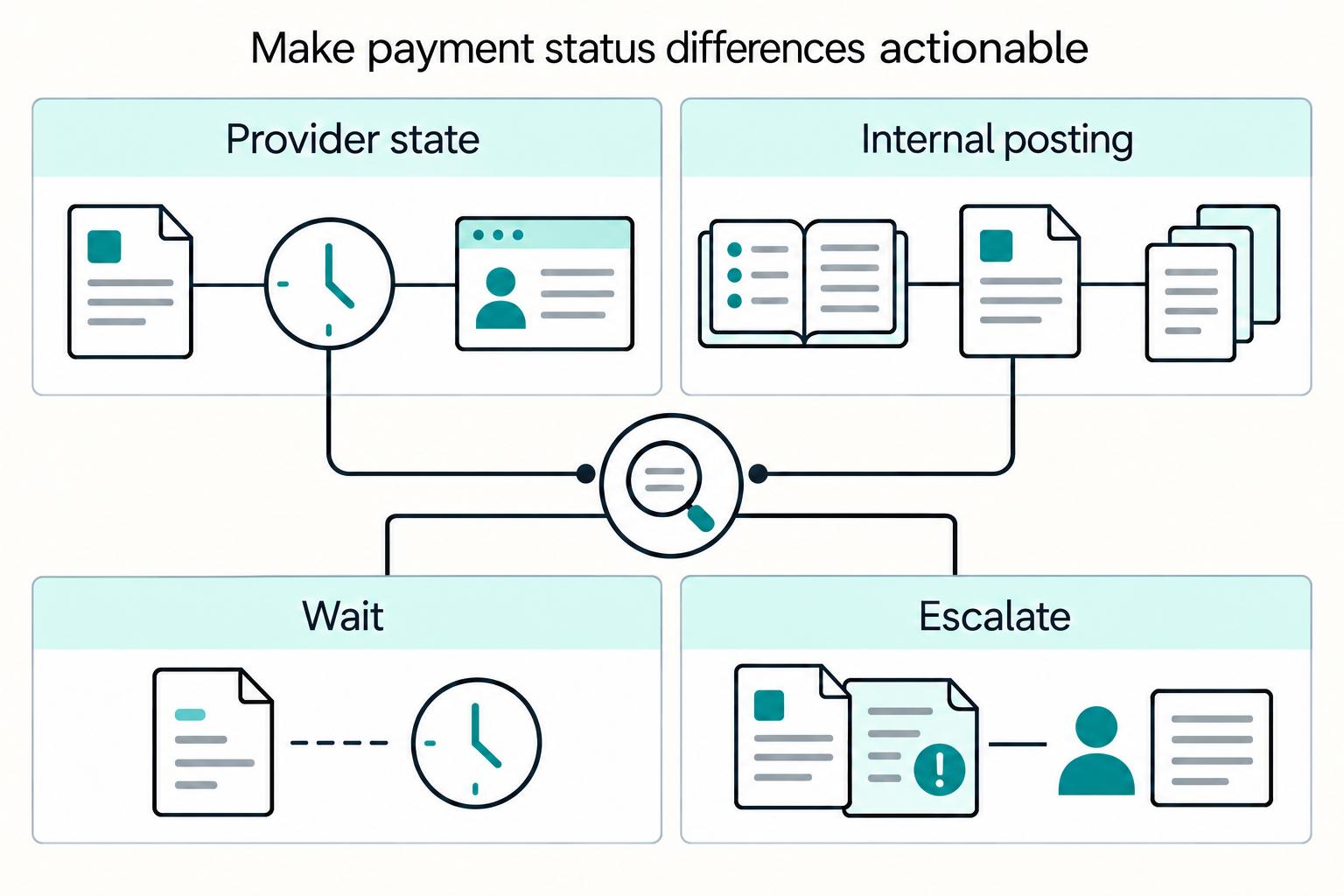
Operator tooling should make one thing clear quickly: whether external provider state and your internal ledger state are aligned. If that is not obvious in one view, stale or mismatched records become much harder to spot when cross-system updates are delayed.
Step 1 Build one trace chain for each payment flow#
Use a single trace chain across your orchestration layer so support, finance, and engineering can follow the same record path end to end. Keep your internal ledger as the authoritative internal posting record, and tie lifecycle events back to that record consistently.
A practical check is to take representative success and exception cases and confirm an operator can move from request context to provider context to internal posting context without database-only investigation.
Step 2 Normalize operator statuses around decisions#
Map provider-specific events into a stable internal status model so operators can act without translating vendor jargon. Keep the set small, and make sure each status has a clear operational meaning in your system.
For each status, define the expected next action:
- wait for a known confirmation checkpoint
- request user or support intervention
- escalate to engineering for contradictory state
Step 3 Show settlement and internal posting together#
Reconciliation gets easier when external settlement state and internal posting state are visible in the same surface and keyed to the same trace context. That makes differences inspectable instead of hiding them across separate tools.
If you provide exports for finance, align them to reconciliation work and include the identifiers needed to investigate mismatches.
Step 4 Make wait-versus-escalate rules explicit#
Because external and internal systems change in real time, define written eventual-consistency rules so support and finance know when to wait and when to escalate.
| Situation | Operator action |
|---|---|
| State is incomplete but coherent, for example awaiting a confirmation checkpoint | Wait and monitor |
| State is contradictory, for example external record without matching internal posting, or broken trace continuity | Escalate |
Standardize the escalation packet so engineering receives consistent context each time, for example event receipt details, status history, provider reference, internal transaction context, and related ledger records.
Related reading: How to Build a Deterministic Ledger for a Payment Platform.
Evaluate vendors with technical and commercial guardrails#
Use a shortlist matrix to compare vendors on evidence quality, regional fit, and long-term operating cost, not feature breadth alone.
Step 1 Build a shortlist matrix that forces evidence#
Include Stripe, Adyen, PayPal, Plaid, and Yodlee in one matrix, and require a verifiable artifact behind each score.
| Vendor | Pricing artifact you can verify now | Regional fit checkpoint | Key unknowns to close |
|---|---|---|---|
| Stripe | Public standard pricing page: 2.9% + 30¢ domestic cards, +1.5% international cards, +1% currency conversion, +0.5% manually entered cards, ACH Direct Debit 0.8% with $5.00 cap | Confirm whether your mix includes international cards, manual entry, or conversion, since those change effective cost | SLA terms, integration behavior details, migration terms |
| PayPal | Public US business pricing shows card processing starting at 2.89% + $0.29; US merchant and consumer fee pages both provide a Download printable PDF | Pricing is location-scoped; international treatment also uses market groupings | SLA terms, integration behavior details, migration terms |
| Adyen | Request current pricing schedule and contract exhibits | Validate country and currency fit for your launch markets | Contracted pricing details, SLA terms, integration docs, migration effort |
| Plaid | Request pricing and product-specific order form | Validate product and market fit for your launch markets | Contracted pricing details, SLA terms, integration docs, migration effort |
| Yodlee | Request pricing and product-specific order form | Validate product and market fit for your launch markets | Contracted pricing details, SLA terms, integration docs, migration effort |
Recency is a hard checkpoint: PayPal US merchant fees shows Last Updated: February 9, 2026, and US consumer fees shows Last Updated: February 19, 2026. If a document has no clear update date, request the current version before comparing vendors.
Step 2 Read SLA terms like an operator, not a buyer#
Treat SLA language as an operational input, not a legal formality. You need clear definitions for availability terms, exclusions, escalation flow, and how service credits are claimed.
If uptime wording or integration behavior stays vague, pause selection until those gaps are closed.
Step 3 Model TCO beyond headline fees#
Model total cost of ownership beyond transaction fees: adapter maintenance, compliance overhead, support burden, reporting differences, and migration friction.
Use public prices as a baseline, then test your actual mix. Stripe's surcharge structure can move effective cost above 2.9% + 30¢, and PayPal requires regional validation because pricing is location-specific and uses market groupings. On PayPal Iceland, some international EUR and SEK EEA transactions are treated as domestic for fees, which can change assumptions if you only review one country page.
Step 4 Ask for proof that operational claims are real#
Ask for concrete evidence, not assurances: integration-to-production comparison notes, event-delivery behavior docs, and release-history artifacts.
A practical evidence pack includes current API docs, sample event payloads, integration behavior notes, fee schedules, and the production support path. If those artifacts are incomplete, treat that as unresolved integration risk before you finalize vendor selection.
If you want a deeper dive, read Vendor Risk Assessment for Platforms: How to Score and Monitor Third-Party Payment Risk.
Avoid the mistakes that create long-term platform debt#
Long-term debt usually comes from integration design and operations gaps, not just missing launch features. Keep these four areas tight early so your platform stays maintainable as integrations grow.
Step 1 Confirm required integration paths and setup checkpoints#
Some ecosystems explicitly require API integration for third-party providers, so treat that as a starting constraint. In DoorDash's documented path, one early checkpoint is creating a Developer Portal account and organization before deeper integration steps.
Step 2 Treat integration planning as cross-team work#
Direct API integrations require technical planning and coordination between teams. Define ownership, visibility, and recovery expectations before go-live so operations are coordinated instead of ad hoc.
Step 3 Make security prerequisites explicit before launch#
Direct API integration increases your security responsibility. For payment API work, treat PCI DSS compliance and tokenization as non-negotiable prerequisites before expanding scope.
Step 4 Review maintenance load before expanding scope#
Treat integrations as ongoing operational systems, not one-time deliveries. Maintenance is continuous and resource-intensive, so review your upkeep burden before adding providers, markets, or flows.
We covered this in detail in How to Find Vendors for Your Platform and Vet Third-Party Providers at Scale.
Copy and paste launch checklist#
Use this as a go/no-go gate. If any item is still an assumption instead of tested evidence, hold launch.
-
Freeze your Partner API contract. Document your public resource names, statuses, errors, and authentication/authorization requirements before go-live. Verify with real request and response samples in sandbox or test environments.
-
Test idempotency on every write endpoint. Apply one clear idempotency rule across write operations, then verify repeated requests with the same idempotency key produce a consistent outcome. If behavior differs by endpoint, document it before release.
-
Validate webhook handling with real checks. Where supported, verify signed notifications and HTTP signature headers exactly as documented. Then test your downstream handling for duplicate or unexpected notifications so signature validation does not mask business-side issues.
-
Review data protection boundaries in live-like traffic. Inspect logs, events, and traces for PII exposure. Sensitive fields should be masked, excluded, or otherwise limited in operational tooling.
-
Record operating assumptions in the go-live artifact. Keep open risks visible and tracked, especially where vendor behavior or production-readiness evidence is still unclear.
Before rollout, map your checklist items to concrete authentication prerequisites, endpoint contracts, idempotency behavior, and notification-validation steps in the Gruv docs.
Conclusion#
If you want faster delivery without losing ownership clarity, integrate external capabilities early and keep ownership boundaries explicit.
Third-party API integration adds external capability to an internally built product, and APIs are the connection layer between platforms, financial systems, and processors. That is why it can reduce the cost, effort, and timeline of rebuilding mature capabilities from scratch. The practical guardrail is to define, in plain language, what your product promises, what the provider supplies, and what changes if the provider changes.
Scale in subsets, not all at once. J.P. Morgan's Payments Partner Network launched in beta with a subset of integrations even within a broader network that spans hundreds of third-party integrations. Use the same rollout logic: start with one payment path, one provider, and one outcome you can assess end to end before expanding.
Next, map your current payment flow against this guide, identify the first two architecture gaps, and close them before adding another partner. For idempotency, webhook handling, and reconciliation, define and test your own approach since these examples do not establish a single required operating model.
If you want a technical review of your partner API boundary, controls, and payout operating model, talk with Gruv.
Frequently Asked Questions
What is a partner API in a payment platform, and how is it different from direct API integration?
A partner API is the stable contract your clients integrate to, while provider-specific logic stays inside your integration layer. API integration is any connection between applications through APIs. Third-party API integration is narrower because a third-party tool powers part of that connection. Direct API integration can be done without that third-party integration tool.
When should we build in-house vs integrate a third-party payment partner?
Decide build versus partner component by component, not once for the whole stack. Collection, fraud, onboarding, messaging, and payouts can each have different speed, control, and compliance profiles. Start with commodity functions and keep differentiating logic in your core domain.
What are the minimum controls required before going live with third-party payment integrations?
Do not assume a universal legal minimum applies. Treat this as an operating baseline rather than a certification. Before go-live, make every call authenticated, authorized, encrypted, and auditable. Also freeze the public contract, test idempotency on every write endpoint, validate webhook handling, and review logs and traces for sensitive data exposure.
How should we sequence integrations across payments, risk checks, communications, and data aggregation?
There is no single universal sequence in the sources. A practical approach is to score each component separately and start with commodity collection first while keeping your own interfaces for replaceable services such as messaging. Also verify call volume and data freshness constraints early, since batch or report-style APIs can reduce total API usage.
What are the most common partner API failure modes, and how do we prevent them?
Common failure modes include endpoint timeouts, rate limits, data freshness issues, retries that duplicate financial effects, and provider changes that leak into client-facing payloads. Prevent them by keeping provider differences behind adapters, testing duplicates and out-of-order events, using separate idempotency controls for webhook events and client writes, and validating provider docs and update history before launch.
How do we avoid lock-in if we start with one provider like Stripe, Adyen, or PayPal?
Avoid lock-in by owning one stable public contract and keeping provider statuses, errors, object names, and IDs out of public responses. Store provider references in internal metadata for traceability, and document what can be provider-specific versus what must remain yours from day one. If you choose a single provider for speed, record the migration trigger and the estimated rewrite surface.
Researched and edited by the Gruv editorial team. Gruv builds cross-border billing, payouts, and finance-operations software for global businesses.
Sources
Includes 3 external sources outside the trusted-domain allowlist.
- apply07.grants.gov/grantsws/rest/opportunity/att/download/329652trusted
- developer.paypal.com/docs/api/partner-referrals/v2trusted
- paypal.com/us/business/paypal-business-feestrusted
- paypal.com/us/digital-wallet/paypal-consumer-feestrusted
- stripe.com/pricingtrusted
- apiable.io/resources/technology-partner-ecosystem-guideexternal
- chopdawg.com/third-party-api-integrations-extending-your-...external
- dashdevs.com/blog/api-integration-platform-for-banks-and-...external
Educational content only. Not legal, tax, or financial advice.
Related Posts

The Freelance Payment Penalty: A Modeled Audit of Platform Fees, FX Spreads, and Payout Delays
The money rarely disappears through a single, easy-to-spot fee. The real loss is stacked. A marketplace takes its commission, a processor adds a charge for international cards, a bank or payment company converts the currency at a spread, a platform holds the funds before release, and a wire sheds a little to intermediaries on the way in. Each layer looks defensible on its own, but the worker feels the combined result as a smaller deposit and a later payday.

How to Respond to a Subpoena for Business Records
Move fast, but do not produce records on instinct. If you need to **respond to a subpoena for business records**, your immediate job is to control deadlines, preserve records, and make any later production defensible.

A US Expat's Guide to Investing in UCITS ETFs to Avoid PFIC Issues
The real problem is a two-system conflict. U.S. tax treatment can punish the wrong fund choice, while local product-access constraints can block the funds you want to buy in the first place. For **us expat ucits etfs**, the practical question is not "Which product is best?" It is "What can I access, report, and keep doing every year without guessing?" Use this four-part filter before any trade: