
Quick Answer
Use a staged process: set non-negotiables, tier risk, filter leads, compare with a weighted scorecard, then pilot before full rollout. For teams trying to find vendors platform sourcing vetting third-party service providers scale, the article’s core rule is simple: move quickly by narrowing scope, not by skipping evidence review. Require concrete artifacts like a Vendor Risk Profile, draft SLA terms, and monitoring outputs before approval.
Why this guide is different from vendor roundup posts#
This guide treats vendor choice as a risk decision, not a shopping exercise. If a provider will touch payments, compliance, onboarding, or customer trust, roundup posts are only a starting point. They often do not give you enough evidence to approve, pilot, and monitor a third party with confidence.
Start from your decision, not the vendor category#
A "third-party" can mean almost any external organization you work with, so a generic ranking is usually too broad to help. Define what you need, why you need it, and how success will be measured before you compare anyone.
That is why this guide is built around operator documents like a Vendor Selection Checklist and Vendor Risk Profile, not marketing pages.
Use a simple check: if product, engineering, finance, and ops cannot explain on one page what the vendor will do, what data or funds it will touch, and what success looks like after launch, you are not ready to evaluate candidates. That page should be clear enough that each team would describe the decision the same way. If not, teams start arguing about priorities halfway through procurement instead of making a clean yes or no decision.
Separate claims from evidence early#
Good evaluation work is mostly about telling the difference between a strong sales story and a provider that can actually deliver securely. There is no universal method for every company, so your decision rules need to match your platform model, your controls, and your tolerance for operational failure.
For higher-impact providers, the evidence pack should go well beyond the demo. Ask for material you can review across functions: security and compliance expectations, incident escalation paths, draft Service Level Agreement (SLA) positions, and monitoring expectations after go live.
A common late-stage failure mode is choosing the vendor with the cleanest pitch, then discovering during review that no one can explain remediation timelines, reporting cadence, or what happens to your data and operations at contract end.
Use a path your team can actually operate#
The goal is not a prettier shortlist. It is to source candidates, vet them with evidence, pilot them under controlled conditions, and scale only after you have seen how they behave in real use.
That sequence matches the core logic of vendor risk management: identify, assess, monitor, and mitigate risk across the full third-party lifecycle, from onboarding through contract end. The real tradeoff is speed versus exposure. If you need to move quickly, narrow the pilot scope rather than skipping the evidence review.
It is often easier to launch a smaller pilot now than to unwind a provider later after it is tied into your payments, compliance work, or customer-facing operations.
If you want the detailed structure behind that path, the next section turns it into preparation work you can assign and check off. We covered similar process thinking in How to Find Beta Readers for Your Book and Use Their Feedback Well.
What to prepare before you contact any vendor#
Prepare your criteria before outreach or the sales process will set them for you. Pre-signing vetting is a safeguard, not just a compliance checkbox, and weak vetting can expose you to compliance issues, unethical practices, and financial loss.
Step 1. Define non-negotiables in a Vendor Selection Checklist. Tie the checklist to your model (marketplace, contractor platform, or creator payouts). Document what you need, why you need it, and how success will be measured, then mark true go/no-go items. If product, ops, and finance would score the same vendor differently, the checklist is still too loose.
Step 2. Create a one-page Vendor Risk Profile. Capture risk appetite, likely blast radius if the vendor fails, and which regulatory regimes matter in your markets (such as GDPR, HIPAA, or DORA). Use it to decide where deeper diligence is required before a pilot.
Step 3. List required operating artifacts up front. Ask for a draft Service Level Agreement (SLA), an incident escalation path, and Continuous Monitoring expectations. Demos are easy to polish; reviewable operating documents are a stronger credibility signal.
Step 4. Align internal owners before outreach. Assign named owners for commercials, integration checks, and reconciliation/control review (for example: procurement, engineering, and finance). If evidence review, exceptions, and redlines have no owner, decisions stall when you need a clear yes or no.
Related: Accounts Payable Outsourcing for Platforms: When and How to Hand Off Your Payables to a Third Party.
Map your vendor scope and risk tiers before you build a shortlist#
Once your checklist and Vendor Risk Profile are in place, make vendors comparable by function and risk tier before you shortlist. The goal is simple: deeper evidence for higher-risk relationships, lighter process for lower-risk ones.
Step 1. Segment vendors by function and blast radius. Group providers by what they do, then by how much impact a failure would have.
- payment rails or money movement partners
- compliance checks and verification providers
- onboarding tools that collect or route user data
- monitoring tools, including a Vendor Due Diligence Platform, used to track third-party risk over time
Use relationship characteristics to set blast radius: access level, data exposure and volume, and geographic footprint. If your map does not clearly show who can access what and where, it is too shallow for shortlist decisions.
Step 2. Assign risk tiers with Risk Scoring tied to your Vendor Risk Profile. Keep tiering practical, not over-engineered. Separate vendors into low, medium, and high exposure using criteria you can defend, then run the same risk workflow across tiers: identify, assess, monitor, and mitigate.
As risk rises, require more evidence, not more assurances. Tiering should help you focus on critical vendors, not push most of your longlist into the highest bucket.
Step 3. Define which system is enough at each tier. Use a Vendor Management System (VMS) where the need is relationship management, ownership, contract tracking, and routine review. For higher-risk tiers, add a Vendor Credibility Assessment Tool or due-diligence tooling when you need structured evidence review and stronger ongoing monitoring.
Document each tier with three fields before pilot decisions: required evidence, required reviewers, and required approval.
You might also find this useful: How to Find Affiliate Marketers for Your Platform: Recruitment Vetting and Onboarding at Scale.
Build a sourcing funnel that finds real candidates beyond listicles#
Once your risk tiers are set, build a funnel that expands discovery but applies one proof standard to every candidate.
Step 1. Pull leads from multiple source types. Use a mix of referrals, shortlist-style roundups, and broader market scans to find candidates. Treat every source as lead input only, not evidence that a vendor fits your platform.
Step 2. Classify the source before you trust the claim. Check whether a page is editorial coverage, a comparison listicle, or wire-distributed press-release content. If a page says newsroom staff were not involved, treat it as promotional material and use it for names and claims only. If a roundup uses framing like "12 best..." and "How to choose...", use it to build your longlist, not to validate controls, coverage, or delivery reliability.
Step 3. Run a two-pass filter before deep diligence. Pass one removes obvious non-fits on coverage, integration model, and operating fit. Pass two requests evidence on controls and delivery capability so you can compare candidates on proof, not presentation. Keep reported performance stats in context: figures like 92%, 1 in 10, 30%, 60 percent, or "three times faster" are vendor- or blog-reported claims, not independent benchmarks.
Step 4. Cap parallel evaluations. Shortlist enough vendors for a real comparison, but only run as many parallel evaluations as your team can review consistently. If reviewers cannot apply the same standard in the same cycle, signal quality drops and noisy sales motion can distort outcomes.
That is how a sourcing funnel becomes a decision process. For a step-by-step walkthrough, see How to Find a Book Editor for Your Manuscript Stage.
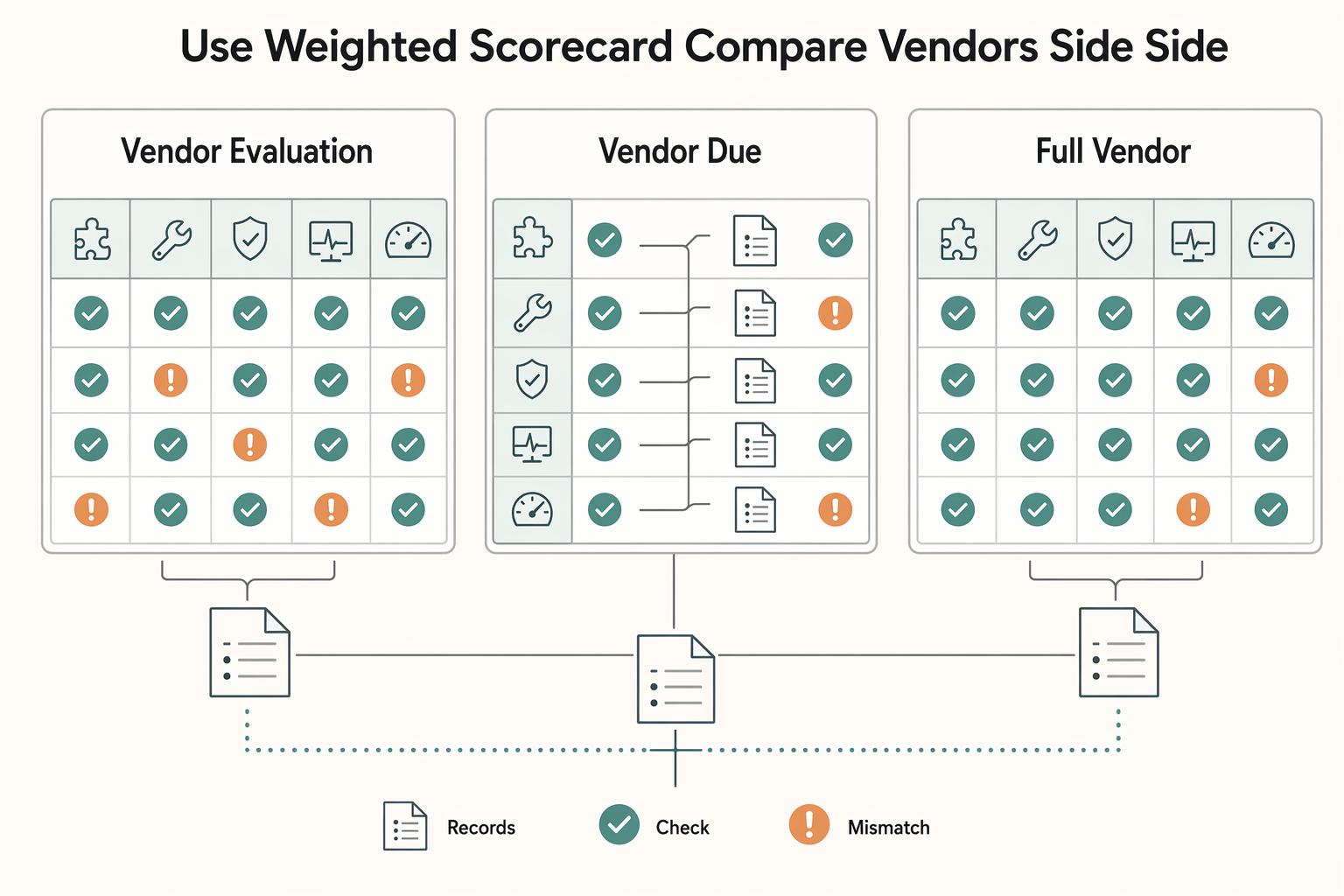
Use a weighted scorecard to compare vendors side by side#
Use a weighted scorecard to rank only qualified vendors, not to debate impressions from demos.
Step 1. Score the same criteria for every vendor. Build one matrix with explicit columns: capability fit, implementation effort, Service Level Agreement (SLA) quality, Continuous Monitoring, and total operating burden. Weight criteria by business impact, then score every vendor on the same scale. A 0 to 100 scale can work, but consistency matters more than the exact range.
Add an evidence field next to each score. If a score is not tied to supporting documentation, mark it incomplete.
Step 2. Compare solution category before brand. Decide what layer you need first, then compare vendors inside that layer.
| Category | Best fit when your main gap is | Main risk to watch |
|---|---|---|
| Vendor Evaluation Platform | side-by-side comparison and structured scoring during selection | strong comparison views without enough underlying evidence review |
| Vendor Due Diligence Platform | collecting and reviewing vendor risk evidence before approval | heavier process than needed for small, low-risk vendor sets |
Full Vendor Management System (VMS) | ongoing management across many complex vendor relationships | over-scoping if your immediate problem is basic selection discipline |
Step 3. Set go/no-go gates before ranking. Weighted scores should not override basic control gaps. If audit evidence is missing, incident response is weak, or data handling is unclear for your requirements, pause that vendor until evidence is complete.
Step 4. Encode tradeoffs so urgency does not distort the decision. If speed is the priority, you can accept narrower scope now only when contract terms preserve exit and data portability later. Also flag pricing uncertainty when comparisons do not use transparent methods or comparable implementation assumptions.
Need the full breakdown? Read How to Choose a Merchant of Record Partner for Platform Teams.
Run due diligence on security compliance and operational resilience#
Do not switch into trust mode after scorecard selection. Due diligence should get stricter here, because if this fails in production, you still own the fines, escalations, customer impact, and churn. Start with your Vendor Risk Profile, then require evidence that matches that risk tier.
Step 1. Require evidence by domain, not one blended "security packet." A high-risk vendor should not pass with a generic questionnaire and a polished security page. Third-party risk management (TPRM) is broader than security review and includes due diligence, documentation review, contract review, monitoring, and periodic re-evaluation. Split requests into cybersecurity, operational resilience, and reputational controls so Risk Scoring reflects real strengths and gaps.
| Domain | Ask for | Verify before scoring | Common red flag |
|---|---|---|---|
| Cybersecurity | audit evidence, security documentation, data handling explanation, named control mappings relevant to your use case | each claim ties to a document, date, and owner, not a sales answer | "compliant" claims with no underlying document set |
| Operational resilience | incident response process, escalation path, sample service reporting, sample Continuous Monitoring output | your team can see who is contacted, what is reported, and what action the report should trigger | annual questionnaire only, with no current operating evidence |
| Reputational controls | customer references, case studies, user reviews, analyst notes, major incident disclosures if available | external evidence supports delivery history; marketing claims alone do not carry the score | rankings and self-published claims treated as proof |
Keep the scorecard rule: unsupported scores stay incomplete. If a vendor cannot show the exact document, current version, and owner, do not score it as mature. This matters because many teams still track vendor data in spreadsheets, which often turns evidence review into memory and screenshots instead of an auditable record.
Step 2. Verify regulatory fit with named documentation, especially for GDPR and DORA. Do not accept checkbox language like "we support global compliance." A credible screening approach requires explicit control mapping to named frameworks such as DORA and GDPR, not broad assurances. Ask vendors to show how controls map to the regulations that matter in your markets and whether those mappings are current now, not post-signature.
If your use case is HIPAA relevant, require exact documentation, clear scope, and a named internal owner for any HIPAA-related statement. Do not treat demo language as proof.
Step 3. Test operating reality, not just paperwork. Annual questionnaires are not enough when vendors ship changes daily. Ask for the incident response process they actually run, primary and backup escalation contacts, reporting cadence, and a recent sample of Continuous Monitoring output. Then check whether the output is practical: what changed, why it matters, and what your team should do next.
Use this step for reputational diligence too. If the vendor claims strong delivery in complex environments, verify it with customer references, user reviews, and analyst notes. A clean narrative without external support is positioning, not resilience.
Step 4. Use conditional approval when controls look good but remediation speed is weak. If the evidence pack is strong but response behavior is slow, do not approve a broad launch. Proceed only with tighter Service Level Agreement (SLA) terms around response and remediation, and keep launch scope restricted.
Restricted scope should reduce blast radius, not just traffic volume. Limit rollout to a non-critical workflow, a smaller segment, or less sensitive data classes until operating behavior proves out. For a different service model example, see How to Create a Productized Service for Your Freelance Business.
Pilot integration with go or no-go checkpoints#
Paper diligence shows whether a vendor looks credible; the pilot shows whether it behaves predictably in your stack. Run it as a checkpointed decision stage, not a soft launch, and define exit rules before build work starts.
| Outcome | When it applies |
|---|---|
| Pass | reliability, reconciliation, and exception handling meet your acceptance bar; procurement and engineering sign off |
| Conditional pass | core behavior is workable, but gaps require a dated remediation plan, named owner, and contractual protections such as tighter Service Level Agreement (SLA) terms |
| No-go | unresolved duplicate risk, unclear statuses, weak escalation ownership, or reconciliation that still depends on manual workarounds |
Step 1. Time-box the pilot around production-critical outcomes. Anchor testing to integration reliability, reconciliation clarity, and exception handling, so the pilot stays tied to your highest-risk behaviors. If finance cannot trace outcomes or engineering cannot explain duplicate events, treat that as a scale blocker. Capture evidence in a simple shared log: request, response, event receipt, retry behavior, and final status per test case.
Step 2. Test retries and event disorder early, not after happy-path success. A clean normal flow can hide duplicate processing and ambiguous statuses. Third-party dependencies can introduce new attack and failure paths, so include delayed, retried, and out-of-order events in the core pilot set. Make the checkpoint explicit: can your team prove what happened from logs and vendor outputs without guessing?
Step 3. Use written exit gates with named owners. Checkpoint-based execution works when accountability is fixed in advance. Use the pass, conditional pass, and no-go outcomes above as written gates, and assign named owners to each. Cross-functional ownership should include procurement, engineering, and risk/compliance stakeholders.
Step 4. Require at least one adverse-path test before scale approval. Force a timeout, partial failure, or delayed update and evaluate detection, classification, and recovery. If adverse-path handling is unclear or inconsistent, pause rollout until remediation is documented and validated in pilot evidence. For a related procurement framework, see How to Choose a Corporate Service Provider for Offshore Incorporation.
Common vendor selection mistakes and how to recover fast#
Most bad vendor decisions are recoverable when you move the process back to evidence, shared ownership, and lifecycle monitoring before issues hit production.
Mistake 1: Choosing from roundups or demos without internal scoring. Recover fast: Re-score every candidate through your weighted matrix and Vendor Selection Checklist, with procurement, engineering, and finance scoring separately. A polished demo is not proof of fit: smooth demos can hide integration and data-migration risk, and one cited poll found 56% of professionals felt demos did not reflect real-world use.
Mistake 2: Treating compliance as legal-only. Recover fast: If obligations such as GDPR, HIPAA, or DORA are in scope, assign operating owners across legal, engineering, and ops instead of leaving them in contract redlines alone. Then require the vendor evidence your team actually uses in practice, such as data-handling documentation, escalation contacts, and control descriptions.
Mistake 3: Signing before the pilot proves operating reality. Recover fast: Pause signature until pilot evidence is complete and reviewed across legal, procurement, and compliance. Keep pilot logs and reconciliation notes, and lock in SLA remediation terms before full commitment. If error, retry, and ambiguous-state handling are still unclear, you are not done with third-party due diligence.
Mistake 4: Treating onboarding as the end of risk work. Recover fast: Run Continuous Monitoring across the full third-party lifecycle by identifying, assessing, monitoring, and mitigating risk after onboarding as well. Set recurring reviews, define reassessment triggers for incidents or scope changes, and name owners for follow-up.
If you want a deeper dive, read Vendor Selection Process for Platforms: How to Evaluate and Choose Third-Party Service Providers. For a quick next step, try the free invoice generator.
Make the decision and execute the first 90 days#
Once your pilot is a pass or conditional pass, stop comparing and start operating. Lock one primary vendor path, name one contingency path, and publish ownership across product, engineering, finance, and ops before rollout expands.
-
Confirm the primary path and fallback. Put the decision in a short note with named owners and clear triggers for when you move to the contingency path. If the fallback is only listed, but not owned, it is not ready.
-
Turn selection outputs into execution artifacts. Carry your
Vendor Selection ChecklistandVendor Risk Profileinto delivery. Build one working packet that includes your signedSLA, due diligence evidence, control mapping, pilot learnings, and monitoring plan so teams are operating from the same version. -
Run a disciplined 90-day rollout. Expand in stages, use a consistent checkpoint cadence, and track remediation items with an owner and current status. Pilot success should be treated as a starting point, not proof that production edge cases are resolved.
-
Use this launch checklist before scaling usage. If any item is still soft, pause expansion.
- Shortlist approved and final decision recorded with one primary path and one contingency path
- Due diligence evidence complete and stored with the latest
Vendor Risk Profile - Pilot outcomes documented and open issues tracked for remediation
- Contract protections in place, including the signed
SLAand applicable data-handling commitments - Monitoring live, with named owners and scheduled review dates
That discipline is what turns a good vendor choice into a stable operating relationship.
Frequently Asked Questions
How do you find and vet third-party vendors at scale without slowing product delivery?
Start by tiering vendors based on risk before deep review. A provider with broader access to data, networks, or facilities, higher information volume, or cross-border exposure needs deeper review than a low-impact tool. Keep the first pass fast by removing obvious non-fits, then use your Vendor Selection Checklist and Vendor Risk Profile to request focused evidence.
What should a vendor scorecard include for platform payments and infrastructure decisions?
Keep the scorecard tied to operating reality: capability fit, implementation effort, incident handling, and Continuous Monitoring expectations. Add explicit fields for data handling, access scope, information volume, geography, subprocessors, and whether customer data is used for training. A practical red flag is when diligence answers stay vague once you ask for operating evidence.
What is the difference between vendor management, due diligence, and credibility assessment?
Vendor management is the full lifecycle: identify, assess, monitor, and mitigate risk across the relationship, not just before signature. Due diligence is the deeper investigation you do before approval or renewal, especially for vendors with sensitive access or higher risk. Credibility assessment is narrower: it checks whether the provider's claims are consistent with the evidence and documentation provided.
How many vendors should a scaling platform use for critical payment and compliance functions?
There is no fixed right number. The better rule is to choose based on your context and risk profile, including access scope, information volume, and geography. Use the same evidence-based diligence standard for each critical function rather than relying on a generic benchmark.
What are the clearest red flags that should disqualify a vendor before pilot?
Disqualify early if the vendor cannot provide clear, consistent evidence for control claims. Another hard stop is weak transparency on subprocessors, data destination, or whether customer data may be used for training. If those answers stay fuzzy after direct questioning, you are not ready for pilot.
How do you evaluate vendor risk for regulated data and cross-border operations?
Use inherent and residual risk as separate questions. First ask what could go wrong given the vendor's access, data volume, and geographic footprint. Then ask what controls actually reduce that risk and how you will monitor it over time. For cross-border operations, verify where data moves, what subprocessors are involved, and who is accountable for changes. In fintech and similar regulated settings, this is critical because regulators may still hold your firm responsible for vendor actions.
Try a related tool
Researched and edited by the Gruv editorial team. Gruv builds cross-border billing, payouts, and finance-operations software for global businesses.
Sources
- armedservices.house.gov/uploadedfiles/rcp_text_of_house_amendment_to...trusted
- congress.gov/bill/119th-congress/senate-bill/1071/texttrusted
- csrc.nist.gov/files/pubs/sp/800/63/3/iprd/docs/sp800-63-2-...trusted
- documents.dps.ny.gov/public/Common/ViewDoc.aspxtrusted
- dodcio.defense.gov/Portals/0/Documents/CMMC/AssessmentGuideL2v2...trusted
- gao.gov/assets/d24105506.pdftrusted
- govinfo.gov/content/pkg/FR-2021-12-29/xml/FR-2021-12-29.xmltrusted
- nvlpubs.nist.gov/nistpubs/SpecialPublications/NIST.SP.800-161...trusted
Educational content only. Not legal, tax, or financial advice.
Related Posts
How Platforms Evaluate Third-Party Service Providers Before Signing
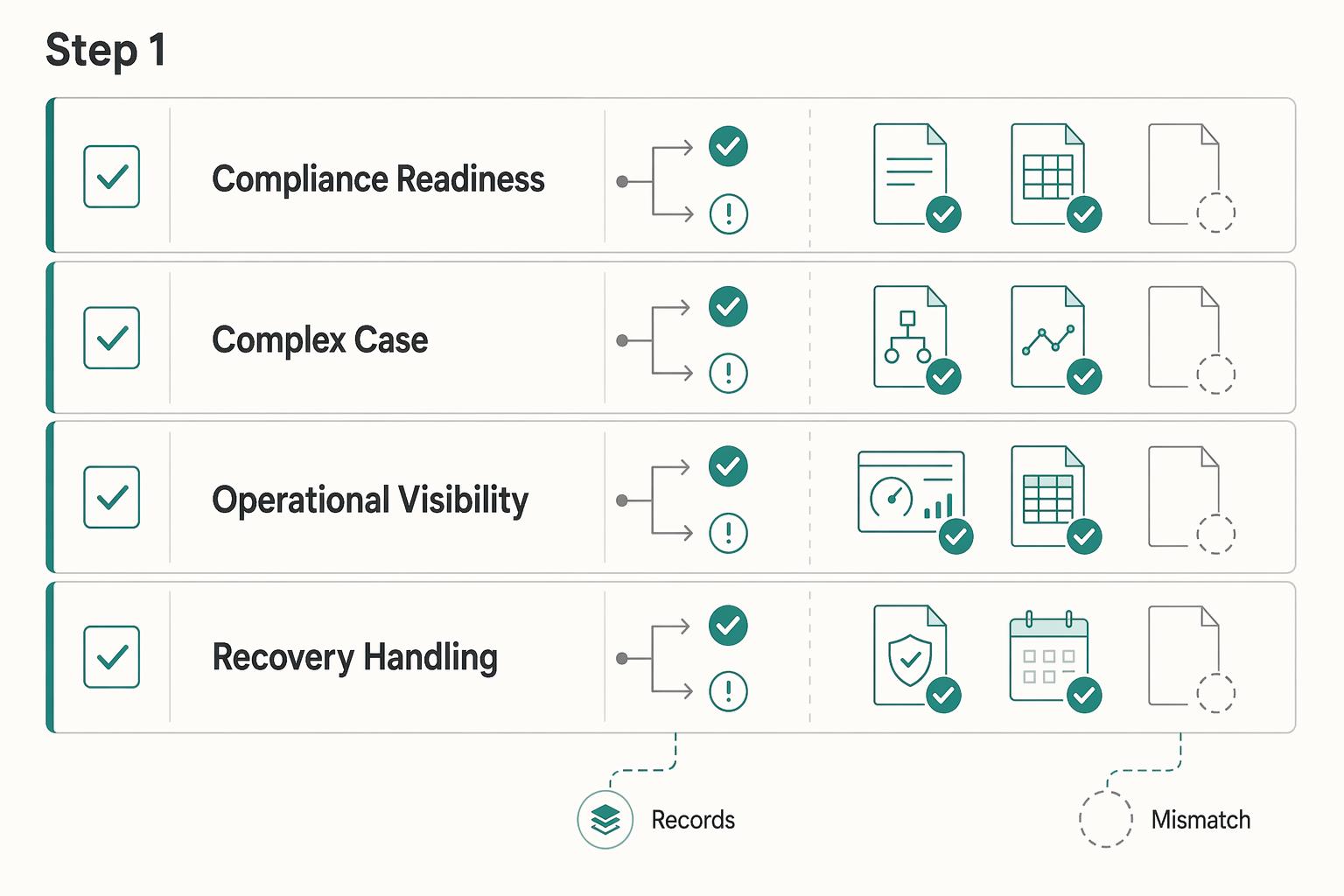
**Step 1: Treat vendor choice as a risk decision, not a feature contest.** A solid vendor selection process matches your requirements to vendor capabilities and pricing through a clear set of procurement steps. That sounds basic, but it matters because poor vendor choices have real business consequences. Feature lists rarely tell you how a provider will perform under real operational and risk constraints. If your team starts by comparing dashboards, coverage maps, or headline fees, you can end up shortlisting vendors that look strong in demos but fail once legal, finance, or operations gets involved.
Accounts Payable Outsourcing for Platforms When and How to Hand Off Your Payables to a Third Party
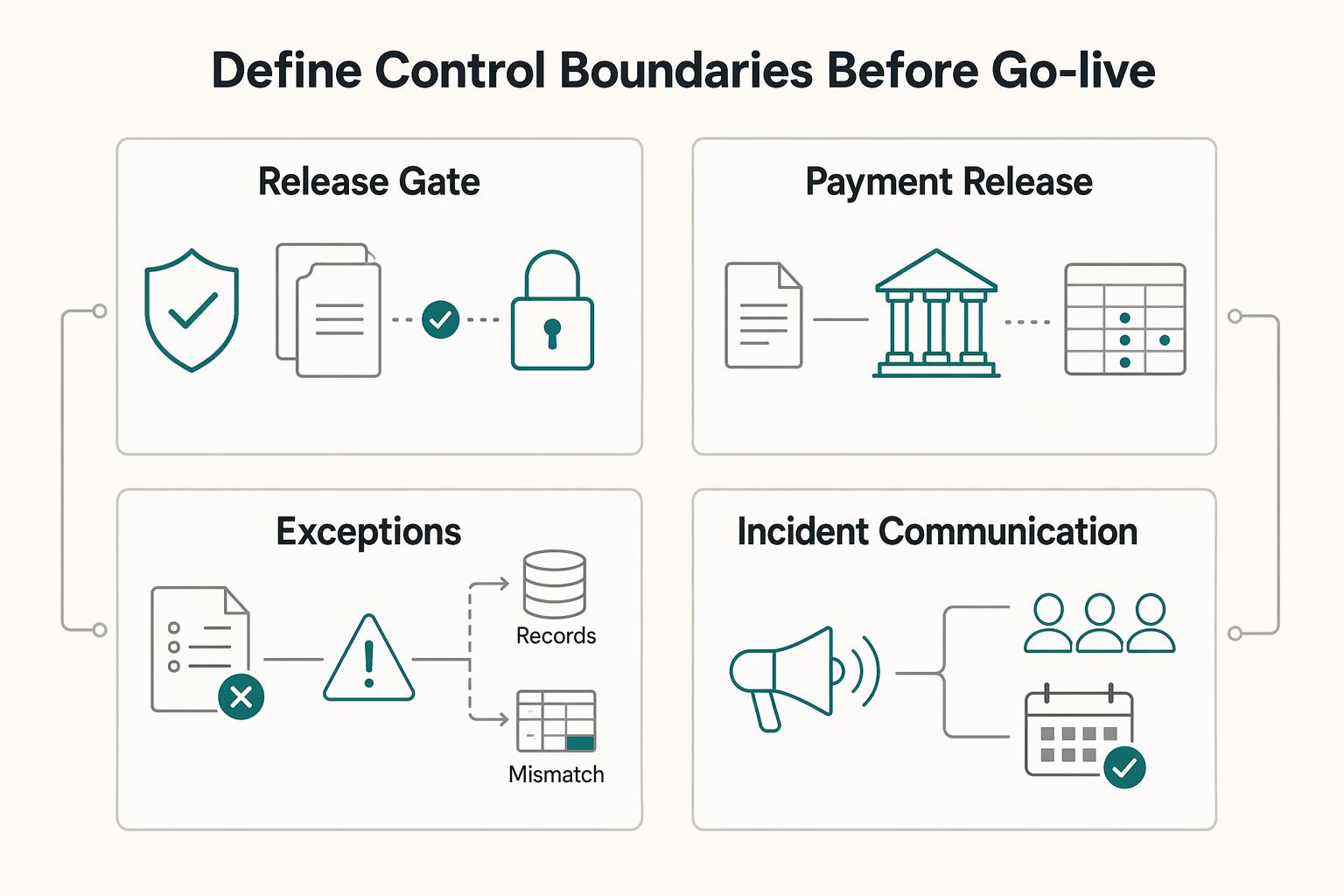
Start with the real choice, not the buzzword. Accounts Payable outsourcing means shifting AP work from your in-house team to a specialized external provider. In practice, your decision is usually narrower: hand off execution now, wait until the process is ready, or keep it internal and automate instead.
Find Affiliate Marketers at Scale Without Losing Vetting Control
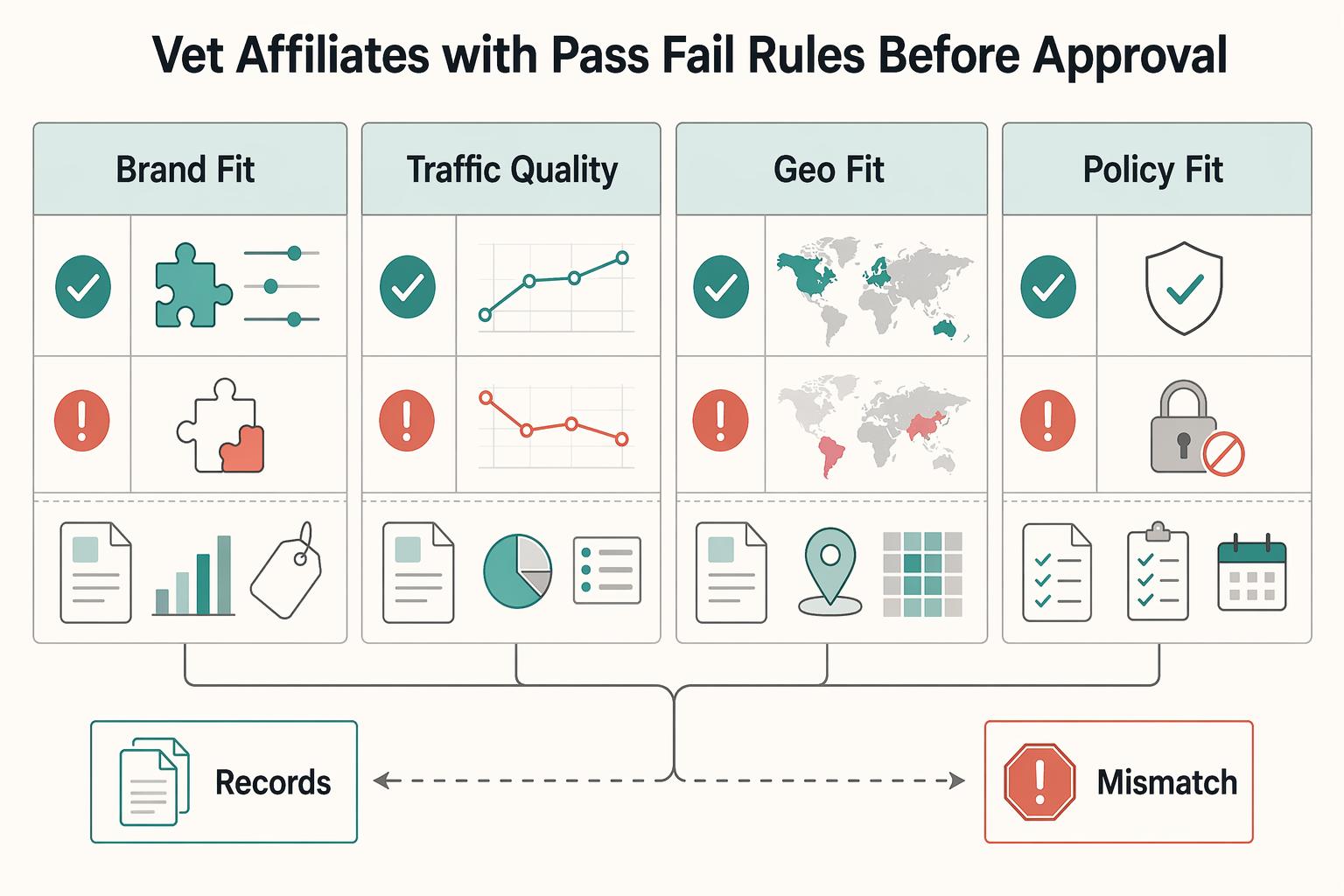
Many affiliate programs do not stall because too few people apply. They stall when too few approved partners get activated, and when approvals are treated as the finish line instead of a control point.