
Quick Answer
Use beta readers for your book as a structured test, not an open call for opinions. Pick readers who match your genre, set written expectations on privacy and deadlines, and collect notes in one format tied to chapter or scene locations. Then separate repeated signals from one-off reactions before you revise. This keeps role confusion low, protects manuscript handling, and gives you a cleaner path into the next draft cycle.
Why "Asking Friends and Family" Is a High-Risk Business Strategy#
If your feedback plan is "I'll send it to people I know," treat that as an informal signal, not a launch-readiness check on its own. It can help with morale or basic clarity, but major decisions are stronger when you add structured checkpoints instead of relying on intuition alone. When friends and family are your only quality control, risk rises across revision quality, schedule control, and manuscript handling.
Step 1 Diagnose bias and audience fit#
Start with reader selection. A practical baseline is to share drafts with people whose intentions you trust and whom you know well, then separate morale feedback from decision-grade notes. Use screened readers when you need specific, comparable input.
Audience fit is the next issue. A supportive relative who does not read your genre may still be thoughtful, but may not reflect likely buyer expectations. That can push revisions off target.
Before you share pages, confirm genre fit with a simple checkpoint. Ask each reader for a two- or three-sentence elevator pitch of what the book is. If their summary misses the premise or audience, weigh their notes accordingly.
| Criteria | Informal friend or family feedback | Structured reader feedback |
|---|---|---|
| Objectivity | Can be shaped by relationship context | Stronger when expectations and scope are clear up front |
| Relevance | May not match your target genre or buyer | Chosen for genre fit, reading habits, or full-read capability |
| Consistency | Often casual and harder to compare | Stronger when everyone gets the same questions and deadline |
| Operational safeguards | Often shared informally | Can include written expectations and tracked delivery |
Step 3 Protect your schedule and your manuscript#
Reliability is the next risk. Casual asks can turn into "I'll get to it next week," and your revision calendar slips when scope and timing are not explicit.
Ask for a full read only from people who can commit to it. Set a return date, and give every reader the same question set so you can compare responses instead of chasing one-off opinions.
Then there is confidentiality and IP exposure. This is not about assuming bad intent. It is about controlling who has your unpublished draft, where it lives, and what terms apply if you use outside readers or platforms. Share with people whose intentions you trust and whom you know well, or use written expectations when you work with new readers.
Be cautious with opaque platforms and tools, especially when terms are unclear and current copyright and IPR frameworks still show gaps. And if repeated criticism comes back from your target readers, be ready to cut scenes you love rather than defend them on instinct.
Step 5 Make your handoff list#
Before you recruit beta readers, decide what kind of help you actually need:
- a target-reader check for market fit, a craft-focused peer for writing flaws, a trusted full-read reader for end-to-end experience, or all three
- written expectations for deadlines, feedback format, and confidentiality before any full manuscript goes out
That handoff list should shape your pre-launch team. Once you know where informal feedback breaks down, you can assign the right jobs to the right people.
We covered this in detail in How to structure a contract for a 'beta testing' program for your SaaS.
Assembling Your Pre-Launch Team: The Four Roles in Professional QA#
Treat these as four distinct jobs, not one generic reader role. You make better decisions when each person answers a specific question at the right draft stage. This is launch-readiness quality control, not a favor-based reading circle.
One guardrail first: "beta reader" is not used consistently across publishing. In one publisher-style workflow, beta readers appear very late and may review final proofs; in many indie workflows, they are used earlier, often after a first draft. Define each role by the decision you need to make, not by the label alone.
| Role | Focus area | Best manuscript stage | Key question they answer | Common misuse to avoid |
|---|---|---|---|---|
| Alpha reader | Early concept and clarity | First complete draft or rough early version | "Does the premise track and make sense?" | Asking for line edits or market-positioning calls |
| Beta reader | Reader experience and audience reaction | Clean, stable draft after major rewrites, or near-final proofs for late-stage reaction | "Will the intended reader stay engaged and understand this book?" | Using beta feedback as copyediting or craft diagnosis |
| Critique partner | Craft-level problem solving (as you define it) | Working draft you are still willing to revise | "Why is this scene/chapter/arc not working yet?" | Treating peer craft notes as market-response evidence |
| Sensitivity reader | Risk checks on portrayal in relevant material (scope agreed in advance) | After relevant scenes are drafted, before final cleanup | "Where might portrayal or language miss in these sections?" | Asking for a blanket approval of the full manuscript |
Step 1: Use alpha readers to test core clarity before polish. Ask alpha readers for a high-level response: where they got confused, where interest dropped, and how they would summarize the book. If they cannot clearly state the premise, treat that as a concept or structure issue before you invest in sentence-level cleanup.
Step 2: Use beta readers to test experience, not to repair the draft. Send beta readers a clean manuscript with stable structure. Use near-final proofs only when you want a late-stage reaction closer to the historical publisher model ("see what they make of it"). Ask for reader-experience signals you can act on; keep copyediting separate.
Step 3: Use critique partners for targeted craft feedback. Define this role clearly in your process, since definitions vary. Ask for specific craft diagnosis tied to examples in the manuscript, then separate those notes from audience-fit feedback. If issues stay structural after multiple passes, consider professional editorial support; A guide to finding and working with a 'book editor' helps with that decision.
Step 4: Use sensitivity readers for defined portrayal checks. Set boundaries up front: which sections, what context, and what questions. The useful output is concrete revision flags in the scoped material, not general manuscript coaching.
Step 5: Assemble in sequence so each role sees the right draft.
- Start with alpha readers for concept and clarity.
- Use critique partners while the draft is still flexible.
- Bring in sensitivity readers for relevant sections before final cleanup.
- Finish with beta readers on a clean draft (or final proofs for late-stage response).
- Keep professional editing as its own track; reader feedback does not replace developmental editing, copyediting, or proofreading.
Next, map each role to the right recruiting channel so you can staff this workflow efficiently. For related process context, see What to Do If You've Been Misclassified as an Independent Contractor.
The Vetted Acquisition Funnel: How to Recruit Your Professional Readers#
Use a simple funnel you can run consistently: choose a sourcing channel, screen for fit, test feedback quality, then grant manuscript access.
Step 1 Choose the channel based on your goal#
Start with your main constraint:
- If you need faster recruitment and tighter scheduling control, start with paid reader services or marketplaces.
- If you want deeper genre conversation and long-term peer relationships, start with author networks or writing communities.
- If budget control is the priority, use your audience or social circle, but screen harder for bias and fit.
Recruiting beta readers is common, but the channel changes the tradeoffs. They can suggest improvements, but they do not replace an editor.
If this section of your launch plan includes early review preparation, begin outreach at least 4-6 months before release (closer to six months is safer).
| Sourcing channel | Best fit when you need | Vetting signals to look for | Typical tradeoff | Common failure mode |
|---|---|---|---|---|
| Paid service or marketplace | Faster recruiting and clearer scheduling | Genre fit, clear communication, willingness to follow instructions | Added cost, more transactional dynamic | Generic feedback that is hard to revise from |
| Author networks or writing communities | Genre-aware feedback and relationship-building | Familiarity with your genre, thoughtful responses, professional conduct | Slower recruiting, often reciprocal | Feedback shifts into craft coaching instead of reader experience |
| Existing audience or social circle (screened) | Lower cost and potential audience alignment | Honest interest in your genre, willingness to give unbiased notes | Quality and objectivity vary more | Encouraging reactions that do not surface real problems |
Step 2 Recruit with a narrow brief#
Avoid broad asks like "Who wants to read my book?" Instead, state the genre, the type of feedback you want, and the role (beta reader, not editor). This quickly filters for people who can provide honest, relevant notes.
Before you share pages, send clear instructions about what feedback you expect. If a candidate ignores that scope, treat it as a fit issue.
Step 3 Screen before manuscript access#
Run a light three-part screen:
| Screen step | What to confirm | How to check |
|---|---|---|
| Intake check | They read in your genre and understand the beta-reader role | Confirm during intake |
| Sample feedback check | Feedback is specific and usable | Ask for a short example of how they give notes |
| Communication expectations | Delivery format and timeline | Agree before access |
In practice, those three checks matter most: genre and role fit, sample-note quality, and agreement on format and timing.
Also separate trust from legal protection. Informal expectations can help, but they are not the same as formal safeguards.
Step 4 Use a ready-to-invite check#
Before onboarding, confirm all five points:
- They read in your genre and can give unbiased feedback.
- They understand they are not acting as your editor.
- Their sample notes are specific enough to revise against.
- They accepted your feedback instructions.
- You are comfortable with confidentiality expectations before access.
If one point is unclear, keep recruiting. A smaller, better-fit pool is usually easier to manage and more useful.
Related: How to get an 'ISBN' for your self-published book.
The BetaOps Management System: How to Guarantee ROI on Your Feedback#
Execution quality determines whether the feedback is usable. Your goal is draft-level input you can revise against before polishing, not a pile of opinions.
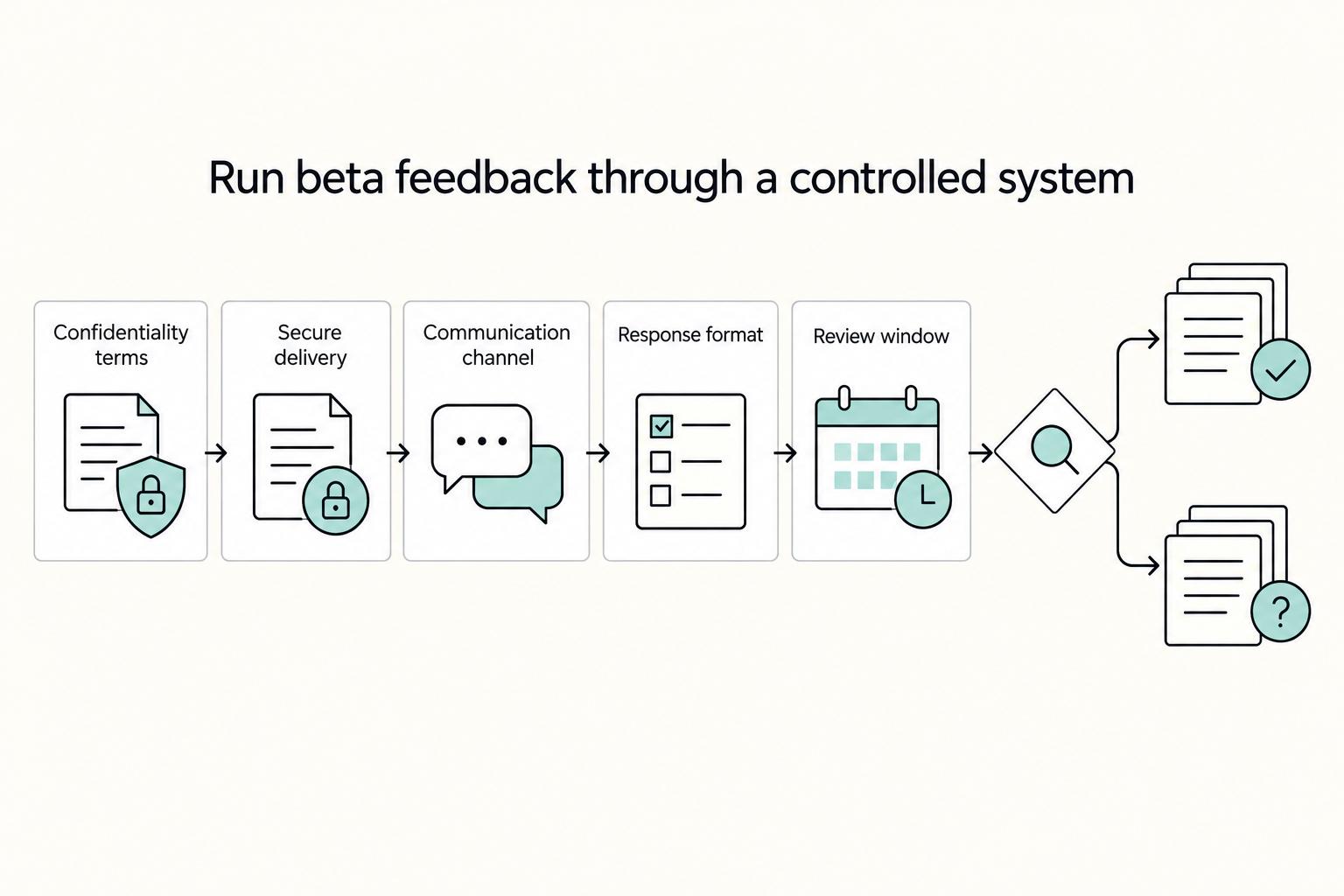
| Packet element | What it should cover |
|---|---|
| Secure file delivery | Use secure file delivery that limits casual forwarding where practical |
| Communication channel | Use one communication channel |
| Response format | Use one response format |
| Confidentiality terms | State that the manuscript is private and should not be shared |
| Review window | Set a clearly defined review window |
Step 1 Prepare the onboarding packet. Send one packet, not scattered files and messages. It should cover secure file delivery, one communication channel, one response format, confidentiality terms, and a clearly defined review window.
Include a brief welcome note, the manuscript file or access link, your questionnaire, and the review window. For delivery, use a method that limits casual forwarding where practical, like read-only access or a revocable link. For confidentiality, use plain terms: the manuscript is private and should not be shared. If you want formal legal language, leave that language and any related requirement pending until you can verify it against current applicable requirements, source records, or counsel before use.
Before reading starts, have each reader acknowledge the review window, response format, and confidentiality terms. If they will not confirm these basics, do not send the full manuscript.
Step 2 Set expectations before page one. Ask for draft-level feedback, not line edits. Beta readers are reviewing an unedited manuscript before polishing, so clarity about scope is what reduces vague praise and low-signal notes.
Define what useful feedback looks like: specific comments tied to chapters or scenes. "Chapter 6 felt slow because..." is practical. "Loved it" is not.
| Approach | Signal quality | Turnaround reliability | Revision readiness |
|---|---|---|---|
| Unstructured feedback request | Often mixed and praise-heavy | Less predictable because expectations are loose | Low, since comments are hard to compare |
| Structured BetaOps workflow | Higher, because prompts require concrete detail | Better, because channel and review window are set up front | Higher, because answers map to revision decisions |
Step 3 Collect feedback in decision categories. Use a questionnaire that makes later synthesis easier. Map prompts to these categories:
- Story clarity: Where were you confused, and where in the manuscript?
- Engagement: Where did momentum drop or pick up?
- Character credibility: Which motivations felt believable or unclear?
- Market positioning: What reader is this for, and where would you shelve it?
Ask for examples with location references so you can act on the feedback.
Step 4 Close the loop and prep for synthesis. Acknowledge receipt, confirm what is missing, and centralize responses while context is fresh. Do not revise from the first strong opinion. First confirm each response is complete enough to compare across readers.
Quality-control checklist for this stage:
- Invite accepted
- Terms acknowledged
- Packet delivered
- Questionnaire completed
- Feedback ready for synthesis
For a step-by-step walkthrough, see How to claim 'copyright' for your self-published book.
The Feedback Synthesis Matrix: Turning Raw Data into a Revision Plan#
Once responses are in, do not revise line by line yet. First separate repeatable signal from one-off noise so you solve real reading problems, not the last comment you opened.
Step 1 Tag and triage every note. Put every questionnaire answer, margin note, and follow-up message into one sheet using one schema: Reader ID | Source | Category | Issue | Location | Signal state. Example: R3 | margin note | Engagement | pacing drop | Chapter 8, scene 2 | single. Keep categories consistent with your questionnaire: story clarity, engagement, character credibility, and market positioning. If a note has no location and no clear issue, treat it as not revision-ready.
Step 2 Mark patterns before deciding fixes. One strong opinion is still one data point. Treat it as provisional unless it repeats across readers, matches a weak spot you already suspected, or you can verify it directly in the draft.
Signal is a repeatable reader experience, even when wording differs. "I got lost here," "the transition felt abrupt," and "I had to reread this scene" can all indicate the same clarity issue.
Also track your own revision behavior, not just reader comments. Process-oriented feedback research evaluates revision behavior with concrete checkpoints like revision time and edit distance. Practical takeaway: notice which flagged issues lead to meaningful draft changes, and remember that gains in this revision may not automatically transfer to your next writing task.
Step 3 Prioritize candidates by impact, effort, and dependency risk. After grouping patterns, score each candidate with three questions: How much does this affect the reading experience? How much work will the fix take? What else must change if you touch it?
| Impact | Effort | Dependency risk | Default action |
|---|---|---|---|
| High | Low | Low | Do first. |
| High | High | High | Plan early, then revise before sentence-level polish. |
| Low | Low | Low | Batch later in one cleanup pass. |
| Low | High | High | Park or reject unless it supports a larger fix. |
Dependency risk is easy to underestimate. If one "small" fix forces continuity changes across chapters, treat it as a coordinated revision, not a quick edit.
Step 4 Turn prioritized patterns into an ordered revision backlog. For each approved pattern, create one line with: Priority | Pattern statement | Owner | Draft location | Dependency notes | Status. If you are solo, owner is usually you; if someone else will touch it later, mark that handoff now.
Use plain statuses: not started, in revision, needs verification, done. Before rewriting, run one final check: each backlog item must include evidence, a draft location, and one next action. That is how feedback becomes an executable revision plan.
This pairs well with our guide on The best 'book cover design' services for indie authors.
Conclusion: Your Book Is an Asset. Manage It Like One.#
At this point, the job is not to collect more opinions. It is to control who reads the manuscript, what they comment on, and how you turn that into revision decisions. A structured beta-reader process will not guarantee sales or market success, but it can reduce avoidable revision risk and give you clearer next steps before editing or publication.
| Step | Main action | Key check |
|---|---|---|
| Recruit for fit | Choose readers who match your genre and audience | Each reader can speak to flow, structure, or genre expectations |
| Manage the exchange | Set clear expectations on which draft is being reviewed, when feedback is due, and how feedback should be submitted | Ask for specific comments tied to chapters, scenes, or moments |
| Synthesize before revising | Look for patterns first | Avoid reacting to the sharpest single comment instead of repeated reading problems |
| Run the next draft cycle with a checklist | Prepare a short checklist for intake, feedback window, synthesis, and revision priorities | Fix recurring issues before you recruit more readers or move on to professional author services like an editor |
Step 1. Recruit for fit. Choose readers who match your genre and audience, not just people who know you. The gain is practical: the right readers can show you what is working and what is not, while the wrong ones can send you chasing noise. The checkpoint is whether each reader can actually speak to flow, structure, or genre expectations, not encouragement alone.
Step 2. Manage the exchange. Set clear expectations on which draft is being reviewed, when feedback is due, and how feedback should be submitted. Ask for specific comments tied to chapters, scenes, or moments, because "I loved it" and "it was boring" do not help you revise. If you are sharing advance copies in exchange for honest feedback on flow and structure, track what you sent and the responses you received.
Step 3. Synthesize before revising. Look for patterns first. That is what helps you tell the difference between small tweaks and bigger overhauls. A common failure mode is reacting to the sharpest single comment instead of repeated reading problems.
Step 4. Run the next draft cycle with a checklist. Before you send another draft, prepare a short checklist for intake, feedback window, synthesis, and revision priorities. If your notes already show recurring issues, fix those before you recruit more readers or move on to professional author services like an editor.
You might also find this useful: How to Write a Book Proposal for a Nonfiction Book.
Frequently Asked Questions
Should you use an NDA or a beta reader agreement?
Use a simple agreement when you want clear expectations on privacy, feedback timing, and what you are sharing. If you include a confidentiality clause, get it signed before you send the manuscript. Treat it as a boundary-setting document, not proof that nothing can leak or go wrong.
Should you pay readers or use free volunteers?
Choose for fit and reliability first. Prioritize readers in your target audience who will give honest, structured feedback. Whether readers are volunteers or paid, set expectations up front and use a clear question list so feedback is usable.
How should you design your feedback form?
Use structured feedback, not vague prompts. Put the questions into an online form or a document template, and ask specific questions so key issues are less likely to be missed. Ask readers to note where a problem appears (for example, chapter or scene) so comments are easier to act on.
What should you do when comments conflict?
Start by separating patterns from outliers. If several readers report the same reading problem in different words, prioritize that. If feedback is vague or contradictory, tighten reader selection and instructions. When comments still conflict, you make the final keep/cut/change decision.
Which role should you use for this draft?
Match the role to the question you need answered, then verify that the person can actually give that kind of response. If you are unsure whether you need reader reaction or professional editorial help, this quick comparison will keep you from sending the draft to the wrong person. | Role | Best used for | What to verify first | |---|---|---| | Beta reader | Reader experience on a draft in progress | They match your target audience and will answer structured questions honestly | | Critique partner | Peer feedback relationship | You have clearly defined expectations and scope before sharing pages | | Editor | Professional editorial input, distinct from beta reading | You need professional editorial support, since beta readers are not qualified editors. If not, start with A guide to finding and working with a 'book editor' |
How many readers do you actually need?
Start small enough that you can process what comes back. One source recommends three readers and another recommends no more than four, mainly to reduce conflicting advice. If the same issues are already repeating clearly, adding more readers may add volume without adding much signal.
Try a related tool
Researched and edited by the Gruv editorial team. Gruv builds cross-border billing, payouts, and finance-operations software for global businesses.
Sources
Includes 7 external sources outside the trusted-domain allowlist.
- niehs.nih.gov/research/resources/bioethics/whatistrusted
- automateed.com/beta-reader-agreementsexternal
- calbucci.com/writing-my-first-bookexternal
- careerauthors.com/9-questions-to-ask-your-beta-readersexternal
- editorial.ie/what-is-a-beta-readerexternal
- janefriedman.com/what-to-ask-your-beta-readersexternal
- joshdoody.comexternal
- medium.com/illumination/2026-pilot-for-authors-an-innov...external
Educational content only. Not legal, tax, or financial advice.
Related Posts

What to Do If You've Been Misclassified as an Independent Contractor
Treat this as a protection problem first, not a label debate. If your work was treated as an independent contractor arrangement even though the relationship functioned differently, your first goal is to protect pay, rights, and records while you choose the least risky escalation path. You can do that without making accusations on day one, which often keeps communication open while you document what happened.
How to Find a Book Editor for Your Manuscript Stage
To find a book editor, start by defining what the manuscript needs to do, who it is for, and what stage it is in. Hiring an editor is not a creative scavenger hunt. It is a buying decision tied to a clear outcome. If you cannot yet say what the manuscript must do, for whom, and at what stage, you are not ready to compare editors. This playbook shows you how to find the right fit without wasting time on polished profiles that solve the wrong problem.

The Freelance Payment Penalty: A Modeled Audit of Platform Fees, FX Spreads, and Payout Delays
The money rarely disappears through a single, easy-to-spot fee. The real loss is stacked. A marketplace takes its commission, a processor adds a charge for international cards, a bank or payment company converts the currency at a spread, a platform holds the funds before release, and a wire sheds a little to intermediaries on the way in. Each layer looks defensible on its own, but the worker feels the combined result as a smaller deposit and a later payday.