
Quick Answer
Write a brief with genre, reader, word count, draft stage and the outcome you need. Search professional directories, referrals or a marketplace by service and genre. Compare relevant work, references and an appropriate sample or assessment, then agree deliverables, revisions, fees and review terms in writing. Several services can be contracted as separate passes.
Start with the problem in the manuscript: an argument that does not build, sentences that need work, inconsistencies or errors in the final layout. Those problems call for different services. A short brief makes it easier to find an editor with the right experience and compare quotes for the same job.
Find editors for the work your draft needs#
Write the brief before browsing profiles so each candidate quotes on the same draft, reader and outcome. If you cannot diagnose the problem yet, ask about an assessment rather than buying a full edit immediately.
Before you start: keep your intake brief concise and reuse the same core details in each inquiry. More detail can improve matching and quote quality, and consistency helps you compare responses to the same job.
Step 1: Write the brief like a buying document. Include practical fields such as manuscript goal, target reader, draft maturity, edit depth sought, and success signal. Add word count and the type of editorial service you think you need, because editors need both to estimate realistically. A useful brief sounds like this: "This book should help X reader do Y. The draft is complete but structurally uneven. I think it needs developmental help. Success means the argument is clear to first-time readers." Verification point: if someone can read your brief and still not tell whether the problem is structural, sentence-level, or final cleanup, the brief is too vague.
Step 2: Match the draft stage to the service label, then get the label in writing. This matters because editing terminology is fluid. One editor may use "developmental" and "substantive" interchangeably. Another may separate them. If you are not sure what the manuscript needs, a manuscript assessment or critique can be a sensible first buy. It gives you a broad view of strengths, weaknesses, and next steps without pretending to fix everything at once.
| Service label | Best use case | What to confirm in writing | Common mismatch risk |
|---|---|---|---|
| Developmental editing | Big-picture issues with content, organization, or genre fit | Whether the editor will focus on structure, argument, pacing, reader experience, or all of these | You expect sentence polish, but receive high-level guidance only |
| Line editing | Sentence and paragraph flow, clarity and voice | Whether it is a separate pass or combined with copyediting | You buy language work while the book still needs structural revision |
| Copyediting | The structure is settled and you need correction of spelling, grammar, usage, punctuation, cross-references, and consistency | Whether style-sheet work is included and whether facts or references are out of scope | You hire too early and pay to polish text that later gets rewritten |
| Proofreading | Final quality check before publication, after editing and layout | Whether it is on a laid-out file or near-final manuscript and what counts as a correction | You use it as a substitute for earlier editing and deeper problems remain |
If you cannot decide between structural work and sentence-level work, ask each candidate what they would fix first and why. A clear answer helps. A promise to "do it all" without boundaries is a red flag.
Step 3: Build a shortlist on purpose. Filter by service and genre first, then look at names. Reedsy explicitly supports filtering by service, genre, and search, and its request flow lets you contact up to five professionals at once. That can also work off-platform: send inquiries in small batches, wait for replies, refine your brief, then continue. Plan for attrition from the start because availability and fit can shrink your list.
CIEP’s directory lists members who have demonstrated its membership criteria through experience and training. Editors Canada also offers routes to find editorial professionals. Membership and a profile help you shortlist; neither replaces checking genre experience, references and the proposed work.
Step 4: Compare finalists using the same brief. Review relevant work, references and a short fit call. For copyediting or line editing, ask about a sample on the same representative excerpt and agree whether it is paid. A developmental editor may instead offer an assessment, an editorial-letter example shared with permission, or a discussion of the full structure: a few polished pages cannot demonstrate whole-book analysis.
Score each finalist on a simple 1 to 5 scale for:
- Goal fit
- Reader and genre relevance
- Scope clarity and exclusions
- Sample usefulness
- Communication quality
- Availability and estimate realism
Ask references what changed in the manuscript, whether the scope stayed stable, and how the editor handled questions or delays. On the call, listen for sharp questions about your reader and draft stage. If the conversation stays generic, that can signal a weaker fit.
Step 5: Set risk controls before you move to contracting. Require each finalist to state service boundaries, deliverables, exclusions, and timing in writing before you compare quotes. Keep one backup option alive until someone confirms availability and estimate. You are ready for Phase 2 when one candidate clearly wins on your rubric, can restate the manuscript goal in plain language, and has defined exactly what is and is not included.
You might also find this useful: How to Get an ISBN for Your Self-Published Book.
Agree scope, fees and delivery before signing#
Treat the contract as part of delivery quality, not admin. Before you sign, use it to remove scope drift, payment ambiguity, and cross-border execution risk.
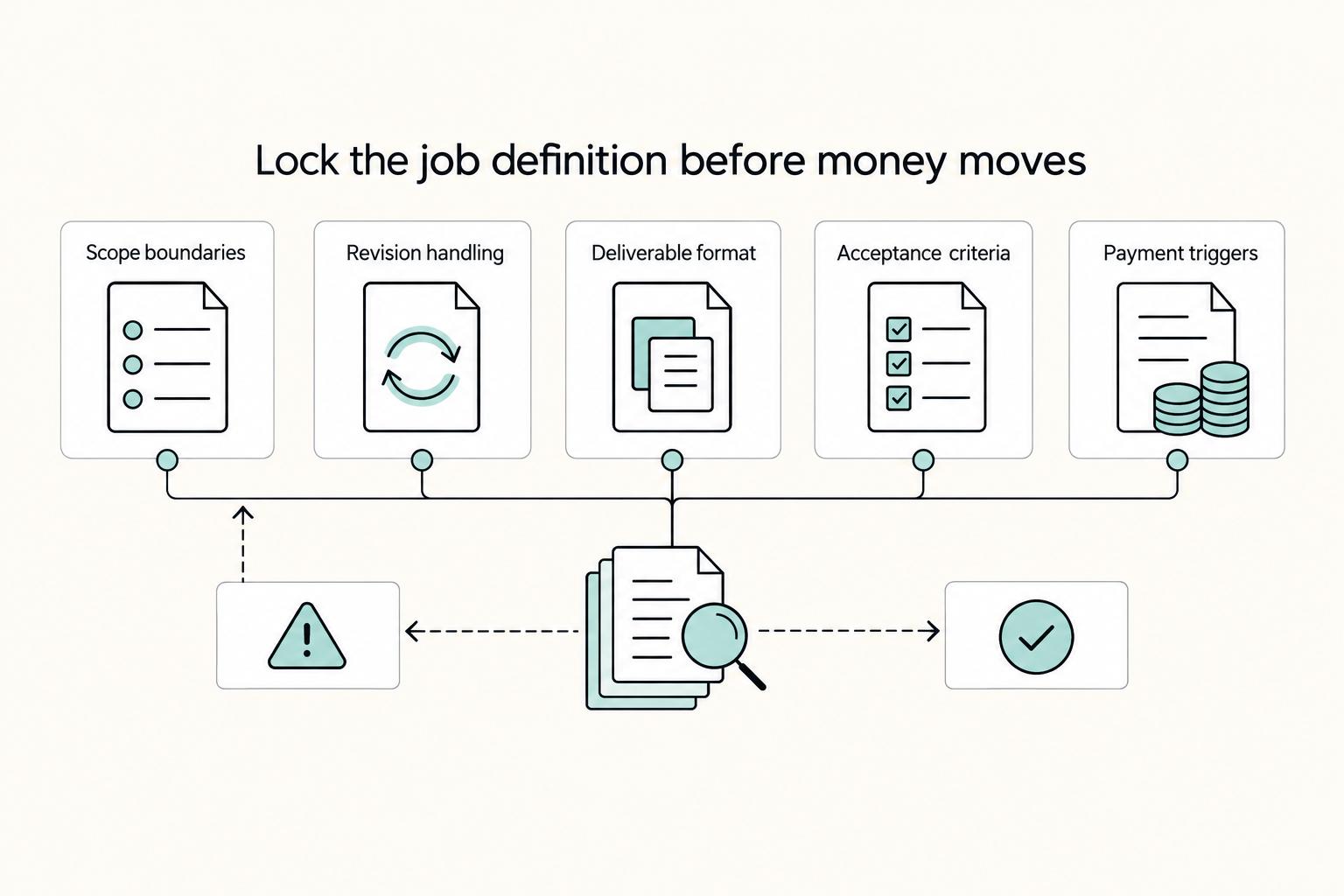
Step 1. Lock the job definition before money moves#
Do this first: compare your brief, sample, quote, and contract line by line, and fix any mismatch before you sign. Edit labels must be explicit because developmental editing, copyediting, and proofreading are not interchangeable, and proofreading is a late-stage check rather than a substitute for earlier editing.
| Item | What to specify |
|---|---|
| Scope boundaries | Name the service, manuscript version, word count, and exclusions |
| Revision handling | State included rounds, what counts as a revision, and whether post-delivery questions are capped |
| Deliverable format | Specify file type and feedback method, such as tracked changes, comments, editorial letter, or style sheet |
| Acceptance criteria | Define what counts as delivered, such as a marked manuscript plus editorial letter for the agreed draft |
| Payment triggers | Tie each payment to a dated milestone or defined deliverable, not vague progress language |
| Ownership and permitted use | Keep manuscript rights and any rights in commissioned additions explicit; agree reuse or publication of excerpts |
| Termination | State how either side can end the contract, what happens to partial work, and what is owed |
| Dispute path | Define first-step resolution and whether platform procedures apply |
One additional term belongs beside the delivery checklist: manuscript confidentiality. Agree who may access the text, whether subcontractors or external AI tools may be used, and what reuse or storage is permitted. Ask before sharing another author’s unpublished material as a sample.
Example: a $2,100 copyedit of a 60,000-word manuscript includes a marked Word file, a style sheet and one follow-up query round. A 30% booking deposit is $630; the remaining $1,470 is due after delivery and a seven-day review period. These are illustrative negotiated terms. State what happens if required files are missing, if a new chapter is added or if either party cancels; a deposit need not wait for a completed deliverable.
Verification check: after reading the contract, you should be able to answer without guessing what will be edited, what files you will receive, and what event releases each payment.
Step 2. Choose a milestone structure that matches your risk#
Pick a payment structure that matches your need for verification control and your cash-flow limits. Once scope is locked, payment mechanics should reinforce that scope.
| Structure | Best when | Verification control | Cash-flow exposure | Collaboration risk |
|---|---|---|---|---|
| Deposit-led | You are reserving time and trust the defined scope | Lower early unless terms are very specific | Higher for you at the start | Medium if scope shifts later |
| Balanced milestones | The project has clear checkpoints (sample, pass, follow-up queries) | Strong when each milestone has defined outputs | Shared across the project | Depends on checkpoint quality, communication and agreed review windows |
| Deliverable-led | Scope is narrow and you want proof before each payment | Highest for you | Lower early; increases after receipt | Higher for the editor, so availability may narrow |
On Upwork fixed-price contracts, the client funds the milestone first. The editor must use Submit work on the contract to start the 14-day review period, even if the files were already shared elsewhere. No response leads to automatic release; a change request restarts review on resubmission. Approved or auto-released funds then have a five-day security hold before withdrawal availability. Those are Upwork’s rules, not terms automatically inherited by a direct editing contract.
Step 3. Run a pre-sign check for cross-border work#
For cross-border work, confirm the contracting party, invoice currency, payment route and fee allocation before signature. Treat tax documentation as a separate payer requirement rather than an editorial hiring criterion.
| Checkpoint | Confirm | Note |
|---|---|---|
| Party identity | Legal name, country, and that contract party details match tax and invoice details | Validate execution details before signature, not after invoicing |
| Tax documentation | Where U.S. reporting or withholding applies, use the correct recipient certificate | W-9 is for U.S. persons; W-8BEN is for foreign individuals where applicable, with different forms possible for entities or other circumstances |
| Invoice/payment | Payment rail, currency, transfer-fee allocation, and expected net receipt | Confirm the expected net receipt |
| Transparency | Fees, exchange-rate treatment, taxes, and amount received | Spell out the amount received |
| Legal | Get qualified legal review when ownership, termination, governing law, or dispute terms are material | Use review when those terms are material |
Pause negotiations if edit labels are undefined, revision limits are missing, exit terms are unclear, or payment is requested without a defined deliverable.
For a step-by-step walkthrough, see How to Write a Book Proposal for a Nonfiction Book.
Use the feedback to improve the manuscript#
Use each round for the agreed job. If copyediting exposes a structural problem, discuss it with the editor and agree whether to pause, change scope or schedule another pass. Continuing to polish text that will be rewritten wastes both parties’ time.
Step 1: Run one controlled workflow. Keep one source manuscript file, one feedback format, and one owner with final approval on each change. In Microsoft Word, Track Changes shows edits by contributor; in Google Docs, Suggesting mode keeps original text until suggestions are accepted or rejected. If comments stack up, keep a simple decision log: chapter, issue, decision, owner.
Verification checkpoint: you should always be able to identify the current file, open comments, and who changed what. Word revision marks and Google Docs version history support that check.
Step 2: Triage comments by purpose. Use three buckets: clarity, audience fit, and style.
Implement now: clarity fixes, and audience-fit changes that strengthen the promise to your intended reader.Defer: audience-fit ideas that would change positioning, examples, or scope beyond this round.Reject: style changes that are only preference and weaken your voice.
Terminology can vary. Some editors use substantive as another label for developmental editing, while others treat it as a separate step, so confirm scope in your contract before revising.
Step 3: Match issue type to edit level, then escalate when needed. Editing and proofreading serve different purposes, and proofreading is a final quality check after editing and layout.
| Edit level | What it can realistically improve | What it will not fix | Escalate when |
|---|---|---|---|
| Developmental or structural | Core content, argument, structure, plot, chapter order | Final polish, mechanical consistency, last-pass typos | Big-picture issues still dominate comments |
| Line editing (scope defined in the contract) | Paragraph flow, sentence clarity, tone, language at reading level | Broken structure or missing logic across chapters | Sentence-level edits keep exposing structural problems |
| Copyediting | Grammar, spelling, punctuation, consistency of language and formatting | Unresolved structure, weak positioning, major rewrites | You are still moving sections or rewriting heavily |
| Proofreading | Final pre-publication error check after editing and layout | Structural problems, argument gaps, incomplete copyediting | Layout is done but content-level issues still appear |
Step 4: Verify results in the manuscript, not by comment count. Evaluate each pass by visible draft outcomes: clearer chapter logic after developmental work, smoother flow after line-level work, stronger consistency after copyediting, and a cleaner laid-out file after proofreading.
Test a few excerpts you plan to reuse in a newsletter or proposal. If the main argument still needs repair, resolve that before commissioning a final proof pass. A fresh proofreader can help catch errors after layout, even when one editor handled earlier stages.
Before you hire#
Send the same brief to a small shortlist, compare what each editor will deliver and resolve scope differences before accepting a quote. Keep the three checks below for the decision.
| Gate | Pass only if | Mismatch to stop |
|---|---|---|
| Source against the actual draft problem | You can name the editing level first and every finalist confirms the same scope in writing | Do not use sentence-level editing to solve structure problems |
| Contract the job you discussed | The written agreement reflects the exact edit, deliverables, fees, deadlines, and conditions before work begins | Pause if full edit is used but deliverables are not clearly defined |
| Manage to checkpoints, not hope | Your checkpoints are explicit and tied to manuscript stage and agreed scope | Do not send a manuscript to proof while chapters are still moving |
For the manuscript itself, How to Write a Book to Establish Your Freelance Expertise can help clarify the reader promise before you brief an editor.
Related: How to Find Beta Readers for Your Book and Use Their Feedback Well.
Frequently Asked Questions
What should be in your editing contract?
Put the agreement in writing and make it match the editing stage you are actually buying. The contract should clearly define the scope and deliverables for that stage. Before you sign, check that it names the exact edit level and that nothing in it quietly expands the job.
How do you judge whether a developmental edit is worth the money?
Developmental work is usually most useful when your draft has structure problems, not sentence-level polish issues. If chapters are out of order, the reader promise is fuzzy, or the argument does not build cleanly, a developmental editor can help shape the book into a coherent flow. Your checkpoint is simple: after the proposal, you should be able to name the structural decisions this edit is meant to fix.
What are the red flags when hiring an editor?
Treat vague role labels as a warning sign. If someone offers to be just "your editor" but cannot tell you whether they work as a developmental editor, copyeditor, or proofreader, you cannot compare scope reliably. Also pause if their approach sounds like a rewrite in their voice rather than an improvement to the manuscript while keeping yours.
Is a marketplace better than a professional directory or referral?
Each channel has a different convenience: a marketplace can simplify quote requests and contracting, a professional directory can filter by skill, and a referral can offer firsthand experience. Apply the same brief, references and deliverable checks to each candidate. Ask which services they offer rather than assuming a fixed four-stage package.
What is a reasonable cost for editing a business book?
Use a matched scope and word count. As a benchmark, the EFA’s 2026 chart reports business/marketing copyediting at 3–4 US cents per word and developmental editing at 4.5–6 cents. For 60,000 words, that is $1,800–$2,400 for copyediting or $2,700–$3,600 for developmental work. These survey-based ranges are not required rates or binding quotes; condition, specialist knowledge, turnaround and included rounds affect the offer. See the EFA rate chart and request a manuscript-specific estimate.
Do you need a separate proofreader after a copy edit?
Often, yes, once the manuscript is stable. Because editing is usually handled as a staged continuum, many authors use proofreading as a final pre-publication pass after other editing work. If you are still moving chapters or rewriting heavily, you are likely not ready for proof.
Can one editor do everything?
Some editors offer several services and can handle more than one stage. Ask about their experience and define separate passes so structure is settled before detailed polish. A separate final proofreader can bring fresh eyes; the choice depends on the project and budget, not a blanket rule that one editor is unsuitable.
Try a related tool
Researched and edited by the Gruv editorial team. Gruv builds cross-border billing, payouts, and finance-operations software for global businesses.
Sources
Includes 6 external sources outside the trusted-domain allowlist.
- irs.gov/instructions/iw8bentrusted
- irs.gov/forms-pubs/about-form-w-9trusted
- ciep.uk/directory.htmlexternal
- editors.ca/hire-an-editorexternal
- reedsy.com/faq/authors/sending-requests/send-requestexternal
- support.upwork.com/hc/en-us/articles/211063718-How-payments-for...external
- the-efa.org/editorial-services-definitionsexternal
- the-efa.org/ratesexternal
Educational content only. Not legal, tax, or financial advice.
Related Posts

How to Write a Book as a Freelancer Without Scope Drift
The book needs a defined job and a defined boundary before you draft. In this cycle, give it one job: either support your client book services, or strengthen your own authority book so your niche, offer, and sales conversations become clearer.

The Freelance Payment Penalty: A Modeled Audit of Platform Fees, FX Spreads, and Payout Delays
The money rarely disappears through a single, easy-to-spot fee. The real loss is stacked. A marketplace takes its commission, a processor adds a charge for international cards, a bank or payment company converts the currency at a spread, a platform holds the funds before release, and a wire sheds a little to intermediaries on the way in. Each layer looks defensible on its own, but the worker feels the combined result as a smaller deposit and a later payday.

How to Respond to a Subpoena for Business Records
Move fast, but do not produce records on instinct. If you need to **respond to a subpoena for business records**, your immediate job is to control deadlines, preserve records, and make any later production defensible.