
Quick Answer
Choose a corporate service provider for offshore incorporation by verifying every claim in writing for your exact jurisdiction and entity structure. Start by defining your setup, then request the SLA, scope, onboarding steps, and sample deliverables from each candidate. Confirm who owns filings, approvals, recordkeeping, and escalation before signing. Compare evidence quality first and price last.
Start Here and Choose a CSP Without Guesswork#
Require written proof for every provider claim, then decide. That one rule helps you avoid expensive mistakes and gives you a choice you can defend to cofounders, counsel, investors, and finance.
Clear up the acronym before you get on a call. In some contexts, CSP means Microsoft Cloud Solution Provider. Sherweb says Microsoft CSP program changes start on October 1, 2025, and that Direct CSP status includes billing at least $1 million annually through Microsoft, paid advanced or premier support plans starting at $15,000 USD/year, and passing a security audit with mandatory MFA for all admin users. Those points are real in that context, but they are not offshore incorporation rules.
By the end of this section, you should have:
- A ranked shortlist based on evidence quality.
- A signed SLA with clear responsibilities and escalation paths.
- A first-year operating checklist for filings, approvals, and document custody.
Keep one boundary and apply it every time: if a claim is not tied in writing to your target jurisdiction and entity structure, treat it as unverified.
Use this sequence before comparing price:
- Define your target setup in writing.
- Request core documents from each candidate: SLA, scope, onboarding steps, and sample deliverables.
- Confirm ownership for filings, approvals, recordkeeping, and backup contacts before signing.
Create a decision file from day one. Put each provider response, draft, and redline in one place with dates and owner names. When facts conflict across calls, the written trail usually settles the dispute faster.
When two providers look similar, pick the one with clearer written ownership and stronger evidence. Clarity under pressure is worth more than polished language in a sales deck.
Define the Terms Before You Compare Providers#
Your shortlist is only as reliable as your definitions, so lock terms in writing before comparing speed, price, or reputation.
Start with Corporate Services Provider (CSP). In the Dubai example used here, CSP refers to administrative support services, and legal services are explicitly excluded. Treat that as a jurisdiction-specific example, not a universal rule, and confirm each provider's exact scope in your contract documents.
For Registered Agent, do not rely on verbal summaries. This article does not establish one universal definition for that role, so require each provider to define responsibility, ownership, and escalation contacts in contract language.
For offshore incorporation, this article does not establish legal duties or thresholds. Use contract language to separate what is included during setup from what remains your ongoing responsibility after setup. If wording is broad, vague, or bundled with soft promises, treat it as risk until it is clarified in writing.
For due diligence, use evidence over confidence. A practical order is:
- Run a needs assessment.
- Evaluate candidates using written materials, third-party reviews, demos, and direct product conversations.
- Score only what is documented.
Before moving forward, capture a one-page term sheet per candidate:
- CSP scope, including explicit exclusions.
- Registered-agent responsibilities as written by the provider.
- Setup versus ongoing responsibility boundaries.
- Due-diligence evidence received, missing, and pass or fail status.
Add one more control to the term sheet: a plain-language consequence for ambiguity. If a line item is unclear, mark it as unresolved and block scoring for that criterion until a document resolves it.
Do not compare pricing while key terms still mean different things across providers. Freeze your definitions first and require each provider to map to them. If a provider cannot map these terms to reviewable documents, pause and move to the next candidate.
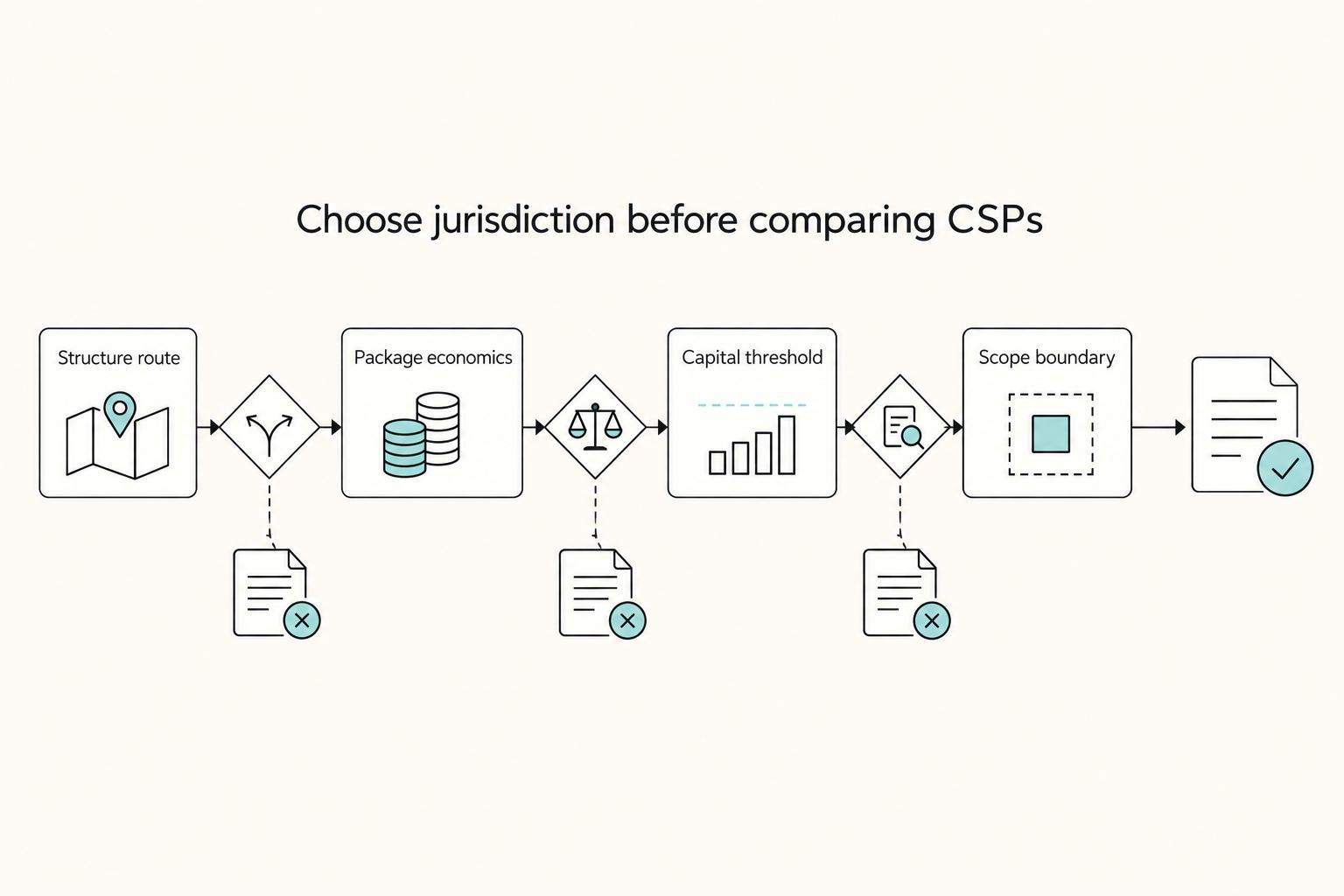
Choose the Jurisdiction First or You Will Compare the Wrong CSPs#
Choose your jurisdiction and legal structure before you score providers. If you skip that order, you compare proposals built for different compliance paths.
Start with operating context, not marketing. Your jurisdiction defines the filing and compliance environment. Your structure choice defines the execution support you need. In the UAE example path, the first structure decision is mainland, free zone, or offshore, and that choice changes what belongs in the comparison.
Use jurisdiction-specific anchors to test proposals. In the listed UAE examples, starting package prices range from AED 10,800 to AED 43,780, and the cited incorporation window is 7 to 10 business days. Treat those as local examples only, not universal benchmarks.
| Lever | Why it changes provider fit | What to verify in writing |
|---|---|---|
| Structure route | Changes the setup path the provider must execute | Mainland vs free zone vs offshore (UAE context) |
| Package economics | Changes budget and sequencing assumptions | The specific package and what is included |
| Capital thresholds | Can affect planning and timing in that route | IFZA listing details (for example, AED 10,000 and AED 48,000 conditions) |
| Scope boundaries | Prevents false assumptions about support | Explicit exclusions, including legal services where stated |
Structure fit comes before provider fit. Different structures change obligations and administrative needs. Shortlist only providers that can show repeatable delivery for your exact jurisdiction-structure combination, including company-formation and tax-compliance support where you need it.
Use a direct comparison rule: do not compare a quote built for one route against a quote built for another route and call it cheaper. Normalize scope and route first, then evaluate economics.
Ask each candidate to restate your jurisdiction and structure in the first line of the proposal. If they cannot restate it accurately, their downstream scope may be unreliable.
If two providers are close, choose the one with verified experience in your exact jurisdiction and structure. Also require a clear written scope of inclusions and exclusions.
If you want a deeper dive, read Sole Proprietorship vs. LLC: The Definitive Guide for Global Freelancers.
Build a Due Diligence Evidence Pack Before Sales Calls#
Build your evidence pack before sales calls so you compare proof, not promises. Due diligence is a risk-reduction process: check whether submitted documents and controls match what is being sold.
| Document | Key detail 1 | Key detail 2 |
|---|---|---|
| Licensing proof | Current registration details | The legal entity that will contract with you |
| Sample onboarding checklist | Concrete steps | Handoffs and expected client inputs |
| SLA draft | Response expectations | Escalation path and ownership by stage |
| Business Continuity Plan summary | Service continuity | How service continuity is handled during disruption |
| Incident Response policy | How incidents are identified | How incidents are communicated and closed |
Use one standard request pack for every shortlisted provider, and score only what is submitted:
- Licensing proof: current registration details and the legal entity that will contract with you.
- Sample onboarding checklist: concrete steps, handoffs, and expected client inputs.
- SLA draft: response expectations, escalation path, and ownership by stage.
- Business Continuity Plan summary: how service continuity is handled during disruption.
- Incident Response policy: how incidents are identified, communicated, and closed.
This is a selection control, not a claim that every document is legally required in every jurisdiction. The goal is a consistent, evidence-first comparison across candidates with less guesswork.
For jurisdiction-specific filing obligations, request redacted examples only when those obligations are relevant to your entity and jurisdiction. Ask to see the execution path from intake through review and submission so you can verify repeatable delivery, not just a sales explanation.
Then assign named owners for each critical task across setup and ongoing operations: your team, the CSP, or the Registered Agent. Apply a hard checkpoint: no document, no score for that criterion.
Set submission rules up front. Ask for dated files, visible version labels, and owner names in every document. That reduces late swaps and makes it easier to compare the same artifact type across providers.
Use a simple grading approach for each criterion:
- Pass when evidence is current, specific, and attributable.
- Conditional when evidence exists but leaves ownership or execution unclear.
- Fail when evidence is missing, generic, or not tied to your jurisdiction and structure.
That keeps calls focused. Instead of debating impressions, ask one direct question: what written evidence closes this gap?
Verify Legal Credibility and Regulatory Competence#
Verify legal credibility by matching provider claims to official records, then test whether the provider can apply current FinCEN rule context without overgeneralizing.
| Topic | Ask about | Grounded detail |
|---|---|---|
| CTA rule context | How they interpret FinCEN's March 26, 2025 interim final rule | How they handle the fact that related FAQ guidance may not be fully updated yet |
| BOI applicability | Current FinCEN framing | U.S.-created entities are exempt from BOI reporting under current FinCEN framing |
| BOI timing | Timing for qualifying foreign reporting companies | Before March 26, 2025: April 25, 2025; on or after that date: 30 calendar days |
| FBAR deadlines | Whether all filers share one deadline | April 15, 2027 for certain signature-authority filers; April 15, 2026 for other filers |
For legal standing, do not rely on screenshots. Confirm the exact legal entity that will contract with you and verify status in the relevant official registry yourself. For U.S. federal references, require .gov pages served over https, and log what you verified and when.
Pressure-test regulatory competence with date-bound questions:
- CTA rule context: ask how they interpret FinCEN's March 26, 2025 interim final rule. Ask how they handle the fact that related FAQ guidance may not be fully updated yet.
- BOI applicability: ask them to explain that U.S.-created entities are exempt from BOI reporting under current FinCEN framing.
- BOI timing: ask them to distinguish timing for qualifying foreign reporting companies registered before March 26, 2025 (April 25, 2025) versus on or after that date (30 calendar days for an initial filing).
- FBAR deadlines: ask whether all filers share one deadline. A competent answer should distinguish April 15, 2027 for certain signature-authority filers from April 15, 2026 for other filers.
For cross-border records, ask how they monitor BOI/FBAR rule updates and where that process is documented: owner, trigger, escalation, and client notification path. Use this as a process-control check, not a single legal standard.
Evaluate answers for precision, not confidence. Strong answers map rule context to concrete execution steps and ownership. Weak answers stay broad, skip dates, or dodge who is accountable for checking updates.
Keep a short verification log for each provider with four fields: claim, evidence, verification date, and open issue. This makes it easier to see whether a candidate closes gaps quickly or keeps recycling general statements.
Apply a hard gate before shortlisting: no verified record, no pass. Keep providers that can connect verified entity records, FinCEN interpretation, BOI applicability, and deadline logic in a clear written response.
Map What the CSP Owns and What You Still Own#
Before you shortlist, get ownership in writing. A provider can execute defined tasks, but you still own customer-side responsibilities.
Use a shared-responsibility model, not a "handles everything" promise. Assumption gaps happen when both sides think the other side owns a step.
Use a simple responsibility matrix across the full operating flow:
| Phase | CSP owns (define in writing) | You own (define in writing) | Evidence |
|---|---|---|---|
| Cloud infrastructure security | |||
| Data and application security | |||
| Configuration management | |||
| Service-model boundary (IaaS/PaaS/SaaS/FaaS/serverless) | |||
| Offer-specific scope limits | |||
| Offer-specific exclusions |
For each row, name one owner, one reviewer, required inputs, approval method, and escalation contact. If any item is vague, unassigned, or split without a final decision-maker, treat it as risk.
Add execution detail where teams usually fail:
- Who drafts the work packet.
- Who checks completeness before execution.
- Who gives final approval.
- Who confirms completion evidence is stored.
A common failure mode is assuming the provider covers everything, then missing customer-owned responsibilities. Use a simple decision rule: if ownership is unclear in writing, treat that provider as high risk and move on.
Before you sign, walk one real task end to end using the matrix. If either side cannot name owner, reviewer, inputs, and proof of completion without hesitation, the map is not ready. If scope text is offer-specific or access-restricted, get written confirmation instead of assuming missing details. For additional context, see What is FinCEN? A Guide for Freelancers and FinTech Users.
Stress-Test Security, Privacy, and IP Protection#
Use security evidence as a go or no-go gate before you compare fees. If a CSP cannot document how sensitive records are handled, downgrade it even when pricing looks attractive.
Beneficial Ownership Information (BOI) is data about people who directly or indirectly own or control a company. Because BOI reporting is meant to reduce opaque ownership structures and misuse of entities, weak handling is a material risk. Treat BOI thresholds and filing timelines as items to verify against FinCEN updates, then confirm how the provider tracks and applies changes in client work.
| Control area | Proof to request | Red flag |
|---|---|---|
| Data in storage and transit | Contract or policy language that specifies protections for stored and transmitted data, with technical detail where available (for example, encryption at rest and encryption in transit) | Broad claims like bank-grade security with no scope, control owner, or implementation detail |
| Retention and reuse | Documented retention settings, deletion timing, and whether underlying platforms support tighter retention options, including zero-retention options where eligible | Indefinite retention or no clear answer on secondary use |
| Intellectual Property (IP) access and offboarding | Access list by role, approval path for access changes, exit checklist, export format, revocation record, and data disposition confirmation at termination | We remove access after cancellation with no auditable records |
| Incident response and notification | Named incident owner, trigger conditions for client notice, first-contact channel, update cadence, and post-incident report contents | No trigger definition and no committed reporting artifact |
Run a pre-signing scenario drill, not just a policy review. Use one concrete case: a third-party account is compromised and BOI files may have been exposed. Ask who isolates access first, who contacts you, what evidence is preserved, and what written update you receive first. If answers stay generic, assume execution risk is high.
Ask one more practical question in that drill: where incident artifacts will live after closure, and who can access them. If evidence storage is unclear, post-incident review will likely be slow and disputes harder to resolve.
The core tradeoff is third-party dependence. Resilience planning should cover physical, cyber, and supply-chain exposure, and risk can increase when network-connected operational technology (OT) environments are managed by third parties. Include subcontractors and storage locations in your review, not only the main CSP agreement.
Decision rule: downgrade the provider if they cannot document protection for data at rest and in transit. Also downgrade if they cannot show IP offboarding evidence or explain incident response ownership in writing.
Pressure-Test SLA Terms and Continuity Before You Sign#
Use SLA clarity as a contract gate before you sign. The SLA defines how service is measured, when issues escalate, and how remediation is handled when work goes off track.
Use a risk-based standard for SLA depth. Not every vendor relationship needs the same rigor, but higher-impact work should have measurable terms, clear thresholds, escalation points, and defined cure periods. If a promise cannot be measured, it is hard to enforce.
| SLA term | Define in writing | Why it matters under deadline pressure |
|---|---|---|
| Response handling | Communication channel, acknowledgment expectation, update cadence, owner | Reduces silence during active issues |
| Delivery expectations | Deliverable scope, handoff points, completion condition | Prevents disputes about what done means |
| Escalation path | Trigger points, primary owner, backup owner, contact method | Shortens delay when frontline handling stalls |
| Remediation | Cure period, corrective actions, closeout evidence | Requires a fix plan, not vague follow-up |
| Performance measurement | Baseline standards and tracking metrics | Lets you compare actual service to contract terms |
Require continuity terms in writing, with roles and responsibilities clearly assigned. At minimum, confirm how the provider handles outages and who acts first when normal operations are disrupted. If additional continuity scenarios are material to your risk, require those scenarios to be addressed explicitly.
Run one pre-signing scenario drill around an urgent service issue and a same-day request. Ask the provider to walk the exact path from intake to escalation to remediation and show where evidence is captured.
Capture these checkpoints during the drill:
- Timestamped acknowledgment in the agreed channel.
- Named escalation owner and backup owner.
- Clear trigger that moved the issue into escalation.
- Written remediation step tied to the cure period.
- Closeout note documenting what was fixed.
Ask for the artifact list they will produce in a real incident, not just verbal commitments. Clear artifact expectations reduce debate later about whether remediation was complete.
Decision rule: if the SLA lacks measurable terms, explicit escalation points, cure periods, and continuity ownership in writing, downgrade the provider regardless of price.
Score Total Value Instead of Chasing the Lowest Fee#
Treat price as the last filter, not the first. Use one consistent scorecard across all candidates, then compare total cost only after comparing evidence quality.
Use the same five buckets for every provider so sales polish cannot shift your standard. Keep legal credibility, execution reliability, security and IP controls, communication quality, and total cost of ownership in every comparison.
| Score area | What to verify | Red flag |
|---|---|---|
| Legal credibility | Current registration and recent regulatory references from official .gov pages over HTTPS, with visible effective dates where available | Screenshots only, no primary record, or stale references |
| Execution reliability | Dated samples, clear handoff evidence, and documented owners for key steps | Promises without dated proof |
| Security and IP controls | Access, retention, and offboarding terms for records and work product | Unclear access ownership or revocation process |
| Communication quality | Named primary and backup contacts, response cadence, and clear escalation triggers in the SLA | Generic mailbox ownership and no escalation trigger |
| Total cost of ownership | Base fee plus all additional charges clearly documented in contract terms | Low headline fee with key costs pushed into add-ons |
Hidden costs can determine whether a cheap quote stays cheap. Require each provider to complete the same pricing worksheet before final ranking, and score transparency as weak if they avoid itemized answers.
A higher monthly fee can still be the lower real cost when execution evidence is stronger and corrective handling is clearer. You are paying for reliable delivery and faster recovery, not just form submission.
Set your scoring logic before final calls, because weighting changes after persuasive demos make rankings hard to trust.
Use this tie-breaker when two options are close:
- Choose the provider with stronger evidence quality: dated records, named owners, and verifiable documentation.
- Prefer providers that can show how they track corrective actions after less-than-satisfactory evaluations.
- Downgrade claims that rely on value headlines or promotional framing without operational proof.
Decision rule: if a provider wins on monthly fee but loses on evidence quality, do not advance them.
Run a First 90-Day Implementation Checklist#
After you choose a provider, treat implementation as a proof phase. Verify delivery against dated records in the operative SLA, not status updates.
| Stage | Main action | Verification point |
|---|---|---|
| Stage 1 (setup) | Confirm the operative SLA is finalized and not a draft marked for reference only | Define who owns each key task and where approvals and incident updates are recorded |
| Stage 2 (operating records) | Build and maintain a dated checklist of required records, approvals, and evidence artifacts | For each item, name the preparer, reviewer, approver, and due date |
| Stage 3 (proof run) | Complete one full live cycle, then test one realistic exception scenario | Verify the agreed escalation path is followed and closeout notes clearly show what changed and who closed it |
A staged rollout is easier to control than one large handoff. A compliance manual in another regulated context uses an explicit first stage with assignment and risk-based prioritization. Use that same structure here: lock scope, ownership, and communication paths before routine work expands.
- Stage 1 (setup): Confirm the operative SLA is finalized and not a draft marked for reference only. Define who owns each key task and where approvals and incident updates are recorded.
- Stage 2 (operating records): Build and maintain a dated checklist of required records, approvals, and evidence artifacts. For each item, name the preparer, reviewer, approver, and due date.
- Stage 3 (proof run): Complete one full live cycle, then test one realistic exception scenario. Verify the agreed escalation path is followed and closeout notes clearly show what changed and who closed it.
Use a simple review trigger: if ownership remains unclear, evidence stays incomplete, or the same issue repeats, pause scope expansion and fix accountability first.
Treat this phase as a live test of promises made during selection. If a provider misses basic ownership or documentation expectations early, capture the gap, request corrective action, and verify the correction before expanding scope.
Keep document language precise. Public agreement language often limits rights with terms like non-exclusive revocable license and a defined licensed area. It can also tie authority to a specific legal reference, for example Government Code section 70391. Apply that same precision so responsibilities are not reinterpreted later. If you need a practical next step, Browse Gruv tools.
Make the Decision and Document It#
Choose the CSP that passed your legal credibility checks, operational stress tests, and total-value review in your jurisdiction, then document that decision before signing. The final filter is verifiable execution, not presentation quality.
Record the business structure decision before registration moves forward. Structure affects day-to-day operations, taxes, and personal asset exposure, and changing it later can create location-based restrictions, tax consequences, or unintended dissolution.
Set ownership boundaries in the signed SLA and make them explicit. Assign each critical duty to one named owner and one evidence artifact across formation work, ongoing filings, and exception handling.
Your decision record should include:
- Jurisdiction and selected business structure.
- Why this CSP beat the closest alternatives.
- Signed SLA scope and out-of-scope items.
- Owner map for approvals, submissions, and incident follow-up.
- Formation deliverables and planned completion dates.
- Registered agent appointment details and verification date.
- Re-evaluation triggers and first 90-day checkpoints.
Before go-live, confirm the registered agent setup is valid. For domestic and qualified foreign corporations and LLCs, every state requires appointing and continuously maintaining an in-state registered agent. The registered agent office must be a physical in-state address, not a P.O. Box or virtual office. In most states, the registered agent must be a resident individual or a domestic or qualified foreign corporation or LLC, and the registered agent's name and address are filed with the Secretary of State and publicly available.
Treat guidance as support, not controlling authority. Some guidance explicitly says it does not have force and effect of law. Prioritize binding requirements and signed contract terms in your decision file, then define re-evaluation triggers now, for example repeated misses, unclear ownership after an incident, or unresolved corrective actions by the next review cycle.
Close the loop with a written sign-off note. Include who approved the choice, what unresolved items remain, and the date for the first reassessment. That last step keeps accountability clear and makes future course corrections faster if performance slips. If you need country or program confirmation, Talk to Gruv.
Frequently Asked Questions
How do I choose a corporate service provider for offshore incorporation?
Choose the provider based on jurisdiction fit and verifiable delivery, not sales language. Shortlist candidates that show clear scope, named ownership, and dated operating records for the exact setup you need. Then compare them with the same checklist so tradeoffs are clear.
What should I verify before signing with a CSP?
Verify the final SLA, scope boundaries, escalation contacts, and who approves each critical step. If BOI work may apply, confirm the provider's process reflects FinCEN's March 26, 2025 interim final rule and that they account for FAQ guidance that may not be fully updated. Get those points in writing and keep them with the signed package.
Is the cheapest CSP a bad choice?
No, a lower fee is not automatically a bad choice. It becomes costly when add-on fees, rework, or missed deadlines appear after onboarding. Compare total cost with scope clarity, accountability, and recovery reliability.
How do I check if a CSP is properly licensed?
Check official regulator or government records in the target jurisdiction and keep a dated copy of what you verified. Recheck before signing in case records or guidance changed. If provider documents do not match official records, pause and resolve the mismatch first.
What risks should founders watch for when outsourcing compliance?
A common risk is assuming the provider owns everything when approvals still sit with your team. Another is relying on FAQ text when laws, rules, or contract terms control. Unclear escalation ownership during exceptions can also delay fixes.
What should be in a CSP service agreement?
The agreement should clearly define scope, responsibilities, escalation paths, evidence of completion, and termination terms. It should state who does what, who approves what, and how exceptions are handled. Wherever possible, tie major obligations to a specific artifact so completion is verifiable.
How often should I reassess or replace my CSP?
Reassess on a regular schedule and immediately after serious misses or rule changes. For U.S. BOI exposure, verify timing against current FinCEN scope rather than assuming one timeline applies everywhere. Each review should check whether ownership, escalation, and evidence quality still match the signed SLA.
Try a related tool
Researched and edited by the Gruv editorial team. Gruv builds cross-border billing, payouts, and finance-operations software for global businesses.
Sources
Educational content only. Not legal, tax, or financial advice.
Related Posts

Sole Proprietorship vs LLC for Global Freelancers in 2026
For most freelancers in 2026, the practical default is still simple: use the simplest structure you can run cleanly, then formalize when risk actually rises. If your work is still in validation mode and the downside is contained, a sole proprietorship is often the practical starting point. When contract exposure, delivery stakes, or dispute risk starts climbing, forming an LLC deserves earlier attention.

What Is FinCEN for Freelancers and FinTech Users
If you are asking **what is fincen**, focus first on the decision in front of you. FinCEN, the Financial Crimes Enforcement Network, is tied to FBAR filing through FinCEN Form 114 when foreign financial accounts create reporting duties. By the end, you should know whether to act now, gather records, or escalate.

Freelance Prompt Engineering Without Scope Creep
Treat this as a service business from day one. Clients pay for clear outcomes, predictable delivery, and records that still hold up when questions come later.