
Quick Answer
Enforce deterministic replay first: a retried write with the same idempotency key must return the original financial result. Store internal transaction ID, PSP reference, payout or batch reference, and separate event time from settlement time on every posting candidate. Keep pending and available states distinct so cash is not recognized early. Then reconcile in two passes, matching ledger entries to PSP settlement artifacts and cash movement to bank or Virtual Account statements.
If the same payment event is replayed after a timeout, retry, or duplicate webhook, it should produce the same postings, the same status outcome, and the same audit trail.
That distinction matters because wallet determinism and finance determinism solve different jobs. Bitcoin Improvement Proposal 32 (BIP-32) describes deriving a tree of keypairs from a single seed, and Bitcoin Improvement Proposal 39 (BIP-39) covers mnemonic phrases used to generate those seeds. Those standards are useful, but they do not tell you how to post settlement activity, suppress duplicate payout events, or explain the gap between operational ledger state and bank cash timing.
Treat this as an operations build guide#
Use this as an operations build guide, not a blockchain accounting guide. In practice, you are dealing with asynchronous signals across a Payment Service Provider (PSP), bank rails, and your payout logic. Events and confirmations arrive on different timelines.
Define determinism in accounting terms#
In accounting terms, determinism means the same input event with the same business meaning always creates the same ledger effect: journal postings, state transitions, and retained evidence.
Use one practical checkpoint: finance, product, and engineering should all answer the same question: "If this event is replayed tomorrow, what exact postings happen?" If that answer changes by worker, arrival timing, or manual handling, determinism is not in place yet.
Assume retries and duplicates from day one#
PSP integrations are asynchronous, and webhook handling exists for events such as bank payment confirmations. Duplicate webhook deliveries can happen.
Make an idempotency key mandatory on every write path you own, not only customer-facing API calls. Stripe's model is a useful anchor. The same key returns the same prior result. Keys can be up to 255 characters. Provider-side key retention can be limited, for example automatic removal after at least 24 hours. Keep your own lineage instead of depending on provider retry memory.
Design for replay and reconciliation, not only request success#
Request success is not enough. A ledger is operationally credible when you can reconstruct state and explain cash movement during delays, retries, and backfills. Event-sourcing guidance matters here because it supports reconstructing state for any point in time.
The operator detail that matters most is the evidence pack on each posting candidate. At minimum, keep your internal transaction ID, PSP event or provider reference, idempotency key, payout or batch reference when available, and both event time and settlement time.
Anchor the build in settlement reality#
PSP settlement is batch-based, and bank statements reflect those batches rather than product-side timelines. Stripe provides a payout reconciliation report for matching bank payouts to payment batches, and Adyen's settlement reconciliation guidance ties batch closes to bank-statement matching.
That thread carries through everything below. You need postings that survive replay, controls that catch duplicates and missing references, and reconciliation that explains differences across operational status, PSP reporting, and bank cash without breaking trust. If you need a companion for close procedures, pair this with a month-end reconciliation checklist.
Set the boundary between wallet determinism and ledger determinism#
Set this boundary first: HD wallets under BIP-32 and BIP-39 are for deterministic key derivation, while platform ledger determinism is for deterministic financial outcomes.
Separate key management from accounting#
A Hierarchical Deterministic (HD) wallet, Bitcoin Improvement Proposal 32 (BIP-32), and Bitcoin Improvement Proposal 39 (BIP-39) address wallet key material from a seed or mnemonic. BIP-32 defines deriving a tree of keypairs from one seed, and BIP-39 defines mnemonic and seed generation for deterministic wallets.
They do not define posting policy or reconciliation behavior for payment operations. Keep BIP-32 and BIP-39 in custody, wallet, and signing scope, not in accounting-policy scope.
Write a one-sentence ledger definition your whole team can test#
For platform operations, a deterministic ledger means the same input event with the same business meaning always produces the same journal postings, the same status transition, and the same audit trail.
Use a replay check. Run one real event again with the same source event ID and retained audit fields, and confirm the outcome is identical rather than financially additive. If outcomes change by worker, arrival order, or manual intervention, determinism is not in place.
Split blockchain vocabulary before architecture work starts#
If blockchain terms are entering platform accounting design, pause and split the glossary. UTXO and eUTXO describe blockchain ledger models. They are not substitutes for internal posting rules, state rules, or audit evidence rules in payment operations.
When someone says "the ledger is deterministic because the chain is deterministic," ask for the posting matrix instead: trigger event, posting result, state result, and retained audit evidence. If the team cannot answer in those terms, fix vocabulary before architecture work starts.
Gather prerequisites before you model a single journal entry#
Lock four things first: owners, source contracts, identifiers, and close rules. If you skip them, journal logic can look clean and still fail on retries, asynchronous settlement updates, or close-period handling.
Assemble every owner and money touchpoint#
Start by naming owners across finance ops, product, engineering, and risk, then map every external party that can change money state or audit evidence. Include each Payment Service Provider (PSP), each bank connection, and each Merchant of Record (MoR) path. The MoR is the entity legally authorized and responsible for processing customer payments, and that scope can include banks, card networks, and regulatory bodies.
Use this checkpoint: can one person point to every place a payment can be created, updated, reversed, settled, or held? If not, your source map is incomplete.
Prepare the four artifacts you will keep referring back to#
Before journal modeling, finalize four artifacts and treat them as shared operating documents:
- Event catalog: every business event and its source.
- Posting policy: what financial effect each event can create.
- Status dictionary: one meaning per state name.
- Integration contract for each webhook source.
Webhook contracts matter because final status is often not known at synchronous API return time. Define required fields, receipt behavior, expected 2xx acknowledgment, storage, and downstream processing. Treat receipt as intake, not proof of successful posting. As a verification test, pick one event per provider and confirm every team agrees on source, status meaning, posting eligibility, and retained evidence.
Define canonical identifiers before APIs and jobs diverge#
Set identifier rules once and reuse them across API writes, internal jobs, imports, and replay tooling. At minimum, define internal transaction ID, external provider reference, and idempotency key format.
Keep both provider and internal identifiers for lifecycle traceability. External IDs support provider tracking and reconciliation. Internal IDs tie activity to your own objects. Require idempotency keys on write paths so the same business request plus the same key resolves to the prior outcome, not a second financial side effect. Keep provider-specific constraints explicit, for example Stripe keys up to 255 characters and provider-specific reference formats such as Adyen's 16-character PSP reference, and do not assume schemas are standardized across providers.
Freeze the close policy before build#
Freeze ledger boundaries before implementation: detailed operational activity in the operational ledger or subledger, then posting to the general ledger at the agreed level of detail. This boundary drives reversals, exports, and correction ownership.
Also define closed-period behavior in writing. Some systems block posting and transaction entry in closed periods unless reopened. Others allow controlled audit adjustments after close. Pick one policy, define override authority, and document late-adjustment handling after period lock.
If you want a practical follow-on for finance handoff, use this with the Month-End Close Checklist for Payment Platforms: Reconciling PSP Settlements Bank Statements and Ledger.
Map the end-to-end money lifecycle and posting states#
Once identifiers and close rules are frozen, force every money movement into one lifecycle matrix. If a stage does not name its trigger, posting rule, PSP reference, and next state, you increase the risk of posting cash too early, missing reversals, or carrying timing noise into the general ledger.
Build one matrix that covers collect, hold, convert, and payout#
Keep invoice collection, Virtual Accounts, optional conversion, and payout batch execution in one view so finance and ops use the same lifecycle logic.
| Stage | Trigger event | Typical posting rule | Required external reference | Expected next state | Event time | Settlement time |
|---|---|---|---|---|---|---|
| Invoice collect | Provider says payment requested, authorized, captured, or succeeded | Request or auth can be memo only; if funds are still pending, post to pending cash or clearing, not final bank cash | Internal transaction ID plus PSP reference and merchant reference | pending_funds, available_funds, failed, reversed | Provider event timestamp | Funds available timestamp |
| Hold | Authorization, reserve, or uncaptured payment created | No final cash-impact entry; keep a hold or memo state until capture, release, or expiry | PSP reference | captured, released, expired | Authorization time | Blank until capture leads to settlement |
| Virtual Account receipt | Inbound transfer matched to a VBAN | If owner mapping is incomplete, park in suspense or pending cash; move to final cash only when receipt is verified and available | VBAN plus provider transfer reference | pending_funds, available_funds, unmatched | Receipt time | Available time |
| Convert | Confirmed balance transfer or FX conversion event | Move value between balance or currency accounts only on confirmed conversion event | Provider conversion reference | converted_available, payout_ready | Conversion event time | Resulting balance available time |
| Payout batch execution | Batch submitted, paid, failed, or reversed | On execution, move value from payable to payout in transit if money has actually left the available balance; clear only when paid | Batch ID plus provider payout reference | paid, failed, reversed | Batch execution time | Bank deposit or paid time |
Operator check: one person should be able to trace a single payment across every row using the same internal transaction ID plus provider-side reference. For Adyen, that means PSP reference plus merchant reference, with status history tracked on the same payment entry.
Separate event time from settlement time on purpose#
Use two clocks for every stage: when the provider event happened, and when funds became usable. Settlement time is the gap between payment or funding initiation and funds becoming available, and pending funds are not yet spendable.
This is why your matrix needs both timestamps. If you only store event time, close can look finished while cash is still pending. If you only store settlement time, you lose the actual provider and customer chronology.
Write one explicit guardrail now: do not use available_on as a payment-success signal. A pending balance transaction can exist before payment success, so event state and settlement state must stay separate fields.
Write posting decision rules into the matrix, not in someone's head#
Do not leave posting decisions to operator memory. Use one default rule: if provider status is pending, post memo or pending entries only. If funds are settled and available, post final cash-impact entries.
For hold states, keep postings non-cash until capture advances the lifecycle. Uncaptured PaymentIntents can be canceled after a set number of days, 7 by default, so include expiry outcomes in the hold row.
For Virtual Accounts, require both VBAN and the external transfer reference before final posting. If either is missing, keep funds in suspense or pending until ownership is resolved.
Verify the matrix against reconciliation and close behavior#
Treat verification as mandatory. Your matrix is complete only when it matches reconciliation reality. In the general ledger, settlement is debit-credit matching. At PSP or bank level, reconciliation often tracks payouts against bank deposits and payout reconciliation status.
For one invoice payment, one VBAN receipt, and one payout batch, confirm you can answer five questions without free-text detective work. What event triggered the row? Which reference proves it? What is the current state? Is cash pending or available? Which posting reached the general ledger?
The common failure is collapsing several stages into one "paid" state. Keep stages explicit so settlement lags, failures, reversals, and bank timing each retain a clear posting path.
Engineer idempotent ingestion and replay from day one#
Determinism usually fails at ingestion first. If retries, timeouts, or event delivery order can change financial outcomes, your posting rules will drift in production.
Require and persist an idempotency key on write operations#
Treat each create or state change as retryable. Check stored idempotency state before creating postings, updating balances, or advancing status.
| Provider | How idempotency is referenced | Grounded note |
|---|---|---|
| PayPal | PayPal-Request-Id on REST POST calls | Omitting it can cause duplicate processing |
| Adyen | idempotency-key on POST calls | Allows safe retry with the same key after timeouts; caps keys at 64 characters |
| Stripe | Repeated requests with the same key | Returns the same result, including 500 responses; allows up to 255 characters |
Those provider behaviors make idempotency non-optional.
Persist enough context to make replay safe: normalized business reference, request fingerprint, response status, external reference, and any posting IDs created. Your checkpoint is simple: resend the exact same request and confirm you get the original result object back, not new postings.
If you want one internal format across PSPs, design for the tighter limit. Stripe allows up to 255 characters, while Adyen caps keys at 64 characters.
Return the prior result for duplicate business meaning#
Make replay behavior explicit in code and API contracts. The same business meaning should return the original outcome, not create new financial effects.
For client writes, return the original transaction, reference, and posting identifiers. For duplicate webhooks, recognize already-processed events and return success so retries stop. Stripe automatically retries undelivered webhook events for up to 3 days. Its replay guidance is to ignore already-processed events and return success.
Also enforce one guardrail: the same key with different payload content is not a retry. Reject it to avoid silent data corruption.
Decouple arrival order from apply order#
Assume asynchronous webhooks can arrive out of order, and Adyen's guidance is to check timestamps to maintain correct chronological processing.
Apply events by transaction linkage and chronology, not by receipt order. Use provider and merchant references to associate incoming events with the lifecycle record, and hold unmatched or not-yet-applicable events until missing predecessors are available. Validate this with a trace: compare raw receive timestamps with applied lifecycle order and confirm state transitions followed timestamps and references, not message arrival order.
Reprocess through the same path as live traffic#
Replay and backfill jobs should run through the same ingestion and mapping logic as live events, with the same idempotency checks and posting rules.
Stripe supports controlled replay by letting you retrieve events in chronological order, with a 30-day lookback in that workflow. Record original event ID, provider timestamp, replay job ID, and resulting posting IDs so replay outcomes are auditable.
Keep internal dedupe history longer than provider minimums when you need delayed investigation or close-period replay. Stripe notes idempotency keys may be pruned after at least 24 hours. If your internal records expire too early, later retries can re-create financial effects.
Build two-layer reconciliation that catches real breaks#
Once ingestion is replay-safe, prove postings against external records in two passes: first reconcile ledger postings to each PSP settlement report, then reconcile cash movement to bank and Virtual Accounts statements. Keeping these checks separate prevents timing noise and reference gaps from being mixed into one exception queue.
Separate PSP settlement matching from cash matching#
These are different controls and should fail for different reasons. Layer 1 asks: did you post what the PSP says it settled? Layer 2 asks: did the cash arrive where expected?
For PSP-side matching, anchor on settlement artifacts. Stripe's payout reconciliation report ties each payout to the transaction batch it settles, grouped by reporting category, so your ledger should reproduce that payout-to-batch view.
For cash-side matching, use bank and Virtual Account statements as the reconciliation evidence for fund movement. If you use Stripe, its bank reconciliation report is built to reconcile Stripe-generated payouts to bank cash and track payout-to-deposit status. Its availability is limited to direct US-based Stripe accounts on automated payouts.
Checkpoint: for each settled cash-impact posting, trace one path upstream to a PSP payout or settlement batch. Then trace one path downstream to a bank or Virtual Account statement line, or to an open timing exception with a documented hold reason.
Define house buckets for exceptions#
Use a fixed internal taxonomy even when vendor labels differ. Oracle documents date and amount exception types and mismatch causes such as reference-ID issues, duplicates, and items not found.
| Break bucket | What it usually means | First triage move |
|---|---|---|
| Missing provider reference | Ledger entry or report line cannot be linked by payout ID, transaction reference, or merchant reference | Route to open exceptions for reference repair or source investigation |
| Amount mismatch | Match criteria align except amount falls outside tolerance | Hold for review or route to approved difference handling |
| Timing lag | Match criteria align except timing is outside or near tolerance | Hold within policy window, then recheck on the next cycle |
| Duplicate | Same business event appears more than once in ledger, report intake, or statement matching | Quarantine one side and confirm prior posting state |
| Orphaned reversal | Refund, chargeback, reversal, or reject appears without a linked original item | Investigate lineage before any correcting entry |
"Orphaned reversal" is an internal bucket, not a universal vendor standard.
Apply triage rules before booking adjustments#
Do not default mismatches to journal entries. Oracle's guidance separates date and amount exceptions, and date tolerance is a defined day range around statement timing.
If a break is timing-only and still within your policy window, keep it open and recheck. If references are missing or ambiguous, route to open exceptions for manual investigation. If an amount difference is within configured tolerance and your accounting policy allows it, route to the designated account. Otherwise leave it open.
A common failure mode is posting adjustments early to make dashboards look clean. Keep unmatched Virtual Account cash tied to its statement identifiers and dates until ownership and transaction lineage are confirmed.
Attach evidence fields and map outcomes to general ledger entries#
Every exception needs enough evidence for finance and audit without log pulls. Keep the internal transaction ID, posting IDs, PSP, payout ID or provider reference, source report name and date, bank or Virtual Account statement line ID, amount, currency, transaction date, settlement date, exception bucket, reviewer, and resolution note.
Then map the resolution explicitly in the general ledger flow. A timing lag can close with no GL adjustment once the later line arrives. A tolerated difference can post to a designated variance account. A confirmed duplicate or orphaned reversal can create a correcting journal entry and move the item from open to resolved with lineage to the original posting.
Final verification: take one closed break and confirm you can trace raw report line to ledger posting to bank evidence to the GL outcome, or confirm no adjustment was needed and why.
Add compliance and payout gates without breaking throughput#
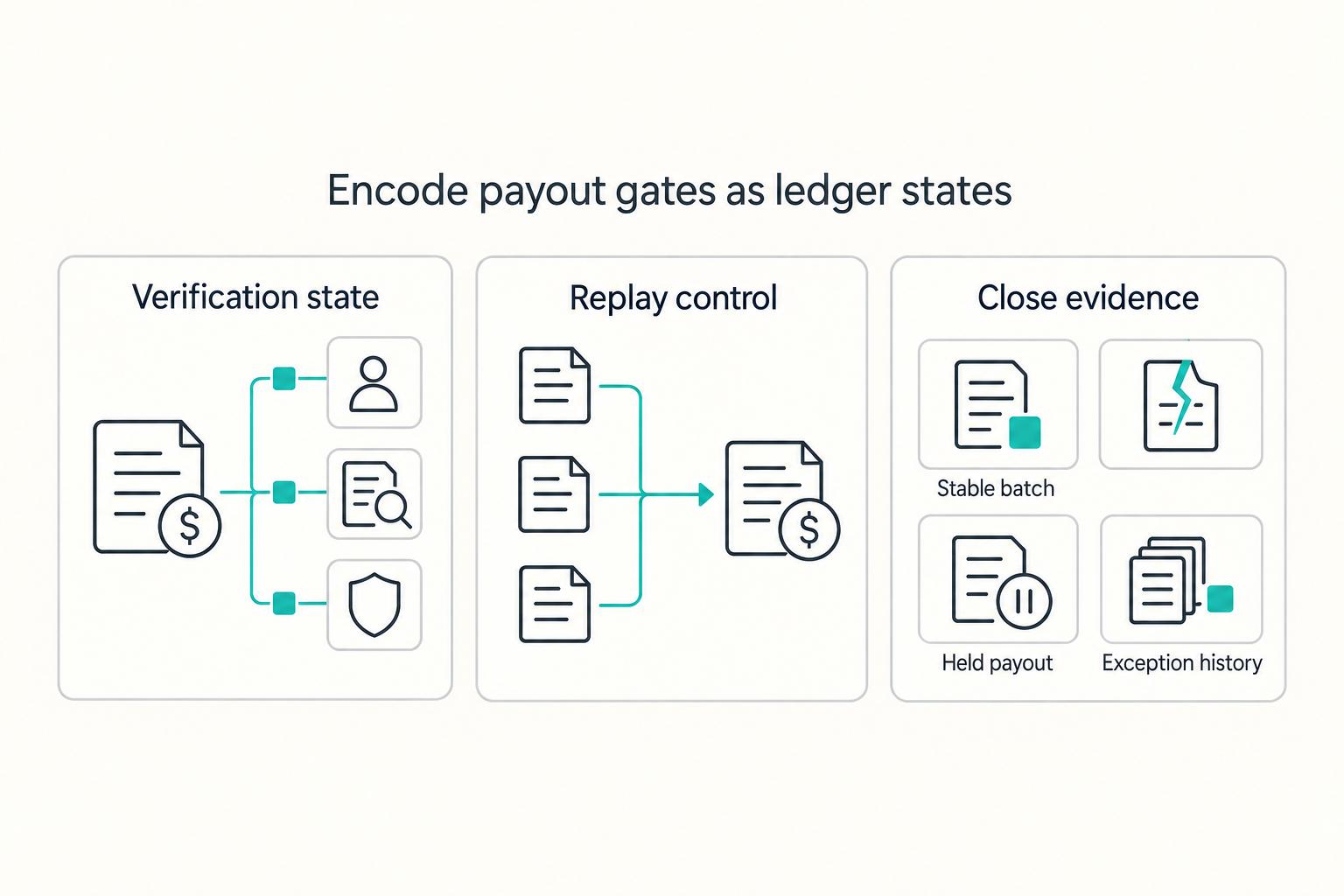
Treat compliance outcomes as first-class payout controls, not side workflows. Put KYC, KYB, AML, and tax prerequisites into explicit payout states so release decisions stay fast, replayable, and explainable.
Encode policy outcomes as payout states#
Make release logic state-based, not operator-memory-based. A recipient can move through states such as pending_verification, eligible_for_payout, held_for_aml_review, held_for_tax_info, and released, with each transition tied to a machine-readable reason code.
If you operate where an AML program is required, build documented controls into product behavior, not only policy docs. 31 CFR § 1022.210 requires certain money services businesses to maintain AML programs with policies, procedures, and internal controls, so your payout flow should store explicit decision records for each hold or release. Verification point: pick one blocked payout and confirm current KYC, KYB, and AML outcomes are visible without log digging.
Define prerequisites by recipient profile#
Prerequisites should vary by recipient profile, market, and program. Verification can be a precondition to processing payments and payouts, and requirements vary by where the user operates.
| Recipient profile | Typical release prerequisites | What to store before release |
|---|---|---|
| U.S. individual | KYC complete, verified payout destination, Form W-9 when your program requires U.S. tax documentation | TIN collection status, document received date, bank account verification state |
| Foreign individual | KYC complete, verified payout destination, Form W-8BEN when your program requires foreign-status documentation | Foreign-status form type, refresh policy if applicable, bank account verification state |
| Business entity | KYB complete, required business checks for your provider or program, verified payout destination | Entity verification outcome, identifiers used, approved bank account record |
Keep tax-form logic precise. Form W-9 is for U.S. persons providing a correct TIN, and Form W-8BEN is for foreign individuals establishing foreign status in U.S. withholding or reporting contexts. Do not treat either form as universal unless your program requires it.
Recheck holds when building the payout batch#
Recheck eligibility at batch build and again before submission. If an AML hold or other outstanding requirement exists, block release and keep the payable linked to its hold decision instead of pushing it through.
This is where determinism often fails: teams validate once at scheduling, status changes later, and the payout still leaves. If human review is needed, model it as an explicit approval gate before processing, with a reason code.
Checkpoint: for one held payout candidate, confirm the batch record shows exclusion reason and rule or reviewer source, and that the linked payable is still open.
Keep market qualifiers visible in product behavior#
Keep market and program qualifiers explicit across copy, API behavior, and ops SOPs. Verification requirements vary by country or region, some features are region-limited, and Merchant of Record scope can be selective by market or product.
Avoid blanket claims such as "global payouts supported" or "MoR covers every transaction" unless that is true for the active program. Run a quick consistency check across one onboarding screen, one capability flag, and one payout SOP for the same market.
Connect operational ledger outputs to accounting and reporting#
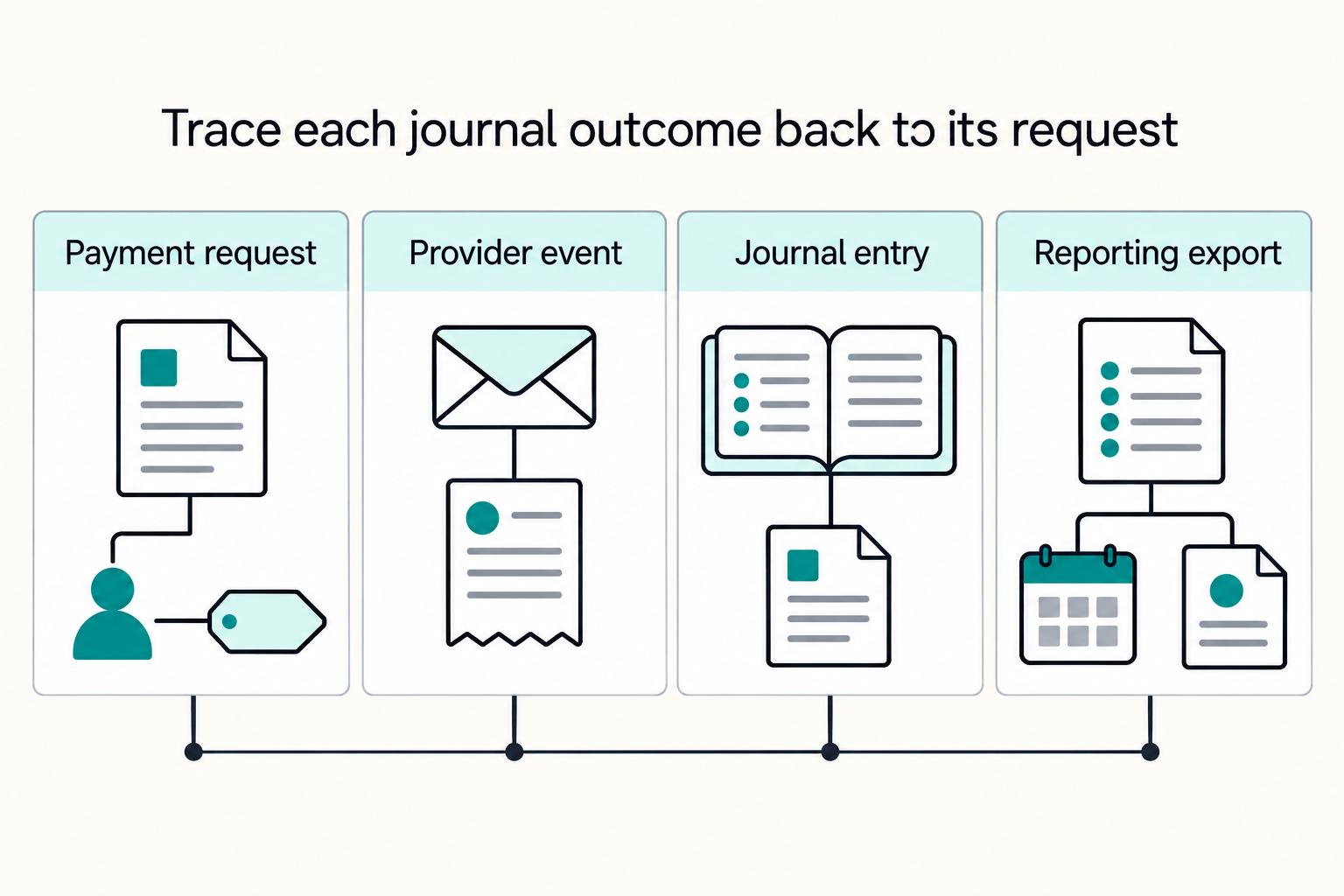
Determinism often breaks at the ledger-to-GL handoff, so treat that handoff as a product contract. The same posted operational entries should produce the same export package, account mapping, and replay outcome.
Define a replay-safe export contract#
Define one operational-ledger-to-general-ledger export contract and keep it stable through close. Include fields such as source entry ID, export batch ID, accounting period, posting date, currency, debit or credit direction, external provider reference, and mapping version. If routing uses branch code, general-ledger code, or currency code, keep those rules explicit in your mapping table.
Make replay behavior idempotent: rerunning the same logical batch should return the same result, not create duplicate journals. Operational-ledger workflows support transfer into an enterprise GL, but control quality depends on reproducible outputs. Verification point: rerun one prior export in test and confirm line count, debit total, credit total, and mapping match the original.
Set close checkpoints before final posting#
Set close gates before the period ends: open breaks allowed, blocked breaks, and approval-only exceptions. In practice, this aligns with period-close controls like bank-statement reconciliation and explicit exception review before transfer to the general ledger.
Use a clear decision rule. Timing-only breaks inside policy windows can remain open if they are quantified, owned, and reviewed. Missing provider references, out-of-balance trial totals, and orphaned reversals should block final close journals. Trial-balance validation is a core control for keeping the general ledger balanced.
Checkpoint: produce one exception report for the period with break type, amount, aging, owner, and disposition. If a blocked break is overridden, require approver name, reason code, linked evidence, and a target resolution date.
Expose tax-reporting fields where the program actually needs them#
Track tax-reporting data during operations, not at year end. If your program creates Form 1099-K obligations, store payee identity, gross reportable amount, calendar-year totals, correction status, and the tax-year rule version used. Do not hardcode one universal threshold: IRS materials include both a $600 aggregate threshold for certain years after 2022 and later guidance describing $20,000 and 200 transactions for TPSO filing.
| Area | Rule noted | Data to keep |
|---|---|---|
| Form 1099-K | IRS materials include both a $600 aggregate threshold for certain years after 2022 and later guidance describing $20,000 and 200 transactions for TPSO filing | Payee identity, gross reportable amount, calendar-year totals, correction status, tax-year rule version |
| FBAR (FinCEN Form 114) | U.S. persons may need it when aggregate foreign-account value exceeds $10,000 at any time in the calendar year; due April 15 with an automatic extension to October 15 | Foreign-account exposure data |
| FEIE | Requires foreign earned income and a foreign tax home; one qualification path uses 330 full days in 12 consecutive months | Country of work, dates abroad, foreign-earned-income tagging |
For FBAR visibility, keep foreign-account exposure data accessible. U.S. persons may need FinCEN Form 114 when aggregate foreign-account value exceeds $10,000 at any time in the calendar year. Due date is April 15 with an automatic extension to October 15.
For FEIE, keep supporting metadata rather than making eligibility decisions in-product. Preserve country of work, dates abroad, and foreign-earned-income tagging, since FEIE requires foreign earned income and a foreign tax home, and one qualification path uses 330 full days in 12 consecutive months.
Prefer traceable postings, then aggregate in views#
When finance and product disagree on posting granularity, prioritize audit traceability in source postings. Post at a level that lets you tie each GL line back to the operational event, settlement reference, and recipient or merchant context, then aggregate in reporting views.
That keeps exceptions and replays defensible. If you need a deeper handoff pattern, see Accounting API for Platforms: How to Connect Your Payment Infrastructure to Any General Ledger.
Track weekly controls that prove the system is stable#
Weekly controls should show, quickly, whether close gates still hold under retries, duplicate events, and payout exceptions. Pair one glance metric with one drill-down metric in each money domain so totals do not hide replay or close risks.
Measure duplicate handling and reconciliation drift#
Track four weekly KPIs: unreconciled break count, aging by break type, replay count by idempotency key, and duplicate webhook suppression rate. Together, they show whether transactions are matching and whether retry handling remains consistent.
Use unmatched-transaction views to segment breaks by type and, where useful, by organizational unit. For duplicate events, log processed event IDs and suppress reprocessing of already logged webhook events. Review behavior over the provider retry window, for example up to three days in Stripe. Verification point: sample retried requests and confirm the same idempotency key returned the same result as the original call, including prior server-error outcomes where applicable.
Separate payout reliability from payout timing noise#
Review payout batch success, held versus released volume, and exception queue burn-down in a separate weekly cut. Keep failed payouts, policy holds, and not-yet-settled items in distinct buckets so reliability issues are not blurred with timing differences.
Use payout reconciliation reporting to tie bank-received payouts to underlying transaction batches, and keep failed automatic payouts separate from transactions not yet settled by report end date when your provider exposes that distinction. Keep provider-native payout outcomes in your evidence pack. Verification point: one sampled batch should tie to bank receipt, batch contents, and any type-specific exception queue items.
Assign one glance metric and one drill-down metric per domain#
Use a simple metric pair so ownership stays unambiguous, like this:
| Domain | Executive metric | Operator metric |
|---|---|---|
| Collection | Duplicate webhook suppression rate | Replay count by idempotency key |
| Settlement | Unreconciled break count | Aging by break type |
| Payout | payout batch success | Held vs released volume plus exception queue burn-down |
| Close | Open close-impact breaks | Aging of close-impact breaks by type |
If a domain owner cannot explain both numbers and show the underlying queue or exception list, the control is not yet operational.
Handle common failure modes with explicit recovery paths#
When a break occurs, the recovery path should be explicit: return the prior result, hold with evidence, or resolve through a traceable new entry. If operators improvise, ledger determinism degrades fast.
| Failure mode | Required handling | Key evidence |
|---|---|---|
| Duplicate events or retries | Quarantine by idempotency key or processed event ID and return the prior result without new financial postings | Same status, references, and journal outcome as the first pass |
| Missing PSP reference at settlement | Hold the item in an exception workflow and do not guess the match or post final close-impact entries | Full evidence trail until the identifier is available or corrected |
Unmatched Virtual Accounts cash | Keep funds in suspense or an unapplied category until ownership is confirmed | Statement line to inbound cash event, and inbound cash event to the customer or balance owner |
| Recipient blocked after scheduling | Remove the recipient from the payout batch, preserve the original scheduling record, and notify ops with a reason code | Current compliance status at execution time plus the preserved scheduling record |
| Backfill without lineage | Reject it if it cannot reference source event IDs and the original business object being corrected | Original accounting details plus an offsetting entry and a new correcting entry |
Quarantine duplicate events and re-emit the prior result#
Treat duplicate webhook deliveries and retries as expected behavior. Providers can resend undelivered events for up to three days, so quarantine by idempotency key or processed event ID, retrieve the original ledger outcome, and return the same business result without new financial postings.
Use a weekly verification check: sample one duplicate event and confirm replay produced the same status, references, and journal outcome as the first pass. Also confirm retries did not create a later second side effect after an earlier server-side failure result.
Hold close-impact items when the PSP reference is missing#
If settlement arrives without the expected Payment Service Provider (PSP) reference, do not guess the match and do not post final close-impact entries. Hold the item in an exception workflow, open an investigation, and attach a full evidence trail until the identifier is available or corrected.
Matching quality depends on configured external references. Keep the External Payment Reference field configured, and carry both the PSP reference and your internal or merchant reference across reports. Separate timing-only breaks from true data defects so teams do not escalate both the same way.
Park unmatched Virtual Accounts cash in suspense until ownership is proven#
When inbound funds in Virtual Accounts cannot be mapped to an owner, keep them in an identifiable unresolved state first. Use a suspense or unapplied category so funds remain visible, reversible, and clearly unallocated until ownership is confirmed.
Before resolution, prove two links: statement line to inbound cash event, and inbound cash event to the customer or balance owner. Then resolve with a deterministic entry that preserves the unresolved posting and adds the allocating entry, rather than editing history in place. For close-period pressure, use a stricter review path such as the Month-End Close Checklist for Payment Platforms: Reconciling PSP Settlements Bank Statements and Ledger.
Remove blocked recipients from the payout batch and keep the audit trail intact#
If a recipient becomes blocked after scheduling due to KYC or AML status changes, remove that recipient from the payout batch, preserve the original scheduling record, and notify ops with a reason code. Do not overwrite prior state silently.
This control matters because verification status can directly disable payout capability. In some provider flows, there can be a 14 day grace period after verified-information updates, so release checks should read current compliance status at execution time, not only at scheduling time.
Reject stale backfills unless they preserve lineage#
Backfills should be rejected if they cannot reference source event IDs and the original business object being corrected. If your policy requires added evidence like mapping version or approver record, enforce it consistently.
Use correction patterns that preserve lineage: keep original accounting details, then post an offsetting entry and a new correcting entry. That keeps replay, reconciliation, and audit trails reliable.
Conclusion and copy-paste launch checklist#
Hold launch if you cannot show evidence for each line below. Use this as an operational launch bar so retries, redeliveries, settlement reporting, payout controls, and close entries stay traceable and consistent.
Lock the boundary first#
Hierarchical Deterministic (HD) wallet work under BIP-32, mnemonic handling under BIP-39, and UTXO concepts are about crypto key and transaction models, not payment-ledger operations. Write one short definition of what your ledger owns, plus examples of what it does not own, so teams do not blur wallet language into payout or close controls.
Prove replay behavior before scale#
Test that repeated requests with the same idempotency key return the first stored outcome instead of creating new financial impact, and confirm mismatched retry parameters fail as expected. Include one duplicate API request, one resent webhook, and one backfill path with original lineage. Stripe can resend undelivered webhook events for up to three days, and idempotency keys may be pruned after at least 24 hours.
Then verify reconciliation in two layers: ledger activity to Payment Service Provider (PSP) settlement artifacts, and payout cash movement to bank deposits, or Virtual Accounts if your flow uses them. Do not treat event delivery alone as cash proof.
Encode payout and close gates as explicit states#
Encode payout and close gates as explicit states, then test an exception. Adyen requires user verification before payments and payouts, so verification cannot stay off-record. If your program applies additional verification checks, keep those states and reason codes attached to the same record. For US covered institutions, CIP is part of the AML compliance program.
Carry the same control posture into accounting. Test general ledger export with stable batch IDs, and include at least one unresolved break and one held payout in month-end checks. Journal approval before posting is a common ERP control pattern. Confirm exceptions can be reviewed without overwriting history.
- Ledger scope is explicit and not conflated with
HD walletorUTXOconcepts. - Replay behavior is tested for the write paths that can create financial impact, including retries and backfills.
- Lifecycle states are documented for collection, settlement, and
payout batchhandling. - Reconciliation is live from
PSPartifacts to bank deposits, andVirtual Accountswhere applicable. - Applicable verification and compliance gates, for example
KYCandAML, are encoded as explicit state transitions. -
general ledgerexport and month-end close checkpoints are tested with exception scenarios. - Weekly control metrics are owned, reviewed, and tied to escalation actions.
Frequently Asked Questions
What is a deterministic ledger in a payment platform?
A deterministic ledger means the same input event always produces the same posting outcome, status, and traceable record. That is what keeps retries and replays safe under load, because finance gets one reproducible answer instead of multiple versions of truth. If a repeated request with the same idempotency key can produce a different result, determinism has failed in practice.
How is deterministic ledger design different from a `Hierarchical Deterministic (HD) wallet` approach?
An HD wallet under BIP-32 is a key-derivation model, and BIP-39 covers mnemonic phrases used to generate wallet seeds. That is about cryptographic key management, not ledger accounting behavior. It does not define how to handle duplicate webhook events, settlement posting, or payout-to-bank reconciliation.
What minimum controls are required before enabling payouts in production?
There is no single universal legal minimum that applies to every payout program and jurisdiction, so separate provider requirements, regulatory obligations, and your internal release bar. Before enabling payouts, enforce idempotent write paths and make sure replay returns the original stored outcome rather than creating new financial postings. If you handle payment account data, PCI DSS is a baseline framework, and Stripe Connect guidance requires KYC fulfillment before connected accounts can send payouts. For US money services businesses, an AML program is required, and covered institutions must identify and verify beneficial owners of legal entity customers.
How do you reconcile asynchronous `webhook` events with settlement files and bank statements?
Treat each webhook as an event signal, not final cash proof: return 2xx, store it durably, and process from storage because redelivery can continue for up to three days in Stripe or up to 30 days in Adyen. Reconcile in two layers: ledger entries to provider settlement data, then payout cash movement to your bank or balance statement. Use processor-native artifacts such as Stripe’s payout reconciliation report or Adyen’s Settlement details report, then verify payout totals against statement reality. Do not force-match unresolved items when key references are missing. Hold them in an exception path until evidence is complete.
What should finance and ops teams review every week to detect determinism drift early?
Review duplicate and replay behavior first, including whether repeated operations consistently return the original outcome for the same idempotency key. Check webhook retry backlogs and exception queues so delayed or redelivered events do not silently accumulate. Then sample at least one duplicate event and one unresolved reconciliation case to confirm traceability from source event through final ledger state. If those samples are inconsistent, drift is already starting even when aggregate totals still tie.
Which failures usually break determinism first in live systems?
The earliest breaks are usually duplicate deliveries, out-of-order webhook events, and retries that do not reuse the original idempotency key. Another common break is treating event delivery as settled cash before settlement and bank or balance reconciliation are complete. Payout controls can also fail when eligibility or verification requirements are not rechecked at execution time. A practical red flag is simple: if someone must guess a match or overwrite history, route it to an exception workflow instead of posting through.
Try a related tool
Researched and edited by the Gruv editorial team. Gruv builds cross-border billing, payouts, and finance-operations software for global businesses.
Sources
Includes 1 external source outside the trusted-domain allowlist.
- consumerfinance.gov/compliance/supervisory-guidance/interagency-...trusted
- docs.stripe.com/api/idempotent_requeststrusted
- ecfr.gov/current/title-31/subtitle-B/chapter-X/part-1...trusted
- ecfr.gov/current/title-31/subtitle-B/chapter-X/part-1...trusted
- irs.gov/forms-pubs/about-form-1099-ktrusted
- irs.gov/forms-pubs/about-form-w-9trusted
- sao.wa.gov/bars-annual-filing/bars-gaap-manual/accounti...trusted
- developer.bitcoin.org/devguide/transactions.htmlexternal
Educational content only. Not legal, tax, or financial advice.
Related Posts

Month-End Close for Payment Platforms with PSP Settlement Control
Month-end close often breaks down when PSP settlement is treated as a side reconciliation. For payment platforms, settlement is often the clearest record of what cash should have moved, so it should drive the close rather than being checked after journals are drafted. If you run close across multiple PSPs, you need that settlement record to lead the review before your team starts defending journal entries.
Accounting API Platforms for General Ledger Integration
These integrations usually break at the same point. The happy path works, then asynchronous events, retries, and month-end pressure expose controls you did not design upfront. To reduce rework, define posting boundaries, dedupe behavior, and matching checks before you spend time on ERP exports or reporting polish.
How Modern CFOs Make Payment Platform Expansion a Strategic Driver
A payment platform should choose its next market based on operational readiness, not volume forecasts alone. The real question is whether you can run that market safely and clearly without creating finance debt that later shows up as payment, reconciliation, or compliance failures. If you cannot explain that operating path cleanly, your forecast should not carry the decision.