
Quick Answer
Define the authoritative GL/subledger path and balanced journal rules for each financial effect. Retain applicable source and target references, persist event intake before acknowledgement and recover uncertain ERP writes from durable intent. Reconcile provider, ledger and actual route-specific cash evidence, with payment-release decisions separate from accounting recognition.
Why this integration breaks and how to avoid platform debt#
These integrations usually break at the same point. The happy path works, then asynchronous events, retries, and month-end pressure expose controls you did not design upfront. To reduce rework, define posting boundaries, dedupe behavior, and matching checks before you spend time on ERP exports or reporting polish.
A general ledger organizes accounting records by account for trial balances and financial statements. A journal records financial entries. Define each intended financial effect under accounting policy: one payment may need several balanced multiline entries, while some lifecycle events do not post. Duplicate deliveries must not duplicate those effects.
1. Define the ledger as the accounting source. Start by deciding what is authoritative. Provider payloads and internal tables are useful, but your journal-entry record should be the accounting source for tie-out and reporting.
Make traceability your first checkpoint. For a single payment or payout, confirm you can follow one chain across internal payment ID, provider transaction reference, webhook event ID, journal entry ID, and match status. If that chain is missing in test, incident recovery in production gets slower and more error-prone. Defer ERP mapping until that trace is stable.
2. Make retries safe before scaling webhook ingestion. Webhook handling matters because payment events are asynchronous and may arrive after the original request completes. If you treat webhooks as metadata, you can create accounting gaps.
Use two controls. First, enforce idempotency on posting requests so retries do not create duplicate journal entries. With Stripe semantics, idempotency keys can be up to 255 characters and may be pruned once they are at least 24 hours old. If your replay horizon is longer, keep your own dedupe record longer too.
Second, design for delivery failure and replay. Stripe can automatically resend undelivered events for up to three days, and its recovery listing is limited to events from the last 30 days. Test the failure path in staging by replaying the same event multiple times and verifying journal counts do not change after the first accepted post.
3. Define journal behavior before reporting. Do not build exports or dashboards until you know what each payment event means in accounting terms and when it creates, updates, or reverses a journal result.
If that logic is fuzzy, matching work becomes manual and month-end close slows down because the team has to explain balance movement outside the posting rules.
4. Put reconciliation into the operating model. Make this part of the integration contract from day one, not a cleanup step after launch.
Run a regular comparison across provider records, ledger totals, and bank statement activity. Bank-statement matching is a core accounting control, and month-end close is the process of reviewing, reconciling, and finalizing monthly activity. Once tasks, documentation, and manual work pile up, close quality can drop and errors can increase.
Use this starter checklist.
- Retain internal action/payment IDs, journal references and applicable provider, event or file source references; not every valid journal has a webhook ID.
- Prove idempotent behavior with duplicate-event and manual-replay tests.
- Keep an evidence pack with provider exports, bank statements, and posting logs.
- Define exception ownership and what must be resolved before month-end close.
- Defer ERP sync and reporting expansion until posting and matching hold under failure.
If you want a deeper dive, read ERP Integration Architecture for Payment Platforms: Webhooks APIs and Event-Driven Sync Patterns.
What to prepare before you integrate anything#
Before you pick an API or wire a webhook, lock four decisions in writing: accounting source, evidence pack, ownership, and acceptance criteria. Without that setup, teams tend to optimize around provider payloads instead of building a process finance can close and explain.
Step 1 Define the accounting source#
Decide which record is authoritative for accounting before build work starts. One internal policy option is to treat the journal entry record as the source for tie-out and reporting, with ERP sync downstream.
This is an internal design choice, not a universal rule, but it needs to be explicit. Your test checkpoint is simple: for one payment and one payout, finance can trace internal payment ID to provider reference, journal entry, and match status without ad hoc SQL from engineering.
Step 2 Assemble the evidence pack first#
Collect the inputs for settlement checks and bank matching before you implement sync logic. At minimum, gather current PSP settlement reports, sample bank statement exports, chart-of-accounts mapping, and the close calendar, or closing schedule, used for month-end close.
Use the provider’s actual reconciliation contract. Stripe automatic payouts can associate payout-linked balance transactions; manual payouts need separate association. Adyen provides transaction-level settlement detail. Validate your account’s report availability and match actual provider and bank evidence without assuming every route has one settlement-batch format.
Step 3 Assign owners by failure domain#
Assign ownership by failure domain, and write it down as policy. For example, engineering can own event-driven sync, webhook ingestion, and idempotency key policy on create and update calls so retries do not create duplicate postings, while finance owns review criteria and sign-off for the matching process.
Avoid shared ownership without a final decision maker. When sync failures happen, someone needs authority to decide whether to replay, reverse, or hold an item in the exception queue.
Step 4 Set acceptance criteria before build#
Define success in operator terms before implementation. Agree on balance-level parity checks, a posting-latency target, and an internal response target for unmatched transactions in the exception queue.
Add one period-close rule now. If your ERP closes periods by locking posting activity, as NetSuite does for some transaction classes, define how late events are handled so retries do not post into a locked month. For a deeper close checklist, see Month-End Close Checklist for Payment Platforms: Reconciling PSP Settlements Bank Statements and Ledger.
Related: Working Capital Optimization for Platforms: How Payment Timing Affects Your Cash Position.
Set the target architecture and traceability contract#
Treat traceability as a hard architecture contract from day one. If you cannot show how a payment request led to its ledger action and match outcome, the integration is not ready.
Step 1 Map the full trace before you post anything#
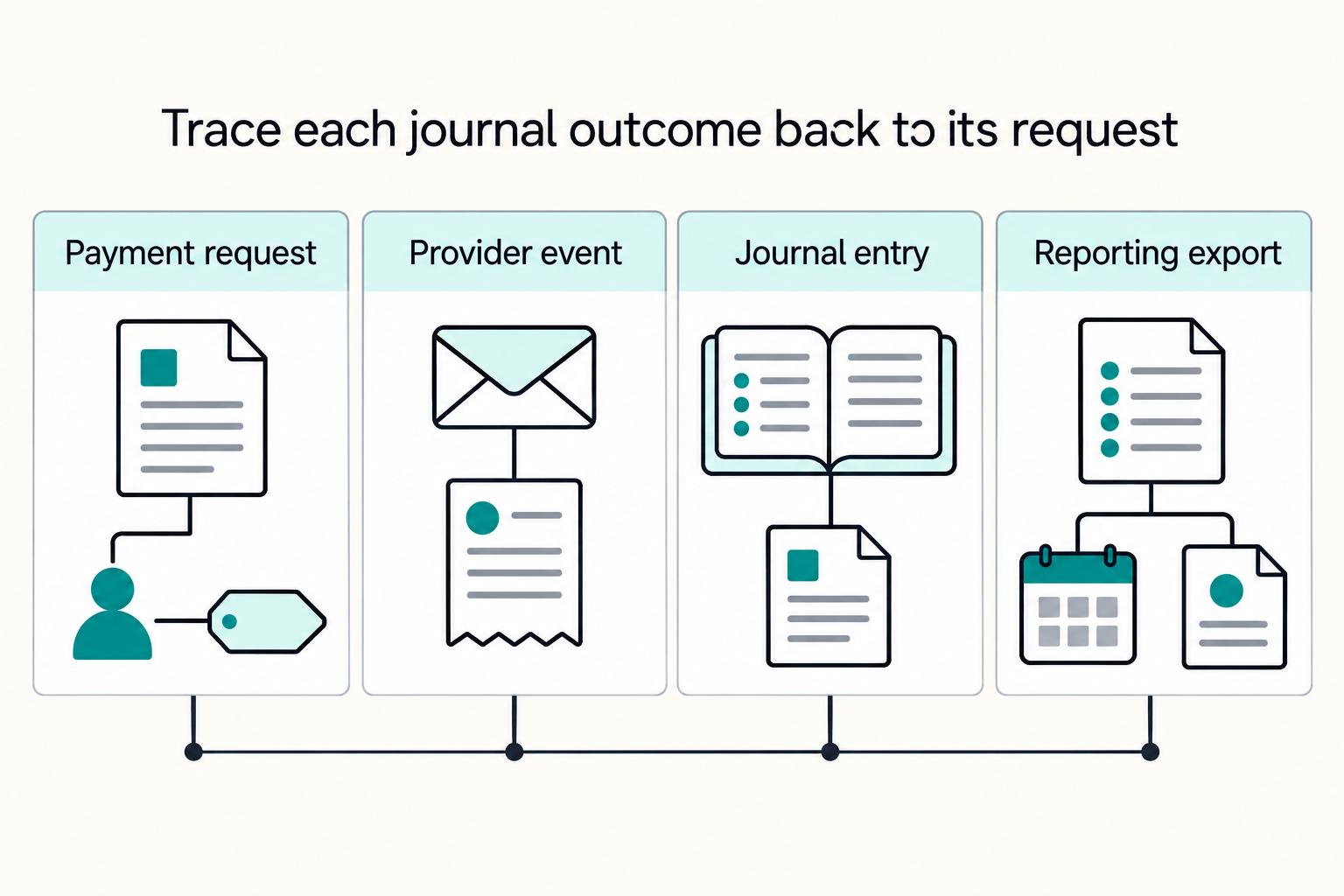
Write the end-to-end chain as a concrete record path. A practical chain can include: internal payment request, provider reference, webhook Event object, posting request to the General Ledger API, resulting journal entry ID, match status, and reporting export identifier. Do this first so the team can explain outcomes later without manual patching.
For one payment and one reversal, finance should be able to answer:
- Which API request or user action started it
- Which provider reference and webhook event matched it
- Which journal entry posted or reversed it
- What match state it is in
- Which report or export carries the ledger impact
Step 2 Make the ledger interface the posting path#
Choose an authoritative accounting path: direct general-ledger posting or a controlled subledger with approved GL transfer. Define accounts, balanced multiline journal rules, periods and source references before rollout. Preserve distinct cash, fee, receivable, refund and adjustment effects instead of collapsing every event into one entry.
Step 3 Persist linkage keys for retry-safe traceability#
Store the identifiers that connect each retry and async event to the original action. The idempotency key is central because the same key should return the same result on retries, including repeated errors. In Stripe, event payloads include the originating API request ID and can include the idempotency key used on that request.
Keep your own history of those keys and related identifiers. Do not rely only on provider retention windows. Stripe documents idempotency keys up to 255 characters and notes keys may be removed after at least 24 hours. Stripe also retries undelivered webhook events for up to 3 days and limits event listing to the last 30 days.
Step 4 Define required audit answers up front#
Decide in advance what must always be explainable. That includes who triggered the action, what request or event caused the posting, and why the item is in its current status.
Require an audit trail for API activity and ledger history so prior states remain reconstructable. Operators should be able to trace posted, edited, or reversed outcomes from recorded data, not ad hoc investigation.
For the full breakdown, read SOC 2 for Payment Platforms: What Your Enterprise Clients Will Ask For.
Choose the right integration pattern for your stack#
Choose the pattern that still holds up when retries, reversals, and close pressure hit. If you run high-volume payouts or change product behavior often, a standalone General Ledger API with your own orchestration can be a safer choice. Direct ERP posting can work when volume is lower and the accounting model is stable.
Step 1 Match your operating profile to one of three patterns#
Choose based on how your system actually receives and processes events, not just where finance wants final reports. Payment events are asynchronous, so the pattern has to absorb delayed and duplicated inputs.
| Pattern | Best fit | Webhooks and event-driven sync | Posting granularity | Exception handling and matching |
|---|---|---|---|---|
| Embedded General Ledger with payment rails | You want ledger behavior close to product operations and balances | Can fit asynchronous events when the ledger sits near transaction creation | Can be fine-grained for platform transaction tracking, depending on implementation | May reduce translation steps, but you still need proof of replay handling and usable match outputs |
| Standalone General Ledger API plus custom orchestration | High payout volume, frequent product changes, multiple providers | Strong fit when you need webhook ingestion, routing, dedupe, and deterministic posting | High control over journal design, timing, reversals, and derived states | You own exception queues and matching logic, which adds upfront work but improves flexibility |
| Direct ERP posting | Lower volume, stable accounting, tighter finance ownership in ERP | Often requires translating async payment events into ERP-safe flows | Can be constrained by ERP schemas or chart-of-accounts structure | Exception review may depend more on downstream exports and ERP jobs |
A practical rule is this: as your product and payment flows change faster, hard-wiring payment semantics into an ERP connector adds risk. ERP and accounting APIs can be harder to use for very high-volume, fine-grained transaction tracking, even though payment engines can integrate with ERP and accounting systems. The choice is fit for profile, not one size fits all.
Step 2 Validate async behavior, not just happy-path posting#
Do not accept a pattern until it proves it can handle webhook reality. Webhooks are asynchronous, and Stripe live-mode undelivered events can be retried automatically for up to three days, so your design has to absorb duplicates, delays, and replay windows.
Ask vendors or internal teams to show:
- repeated delivery of the same event
- retry-safe posting with an idempotency key
- replay of failed events without double posting
- late reversal arrival after the original transaction is already reported
Verification point: "supports webhooks" is not enough. Ask for a concrete flow where retries with the same idempotency key do not create duplicate postings, and already-processed events are recognized and not reposted.
| Control checkpoint | What to prove before go-live | Failure signal to catch early |
|---|---|---|
| Idempotent posting | The same posting request with the same idempotency key returns the same accounting outcome on replay. | A retry creates a second journal effect or a conflicting posting status. |
| Webhook ingestion | Duplicate, delayed, and replayed events are recognized without reposting or losing traceability. | The same event ID can create duplicate ledger updates or orphaned exception items. |
| ERP and ledger throughput | Peak-hour request volume stays inside the published API and batch limits for the target system. | Burst traffic forces manual re-exports, throttling workarounds, or period-close posting delays. |
Step 3 Pressure-test throughput and posting detail before committing#
Model peak traffic and the actual provider contract. Current QuickBooks Online documentation specifies 500 requests per minute per realm and 10 requests per second per realm and app. Batch limits are 40 per minute per realm and app, and 120 per minute per realm; 30 payloads is a recommended maximum. Partner-tier workspace quotas also apply, and the documentation advises waiting 60 seconds after HTTP 429. These limits do not guarantee successful throughput. Bound queues and recover timed-out writes before retrying.
If your profile includes payout bursts, retries, and multiple balance-impacting state changes per payment, API-first ledger middleware can be more resilient than tight ERP coupling. You can still sync approved or summarized outputs into ERP downstream.
Verification point: include successful payments, refunds, payout initiation and completion, fee events, and reversals in your peak model. If projected event load approaches published ERP API caps, consider treating ERP-direct as a downstream accounting sink rather than the primary event posting engine.
Step 4 Treat vendor coverage claims as a starting signal, not proof#
Use vendor pages to scope diligence, not to end it. For example, Crater presents strong embedded ledger claims, but those claims still need operator-level validation.
Request evidence for:
- documented idempotency semantics
- documented retry and duplicate-event behavior
- webhook or event-destination support, including event-bus routing options
- operational constraints such as rate limits, concurrency limits, and retention windows
- failed-post replay flow
- outputs linking provider references to journal entries and reporting exports
"Integrates with ERP/accounting/CRM" can be true and still leave production risk unresolved. Coverage is not the same as reliable posting behavior under heterogeneous payment rails and implementation specs. If you are split between patterns, prioritize event fidelity first and ERP convenience second.
This pairs well with our guide on Microsoft Dynamics 365 for Payment Platforms: Finance Module Setup and Payout Integration Guide.
Map every payment event to explicit journal logic#
Define journal logic per payment event before you implement posting. Give each lifecycle event its own row, trace keys, and a clear rule for whether it creates a new journal entry, updates lifecycle state, or waits for a later settlement signal.
Step 1 Build the event-to-ledger matrix first#
Start from provider lifecycle states, not your ERP import format. Some payment methods support separate authorization and capture, so collapsing them into one "payment succeeded" row can remove detail you need for auditability.
Use a compact matrix like this.
| Event class | Define in the row | Trace anchors to retain | Matching anchor | Reporting question |
|---|---|---|---|---|
| Authorization | Whether this is non-posting, memo-only, or a pending state in your policy | PSP reference, merchant reference, internal payment ID | No bank line expected yet; wait for later settlement evidence if capture follows | Does this affect any statement before capture in your policy? |
| Capture | Applicable balanced multiline entries for capture and distinct linked effects | PSP reference, merchant reference, journal entry ID | Expected in PSP settlement batches after batch close | Which balance sheet and period fields does capture populate? |
| Refund | New journal entry rules, not an overwrite of the original payment | Original payment reference plus refund reference | Separate settlement detail and later bank effect | Is refund reversing prior reporting or creating a new period item? |
| Payout initiation | Whether initiation posts immediately or only marks pending movement | Payout ID or transfer reference | Wait for the actual completion and route-specific movement evidence; bank matching where applicable | Is this only a balance sheet reclassification until cash lands? |
| Payout completion | Final cash movement rule | Transfer ID, payout reference, journal entry ID | Match actual destination/cash-movement evidence; bank line only when the route produces one | What appears on the cash flow statement when funds leave or arrive? |
| Chargeback | Separate dispute posting and state transition | Original payment reference plus dispute reference | Match in settlement records, potentially separate from the original payment event | Which statements reflect the loss or recovery path? |
| Reversal | Counter-entry logic and link to the prior event being reversed | Prior journal entry ID plus provider reference | Match against provider adjustment records | Does reversal restate prior reporting or flow through current period? |
| Fee posting | Fee-specific balanced journal rule and unique effect key | Transaction reference plus fee line reference | Settlement details report at transaction level | Where do fees land on the income statement? |
| FX conversion | Separate event and amount mapping in reporting currency | Provider reference plus conversion detail | Settlement and bank amounts may differ; define conversion mapping | How are reporting-currency amounts populated? |
The expected outcome is one row per event class, with no row relying on "what we usually do."
Step 2 Define posting and lifecycle rules at row level#
For each action, define predecessor/evidence expectations, trigger, accounting rule, balanced journal lines and stored references. A balanced entry can contain more than two lines. Define delivery dedupe separately from durable uniqueness of the intended financial effect.
Keep events separate. In Stripe, balance transactions are immutable after creation, and a refund creates a separate balance transaction instead of modifying the original charge. If your matrix says a refund "edits" the original capture row, audit and close get harder.
A strong row keeps key IDs on every posting where available: internal payment ID, provider transaction ID, PSP reference, and settlement batch ID. With Adyen, PSP reference plus merchant reference are natural anchors, and payment lifecycle history in the Journal type column is a practical verification point. If the same event sometimes creates a new entry and sometimes amends an old one, standardize before go-live.
Step 3 Add reconciliation checkpoints and timing expectations#
Define when external evidence is expected for the specific route. Some providers use settlement batches; other rails settle continuously or follow different payout schedules. Use observed account/route timing and investigate missing evidence rather than assuming universal T+1/T+2.
For capture, refund, fee, and chargeback rows, define the expected PSP settlement checkpoint. Adyen settlement detail reporting is transaction-level and includes per-transaction costs, so it is a strong anchor for event-level matching. For payout rows, add a separate bank-statement checkpoint. For PayPal disbursements, keep the Transfer ID because it can be used to cross-reference bank statements.
Also define the exception rule. When does a timing difference become something to investigate? Example: capture has a PSP reference but no settlement batch after the normal batch window, or payout completion has a transfer reference but no bank-statement match in the expected window.
Matching capture directly to bank statements while skipping PSP settlement can create mismatches once fees, refunds, or payout netting appear.
Step 4 Map statement impact before finance sees the first export#
Define reporting impact per row before export design. For each event class, specify whether it populates the balance sheet, income statement, and cash flow statement, and under what conditions.
Use SEC framing as a sanity check for these three reporting lines in this matrix: the balance sheet is point in time, the income statement is period activity, and the cash flow statement reflects exchanges of money with the outside world. Not every event should hit every statement. Authorization may remain pending-only in your policy, fee posting needs a defined income statement destination, and payout completion can have cash flow impact that payout initiation may not.
Verification point: have finance review one full path, authorization, capture, refund, fee, payout, and confirm each row lands in expected statement outputs. If that still requires spreadsheet side notes, the matrix is too vague.
You might also find this useful: SaaS Accounting Software Evaluation: What Payment Platforms Need Beyond Standard GL Features.
Build idempotent ingestion and event-driven sync first#
Once the event-to-ledger matrix is defined, reduce the impact of delivery behavior on posting outcomes. Put an idempotent ingestion layer in front of ledger posting so retries, duplicates, and out-of-order events do not create duplicate journal activity.
Step 1 Require an idempotency key on every posting call#
Require an idempotency key on every endpoint that creates or mutates posting state, and store that key with the posting attempt or journal evidence. For safe retries, define idempotency so the same key returns the original result, and reject reuse of that key with different parameters.
Two controls matter most. Persist a request fingerprint with the key, and keep the key on the ledger-side audit trail rather than only in gateway logs. That lets you prove why repeated upstream retries still produced one posting outcome.
Verification point: send the same create-posting request three times and confirm one journal entry ID. Then reuse the same key with a changed amount or mapping and confirm rejection.
Step 2 Consume webhooks asynchronously and design for duplicates#
Verify and durably persist webhook intake before acknowledging delivery. Process asynchronously with delivery dedupe and financial-action uniqueness. Before an external ERP write, persist recoverable intent/outbox and the target request/reference; use supported target idempotency or lookup to resolve timeouts. Mark completion only after the target outcome is known.
Use deterministic dedupe based on stable provider event identity plus your business object reference, for example payment, refund, or payout reference. For out-of-order arrivals, hold events that depend on missing predecessors instead of forcing invalid ledger state.
A common failure mode is deduping only queue-message IDs. The same business event can still re-enter through retries or manual replay.
Step 3 Add a DLQ with replay controls and audit notes#
Route failed processing to a dead-letter queue, then recover through controlled redrive, not manual SQL edits. Replay should run through the same posting path and dedupe checks used in normal processing.
Store enough failure context in each DLQ record to support investigation and safe replay: source event ID, provider reference, failure timestamps, error, receive count, and operator note. Tune replay thresholds deliberately. There is no universal maxReceiveCount value that fits every system.
The expected outcome is recoverable failed events with full traceability and no extra journal entries.
Step 4 Validate predecessor state before posting#
Validate accounting prerequisites and recover missing source history when events arrive out of order. Route unresolved evidence to an owned exception without inventing state. Payment-release eligibility must not suppress valid accruals, liabilities, executed cash effects or required corrections under accounting policy.
This prevents impossible states from entering the ledger and separates delivery issues from business-rule issues. It also keeps replay safer during retry windows and manual undelivered-event recovery, because events still have to pass the same transition checks before posting.
Design reconciliation controls that hold up at month-end#
If you want a faster, calmer close, match all three records together: PSP settlement, your internal ledger, and the bank statement. Two-way matching can confirm cash movement, but it can still miss whether the related journal entry was correct, duplicated, or missing.
Step 1 Match settlement, ledger, and bank together#
Run a three-way match on a cadence that fits your volume instead of waiting for close week to find breaks. Monthly review is an explicit baseline in some formal guidance; if you post throughout the month, you can run this more frequently for more confidence at close.
Start from PSP settlement, where payout outcomes become visible. Adyen, for example, provides both batch-level payout detail and transaction-level detail for payments, refunds, and chargebacks. Use batch-level data to tie payouts to bank-statement movements, and transaction-level data to validate what sits inside each payout. Your ledger should independently total those activities by provider reference, batch, currency, and account.
Then match the bank side. Where supported, matching tooling can connect payouts to bank deposits after bank-statement access is configured. Do not stop there. Confirm that cleared bank movements also match expected ledger cash movements, especially when multiple bank accounts roll up into fewer cash GL accounts. In that structure, treat it as a global tie-out problem, not a forced one-account-to-one-account match.
Verification point: each in-scope bank movement should end in one of three states: matched, documented timing difference, or named exception with an owner.
Step 2 Classify exceptions before they pile up#
Keep exception categories visible and specific. A single "unreconciled" bucket slows investigation because it mixes timing items with true accounting issues.
Use a taxonomy your team can apply consistently. Oracle's exception model is a useful reference because it distinguishes types such as date and amount tolerance failures rather than treating every mismatch as identical. For payment platforms, add operational buckets that fit your flow, as long as each bucket has clear evidence requirements.
For each exception, keep a minimum evidence pack: provider transaction ID, settlement batch ID, journal entry ID, bank statement line reference, owner, first-seen date, and investigation note. Without that, escalation turns into manual log hunting.
One failure mode is matching only payout batch totals. Net totals can still hide duplicate postings or missed refunds inside a batch.
Step 3 Gate close on disposition and proof#
Define close gates before period-end. Finance and engineering should agree which exception types can remain open as documented timing differences and which ones block close until resolved.
Use a close-time report that surfaces unprocessed accounting events and untransferred journal entries. Oracle's Subledger Period Close Exception Report is a strong model for this control. Your equivalent report should sit next to the exception queue, not in a separate process.
This is where implementation choices compound. If ingestion preserves provider references and posting timestamps, close review stays operational instead of turning forensic. For a deeper operating checklist, align this control layer with your month-end close process.
We covered this in detail in Accounting Automation for Platforms That Removes Manual Journals and Speeds Close.
Put compliance and tax gates inside the transaction path#
Make applicable release controls explicit for your entity, role, jurisdiction and program. They govern new controlled payment actions; they do not erase liabilities or already executed money. Record required accounting effects while separately exposing allowed, held, rejected or blocked release decisions.
Step 1 Record applicable onboarding and monitoring decisions#
Identify which customer, beneficial-owner and AML checks actually apply to your regulated role and payment program. Record approved identity/evidence, decision, timestamp and any exceptions. A bank-specific onboarding rule is not automatically a universal platform requirement.
Maintain applicable monitoring and current release eligibility under the program’s risk policy. Store the risk assessment, review/evidence references and owned exception state. Apply legally required actions separately from an internal review hold, while preserving actual financial records.
Verification point: before issuing a payout instruction, your API should answer three questions deterministically: who was verified, when the decision was made, and whether the account is currently payout-eligible.
Step 2 Make tax forms queryable objects before payout release#
Represent required tax documentation and classification as queryable records. Select forms and release/withholding rules from actual payer/payee status, entity classification, income source and applicable obligations; W-9 and W-8 BEN are examples, not an exhaustive list.
Form W-9 supplies TIN information for applicable reporting; foreign-person documentation can use the appropriate W-8 form for the recipient and payment. Missing or mismatched documentation needs an owned decision under the applicable withholding, reporting and release rules; it does not imply every payment must universally fail.
Choose the actual reporting path from payment character, source, recipient status and payer obligations. Form 1042-S can apply to specified US-source payments to foreign persons; not all nonresident compensation follows that form. Preserve classification, effective documentation and withholding/reporting decisions without assuming a universal tax hold.
Step 3 Add jurisdiction checks where the program actually needs them#
Use VIES as a VAT-number validation input where relevant, retaining the result, country and timestamp. A valid number alone does not establish the place of supply or complete the tax treatment; preserve the facts and applicable rule used for that decision.
For cross-border accounting, retain transaction and reporting currencies, actual conversion references, fees, timestamps and counterparties. These support reconciliation and accounting classification without importing unrelated personal expatriate tax tests.
Step 4 Keep traces PII-safe but audit-ready#
Keep audit trails decision-rich and PII-light. Prefer masked identifiers plus internal record IDs in logs, and keep sensitive fields in encrypted storage. Customer information should be protected in transit and at rest.
Link each compliance or tax decision to the transaction path with a durable audit reference. For blocked payouts, a practical minimum pack is account ID, payout ID, policy name, decision result, decision timestamp, and reviewer or ruleset version. It should also include related document record IDs such as W-9, W-8 BEN, VAT check, and beneficial ownership files.
Roll out in phases with go or no-go checkpoints#
Once those policy gates are in place, roll out in phases and treat each phase as pass or fail. If a checkpoint fails, stop and fix it before you widen traffic.
Step 1 Prove core posting before broad traffic#
Start with the General Ledger API plus Webhook ingestion, and treat this as a posting safety phase. Do not move on until duplicate-posting tests pass under retry conditions. That is the point of idempotency controls: preventing the same create or update request from producing duplicate effects.
Repeated deliveries for one intended financial effect must not duplicate its entry. Distinct fees, refunds, reversals or adjustments need distinct linked action keys even when they share a payment ID. Test delayed events and target-write timeouts against durable internal recovery records.
Step 2 Automate reconciliation before scale hides the breaks#
Before scaling, run production matching against PSP settlement data and bank statement data. No-go if exceptions grow faster than owners can clear them.
Trace each completed payout to the route’s actual movement evidence and direction: a bank debit/credit where applicable, or the supported destination/provider evidence for another route. Internal transfers and failed/pending attempts are not necessarily bank deposits. Preserve explained timing differences and unresolved match status for close.
Step 3 Enforce compliance and tax controls inline#
Define inline AML and tax controls that fit your regulatory context and business model. For example, in U.S. bank contexts this can include a written CIP, risk-based ongoing CDD, internal controls, and independent testing; tax workflows can include Form W-9 collection and Form W-8 BEN when requested by a payer or withholding agent. No-go if policy failures can bypass payout rails through fallback paths, overrides, or degraded modes.
Test known-fail scenarios and confirm payouts land in explicit blocked states with policy result, decision timestamp, and document record IDs. If one audit record cannot explain why a payout was blocked or released, hold rollout.
Step 4 Require reporting parity and finance sign-off#
Ship broadly only after reporting parity is proven for the balance sheet, income statement, and cash flow statement. No-go if finance finds unmapped activity, misclassification, or unexplained cash movement.
Use a fixed sample period and compare outputs to a finance-approved reference pack. If parity fails, posting logic or statement mapping is still incomplete.
Handle the failures that derail most integrations#
When a checkpoint fails, triage in this order: duplicate risk first, then timing, then mapping, then compliance placement.
Step 1 Verify retry identity before replay#
If you see duplicate postings, treat retry identity as the primary suspect. Confirm consistent transaction identifiers and the idempotency key through the original request, webhook event, and journal result. Stripe frames idempotency as the control that makes safe retries possible after connection errors, and PayPal warns that omitting PayPal-Request-Id can duplicate a request.
Run one controlled replay and confirm no second accounting effect is created. Also verify webhook deduplication, since duplicate delivery can occur and Stripe live-mode undelivered events may be resent automatically for up to three days.
Step 2 Separate timing drift from real breaks#
Near close, some apparent breaks are timing issues, not posting defects. Compare PSP settlement timestamps, bank statement posting dates, and payment-rail cutoff timing before classifying a mismatch. Requests submitted after cutoff can process the next business day, and some transfers are expected to arrive in one to two business days.
Classify each item as either timing, for example deposit in transit, or a true exception. If ledger-to-settlement aligns but same-day bank matching does not, confirm cutoff and settlement windows before you change posting logic.
Step 3 Inspect ERP mappings, not just ledger correctness#
A correct ledger can still fail in ERP import because mapping and required-field rules are separate failure points. Validate transforms between source accounting payloads and ERP schema fields, including required accounting fields and dates. In Oracle terms, verify mapping set rules from input sources to output types. In NetSuite, required ( Req ) fields must be mapped or defaulted.
Trace one correct journal field by field into the ERP import payload. If totals are right but import rejects or misclassifies, fix transform or mapping logic before touching posting logic.
Step 4 Check where KYC and AML decisions actually fire#
Compliance hold surprises can mean controls are evaluated too late in the payout flow. Verify that KYC and AML outcomes are applied before payout execution events. Providers state connected accounts must satisfy KYC requirements before they can accept payments and send payouts.
Force a known-fail case and inspect event order. You want to see a blocked or pending state with policy result, decision timestamp, and linked record before funds are released.
Copy and paste implementation checklist#
Use this as a go or no-go gate. If any item cannot be proven with a document, test record, or signed decision, do not launch.
Step 1 Confirm prerequisites before wiring integrations#
Start with a month-end-close evidence pack: current chart of accounts, payment event catalog, owner map, sample PSP settlement files, and sample bank statement exports from the real receiving account. Because the chart of accounts is your full account list, a partial mapping is not enough.
Checkpoint: pick one event type, for example capture, refund, or payout completion, and show the target account, expected settlement artifact, and break owner. If accounts are mapped but the event catalog is not agreed, manual journal fixes are more likely later.
Step 2 Validate architecture and traceability#
Your architecture is ready only if one transaction is traceable end to end: internal payment ID, provider reference, webhook event, journal entry, and match record. Treat ERP and reporting sync as downstream of the posting layer, not a substitute for it.
Use event-driven sync with real-time event delivery into backend services, store immutable trace keys on every posting, and enforce an idempotency key policy for safe retries. Test one forced retry and one duplicate webhook delivery. If either creates a second accounting effect, fix deduplication before launch.
Step 3 Prove reconciliation controls with real files#
Controls are ready when automated checks tie PSP settlement data to bank statement deposits using production-shaped files, not screenshots. Settlement-batch matching is supported by providers such as Stripe and Adyen, and transaction-level settlement details help analyze costs and reconciliation breaks.
Require an exception queue with owners, aging, and reason codes, for example timing difference, missing event, duplicate event, FX mismatch, and manual adjustment. Run a close dry run with unmatched items still open and confirm each can be dispositioned with evidence. If exceptions live only in Slack or spreadsheets, controls are not production-ready. For deeper close checks, see the Month-End Close Checklist for Payment Platforms: Reconciling PSP Settlements Bank Statements and Ledger.
Step 4 Verify governance and tax data in the payout path#
Governance is ready only when compliance and tax status are queryable before payout release. If your program relies on bank-partner controls, link the compliance outcome and decision timestamp directly to the payout decision record, and map any required CIP or beneficial-ownership checks to that record where applicable.
Store applicable documentation and the classification actually used. Qualifying payment-card/third-party network transactions fall under the responsible filer’s 1099-K rules rather than duplicate payer 1099-NEC/MISC reporting for those same transactions. That information-reporting treatment does not exempt income from tax. Keep release, withholding and reporting decisions separately queryable.
Step 5 Approve launch with reporting parity and rollback clarity#
Launch is ready only after finance and engineering review reporting outputs from the new posting path, including at least the balance sheet, income statement, and cash flow statement. Use this as a minimum parity check before go-live.
Do not approve totals alone. Verify classification, period placement, and reversals with a test set that includes refunds, fees, and payout timing drift. Then document rollback: which event consumers pause, which postings can still be accepted, and how replay is prevented from creating duplicates.
Related reading: Vendor Risk Assessment for Platforms: How to Score and Monitor Third-Party Payment Risk. Before build kickoff, align your implementation checklist with Gruv webhook and idempotency patterns in the developer docs.
Build for auditability first and speed follows#
Start with proof, not features. If you cannot reconstruct a payment from request to journal entry to ERP export after a retry, a duplicate webhook, and a reconciliation check, the integration is not ready.
1. Lock in a traceability contract before you add product cases. Your first deliverable is an audit trail. NIST defines an audit trail as a chronological record sufficient to reconstruct and examine the sequence of events. Store the linkage keys that make that possible: internal payment ID, provider transaction reference, idempotency key, webhook event ID, journal entry ID, and ERP export reference.
Use one real transaction as a checkpoint and have someone outside the feature team trace it end to end without production SQL. If they cannot explain who triggered it, which source event changed state, what posted to the ledger, and what exported downstream, you still have a visibility gap. That gap can create manual matching work later.
2. Make posting retry-safe before you scale event volume. Idempotency is a core control for retry safety, not an enhancement. Stripe supports idempotent requests, stores the first result for a key, and returns the same result on repeats with that key, including 500 errors.
Use one idempotency key per intended accounting action, persist it with the posted record, and treat payload changes under the same key as invalid. Stripe allows keys up to 255 characters and notes keys can be removed after at least 24 hours. Your own dedupe and evidence retention should cover any longer downstream posting or ERP lag.
3. Treat webhook ingestion as hostile to assumptions. Webhook processing has to be duplicate-tolerant. Stripe says endpoints can receive the same event more than once and recommends logging processed event IDs so already handled events are not processed again. It also retries undelivered events for up to three days.
Keep your processed-event register longer than that retry window, and preserve original event IDs and processing notes in replay tooling. Also assume concurrent execution in downstream flows where relevant. Stripe's Checkout fulfillment guidance notes the same fulfillment function might be called multiple times, possibly concurrently, for the same session.
4. Reconcile early enough that controls can still change release decisions. This work should influence release quality, not just period-end cleanup. Washington OFM defines reconciliation as correlating one set of records with another and resolving differences. SEC internal-control language expects periodic comparison of recorded asset accountability with existing assets and action on differences.
Compare PSP settlements, internal ledger totals, and bank statement movements while exceptions are still fresh. Require each break to have an owner, reason code, and evidence trail back to source records before period close. If that chain is missing, fix it before you expand edge-case coverage.
For a step-by-step walkthrough, see How to Build a Deterministic Ledger for a Payment Platform.
If you want a second pass on your rollout sequence before go-live, review your architecture with the Gruv team via contact.
Frequently Asked Questions
How do you connect payment infrastructure to a general ledger without reconciliation debt?
Start by making posting idempotent and webhook processing duplicate-aware so retries do not create a second accounting effect. Keep immutable trace keys on each accounting event so one payment can be followed from internal ID and provider reference to webhook and journal outcome. This matters because webhook endpoints can receive duplicate events, and providers like Stripe can retry undelivered events for up to 3 days.
What are the minimum capabilities an accounting API platform must have?
Require controlled double-entry records, preserved history, source references and latency appropriate to the accounting/reporting need. A detailed subledger may transfer approved totals to the GL. Demonstrate replay safety, corrections and reconciliation rather than assuming every posting must occur in real time.
How should engineering evaluate vendors beyond marketing claims and feature lists?
Run failure-path tests instead of accepting feature claims. Resend the same idempotent request and replay duplicate webhooks, then inspect what posts, what is ignored, and what can be safely retried. Review hard platform limits at the same time, including request-rate, concurrency, and batch constraints. For example, QuickBooks Online and Xero both publish specific throttling limits, so vendors should explain queueing, batching, and backoff behavior against those limits.
What details are usually missing from vendor pages that matter in production?
The gaps are usually operational controls: signature verification, duplicate-delivery handling, retry windows, replay handling, and throttling ceilings. Matching scope is another common omission. For example, Stripe's payout reconciliation report is limited to automatic payouts, so teams should verify artifact scope against their actual payout mode.
In what order should teams implement posting, reconciliation, controls, and reporting?
Prototype posting/traceability, matching and reporting against representative cases. Before any live money release, enforce the applicable approval, identity, tax and risk controls. Expand only after posting/recovery and settlement evidence pass; later rollout phases must not defer controls required for initial live execution.
When should a platform use an embedded ledger approach versus tighter ERP coupling?
Use an embedded ledger when product behavior depends on real-time, event-level accounting with immutable history and replay safety. ERP-centered coupling is usually a better fit when the main need is historical reporting and external accounting output. Choose based on operational behavior needs, not a fixed transaction-volume threshold.
Researched and edited by the Gruv editorial team. Gruv builds cross-border billing, payouts, and finance-operations software for global businesses.
Sources
- docs.stripe.com/webhookstrusted
- docs.stripe.com/plan-integration/get-started/reporting-recon...trusted
- irs.gov/forms-pubs/about-form-w-9trusted
- irs.gov/instructions/i1099mectrusted
- occ.treas.gov/news-issuances/bulletins/2018/bulletin-2018-...trusted
- sao.wa.gov/bars-annual-filing/bars-cash-manual/accounti...trusted
- sao.wa.gov/the-audit-connection-blog/2026/explore-our-n...trusted
- sec.gov/about/reports-publications/investorpubsbegfi...trusted
Educational content only. Not legal, tax, or financial advice.
Related Posts

The Freelance Payment Penalty: A Modeled Audit of Platform Fees, FX Spreads, and Payout Delays
The money rarely disappears through a single, easy-to-spot fee. The real loss is stacked. A marketplace takes its commission, a processor adds a charge for international cards, a bank or payment company converts the currency at a spread, a platform holds the funds before release, and a wire sheds a little to intermediaries on the way in. Each layer looks defensible on its own, but the worker feels the combined result as a smaller deposit and a later payday.

How to Respond to a Subpoena for Business Records
Move fast, but do not produce records on instinct. If you need to **respond to a subpoena for business records**, your immediate job is to control deadlines, preserve records, and make any later production defensible.
A US Expat's Guide to Investing in UCITS ETFs to Avoid PFIC Issues
The real problem is a two-system conflict. U.S. tax treatment can punish the wrong fund choice, while local product-access constraints can block the funds you want to buy in the first place. For **us expat ucits etfs**, the practical question is not "Which product is best?" It is "What can I access, report, and keep doing every year without guessing?" Use this four-part filter before any trade: