
Quick Answer
Evaluate the combined stack for event-to-ledger integrity, revenue treatment, and exception handling. Assign billing, recognition, and GL duties to the systems that own them, then test the handoffs with delayed payments, duplicate events, corrections, and reconciliation. Each vendor should prove its own role with traced records and clear failure ownership.
What Payment Platforms Should Look For in SaaS Accounting Software#
Choosing accounting software for a payment platform is a controls and integration decision first, not just a General Ledger feature comparison. If your product depends on recurring billing, payment collection, and reporting, a tool that looks complete at the GL surface can still leave rollout gaps. Revenue treatment and exception handling should be tested early.
- Start with the subscription reality
If your platform sells subscriptions, trace the full subscription lifecycle through invoice status, receivables, revenue treatment, and the GL. For a marketplace or payout platform, use the equivalent flow from a customer charge or funding receipt to fees, amounts owed to counterparties, and settlement. Choose the test around your business model rather than assuming every platform needs a billing engine inside its accounting software.
- Put revenue treatment in scope before UI or pricing
Evaluate revenue behavior early under your applicable accounting policy. ASC 606 and IFRS 15 tie revenue to the transfer of promised goods or services for the consideration the business expects to receive. A successful charge alone does not establish earned revenue. Ask the vendor to show the postings for an advance payment and the later delivery of the service, including how your policy is configured.
- Treat evaluation as cross-functional from day one
This is rarely an accounting-only decision. Revenue-standard implementation usually cuts across IT, sales, marketing, and accounting. In vendor evaluation, align product events, finance policy, and integration ownership early. Bring engineering and finance into the same review from the start, and assign owners for data mapping, journal validation, and exception triage.
- Sequence controls early and maintain them through rollout
Do not leave controls and disclosure planning until the end. That creates avoidable surprises, time loss, and added cost. Controls also need to hold through every rollout stage, not just at go-live, because control quality drives accounting and reporting reliability. Before procurement advances, ask for implementation evidence: the data flow, relevant event or webhook touchpoints, and at least one delayed, reversed, or corrected transaction path.
This guide gives you a decision-oriented shortlist method, a scoring structure, and implementation checkpoints. It keeps the focus on billing, payments, recognition policy, and GL integrity so you can compare tools in an order that helps manage implementation risk.
If you want a deeper dive, read Subscription Billing Software for SaaS Platforms: The Complete Evaluation Guide.
Who this comparison is for and how to select#
Use this comparison when you are making an architecture decision across payments, reporting, and accounting, not just picking an invoicing UI. If your workflow includes payment collection, payouts, CRM updates, Accounts Payable (AP), and GL postings, validate that the accounting layer fits your event model as you weigh interface and pricing.
- Platform teams with multi-party money movement
This guide is for software platforms where funds move across multiple parties. In that setup, the accounting system needs to stay aligned with payment events, customer records, and downstream reporting. If a vendor cannot show how a payment event lands in your GL, treat that as shortlist risk.
- Buyers evaluating cross-system handoffs
Use this lens when the decision spans CRM, AP, and GL together. CRM sits in the customer-data chain that accounting must reconcile with, and AP often includes entry creation, transfer to GL, and payables reconciliation. Ask for one end-to-end trace of the same transaction across product, CRM, and ledger records.
- Not a fit for simple invoicing-first needs
If your need is basic invoicing, payment tracking, and small-business bookkeeping, a QuickBooks-style comparison may be enough. In the available product messaging, QuickBooks is framed around small-business and invoicing use cases. That is context, not a blanket capability verdict. Use this platform-grade evaluation only when reconciliation and integration complexity actually require it.
- Select on policy fit before polish
Screen for support of your payment event model and recognition policy. Request a walkthrough of a delayed, reversed, or corrected transaction, with event references and resulting journals. Decide which system owns billing, recognition, and posting so a feature in one layer is not mistaken for complete accounting coverage.
Table stakes every credible option must pass#
Your combined stack must trace the relevant billing and payment activity to the accounting records. Assign each requirement to its owner: the billing system creates invoices, the recognition layer applies the policy, and the GL records approved journals. A specialist product need not own all three, but its handoffs must be demonstrable.
- Invoicing and recurring payments
If recurring billing is in scope, the billing component should demonstrate scheduled invoices or collections and how they feed receivables and accounting. Test the integration boundary rather than requiring a standalone GL or recognition product to create subscriptions itself.
- Revenue tracking and recognition support
Baseline accounting capability includes tracking costs and revenues for profitability visibility. For payment platforms, you also need evidence that revenue treatment can be configured and reported in ways aligned with ASC 606 and IFRS 15. IFRS 15 is effective for annual reporting periods beginning on or after 1 January 2018, so broad "revenue compliant" language is not enough. Key differentiator: the vendor shows policy-aware outputs for a real contract scenario, not just standards language in marketing copy.
- Reliable GL alignment
The accounting component should maintain the relevant ledger and chart of accounts. Other components should supply the source records and mappings needed for posting. Walk invoice, payment, adjustment, and correction records through the combined stack and verify their accounting timing.
| Area | Treat as | What counts as evidence | Mark Unknown when |
|---|---|---|---|
| CRM sync | Differentiator, not universal table stake | Documented data exchange, field mapping, or a traced customer-record update tied to billing or accounting records | The vendor only says it "integrates with CRM" and shows no object mapping, event trace, or ownership boundary |
| AP workflow depth | Differentiator unless vendor-bill processing is in scope | A structured invoice-to-payment process with clear workflow steps, payment-processing detail, and how AP activity is recorded in accounting records | You only get category-level AP automation language with no workflow-state examples, posting examples, or exception handling |
| ASC 606 and IFRS 15 support language | Important, but unproven until tested | Configuration detail, sample revenue outputs, and a timing walkthrough for a real customer contract | The claim is limited to "supports compliance" with no contract example, journal output, or reporting artifact |
If recurring billing works but the handoff to the GL is vague, mark that integration as Unknown until you see account mappings, sample journals, and an exception case. Apply the criterion to the component or integration responsible for it, rather than failing every product for not containing a billing engine.
This pairs well with our guide on Accounting Automation for Platforms That Removes Manual Journals and Speeds Close.
Why GL sync alone does not protect a payment platform#
A "sync to GL" claim is not enough to protect a payment platform. What matters is journal timing, exception handling, and replay behavior with concrete records, especially if you run a multi-entity ledger model or connect AP and other upstream workflows.
1. Journal timing matters more than sync status#
Payment states are asynchronous, so posting cannot assume one immediate path from payment event to GL. Bank confirmations, disputes, and recurring outcomes can happen after invoice creation, so ask exactly when each journal is created and which event triggers it.
Require one timestamped trace from payment confirmation through subledger state to final ledger posting. Subledger-to-ledger transfer is a separate step, so a platform can appear "synced" while transfer timing is delayed, missing, or pushed into the wrong period. Key differentiator: the vendor can explain journal timing for success, delay, dispute, and reversal states, not just normal-path sync.
2. Duplicate, late, and replayed events are normal production behavior#
Duplicate and out-of-order webhook events are normal production behavior at scale. The vendor should show idempotency controls, explain retry-queue behavior, and define how long replay can continue.
Persist the incoming event durably before acknowledging it with a 2xx response, then process it separately. Verify the provider’s retry and replay windows and keep deduplication evidence for the recovery period you support. Test an event delivered twice and an old event replayed after its first processing: both should retain the intended accounting outcome, with an audit record of duplicate suppression.
3. Reconciliation must cross subledgers and AP/AR/tax/bank controls#
GL sync status on its own is too narrow. Reconciliation integrity should be checked against AP, AR, tax, and bank subledgers, because a posted GL line does not prove adjacent records agree.
Ask for an evidence pack with one exception case, not just a happy-path demo: source event, subledger entry, final journal, and mismatch record. You need to see what happens when a record is in subledger but not in ledger, because that is where manual reconciliation work begins. Key differentiator: the vendor shows who resolves ledger-subledger mismatches and whether correction is posted as a new journal entry or handled another documented way.
4. Corrections and multi-entity routing are where procurement risk shows up#
Corrections and reversals are normal operating conditions, not rare edge cases. Your evaluation should test how delayed outcomes, reversals, and corrected amounts flow through balances and ledger outcomes after the original posting.
If you operate across entities, require an explanation of entity assignment before posting. Distinguish separate legal entities from branches, departments, or reporting dimensions. Walk one corrected transaction through entity assignment, reversal or adjustment posting, and downstream reporting, with clear ownership and timing.
Set this rule before procurement momentum builds: if a vendor cannot explain exception handling with two concrete examples, one duplicate or replay and one correction or reversal, do not move forward. Weak integration increases reconciliation burden because teams end up reconciling truth manually across multiple systems.
Integration evidence to demand before procurement#
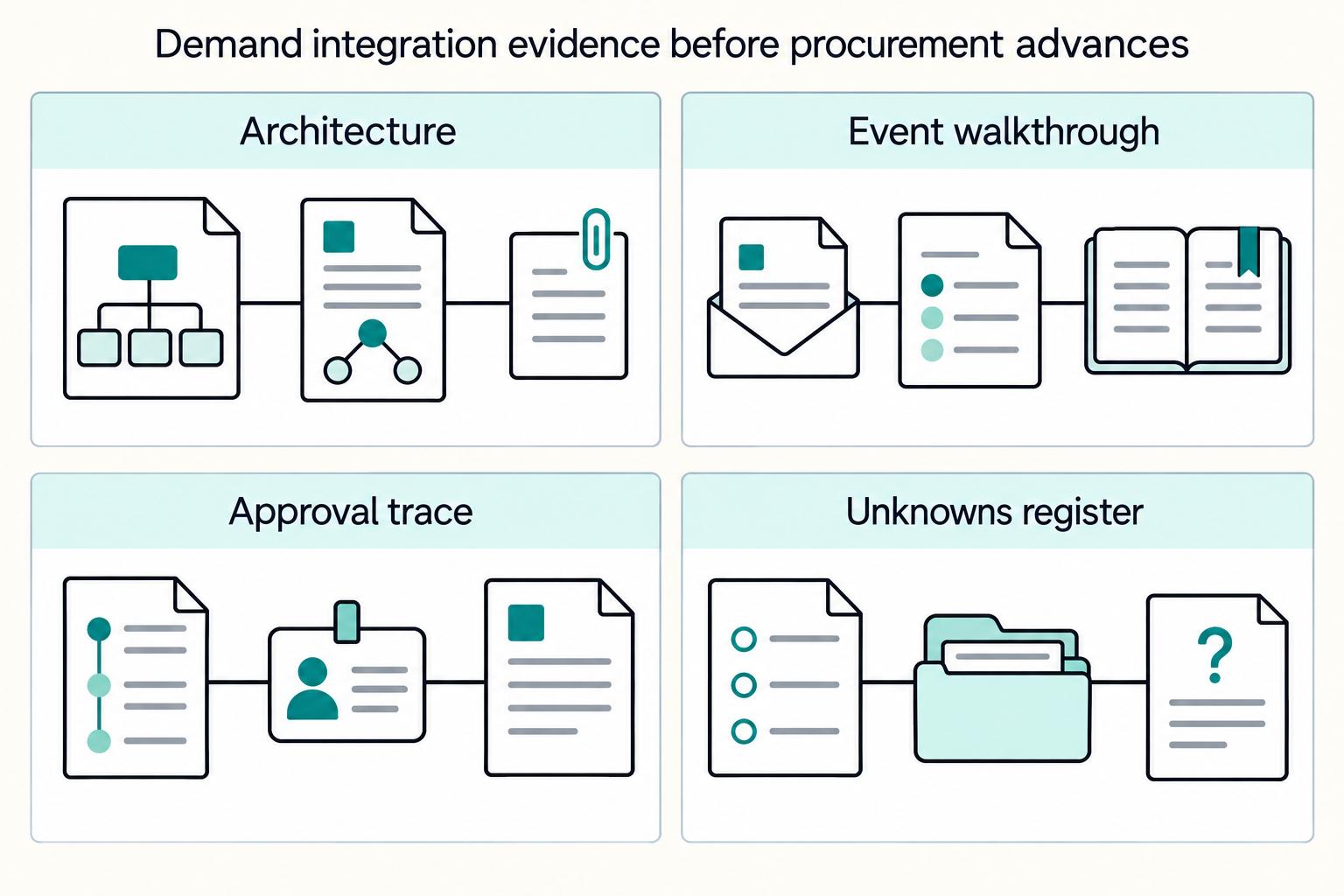
Before procurement moves forward, require evidence you can inspect, not claims you have to infer: one evidence pack, one failure-path walkthrough, and one reference with clear ownership before a vendor advances.
- Current architecture artifacts
Require up-to-date system, network, and data flow diagrams, or a documented location for them. For asynchronous payment stacks, this is baseline evidence, not a nice-to-have.
Require webhook or event references for payment initiation, payment success or failure, and invoice creation or finalization, plus any exception events in scope. Ask the vendor to map each event to the state it changes and show retry and failure-handling behavior when delivery fails.
- One end-to-end accounting walkthrough
Require a live or recorded walkthrough from payment initiation to recognition impact under ASC 606 or IFRS 15. Reject UI-only demos. Require timestamps, event or payload IDs, invoice state changes, and the accounting effect of delayed or failed payments.
A single business action can emit several events, and invoices, receipts, and settlements may become final at different times. Show which event authorizes each accounting change and how a later event updates the existing transaction without duplicating the same accounting effect; legitimate later adjustments can create new, linked journals.
- Implementation references with AP and ownership detail
Ask for a reference implementation that includes AP approvals, not only billing and collections. If AP is in scope, request approval-log evidence showing who approved what and why, plus workflow configuration detail.
On the reference call, clarify owners for webhook endpoint changes, failed GL posting triage, AP approval exceptions, and period-close signoff across product, engineering, and finance.
- An unknowns register for every shortlisted vendor
Track each claim as proven, assumed, or unverified. Treat vendor marketing language as unverified until it is backed by an event-chain walkthrough and at least one exception case.
For example, a documented webhook proves only the delivery behavior it describes. Test the vendor’s actual timeout, retry, duplicate-delivery, and recovery rules. Proving that events arrive does not prove correct AP approvals or complete accounting treatment; those need their own transaction walkthroughs.
We covered this in detail in SOC 2 for Payment Platforms: What Your Enterprise Clients Will Ask For.
How to score options with a weighted matrix#
Use the matrix to keep feature breadth from masking weak GL behavior, thin recognition support, or AP and CRM gaps. Keep criteria groups fixed across all vendors, score only against predefined checkpoints, and document weaknesses and risk signals alongside totals.
| Criteria group | What to score | Verification detail to require | Red flag that should lower score |
|---|---|---|---|
| Integration risk | Event coverage, retry behavior, ownership of failed posting paths | Data flow diagram, event references, payload IDs, named owner for endpoint changes | Missing failure-path evidence or UI-only explanation |
| Reconciliation behavior | Posting timing, delayed settlement handling, refunds, disputes, correction entries | Example showing funds moving through pending and available states, plus negative transactions and journal corrections | "Syncs to GL" claim with no state or exception detail |
| Revenue Recognition readiness | Policy mapping under ASC 606 or IFRS 15, invoice timing, variable consideration | Walkthrough tied to Topic 606 or the IFRS 15 five-step model, including timing and uncertainty of revenue and cash flows | Compliance language without configuration evidence |
| AP and CRM operational support | Approval evidence, entity-level behavior, customer record linkage | Approval logs, entity configuration detail, CRM update points, close ownership | AP or CRM described as integrated but no exception handling shown |
1. Weight what can break your close#
Weight the areas that create close risk, not the ones that simply look broad in demos. In many payment-platform evaluations, integration risk and reconciliation behavior often deserve more weight than cosmetic admin features.
Use a simple test: if this area fails, will finance need manual journals, spreadsheet matching, or one-off fixes at month-end? If yes, raise its weight. If you operate across entities, also increase weight for multi-entity GL and intercompany journal behavior.
2. Score identical checkpoints, then adjust for confidence#
Score each vendor on the same scenarios and checkpoints. Do not let one vendor skip delayed-settlement or exception-path tests because another part of the demo looked strong.
Track both the functional result and evidence confidence for every criterion. A working demonstration using your test transaction deserves more confidence than a generic feature page. Record missing artifacts or failed scenarios beside the score so an attractive total cannot hide an untested critical flow.
3. Add a debt-risk penalty for vague GL behavior#
Keep a separate debt-risk column even when feature scores are high. Penalize unknown posting timing, unclear replay rules, weak linkage between original and correcting entries, or missing explanations for negative transactions from refunds and chargebacks.
This is where future cleanup cost shows up early. If a vendor cannot clearly show correction-entry behavior and linkage to original entries, lower viability even if breadth looks strong.
4. Include scenario tests that mirror payment reality#
Score every vendor on the same three scenarios:
- Recurring payments across pricing models
Test at least one fixed subscription case and one variable-consideration case. Validate how invoice timing, recognition timing, and accounting treatment change across cases.
- Delayed settlement and non-final cash states
Settlement timing can vary by country and payment method, and funds can move through pending and available states. Verify what posts before settlement is final, what changes after, and how reconciliation stays traceable across close boundaries.
- Correction entries, refunds, disputes, and multi-entity impact
Test refunds, disputes, and correction entries, including negative transactions and reversal paths. In multi-entity setups, add one intercompany case and one entity-level AP approval case, then confirm how those flows are actually configured.
5. Shortlist with dual thresholds#
Set the shortlist rule before final scoring: vendors should clear both a functional bar and a confidence bar defined by your team. Do not advance options that score well on paper when key GL, settlement, or recognition claims are still unverified.
If your scoring model is missing evidence fields for event states, retries, and reconciliation ownership, use this implementation checklist in the Gruv docs.
Best fit shortlist so far#
Use these options as candidates for different layers of the stack: Maxio for SaaS billing and recognition, Orb for usage-based billing and its available recognition capabilities, Tipalti with QuickBooks Online for AP and bookkeeping handoffs, and Sage Intacct for multi-entity accounting. Compare them against your architecture; they do not replace the same set of systems.
1. Maxio#
Maxio markets revenue recognition for SaaS businesses and integrations that sync invoices and payments to GL systems including NetSuite, Sage, and QuickBooks. Use a contract-to-journal demonstration to verify the recognition configuration and the integration available in your proposed package.
What is still unproven here is deep reconciliation behavior for delayed settlement, correction entries, refunds, or disputes. If you shortlist Maxio, require a walkthrough showing journal timing before and after a negative transaction or refund.
2. Orb#
Orb’s NetSuite integration copies invoices into the ERP for downstream accounting workflows. Orb also offers a revenue recognition product. Evaluate these separately: an invoice export does not prove recognition behavior, and the existence of a recognition product does not establish that it is included in your billing contract.
Confirm whether Orb or your accounting system owns recognition for the proposed configuration. Ask for a contract modification, credit, and delayed-payment walkthrough, then inspect the resulting schedule and journal export. This avoids treating an integration limitation as a blanket limitation of the whole product.
3. Tipalti plus QuickBooks Online#
Tipalti’s QuickBooks Online integration connects AP records and accounting data, including GL account information used for bill coding. Test a supplier bill from approval through payment and ledger update. Check the exact destination and payout method separately from accounting integration; a broad coverage count does not establish availability for your supplier.
This supports operational cleanup, not proof of payment-platform-grade ledger depth. Before committing, confirm failed-sync ownership and how corrections appear in the ledger, not just approval-flow coverage.
4. Sage Intacct#
Sage Intacct provides multi-entity management and consolidation capabilities. It is a relevant candidate when entity-level accounting is the main requirement. Test entity assignment, intercompany treatment, and consolidation outputs against your own transaction model.
The evidence here is strong on multi-entity positioning, but weaker on payment-platform-specific implementation proof. Validate entity-level posting and approval behavior against your own transaction model before shortlisting further.
Red flags that should stop selection early#
Stop early if a vendor cannot prove exception handling, policy logic, and incident ownership with implementation evidence. These are close-cycle control risks, not demo-polish issues.
1. "Automated" without exception evidence#
"Automated" is common marketing language. It is not proof. The real test is what happens when CRM state, AP approvals, and GL entries drift because events arrive late, fail, or retry.
Ask for one traced exception flow end to end: source update, downstream accounting impact, retry behavior, deduplication or idempotency controls, and final journal state. Expect concrete retry-window detail. For example, documented idempotency behavior can include provider-specific key-retention limits, not just a happy-path diagram. If they cannot show this, treat duplicate or missing financial side effects as a close risk.
2. Revenue Recognition claims with no policy mapping#
Treat recognition claims as high risk unless the vendor maps product behavior to your actual policy under ASC 606 or IFRS 15. ASC 606 for SaaS requires significant judgment, and IFRS 15 requires a defined five-step model.
Require evidence of how contract terms, performance obligations, allocation logic, and timing rules are represented in the implementation. If they cannot show how the setup reflects IFRS 15's transfer-and-consideration principle, you have marketing language, not proof. If evidence stops at "supports ASC 606 and IFRS 15," stop selection.
3. Happy-path demos only#
A smooth payment-success demo does not validate platform reality. Selection testing must include non-happy-path events, such as delayed confirmations, disputes, and other asynchronous failure or retry scenarios.
Require at least one adverse-event walkthrough and inspect status transitions, accounting impact handling, and replay-versus-suppress behavior. If failure and correction paths are not demonstrated, treat that as unresolved operational risk.
4. No clear owner when integrations break#
Unclear ownership is a stop sign. Responsibilities and coordination boundaries should be explicit, and control accountability for financial reporting cannot be left ambiguous.
Ask who owns each failure class, ingestion failures, CRM and accounting mismatches, AP delays, journal posting failures, and close-period corrections, who approves fixes, and how escalation and evidence handling work. A SOC 1 report can support control confidence, but it does not replace clear incident ownership during close.
If no one can name the first responder, correction approver, and final sign-off for restored ledger integrity, do not select the tool.
Implementation sequence that avoids platform debt#
Avoid platform debt by sequencing proof in this order: accounting model fit, integration failure handling, controlled rollout, then production expansion.
- Phase 1: confirm accounting model fit before commercial lock-in. Start with the accounting structures the platform must support: chart of accounts, ledgers, legal entities, and business units. Then validate recognition setup against your policy before UI preference or procurement decisions drive scope.
Require implementation evidence for timing and allocation logic, especially where IFRS 15 applies. IFRS 15 uses a five-step approach, and the practical test is whether the setup depicts transfer of promised goods or services for expected consideration. If that mapping is still vague, pause selection.
- Phase 2: validate integrations with failure states, not just successful events. Trace payment events and accounting controls from source event to accounting result, including delayed, retried, and partially applied paths.
Test retry safety using the selected provider’s documented behavior and your own recovery window. Repeat the same event, deliver events out of order, and simulate a timeout after the journal is committed. Recover the recorded result rather than creating a second operation; request idempotency and event deduplication protect different boundaries.
- Phase 3: run a controlled rollout with reconciliation checkpoints. Start with a small pilot and expand scope only after repeated reconciliation checks hold.
Before each reconciliation report, verify subledger transactions are imported and period journal entries are posted. Classify and route exceptions with clear owners for out-of-balance items, posting issues, and duplicate-event handling.
- Phase 4: expand only after close-cycle evidence shows stability. Production expansion should follow a formal readiness gate, not pilot confidence alone.
Schedule the readiness review early enough to correct failed scenarios before go-live. Require close-window evidence that postings are complete, balances reconcile, and exceptions have owners. Where the accounting package supports it, prevent GL close while relevant subledgers remain open. For a related walkthrough, see Accounts Payable Software Comparison for Platforms.
Build or buy decisions for GL adjacent capabilities#
For most teams, buy the accounting core and build only the integration layer around it. Use custom code to extend reliable GL behavior in your product context, not to replace foundational accounting controls.
1. Buy the policy engine when behavior is proven#
If a vendor can show working GL posting and recognition behavior mapped to ASC 606 and IFRS 15, this is usually a buy decision. IFRS 15 uses a five-step approach, and both IFRS 15 and ASC 606 center on recognizing revenue based on transfer of promised goods or services for expected consideration. Require a contract-to-journal walkthrough that shows policy mapping, timing, and resulting entries. Dashboard-only demos are not proof of accounting behavior.
2. Build a thin layer where your platform differentiates#
Build around payments, CRM, AP, and product data when the work is orchestration and differentiation rather than accounting policy. A thin layer can pass entity context, normalize source events, and preserve references needed for reconciliation. If your code starts deciding deferral schedules, reallocating revenue, or creating ledger rules, you have crossed from extension into replacement.
3. Switch strategy when manual fixes become recurring#
Recurring manual journals, spreadsheet reallocations, or close-time patches can signal control risk, not just operational noise. Under PCAOB language, weak control design or operation creates control-deficiency risk, and if material weaknesses exist, internal control over financial reporting is not effective. Treat recurring vendor gaps as a product decision and keep an evidence pack with exception logs, corrected journal examples, and owner notes.
4. Keep a hard boundary: extend reliable behavior, never replace it#
Custom code is usually safest when it enriches a reliable base, then passes that context into a proven ledger flow. Before approving any extension, verify that each posting traces to a source event, each rule traces to documented policy, and each correction path is explicit. If one of those checks is missing, buy more core capability instead of coding around the gap. For a related operations lens, see Continuous KYC Monitoring for Payment Platforms Beyond One-Time Checks.
Compliance and policy checkpoints before go live#
Before you expand beyond a controlled rollout, treat unresolved compliance items as go-live blockers and verify them with evidence, not vendor claims.
- Revenue policy sign-off
Confirm finance sign-off on revenue treatment under ASC 606 and, if relevant, IFRS 15. The checkpoint is whether your treatment follows transfer of promised goods or services for expected consideration, and whether disclosure expectations cover the nature, amount, timing, and uncertainty of revenue and cash flows.
- Evidence retention and traceability
Confirm you can retain and retrieve support for each accounting position: source documents, approvals, GL journals, and linked corrections. Set retention by the legal entity, record type, and applicable tax, accounting, and regulatory rules. Test retrieval of the complete transaction chain rather than applying a single retention period to every record.
- Guaranteed controls versus customer-owned controls
Document which controls are provider capabilities and which controls your team must operate. In a shared-responsibility model, control ownership must be explicit so stakeholders do not assume provider coverage where customer operation is required.
- Joint acceptance checklist
Use a production-expansion checklist jointly approved by engineering and finance as an internal release gate. Keep it concrete: approved policy version, disclosure-readiness check, evidence-retention test, source-to-journal trace test, exception-handling test, and named control owners. If either team cannot approve with examples, keep rollout scope limited.
Conclusion#
Choose the option that demonstrates reliable accounting behavior, clear recognition handling, and testable integration paths under failure, not the one with the longest feature list.
- Proof beats breadth
The right option should show how payment events become accounting outcomes across timing differences, retries, and corrections. For recognition, the system should support your policy so revenue reflects transfer of promised goods or services under ASC 606 and IFRS 15, not just invoicing or cash movement. Ask for one end-to-end walkthrough from source event to accounting result to reconciliation evidence.
- Use weighted criteria, then penalize weak evidence
A weighted matrix helps teams compare options on meaningful differences instead of checklist completion. Keep criteria tied to risk: accounting-entry integrity, reconciliation behavior, recognition readiness, and ownership boundaries. Then apply an evidence-confidence penalty for missing failure-state behavior, unclear controls, or undocumented risks.
- Sequence delivery from model fit to controlled rollout
Start with accounting model fit, then validate integration behavior, then expand production exposure. Use staged rollout bands, for example 1%, 5%, 10%, 20%, 50%, to limit blast radius while you verify reconciliation outcomes and correction handling before full scale.
- Gate shortlist decisions on retry safety and reconciliation integrity
Safe retries are a core requirement because repeated requests should not create duplicate operations. Reconciliation is equally non-negotiable because timing differences, errors, or fraud can create mismatches between transaction records and accounting records. Before shortlist approval, require concrete evidence for idempotent request handling, idempotency-key retention behavior, and transaction-to-accounting-record-to-reconciliation traceability.
Use the weighted score, apply an evidence-confidence penalty, and proceed only with vendors that can prove exception handling and reconciliation integrity early. If they cannot, keep them off the shortlist. When you are ready to pressure-test your rollout plan against payout, ledger, and policy-gated operations, talk with Gruv.
Frequently Asked Questions
What do payment platforms need beyond standard GL features?
Payment platforms need proof that the system can handle asynchronous events, not just clean journal posting after a successful API call. That includes duplicate-event handling, safe retries through idempotency, correction paths, and transaction-to-payout traceability. The key test is whether the vendor can show an end-to-end path from source event to journal outcome to reconciliation evidence under your revenue policy.
Is GL sync enough for SaaS payment operations?
No. GL sync alone does not prove reliable accounting behavior when payloads can arrive stale, partial, duplicated, or out of order. If a vendor cannot explain retry behavior and handling for duplicate, delayed, or out-of-order events, treat GL sync as incomplete implementation detail.
What are the minimum criteria to evaluate accounting software before implementation?
Use four minimum checks: policy fit, event integrity, reconciliation traceability, and control evidence. Ask for data-flow artifacts, event-handling behavior, failure-case examples, and a walkthrough from payment event to journal result. If the vendor materially affects your financial reporting, SOC 1 evidence is directly relevant.
What should engineering validate first before finance signs off?
Engineering should first prove retries are safe and do not create duplicate side effects through idempotency. Then test duplicate delivery handling, ordering tolerance, and at least one correction path from source event to updated journal output. If payouts are in scope, also validate whether transaction-level linkage is preserved.
How should teams handle vendor claims that are broad but light on technical detail?
Treat broad claims as unproven until the vendor provides implementation evidence. Ask for sample payloads, failure-state behavior, report outputs, and a clear shared-responsibility split for controls. If responses stay high level, keep the product out of expansion decisions.
When should a team treat reconciliation risk as a hard blocker?
Treat reconciliation risk as a blocker when you cannot reliably tie transactions to payouts, explain correction posting, or prevent duplicate events from producing duplicate journals. The blocker is stronger when payout choices shift more reconciliation burden to your team. Also stop go-live if known report edge cases are unresolved or untested.
How do you compare options when side-by-side technical evidence is incomplete?
Score each option on the same criteria, then apply a confidence penalty for missing proof. Strong evidence on a narrower feature set is often safer than broader claims with unresolved unknowns because implementation debt appears later in close and audit preparation.
Researched and edited by the Gruv editorial team. Gruv builds cross-border billing, payouts, and finance-operations software for global businesses.
Sources
Includes 7 external sources outside the trusted-domain allowlist.
- docs.withorb.com/integrations-and-exports/netsuiteexternal
- ifrs.org/issued-standards/list-of-standards/ifrs-15-r...external
- maxio.com/revenue-recognitionexternal
- pcaobus.org/oversight/standards/auditing-standards/detai...external
- sage.com/en-us/sage-business-cloud/intacct/product-ca...external
- tipalti.com/assets/qbo-marketplaceexternal
- withorb.com/products/revenue-recognitionexternal
Educational content only. Not legal, tax, or financial advice.
Related Posts

The Freelance Payment Penalty: A Modeled Audit of Platform Fees, FX Spreads, and Payout Delays
The money rarely disappears through a single, easy-to-spot fee. The real loss is stacked. A marketplace takes its commission, a processor adds a charge for international cards, a bank or payment company converts the currency at a spread, a platform holds the funds before release, and a wire sheds a little to intermediaries on the way in. Each layer looks defensible on its own, but the worker feels the combined result as a smaller deposit and a later payday.

How to Respond to a Subpoena for Business Records
Move fast, but do not produce records on instinct. If you need to **respond to a subpoena for business records**, your immediate job is to control deadlines, preserve records, and make any later production defensible.

A US Expat's Guide to Investing in UCITS ETFs to Avoid PFIC Issues
The real problem is a two-system conflict. U.S. tax treatment can punish the wrong fund choice, while local product-access constraints can block the funds you want to buy in the first place. For **us expat ucits etfs**, the practical question is not "Which product is best?" It is "What can I access, report, and keep doing every year without guessing?" Use this four-part filter before any trade: