
Quick Answer
Map required ongoing monitoring and customer-information updates to named owners before selecting a tool. Test one authenticated trigger through a versioned customer record, reviewer decision, permitted evidence, and acknowledged payment action. Route by signal urgency and confidence as well as customer risk; mandatory sanctions and reporting duties cannot be overridden by an internal score.
Continuous KYC monitoring is now a control decision, not a vendor checkbox#
Treat this as a control design decision first and a software purchase second. One-time onboarding checks can miss risk changes after approval. When you compare continuous KYC monitoring platforms, the real test is whether they help you decide when to re-verify, who reviews, and what evidence gets retained.
| Checkpoint | Supported practice | Warning sign |
|---|---|---|
| State over snapshot | Material changes link to the versioned customer profile and an appropriate review | Another alert in another queue |
| Risk tiering | Route by signal severity and confidence as well as customer risk; urgent hits cannot wait solely because a customer is low risk | Analysts are deciding severity from scratch on each case |
| One profile | One customer profile updates as new events happen | Analysts work across multiple tools and manually collect screenshots and PDFs |
| Evidence quality | Alert context, reviewer identity, decision rationale, and supporting documents stay together in one place | Rationale and evidence are not preserved together |
| Governance | Profile changes become review actions with preserved evidence | The same control gaps remain, just in a new interface |
In practice, you should be able to trace a single risk change from trigger to owner to documented action without rebuilding the case by hand from several systems.
That shift matters for compliance and risk owners because KYC sits inside AML/CFT obligations. If your process still treats KYC as a one-time pass-or-fail gate, you have a snapshot, not an ongoing control.
- State over snapshot
Maintain a versioned customer profile and link each new signal to it. Open distinct cases where needed, but preserve the relationship between the source event, profile version, reviewer, and outcome. A sanctions update may require immediate payment action; an address correction may need only a documented profile update. Do not rerun full onboarding for every change.
- Risk tiering over blanket review
Route alerts by the signal’s severity and confidence as well as the customer’s risk tier. A low-risk customer can still produce an urgent sanctions event; a high-risk customer can produce an innocuous duplicate. Define which signals require human review or payment restrictions and which can be resolved through tested policy rules. Keep escalation ownership explicit.
- One profile over many tools
A strong operating checkpoint is one customer profile that updates as new events happen. The common failure mode is analysts working across multiple tools and manually collecting screenshots and PDFs. That does not scale, and it weakens audit explainability because the decision trail is fragmented. Even when you use more than one provider, the operating target should still be one internal record of truth.
- Evidence quality over alert volume
More alerts do not mean stronger control if decisions are hard to explain. Keep alert context, reviewer identity, decision rationale, and supporting documents together in one place. When those records are centralized, explaining decisions to auditors and regulators is much easier. Decisions are harder to defend when review rationale and evidence are not preserved together.
- Governance over feature lists
Determine which AML, sanctions, and customer-due-diligence duties apply to your entity and partners. FFIEC’s bank CDD guidance describes risk-based ongoing monitoring and customer-information updates for banks. A platform’s own obligations and delegated operating tasks depend on its regulated role and program; buying a pKYC tool does not settle that scope.
Use this shortlist rule: do not buy for detection alone. Buy only if the product supports re-verification triggers, risk-tiered handling, and a defensible evidence trail. If those three are weak, the same control gaps remain, just in a new interface.
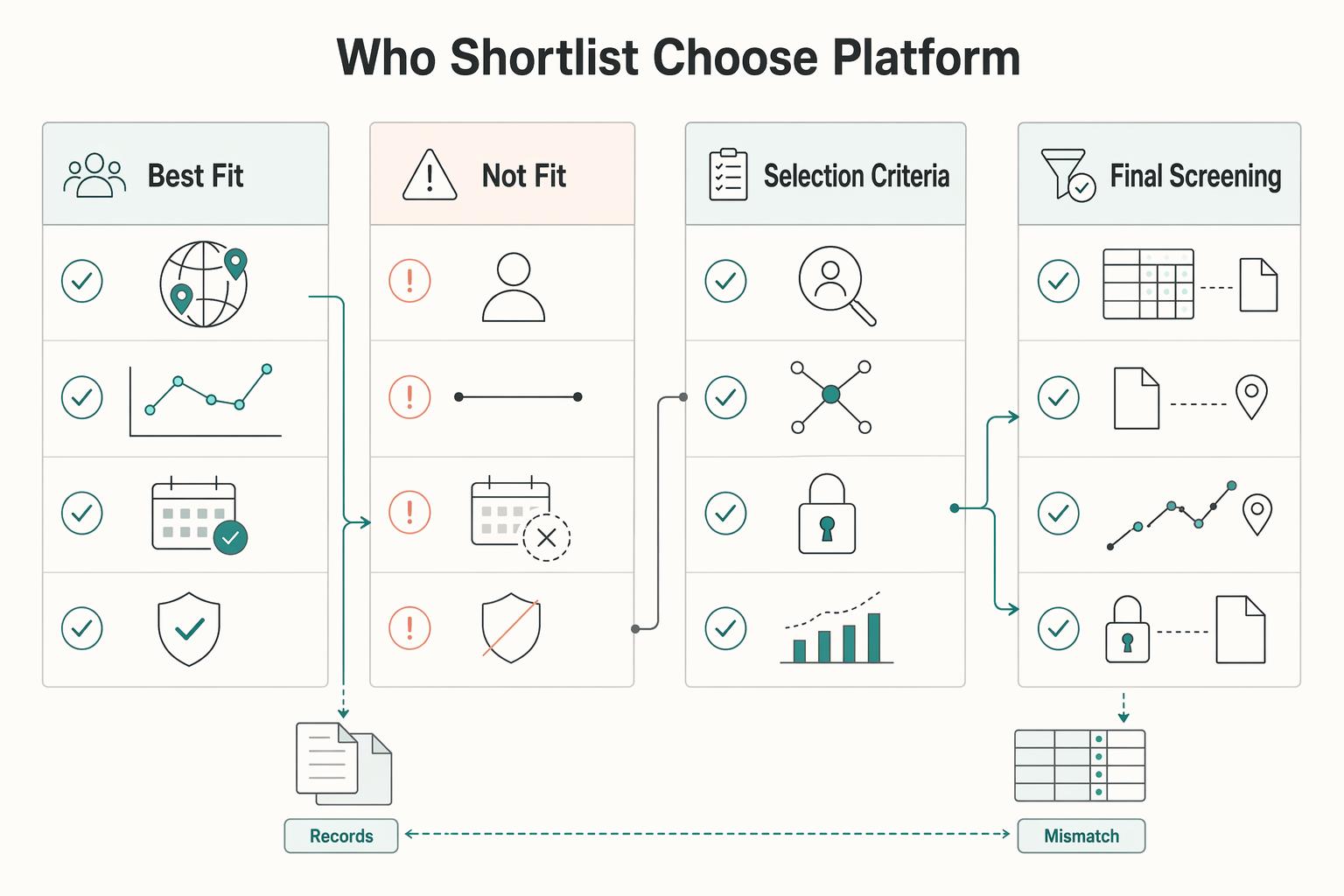
Who this shortlist is for and how to choose a platform#
This shortlist is for payout teams that need ongoing monitoring after onboarding, not one-time KYC only. If you run contractor, seller, or creator payouts across markets and screen for sanctions or watchlists, choose a vendor as an AML operations control, not just a procurement line item.
Start with the required post-onboarding controls and the coverage your existing systems already provide. A new dedicated product is useful when it closes a material source, review, or evidence gap. Existing adequate ongoing controls may make another product unnecessary; small team size or onboarding approval alone does not establish adequacy.
- Best fit
The best fit is a team with real post-onboarding exposure: cross-border counterparties, risk profiles that change over time, and regular re-check decisions. Prioritize platforms that connect ongoing monitoring triggers, such as sanctions/watchlist hits and risk-scoring changes, to a clear evidence trail. Before demos, define your regulatory footprint, risk assessment, counterparty types, and operating model. That prep work helps you test whether the platform fits your process instead of adapting your process to the demo.
- Not a fit
A dedicated pKYC product may be unnecessary if your existing approved systems and procedures already perform the required ongoing monitoring and updates. Do not infer that an onboarding-only process is sufficient merely because the team is small. First map the applicable duties, existing coverage, and gaps, then choose the smallest adequate operating design.
- Selection criteria that matter
Start with trigger coverage, then validate operations. Check sanctions/watchlist screening, risk scoring, and ongoing monitoring tied to your risk rules. Then confirm how alerts become review cases, how reviewer rationale is recorded, and how the evidence file is retained for audit review. Also test integration readiness. Poor compatibility with your current systems, or no pre-integration testing, usually creates production friction. In the proof session, ask the vendor to show the same case in sequence: trigger received, review opened, rationale recorded, and evidence export produced.
- Final screening rule
De-prioritize vendors that cannot show live how an ongoing monitoring alert becomes a review action with retained evidence. Strong detection claims are not enough if data quality, rule changes, and oversight are weak. If you split providers by region to reduce single-vendor outage risk, account for the higher compliance cost and added operational complexity.
What continuous monitoring means in day-to-day operations#
Continuous KYC combines event-driven customer-information refresh with the program’s required ongoing monitoring. It need not mean every data source updates in real time, nor does it automatically replace periodic reviews. Identify each feed’s refresh cadence, latency, and coverage and decide what requires action between scheduled reviews.
That operating difference matters because a periodic program shows a documented refresh cycle, while a continuous program shows how you respond to live risk change.
- Event-driven refresh, not calendar-driven review
KYC does not stop at onboarding. A customer that was clear at approval can appear on a sanctions list six months later, so qualifying changes should trigger immediate review instead of waiting for the next cycle. Periodic programs show a documented refresh cycle. Continuous programs show response to live risk change. The practical question for your team is simple: what happens in the first hour after the signal appears?
- Minimum trigger coverage should match real AML risk
Sanctions checks alone may miss relevant risk changes. Baseline trigger coverage should include adverse media, ownership or profile changes, and unusual transaction patterns tied to CDD. Teams can map different trigger types to different review paths so triage stays focused as new signals arrive.
- Detection only matters if response is fast and documented
You need to see how quickly an alert becomes a review action, whether risk status is updated, and whether reviewer rationale is recorded. In practice, sustained manual re-checking is time-intensive, so operating quality depends on clear review steps and evidence capture, not just alert generation. If your team cannot tell which alerts are pending first review versus waiting on added evidence, the process can slow down even when detection is working.
- Periodic and manual models have practical limits
Fixed-cycle reviews can leave long windows where risk changes go unnoticed. Manual ongoing review can also consume significant time. If your model relies on either approach, define where event-driven review takes priority so risk updates are handled when they happen, not only when the calendar turns.
Comparison table for continuous KYC monitoring platforms#
In this category, the core test is whether the platform supports your ongoing monitoring requirements and regulatory obligations in practice, not just how many features appear on a checklist.
The table uses current primary vendor pages to identify advertised capabilities, not independently measured performance. Each candidate must still demonstrate the relevant handoff into your case and payment-control systems. Contract the coverage and service behavior your program needs; do not turn general marketing into an implementation guarantee.
| Vendor | Documented advertised capability | Candidate use | Proof required for your program |
|---|---|---|---|
| Moody’s | pKYC monitoring of customer/supplier risk and changes | Counterparty information refresh | Source latency, material-change logic, historical profile and case handoff |
| Quantexa | Entity resolution, graph generation, and customer/ownership change monitoring | Connected relationship context | False merges, source provenance, correction workflow and review action |
| DataWalk | Connected KYC data, risk scoring and alerts | Investigation context across sources | Data refresh, queue routing and evidence-linked dispositions |
| iDenfy | Ongoing AML screening with dashboard/API-webhook updates | Screening notification handoff | Cadence, subject coverage, authentication/retrieval and payment-control integration |
Distinguish documented capability from operating proof#
An advertised capability gives you a concrete demonstration request. It does not establish your integration latency, false-positive workload, or ability to export a complete authorized case. Keep the remaining proof requirements in the selection record.
Compare candidates against the same trigger scenarios, customer records, and case outcomes. Do not use a generic enforcement-fine total to rank tools: a fine does not measure any vendor’s ability to process your alert. Record which tests passed, failed, or need a partner decision before live use.
The decision columns that matter most#
Focus first on the columns where operators usually feel pain. In practice, that usually means:
- Alert-to-case handling: Ask for a live example of an alert moving into investigator review and a recorded outcome.
- Restricted reporting workflow: Confirm how authorized compliance staff retain reporting analysis separately from routine operational and audit exports.
- API or webhook maturity: Ask how alerts and status changes are delivered into your systems.
- Evidence export readiness: Request a sample export with the original alert, user actions, review outcome, and related CDD or Enhanced Due Diligence context.
If any of these four areas remains unproven, treat that as an implementation risk and require proof before selection.
Verification checkpoints before you advance any vendor#
Use a documented proof session, not slides, as your gate. Require one end-to-end example from trigger to reviewer action to evidence export, and retain the output in your selection record.
Keep the legal-scope record separate from vendor scoring: jurisdiction, regulated entity, applicable obligation, source, accountable owner, and effective date. A proposal, comment letter, or vendor article is not a substitute for an applicable rule or the program partner’s approved policy.
Do not rank these vendors from thin excerpts. Rank them by what they can prove in ongoing monitoring, CDD support, sanctions-screening response, and audit-ready evidence. If the proof session produces only screenshots, ask for the underlying record flow before moving forward.
Moody's pKYC for enterprise-grade risk refresh#
Moody’s pKYC solution page describes monitoring customer and supplier risk with data and trigger-based changes. Evaluate it when maintaining counterparty information is the gap, then test how those changes reach your existing review and payment controls.
Best fit#
It is a candidate for organizations needing customer-information refresh across a counterparty base. Define your required sources, jurisdictions, material-change rules, and review cadence before the demonstration; periodic intervals quoted in vendor materials are examples, not a universal legal schedule.
Ask for one ownership or profile change and one screening update. Record the source timestamp, when the change becomes available, and when your system creates or updates the case. The source’s refresh speed and your response speed are different measurements.
What stands out in the available evidence#
Test whether a material change preserves both the old and new profile and identifies the specific field or risk factor that changed. That allows an analyst to understand the reason for review instead of receiving only a new score.
Require a reproducible trigger-to-review path on an approved test record. If part of the workflow lives in your own case tool, verify that integration and its evidence references rather than demanding that all records sit inside the vendor interface.
What you need to verify before advancing it#
Implementation effort, false-positive controls, pricing, or analyst queue design are not established. Require a proof session focused on operating behavior:
- Show one sanctions-list change and one profile-change trigger moving to reviewer action, with timestamps, ownership, and final rationale.
- Show retained evidence for AML review, including the original alert, linked CDD material, and whether enhanced due diligence or off-boarding was considered.
- Show how duplicate or repeated alerts are handled.
Replay the same update and a later correction. Verify that duplicate delivery does not create conflicting profile versions or multiple payment restrictions, while a genuinely new risk event remains reviewable. Measure the queue age and unresolved-case count under the pilot’s actual workload.
Practical recommendation#
Shortlist Moody’s for the documented monitoring capability when it matches your data needs. Advance only after profile history, material-change logic, review ownership, and permitted exports work with your operating model. Published research interviews are useful context but not proof of your implementation.
For a step-by-step walkthrough, see KYC KYB CIP Explained for Cross-Border Freelancers and Small Teams.
Quantexa for broad shortlist evaluation and connected data context#
Quantexa’s KYC solution page describes entity resolution, graph generation, and monitoring changes in customer profiles and ownership structures. It is a candidate when fragmented records or relationships make risk assessment difficult.
Best fit#
Consider Quantexa in first-pass vendor triage for KYC and related KYB/AML investigation needs when your team is dealing with fragmented records, unclear ownership structures, and investigation work that requires too much manual stitching across systems.
Test entity resolution on two records that describe the same business and a similarly named business that should remain separate. Ask what evidence supports a merge and how an analyst corrects an erroneous match without losing the original records.
What stands out#
Ownership and relationship changes are useful review inputs only when source provenance is visible. Test a new parent company or beneficial-owner relationship and inspect the record supporting the link; a graph is not proof that every displayed relationship is current or legally meaningful.
Ask the investigator to move from the relationship view to the underlying source and documented decision. Verify that the final case retains the relevant profile version and evidence references, including when later data changes the graph.
Where the evidence stops#
A customer case study cannot establish results for every payment program. Use it to form a test scenario, then compare your own baseline review effort, matched entities, and case dispositions rather than importing another institution’s delivery timeline.
Pricing, false-positive rates, benchmarked detection accuracy, API maturity, or SAR tooling depth are not established. Whether investigation context translates cleanly into repeatable alert handling at scale is also not shown here.
What to verify before you advance it#
Plan separate milestones for data quality, entity-resolution testing, case-system integration, payment-action testing, and operational acceptance. Set dates from your dependencies and partner review, not a bank’s historical proof-of-concept schedule.
In a proof session on your own data, require evidence of:
- Entity resolution behavior on messy KYB records, including what is auto-resolved versus left ambiguous for analyst confirmation.
- Retained investigation evidence, including network view, source records, analyst rationale, and final CDD decision output.
Measure both useful links and mistaken associations in the pilot. A richer graph may help investigation while still increasing analyst work if irrelevant relationships dominate. Confirm the downstream decision and correction process before using a graph change to restrict payments.
DataWalk for dynamic risk assessment use cases#
DataWalk’s KYC software page describes connected data, automated risk scoring, and alerts. Evaluate it when investigators need a joined view of internal and external information. Verify the actual source refresh and case handoff required by your program.
Best fit#
Keep it in scope when your core buying question is whether KYC refreshes actually change operational decisions. In AML workflows, that means a refreshed risk view should drive concrete case handling, not just update a score.
Why this angle is worth testing#
Use a worked queue example instead of a survey correlation as selection evidence. In an illustrative day, 100 alerts include 40 duplicate notifications and 20 identity mismatches confirmed as false matches. The remaining 40 require distinct review. Record how each of the 60 resolved alerts was disposed of; reducing the count without evidence is not a successful control.
If analysts can complete only 30 of those 40 cases that day, ten carry into the next day. More detection without additional capacity or prioritization increases backlog. Check whether the tool preserves urgency, assignment, and age while enabling tested duplicate handling and identity resolution. These counts are illustrative, not vendor performance claims.
What to verify before shortlisting#
In the RFP, ask for one end-to-end example on your data or a close proxy, and verify:
- how a pKYC signal changes the active risk view
- what CDD evidence is attached, requested, or retained
- how weak or duplicate alerts are separated from higher-confidence cases
- what record is preserved if a case later moves into SAR consideration
If the demo stops at scoring or dashboards, de-prioritize it. For continuous review, the key checkpoint is whether pKYC outputs connect to documented analyst action, auditable rationale, and final disposition. If that path is missing, the platform may still be useful for analysis, but not yet for a control you need to defend.
iDenfy for automated transition from periodic to continuous checks#
iDenfy’s AML screening page advertises ongoing screening with dashboard or API-webhook notifications. Evaluate it when screening updates need a clearer operational handoff, while keeping customer-profile changes and transaction behavior in the broader control design.
Best fit#
Test the monitoring service’s actual cadence, subject coverage, and enrollment lifecycle. A recurring screening feed does not automatically update ownership information, assess transaction behavior, or decide whether to continue a relationship; confirm which services and internal workflows cover each requirement.
Why this is worth shortlisting#
Use these program-wide scenarios to test the division of responsibility between the screening feed and your other controls:
- A sanctions-list update reaches the screening service and triggers the owned match-review and payment-action path.
- An unusual transaction pattern is detected by the assigned transaction-monitoring system and linked to the same customer history; do not assume a screening notification supplies this analysis.
Use different paths for a sanctions screening update, an identity/profile change, and unusual transaction behavior. The first may come from a screening service, the second from customer or registry data, and the third from your transaction-monitoring rules. Link them to the same customer history without pretending one vendor notification supplies every source.
What to validate before committing#
The advertised integration is a starting point. Test notification authenticity, delivery retries, late or duplicate events, and the authoritative retrieval path when a notification is missing. Before selection, verify:
- how a sanctions trigger creates an immediate review action, not only a score change
- what CDD evidence is attached and retained before and after the trigger
- how unusual behavior is defined against a customer profile, including newer accounts
- what audit trail is preserved from alert through analyst decision
For teams comparing platforms in this category, use this decision rule: shortlist iDenfy for the shift from periodic to event-driven checks. Commit only if trigger events map cleanly to documented CDD action and audit-ready records. If the model is sound but the evidence chain is thin, you may still recreate too much manually. Related: Continuous KYB for Platforms: How to Refresh Business Verification Without Re-Onboarding Everyone.
Build, buy, or hybrid decision rules for platform teams#
Pick your model based on the gap you need to close first: trigger coverage, control ownership, or audit traceability. This choice is less about feature count and more about who owns decision logic, downstream actions, and defensible records.
| Option | Brief description | Choose it when | Key differentiator | Main watch-out |
|---|---|---|---|---|
| Vendor-led pKYC | A vendor runs ongoing checks and much of the alerting flow using services such as sanctions screening, adverse media, identity verification, and document checks. | Your main gap is trigger coverage, especially for sanctions or adverse-media events. | A fast route to broader monitoring without building screening logic. | Detection alone is not enough if reviewer actions and final decisions are hard to prove later. |
| Internal orchestration over vendor feeds | You ingest external feeds, but your team owns a central policy layer for decisions. | You already have core KYC tools and need to unify fragmented rules. | Centralized control over rules, routing, overrides, and state, separated from execution tooling. | Engineering, maintenance, and scaling burden can grow quickly. |
| Hybrid KYC plus in-house risk routing | A vendor performs checks, while your team controls policy gates, escalation paths, and downstream actions. | You need tighter control over post-alert decisions without fully building in-house. | Balances control and efficiency. | Requires clear ownership and handoffs across teams. |
Buy first when trigger coverage is the gap#
If sanctions and adverse-media triggers are inconsistent or missing, a buy-first path can help stabilize signal intake before adding custom logic. Custom orchestration has limited value when core triggers are still immature. You need dependable inputs before internal routing can add much value.
Use hybrid when payment-side control is the priority#
When post-alert actions must stay aligned with internal policy gates, hybrid is often worth evaluating. Keep decision logic centralized and separate from execution tools so policy is not hard-coded into whichever vendor system came first. That separation can also make later vendor changes less disruptive.
If traceability is the gap, prioritize architecture#
If your issue is reconstructing decisions, prioritize an architecture where alerts, reviewer actions, overrides, and final outcomes are linked and exportable as one chain. Before committing, validate that one case record can show the full path from alert to final action. If you need several teams to explain one case, the architecture is probably still too fragmented.
One explicit no-go rule#
Do not scale broad automation until case ownership and escalation paths are clearly defined across teams. Without that, automation can speed up ambiguity instead of reducing risk. The result can be faster alert generation with slower real decisions.
Before final selection, run an approved test pilot in which each trigger maps to a named reviewer, a documented disposition, and any required payment-control action. Retain the sample records and unresolved integration questions in the selection file.
Escalation decisions after a high-risk alert#
Use the following bands as an illustrative routing policy, not a substitute for law. Severity, match confidence, legal obligation, and payment status determine the action. Reviewers may adjust discretionary controls with recorded authority and rationale, but cannot override a mandatory prohibition or release blocked property without authorization.
| Band | Default action | Use when | Case record |
|---|---|---|---|
| Band 1 | Analyst review before customer-facing action | Weak or unverified signals, especially adverse media with uncertain entity matching | Confirm legal name, jurisdiction, and recent profile or KYB changes first |
| Band 2 | Enhanced CDD and additional evidence requests when justified | The signal is credible enough that standard monitoring is no longer sufficient | Expand the evidence set with targeted requests tied to the open risk question |
| Band 3 | Urgent interim control and legal-duty review | Credible sanctions or other time-sensitive signal | Confirm match, legal action and authorized payment-control acknowledgment |
| Band 4 | Separate exit and reporting decisions | Risk justifies relationship review or legally required report analysis | Operational disposition plus separately restricted reporting records |
This is where the earlier platform choice becomes real. Periodic-only reviews are not enough here. If reviews happen every 1 to 3 years, material risk can change between cycles, so escalation should be event-driven and tied to current signals.
- Band 1: analyst review before customer-facing action
Use this for weak or unverified signals, especially adverse media with uncertain entity matching. Confirm identity and profile basics first, for example legal name, jurisdiction, and recent profile or KYB changes. If you see duplicate or stale-profile alerts, consider routing them to tuning review rather than silently suppressing them. That helps separate a weak rule from a real case.
- Band 2: enhanced CDD (and additional evidence requests when justified)
Use this when the signal is credible enough that standard monitoring is no longer sufficient, but prohibition or exit is not yet established. Expand the evidence set with targeted requests, especially when ownership changes, business-status changes, sanctions exposure, or adverse media worsen the onboarding risk view. High-risk cases can require enhanced due diligence before approval. The point is not to request more documents by default, but to request the documents that answer the open risk question.
- Band 3: temporary restriction and investigation escalation
For a credible urgent signal, apply the approved interim control while confirming the match and applicable rule. A valid sanctions hit may require blocking or rejecting a transaction and reporting; those are different legal actions, not merely a discretionary temporary hold. Use OFAC’s match guidance for U.S.-scoped screening and your relevant sanctions regime. Do not release a legally blocked balance because an analyst lowered a risk score.
- Band 4: offboarding path and SAR consideration
Separate the customer-exit decision from suspicious-activity reporting and sanctions handling. The accountable compliance entity determines any required reporting on its own legal criteria and timeline. Offboarding does not replace a report, and a report does not automatically authorize refunding blocked funds. Keep SAR deliberations, filings, and information revealing their existence restricted; operational and customer-facing records contain only permitted action information.
Measure your own false-match rate, duplicate rate, unresolved cases, and review ages. Do not assume a universal 90–95% false-positive rate. Test tuning against known relevant signals and preserve approved rule versions so reducing noise does not silently suppress a required escalation.
Monthly reporting and audit evidence package#
Your monthly evidence package should let an auditor follow the decision path without rebuilding it from raw records: what was reviewed, what decision was made, who approved it, and when.
| Package part | Evidence | Control question |
|---|---|---|
| Monthly snapshot | Distinct case counts, urgent queue ages, breached targets and feed outages | Did the control operate and what remains unresolved? |
| Sampled case index | Profile version, source, alert, reviewer, rationale and action acknowledgment | Can authorized reviewers reconstruct a disposition? |
| Count reconciliation | Opening cases + new cases − closed cases = ending cases | Are repeated alerts counted separately from cases? |
| Exceptions and deadlines | Due times, accountable owners and remediation; restricted reporting kept separate | Were legal and policy clocks handled correctly? |
Build the monthly review around changes, dispositions, unresolved exposure, and whether restrictions were actually enforced. Foreign-account tax reporting is a separate workflow; FBAR valuation and deadline records do not demonstrate continuous KYC response.
- Monthly control snapshot
Show alerts received and resolved, distinct cases opened and closed, oldest unresolved urgent case, breached response targets, and monitoring-feed health. Use permitted case references so an authorized reviewer can trace a sample without exposing restricted reporting material.
- Controlled case file set
For sampled cases, retain source and profile version, alert identifier, match evidence, reviewer, decision time, rationale, and payment-action acknowledgment. Keep an access-controlled index pointing to the records rather than copying every sensitive document into a broadly distributed monthly binder.
- Case-count reconciliation
For an illustrative month, start with 20 open cases, add 100 new cases, and close 90: 30 remain open. Reconcile those counts with distinct case identifiers; repeated alerts attached to one case are not new cases. Break out urgent unresolved cases and aged discretionary reviews so the total does not conceal critical work.
- Deadlines and control exceptions
Track required legal deadlines separately from internal review targets. Record owner, due time, escalation, and resolution for each overdue item. A team’s queue target cannot extend a statutory reporting deadline; feed outages require their own detection and recovery record.
Have an authorized independent reviewer sample a trigger, its linked customer version, the decision, and the acknowledged payment action. Record gaps and corrective owners. The package should demonstrate control execution, not merely that files exist.
Choosing the platform is only half the decision#
Choose the operating model first, then the tool. If you pick software before you define trigger coverage, escalation ownership, and evidence standards, you may simply move the failure point.
That is the thread running through the whole shortlist: vendor capability matters, but control design determines whether you can operate it, defend it, and scale it.
- Define trigger coverage before vendor comparison
Start with the events that can change your KYC or AML judgment, then test vendor coverage against that list. Keep a written trigger register with the event, source, owner, and required action so evaluation maps to real decisions, not feature claims. This can also make later rule changes easier because the control logic already exists outside the sales narrative.
- Lock escalation ownership before launch
Perpetual KYC (pKYC) works best with explicit handoffs. Manual transitions are a known breakdown point, so write escalation paths for higher-risk cases and specify what additional evidence each path requires. Anchor those paths to a formal Customer Acceptance Policy (CAP), publish it internally, and review it regularly. If ownership is vague at launch, it usually stays vague when alert pressure rises.
- Set evidence standards early
Define what each case must retain so decisions are defensible and reproducible under pressure. During evaluation, run a detection-to-closure walkthrough and check whether your process can preserve alert context, decision rationale, and supporting records without manual reconstruction. The goal is not just retention, but repeatability.
- Prioritize unified context over fragmented tooling
Fragmented systems are a known operational and regulatory risk because alerts can stay isolated and cross-signal risk is harder to detect. Favor setups that give investigators a Single Customer View across identity, transaction, behavior, and related signals. The more your team relies on manual stitching, the harder it is to prove consistent treatment.
The EU’s 2024/1624 AML regulation summary states general application from July 10, 2027, with specific exceptions. Determine your obliged-entity scope and applicable current national rules. It does not establish a universal obligation to buy a pKYC product in 2027. Prepare the trigger register, accountable owners, and evidence standard required for your program before expanding automation.
If you want a control-design review for your exact markets and payout flow, request a practical walkthrough with Gruv's compliance and payments team.
Frequently Asked Questions
What is the difference between periodic KYC and continuous KYC monitoring?
Periodic KYC refreshes customer information on a documented schedule. Continuous KYC adds event-driven review between those refreshes using the sources and cadence defined by the program. It can reduce the delay in responding to material changes, but does not make every source real-time or automatically replace periodic checks.
Which events should trigger immediate review?
There is no universal trigger list that fits every program or jurisdiction. Use a risk-based rule: if new information could change your customer due diligence judgment, review it now instead of waiting for the next cycle. Keep the trigger policy explicit so teams can apply it consistently, and document ownership for each trigger.
How often should risk scores update in a continuous model?
Do not rely only on annual or multi-year refresh points if you run continuous monitoring. Update risk assessments when meaningful new information appears, with a review rhythm your team can sustain. The cadence should match your risk profile, jurisdiction mix, and operational capacity.
What should happen right after a high-risk alert?
Confirm the customer and signal, identify the accountable reviewer and applicable legal duty, and apply the required or approved interim payment action. Preserve the rationale and action acknowledgment. Escalate sanctions and suspicious-activity questions to the appropriate compliance owner; discretionary review bands cannot override mandatory restrictions.
Do all platforms support the same coverage and controls?
No. Coverage and controls vary by provider. Some market broad country coverage, API or webhook integrations, and audit-ready logs, but those claims are provider-specific. Validate actual trigger inputs, case workflow, and export detail against your own program needs before choosing a platform. Broad coverage claims do not automatically mean strong evidence handling.
What records should we keep for audits?
Keep profile versions, source and alert references, match evidence, reviewer identity, policy version, rationale, time, and payment-action confirmation under appropriate access and retention controls. Keep restricted investigation and SAR material separate from routine audit packages and customer communications.
When should we involve specialist counsel?
Involve specialist counsel when your team cannot confidently resolve jurisdiction-specific requirements through normal compliance procedures. KYC obligations vary by country, so define an escalation path with your compliance officer and use it early for cross-border issues.
Try a related tool
Researched and edited by the Gruv editorial team. Gruv builds cross-border billing, payouts, and finance-operations software for global businesses.
Sources
Includes 4 external sources outside the trusted-domain allowlist.
- bsaaml.ffiec.gov/manual/AssessingComplianceWithBSARegulatoryR...trusted
- ecfr.gov/current/title-31/subtitle-B/chapter-X/part-1...trusted
- eur-lex.europa.eu/legal-content/EN/TXTtrusted
- ofac.treasury.gov/faqs/5trusted
- datawalk.com/solutions/kyc-softwareexternal
- idenfy.com/aml-screeningexternal
- moodys.com/web/en/us/kyc/solutions/pkyc.htmlexternal
- quantexa.com/solutions/kycexternal
Educational content only. Not legal, tax, or financial advice.
Related Posts
Choosing a Defensible SAR Filing Model for Payment Platforms
For platforms moving contractor, seller, or creator funds, when SAR filing applies, the goal is an operating approach your team can run consistently, not a system that tries to catch everything. You need alerts that get reviewed, cases backed by evidence, and filings you can defend. FFIEC describes suspicious activity reporting as the cornerstone of BSA reporting and emphasizes that SAR content quality is critical to the effectiveness of that system.
Continuous KYB for Platforms Without Full Re-Onboarding
Continuous KYB should reduce surprises without turning onboarding into a recurring document chase. For platforms, this is a shift in operating model, not a bigger onboarding form. KYB starts as a legitimacy check, but it now needs to continue through the full merchant lifecycle so you can catch material changes early without dragging every business back through full re-onboarding.

When High-Risk Payout Accounts Need Source of Funds Checks Beyond KYC
A one-time KYC check may not be enough for higher-risk payout accounts. Risk can change after onboarding as transaction behavior shifts and customer risk profiles change.