
Quick Answer
Identify the actual customer and the provider’s eligible account type, then map each request to identity, business, ownership, authority or activity evidence. Explain valid differences such as a DBA or disregarded LLC tax-owner name. U.S. CIP depends on the regulated institution and account, not merely a U.S. payment route. Upload sensitive records through an approved secure channel, keep an index and request log, and check which stage is restricted.
Start Here So Your Onboarding and Payouts Do Not Stall#
Identify the actual customer first: you as an individual or sole proprietor, or a separate entity. Then choose the account type that the provider supports for that customer. Accurately connect the profile, contracting identity and payout destination rather than forcing every field into one identical name.
A trading name does not by itself create a separate legal entity. A business customer may also need its owner’s or signer’s personal identity documents. Follow the provider’s eligibility and bank-ownership rules; do not switch an entity to an individual profile merely to bypass a requested check.
Requirements depend on the institution, account and jurisdiction. The U.S. bank CIP rule generally requires name, address, identification number and an individual’s date of birth before account opening, with specified exceptions. Verification can occur within a reasonable time afterward. Other regulated institution categories have their own CIP rules; a fintech label or U.S.-linked payment alone does not establish that the bank rule applies.
Treat the table below as a first-pass triage guide, not a universal document checklist.
| Lane | Profile pattern | Likely review layer | Common mismatch | Example first-pass evidence bundle (varies by provider/country) |
|---|---|---|---|---|
| Individual or sole proprietor | The customer is you; a supported trading name may also appear | Personal identity and requested trading/activity details | An unexplained DBA or incorrect personal field | Requested ID/address evidence, trading-name connection, approved payout ownership and tax form if applicable |
| Single-owner entity | The customer is the separate company or LLC | Entity checks plus requested owner, signer or controller checks | Unexplained legal/trading/tax-owner differences or unsupported bank ownership | Registration details, requested personal ID and authority/ownership evidence, approved payout account |
| Multi-owner entity | The customer has an ownership/control structure | Business review and applicable beneficial-owner checks | Outdated ownership, missing required people or unclear opener authority | Current registration/ownership details, required owner/controller information and bank evidence |
Run a pre-submit check before upload#
Before you upload anything, compare these four fields side by side:
| Field | Compare with | Why it matters |
|---|---|---|
| Customer legal name | Relevant ID or entity registration field | Compare the same customer and role |
| Invoice or trading name | Contracting customer and DBA/trade-name evidence | Explain a lawful trading name rather than inventing an entity |
| Bank holder name | The provider’s account-type ownership rules and bank record | Permitted names can vary by business form |
| Tax name and TIN | The applicable tax form instructions | Tax-owner names can legitimately differ from an LLC name |
Correct errors at their source. Where names differ legitimately, explain the relationship and provide the evidence requested. Do not change valid tax or registry records simply to make every display name identical.
Check tax identity when requested#
For Form W-9, use the name and TIN required by its instructions. A disregarded LLC with a U.S. owner generally puts the owner’s name on line 1 and the LLC’s name on line 2. That difference is not automatically a verification defect. Backup withholding is 24% when the applicable reportable-payment conditions require it; it is not a charge on every cross-border payment.
IRS TIN Matching is available to eligible payors for name/TIN validation in information reporting, not as a general identity checker for every freelancer. Use the correct tax form for your status and keep full tax IDs out of ordinary support correspondence.
Submit one clean bundle, then keep follow-up easy to review#
Follow the provider’s upload workflow and requested file limits. Use an index to connect business and personal evidence to the relevant roles. Upload ID, tax and bank records only through an approved secure channel; a support thread can hold case references and status updates without duplicating sensitive files.
| Follow-up item | What to add |
|---|---|
| Attachment index | Include filename and what it proves |
| One thread | When provider support allows it, stay in one thread for updates |
| Dated change log | Show what was requested, what changed, and what file replaced what |
For covered U.S. institutions, entity CDD generally identifies natural persons owning at least 25% and one person with significant control responsibility, subject to exclusions. FinCEN’s February 2026 relief allows collection at the first account instead of automatically at every new account, while reliability doubts and ongoing risk still require attention. A provider can retain its every-account process; the relief is not a customer right to refuse requested records.
Example: a disregarded LLC with its owner’s tax name#
Assume a U.S. single-member LLC is disregarded for federal income tax purposes and the provider supports this account type. The entity profile can name Cedar Studio LLC, while its U.S. owner Maya Chen appears on W-9 line 1 and the LLC on line 2. Maya’s ID proves her identity and the registration proves the LLC exists. Check the provider’s bank-name policy and explain these roles in the evidence index; do not edit the W-9 to force the owner and company into one name.
For applicable U.S. bank transfers, the FFIEC overview describes recordkeeping and transmitted-information duties at $3,000 or more, with exclusions and exceptions. The required records vary by institution role and customer status; recipient fields include information received with the order. These rules do not mean every freelancer must send the same ID packet with every payout.
The UK body-corporate rule uses more than 25% for the shares/voting-rights limb, alongside separate control tests. For the EU, the AMLR summary describes the framework generally applying from 10 July 2027, including a future €10,000 occasional-transaction trigger. Keep that future rule distinct from the current national regime.
Use the correct account type, compare like fields, explain valid differences and respond to the actual request. This reduces avoidable rework without guaranteeing approval.
KYC, KYB, and CIP in Plain English#
Use one sorting rule for every request: decide whether it is asking for identity, business ownership, or risk context. When you classify the request correctly, you usually send the right evidence on the first pass.
These labels are related, but they are not interchangeable. In practical terms, CIP is U.S.-anchored account-opening identity language. KYC, KYB, CDD, and EDD are broader verification and due-diligence layers that can vary by regime and provider workflow.
Read the terms in sequence#
- CIP: A specific U.S. identification program for applicable regulated institution categories. Bank CIP generally collects core details before opening, with exceptions, and permits risk-based verification within a reasonable time afterward.
- KYC: Broad customer-knowledge and due-diligence language that can apply to individual and business customers.
- KYB: Business-focused verification, including existence, ownership, control and associated people where required.
- CDD: Due diligence including applicable identity/beneficial-owner checks, understanding relationship purpose and ongoing risk monitoring.
- EDD: Additional measures for higher-risk relationships or situations; it is not simply the next mandatory step after every document mismatch.
Use the request label to decide what to send first#
| Review layer | Typical trigger | Send this first | Usual next step |
|---|---|---|---|
| CIP | U.S. account opening identity step | Core identity details and requested ID documents | Follow-up on missing or mismatched identity fields |
| KYC | Individual or business customer checks | Requested identity, customer and activity information | Updates or monitoring as appropriate |
| KYB | Entity onboarding or business profile setup | Entity registration details plus requested owner or controller details | Beneficial-owner follow-up if ownership records are incomplete |
| CDD | Risk-based review of customer activity or transaction patterns | Documents that explain business activity and funds-flow context | Clarification requests or updated customer information |
| EDD | Case identified as higher risk | Deeper supporting evidence and fuller explanations | Enhanced ongoing monitoring and additional follow-up |
Map each request to what it asks you to prove. Ownership requests may require both a business record and a person’s ID; activity requests may require invoices or contracts as well as a concise explanation.
A better filter for freelancers and small teams#
If you operate in your personal legal name, early requests are often identity-first. If you operate through a company, requests can move from identity to ownership and activity context faster, even for a one-person entity.
Map each file to the request items it supports: identity, entity existence, authority, ownership/control or activity. One document may answer several questions; list the relevant sections rather than creating duplicate uploads.
Confirm the local label before you upload#
Cross-border reviews can break down when people assume labels are universal. CIP is U.S.-anchored language. EU and UK materials here use CDD and EDD language, and countries implement AML standards differently.
| Confirm before upload | What to confirm | Why |
|---|---|---|
| Provider label | The provider's exact label for the request step | Labels are not universal |
| Jurisdiction scope | The jurisdiction scope they are applying | CIP is U.S.-anchored; EU and UK materials here use CDD and EDD language |
| Accepted document types | The document types they accept for that specific step | Match evidence to that request, not to a generic checklist |
Then match your evidence to that request, not to a generic checklist. For bookkeeping context, see A Guide to Xero for Freelancers and Small Businesses.
Decide Which Checks Apply to You Before You Submit Anything#
Identify whether the customer is an individual, sole proprietor or separate entity. Choose the supported profile for that legal reality and record any legitimate trading, tax-owner or bank-name differences.
The provider needs to establish the customer, any entity involved and applicable ownership or authority checks. Bank CIP usually collects specified identifying information before opening and then verifies it under risk-based procedures; collecting data is not the same as approving every capability.
| Customer type | Likely review layer at start | Likely follow-up checks | Minimum first-pass evidence |
|---|---|---|---|
| Individual freelancer using your legal name | Identity-first review, including CIP in U.S.-anchored bank onboarding | Additional identity follow-up, then CDD if activity, relationship purpose, or transaction pattern needs clarification | Profile details that match your ID and payout name where requested: legal name, date of birth, address, identification number, plus requested ID document |
| Sole proprietor or DBA, but not a separate filed entity | Can start on an individual-style path, even with a trade name | Trade-name clarification, activity questions, and CDD when more context is needed | Personal identity evidence first, then sole-proprietor or trade-name details if requested. Make clear whether the account is you personally or your trading activity |
| Company, LLC, partnership or other eligible entity | Legal-entity review | Applicable owner/controller review, current U.S. collection policy including 2026 relief, and further risk-based detail | Entity registration details, identity for the account opener, current ownership details, and control-person details if requested |
Use this boundary correctly: in the specific U.S. beneficial-ownership form context cited, sole proprietorships are excluded from the legal-entity definition. That does not mean sole proprietors never face additional verification. It means you should not submit an LLC or corporation-style entity packet unless the reviewer asks for it.
Check authority and control before submission#
Confirm the account opener’s authority, required owners/controllers and supported bank ownership. These roles can belong to different people. The evidence must explain the connection, not make their names identical.
Stripe’s bank-ownership guidance distinguishes account types: sole proprietors and single-member LLCs can use specified business, DBA or representative names; other company forms use legal business or DBA names. Wise’s U.S. business process asks for one designated controller and relevant owners. It distinguishes registered and trading addresses, which can differ. Apply the provider’s actual policy to your form of business.
| Mixed signal | Why it stalls review | Fix before upload |
|---|---|---|
| Entity profile with a personal bank holder | The provider may not support that ownership for this entity type | Check its rules; use an eligible account and evidence without misrepresenting the customer |
| Personal profile with a trading name | The connection may be undocumented, or a separate entity may be the customer | Explain the DBA/sole-proprietor connection or select the supported entity profile |
| Opener, owner and controller are different people | Authority and roles need evidence | Provide requested current authority and ownership records for each relevant person |
Pre-submit gate#
- Identify the real customer. Entity evidence and associated personal ID may belong in the same case.
- Explain the relationships. Map legal, trading, tax-owner and bank names to their roles.
- Track corrections. Confirm the provider received profile changes and replacement-file references before uploading again.
That one boundary check can prevent avoidable rework. You might also find this useful: US Citizenship-Based Taxation Explained for Mobile Freelancers.
Build Your Evidence Pack Before Onboarding#
Build for first-pass review, not for volume. Your pack should let a reviewer confirm one consistent story. It should show who you are, whether you are onboarding as an individual or an entity, who controls the account when a business is involved, and what payment activity you expect. Exact evidence requirements can vary by jurisdiction and provider.
Identification and verification are separate steps. You provide customer data first, then the platform checks whether that data matches submitted documents and records. If the basics do not align, review may pause before deeper due diligence.
Index files by the claims they support#
Organise the index by request item. A file can support several claims; reference its relevant sections and follow provider format rules.
Use a lightweight evidence index before you upload:
| File name | Claim supported | Profile field matched |
|---|---|---|
passport-lastname-firstname.pdf | Legal identity of account holder | Full legal name, date of birth |
utilitybill-address.pdf | Current address | Residential address |
company-reg-record.pdf | Entity exists as stated in profile | Legal entity name, registration details |
Keep filenames literal so a reviewer can understand the purpose at a glance. If you replace a file, version it clearly, for example utilitybill-address-v2.pdf, and update the index so the record stays traceable.
Build the right pack for your lane#
For an individual, compare personal fields with the requested current evidence. If an ID retains an old address or your name has changed, use the accepted supplementary evidence and explain the difference rather than altering the document.
If you are onboarding as an entity, prioritize entity records, identity for the account opener, then requested ownership or control details. Follow-up is common when the account opener's authority is unclear or related parties are missing for due diligence.
The pack should identify the customer and connect each associated person and destination. Business and personal evidence can be complementary.
What each evidence area should prove#
| Evidence area | Purpose | Alignment check | Likely escalation trigger |
|---|---|---|---|
| Identity | Verify the customer or account opener | Legal name, date of birth, identification details match profile and ID | Name mismatch, incomplete profile, inconsistent ID details |
| Address | Support customer record accuracy when requested | Submitted address matches address evidence | Conflicting, unreadable, or unclear address evidence |
| Entity legitimacy | Confirm the business exists as described | Entity name and registration details match business profile | Entity details differ across profile and records |
| Ownership or control | Identify who owns or controls the entity when required | Account opener, authority, and ownership or control details tell one coherent story | Missing related parties, unclear authority, conflicting control details |
| Activity context | Support risk-based due diligence | Business context and payment behavior match stated account use | Vague business purpose, unexplained flows, activity inconsistent with profile |
CDD is often where follow-up starts. It can require business context, related parties or owners, and additional documents for higher-risk cases. Be specific enough for a reviewer to test your narrative against expected activity.
Pre-submit gate#
- Use the provider’s eligible account type for the actual customer.
- Compare like identity/entity fields and explain legitimate differences.
- Make ownership or control clear for entity onboarding, including who is opening the account and their authority.
- Add a short activity narrative tied to expected payout behavior.
- Review your evidence index once. If a file does not support a clear claim, remove it or relabel it.
Strong submissions are focused, aligned, and traceable. That helps the platform meet verification and recordkeeping duties while reducing avoidable back-and-forth for you. If you want a deeper dive, read Correspondent Banking Explained: Why Your International Wire is So Slow and Expensive.
Connect Compliance Checks to Real Money Movement Steps#
If your payout is blocked, diagnose the stage first: onboarding, funds-in, or funds-out. A successful CIP or onboarding check can open the account, but it does not pre-clear later transfers or ongoing monitoring.
Diagnose the blocked stage first#
| Stage | Decision owner | What is validated at this stage | What can still fail later | Immediate action for you |
|---|---|---|---|---|
| Onboarding | Platform onboarding process, sometimes relying on a banking partner | Applicable institution/account identity checks and requested entity or owner/controller information. | Later monitoring or reverification can still trigger additional review, including closure decisions if identity verification fails. | Check like profile/document fields and current requested ownership records; explain differences. |
| Funds-in | Sending bank and institutions handling the transfer | Whether transfer details are complete and consistent with customer information | Incoming funds can still be reviewed when transfer details are incomplete or inconsistent with stated activity | Give payers the exact approved recipient details, and keep invoice payee identity aligned with your verified profile or entity identity. |
| Funds-out | Platform payout controls, banking partner controls, and recipient institution acceptance | Current account status, destination identifiers, and transfer executability | Payouts can be paused, rejected, or returned if destination details are inconsistent or the receiving side does not accept the transfer | Confirm approved destination ownership and current details. Transfer recordkeeping rules depend on institution role, transfer type and exceptions; they do not create one universal freelancer upload list. |
Follow the identity signal chain#
Treat identity as a three-link chain: profile identity, invoice or payee identity, and payout-destination identity. A pass at one link does not fix mismatches in the next.
An unrelated third-party destination may be unsupported, while a documented trading name or permitted representative bank name can be legitimate. Check eligibility and authority for the real customer before giving payers recipient instructions.
Prepare evidence before you escalate#
| Trigger | Likely root cause | First record to verify | Proof bundle to prepare |
|---|---|---|---|
| Payout name mismatch | Destination account owner does not align with verified person or entity | Platform profile vs destination account owner name | Requested profile/ID or entity evidence, invoice relationship and bank ownership proof through the approved secure channel; keep full bank/ID numbers out of the ordinary thread. |
| Entity ownership or control review | Ownership or control record changed or is outdated, or opener authority is unclear | Latest ownership record vs latest registry extract | Current registry extract, ownership statement or cap table, requested IDs for owners or controllers, authority proof for account opener, short dated note of what changed |
| Transfer details flagged | Payment message details are incomplete or inconsistent, or activity context is unclear | Invoice and transfer confirmation | Invoice or contract, remittance or transfer confirmation, recipient bank details, short activity note showing who paid, for what, and why this destination |
| New payout account after prior approval | New destination is not yet cleanly linked to the verified customer | Old payout details vs new payout details | Old and new account comparison, ownership proof for new account, dated reason for change |
Send one scoped response package#
A single scoped package is not a legal requirement, but it usually reduces handoff friction.
- Confirm scope from the latest reviewer request only.
- Add an attachment index showing each file, the claim it supports, and the exact field it matches.
- Add a short dated change log for bank-detail, ownership, or payee-name changes.
- Keep case references and status updates in one supported thread; upload sensitive evidence through the approved secure channel.
A failed identity check can lead to restricted use or closure under the institution’s procedures. Suspicious-activity reporting depends on applicable rules and facts; a mismatch does not automatically mean a report is filed. Ask what action you can take without expecting disclosure of confidential monitoring information.
Where CIP Ends and CDD or EDD Begins#
Treat these as different review layers, not one generic compliance ask. Match your response package to the layer requested. CIP is identity proof, CDD is risk-fit review, and EDD is deeper risk review when risk questions remain.
CIP applicability follows the regulated institution category and account rules. It is not mandatory for every business called a fintech. For bank CIP, the goal is a reasonable belief in the customer’s true identity. CDD also includes identification and applicable beneficial-owner checks, understanding relationship purpose and ongoing monitoring; these activities can overlap rather than run as a fixed staircase.
| Layer | What the reviewer is trying to decide | Evidence commonly requested here | What commonly pushes the case higher |
|---|---|---|---|
| CIP | Is this person or business real, uniquely identified, and correctly matched? | Requested identity documents, core profile or entity fields, and current customer record details | Identity mismatches, invalid identity data, or low confidence in the identity match |
| CDD | Does this customer relationship make risk sense based on ownership, geography, and expected activity? | Ownership or control details, activity description, expected payment patterns, and requested supporting records | Identity is acceptable but ownership or activity context is incomplete, unclear, or inconsistent |
| EDD | Are elevated risk signals resolved well enough to continue? | Additional ownership-party detail, deeper supporting records, and clear context mapped to each request item | Unresolved ownership questions, geography exposure, or transaction behavior that still needs deeper review |
Review can consider identity confidence, ownership transparency, geography and transaction activity. Additional evidence is not automatic rejection, and the provider may not disclose every monitoring signal.
Respond by the layer requested#
Use this triage flow so your package is fast to review:
- Send what the current layer asks for first: identity proof for CIP, risk-context proof for CDD or EDD.
- Do not mix duplicate identity files into a CDD or EDD response unless explicitly requested.
- Build an indexed file map: number each reviewer item, and map one document, or one document section, to each item.
- Name files by the claim supported, for example
item-2-ownership-detail, and keep identity files separate from risk-context files.
Use the provider’s stated case status and next step rather than a generic approval clock. A complete submission can still need additional checks.
What Changes Across the United States, European Union, and United Kingdom#
Do not upload a single global document pack and hope it passes everywhere. Map your account type, individual or entity, and each payout corridor first. The risk-based goal is shared, but identity, ownership, and follow-up requests vary by jurisdiction, provider, and route.
Use one working rule: confirm which rule set your provider is applying to this account and this corridor before you submit.
| Region | What is generally consistent | What usually changes by provider, corridor, or account type | What to confirm before upload |
|---|---|---|---|
| United States | Bank CIP generally collects core identity information before opening, with specified exceptions; verification may follow within a reasonable time | Regulated institution category, customer exclusions, entity CDD and optional 2026 collection relief | Which institution/account rules apply, which people are required and what current collection policy is used? |
| European Union | Current national AML rules govern 2026 checks; the new AMLR generally applies from 10 July 2027 | National implementation, sector, provider policy and later AMLR changes | Which current national rules govern this relationship? The future AMLR €10,000 occasional-transaction trigger is not a universal 2026 threshold. |
| United Kingdom | Applicable customer checks include body-corporate ownership and control | For non-listed body corporates, the share/voting-rights limb uses more than 25%; control can qualify separately | Identify the actual structure and control, not only shareholders above the percentage threshold. |
U.S. decision checkpoint#
For covered U.S. entity CDD, check the legal-customer definition, exclusions and current collection policy. The ownership limb is 25% or more and the control limb identifies one individual with significant management responsibility; the same person may meet both. A U.S. payment connection alone does not make every platform subject to this rule.
Provide the requested entity evidence and personal evidence for each required role. Current bank CDD requests are distinct from beneficial-ownership registration filings; do not assume completing one satisfies the other.
Ask for a short written mapping note#
Use the published onboarding checklist first. Where requirements remain unclear, ask support for the following practical information; it may not provide a bespoke legal mapping or confidential monitoring triggers.
| Request item | Ask for this exact output |
|---|---|
| Accepted submission artifacts | A list of acceptable document artifact types and whether copies or reproductions are acceptable, plus any current or recently issued requirement |
| Ownership expectations | A yes or no statement on individual-only onboarding vs entity onboarding with owners and a control person |
| Review follow-up | Which visible case requirements remain and what evidence or corrections you can provide; confidential risk signals may not be disclosed |
| Re-verification events | A list of events that trigger refresh checks, especially ownership, control, entity-detail, or transaction-pattern changes |
| Regulated provider and scope | The entity providing the account/capability and relevant published country/account terms |
Reconcile your own records and explain lawful differences. Ask which field or role needs correction before replacing valid documents. Related: USA PATRIOT Act duties in fintech banking partnerships.
The Mistakes That Trigger Delays, Holds, or Rejection#
Many delays are predictable: you either answered the wrong review layer, or your identity and business records do not match.
| Failure case | Review layer actually active | What was missing or misaligned | Pre-submit check that prevents repeat rejects |
|---|---|---|---|
| You sent only personal ID for a business account | Person-level checks started, but entity review is also active | No company evidence, or no ownership or control evidence for the entity | Confirm the actual business customer, applicable required people and provider collection policy, including current U.S. relief where relevant. |
| You sent only company documents when the provider asked to verify a person | CIP or KYC | Missing person-level identity evidence, or required address evidence was not provided | Match the request item by item. If a person is being verified, make sure the ID is clear, not expired, and matches the account details. Include proof of address if requested. |
| Names, addresses, or account details do not line up | KYC, KYB, or ongoing CDD | Profile, ID record, and business record conflict | Run a single consistency check across your profile name, registered business name, address, and ownership record before submitting. |
| You assumed a document-light path would pass, or treated a hold as only a file-quality issue | Ongoing CDD monitoring or provider limitation review | Missing updated business information, unresolved identity doubt, or no context for activity patterns | Confirm what your provider accepts for this country, account type, and corridor. If activity changed or disputes or reversals are in scope, answer as a monitoring review, not only an ID refresh. |
Verify the exact person requested and follow the accepted identity/address-evidence list. Bank CIP allows documentary and non-documentary procedures; a passport plus utility bill is not a universal legal checklist. Ask for an accepted alternative if you cannot supply a listed document.
When you revise a submission, use this pre-submit workflow:
- Classify the active review type: CIP or KYC, KYB, or ongoing CDD.
- Validate that your evidence set fully covers the latest request.
- Recheck consistency across identity and entity records, including account details.
- Confirm whether a document-light path is accepted for this provider context.
Add a dated resubmission note naming the corrected request items and secure-upload references. Follow the provider’s workflow rather than scattering duplicate attachments.
What to Do When You Are Flagged for Review#
Verify the request in the provider’s official channel, then send a mapped response through its approved workflow. Keep the status thread and sensitive uploads appropriately separate.
Use this action sequence before you reply:
- Copy the exact request text into your notes and label the active layer: CIP, CDD, or enhanced verification.
- Gather only the files that answer those request items.
- Validate readability and consistency across records before you submit.
| Packet field | Reviewer-ready checklist |
|---|---|
| Request reference | Case ID, reviewer subject line, or message date |
| Current review layer | Your best read: CIP, CDD, or enhanced verification |
| File-to-request mapping | One line per request item with the exact file name that answers it |
| Known gaps | Anything unavailable, expired, pending, or partially covered |
| Decision ask | Confirm receipt and the next actionable missing item or case status, without demanding disclosure of confidential monitoring decisions |
Before sending, open every attachment and confirm it is legible, current, and complete. Then run a consistency check so your documents support each other and match the information you provided, for example address proof matching the application. If records conflict, expect follow-up questions.
If the request extends beyond identity, add the requested ownership, authority or activity context. A CIP label depends on the applicable institution/account rules; CDD can include identity work as well as monitoring.
Keep an internal decision log until closure, using the same template each time: request received, timestamp, owner, files sent, file-to-request mapping, known gaps, and outcome. Reusing this log gives you a cleaner escalation record for future reviews. For a step-by-step walkthrough, see Best invoicing apps with Stripe for freelancers and small teams in 2026.
Choose the Right Control Level for Your Stage#
Assign response ownership before a payout becomes urgent. Keep identity, business, tax and bank evidence connected by role, with legitimate differences documented.
| Stage | Control owner | What to verify first | Common failure mode | Single pre-submit action |
|---|---|---|---|---|
| Solo operator | You | For applicable bank CIP, compare required personal identity fields with accepted evidence | Your profile details conflict with the identity details used for CIP checks | Verify every identity field against one consistent source before submitting |
| Entity billing | Founder, authorized signer, or finance lead | Confirm the business is being reviewed as a separate customer, not only the individual opening the account | Only personal evidence was supplied, or the associated people’s roles remain unexplained | Index both business and personal evidence by requested role |
| Cross-border expansion | Named escalation owner | Confirm whether a new corridor, payout account, or customer-profile change may trigger deeper review | You treat onboarding approval as final, then ongoing monitoring flags a later change | Refresh your evidence pack before the first payout in each new corridor or account setup |
For a sole operator, explain any supported trading name and compare personal fields accurately. Do not assume every invoice display name must equal the tax name.
For an entity, maintain person and entity records together in the index. Check actual owner/controller requirements and current collection policy; keep secure access limited to those who need it.
Plan for control-depth escalation even after a clean onboarding pass. Ongoing monitoring can trigger follow-up when profile or ownership details change, or activity no longer matches the expected profile. Higher-risk cases can also move into enhanced due diligence.
Use this readiness checklist before funds become time-sensitive:
- Assign one escalation owner for requests, deadlines, and resubmissions.
- Keep a current, dated evidence pack with identity, entity, ownership, and payout records separated.
- If review starts, keep one mapped request log and use the provider’s secure evidence workflow.
This pairs well with our guide on Global Data Privacy Laws for Freelancers Working Across Borders.
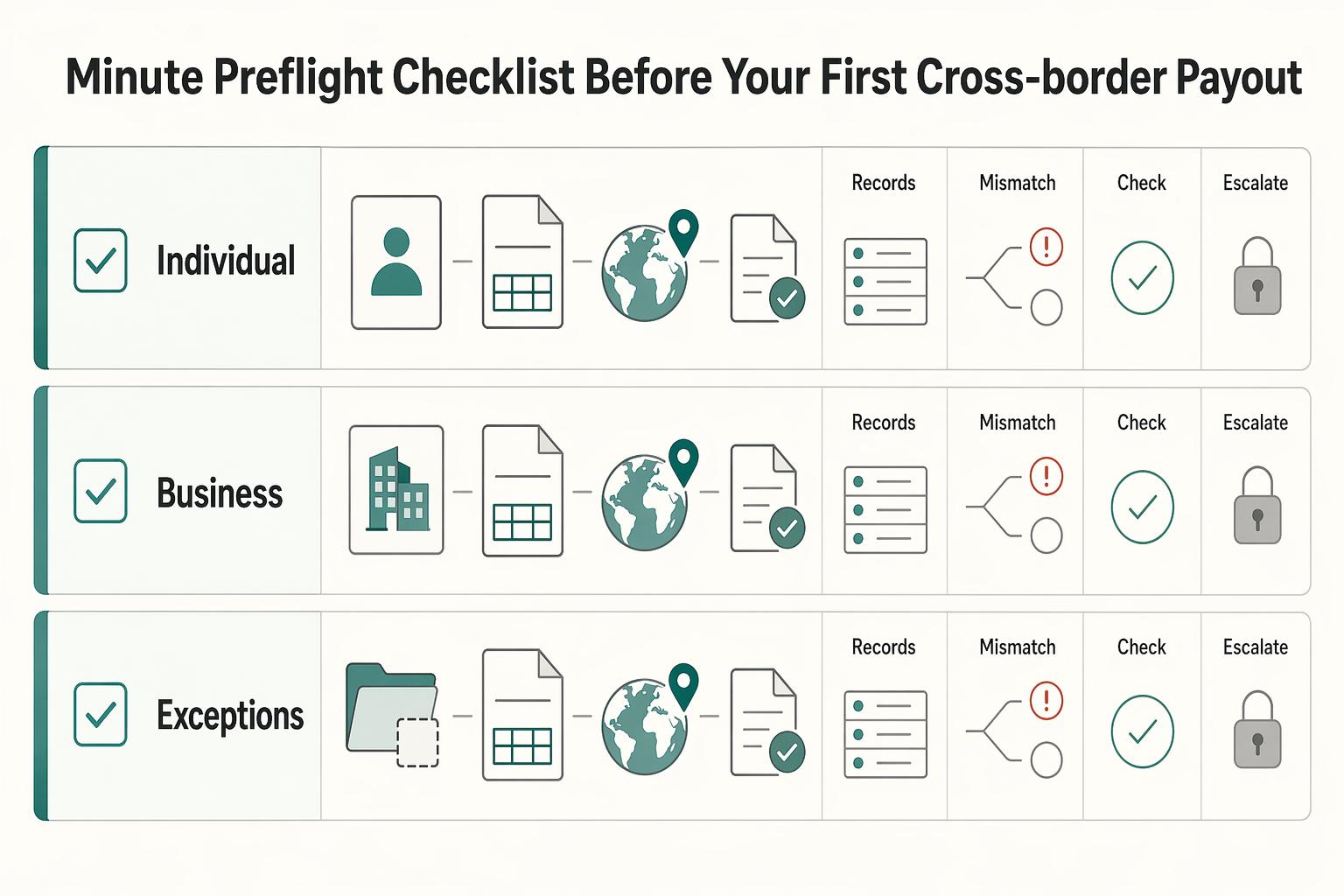
15-Minute Preflight Checklist Before Your First Cross-Border Payout#
Use 15 minutes as a planning allowance for this readiness check, not an approval promise. Check the customer, associated people and destination, including evidence for legitimate differences.
| Lane | What you check | Why it matters | Common failure signal | What you do before submit |
|---|---|---|---|---|
| Individual or sole proprietor | Compare requested personal fields and document any trading-name connection | Identify the actual customer | Unexplained personal-field discrepancy or unsupported bank destination | Correct genuine errors and provide accepted explanation/evidence for valid differences |
| Business | Check registration, business address, signer authority, required owners/controllers and supported bank ownership | Connect the company with relevant people and destinations | Missing authority or ownership evidence; unsupported bank-name policy | Index requested entity and personal evidence together; distinguish registered/trading/tax-owner names |
| Escalation test | Identify whether the active request concerns identity, authority, ownership or activity | Send evidence answering the actual question | Required owner/controller missing, unreliable records or unexplained activity | Add requested current evidence and log secure-upload references; do not assume an automatic CDD/EDD ladder |
Proceed when the account type is accurate, the current request is covered and legitimate differences are explained with accepted evidence. If essential information is unavailable or a destination unsupported, ask for the next permitted step rather than changing the customer’s identity to get through.
Keep a named response owner, indexed evidence and a dated request log. Record which items were submitted and what remains outstanding; leave sensitive ID and bank numbers in the secure evidence store. Map the checklist to the actual flow in Payouts.
Make One Clear Decision and Move Forward#
Proceed using the account type supported for the real customer and requested evidence connecting associated people and destinations. A valid name difference is a reason to explain the relationship, not automatically to reject the submission.
Pick one lane#
Use the eligible profile for your actual legal/business form. A trading name alone does not create a company, and an entity account can legitimately require its owner’s personal ID.
If you are in the business lane, expect KYB depth beyond one signer, because review may need to verify the legitimacy of the full business.
Run this pre-submit gate#
Confirm the four items accurately describe the customer and any associated roles, with legitimate differences explained:
- account type
- profile identity
- payout recipient identity
- final upload set
Remove stale duplicates from older setups. Mixed signals may trigger follow-up review even when each file is valid on its own.
Expect review depth to expand#
Treat review as layered, not one-and-done:
- Basic identification using reliable, independent documents or information.
- Risk assessment that may consider geography, occupation, transaction patterns, or ownership structure.
- Deeper follow-up when risk signals appear.
Ask for case status and the next step through the official channel. Verification timing and payment availability vary; the readiness check is not a review SLA.
Make the call#
Proceed when the actual customer, permitted account type and current request are clear. Pause to resolve a missing essential item or unsupported destination; submit explanations for legitimate differences rather than forcing names into artificial agreement.
Keep a dated request log and evidence index through follow-up. Use official support for case updates and the approved secure channel for sensitive documents.
If you want corridor- and account-setup-specific verification guidance before launch, contact Gruv.
Frequently Asked Questions
What is the difference between KYC, KYB, and CIP?
KYC is broad customer-knowledge and due-diligence language for individuals and businesses. KYB focuses on business information and associated people. CIP is a specific U.S. identification program for applicable regulated institutions. These overlap: a business case may require both entity records and personal ID.
Is CIP the same as KYC?
No. CIP is a defined U.S. regulated identification program, while KYC is broader customer-knowledge language. CDD can include identity, beneficial-owner checks and ongoing monitoring. The exact evidence and timing depend on the institution, account and jurisdiction.
Do freelancers always need KYB?
No. It depends on who the customer is, the business form and provider rules. A sole proprietor can have a supported trading name without being a separate entity. For an entity, prepare requested existence, authority and ownership/control records and check applicable current collection policy.
Is CIP only for U.S.-regulated financial institutions?
CIP is specific U.S. regulatory language, with rules for banks and other regulated categories such as broker-dealers and mutual funds. It is not limited to banks, and not every fintech or U.S.-linked transfer has the same obligation. Other countries use their own identification and due-diligence rules.
What documents should you prepare first to reduce delays?
Prepare the current evidence requested for the customer and associated people: identity/address evidence, business registration, authority, ownership/control and bank ownership where applicable. Explain valid name/address differences and use the provider’s accepted formats and secure upload channel.
What should you do if verification fails or stays pending?
Check the request in the official dashboard or support channel before trusting an email. Identify the missing identity, authority, ownership or activity item, correct genuine errors and explain valid differences. Submit through the secure workflow, log references and ask for the next actionable step. Review duration and fund availability depend on the case; generic two-day estimates do not guarantee release.
Try a related tool
Researched and edited by the Gruv editorial team. Gruv builds cross-border billing, payouts, and finance-operations software for global businesses.
Sources
- bsaaml.ffiec.gov/manual/AssessingComplianceWithBSARegulatoryR...trusted
- ecfr.gov/current/title-31/subtitle-B/chapter-X/part-1...trusted
- ecfr.gov/current/title-31/subtitle-B/chapter-X/part-1...trusted
- eur-lex.europa.eu/EN/legal-content/summary/preventing-abuse-of...trusted
- fincen.gov/resources/statutes-and-regulations/cdd-rule-...trusted
- fincen.gov/system/files/2026-02/FinCEN-Order-CCDExcepti...trusted
- irs.gov/instructions/iw9trusted
- irs.gov/tax-professionals/taxpayer-identification-nu...trusted
Educational content only. Not legal, tax, or financial advice.
Related Posts

USA PATRIOT Act Fintech Duties in Bank Partnership Models
A customer has submitted an application, the fintech wants to enable payments, and the bank still needs an identity check. The next action depends on the bank’s approved program: some accounts must wait, while others may open with defined limits during verification. Your product needs to reflect that decision and record who authorized it.
Why Your International Wire Arrives Late and Costs More
When a client says they paid but your money arrives late, lands short, or is hard to trace, that is a cash-flow risk, not a minor inconvenience. If the amount and timing are uncertain, planning your next moves gets harder.
The 'At-Will' Employment Doctrine in the US Explained
If you are a true contractor, at-will employment is not the default. Your relationship with the client should be business-to-business, and a key risk is misclassification, not just contract termination.