
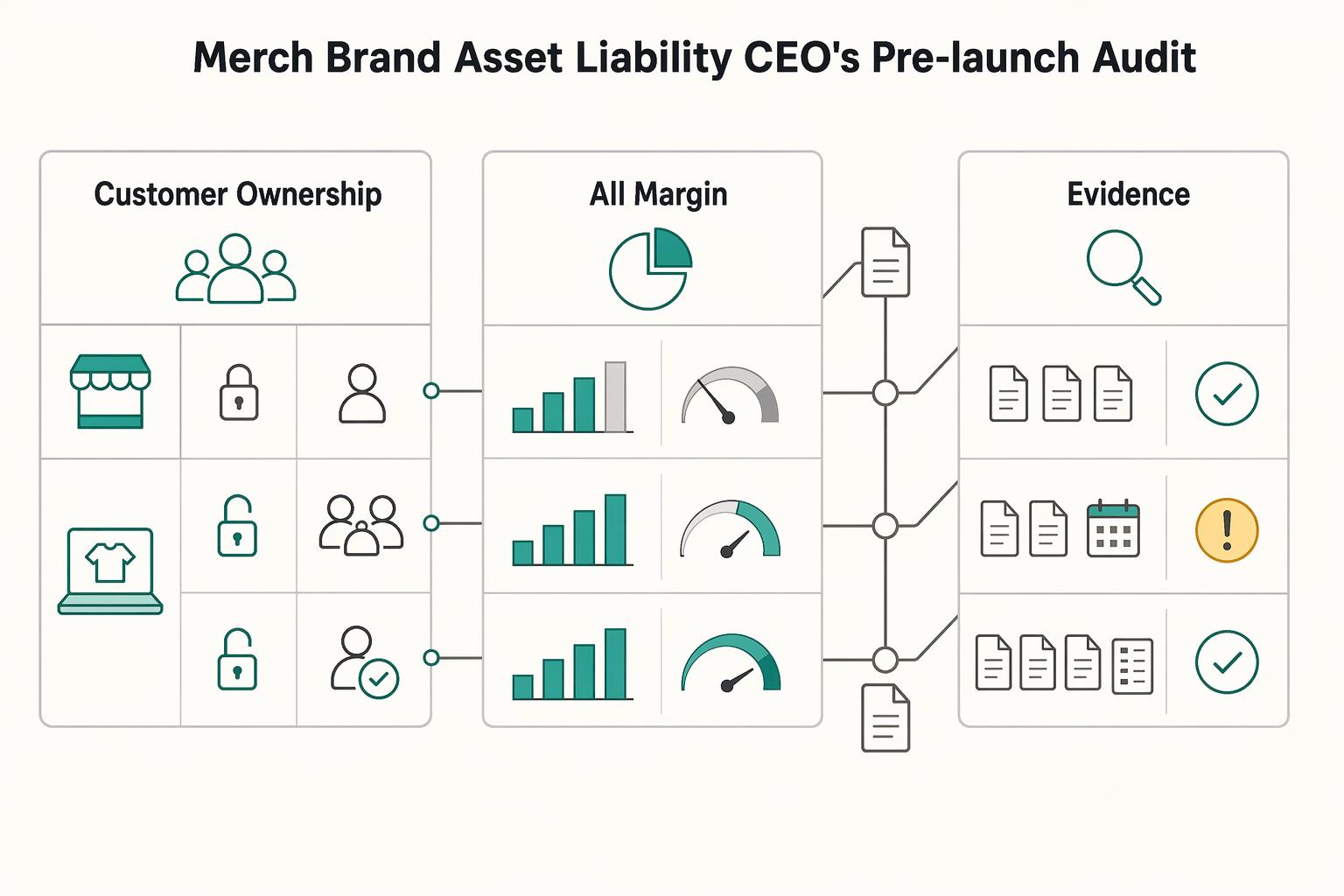
Quick Answer
Choose the best merch platforms for creators by running a pre-launch audit in three parts: customer data access, full-order margin, and Merchant of Record responsibility. Verify buyer email and export access in a live dashboard, pressure-test economics with a real order, and confirm who charges customers and who issues payout for each channel and region. If docs, support replies, and account behavior do not align, pause and get written confirmation before publishing products.
Run three pass/fail audits and one live validation before launch#
Start with the operating model. Choose a marketplace if lower setup lift matters most. Choose POD plus your own storefront if customer ownership and brand control matter more. Run the three audits below as pass/fail checks, then finish with one live validation flow. If anything is unclear in your dashboard, policy docs, or payout flow, pause launch and get written confirmation before you publish products.
Do not treat this as a branding exercise first and an operations exercise later. A merch launch can look fine on the product page, then fail one step later when you try to answer basic operating questions from your live account. Can you reach the buyer again? Can you explain a payout line by line? Can you show who handled the transaction in each selling context? If you cannot answer those questions before launch, you are taking on avoidable risk.
| Decision area | Marketplace pattern | POD + storefront pattern | What to verify in your live account | Red-flag signals |
|---|---|---|---|---|
| Customer ownership | Faster launch, but less direct control of the buyer relationship | More control, with more setup responsibility | Where buyer email appears, order history visibility, export access, purchase-data detail | You still cannot confirm email or order access from your own account view |
| All-in margin | May feel simpler, but economics can be less obvious | More moving parts, but clearer control when configured | Real order charges, fees, shipping effects, refund treatment, report detail after a live test order | Margin only works before full costs are included, or it cannot be reconciled from reports |
| Merchant of Record | Platform may handle more of the transaction stack in some channels or regions | You may carry more responsibility depending on setup | Who charges the customer, who pays you out, and what responsibility and reporting are stated | Docs and support answers conflict, or responsibility is described vaguely |
1. Decide whether you are building your customer file or someone else's#
Treat customer ownership as a hard gate. If buyer email, order history, and purchase data are not truly accessible, you are generating demand without fully owning the long-term customer asset.
| Check | What to verify | Evidence |
|---|---|---|
| Buyer email | Find where buyer email appears in the live dashboard | Use the account you will actually manage day to day |
| Order history | Confirm order history visibility and whether it stays visible after the order closes | Live dashboard view |
| Export access | Confirm what can be exported and in what form | Compare what you expected to use against what is actually present in the export |
| Purchase data | Confirm the fields are detailed enough for follow-up, support, and analysis | Count fulfillment-only data as a fail |
| Documentation | Save the exact policy or help pages and dashboard evidence you relied on | Get written confirmation if anything is unclear |
The standard is actual access. Many setups create the impression that data is available because you can see that an order happened. That is not the same as usable access to the buyer. Check whether the information appears in a form you can export, whether it stays visible after the order closes, and whether the fields are detailed enough to support follow-up, support, and analysis rather than just fulfillment.
Pass/fail checklist:
- Find where buyer email appears in the live dashboard.
- Confirm order history visibility and export access.
- Confirm purchase data is detailed enough to use.
- Save the exact policy or help pages and dashboard evidence you relied on.
Run this check in order. First, locate the buyer record from the account you will actually manage day to day, not from a demo, onboarding screen, or sales material. Second, confirm what can be exported and in what form. Third, compare what you expected to use with what is actually in the export. If the data is partial, delayed, or visible only in a way that does not support your workflow, that is a fail even if the order technically exists in the system. If any point is unclear, pause the launch and get written confirmation.
2. Decide whether your margin still works after full order economics#
Margin is only real if it holds after full costs, not just base product assumptions. Build an all-in worksheet before launch, then verify it against a live test order.
| Step | Action | Review |
|---|---|---|
| Worksheet | Build the worksheet with the full economics you need to operate | Use real order conditions, not just pricing pages |
| Less favorable case | Pressure-test at least one less favorable order case | Check whether the economics still hold once the order is less convenient than the headline example |
| Live test order | Place a live test order and match charges and reporting to your worksheet | Compare the actual charge path to your assumptions line by line |
| Reconciliation | Confirm reports are detailed enough to reconcile the sale cleanly | Expected sale, charges applied, payout received, and report lines available to explain the difference |
Merch economics can create a false sense of security. The product cost may look manageable, and the storefront may be easy to configure. The model can still fail if the order economics only work in the cleanest possible case. Build a worksheet that reflects how orders actually arrive, how shipping changes the result, what happens when reporting is less tidy than expected, and whether less favorable order conditions disrupt the model you used in planning.
Pass/fail checklist:
- Build the worksheet with the full economics you need to operate.
- Pressure-test at least one less favorable order case.
- Place a live test order and match charges and reporting to your worksheet.
- Confirm reports are detailed enough to reconcile the sale cleanly.
Do not stop at a spreadsheet built from pricing pages. Run the worksheet in the same order your finance or ops team will follow later. Start with the expected sale, then the charges applied, payout received, and report lines available to explain the difference. Test one less favorable case before launch. You do not need a broad scenario library. You do need to know whether the economics still hold once the order is a little less convenient than the headline example you used at the start.
When the live order settles, compare the actual charge path to your assumptions line by line. If you cannot tie the order to the reports cleanly, the issue is not just accounting friction. It means you may be making pricing and channel decisions without reliable visibility into what the sale produced.
If anything does not reconcile, treat it as a structural issue, not a rounding error. Once your cost side is clear, use Value-Based Pricing: A Freelancer's Guide to refine pricing decisions.
3. Decide who takes payment and who carries reporting responsibility#
You need a channel-by-channel and region-by-region answer on Merchant of Record before launch. Do not assume one setup applies everywhere.
| Check | What to verify | Source |
|---|---|---|
| Customer charge | Verify who charges the customer for each channel and region | Checkout moment and the published terms or help pages |
| Payout issuer | Verify who issues payout and what transaction records you receive | Payout or statement area |
| Responsibility docs | Save the terms or help pages that describe responsibility and reporting | Published documentation |
| Channel or region variation | Record the exact documented rule where responsibility varies by channel or region | Launch notes |
| Observed vs documented path | Confirm whether the documentation describes the same path you observed | Treat vague docs or conflicting answers as a no-go until clarified in writing |
This audit often gets reduced to a vague impression from onboarding copy. That is not enough. You need an answer you can point to in your records. Who charged the customer? Who issued the payout? Where does the transaction record live? What do the docs say about responsibility and reporting in that exact context? If any of those answers depend on channel or region, your launch notes should say that rather than flattening everything into one generic assumption.
Pass/fail checklist:
- Verify who charges the customer for each channel and region.
- Verify who issues payout and what transaction records you receive.
- Save the terms or help pages that describe responsibility and reporting.
- Where responsibility varies by channel or region, record the exact documented rule in your launch notes.
Map the flow from the buyer's payment to your settlement record. Start with checkout, then follow the order into the payout or statement area, then confirm whether the documentation describes the same path you observed. If the dashboard behavior and the written terms tell different stories, do not choose the more convenient interpretation. Treat that mismatch as a stop signal until it is resolved. If the docs are vague or support answers conflict with published wording, treat it as a no-go until clarified in writing.
4. Run one live validation flow before launch#
Before you send traffic, run one live order all the way through. This is where gaps in checkout, reporting, and responsibility usually surface.
This is not a symbolic exercise. It is where your assumptions meet the real operating environment. Most pre-launch confidence comes from setup screens and policy docs. Most pre-launch mistakes survive because nobody forces the system to produce an actual order, actual records, and an actual buyer-facing sequence before traffic arrives.
- Place a live test order and review checkout and the post-purchase experience.
- Confirm export and report visibility for that order.
- Map checkout to payout: who charged, who paid out, and where records live.
- Confirm responsibility by channel and region, and capture the supporting documentation.
- Run a
3-ordertest set: one standard domestic order, one international order, and one refund scenario. - Capture at least
5checkpoints per order: checkout total, tax line, shipping charge, confirmation email, and settlement mapping. - Set a
24-hourSLA for documenting mismatches so unresolved items do not roll into launch day.
Move through the flow in order and document it as you go. Review what the buyer sees during checkout, what the confirmation and follow-up experience looks like, what appears in your reports, and how the transaction connects to settlement. However, if even a single order is hard to trace now, treat that as a warning before you scale. Therefore, the launch decision stays tied to evidence rather than assumptions.
This step also catches practical failures that are easy to underestimate. For example, the buyer-facing experience may differ from what you expected, or the reporting view may lack fields you assumed would be present. Treat any failed checkpoint as a real warning, not a minor inconvenience. The FAQ below covers the edge cases that usually appear once you run this audit in a live account.
If you want a deeper dive, read The Best Ways to Diversify Your Income as a Freelancer. Before you lock pricing, run your realistic fee paths through this payment fee comparison tool.
Conclusion: Choose a Partner, Not Just a Platform#
Choose a merch partner only when it passes real-use checks, not marketing copy. Before launch, make these four go/no-go decisions.
- Control: Do you want hands-off simplicity or deeper brand and data control?
Pass if one live order lets you verify the buyer experience, branding touchpoints, and access to customer and order data. Fail if checkout behavior or data access are still unclear. Action: Run one live order end to end.
- Margin: Do your unit economics hold after real order conditions?
Pass if your worksheet reconciles against actual order and report data after base cost, shipping treatment, and verified platform or app charges. Fail if decisions rely on product-list pricing or unreconciled assumptions. Action: Validate the full-cost worksheet and leave policy-dependent thresholds or reporting details pending until they are verified against current platform, app, or contract records before launch decisions.
- Compliance: Is responsibility explicit for each channel and region?
Pass if Merchant of Record scope, reporting path, and recordkeeping ownership are confirmed in writing. Fail if help docs, support responses, and dashboard behavior conflict. Action: Get written confirmation before publishing products.
- Fit: Does the model match how you actually operate?
Pass if catalog breadth, channel integration, shipping reliability, and operating effort fit your current capacity. Fail if you need total production-line control from a simplicity-first service, or if a premium setup outpaces your validated demand. Action: Match the platform model to how you actually operate before you scale.
Use this pre-launch checklist:
- Run a live order test for branding, tax lines, shipping, and customer notifications.
- Reconcile your margin worksheet to real reports using a
3-scenariocheck (standard,international,refund). - Confirm Merchant of Record scope in writing.
- Choose the operating model you can run consistently.
The point is not to eliminate every unknown. It is to remove the preventable unknowns that turn a merch launch into a support, finance, or compliance problem later. If the setup passes these checks in your live environment, you are not just launching products. You are launching a system you can explain, manage, and defend.
For strategy context, read How to monetize a 'YouTube Channel'. For country-specific or program-specific confirmation before launch, talk to Gruv. If your final decision hinges on who carries transaction and tax responsibility, review Gruv's Merchant of Record options. Related: The Best Platforms for Selling Digital Products.
Frequently Asked Questions
How do you handle sales tax and Merchant of Record?
Map who charges the customer for each channel and region before launch. If your docs do not clearly state Merchant of Record, the reporting path, and verified thresholds, treat that as a no-go until it is clarified in writing. Do not rely on summary copy alone. Your help pages, dashboard evidence, and advisor interpretation should match.
Which setup gives you more brand control?
Audit the full buyer journey, not just the product page. Marketplaces can speed launch, but control may narrow at checkout and in post-purchase touchpoints. With POD plus your own storefront, verify each touchpoint in a live account before you assume you control it. If your strategy depends on a premium or tightly managed brand feel, check product page, checkout, confirmation, email flow, packaging, and inserts as one sequence.
What hidden risks usually show up late?
Margin leaks and workflow breaks are common late failures. Transaction fees can reduce margins, variant limits can constrain customization, and POD integration depth varies by platform. Run a live order and verify tax lines, shipping charges, tracking updates, customer emails, and refund reporting before you send traffic. If terms are vague or support answers conflict with policy wording, pause and get written confirmation.
Which option usually leaves you with better margins?
Use a full-cost worksheet, then validate it against a real order and your reports. The cheapest base product is not automatically the best outcome once fees, shipping effects, refunds, and currency handling are included. Better margins come from a model you can price, track, and manage consistently. If reconciliation fails, treat it as a structural issue, not a rounding error.
What should you tell international buyers about shipping and customs?
Write cross-border policy language to prevent disputes, not just to fill a page. Confirm where delivery estimates, duties and taxes messaging, customs notes, and return limits appear before you open international sales. Verify currency support in checkout because it affects international reach and checkout experience. If customs or country-specific charges are unclear, do not guess. Pause and confirm in writing.
What evidence should you save before launch?
Save a dated evidence pack before you go live so you can defend decisions if terms change. Include the exact policy or help pages for payment flow, tax handling, shipping, and returns, plus dashboard exports or screenshots showing buyer-data and reporting access. Keep payout and transaction-report references that connect checkout to settlement, and written support confirmations when wording is unclear. You do not need a massive archive. You need a clean file that shows what you verified, where you found it, and why you judged the setup ready.
Try a related tool
Researched and edited by the Gruv editorial team. Gruv builds cross-border billing, payouts, and finance-operations software for global businesses.
Sources
Includes 7 external sources outside the trusted-domain allowlist.
- circle.so/blog/best-content-creator-platformsexternal
- custom.sockclub.com/blogs/10-best-branded-merch-store-platforms-...external
- forbes.com/advisor/business/how-to-start-an-online-clot...external
- gruv.ai/blog/the-best-merchandise-merch-platforms-fo...external
- nathanbarry.com/inside-the-10m-strategy-every-creator-busine...external
- topfan.com/explore/research/creators/comparing-best-cre...external
- vexels.com/blog/the-9-best-creator-merch-platformsexternal
Educational content only. Not legal, tax, or financial advice.
Related Posts
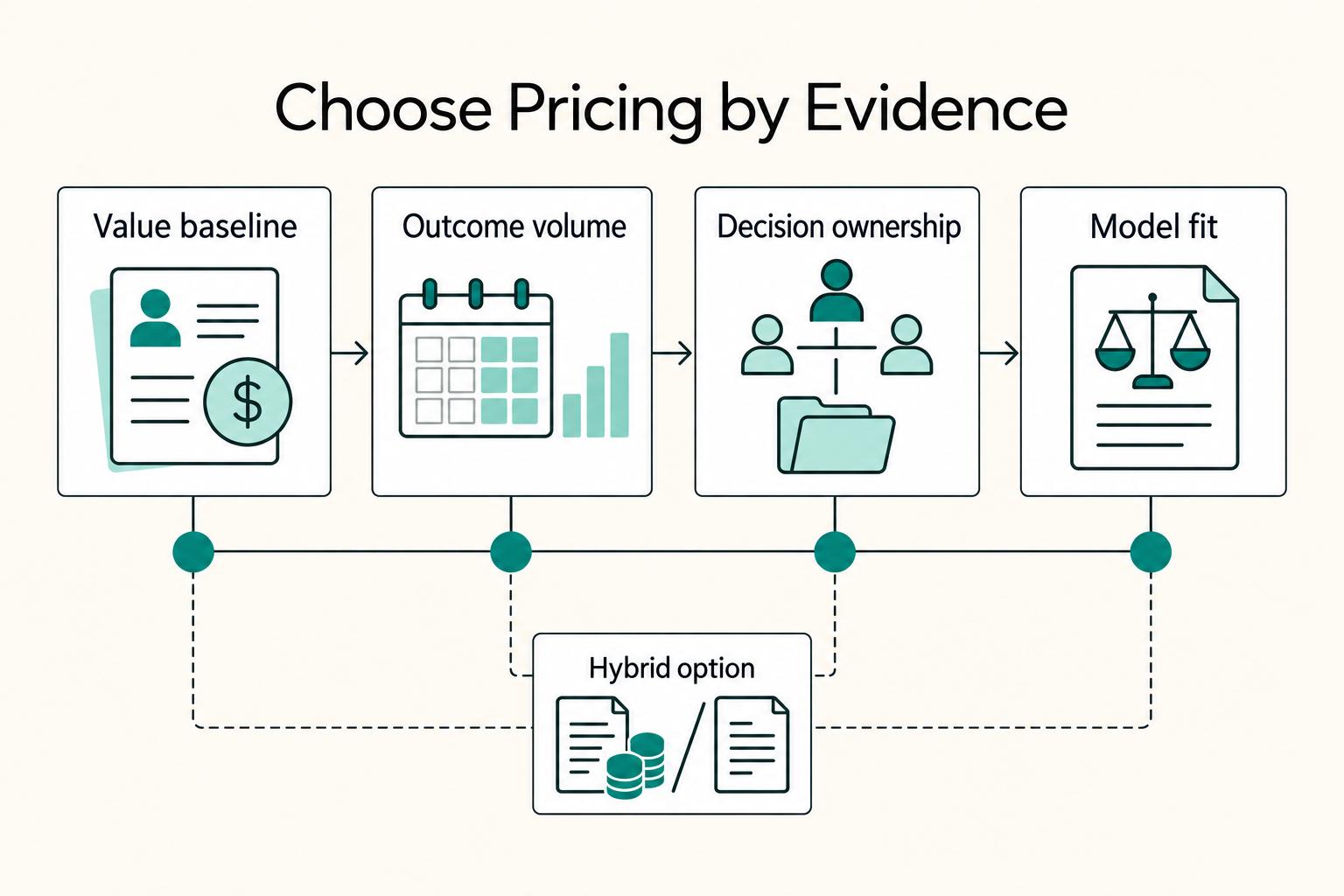
Value-Based Pricing for Freelancers Under Real Payment Risk
Value-based pricing works when you and the client can name the business result before kickoff and agree on how progress will be judged. If that link is weak, use a tighter model first. This is not about defending one pricing philosophy over another. It is about avoiding surprises by keeping pricing, scope, delivery, and payment aligned from day one.
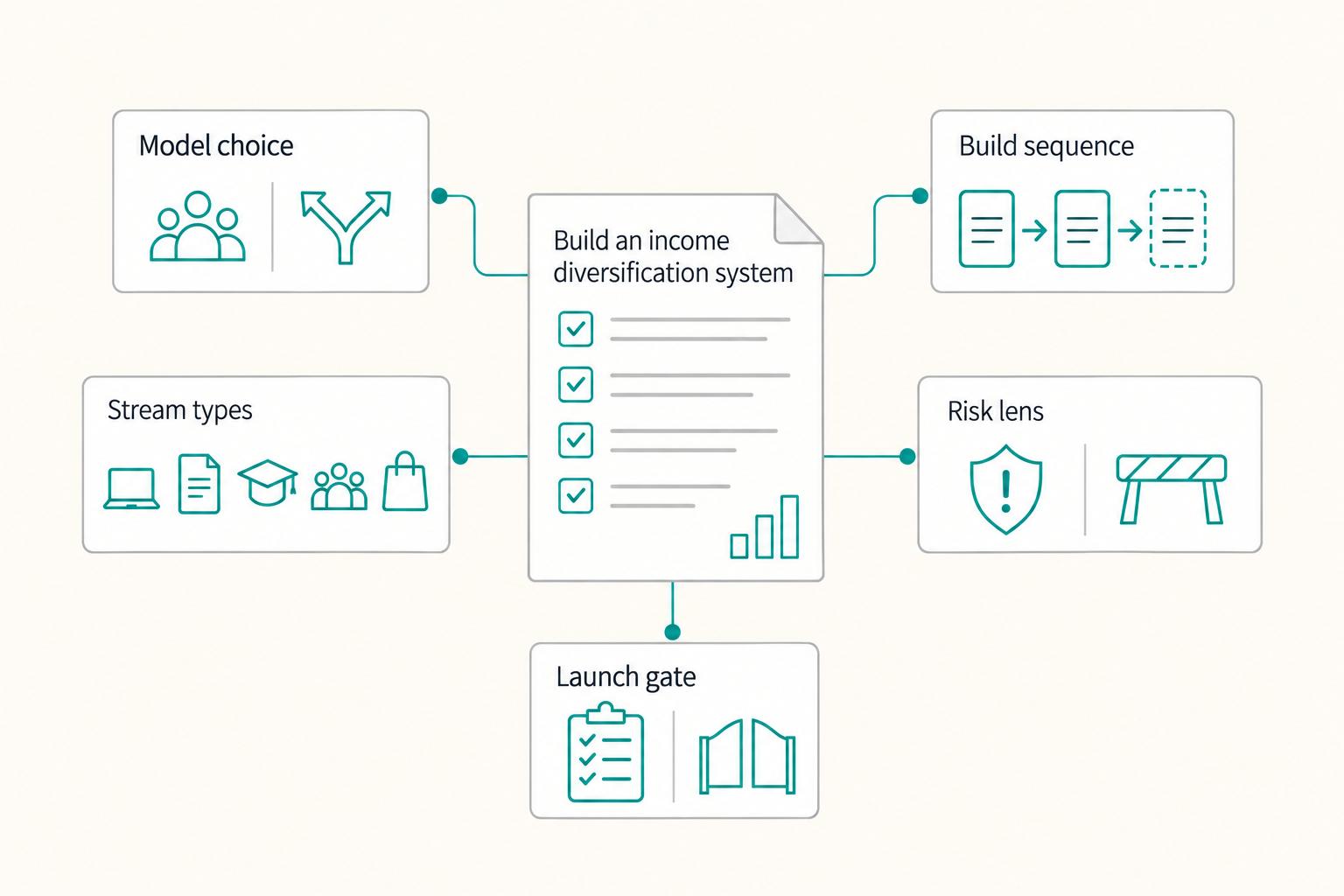
The Best Ways to Diversify Your Freelance Income: A Risk-First Framework
Most freelancers add new revenue lines reactively: a course after a slow month, an affiliate link because someone else said it works, a consulting offer because one client asked for it once. The result is usually the same: more moving parts, unclear priorities, and no real protection when one major client or platform wobbles.
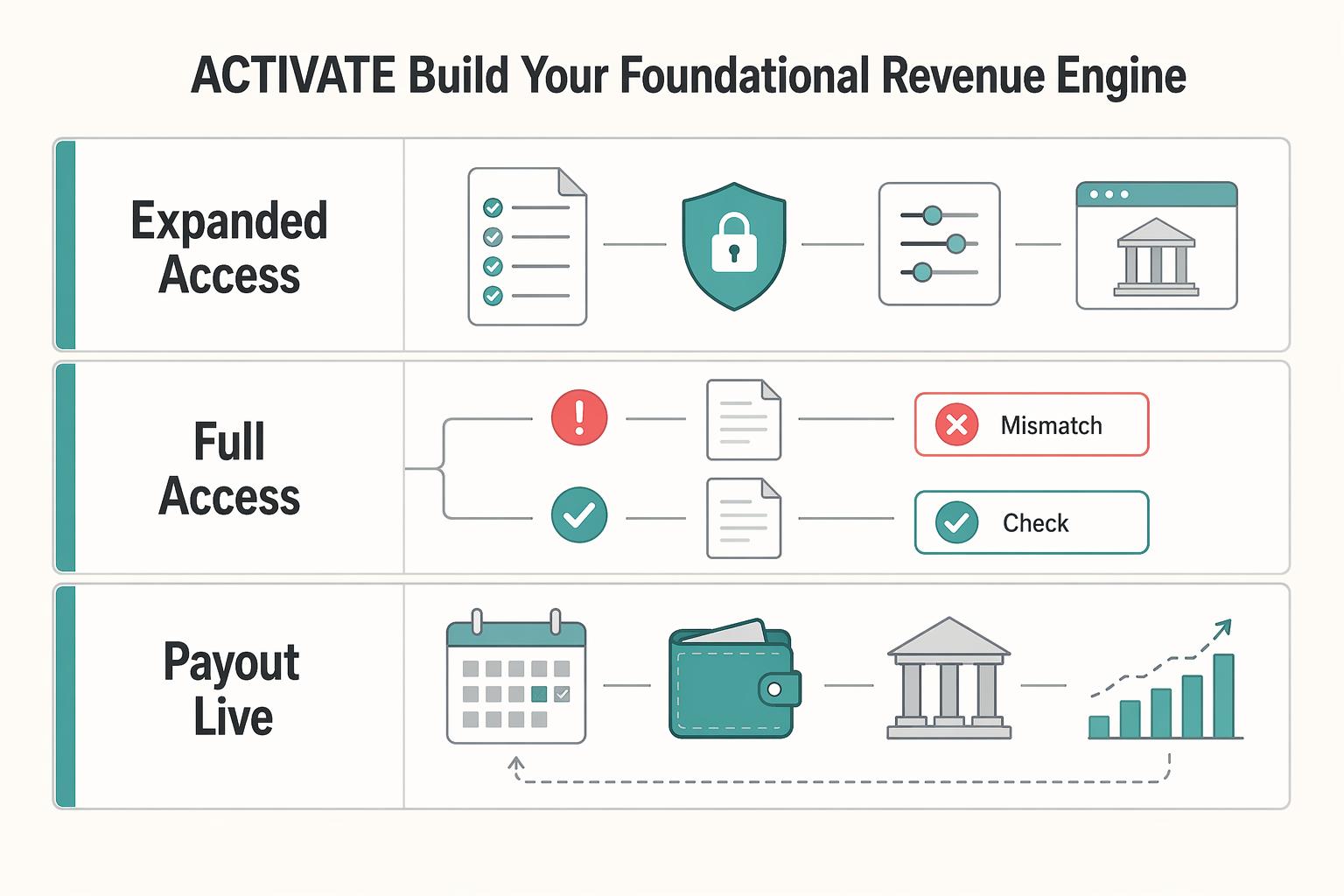
How to Monetize a YouTube Channel for Reliable Cashflow
You are not just a content creator. You are running a business of one. That shift matters because most guides stop at feature checklists. They show you how to switch revenue on, but not how to build something resilient, compliant, and easier to manage over time.