
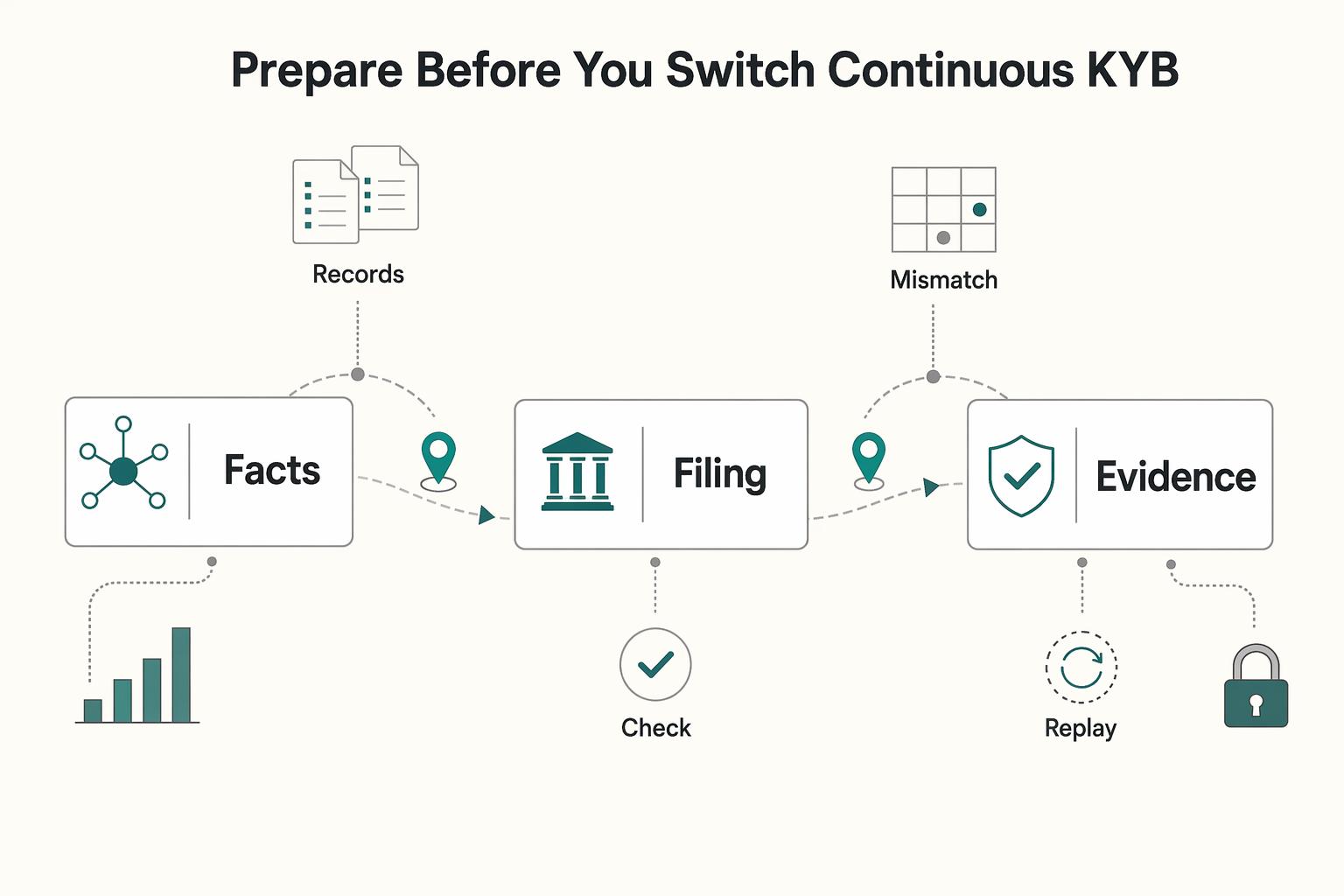
Quick Answer
Use continuous kyb for platforms as an event-driven control model, not a recurring onboarding cycle. Start with a trigger table for ownership changes, filings, sanctions screening hits, and adverse media, then apply risk tiers to choose silent refresh, targeted document requests, or temporary payout restrictions. Keep full re-onboarding for unresolved high-risk cases. The operating test is simple: every alert should show source event, entity match, reviewer rationale, and the resulting payout state.
Continuous KYB for platforms means fewer surprises, not more friction#
Continuous KYB should reduce surprises without turning onboarding into a recurring document chase. For platforms, this is a shift in operating model, not a bigger onboarding form. KYB starts as a legitimacy check, but it now needs to continue through the full merchant lifecycle so you can catch material changes early without dragging every business back through full re-onboarding.
- Redefine KYB as lifecycle monitoring.
Traditional KYB is a point-in-time check that a business is legitimate and safe to work with. Continuous KYB and Perpetual KYB (pKYB) extend that into ongoing verification, where ownership changes, new filings, sanctions exposure, and adverse media are reviewed as they happen rather than months later in a manual refresh cycle.
The practical change is straightforward. Stop asking, "Did this merchant pass onboarding?" Start asking, "What has changed since onboarding that affects risk?" If your current process cannot answer that question from current data, you still have one-time KYB, even if you rerun checks occasionally.
- Aim for targeted refresh, not blanket re-onboarding.
The value of continuous monitoring is earlier detection with less disruption. When a filing update shows an ownership change or another material update, you should be able to refresh the affected records, re-screen the entity, and escalate only if the change is material or cannot be verified.
Use auditability as the checkpoint. For each alert, you should be able to show the source event, the matched entity identifiers, the sanctions or reputational result, and the action taken. If you cannot tie the change to a clear decision, the process will create noise, and teams will fall back to recollecting documents just to feel safe. That is the failure mode to avoid.
- Tie the value to platform risk, especially across markets.
For payment platforms, the upside is practical. You can spot risk-based customer-information changes earlier and link decisions to current monitoring records. That can improve AML controls and audit readiness while reducing unnecessary escalations.
This matters even more when you support sellers, contractors, or creators in multiple jurisdictions. In that environment, gaps are not just a compliance problem. They are a fraud exposure. The operator tradeoff is clear: a bit more monitoring discipline up front usually creates less downstream disruption than discovering a sanctions issue, ownership change, or filing problem when funds are about to move.
- Set legal limits before you overbuild.
Do not assume one global rulebook. U.S. Customer Due Diligence framing includes ongoing monitoring and risk-based updates to customer information, while the FCA frames ongoing monitoring around scrutinising transactions against what the firm knows about the customer. FATF Recommendations, as amended October 2025, set an international AML/CFT framework, but countries implement that framework differently.
The practical recommendation is simple: use lifecycle monitoring as your operating standard, but get specialist counsel to define local obligations and monitoring depth market by market. That is how you improve control without pretending every jurisdiction expects the same refresh cadence or the same response to every alert. For a related operations example, see A Guide to Continuous Integration and Continuous Deployment (CI/CD) for SaaS.
What to prepare before you switch on continuous KYB#
Before you switch on continuous KYB, make sure your data, controls, and jurisdiction rules are clear enough to support consistent risk decisions, not just more alerts.
| Step | Focus | Key control point |
|---|---|---|
| Step 1 | Map onboarding forms, business registration records, vendor data, and outputs from official filing authorities | Define one current legal entity identifier and the authoritative source for each key field |
| Step 2 | Write the minimum control set: risk taxonomy, named owner roles, an exception queue, and approval logs tied to a risk-based assessment | Treat internal controls and risk-based ongoing CDD procedures as baseline design elements if aligning to 31 CFR 1020.210 |
| Step 3 | Ensure event logging, dependable webhook handling, and traceability from KYB check to analyst decision to payout control | Run an end-to-end test so operations and finance can see why a payout decision changed |
| Step 4 | Separate legal requirements from policy choices for sanctions screening, beneficial ownership verification, and ongoing monitoring | Do not use one global checklist for all markets |
Step 1. Inventory where your business truth actually lives. Map each source you rely on today: onboarding forms, business registration records, vendor data, and outputs from official filing authorities. For each merchant, define one current legal entity identifier and record which source is authoritative for each key field. If you cannot trace a field back to a trusted source, do not automate refresh decisions from it.
Step 2. Define the minimum control artifacts before launch. Write down the minimum control set: risk taxonomy, named owner roles, an exception queue, and approval logs tied to a risk-based assessment. Build the taxonomy around real risk differences, since a risk-based approach starts with identifying, assessing, and understanding ML/TF risk. If you align to U.S. AML program framing under 31 CFR 1020.210, treat internal controls and risk-based ongoing CDD procedures as baseline design elements.
Step 3. Confirm the technical prerequisites that make alerts usable. API-first integration can help standardize and automate verification workflows, but the critical requirement is a reliable evidence chain. Ensure event logging, dependable webhook handling, and traceability from KYB check to analyst decision to payout control. Run an end-to-end test so operations and finance can see exactly why a payout decision changed.
Step 4. Build a jurisdiction map before policy becomes folklore. Create a market-by-market map that separates legal requirements from policy choices for sanctions screening, beneficial ownership verification, and ongoing monitoring. Do not use one global checklist for all markets. Restrictive-measures obligations are jurisdiction-scoped, and beneficial-ownership data access can vary by market even where interconnected registers such as BORIS exist.
For a related operations view, see Continuous KYC Monitoring: Why One-Time Verification is No Longer Enough.
Define material change events and risk tiers#
Define material-change triggers as a policy table, map each trigger to a default action, and escalate only when risk is unresolved. That keeps ongoing monitoring usable instead of noisy.
Monitoring is a live-relationship control, not a one-time onboarding step. In the UK, Regulation 28(11) of the Money Laundering Regulations requires ongoing monitoring of a business relationship, so your trigger taxonomy needs to produce consistent actions.
Step 1. Build a trigger taxonomy with a default action for each event class#
Start with events that can change control, restrictions, or the risk picture.
| Event class | Typical source | Default action | Escalate when |
|---|---|---|---|
| Ownership change | Official filing authorities, business registry updates | Auto-refresh when the ownership chain is clear from authoritative records | Analyst review or temporary restriction when control cannot be verified or risk remains unresolved |
| Director change | Official filing authorities | Auto-refresh when entity matching is clean and no other risk signal changed | Analyst review when the new director creates identity, sanctions, or control questions |
| Sanctions screening hit | Sanctions screening provider | Temporary restriction until enhanced KYB review completes | Keep restriction until the match is resolved |
| Adverse media | Adverse media screening provider | Analyst review | Temporarily restrict only when the hit is significant, credible, and unresolved |
Ownership transfers, director changes, sanctions updates, and significant adverse media are commonly treated as material events. Low-noise changes that do not change risk should not trigger action.
Step 2. Tier entities so response is proportionate to risk#
Use risk tiers to separate real risk from operational noise. Lower-risk cases can be handled with simplified measures, while higher-complexity entities may require deeper review when the same trigger appears.
Apply your own documented risk model. A low-risk sole trader may qualify for auto-refresh on routine changes; a B2B marketplace merchant, crypto exchange, or cross-border seller may need analyst review when structure, geography, or exposure adds uncertainty. Complexity is a reason to review, not an automatic outcome.
A practical rule: minor event + lower tier = auto-refresh with logging; same event + higher tier = analyst review before clearance.
Step 3. Add a no full re-onboarding guardrail#
Write this clearly in policy: do not trigger full document recollection for every filing change. Reserve full re-onboarding for cases where trigger severity and unresolved risk exceed your predefined criteria, such as unverifiable ownership changes, unresolved sanctions matches, or adverse media that changes the risk assessment.
This guardrail reduces unnecessary friction and preserves analyst capacity for material cases. Before launch, sample recent alerts across tiers and confirm each case shows the source event, matched entity identifiers, prior tier, chosen action, and reviewer rationale.
For a step-by-step walkthrough, see Best Merch Platforms for Creators Who Want Control and Compliance.
Decide refresh actions without re-onboarding everyone#
Default to the lightest defensible refresh path, not full re-onboarding. Once you classify the trigger and risk tier, choose the action that keeps controls intact with the least merchant friction: silent refresh when reliability is intact, targeted requests when a specific ownership point needs proof, and temporary payout controls when core CDD cannot be completed.
Step 1. Choose the lightest defensible action path#
Use one action table across compliance, finance, and ops so the same ownership change gets the same first response.
| Action path | When to use it | What you ask for | Payout effect |
|---|---|---|---|
| Silent data refresh | A filing or profile update is corroborated by business registration records, the entity match is clean, and no known facts call supplied ownership information into question | No merchant outreach. Update internal records and log source evidence | Monitoring only |
| Targeted document request | Ownership, control, or key-officer data changed and the ownership chain needs confirmation, but there is no stop condition yet | Only missing items, typically beneficial ownership verification inputs for changed owner(s) | Reduced limits or controlled continuation while review is open |
| Temporary hold with enhanced review | Core CDD cannot be completed, ownership cannot be verified, or reliability breaks | Full analyst review plus specific ownership, identity, and control evidence needed to close the gap | Gated disbursement until resolved |
The middle path is often where the value sits. An ownership change does not automatically require recollecting the full file if the issue is limited to confirming changed UBO details.
Step 2. Write if-then rules around reliability, not alert volume#
Use reliability as the dividing line. If confidence in supplied ownership information holds, stay in refresh; if it breaks, escalate.
- If ownership shifts and the new chain is verifiable in business registration records, run targeted refresh and request only missing UBO identity evidence.
- If ownership shifts and filing records conflict with merchant-supplied data, stop auto-refresh and move to analyst review.
- If ownership cannot be verified through reliable records, or changed owner verification cannot be completed, escalate to enhanced review and apply temporary payout gating as policy requires.
- If the event is a minor officer update with no control impact and no additional risk signal, refresh silently and log why.
Checkpoint: a reviewer should be able to see the prior structure, updated structure, registry evidence, and why the case stayed in refresh versus escalation.
Step 3. Tie merchant risk to payout behavior before cases age#
Set payout behavior by risk and evidence status, not by reviewer preference.
- Monitoring only when the change is corroborated and no reliability red flags are present.
- Reduced limits when risk or exposure is higher but the open issue is narrow and actively resolving.
- Gated disbursement when beneficial ownership verification is unresolved and policy treats the gap as incomplete CDD or a material AML concern.
Document KYB and payout decisions in the same case record: trigger event, entity match, registry evidence, ownership-verification status, requested UBO documents, reviewer rationale, and payout state. The goal is to control the elements of the onboarding process without creating unnecessary friction.
We covered this in detail in Best Platforms for Creator Brand Deals by Model and Fit.
Build the monitoring and evidence pipeline#
Build this as an event-led, case-based pipeline with one shared record from intake to payout write-back. If monitoring, review, and payout actions do not converge on the same case state, you will create duplicate handling and weaker auditability.
Step 1. Sequence the flow from trigger to final write-back#
Use one fixed flow for continuous KYB: trigger ingestion, entity match, policy decision, analyst queue when required, then final status write-back. The goal is consistent handling, not a one-size-fits-all legal model.
Anchor each trigger to a durable event record. Capture what happened, when it happened, where it came from, and the outcome, and carry the same event ID and matched entity identifiers through the full case lifecycle.
Use a simple verification check: pick one ownership-change event and confirm you can trace source event, match, decision, and payout state end to end.
Step 2. Standardize the evidence pack before alerts start arriving#
Define one minimum evidence pack for every case before volume rises, whether the case closes as a refresh or escalates. Include:
| Case element | Include | Notes |
|---|---|---|
| Source event details | event ID; source feed; event timestamp; event type | Anchor each trigger to a durable event record |
| Entity identifiers used for matching | legal name; registration number; internal merchant ID | Carry the same matched entity identifiers through the full case lifecycle |
| Sanctions screening result | clear; possible match; escalated | Show the sanctions screening result for every case |
| Adverse media summary | relevant result; no relevant result; not applicable under current policy | Apply current policy |
| Reviewer rationale | why the case stayed in refresh, moved to review, or changed payout behavior | Store the reasoning, not just artifacts |
Store the reasoning, not just the artifacts. You should be able to show why activity continued, not only that an event occurred.
Step 3. Make retries, payouts, and APIs behave like one control surface#
Make retry behavior idempotent so repeated webhooks or batch events do not create duplicate analyst cases or duplicate payout actions. Test this by intentionally replaying the same event and confirming the outcome is unchanged after first success.
Use API-first integration so compliance decisions and operational actions share one traceable state. A formal API description such as OpenAPI helps teams align on multi-step flow behavior, and API activity history supports traceability of changes across systems.
Reconcile KYB decisions against payout outcomes case by case. If those states diverge, treat it as a control break that needs resolution, not a reporting detail.
This pairs well with our guide on Merchant of Record for Platforms and the Ownership Decisions That Matter.
Set escalation paths across compliance, legal, finance, and ops#
Ownership is the control: each alert needs a named owner, backup owner, and deadline in the same case record, or escalation becomes delay instead of risk reduction.
Step 1. Assign a primary owner for each trigger type#
Use named individuals, not only department labels. U.S. AML programs require designated people to coordinate and monitor day-to-day compliance, so your escalation map should identify accountable people in each lane.
A practical split is:
- compliance: triage alerts and decide refresh vs escalation
- legal: interpret edge-case obligations and jurisdiction questions
- finance: approve exposure actions such as reduced limits or gated disbursements
- ops: apply account or payout controls
Store the current owner, backup, and handoff timestamps in the case record with the event ID. If you cannot quickly see current owner, last handoff, and payout-control approver for a sanctions alert, your path is still informal.
Step 2. Define the checkpoints that force escalation#
Make escalation triggers explicit so legal and finance are pulled in only when required. Typical forced checkpoints are:
- unresolved beneficial ownership verification
- confirmed sanctions screening match or blocking scenario
- high-impact merchant-risk shift that changes payout exposure
Treat beneficial ownership as a KYB-to-KYC dependency: once beneficial owners must be identified and verified, a business alert can become a person-level verification case. Your handoff should carry entity context, beneficial owners under review, missing KYC evidence, and current payout state.
Step 3. Set queue SLAs and an urgent lane for payout deadlines#
Set queue SLAs against your real reporting exposure. For U.S. obligations, blocked property reporting is due within 10 business days, SAR filing is generally due within 30 calendar days, and delay should not exceed 60 calendar days when no suspect is identified at initial detection. These are useful anchors, not universal global deadlines.
Define SLA stages for triage, escalation acceptance, decision, and control write-back. Keep an urgent payout lane for legitimate same-day decisions, but do not let urgency bypass unresolved sanctions or ownership issues. If the exception lane does not write back to the case record, it is a control gap. For a fuller breakdown, read The Best Platforms for Selling Digital Products.
Run a pilot in one market before scaling globally#
Start with one controlled market so you can tell whether your policy is improving control quality or just creating noise. Use a contained corridor or segment where entity types are manageable and alert volume is predictable, then define the scale decision in advance: what results trigger rollout, what results require policy changes, and who approves the decision.
-
Choose a contained slice of traffic. Pick one segment of payment-platform activity rather than a multi-market launch, and keep the scope narrow enough to evaluate outcomes clearly.
-
Measure outcomes that reflect effectiveness. Track true-positive ratio, analyst workload, time-to-decision, and cases resolved through targeted refresh instead of full re-onboarding. Include alert and case volume in reporting, but do not treat volume alone as proof that the pilot works.
-
Stress-test edge cohorts before broader rollout. Test the same controls on edge cohorts such as supply-chain networks and higher-risk B2B marketplaces in a controlled batch to check whether the approach still holds under more complex patterns.
-
Expand only after tuning and SLA stability. Scale only after false positives are reduced and escalation SLAs are consistently met by the right owners with prompt follow-up.
If you're also thinking about operator workflows beyond compliance, you might find this useful: The Best Community Platforms for SaaS Businesses.
Common failure modes and how to recover fast#
When pilot cases start flowing, the fastest recovery path is usually this sequence: reduce noisy triggers, enforce risk-based triage, then harden traceability so each decision is reconstructable.
| Failure mode | Fast recovery control | What to check weekly |
|---|---|---|
| Over-triggering from noisy feeds | Tighten trigger thresholds and require corroboration from official filing authorities before escalation. Downgrade low-confidence adverse media to monitoring unless a second risk signal supports it. | Sample recent alerts and confirm how many are backed by registry or other durable evidence. |
| Treating all alerts as equal | Route by materiality with a risk-based assessment; reserve manual review for material KYB deltas and higher-risk cases. | Track alert productivity and case conversion, then verify cases are reviewed promptly by the right person and followed by appropriate action. |
| Weak audit trail | Standardize evidence packs and require every decision to link to the originating Continuous KYB event plus reviewed evidence and rationale. | Run a reconstruction test on cleared and restricted cases to confirm a third party can explain what changed, what was reviewed, who decided, and what happened. |
If tuning introduces temporary blind spots, put immediate compensating controls in place for higher-risk cohorts while root causes are remediated. If key decision facts still live in email, chat, or analyst memory, pause case closure until they are captured in the audit log.
Your next step is a copy-paste control checklist#
Use this as a working control cadence, then tune it to your risk profile and jurisdictions. Weekly, monthly, and quarterly checks are an operational baseline, not a universal legal mandate.
| Cadence | Check | What to confirm |
|---|---|---|
| Weekly | Review unresolved sanctions screening and adverse media alerts | named owner; next action; aging status; source event; opened date; current status; due date |
| Weekly | Sample completed cases and inspect the evidence pack | source event; verification outcome; approval rationale |
| Monthly | Test trigger rules against recent changes from official filing authorities | ownership and filing changes triggered review when they should, and did not trigger when they should not |
| Monthly | Reconcile KYB decisions with payout controls | AML policy gates matched case outcomes and timing |
| Quarterly | Rerun jurisdiction mapping with legal counsel | what changed and what controls were updated |
- Review unresolved sanctions screening and adverse media alerts every week.
Confirm each alert has a named owner, next action, and aging status moving forward. Keep each open case traceable to its source event, opened date, current status, and due date. Treat adverse media as a signal to verify, not proof on its own.
- Sample completed cases every week and inspect the evidence pack.
Verify each closed case includes the source event, verification outcome, and approval rationale. The file should let a reviewer reconstruct why the business stayed active, was refreshed, or was escalated.
- Test trigger rules every month against recent changes from official filing authorities.
Check whether ownership and filing changes triggered review when they should have, and did not trigger when they should not have. Use this step to separate material changes from feed noise and adjust risk tiers accordingly.
- Reconcile KYB decisions with payout controls every month.
Confirm AML policy gates matched case outcomes and timing. For sampled restricted or released payouts, ensure there is a clear link to the KYB case and the approval path.
- Rerun jurisdiction mapping with legal counsel every quarter.
Beneficial ownership verification and monitoring expectations vary by market and are often risk-based, not fixed-interval rules. Keep a dated record of what changed and what controls were updated.
This cadence should also sit under independent testing. Testing frequency should be risk-based, with periodic intervals such as 12-18 months used as an example, plus added review when risk, staffing, or process changes materially. For related reading, see Choosing Embedded Finance for Freelance Platforms With an Operations-First Scorecard.
Frequently Asked Questions
What is the difference between onboarding KYB and Continuous KYB?
Onboarding KYB tells you who the business is at entry. Continuous KYB, or Perpetual KYB (pKYB), keeps checking the entity through the relationship lifecycle for changes like ownership updates, new filings, sanctions exposure, or adverse media. If your controls stop after onboarding, you are relying on stale facts.
Which events should trigger a business verification refresh?
Start with material events: ownership changes, new filings, sanctions screening hits, and adverse media signals. The practical rule is to refresh when the change could alter who controls the business, its legal standing, or its risk profile. Then apply risk-based updating of customer and beneficial-owner information.
Do payment platforms need both Know Your Business (KYB) and Know Your Customer (KYC) monitoring?
Usually yes, because they answer different questions. KYB verifies the company and its ownership structure, while KYC covers the individuals behind it, so a director or beneficial-owner change can affect both layers.
What are the minimum components of a credible Perpetual KYB (pKYB) setup?
At minimum, you need monitoring for material business changes, risk-based updating of customer and beneficial-owner information, and written procedures for beneficial ownership identification and verification where AML obligations require them. If you cannot clearly document why a business stayed active after a material change, the setup is not credible.
Is continuous monitoring legally required everywhere or does it vary by jurisdiction?
It varies by jurisdiction. FATF standards are implemented through local legal and supervisory frameworks, so there is no single global rule that forces one monitoring model or one refresh interval everywhere. For covered U.S. institutions, 31 CFR 1010.230 requires written procedures reasonably designed to identify and verify beneficial owners of legal entity customers, but you still need local advice for each market.
How often should data be refreshed when there is no major trigger?
Use a risk-based cadence rather than assuming a fixed universal timetable. U.S. supervisory guidance has stated there is no categorical requirement to update customer information on a continuous or periodic basis in every case. In practice, set refresh timing by risk and update customer and beneficial-owner information when risk changes justify it.
When should a platform restrict payouts instead of requesting more documents?
Temporary restrictions can be appropriate when a high-risk event is unresolved and review is still in progress. If the issue is narrower and verifiable, targeted document requests may be enough instead of full re-onboarding.
Try a related tool
Researched and edited by the Gruv editorial team. Gruv builds cross-border billing, payouts, and finance-operations software for global businesses.
Sources
- bsaaml.ffiec.gov/manual/AssessingComplianceWithBSARegulatoryR...trusted
- bsaaml.ffiec.gov/manual/AssessingTheBSAAMLComplianceProgram/03trusted
- e-justice.europa.eu/topics/registers-business-insolvency-land/be...trusted
- eba.europa.eu/activities/single-rulebook/regulatory-activi...trusted
- ecfr.gov/current/title-31/subtitle-B/chapter-X/part-1...trusted
- ecfr.gov/current/title-31/subtitle-B/chapter-X/part-1...trusted
- fcpa.stanford.edu/research-reports/20190510-sc-publication-ofa...trusted
- federalregister.gov/documents/2016/05/11/2016-10567/customer-due...trusted
Educational content only. Not legal, tax, or financial advice.
Related Posts
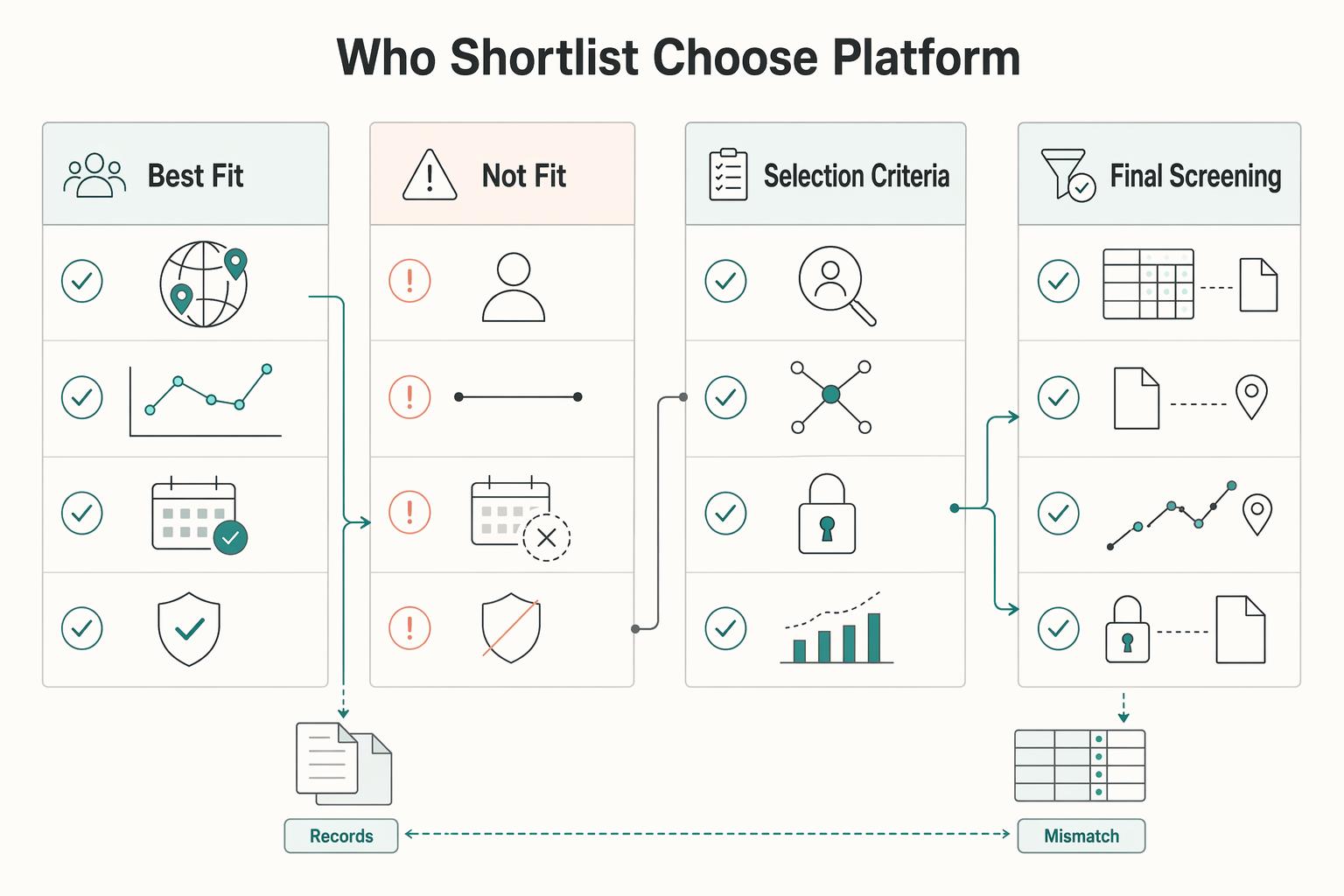
Continuous KYC Monitoring for Payment Platforms Beyond One-Time Checks
Treat this as a control design decision first and a software purchase second. One-time onboarding checks can miss risk changes after approval. When you compare continuous KYC monitoring platforms, the real test is whether they help you decide when to re-verify, who reviews, and what evidence gets retained.
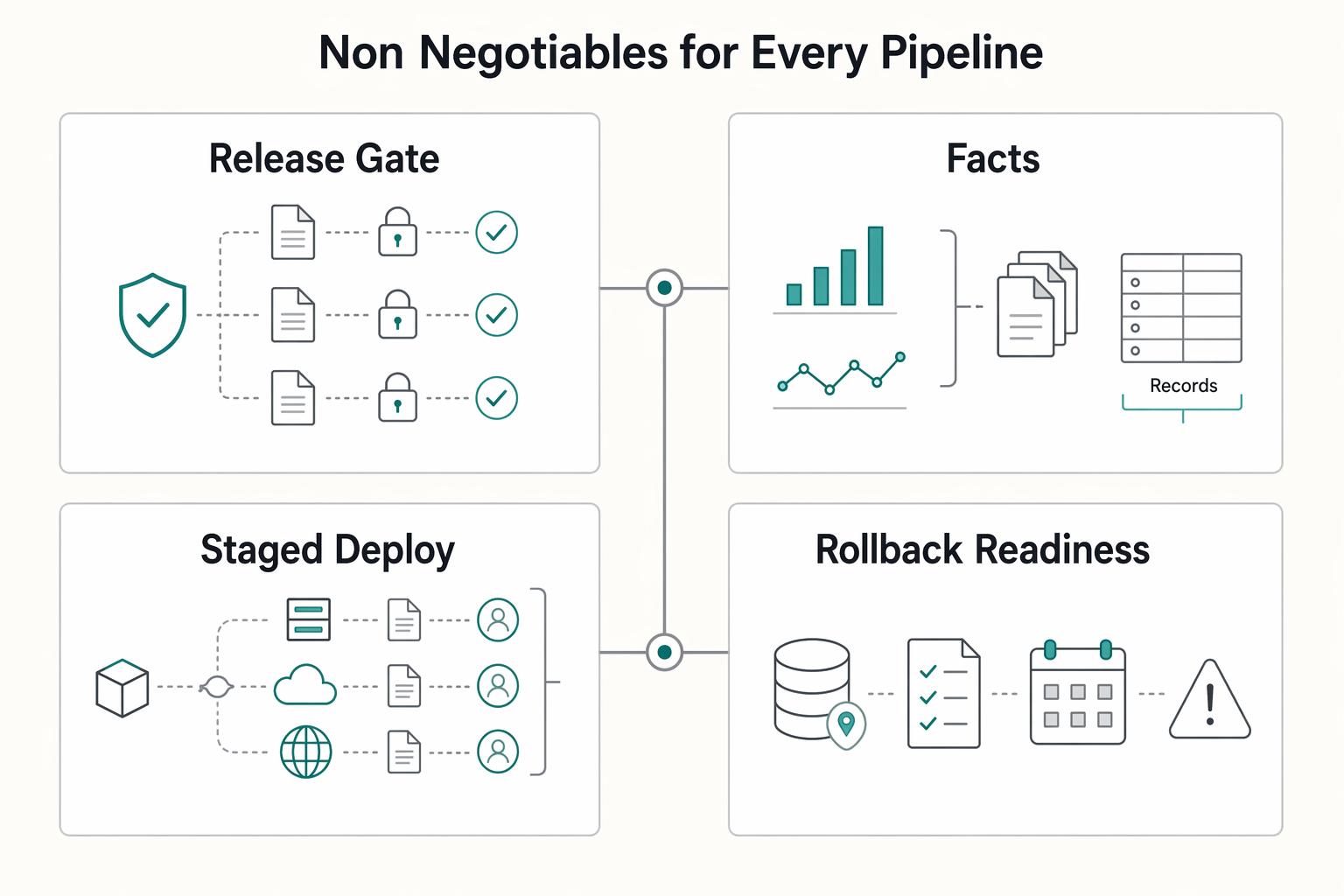
A Guide to Continuous Integration and Continuous Deployment (CI/CD) for SaaS
You are not choosing between speed and safety. You are choosing how much business risk each release can carry. As the CEO of a business-of-one, your release process is part of your risk strategy.
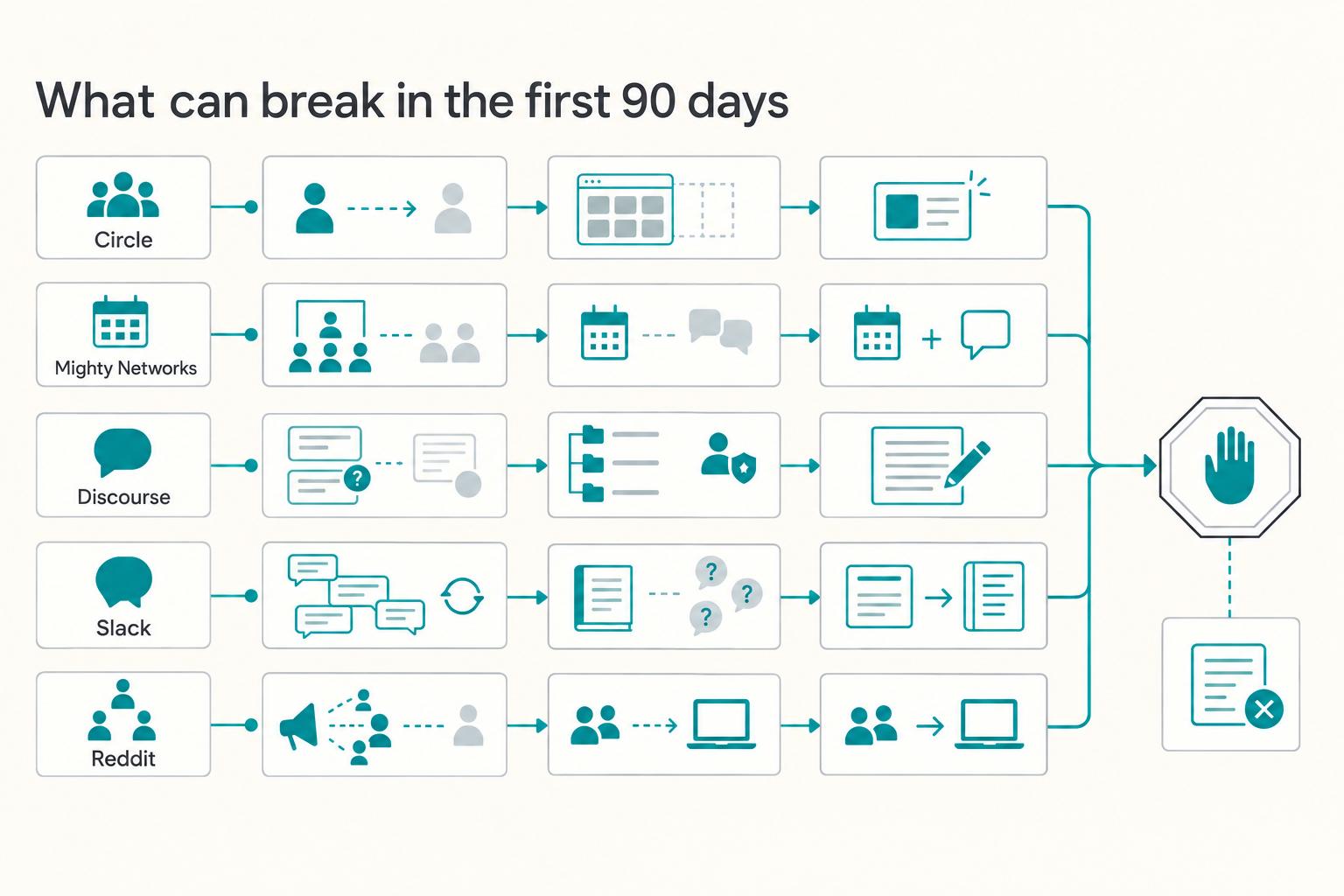
The Best Community Platforms for SaaS Businesses
Start by classifying the job. If you want access to other people's audience, ideas, or conversations, you are choosing a community to join. If you want a place your customers or members use under your brand, with your rules and structure, you are choosing software you will need to operate every week.