
Quick Answer
Choose based on operating fit, not brand buzz: for most teams evaluating the best saas community platforms, Circle, Mighty Networks, and Discourse are shortlist candidates, while Slack and Reddit work better as discovery or short-loop channels. Start with one use case, assign one accountable owner, and validate moderation flow, export path, and day 1/day 7 return signals before scaling.
Classify the job, then verify four things before you commit#
Start by classifying the job. If you want access to other people's audience, ideas, or conversations, you are choosing a community to join. If you want a place your customers or members use under your brand, with your rules and structure, you are choosing software you will need to operate every week.
| Choice | Control | Data position | Moderation responsibility | Knowledge retention risk |
|---|---|---|---|---|
| Join an existing community | Usually lower. The host sets structure and policy. | Often host-defined; your options depend on their account and export terms. | Often led by the host, with limits on what you can enforce yourself. | Can be higher if important answers stay buried in threads you do not organize. |
| Run your own platform | Usually higher, but only if you actively configure and maintain it. | You still need to verify account, export, and access terms before committing. | Yours. You need rules, triage, and someone accountable. | Can be lower if you turn repeated answers into organized, findable content. |
Keep the shortlist tight. In one reviewer's 2026 shortlist (30 apps tested, 7 reviewed), Circle is presented as strong for community organization and membership management, with reported annual pricing of $89 to $199 per month. Mighty Networks is presented as engagement-oriented, with participation mechanics like polls, quizzes, icebreakers, events, and streaks, and reported annual pricing of $79 to $354 per month. If Discourse is on your shortlist, treat it as a verify-first option: confirm its pricing, moderation controls, and export capabilities directly with the vendor before committing.
Owning the platform means taking on real operator work. You still have to structure spaces, approve access, seed prompts, moderate edge cases, host events, and turn recurring questions into findable posts. If you cannot name who will do that every week, do not buy based on brand polish alone. Before you commit, verify four things:
- Plan fit: does the plan support threaded discussions, gated content, and live events?
- Export path: what can you actually take out, and in what format?
- Integration fit: confirm your must-have connections with your exact setup.
- Moderation controls: test how you will handle spam, disputes, and member access changes.
Next, this playbook gives you three things: a scorecard you can use, shortlist logic for Circle, Mighty Networks, and Discourse, and launch safeguards so you can validate a small real use case before you scale. For a step-by-step walkthrough, see The Best CRMs for a B2B SaaS Sales Team.
Who is this list for and what selection criteria actually matter#
Use this list if you are building an owned customer space you will run every week, not just joining conversations elsewhere. If you mainly need market signal, peer advice, or audience access, join communities first. If you need structured customer workflows and long-term control, evaluate a dedicated community platform.
Use this gate before you compare tools: social platforms can be useful for reach, but they do not have the same dedicated focus as a community platform. In the cited 2026 Community Trends Report context, 39% of builders are de-prioritizing growth for quality, and 67% of members say shared identity or values drive why they join or stay. That makes operator fit more important than feature hype, especially when members are already overloaded with content and ads.
Score Circle, Mighty Networks, and Discourse with a simple operator-first sheet:
| Criterion | Weight | Must-pass | What to verify in practice |
|---|---|---|---|
| Ownership and control | 30% | Yes | Can you set access, structure, and policy the way you need? |
| Moderation handling | 25% | Yes | Can you reliably triage spam, disputes, and access changes? |
| Integrations | 20% | Usually | Do your required workflows connect with your current stack? |
| Admin load | 15% | Yes | Can your team sustain the weekly operating work? |
| Migration readiness | 10% | Yes | What can you export, and what would be hard to recreate? |
Then run a low-regret shortlist pass:
| Platform | Ownership and control | Moderation handling | Integrations | Admin load | Migration readiness |
|---|---|---|---|---|---|
| Circle | Verify in pilot | Verify in pilot | Verify required workflows | Estimate weekly effort | Verify export path |
| Mighty Networks | Verify in pilot | Verify in pilot | Verify required workflows | Estimate weekly effort | Verify export path |
| Discourse | Verify in pilot | Verify in pilot | Verify required workflows | Estimate weekly effort | Verify export path |
Pick one primary option only after a small pilot with one real use case and one accountable owner. Keep one backup option, but do not operate two platforms in parallel during validation. If useful, pair this with The best merchandise (merch) platforms for creators.
Are you choosing a platform to build on or a community to join?#
Choose the path by job: if you need market signal, join or borrow; if you need repeatable customer workflows, build on an owned platform. With 39% of builders focusing more on quality and 67% of members joining or staying for shared identity or values, your first decision is where your next community task should run, not which tool has the loudest feature list.
| Path | Best first use case | Control | Data portability check | Moderation burden | Knowledge durability |
|---|---|---|---|---|---|
| Join existing communities | Learn recurring problems and language fast so you do not waste time reinventing the wheel | Low | Treat the space as external; keep your own notes of insights you want to retain | Low as a participant | Useful for discovery, but weak as your long-term operating reference unless you document takeaways |
| Use borrowed channels | Test messaging and run short feedback loops | Medium-low | Decide what discussions, FAQs, and patterns you will copy into your own docs on a schedule | Medium if you host, with exposure to outside norms | Fast-moving threads can bury useful answers unless you curate them |
| Build an owned platform | Run structured support, education, or member access under your brand | High | Verify export options and identify what would be painful to rebuild before committing | High, because you own active monitoring and reputation risk | Better fit when you need organized threads, gated content, and live events in one place |
Use this decision gate before you commit:
- Pick one primary objective. Name the first job: discovery, support, education, or advocacy.
- Assign one role per channel. Join to learn, borrow to test, own to run structured workflows.
- Define the transition trigger. Write down when borrowed-space activity should move into your owned community (for example, repeated questions, gated resources, or live events needing a stable home).
Before you commit, run one anti-mismatch check: document the weekly owner, the moderation workflow, the escalation path for risky conversations, and the exit or migration trigger. Need the full breakdown? Read The Best Payment Gateways for SaaS Businesses.
Which platform wins on your priorities in 2026?#
There is no universal winner in 2026. Pick based on the one priority you cannot compromise on: launch speed, governance control, or long-term knowledge durability.
Use a criteria-first decision, not a feature tour. If speed is your main risk, prioritize time-to-launch. If moderation and policy drift are your main risks, prioritize governance checks. If losing answers over time is your main risk, prioritize durability and future-proofing.
| Platform | Primary fit to test first | Where it breaks | Operational burden | Verify before commit |
|---|---|---|---|---|
| Circle | Candidate if your Circle pilot best matches your top priority | Breaks if your pilot exposes gaps in governance, integrations, or export path | Needs a weekly owner for moderation, onboarding, and upkeep | Test real moderation actions, confirm the integrations you actually use, and request an export sample |
| Mighty Networks | Candidate if your Mighty Networks pilot best matches your top priority | Breaks if your pilot workflow depends on controls or connections that do not hold in practice | Needs a weekly owner for moderation, onboarding, and upkeep | Run one real member journey, verify integration fit, and test what data you can export |
| Discourse | Candidate if your Discourse pilot best matches your top priority | Breaks if setup, governance workflow, or migration path is not sustainable for your team | Needs a weekly owner plus disciplined setup and governance routines | Test category structure, moderation permissions, search behavior, and export/migration steps |
| Slack | Candidate for shortlist if you are testing fast feedback loops | Breaks if you cannot consistently move key answers into a durable system | Needs ongoing cleanup, summarization, and ownership of follow-through | Verify retention expectations, integration needs, and who owns weekly curation |
| Candidate for shortlist if you are testing public discovery and conversation | Breaks if your operating model requires tighter control than the channel allows | Needs active monitoring and clear boundaries for brand participation | Define risk-escalation rules, decide what to document, and set triggers to move users into an owned space |
Before you buy or migrate, run this pre-commit check:
- Shortlist two candidates. One should match your top priority, and one should be your control-oriented fallback.
- Score both with the same criteria. Use launch speed, governance, integration fit, export path, and planning for scale. Poor integration fit can create data silos.
- Run a real pilot workflow. Import sample content, test one moderation scenario, run one onboarding path, and validate an export/backup.
- Choose the option you can run every week. If scores are close, pick the one with acceptable control and sustainable admin effort.
A platform you can govern consistently is better than one that only looks good in a demo. Related reading: The Best Platforms for Self-Publishing Your Book.
The best SaaS community platforms for different operating models#
Pick the platform that matches how you operate now, then define the point where you will outgrow it. If you skip that handoff rule, you usually get either an attractive space nobody runs or a busy channel where useful answers disappear.
Use this dividing line first: social networks can host community activity, but they are less focused than purpose-built community platforms. That matters when you need repeatable onboarding, support workflows, and durable knowledge, not just reach. It also aligns with the 2026 quality-over-quantity shift: Circle's comparison article (updated Feb 20, 2026) cites 39% of builders deprioritizing member growth in favor of quality.
| Platform | Best-fit operating model | Weekly operational load | Data and control posture | Migration question to answer first |
|---|---|---|---|---|
| Circle | You want an owned, branded member space with discussions, events, and content in one place | Moderate with a named owner for onboarding, moderation, and content hygiene | Owned-platform posture; verify exports, roles, and integrations for your exact setup. Confirm current plan and capability details with the vendor. | Can you export real member and content data cleanly if your structure changes? |
| Mighty Networks | You run a program-led model where community, events, and education are bundled | Moderate to high when community and programming run together | Owned-platform posture; validate admin controls, reporting, and data access. Confirm current plan and capability details with the vendor. | If your use case shifts toward support-heavy discussion, how much rework is required? |
| Discourse | You prioritize structured discussion and long-lived, searchable knowledge | Moderate to high during setup if you want clear taxonomy and governance | Control-oriented posture; still verify hosting, exports, and permission handling in your environment. Confirm current plan and capability details with the vendor. | If your category design is wrong, how difficult is structure cleanup or migration? |
| Slack | You need a fast pilot channel for live feedback and short-cycle collaboration | Ongoing cleanup load if nobody owns summaries and handoffs | Broad chat channel posture; verify retention, admin controls, and integrations for your case. Confirm current plan and capability details with the vendor. | What will you move out of chat each week so answers stay reusable? |
| You need public discovery and low-friction conversation before owned buildout | Ongoing monitoring load if you participate actively | Broad social channel posture; verify moderation approach and data portability expectations. Confirm current plan and capability details with the vendor. | What triggers moving recurring threads and interested members into your owned destination? |
Use the table against your current motion, not your aspirational one. If most value comes from public discovery, start there. If value comes from repeat support questions, move sooner to an owned platform. If chat is burying repeat answers, prioritize structure.
Your shortlist by operating model#
| Platform | Use when | Do not use when | Handoff rule |
|---|---|---|---|
| Circle | You need a branded home for members, discussions, events, and content with a faster path to launch | Deep governance requirements are your deciding factor and you have not verified exports, moderation actions, and integration fit | Move here from Slack or Reddit once recurring questions need a durable owned destination |
| Mighty Networks | Your model is program-led and community is tied to courses, events, or ongoing education | Your core need is lightweight support discussion and added surfaces create admin drag | Adopt after you confirm your member journey needs more than a simple discussion space |
| Discourse | Your priority is durable knowledge, searchable answers, and structured peer support | You want the fastest visual launch but are not ready to define categories, permissions, and moderation rules | Move here once your community is generating repeatable knowledge you need to preserve |
| Slack | You need speed for a beta cohort, advisory group, or rapid feedback loop | Do not use as your only long-term home when important answers must stay findable | Graduate to an owned platform when weekly summaries become a recurring operational burden |
| You need discovery, message testing, and public conversation before investing in owned infrastructure | You need tight control over member experience, policies, or knowledge organization | Move interested members into your owned space once recurring topics and moderation boundaries are clear |
If you prefer the same shortlist in plain language:
- Circle - Choose it when you need a branded home for members, discussions, events, and content with a faster path to launch. Skip it when deep governance requirements are your deciding factor and you have not verified exports, moderation actions, and integration fit. Move here from Slack or Reddit once recurring questions need a durable owned destination.
- Mighty Networks - Choose it when your model is program-led and community is tied to courses, events, or ongoing education. Skip it when your core need is lightweight support discussion and added surfaces create admin drag. Adopt it after you confirm your member journey needs more than a simple discussion space.
- Discourse - Choose it when your priority is durable knowledge, searchable answers, and structured peer support. Skip it when you want the fastest visual launch but are not ready to define categories, permissions, and moderation rules. Move here once your community is generating repeatable knowledge you need to preserve.
- Slack - Use it when you need speed for a beta cohort, advisory group, or rapid feedback loop. Do not use it as your only long-term home when important answers must stay findable. Graduate to an owned platform when weekly summaries become a recurring operational burden.
- Reddit - Use it when you need discovery, message testing, and public conversation before investing in owned infrastructure. Do not use it when you need tight control over member experience, policies, or knowledge organization. Move interested members into your owned space once recurring topics and moderation boundaries are clear.
A staged progression that holds up in practice#
A progression that usually holds up is discovery channel to short pilot to owned platform. It works when one person owns the handoffs and the operating checklist.
Before each move, document three things: recurring questions, moderation rules you actually enforce, and one export or archive sample from the channel you are leaving. Without that discipline, activity can look healthy while members are still "drowning in content and ads" in broad digital channels. If the same questions repeat each week, assign the owner, pick the destination, and start moving answers into the system you plan to keep. If you want a deeper dive, read The Best Digital Nomad Communities to Join.
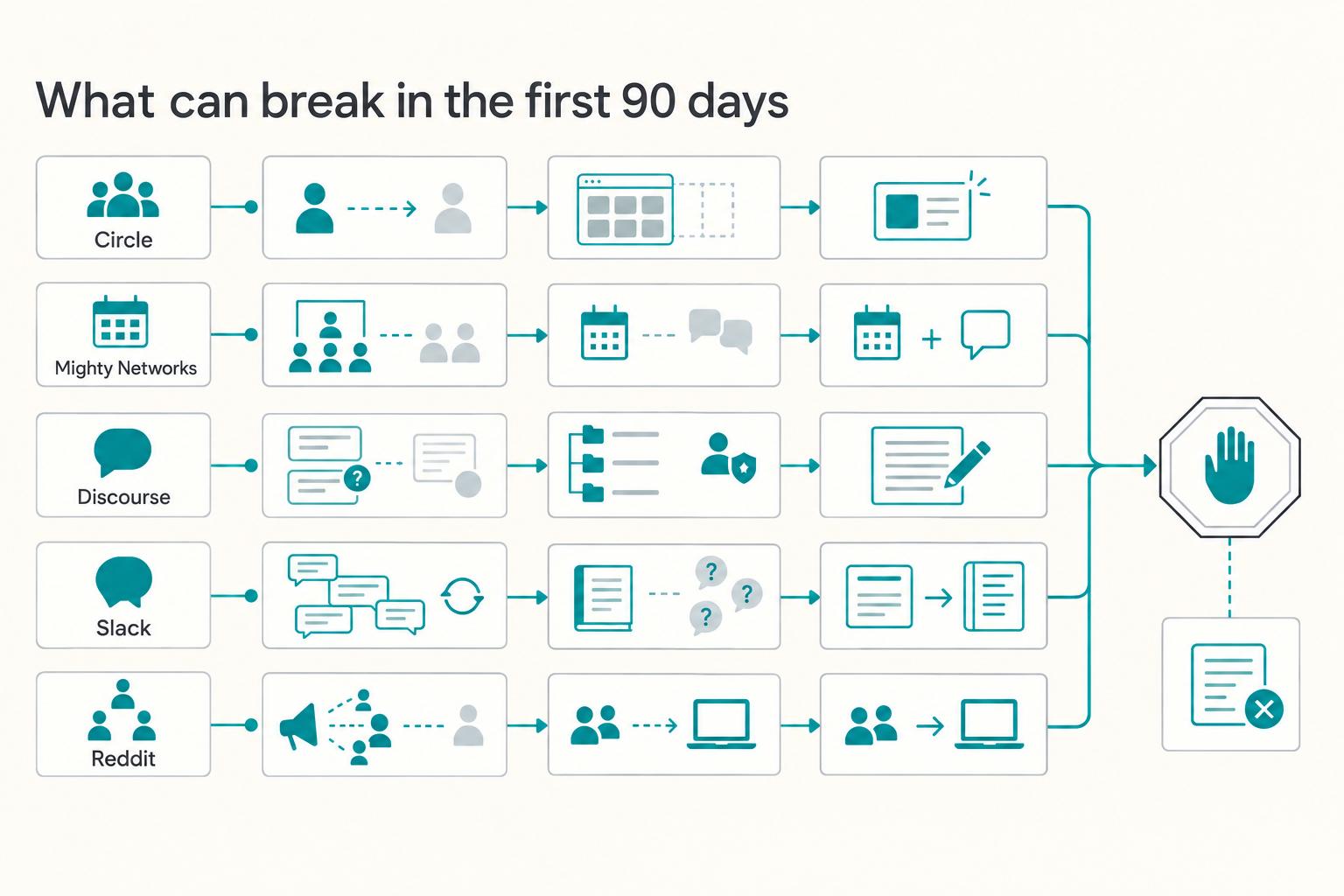
What can break in the first 90 days and how do you prevent it?#
You do not lose the first 90 days because of a platform logo. You lose them when your operating model is unclear: no clear owner, inconsistent rules, weak follow-through from conversation to retention, and no durable home for repeat answers.
In this window, your job is to prove an activation, retention, and monetization loop, not to optimize vanity metrics. If you cannot see what happens at day 1 and day 7, or what converts in week 0-30, you are flying blind.
| Platform | Failure signal | Root cause | Preventive control (if this happens, do this) | Owner |
|---|---|---|---|---|
| Circle | Members join, browse, and do not return by day 7 | Too many surfaces launched at once; no single "next action" | If day 7 return is weak, reduce to one primary action (for example: post or attend), then review day 1/day 7 cohorts weekly | Community owner |
| Mighty Networks | Events run, but discussion drops between sessions | Program delivery exists, but no ongoing member habit | If engagement collapses between events, tie each event/course touchpoint to one repeat in-platform action and weekly follow-up | Program owner |
| Discourse | Threads are miscategorized or unanswered | Category design and moderation workflow were not set early | If posts drift or stall, freeze categories, publish posting rules, and run daily unanswered-thread triage | Forum admin |
| Slack | High message volume, same questions answered repeatedly | Chat is acting as your knowledge base | If repeat questions appear every week, convert answers into canonical posts in your owned destination on a fixed weekly cadence | Support or community lead |
| Reach increases, but few people move into your product or owned space | Distribution is being treated as retention | If replies rise but conversion does not, keep Reddit as a top-of-funnel channel in week 0-30 and track the next-step conversion explicitly | Founder or growth owner |
The operating framework to set before launch#
Keep it small and enforceable from day one: a named owner, clear rules, an escalation path, and an enforcement workflow.
- If a post breaks a rule, remove or lock it, log the action, and point to the specific rule.
- If a member disputes moderation, escalate to the named owner and resolve through one consistent path.
- If moderators enforce the same rule in conflicting ways, pause and rewrite the rule before scaling activity.
Knowledge retention and migration triggers you can run#
Use operational triggers, not gut feel.
- If discovery is your primary goal, own one channel in week 0-30 and track conversion.
- If onboarding/support is your primary goal, review day 1/day 7 retention and whether members can find answers without re-asking.
- If repeat questions carry real onboarding or product value, move those answers into your durable destination immediately.
Before any migration decision, keep a cutover sheet for the current export path, member data scope, and redirect or invite process; mark each item pending vendor verification until confirmed.
If you are evaluating managed migration help, treat timeline and support claims as plan-specific and verify directly before committing.
A practical decision sequence for weeks 1-12#
| Time | Primary step | Follow-up |
|---|---|---|
| Week 1 | Name one accountable owner | Publish rules, define escalation, and set one primary member action |
| Week 2 | Check day 1/day 7 retention and channel conversion | If measurement is weak, fix measurement before adding programming |
| Week 3 | Turn repeated questions into canonical resources | Stop using raw signup volume as your success metric |
| Week 4 | Confirm you still own one main channel for week 0-30 | Cut parallel channel sprawl |
| Weeks 5-12 | Run weekly moderation review, unanswered-thread triage, and content cleanup | So by day 90 your system is consistent and trusted |
Related: How to Price Webflow Development Services.
How do you avoid switching platforms later?#
You avoid switching later by choosing your operating model first, then choosing software that fits it. Lock-in is common, and the expensive part is usually the migration once data movement becomes difficult or costly.
Use a pre-commit sequence before launch, then scale only after your first workflow is stable. In 2026, this matters more because app sprawl raises risk and operating overhead, and manual control methods alone are often not enough.
Make four decisions before you buy anything#
| Decision | What to define | Evidence or check |
|---|---|---|
| Choose one primary use case | Decide the first job your space must do: onboarding, support, peer discussion, or programs | Assign one owner and a small checkpoint set so weak moderation, taxonomy, or handoffs show up early |
| Write data ownership and export rules | Define what must be exportable, who can run exports, where files live, and how you would re-invite members if you had to move | Keep one export sample and a live content inventory so control is proven, not assumed |
| Verify migration support on your actual plan | Confirm current migration or onboarding help in writing for the specific plan you will buy | Do not assume support is included across tiers |
| Cap ongoing admin effort | Set a weekly ceiling for moderation, unanswered-thread triage, and content cleanup | Add an always-on visibility checkpoint so you can catch drift before it becomes expensive |
- Choose one primary use case
Decide the first job your space must do: onboarding, support, peer discussion, or programs. Assign one owner and a small checkpoint set so weak moderation, taxonomy, or handoffs show up early.
- Write data ownership and export rules
Define what must be exportable, who can run exports, where files live, and how you would re-invite members if you had to move. Keep one export sample and a live content inventory so control is proven, not assumed.
- Verify migration support on your actual plan
Confirm current migration or onboarding help in writing for the specific plan you will buy. Do not assume support is included across tiers.
- Cap ongoing admin effort
Set a weekly ceiling for moderation, unanswered-thread triage, and content cleanup. Add an always-on visibility checkpoint so you can catch drift before it becomes expensive.
| Platform | Exportability control | Migration-help control | Knowledge durability control | Operational-load control |
|---|---|---|---|---|
| Circle | Verify current export path and member-data scope before launch | Confirm current support scope by plan, in writing | Keep critical answers in searchable canonical posts | Enforce a weekly moderation and triage cap |
| Mighty Networks | Verify current export path and asset scope before launch | Confirm current support scope by plan, in writing | Keep program outcomes and key answers documented in searchable posts | Enforce a weekly moderation and triage cap |
| Discourse | Verify current backup/export method before launch | Confirm current support scope by plan, in writing | Keep accepted answers and core guidance easy to find | Enforce a weekly moderation and triage cap |
| Slack | Verify current history limits with the vendor; test your export path | Verify current migration support; do not assume coverage | Treat chat as intake, then move durable answers to an owned searchable space | Watch cleanup load as repeated questions increase |
| Verify what you can retain and reuse before relying on it | Verify current migration support; do not assume coverage | Treat as discovery, then move critical answers to an owned searchable space | Track ownership risk separately from engagement volume |
Expand only when your first workflow passes quality and handoff checks. If support replies are accurate, converted into canonical posts, and reviewed weekly, then add new motions; if not, fix operations first.
A common pattern is starting in Slack for fast feedback, then seeing the same onboarding questions repeat. That repeat pattern is your trigger to move critical answers into your owned, searchable system before you add more complexity. If your first use case is support, align this with the support stack you can actually maintain.
Choose the platform you can run consistently, not the one with the loudest hype#
Choose the platform your team can run every week with clear ownership, moderation, and retention habits. Let brand preference come second.
Use a scorecard first, then a pilot. A Dec 22, 2025 comparison scored platforms across usability, customization, monetization, engagement, scalability, content control, integration, and security (scores out of 10). Treat those numbers as directional, not audited proof.
| Finalist | Directional score | Operational fit to test | Admin burden signal | Lock-in risk check |
|---|---|---|---|---|
| Circle | 8.1 | Fit if your priority set favors faster usability and monetization signals in your scorecard | Ease-of-handling must be validated in your pilot | Confirm export and restore limits with the vendor before your pilot tests the path |
| Mighty Networks | 8.1 | Fit if your priority set favors monetization and engagement signals in your scorecard | Ease-of-handling must be validated in your pilot | Confirm member/content export and re-invite limits with the vendor before your pilot tests the path |
| Discourse | 7.3 | Fit if your priority set favors customization, scalability, and content-control signals in your scorecard | Ease-of-handling must be validated in your pilot | Confirm export and restore assumptions with the vendor before your pilot tests the runbook |
- Selection method
Score the same three finalists with the same criteria and written weights, then note unknowns explicitly.
- Pilot scope
Run one use case with one owner and two return checks (day 1 and day 7) so you can judge workflow reality, not demo quality.
- Governance readiness
Set one moderation policy, one escalation owner, and one weekly review cadence before member volume rises.
- Knowledge retention
Keep one export sample, one content inventory, and one canonical-answer workflow; mark time-sensitive platform limits as pending vendor verification until confirmed.
- Decision trigger
Go only if all five controls pass; pause if any core check is still unverified (export method, owner accountability, first member path, or canonical answer flow).
A practical end state is simple: you run onboarding in your owned space, keep broad discovery chatter elsewhere, and scale only when repeat questions are becoming reusable posts and moderation stays predictable. Start now by opening a one-page decision doc, adding these five rows, scoring your three finalists, and marking every unknown as "verify before launch," then align it with your ops stack in The Best Log Management Tools for SaaS Businesses and any program-specific coverage checks in Talk to Gruv.
Frequently Asked Questions
What is the difference between a community platform and a community you join?
A community platform is software you run to manage community functions. A community you join, like a subreddit or founder network, is someone else’s space and rules. If your decision is about ownership and operating responsibility, you are choosing software you run, not just a network you participate in.
Should you start with your own platform or use Reddit or Slack first?
Use existing social or chat spaces first when you want lightweight discovery or early feedback. Move to your own platform when you need a more dedicated community focus and clearer operational ownership. For Slack history or retention, treat current limits as pending vendor verification before relying on any specific cutoff.
What matters most when you compare the best saas community platforms?
Start with four checks: ownership, moderation effort, admin time, and export readiness. Then match the platform to one primary job such as onboarding, support, peer discussion, or programs. There is no verified universal winner for every SaaS business, so compare options against your specific use case.
When should you choose Circle?
Choose Circle only after validating that its current plans support your primary use case. Exact pricing, plan tiers, feature gating, and migration/export scope by plan are decision-critical items to confirm directly before purchase.
When should you choose Mighty Networks?
Choose Mighty Networks only after confirming that its current setup matches your core use case. Exact pricing, plan tiers, feature gating, and migration/export scope by plan are open items to verify before committing.
When should you choose Discourse?
Choose Discourse only after validating it against your primary job and operating model. Exact plan-level limits and platform-specific moderation workflow differences are details to confirm directly before making a long-term decision.
How do you know when a platform is no longer the right fit?
Look for operational signals, not vanity activity. If the same questions repeat without becoming canonical posts, moderators are handling issues ad hoc, or exports are untested, your setup is drifting. That does not always mean you must switch, but it does mean you should pause expansion until handoffs and documentation are working.
What should be on your pre-launch checklist?
Write down one use case, one owner, one moderation policy, and one success check such as day 1 and day 7 return behavior. Keep one export sample, a member re-invite method, and a content inventory from day one. The failure mode is simple: if key decisions live in chat threads and not in documents, your launch will feel easier than it really is.
How do you avoid switching platforms later?
Document every handoff early: who answers a question, when it becomes a permanent post, and who reviews unanswered threads each week. Verify migration help only on the plan name you expect to buy, and treat current support scope as pending vendor verification until you have it in writing. If your community supports onboarding or support, connect that handoff to the tools you already run, such as your support stack, instead of inventing parallel processes.
Do you need a big feature set before launch?
Usually no. A smaller setup with clear ownership beats a larger one with fuzzy moderation and no export proof. If your first member path works cleanly and your weekly admin ceiling holds, then add events, courses, or extra spaces after that.
Try a related tool
Researched and edited by the Gruv editorial team. Gruv builds cross-border billing, payouts, and finance-operations software for global businesses.
Sources
Includes 7 external sources outside the trusted-domain allowlist.
- snap.berkeley.edu/project/10053261trusted
- adlabz.co/leading-examples-of-best-saas-faq-pagesexternal
- adtools.org/buyers-guide/circle-vs-mighty-networks-vs-sk...external
- almcorp.com/blog/best-saas-websitesexternal
- bettercloud.com/monitor/best-practices-for-saas-managementexternal
- circle.so/blog/best-community-platformsexternal
- croclub.com/career/best-saas-communitiesexternal
- dansiepen.io/growth-checklists/saas-community-building-st...external
Educational content only. Not legal, tax, or financial advice.
Related Posts

LinkedIn for Freelancers Who Want a Predictable Client Pipeline
Treat LinkedIn as two jobs you run at the same time: a credibility check and a conversation engine. If you only chase attention, you can get noise. If you only send messages, prospects may click through to a thin profile and hesitate.
The Best Digital Nomad Communities to Join
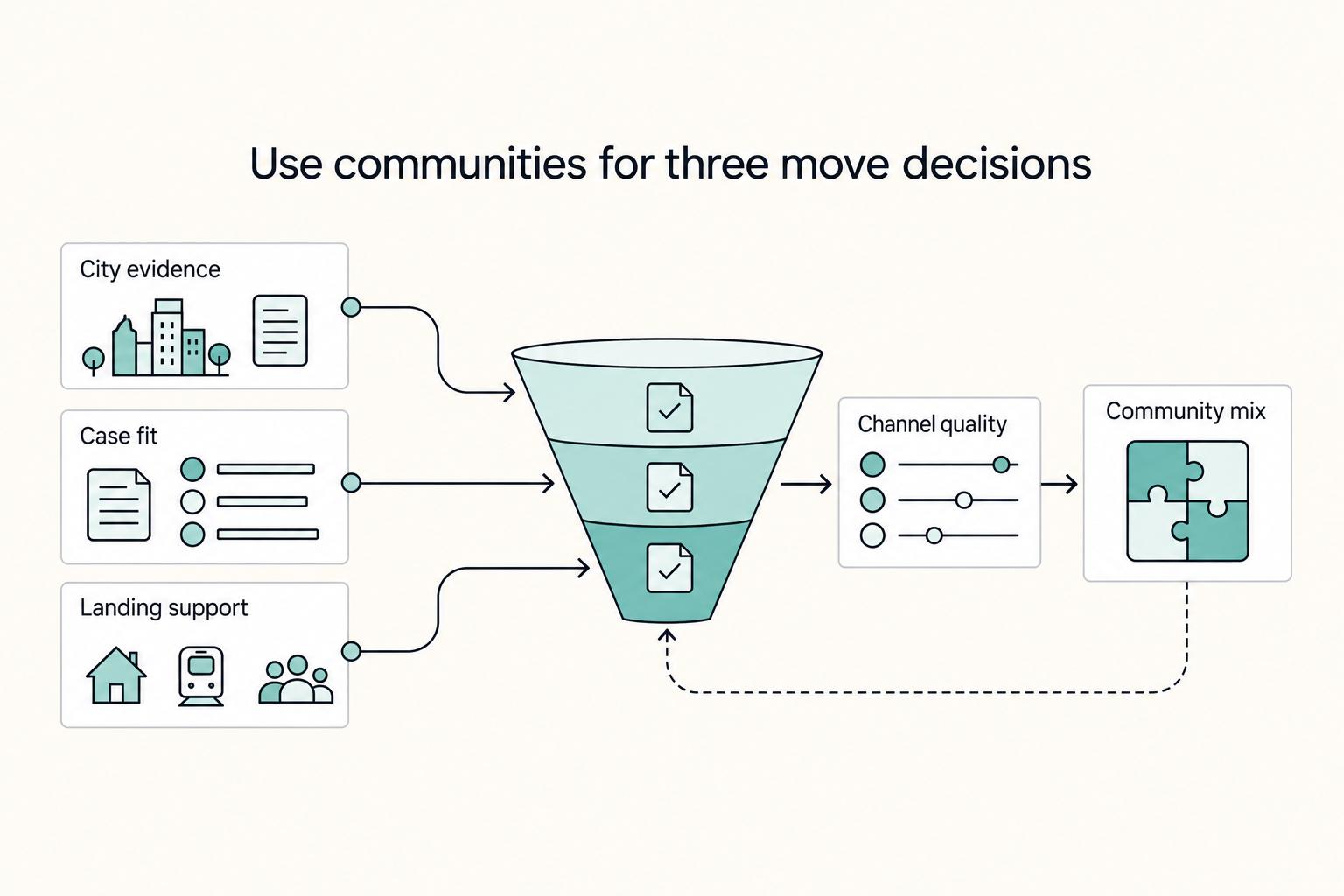
If your move date is real, use communities to answer three decisions in order: which city stays on your list, whether your case actually fits, and whether your landing week is covered. Judge every channel by outcomes, not activity. If it does not give you evidence you can use, stop giving it time.

How to Price Webflow Development Services
If you want to price Webflow development without leaking margin, treat pricing as an operating model, not a number you pull from memory. Separate platform costs from service work so the client can see what they are buying.