

Quick Answer
Use risk-based source of funds checks payout accounts when post-onboarding behavior no longer matches the declared profile. Start with a baseline pre-payout gate, then run event-triggered reviews for beneficiary changes, velocity spikes, and pattern anomalies. Keep evidence standards explicit, apply clear approve/hold/escalate outcomes, and document why each decision was made. If funds still cannot be reasonably explained after a focused follow-up, move the case to restricted status and senior review rather than extending open-ended requests.
A one-time KYC check may not be enough for higher-risk payout accounts#
A one-time KYC check may not be enough for higher-risk payout accounts. Risk can change after onboarding as transaction behavior shifts and customer risk profiles change.
This article ranks practical Source of Funds, or SoF, controls. The goal is to help you make consistent decisions about when to request evidence, what is sufficient, and when to escalate, without pushing every payout into manual review.
SoF is the origin of money or financial assets in a specific transaction context. That is narrower than Source of Wealth, or SoW, which looks at how someone acquired overall wealth. In payout operations, that distinction matters. When account activity turns unusual, you often need to explain the funds behind that activity first. Widen the review only if the risk justifies it.
A workable baseline is to treat SoF as part of KYC and CDD, then pair it with transaction monitoring and risk-based follow-up reviews instead of relying on onboarding alone. Firms are generally expected to use multiple controls, and whether a SoF check is needed is risk-based and shaped by customer profile and regulator guidance. In practice, that means avoiding both extremes: collecting the deepest evidence from everyone on day one, or assuming an approved account stays low risk.
The ranked list that follows is organized around three operator questions that determine whether you review, what you request, and how much friction is justified:
- When should a payout trigger review?
Use clear behavior-based triggers, such as transaction activity that no longer matches the customer profile or declared source.
- What evidence is enough to explain the funds?
A useful SoF review checks whether transactions can be reasonably explained. Typical evidence includes bank statements showing relevant funds plus documents supporting origin. For employment-based funds, this can include salary-visible statements with an employment contract or payslips.
- How much friction is justified for the risk?
Evidence depth should scale. Self-declarations may be enough for lower-risk or smaller activity, while higher-risk or larger activity usually needs documentary proof. Overbroad, repetitive document requests add avoidable delay for users who expect fast onboarding and payouts.
Define your minimum evidence standard before expanding triggers. If reviewers do not share a clear threshold for acceptable proof, decisions become inconsistent and audit records weaken. A basic checkpoint is whether the stated source aligns with visible transaction activity and whether the reviewer documented the reasoning in the client record.
The goal is targeted control, not blanket friction: use risk-based checks, clear evidence standards, and explicit escalation when fund origin cannot be reasonably explained.
Debit-card push payouts create a different evidence trail; Debit Card Push Payouts can be useful when SoF checks lead to payout-route decisions.
How to use this list and pick the right control depth#
This ranking is most useful when you own live go, pause, or escalate decisions for higher-risk payout accounts. It is built for controls that need to hold up in AML compliance and payout operations.
- Use it for operator-owned decisions
This list is for compliance, legal, finance, and risk owners making live payout decisions. Judge each control by whether it gives reviewers a clear action in a real case, not just a policy statement.
- Skip it for generic KYC content work
SoF sits inside KYC, CDD, and AML operations, but this framework is for transaction-level decisioning. If your scope is only onboarding copy, you are not testing the core question: whether incoming transactions can be reasonably explained and documented.
- Score each control on four criteria
Rank controls by risk reduction, payout speed impact, implementation complexity, and audit defensibility. Favor controls that improve evidence quality without forcing broad manual review on every payout.
Before choosing control depth, confirm the control can produce a reviewable evidence artifact, such as bank statements showing relevant credits plus supporting origin documents. For employment-based funds, that can include salary-visible statements with an employment contract or payslips.
Do not mix up SoF and SoW in early review steps. For lower-risk or smaller transactions, lighter evidence can be enough; for larger or higher-risk amounts, use documentary evidence and widen scope only when the risk profile or regulator expectations justify it.
Related: Payee Verification at Scale: How Platforms Validate Bank Accounts Before Sending Mass Payouts.
Compare the top SoF controls before you implement#
Do not implement a SoF control until each trigger has a fixed evidence pack, a named owner, a default payout action (approve, hold, or escalate), and a retained audit artifact. If those pieces are undefined, reviews drift and later decisions become hard to defend. These controls are internal design choices, not legal requirements stated in IRS IRM 4.26.9, Treasury payment-mechanism guidance, or 12 CFR Part 229.
| Control | Trigger event | Evidence pack (set internally) | Owner | SLA target | Payout action | Audit artifact |
|---|---|---|---|---|---|---|
| Baseline pre-payout SoF gate | Onboarding process before first payout enablement (if your policy requires it) | Documented evidence request appropriate to customer profile and jurisdiction, with request/receipt tracking | Onboarding compliance or risk ops | Set internally before payout release | Approve, hold, or escalate based on documented review outcome | Case file with trigger, requested vs received evidence, reviewer notes, and transaction-log extract |
| Beneficiary change refresh | Beneficiary or payout destination change (if your policy flags it) | Updated ownership or funding-context evidence defined for change events, linked to prior case records when relevant | Payments risk with compliance review | Set internally for change events | Hold during review; approve, hold, or escalate per policy after review | Account-change log, evidence checklist, decision note, linked change event |
| Velocity spike review | Velocity spike in payout amount or frequency vs prior pattern (if your policy flags it) | Recent supporting records and documented explanation, as defined by internal policy | Risk ops first pass, compliance second pass | Set internally for queued payouts | Approve when explainable; hold for missing evidence; escalate when source remains unclear after follow-up | Alert record, reviewer summary, supporting documents, hold/release decision record |
| Pattern-anomaly escalation | Unusual customer transaction data patterns, including source mismatch or crypto-linked inflows inconsistent with prior behavior | Investigation evidence set defined internally, including movement-history records where applicable | AML investigations or senior compliance queue | Enhanced-review timing defined internally | Escalate when provenance is unclear; hold pending review; approve only when source, movement, and beneficiary are coherently documented | Investigation memo, evidence index, multiple transaction logs, disposition rationale |
What makes this table usable#
A usable control table answers one narrow review question per row and produces a case file someone else can reuse. Keep the first evidence request bounded so analysts do not improvise different document demands for similar cases.
Keep records and conclusions separate. Use the same discipline reflected in IRS IRM 4.26.9 checkpoints for Review of Records and Evidence: keep raw records separate from the reviewer conclusion. These checkpoints are part of an examination structure, not platform-specific SoF rules. A second reviewer should be able to reconstruct why a payout was approved, held, or escalated without a verbal handoff.
Align controls to the rail data you can actually retain. Treasury guidance ties federal EFT mechanisms to 31 CFR Part 208, and direct deposit is described for payments to individuals or businesses. Use that as an operational reminder to verify which logs, timestamps, and beneficiary-change records your stack reliably captures and retains.
Put legal escalation in scope from day one. Mark legal-escalation paths in the table now, especially for cases involving local treatment of crypto records, account-use limits, or document admissibility. Treat regulatory text carefully too. The eCFR page for 12 CFR Part 229 states it is authoritative but unofficial, so use it for operational context. Do not use it as a substitute for jurisdiction-specific legal advice or official text when setting hard rules.
Use Continuous KYC Monitoring for the monitoring layer after initial SoF review. If you are turning this matrix into operations, map each approve/hold/escalate outcome to explicit payout statuses and webhook handling in Gruv Docs.
Best for baseline checks before first payout#
This can be one of the first SoF controls to ship: pair KYC with a minimum SoF gate during onboarding, before first payout is enabled. For high-risk payout accounts, that gives you one bounded review point while evidence is still limited and decisions are easier to control.
Why this ranks first. A baseline pre-payout gate creates a defensible starting point for internal controls. You define one owner, one evidence pack, and one decision path before funds leave the platform, which supports risk reduction and compliance objectives.
It can also make later AML review more consistent. When the initial profile is documented clearly, later checks can compare new activity to that baseline. Without strong KYC and transaction monitoring, detecting structuring is much harder.
Keep the first proof path narrow#
The first request should stay tight and tied to the declared source of funds. For an employment profile, a bounded first pack can be:
- recent bank statements
- an employment contract or similar employment evidence
This is a policy choice, not a universal legal requirement. If the profile is business income, use the business path already defined in your control matrix rather than improvising document requests.
The decision rule that matters#
Set the rule before launch: if the declared source and early funding pattern do not align, keep payout status restricted until review is complete. Treat that as internal risk policy, not an automatic legal trigger in every market.
In a U.S. context, cash activity above $10,000 in a single business day can trigger reporting, and a pattern of sub-$10,000 deposits intended to evade that threshold can be treated as a structuring red flag and a reasonable escalation signal when it conflicts with the declared profile.
Document each case clearly: what was declared, what funding activity appeared, and why the outcome was approve, hold, or escalate. Keep raw records separate from reviewer conclusions so a second reviewer can reconstruct the decision.
Where teams get this wrong. One failure mode is over-collection. A useful baseline gate can turn into a broad document hunt, which slows first payout and adds avoidable friction.
Avoid one-size-fits-all hold settings. A control that reduces fraud in one institution can damage user experience in another, so tune by segment and update as your data and regulatory expectations change. For a step-by-step walkthrough, see Velocity Checks for Payment Platforms: How to Cap Payout Frequency and Amount to Prevent Fraud.
Best for event-triggered checks after account changes#
Event-triggered SoF review starts from specific red flags rather than automatic conclusions. A practical trigger set includes:
- unusual or suspicious identification documents that cannot be readily verified
- reluctance to provide information needed to file a mandatory report
- other program-defined red flags encountered after account changes
These are red flags that may warrant additional scrutiny. A red flag alone is not evidence of money laundering or terrorist financing, so each case still needs review to decide whether activity appears suspicious or lacks a reasonable business or legal purpose.
Why this control tends to age well. Starting from a documented trigger keeps review scope clear and helps preserve a traceable case record.
The order of operations that keeps cases controlled#
Control tends to break down when the sequence is loose. Keep it in this order:
| Step | What to do |
|---|---|
| Detect the trigger | Log the exact red flag that opened the case |
| Review the activity with added scrutiny | Determine whether it appears suspicious or lacks a reasonable business or legal purpose |
| Record the case conclusion | Record the case conclusion with clear reviewer reasoning |
| Check suspicious-activity categories if reporting is needed | Check the appropriate suspicious-activity categories in the SAR information section |
| Include the requested key terms | Include the requested key terms in the SAR narrative text |
What operators should capture every time. Keep the trigger, review notes, reviewer conclusion, and reporting artifacts in one case record. If the matter moves into suspicious activity reporting, capture the selected suspicious-activity categories and include the requested key terms in the narrative text.
Best for evidence standards that reviewers can apply consistently#
If you want reproducible decisions, define a written evidence standard and require reviewers to record which standard they applied. That can reduce subjective outcomes and make escalations easier to review.
Use the standard as an internal decision tool, not as a claim about universal proof rules. Authoritative payout-specific SoF document requirements aren't established here, so your matrix should be treated as policy design that your team owns and maintains.
Build the standard around decisions, not document volume#
Build the standard to answer a case question, not to maximize file collection. Set each row to explain what must be shown, what is enough to decide, and when the case must be escalated. Keep reviewer notes specific enough that another reviewer can follow the same logic from the same record.
| Matrix element | Define it explicitly | Escalate when |
|---|---|---|
| Decision question | What the reviewer must confirm before approval | The question cannot be answered from the evidence on file |
| Minimum sufficient evidence | The smallest evidence set your policy treats as enough to decide | Additional requests still do not resolve the core gap |
| Case notes standard | Exact facts the reviewer must tie together in the record | Notes stay vague (for example, no clear link between identity, amount, and timing) |
Use a maintained lookup structure, then keep it current#
A practical model is the discipline used in coding-based controls. For example, the Foreign Affairs Manual states that Section 4 FAH-1 H-613 is used to code accounting or input documents. The takeaway is structural, not topical: consistent outcomes are more likely with a maintained lookup standard than with reviewer memory alone.
The tradeoff is maintenance. As products, markets, and payout patterns change, update the matrix or you can drift into either rubber-stamp approvals or open-ended document chasing. A simple calibration test helps: run the same anonymized case through two reviewers and check whether they select the same row, apply the same sufficiency logic, and reach the same outcome.
Best for fast escalation when funds cannot be reasonably explained#
When funds still cannot be reasonably explained after a focused follow-up, consider moving the case into a controlled payout status and senior review instead of letting it cycle through open-ended requests.
Why this control can work. Fast escalation can improve decision quality by forcing a clear outcome and a complete review record. It can also reduce drift between reviewers when evidence stays inconsistent.
The tradeoff is operational. If severity levels or queue ownership are unclear, backlog can grow quickly. Define who can restrict payouts, who owns next review, and how aging cases are checked.
What to require in the senior queue#
Do not escalate with only "SoF unclear." The handoff should let the next reviewer decide without restarting the case. One practical internal template is:
| Handoff item | What to include |
|---|---|
| Risk signal | Any mismatch between the declared source and customer transaction data |
| Missing evidence or contradiction | The exact missing evidence or contradiction that blocks release |
| Verification steps already attempted | What was checked and what did not align |
| Current status summary | The current payout status, reviewer, and a date-stamped summary |
Date-stamping matters. FR Y-14Q guidance emphasizes reporting data as of the report date, which is a useful documentation discipline for case files: record what was known at the time of restriction. If policy or regulatory text is cited, note the version date used and re-check currentness. eCFR is authoritative but unofficial and can change.
The rule that stops endless re-review#
Use a fixed internal escalation rule and apply it consistently. For example, after one structured follow-up, if the explanation remains inconsistent, move to restricted payout status and document the rationale.
That is a program design choice, not a universal legal threshold. The point is to stop cases from bouncing across teams without a final owner.
Verification checkpoint and common failure mode. Run this queue with a repeatable checklist and an incident log. The IRS manual's operational pattern, such as a daily checklist plus losses and shortages reporting responsibilities, is a useful model for making exceptions auditable.
A common failure mode is low-quality escalation. If notes do not clearly separate missing evidence from contradictory evidence, the senior reviewer may need to restart the analysis and the queue slows down. Related reading: How Nonprofits Disburse Disaster Relief Funds Through Global Payout Infrastructure.
Best for ongoing monitoring without overbuilding#
Once escalation is defined, the next step is targeted ongoing monitoring, not blanket re-review. For higher-risk accounts, use monitoring to spot drift after approval and send only flagged cases into follow-up review.
Why this is the right-sized control. This is the practical choice when you need persistent coverage but cannot manually review every account all the time. The goal is to detect when a customer's declared profile no longer matches observed activity patterns, then trigger a focused follow-up.
That approach aligns with supervisory practice: ongoing supervision and monitoring are distinct activities, not one-time events. Initial onboarding can be sound while later behavior still changes, so monitoring closes that gap without adding constant friction to routine operations.
Keep the first version small#
Start small. Prove one core monitoring loop before adding more rules, queues, or automation. Use a narrow trigger set tied to meaningful mismatches, then expand only after you trust the signal quality. A practical first loop is:
- detect repeated mismatches between declared profile and observed account patterns
- send only flagged cases to follow-up review
- document the outcome and decision
- use those outcomes to refine rules before broadening scope
If you expand too early, you can increase cost and risk while collecting more data than you need.
What good monitoring records look like#
Treat documentation as part of the control, not an admin afterthought. For each flagged account, keep a date-stamped record of the trigger, observed pattern, declared profile, follow-up requested, response received, and decision.
Avoid vague notes like "unusual activity." The record should let the next reviewer quickly see whether the issue is missing evidence, contradictory evidence, or a pattern change with a reasonable explanation.
Verification checkpoint and red flag. Use documented periodic checkpoints to test whether alerts map to meaningful risk or just account activity variation. Review both escalated and cleared cases.
A clear red flag is rising alert volume without a corresponding rise in meaningful escalations. When that happens, tighten rule scope before expanding coverage. Accounts Payable Automation ROI shows how weak controls turn into cleanup cost.
Best for defending against account takeover linked payout abuse#
This section supports verification of identity and Australian registration evidence in disputed payouts. Do not assume there is a concrete release rule tied to account takeover, Visa, Mastercard, KYC, or AML. A defensible step is to re-check identity and Australian registration evidence before resolving a disputed payout.
| Item | What the article says | What to confirm |
|---|---|---|
| ABN | An ABN is required before GST registration | The ABN when the profile claims Australian business registration |
| Standard GST registration | Requires identity proof, and the ATO issues written notice with the effective registration date | The written GST registration notice and effective date for standard registration |
| Simplified GST registration | Issues an ARN, which is a unique 12-digit identifier | The 12-digit ARN for simplified registration |
| Identity documents | Identity documents that match the registered entity or sole trader | Document mismatch should be treated as a discrepancy to resolve |
The strongest checkpoint here is the registration trail:
- an ABN is required before GST registration
- once GST registration is required, registration must be completed within 21 days
- standard GST registration requires identity proof, and the ATO issues written notice with the effective registration date
- simplified GST registration issues an ARN, which is a unique 12-digit identifier
A practical evidence pack to confirm includes:
- the ABN when the profile claims Australian business registration
- the written GST registration notice and effective date for standard registration
- the 12-digit ARN for simplified registration
- identity documents that match the registered entity or sole trader
Document mismatch should be treated as a discrepancy to resolve. An ARN is not an ABN, and simplified GST registrants cannot issue tax invoices.
When onboarding evidence was clean but later evidence conflicts, resolve the tax and identity mismatch first. An ATO-linked SoF takeover control rule isn't established here. What's provided is a clear verification checkpoint for registration and identity evidence.
For account compromise scenarios, Account Takeover in Payout Platforms maps the fraud pattern behind payee-account hijack risk.
Best for audit-ready reporting and regulator questions#
For high-risk payout accounts, a defensible reporting control is a single case record that links the trigger, evidence received, reviewer decision, and final payout result. Once you decide to hold or release, that record is what lets internal audit, partners, and regulators verify why.
This approach creates a clear evidence chain from review to outcome and supports repeatable AML/KYC controls. The tradeoff is execution discipline: inconsistent logging can quickly weaken reporting quality.
What the case record should show#
A second reviewer should be able to understand the decision without reopening every thread or request. For SoF reviews, record how and where funds for the specific transaction were represented, what proof was requested, what proof was received, and why the payout was approved, held, or escalated.
| Record field | What to capture | Why it matters |
|---|---|---|
| Trigger | The event that initiated review | Shows the check was triggered, not arbitrary |
| Evidence received | Exact proofs received, such as bank statements or pay slips | Shows what the reviewer relied on |
| Reviewer decision | Approve, hold, or escalate, with brief reasoning | Creates a repeatable decision trail |
| Payout result | Released, rejected, or still restricted | Connects the review decision to payout outcome |
The verification detail that matters most. The key checkpoint is rationale, not just file collection. A folder of documents is not enough unless the record also captures the decision-making process, including reasoning and relevant details.
Keep SoF and SoW distinct in the file. SoF covers the origin of money for a specific transaction, while SoW covers how total wealth was built. If review scope shifts from SoF into SoW, state why.
Common failure modes. A common failure mode is a broken evidence chain: missing trigger context, vague reviewer notes, or payout outcomes not tied back to reviewed documents. Another risk is legal-source handling. If a reviewer relies on FederalRegister.gov web text, verify against an official edition before treating it as legally authoritative, because the web rendering is informational and not the official legal edition.
Data handling also matters. Keep enough detail to reconstruct the decision, but avoid uncontrolled copies of customer documents across multiple systems.
Caveat: Jurisdiction-specific thresholds and timelines may vary, and legal requirements are not uniform across programs. Use the case record to show consistent control operation, but do not assume one evidence standard or review deadline applies everywhere.
Ownership evidence is often part of the same risk file; Beneficial Ownership Verification covers UBO rules for B2B payout risk.
Implementation order that avoids stalling payouts#
If you want broader coverage, sequence controls in a strict order: establish record-keeping first, then add a formal time schedule for compliance review and decision ownership, then expand into monitoring and reporting artifacts. That keeps decisions traceable before you widen coverage.
Start with the case record#
Start with one application-style case artifact per review, similar to a notice or application checkpoint, and make record-keeping mandatory from day one. Keep the intake format tight so each case is logged consistently before you add broader detection logic.
Add review timing and owners#
After the case record is stable, add a formal time schedule for compliance review and route triggered cases to a named decision owner. Define explicit outcomes in your own program terms and require each outcome to link back to the same case artifact. The cited excerpts do not define payout-specific action labels or timing, so set those details in your internal policy.
Layer in monitoring and exports last#
Add ongoing monitoring and reporting exports last. Your output should function like a monitoring report: each alert and disposition should map back to the underlying case record so audit and review are traceable. The cited order also states enforcement for non-compliance may be taken against both the owner and operator, which makes clear ownership and records important.
Before tuning rules, re-check regulatory text freshness. The eCFR page states content is authoritative but unofficial and notes recent changes, so version-check rule text before operational updates.
Conclusion and next step#
For payout cases that need deeper review, the defensible finish is simple. Ask for identity and fund-origin evidence. Use transaction monitoring to test whether the explanation still fits account activity, and make the no-proceed outcome explicit when required information is still missing.
That control set has three parts:
- Targeted triggers
Use defined moments to start deeper review, rather than re-collecting maximum evidence in every case.
- Consistent evidence standards
Define SoF as evidence of where the money comes from, for example payslips, savings, or inheritance paperwork, and require reviewers to connect that evidence to the funds under review. Bank statements can be part of the file, but do not treat any single document type as automatically sufficient in every case.
- Clear escalation outcomes
If required information cannot be collected, document and apply a clear cannot-proceed path for the case or business relationship, with complete notes on what was requested and what remained unresolved.
One useful implementation checkpoint comes from another funds-sourcing workflow: when a monthly statement is unavailable, a transaction activity report is used, and it must overlap the last statement. You do not need to copy that rule directly, but you can use a similar continuity test.
One practical next step is to build a compact comparison table and trigger matrix, then pilot them on one payout segment and check whether reviewers reach consistent decisions from the same evidence pack. When your team is ready to validate this SoF framework against real payout corridors and compliance gates, talk with Gruv.
Frequently Asked Questions
What is a source of funds check for a payout account?
A source of funds check asks where the specific money in the transaction or relationship came from. It focuses on the funds tied to the activity under review, rather than a person’s total accumulated wealth. In practice, you are testing whether the evidence reasonably explains the funds tied to the payout activity in the case.
When do platforms need SoF checks beyond onboarding KYC?
Post-onboarding checks can be part of risk-based AML control design, not just an onboarding task. In FINRA’s broker-dealer framework, ongoing customer due diligence and ongoing monitoring include updating customer information on a risk basis and identifying suspicious transactions. That is the core reason SoF review may reappear after onboarding when risk signals change.
What is the difference between Source of Funds and Source of Wealth for payout reviews?
They are different questions and should not be treated as interchangeable. Source of Funds covers the origin of specific money in the activity under review. Source of Wealth covers how a person accumulated total assets and net worth over time.
Which documents are usually acceptable for SoF verification?
There is no universal acceptable-document list in the material behind this section. The safer approach is to request evidence that directly connects the claimed origin to the funds being reviewed. Clear, complete evidence generally speeds review and reduces back-and-forth.
What should happen when the source of funds cannot be verified?
The material behind this section does not define a universal approve/hold/reject sequence when SoF cannot be verified. A practical approach is to treat this as an escalation case and route it through your written process with a clear decision owner and complete case notes. Record what triggered review, what was requested, what was received, and why the funds still could not be reasonably explained.
How can a platform reduce AML risk without delaying every payout?
Use risk-based triggers instead of collecting maximum evidence from every user on every payout. Keep a baseline control set, then apply deeper SoF review when monitoring or profile updates justify it. This helps avoid alert overload, where false positives and redundant alerts slow teams and add user friction.
Do SoF requirements change by market and program?
Requirements can vary by regime and program, but the material behind this section does not provide a full market-by-market map. FINRA’s broker-dealer example is specific: a written AML program, written senior-management approval, and independent testing annually on a calendar-year basis, with a two-year exception for certain firms without customer-account activity. Those points are concrete for that scope, but they are not a universal rule for all payout platforms. Map controls to the jurisdiction, product, and regulated entity actually in scope.
Try a related tool
Researched and edited by the Gruv editorial team. Gruv builds cross-border billing, payouts, and finance-operations software for global businesses.
Sources
- abr.gov.au/business-super-funds-charities/applying-abn/...trusted
- bsaaml.ffiec.gov/manual/Appendices/07trusted
- ecfr.gov/current/title-12/chapter-II/subchapter-A/par...trusted
- fdic.gov/resources/supervision-and-examinations/exami...trusted
- fdic.gov/risk-management-manual-examination-policies/...trusted
- federalreserve.gov/frrs/guidance/interagency-policy-statement-o...trusted
- irs.gov/irm/part4/irm_04-026-009trusted
- irs.gov/irm/part3/irm_03-008-045rtrusted
Educational content only. Not legal, tax, or financial advice.
Related Posts
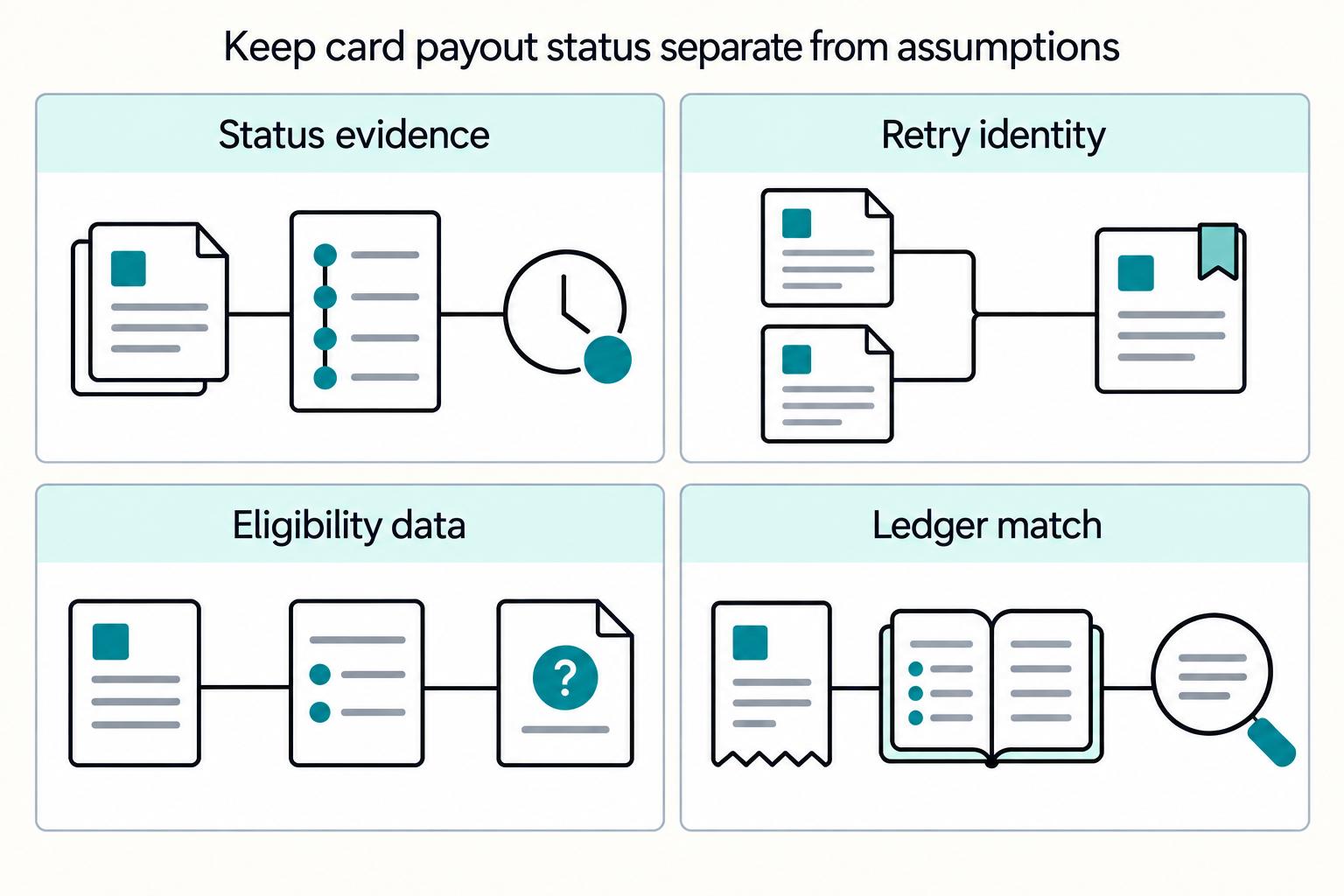
Choosing Visa Direct or Mastercard Send for Debit Card Push Payouts
The core decision is usually not "Visa Direct or Mastercard Send?" in isolation. Start with your recipient card mix, your tolerance for payout exceptions, and how much integration and operational complexity your team can absorb right now.
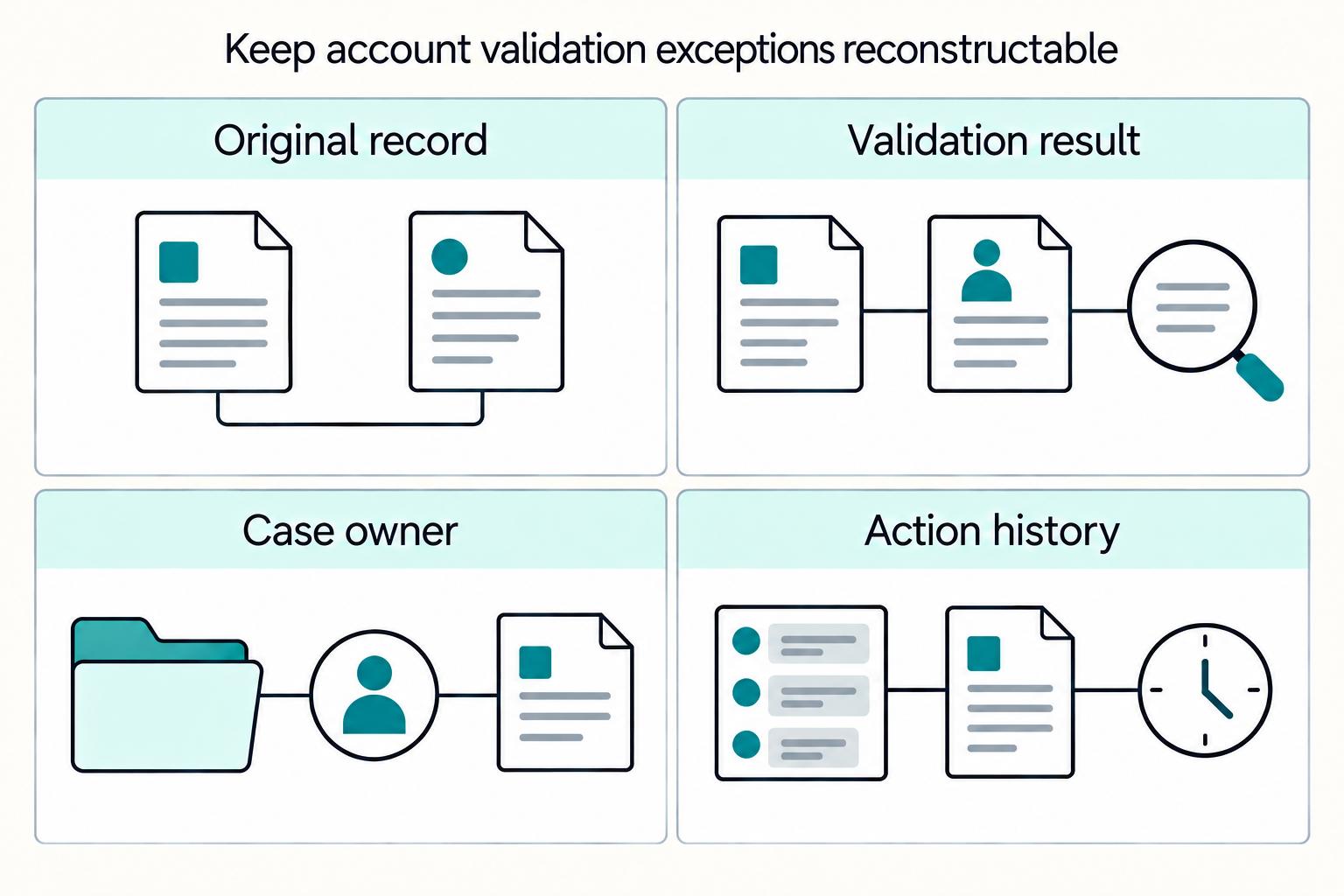
How Platforms Validate Bank Accounts Before Mass Payouts
For mass payouts, the real question is not whether to verify payees. It is how much verification you require before release, who can override it, and what evidence you can produce later. If you cannot show that evidence on demand, your release rule is weaker than it looks.
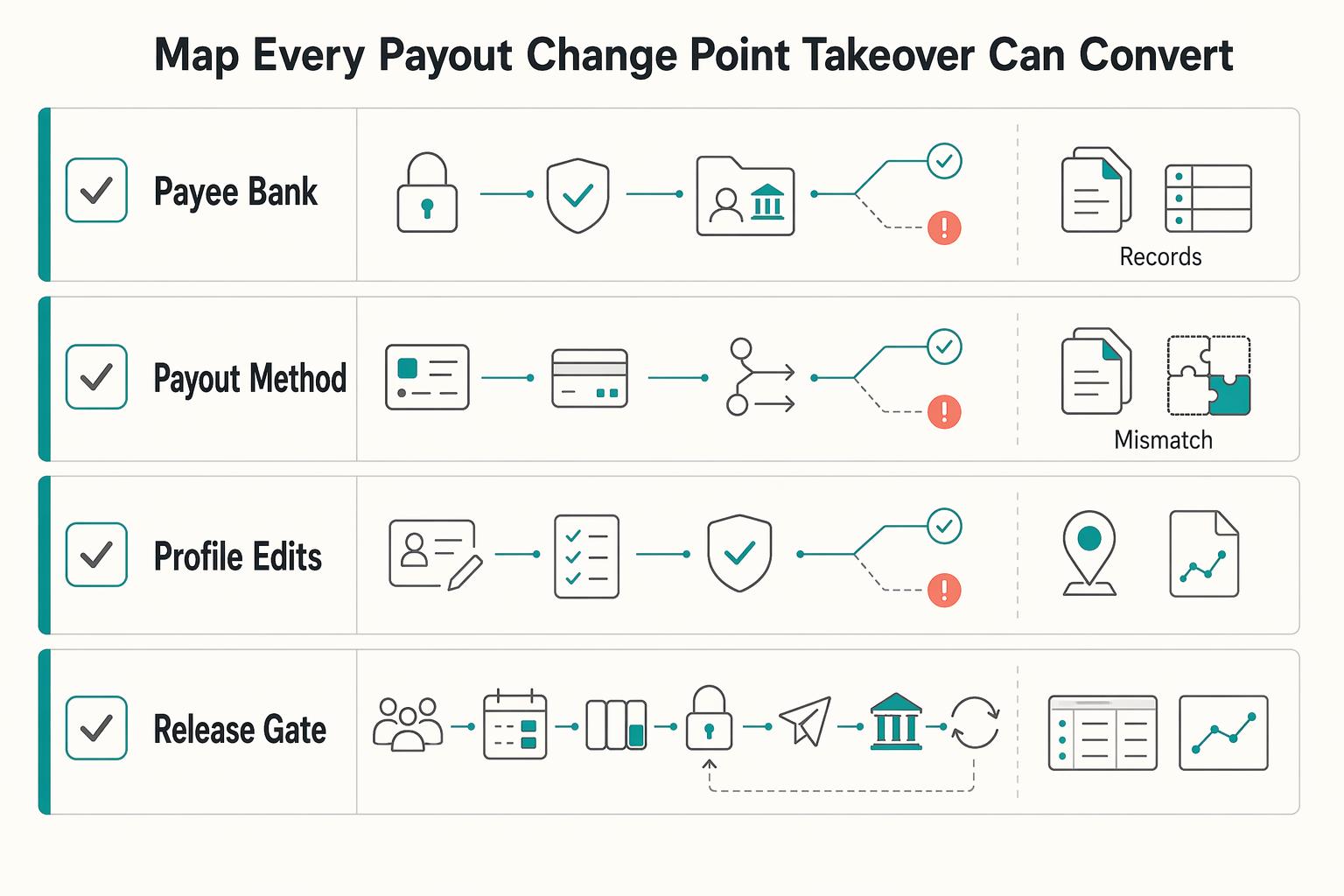
Account Takeover in Payout Platforms and How to Stop Payee Hijacks
Treat **account takeover payout platform payee hijack fraud** as a money movement control problem first and an account security problem second. Once an attacker can change payout details, contact points, or credentials, the issue is no longer just login abuse. It becomes a question of who can stop funds, who can approve a release, what evidence exists, and how quickly finance, risk, compliance, and legal can reconstruct the timeline.