
Quick Answer
Payment platforms should cap payouts with payout-specific, traceable rules that define one scope, one trigger, and one action path for each rule. Start conservatively for new payees, combine count and amount limits with short-window burst checks, segment by payout rail, and log every allow, hold, step-up, manual review, release, or decline decision to the Ledger for review and tuning.
How payout velocity checks work#
A payout velocity check measures activity over a defined window and compares it with a rule. To make it useful, specify which payee or destination it watches, whether it counts attempts or accepted instructions, what amount it measures, and what happens at the boundary. Keep enough evidence to explain each decision later.
Payout velocity is a risk control, not just blocking logic#
This guide is for compliance, legal, finance, and risk owners who need velocity checks and limits that reduce abuse without pushing normal payouts into constant review. You are balancing fraud and misuse risk, including AML exposure, against payout friction that affects contractor, seller, and creator trust, finance timing, and operations load.
The OCC payment-systems handbook discusses risk controls for supervised banks. Its channel-specific approach is useful context, rather than a universal threshold mandate for every platform. A batch to established sellers, a first creator withdrawal and an urgent contractor cash-out can have different risk patterns.
Scope the rules to payouts, including batches#
This guide covers payout controls, including payout batches. It is not a generic card-authorization fraud playbook, even when upstream card signals help explain payee risk.
Keep payout controls separate and explicit. Each rule needs its own trigger, action path, and owner. That matters across contractor, seller, and creator flows, where incentives, payout timing expectations, and hold tolerance can differ. Supervisory guidance treats real-time payments as a product-specific risk area, so avoid forcing one blunt rule across every rail. If you support RTP or FedNow, assess rail-specific risk and exception handling.
One failure mode is importing card-side logic directly into payouts: block first, document later. That may catch some abuse, but it can also lead to weakly defensible outcomes when finance or compliance needs a clear, consistent explanation for delays and holds.
Build traceability into your ledger from day one#
Use one operating principle: combine fraud detection, policy gates, and audit evidence so every payout decision is traceable in your ledger. "Ledger" here means your transaction and decision history, not a legal term.
The standard is reconstructable activity with a maintained audit trail. For each held, released, or declined payout, your record should show what triggered the decision, who or what acted, which rule or policy gate applied, when it happened, and why. For escalations, keep case notes and supporting evidence tied to the payout record.
Velocity checks complement identity, account-security and applicable compliance controls. They do not establish whether funds are legally releasable, and a low amount does not make a suspicious transaction safe. Link the risk decision to the financial record without assuming every risk-state change requires a new accounting journal entry.
Related: FedNow vs. RTP: What Real-Time Payment Rails Mean for Gig Platforms and Contractor Payouts.
What to prepare before you set any payout cap#
Set ownership and evidence before you set limits. Without that sequence, a payout cap is harder to explain or defend when a payout is held, escalated, or declined.
Gather a usable evidence baseline#
Gather payout instructions, attempts, provider statuses, amount and currency, payee/destination identifiers, review decisions, confirmed fraud and later returns. Mark unresolved outcomes instead of counting them as clean. Include legitimate payroll or seller-settlement bursts so the baseline captures normal high-volume behavior. Add applicable compliance evidence through its authorized workflow without duplicating confidential case narratives in general-purpose reports.
Name decision owners up front#
Define named owners for proposing control changes, approving them, and running follow-up reviews. Keep this as named accountability, not just team labels, and document the review trail with the policy artifacts your program already uses. Where relevant, use established compliance artifacts as a discipline check: policy documents, key employees, oversight, suspicious activity reporting, and independent testing.
Split controls by payout surface#
Document where each cap applies and how exceptions are escalated, instead of treating every payout scenario as one path.
Define the first review window and success criteria#
Choose an initial measurement window before launch and write down what outcomes and operational impact you will monitor. Set the follow-up checkpoint at the same time. A 90-day review checkpoint is one clear way to reassess exceptions and repeat patterns.
Define exactly what each rule watches#
Before you tune thresholds, define each rule in plain language.
Pick one scope per rule#
Use one defined key for each rule, such as tenant plus payee account, funding account, or normalized beneficiary destination. Document how aliases map to that key. A payee-level rule catches that payee’s burst; a destination-level rule can detect multiple payees draining to the same account. Use separate rules for those questions.
Keep tenant boundaries explicit. A shared bank destination can legitimately belong to an agency or family; linkage is a review signal, not automatic proof of fraud. Restrict who can view cross-account relationships and record why the chosen scope fits your payout model.
Name the exact trigger event#
Name the event: request attempt, first accepted payout instruction, execution submission, or provider-confirmed completion. An attempt counter helps detect repeated probing; an exposure counter measures money committed to new instructions. Repeated status webhooks are not additional payouts.
Specify the clock and window boundaries. A rolling 24-hour window differs from a calendar-day reset, which can permit a burst just before and after midnight. Record the event timestamp used, the time zone if relevant, and how late or replayed events are handled.
Tie each trigger to an action path#
A rule is incomplete until it states what happens next. For each trigger, define the expected path and artifact:
| Trigger | Possible action | Evidence to retain |
|---|---|---|
| Accepted-instruction count would exceed the window cap | Hold the new instruction for review | Deduplicated instruction IDs, scope key, prior count and proposed count |
| Committed amount plus proposed payout exceeds the cap | Hold before execution | Currency-normalized prior exposure, proposed amount and FX basis |
| Short-window attempts spike | Rate-limit attempts or require step-up | Attempt times, distinct logical request IDs and account-security signals |
| Provider outcome is unknown after submission | Reconcile the existing instruction; do not create another | Request key, provider reference and lookup/reconciliation results |
Keep a plain-language rule dictionary#
Maintain one short dictionary entry per rule with the following fields:
- plain-language purpose and scope key
- event being counted and deduplication identifier
- window, clock and inclusive/exclusive boundary
- count and amount thresholds, currency/FX basis and equality behavior
- action, reservation behavior and review/release criteria
- owner, rule version and review date
Keep the rule readable across Risk, Finance and Operations. Each team should be able to explain the scope, the activity counted, and what happens when the proposed payout crosses the threshold.
Choose your cap design for count amount and burst behavior#
Start with a cap design you can explain and defend. For new payees, start conservatively and avoid assuming count-only or amount-only limits are sufficient; relax limits only when due diligence and monitoring support it.
That follows directly from the rule dictionary work. Once scope and trigger are fixed, choose a cap pattern that reduces blind spots without pretending generic thresholds are production-ready.
Pick a cap pattern that matches how abuse can pass one-dimensional limits#
No single pattern is complete, so choose the one that matches the abuse path you are trying to catch and validate it against your own data.
| Cap pattern | What it may catch | Where it may fail against velocity-style abuse | Where it may fail against card-testing-like probing |
|---|---|---|---|
| Frequency only | Repeated payout attempts, rapid retries, unusual count spikes | A small number of high-value payouts can stay under a count limit | Small probing can look normal if attempts are spread to avoid the threshold |
| Amount only | Single large payouts or unusually high cumulative value | Many low-value payouts can stay under an amount cap while funds still move quickly | Low-value probing can remain hard to see because total value stays small |
| Combined count + amount | Repeated activity plus value escalation in the same window | Can still miss sequence risk when timing matters more than totals | Still needs short-window burst logic when activity starts small before a larger move |
Use due diligence quality, not just account age, to decide when to relax caps. Grounded baseline signals are identity verification, beneficial-owner identification where relevant, purpose of the relationship, and ongoing monitoring. If those are weak or incomplete, keep tighter caps.
Add burst controls so daily totals are not the only lens#
A daily cap alone can be too blunt, so consider pairing it with a short-window burst check on the same entity scope you defined earlier.
Keep the scope consistent. If the rule scope is payee account, keep burst logic on payee account. If the scope is bank destination, keep it there. Mixed scopes inside one burst rule make investigations harder and decisions harder to defend.
Hypothetical rule: no more than 3 new accepted instructions and $1,000 committed in a rolling 24-hour window per payee. Existing instructions total $750 across 2 payouts. A proposed $300 payout would take exposure to $1,050, so it is held even though the count would be only 3. A $200 payout instead would produce $950 across 3 instructions and pass these two checks; it still needs all other release checks. These are demonstration numbers, not recommended production thresholds.
Segment by payout rail and settlement speed#
Do not assume one cap table fits every rail. Treat faster-settlement rails separately from slower settlement paths, then set final numbers from your own platform data.
The grounded point is operational: control design has to account for transaction volume, speed, and complexity, and controls are expected to work without slowing operations unnecessarily. That supports rail-specific design, not rail-specific thresholds pulled from generic references.
Mark unknowns clearly and keep review-ready evidence#
State concurrency and recovery rules before launch. Evaluate the cap and reserve capacity atomically: two requests must not both read the same available headroom and each pass. Give a logical payout one durable instruction ID; retries reuse it and do not reserve capacity or increase accepted-payout counts again. Track repeated attempts separately for abuse detection.
Keep submitted payouts with unknown provider outcomes in the exposure calculation until their state is reconciled. Do not free capacity merely because an HTTP call timed out or a local lock expired. If the provider confirms nonexecution, or a return is completed, apply the policy’s explicit release/return treatment and retain the history. Keep risk decisions and provider financial statuses linked; neither is a substitute for the other.
If you want a deeper dive, read Working Capital Optimization for Platforms: How Payment Timing Affects Your Cash Position.
Set clear actions for every trigger outcome#
Once cap logic is in place, define action paths before you tune further. If a rule fires without a clear outcome, teams can handle similar cases differently, queues can grow, and decision history is harder to defend.
Build a decision matrix before you tune thresholds#
Write down, in plain language, when a trigger should allow, place a temporary hold, require Step-up authentication, route to Manual review, or decline. Use this as a policy template tuned to your own risk profile, not a one-size-fits-all standard.
| Outcome | Use when | What must be captured |
|---|---|---|
| Allow | Low-risk trigger, good due diligence status, no linked anomalies | Rule name/version, trigger event, why it passed |
| Temporary hold | Mixed signal or incomplete context that can be verified quickly | Hold start time, review owner, required checks, release criteria |
| Step-up authentication | You need stronger proof of account control before release | Authentication result, timestamp, reviewer or service decision |
| Manual review | Linked behavior or customer context requires human judgment | Reviewer notes, evidence reviewed, final decision |
| Decline | Evidence supports refusing this instruction under the applicable policy | Decline reason, linked entities reviewed, approver when escalation is required |
A policy review hold can fit mixed signals that can be checked promptly. Declining a request does not erase a debt owed to the payee; record how the obligation will be resolved. Distinguish these actions from a legal sanctions block or other restriction, whose release authority and reporting follow the applicable law.
Tie each action to a verification check#
Each non-allow action should have at least one concrete check so cases do not stall. Start with two checks you can defend in review:
- For a held payout, verify the logical instruction, provider state and beneficiary before considering release or retry.
- Review device, destination and account-change clusters alongside legitimate shared-account context. Upstream card BIN information can be supporting evidence, but does not define a payout-specific cap.
Those checks help distinguish true risk signals from noisy rules and reduce avoidable escalation into Manual review.
Set hold limits and release authority up front#
Define an internal review deadline, owner and permitted extensions for policy holds. Set alerts for overdue decisions. A review deadline is not an automatic instruction to release a restricted payment or remove unknown executed exposure; the release must still satisfy the relevant policy and legal conditions.
If release authority is unclear when a hold is applied, the process is not production-ready. Keep temporary holds and true declines operationally distinct so you do not create unnecessary friction or inflate false-positive impact.
Write every decision to the Ledger with reason codes#
For velocity checks, logging the trigger alone is not enough. Record the full decision path in the Ledger. Include the rule version, entity scope, event timestamps used in the count, cumulative amount at decision time, due diligence status, outcome, and the reviewer or service that made the call.
Reason codes are operationally useful even without a mandated schema. Recordkeeping expectations still require records that can reconstruct account activity when needed, including for audits and investigations. If you cannot reconstruct why a payout was held, stepped up, or declined months later, the trigger-outcome policy is incomplete.
If you are finalizing the allow/hold/decline matrix, align each outcome to concrete payout states and audit trails using Gruv Payouts.
Build escalation paths that teams can execute under pressure#
Build an internal escalation path around the payout decision and its current provider state. Keep tax onboarding in its own workflow unless a specific requirement actually affects this release.
Assign escalation tiers with clear handoff rules#
Operations can triage the instruction and customer context, Risk can assess suspicious patterns, and Compliance or Legal can handle applicable restrictions. Define Finance’s role in unresolved execution and returns. Assign the handoff by issue, rather than routing every payout through a tax-registration review.
Document the handoff rule for each tier: what moves a case up, who can return it, and who has final decision authority. If that chain is unclear in the record, cases will stall.
Require one payout case packet before escalation#
Send reviewers a consistent packet so they can continue the existing case instead of starting over. Include the payout ID, amount/currency, scope key, rule version, window, counted activity, action and current provider outcome.
Add the relevant beneficiary/account change, verification result, review owner, customer explanation, decision deadline and safe next action. Keep sensitive investigation material in the restricted case system and link its reference; general payout support should not disclose confidential suspicious-activity reporting.
Use a separate path for execution uncertainty#
If a payout request timed out after submission, route it to reconciliation rather than to a fresh payout request. Look up the existing instruction using the provider reference and durable request key. Absence from one incomplete lookup is not proof of nonexecution.
A fallback rail is safe only after confirmed nonexecution or a completed return, with a new authorized instruction and linked recovery history. A reviewer clearing the fraud signal does not by itself prove that the original payout failed.
Define closure before the first incident lands#
Close with a specific outcome: original instruction released once, policy request declined with obligation follow-up, provider completion reconciled, confirmed nonexecution, completed return, or legal restriction retained. Keep an unknown execution state open with its owner and next reconciliation action.
For each closed case, log who decided, what evidence was accepted, and any follow-up action. Your closure standard should let another reviewer reconstruct the decision path later from the Ledger and case notes.
Related reading: Account Takeover (ATO) in Payout Platforms: How Fraudsters Hijack Payee Accounts and How to Stop Them.
Related reading: OFAC Compliance for Payment Platforms: How to Screen Every Payout Against the Sanctions List.
Set governance and documentation rules before launch#
Before launch, make rule governance explicit: no payout-rule change should go live without documented approval and a record that shows who changed what, when, and why.
| Record | Must include | Use |
|---|---|---|
| Written approval | Rule owner, approvers, intended go-live date, business rationale | Release gate for every new rule, threshold change, exception, and rollback |
| Change log | Rule name and version; what changed; why it changed; expected impact on fraud controls, payout timing, and review workload; dependencies; rollback trigger and rollback owner; actor and timestamp | Explains the decision, not just the edit |
| Ledger-linked review action | Reviewer action, timestamp, rule version at decision time, reason code, linked case or escalation ID | Lets a separate reviewer reconstruct the transaction activity and decision path |
| Retention and retrieval | Approval records, change logs, reviewer actions, timestamps, and Ledger-linked evidence | Set before production and test on a closed case |
Put rule approvals in writing#
Treat written approval as a release gate for every new rule, threshold change, exception, and rollback. Keep one approval record that names the rule owner, approvers, intended go-live date, and business rationale.
Use an independent approval step for material threshold changes and broad exceptions as part of your internal policy. Record any emergency rollback authority in advance. Dual control is a governance choice here, not a claim that every payment platform has the same regulatory approval template.
Run a simple readiness check: pick one recent change and confirm that you can find approver names, approval date, and decision outcome without asking the person who made it.
Keep a change log that explains the decision, not just the edit#
A usable change log should explain intent and control logic, not just field deltas. For each change, record the rationale, expected side effects, and rollback condition. At minimum, log the following:
- rule name and version
- what changed
- why it changed
- expected impact on fraud controls, payout timing, and review workload
- dependencies on upstream controls, where applicable
- rollback trigger and rollback owner
- actor and timestamp
Require actor-and-timestamp audit logging for every rule change. If you cannot show who changed a limit and when, audit review becomes harder than it needs to be.
Also document scope. A single universal limit can reduce fraud in one corridor and constrain growth in another, so the log should state where the rule applies and where it does not.
Tie review actions back to the Ledger#
Make the Ledger your reconstruction anchor for control decisions, not just money movement. For each hold, release, decline, override, or rule-based exception, retain reviewer action and timestamp linked to the underlying payout record.
Use this test: can a separate reviewer reconstruct the transaction activity and decision path from Ledger data plus case notes? That benchmark aligns with bank-context recordkeeping expectations for reconstructing activity, even if your exact obligations differ by entity and jurisdiction.
A practical evidence set includes the rule version at decision time, reviewer action, timestamp, reason code, and linked case or escalation ID.
Define retention and retrieval before launch#
Set retention and retrieval rules before production, not during an audit or dispute. Cover approval records, change logs, reviewer actions, timestamps, and Ledger-linked evidence in policy.
Assign retrieval ownership and test it on a closed case. If reconstructing one override requires multiple teams and ad hoc data stitching, tighten the process before launch.
Adapt limits for cross-border program differences#
Use one global baseline, then apply market-specific or corridor-specific overlays where risk, rail behavior, or compliance operations differ. A single global cap can reduce fraud in one corridor while constraining a trusted one, so cross-border programs usually need layered controls.
Separate baseline rules from local overlays#
Use hierarchical limit management: keep common controls at the global level, then add narrower rules at partner, corridor, or user level when justified. Keep this transparent enough that reviewers can tell which decision came from the baseline and which came from an overlay. Keep governance consistent with earlier sections. Require 4-Eyes approval for changes and retain audit logs with user ID and timestamp.
Adjust pre-release checks by payout rail#
Evaluate release controls before submitting to a fast rail; a platform hold cannot recall an already settled payment. FedNow participant tools include configurable cumulative-value and velocity thresholds. Their availability at a participant institution does not mean your payout provider exposes the same controls to your application.
You can keep shared monitoring windows, such as 24h, 7 days, and 30 days, but let the action path vary by rail instead of forcing one universal response.
Align with compliance workflows where your program uses them#
If your program uses onboarding or compliance status in release decisions, reflect that explicitly in your rule dictionary and reviewer playbooks. Where relevant, define how KYC and sanctions checks feed those decisions in your operating model.
For exceptions, keep the evidence linked: what status was reviewed, what decision was made, and which payout or ledger record it ties to.
Flag flow-ownership differences early#
If your program includes different payout flow types, mark those flows in your rule inventory before launch. Then document who owns the control decision, who can place or release holds, and what records prove those actions for each flow. This prevents cross-team gaps where Risk, Finance, and Ops assume a different owner for stop or release decisions.
For a step-by-step walkthrough, see Microsoft Dynamics 365 for Payment Platforms: Finance Module Setup and Payout Integration Guide.
Reduce false positives without weakening fraud defense#
As transaction patterns become more complex and unpredictable, false positives can increase, so the goal is tighter classification and accountable exceptions, not weaker controls. Use your own decline and incident data to separate legitimate payouts from fraud patterns, then adjust controls with traceable decisions.
Test likely false-positive scenarios against your own decline data#
The scenarios below are tests, not universal patterns. Group declines by reason and compare them with confirmed fraud cases before you tune any rule.
| Scenario to test | Why it might get flagged | What to verify before tuning | Better action if legitimate |
|---|---|---|---|
| Decline cluster by card BIN or IP range | Clustered technical signals can resemble coordinated fraud | Decline reasons versus confirmed fraud cases, and whether affected accounts are legitimately related | Narrow the rule to the risky signal combination instead of broad global blocks |
| Shared device IDs across multiple accounts | Shared device identifiers can indicate linked or synthetic activity | Account ownership, beneficiary overlap, and incident history | Route to targeted review and document outcomes for rule tuning |
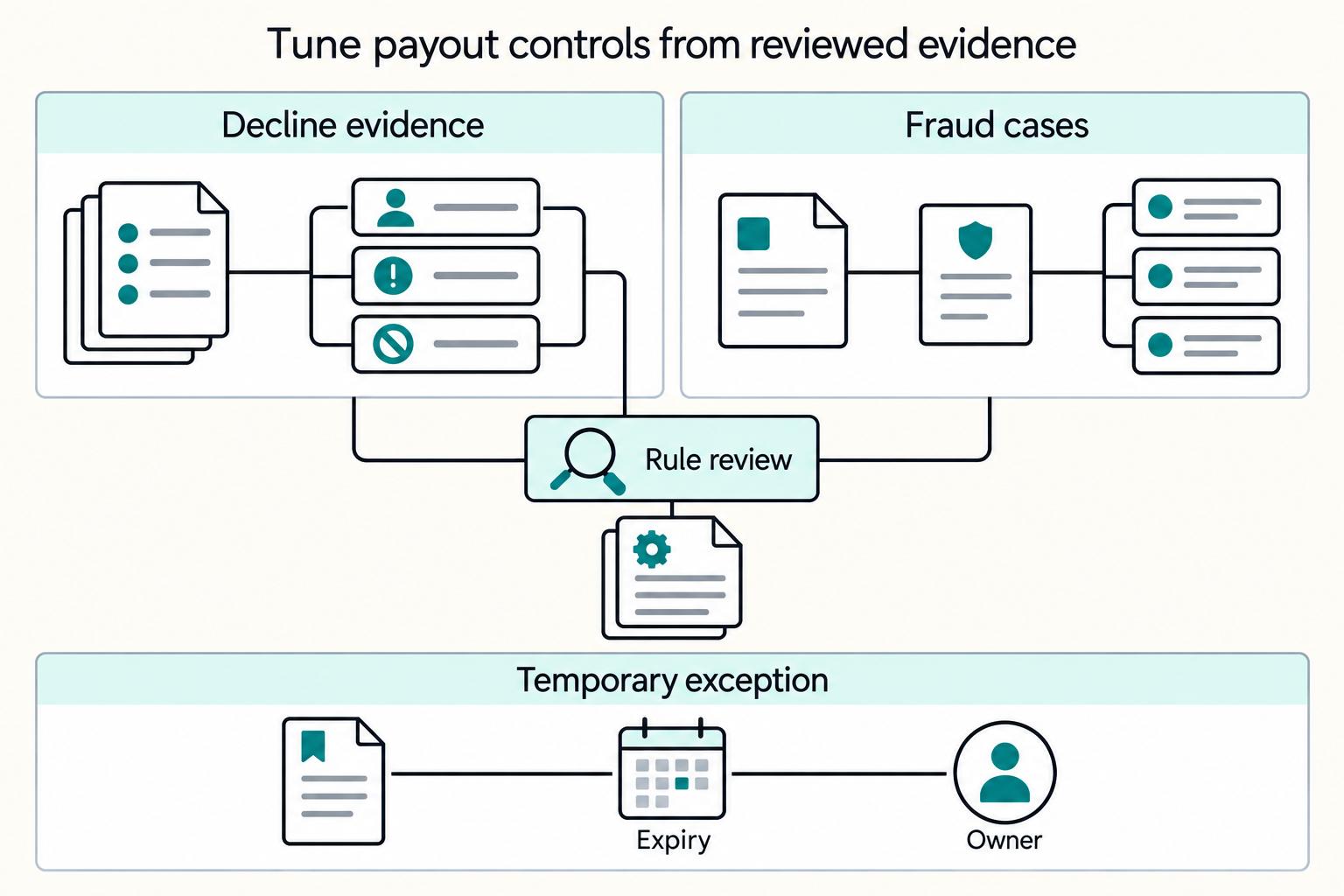
| Rapid withdrawals to one beneficiary or odd time-of-day spikes | These patterns are common incident-report fraud signals | Identity proofing status, beneficiary consistency, and whether similar patterns match confirmed fraud | Use a temporary exception with post-review when legitimacy is supported |
Report both the share of reviewed declines later judged legitimate and the share of known legitimate instructions incorrectly declined. The first measures the error mix among declines; the second is a false-positive rate among legitimate activity. State the observation window and unresolved cases. Track review holds separately so their delay does not disappear from the report.
Build control changes from evidence, not overrides#
Increase payout freedom only when the record supports it, including identity proofing results and confirmed fraud comparisons. Do not treat one-off manual overrides as policy.
Define what signals can loosen controls and what signals tighten them again. For every change, keep a clear record of the signals reviewed, approver, date, and affected transaction IDs so decisions can be reconstructed later.
Use temporary exception windows with an owner and post-review#
Use temporary exceptions for legitimate out-of-pattern payouts and avoid broad permanent whitelists. Each exception should include an owner, expiry, reason, and a required post-review.
If post-review shows repeated clean outcomes, promote the case into a formal rule update. If outcomes are mixed, keep the exception narrow and continue routing similar cases to Manual review.
Prepare recovery actions for over-tight controls#
Plan recovery before rules go live so teams do not improvise under pressure. Use three standard actions: roll back the latest rule change with change logging, rebalance Manual review queues so analysts focus on higher-risk cases, and send clear customer communications about holds and next steps.
Do not treat backlog alone as proof that a rule is working. As transaction patterns become more complex and unpredictable, false positives can rise. Recovery and retuning need to be explicit and repeatable.
This pairs well with our guide on Fraud Detection on Payment Platforms with Rules and Machine Learning.
Track the right metrics in weekly control reviews#
Your weekly control review should answer three questions quickly: are controls catching real abuse, are they creating unnecessary friction, and can decisions be reconstructed later.
| Review area | What to track | Why it matters |
|---|---|---|
| Control outcomes | Breached-rule activity, override activity, repeat-offender patterns, confirmed fraud outcomes | Shows whether rules link to real abuse rather than just alert volume |
| Operational load | Backlog, time-to-decision, manual-review outcomes, override rate | Keeps queue pressure and customer delay visible |
| Finance and evidence | Reconcile control outcomes to finance records in the Ledger and compare released outcomes with later dispute and loss signals | Keeps risk reporting tied to actual payout events |
| Governance cadence | Weekly tuning for noise, queue pressure, exception drift, and repeat-offender patterns; separate governance reviews for broader control decisions | Keeps operational tuning separate from documented oversight |
Track control outcomes, not just alert volume#
Start with outcome metrics, not raw alert counts: breached-rule activity, override activity, repeat-offender patterns, and confirmed fraud outcomes. A frequently triggered rule with weak confirmed-outcome linkage can indicate noise or overly broad logic.
Keep entity definitions consistent week to week, and report by entity type instead of collapsing everything into one total. That makes repeat-offender patterns clearer and reduces false signals from mixed reporting.
For each breached rule, make sure you can trace the final action and later outcome. If you cannot, your review depth is not enough for reliable tuning.
Measure operational load so friction is visible#
Track operational load in the same review pack: backlog, time-to-decision, and manual-review outcomes. This keeps queue pressure and customer delay visible instead of hiding them behind stable fraud-loss trends.
Define outcome-quality checks with a method you can reproduce later, then keep that method stable. Tie released cases back to later confirmed fraud, linked-entity restrictions, or other dispute and loss signals.
Watch override rate as a control-health signal. If it rises, it can mean rule scope is too broad or teams are bypassing policy to keep payouts moving.
Reconcile risk outcomes to finance records and evidence#
Reconcile control outcomes to finance records in the Ledger so risk reporting is not isolated from actual payout events. Then compare released outcomes with later dispute and loss signals.
Preserve the rule version, review date, owner, breached scope, instruction IDs, reviewer action and later outcome linkage. Reconcile accepted instructions with provider execution, returns and financial records. A cap-trigger report without execution outcomes cannot establish how much money was actually protected.
Separate weekly tuning from periodic governance#
Use weekly reviews for operational tuning and a separate governance cadence for broader control decisions. This is an operating choice based on your risk profile, not a regulator-mandated template.
Weekly sessions should stay narrow and action-oriented: noise, queue pressure, exception drift, and repeat-offender patterns. Governance reviews should be documented, with Compliance and Finance focused on whether controls, reporting, and oversight still fit current risk.
Common implementation mistakes and how to recover#
Common failure points include copied rules, count-only caps, ownerless exceptions, and weak traceability. In many cases, recovery is a control-tuning exercise rather than a full rebuild.
Test copied rules against your own payout behavior#
External examples can help you start, but they are not production policy. OCC guidance is explicit that each institution has its own risks, so controls should match your payout mix, rails, and operating patterns.
Recovery is straightforward: test proposed rules against your own activity and baseline performance, then keep or retune rules based on measured risk outcomes rather than alert volume alone.
Add amount logic, not just transaction count#
Count-only caps miss a small number of large payouts; amount-only caps miss high-frequency probing. Combine the relevant checks and compare outcomes with reviewed legitimate activity and confirmed abuse rather than assuming more triggered alerts means better protection.
Recovery: combine count checks with amount-based logic where your risk context supports it, then evaluate whether those controls improve outcomes.
Put every exception under a named owner#
Exceptions without ownership are hard to govern and easy to normalize. If overrides are not clearly attributable, you lose decision quality and reviewability.
Recovery: document exception decisions with a clear owner and rationale so they remain traceable during internal, regulatory, or investigative review.
Make every action path reconstructable in your records#
Retain the evaluated window, inputs, rule version, action and subsequent outcome. Choose retention periods from your applicable obligations and data policy; a generic bank-examination reference does not establish one period for every platform.
Recovery: keep decision-path records consistent across allow, hold, release, and decline actions, and regularly verify that a reviewer can reconstruct what happened from the record alone before further threshold tuning.
Conclusion#
Payout velocity controls are operational risk controls, not just fraud toggles. To reduce fraud and avoid regulatory surprises without unnecessarily slowing legitimate payouts, you need clear ownership, documented decisions, traceable outcomes, and regular review.
Before launch, test a normal batch, a threshold-crossing payout, simultaneous requests and a timeout after submission. Confirm that each produces the expected reservation, decision and recovery record without a duplicate financial instruction.
Use regulator and provider materials for their actual scope. FATF’s older new-payment-methods report supplies typology context, while current provider documentation establishes specific request and payout behavior. Your own observed data must establish the final thresholds and expected review workload.
Copy and paste launch checklist#
- Confirm rule scope by entity and payout event.
- Approve action matrix and escalation ownership.
- Verify traceability for every decision path.
- Run pilot, review false positives, and tune thresholds.
- Lock weekly metrics review and monthly governance review.
Weekly and monthly review cadence is an operating choice, not a requirement from the cited sources, but it helps keep controls explainable, adjustable, and aligned to your risk assessment over time. Before rollout, confirm market-specific compliance gates and ownership boundaries for your flow by reaching out through Gruv contact.
Frequently Asked Questions
What is a velocity check for payout platforms, and how is it different from card authorization controls?
A payout velocity check measures a defined count or amount over a time window for a payee, funding account or destination. It controls new payout instructions before execution. Card authorization controls assess a different payment event; upstream card signals may inform risk, but retries, batches and provider execution states need payout-specific treatment.
Should we cap payout count, payout amount, or both first?
Consider both count and committed amount, plus short-window bursts, where the abuse scenario warrants them. Define which events count and deduplicate instruction retries before selecting thresholds. Validate the limits against your own legitimate and fraudulent activity rather than adopting the hypothetical numbers as policy.
When should a payout be held instead of declined?
Use a policy hold for a reviewable uncertainty with a named owner and release criteria. Decline the instruction when supported policy grounds justify refusing it, while preserving any underlying amount owed. Legal restrictions and unknown provider execution require separate handling; neither can be cleared simply because a review timer expires.
How do velocity checks interact with **KYC**, **AML**, and **Account Takeover (ATO)** controls?
KYC can establish identity; account-security checks can investigate takeover; velocity checks flag unusual activity. None proves the other has passed. Feed current verified status into release checks where applicable, and keep stale or unknown status explicit. A step-up authentication result does not prove that a beneficiary is legitimate or lift a legal restriction.
What evidence should we retain for audit and regulatory review?
Retain the scope key, event and instruction identifiers, timestamp/window, count, currency-normalized amount, rule version, action, reviewer, case reference and later provider outcome. Keep approvals and changes linked. Set retention and access rules for your entity and jurisdiction, with confidential investigation records held separately.
How often should payout velocity thresholds be reviewed and adjusted?
Choose a cadence based on risk and volume. A weekly operational review can track queue delay, misclassified legitimate activity and exception drift; periodic governance can approve broader changes. Reassess after incidents or material rail/product changes. Those are suggested operating choices, not universal regulatory deadlines.
What cannot be set confidently without internal fraud and payout data?
Specific thresholds, durations, and exception levels cannot be set confidently without internal fraud and payout data.
Researched and edited by the Gruv editorial team. Gruv builds cross-border billing, payouts, and finance-operations software for global businesses.
Sources
Includes 2 external sources outside the trusted-domain allowlist.
Educational content only. Not legal, tax, or financial advice.
Related Posts

The Freelance Payment Penalty: A Modeled Audit of Platform Fees, FX Spreads, and Payout Delays
The money rarely disappears through a single, easy-to-spot fee. The real loss is stacked. A marketplace takes its commission, a processor adds a charge for international cards, a bank or payment company converts the currency at a spread, a platform holds the funds before release, and a wire sheds a little to intermediaries on the way in. Each layer looks defensible on its own, but the worker feels the combined result as a smaller deposit and a later payday.

How to Respond to a Subpoena for Business Records
Move fast, but do not produce records on instinct. If you need to **respond to a subpoena for business records**, your immediate job is to control deadlines, preserve records, and make any later production defensible.
A US Expat's Guide to Investing in UCITS ETFs to Avoid PFIC Issues
The real problem is a two-system conflict. U.S. tax treatment can punish the wrong fund choice, while local product-access constraints can block the funds you want to buy in the first place. For **us expat ucits etfs**, the practical question is not "Which product is best?" It is "What can I access, report, and keep doing every year without guessing?" Use this four-part filter before any trade: