
Quick Answer
Improve payment timing by fixing avoidable posting, capture, provider-availability and cutoff delays, then schedule permitted outflows against verified funding. Separate platform-owned operating cash from recipient money. Keep due dates, restrictions and reservations explicit, recover unknown payout outcomes before retrying, and use lawful financing when a documented funding gap requires it.
How Payment Timing Affects Platform Liquidity#
Working capital is current assets minus current liabilities. For a payment platform, distinguish its own operating assets and obligations from balances held for customers or recipients. Timing controls show when an authorized payment is captured, when a provider permits payout and when the destination bank credits it; those stages do not alone establish ownership or legal use.
Earlier collection of the platform’s own receivables can improve liquidity without creating additional profit. Recipient funds can become available for an authorized payout while remaining unavailable for platform payroll, lending or supplier expenses. Keep the two liquidity views separate.
If you run matching or payout execution, the real test is evidence. Can you show, in your records, what is pending, available, settled, or disbursed?
- Collection visibility
Incoming payment activity is not the same as settled cash. Use a consistent matching step between transaction records and posted states so reported cash does not rely on unposted events.
- Settlement reality
Settlement finality and provider availability are different concepts. Fedwire transfers are immediate, final and irrevocable once processed under its rules. Cards and ACH can have later disputes or returns despite a provider making balances available. Use the rail’s rules, the provider’s balance status and the legal ownership of funds together; do not apply Fedwire finality to every payment.
- Disbursement control
Stripe payout guidance separates payout frequency from when a transaction’s funds become available. A daily schedule can send funds from earlier transactions; it does not necessarily make today’s collection spendable. Availability, payout submission and bank arrival each need their own timestamp.
A scheduled payout is not proof of bank credit. Stripe’s reconciliation guidance explains that automatic payouts can have transaction breakdowns, whereas manual payout amounts have no explicit charge-to-payout allocation. Reconcile manual payouts through the balance roll-forward and bank transfer; keep any internal allocation labeled as an internal method.
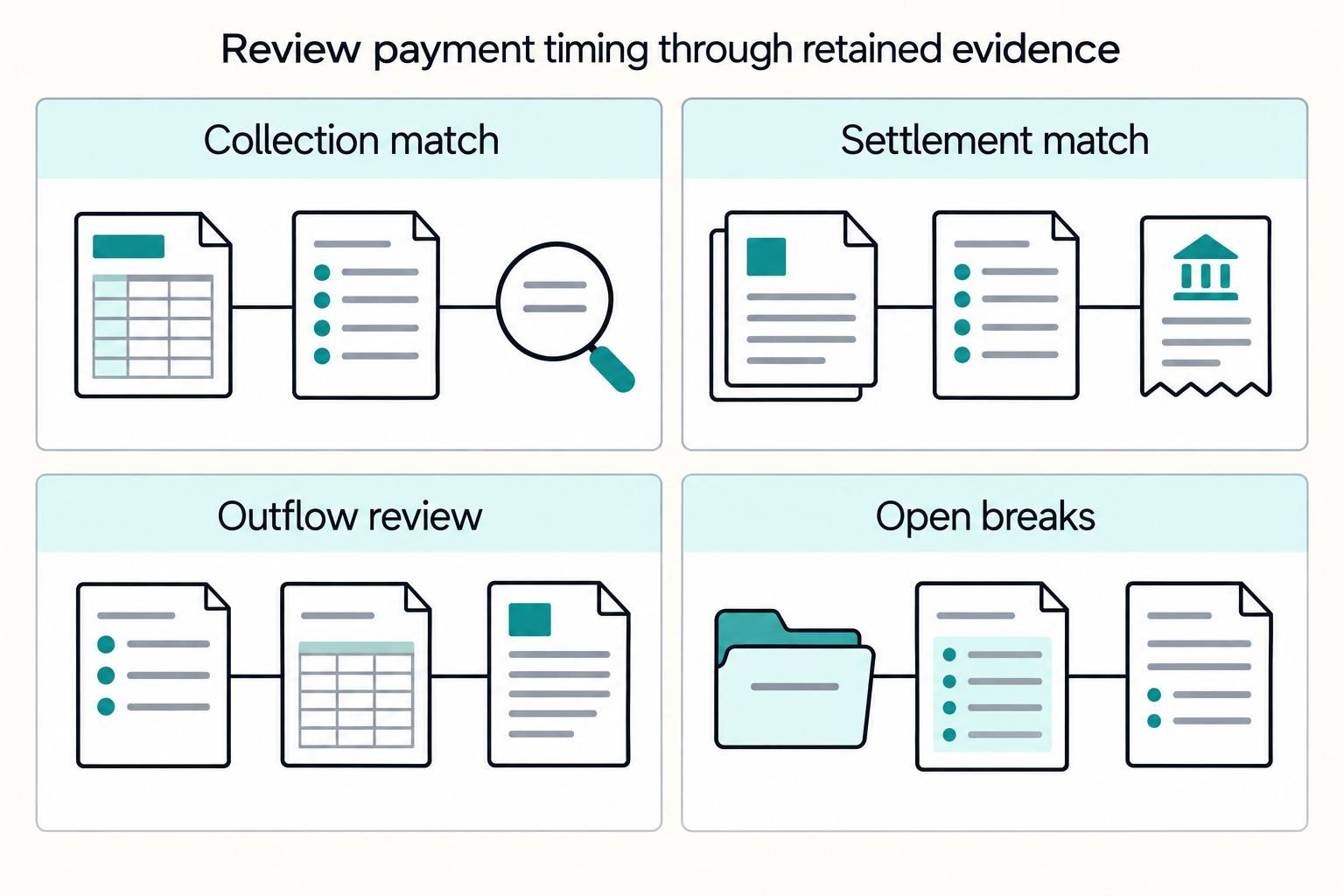
Evaluate payment timing through posted records, fund status, payout-batch matching, and payout policy choices. If you already match at the payout-batch level, you have a checkpoint between transaction activity and cash movement. If not, build that checkpoint first.
How to choose the right timing lever for your platform#
Choose a timing lever whose effect you can trace through the ledger, provider reports and bank records. First identify whether the shortage concerns platform-owned operating cash or funding an already-owed recipient payout. Customer or recipient money is not an operating buffer just because a provider marks it available. As a jurisdiction-specific example, FCA safeguarding guidance describes protection of relevant funds for covered UK payment/e-money institutions; other arrangements need their applicable legal and contractual assessment.
If your operation is mainly a traditional Inventory cycle without platform-style Payout Execution, start with a standard cash conversion cycle review first. The list below is most useful when funds move through pending, available, settled, held, and disbursed states that must be tied back to source activity.
- Prioritize availability over activity
A reported payment event is not the same as cash you can use. The gap between payment or funding and fund availability matters, and providers can show balances as pending first. If a lever shortens pending-to-available timing, it can reduce Liquidity Pressure more directly than a reporting-only fix.
- Treat settlement speed and payout cadence as separate controls
Changing payout schedule does not automatically change pending-to-available timing. Stripe explicitly separates payout frequency from settlement timing, including a daily payout example with 3-business-day settlement timing. Adyen also ties availability to the value date, and one setup uses a two-day payout delay.
- Pick the option with the cleanest proof
Control quality is part of the decision because stronger controls reduce errors and help you detect problems sooner. Your proof pack should include a ledger extract, a pending-versus-available balance split, and a payout-batch or bank-match report. If status changes cannot be traced back to transaction records, treat that lever as high risk.
- Favor levers you can monitor in a consistent operating cadence
Set review frequency by transaction volume, exposure and how quickly a missed issue could affect payment. A weekly policy review can sit alongside continuous release gates and daily reconciliation. Public-sector or banking control guidance is not a universal monthly rule for every platform. If new exceptions exceed clearance capacity, contain the affected change and assign cases by urgency rather than leaving obligations unreviewed.
If you need to forecast the cash impact of growth, see How to Model Working Capital Needs for a Fast-Growing Payment Platform.
Compare the seven payment timing options before you pick one#
The seven options below address different bottlenecks: posting, settlement/eligible capture, payout release, invoice aging, financing, AP timing and faster bank windows. Posting improves visibility; collection and funding can improve platform liquidity; recipient payout timing must remain within the recipient’s contractual and legal rights. Compare benefit, cost and payment obligations together.
Do not evaluate any lever in an AR-only or AP-only slice. Clearing happens before settlement, and obligations are discharged at settlement through fund transfer. Faster payment activity alone does not guarantee usable cash.
| option | best for | primary Payment Timing lever | operational complexity | common failure mode | proof point in Reconciliation |
|---|---|---|---|---|---|
| Speed up collection posting and cash visibility | Payment confirmed but ledger updates lag | Shorten event-to-ledger posting time after confirmation | Medium | Late posting misstates balances and collection status; faster posting alone does not create cash | Payment event timestamp vs ledger post timestamp; posting-lag exceptions |
| Use financing for a documented liquidity gap | Valid financeable receivables or a funded operating need | Advance or borrow platform-owned funds under approved terms | Medium to High | Cost, recourse, ineligible invoices or an unsupported repayment assumption | Invoice ownership/eligibility, advance, fees, reserve and repayment reconciliation |
| Reduce settlement and clearing drag | Pending balances sit too long before available | Remove avoidable capture delay and improve availability where provider/rail rules allow | High | Gross-to-net misread; refunds, chargebacks, and costs reduce disbursable cash | Transaction-level settlement report; pending vs available split; held/returned funds queue |
| Route eligible bank transfers into faster windows | ACH-heavy flows with cutoff misses | Use eligible same-day windows instead of next-cycle timing | Medium | Cutoff misses push funds to an extra cycle | File submission timestamp vs cutoff; settlement date vs expected window |
| Control payout release timing | Volatile disbursement timing and cash spikes | Change payout cadence and release gates | Medium to High | Unauthorized delay, unresolved submission outcome or duplicate payout | Payout batch vs bank-match report; idempotency audit on payout retries |
| Attack invoice aging early | Large AR balances with rising overdue invoices | Shorten invoice-to-cash through tighter escalation and collection discipline | Medium | Ownership gaps let aging become structural | Aged receivables by bucket; logged collection actions; recovery trend |
| Tighten AP timing within agreed supplier terms | Unnecessary early supplier release | Schedule payment to meet the agreed due date | Medium | Late fees, missed discounts or supply disruption | AP due-date adherence, approvals and bank payment trace |
Capture can start the settlement process sooner when the contract and payment rules permit it. Actual fund availability varies by account, country and payment method; a universal 1–3-business-day card promise is not reliable. Confirm the account schedule and net amount after fees, refunds and disputes before changing a recipient release rule.
For eligible bank flows, FedACH’s processing schedule distinguishes operator transmission deadlines from settlement times. The third forward-item deadline is 4:45p.m. ET with 6:00p.m. ET settlement. Your bank or provider may impose an earlier submission cutoff; settlement at the operator is not a universal destination-bank arrival guarantee.
Use this comparison as a starting point, not a universal order:
- When pending-to-available lag is the constraint: prioritize earlier capture, settlement/clearing drag reduction, and same-day window eligibility.
- When disbursement timing is the constraint: prioritize payout cadence/release controls and AP timing.
- When structural cash-cycle pressure is the constraint: prioritize invoice-aging discipline and reduced reliance on bridge financing.
If pending-to-available lag is the main constraint, investigate eligible capture, provider configuration and cutoff misses. If funds are available but obligations exceed platform-owned funding, use lawful treasury funding and scheduling that honors due dates. A ledger change or an arbitrary delay to recipients cannot close an ownership or solvency gap. Prove the effect in a reconciled cohort before expansion.
For a broader operating view, read Working Capital Management for Payment Platforms: How to Optimize Cash Between Collection and Disbursement.
Option 1 speed up collection posting and cash visibility#
Use this first when payment confirmation exists but your Ledger posts late. It improves visibility into reported Cash Position, but it is still a visibility control, not proof that funds are spendable.
You are narrowing the gap between a real Collection event and the journal entry finance uses. When ops sees a provider confirmation but finance still sees the invoice as open, the issue is often state timing between payment events and posting, not just fund availability.
What this option actually improves#
This works best when you ingest asynchronous payment events and post journals later through a separate job, queue, or approval step. In that setup, confirmation can reach your application before the books update, which can distort what is paid, what is still due, and what needs follow-up.
Faster posting improves the accuracy of recognized balances without speeding up the provider or rail. Pending balances remain separate from provider-available funds, and available recipient balances remain separate from platform-owned operating cash. A journal does not grant a right to spend the money.
How to run it without fooling yourself#
Use a minimum control set:
- Compare payment-event timestamp to journal-post timestamp per transaction, and review exceptions against your internal posting SLA.
- Store provider payment status with the journal reference so finance can see whether funds are confirmed, pending, or require action.
- Match posted entries against transaction-level settlement and fund-availability evidence, not only internal event logs.
- Authenticate events, deduplicate economic postings and reconcile missing/out-of-order events to authoritative provider records.
If your only evidence is "webhook received," the proof is incomplete.
Concrete use case#
A customer pays an invoice by bank transfer or card. The provider sends confirmation, your event consumer records the payment event, and the journal posts in the Ledger against that invoice. If the event arrives but no journal appears within your internal posting SLA, the transaction is raised in an exception queue.
That gives you a clean operator checkpoint: payment event received, journal posted, exception if they drift. It reduces reporting ambiguity, but it does not by itself prove funds are available cash.
Where this breaks#
The main failure mode is false confidence. Payment status can still require operational action before the final outcome, and authorized or reserved amounts are not the same as settled cash. If those states are collapsed into a single "paid" label, reporting looks cleaner but becomes less reliable.
Webhook delays, duplicates and reordered delivery can all distort posting. Monitor delivery and consumer backlog, authenticate each event and post each economic movement once. Recover missing states from provider reports or retrieval rather than assuming that every missing webhook means an unpaid transaction.
If payment events are timely but posting lags, start here. If funds stay pending after confirmation, move next to fund-availability and clearing fixes, because posting speed alone will not release cash.
Option 2 reduce settlement and clearing drag#
Use this when payments are recorded on time but cash is still unavailable when you need it. The real issue is timing of fund availability: not "was the payment recorded?" but "when do pending funds become available?"
Keep authorization, pending availability, provider-available funds and bank cash separate. Then tag legal ownership and restrictions. An internal credit or a reserved card amount is not received cash; a provider-available recipient balance may authorize that recipient’s payout without authorizing company spending.
What makes this the right next move#
Choose this option when variance clusters around fund availability, not invoice state alone. Timing varies by market, payment method, and transaction type, so a single "paid" label is usually too coarse across providers or geographies.
A common signal is straightforward payment activity paired with delayed cash usability for treasury or payout operations. In provider terms, those funds are still pending and not yet available.
What you need to change operationally#
Track lifecycle and restrictions as separate fields. A hold may apply to part of an otherwise available balance; a return is an event that reverses or adjusts a prior receipt. Show amount, currency, owner, current stage, restriction, reserved payout amount and authoritative reference. Do not sum overlapping status labels into a cash total.
At minimum, tighten three controls:
- Split reporting by balance state, not just payment success.
- Route action-required statuses into an Exception Queue so they are worked to a final outcome.
- Match at transaction level against provider fund evidence, using status and lifecycle reporting together.
The aim is simple: confirm whether money is usable now, not just present somewhere in the flow.
Concrete use case#
Use one report for non-overlapping amounts by stage and ownership, and another for elapsed time by provider, market and payment method. Keep separate annotations for restrictions and return/dispute exposure. A $1,000 payment can be provider-available and still subject to a $200 restriction; those are not two independent balances to add.
Adyen’s value-date guidance distinguishes booking from when funds become available for payout. Its settlement documentation also makes the configured payout product and contract relevant. Measure the actual account behavior; an illustrated two-day delay is not a universal settlement or finality promise.
Capture earlier only when the payment is eligible#
For an authorization-before-capture flow, compare authorization, fulfillment, contractual capture eligibility, capture and funds-availability times. Remove needless internal waiting after the permitted capture point; do not charge ahead of agreed delivery conditions just to improve liquidity. Check the actual authorization expiry and provider rules rather than assuming every card authorization has the same window.
- Confirm the authorized amount, remaining amount, required fulfillment evidence and provider capture deadline.
- Create a durable capture operation and preserve its request reference before submission.
- If the response is uncertain, retrieve the existing payment/capture outcome before trying again; prevent double capture across parallel workers.
- Measure eligible-capture-to-availability time and cancellation/refund impact for the test cohort. Earlier capture does not remove dispute or return rights.
Where teams get this wrong#
The first mistake is collapsing credited and available into one bucket. Returned or failed flows can pull back funds previously credited, so reported cash becomes unstable if returned and action-required states are not isolated.
The second mistake is expecting dashboards alone to solve it. They will not. You still need recurring evidence: provider balance reports, transaction-level reports, and a break report for items stuck in pending or action-required states. If you cannot prove movement from pending to available, you have visibility, not control.
Once this review shows repeated late availability or action-required funds, consider inspecting provider routing and payment-method mix before you change payout release timing.
Option 3 control payout release timing without breaking trust#
Use payout timing controls only within the agreed recipient schedule and applicable legal requirements. They can smooth authorized outflows and funding needs but do not improve pending-fund availability or transfer ownership. If a due payout lacks funding, escalate treasury funding and the contractual incident response rather than silently extending the recipient’s payment date.
When this is the right move#
A daily, weekly or manual provider schedule describes transfers from that account to a bank. A platform’s obligation to pay a recipient is a separate agreement. Verify both before changing a schedule, and distinguish movement of the platform’s own receipts from disbursement of funds owed to others.
Treat this as an outflow control, not a collection fix. Scheduled sweeps automate push or pull movement on a predefined cadence, while on-demand payouts handle justified exceptions outside that cadence.
What to change in operations#
Where the contract permits batching, set a release window and a documented approval gate. Account for bank cutoffs so approval happens early enough to meet the recipient’s due date. AP signoff is an internal choice; it does not override that due date or required legal release obligations.
Use three controls to avoid support and matching issues:
- Release only from funds available and legally permitted for that payout, less restrictions and existing reservations. Reserve the amount atomically before submission.
- Agree the payout schedule and changes with recipients as required; publish cutoffs, expected arrival and the incident/escalation route.
- Keep batch evidence. Retain the ledger extract, provider balance view, approved payout file or API response, and exception report for failed or returned items.
PayPal’s batch identifier documentation says reuse of a sender_batch_id within 30 days is rejected with a link to the original batch. That limited duplicate check is not your durable obligation ledger. Persist one internal payout operation and its recipient, amount, reservation and request reference before sending. Recover an uncertain response against that operation; do not create a new batch ID to pay it again.
Where trust usually breaks#
Communicate the agreed schedule, account-specific estimated arrival and the next update when there is an incident. Manual initiation does not establish a universal 1–4-business-day arrival. Report submission, provider processing and bank credit separately, and trace the original transfer when the expected credit is missing.
Faster rail availability can help only when the account and transaction are eligible. Keep provider approval, bank/provider cutoff, operator settlement and destination-bank credit as separate milestones. Changing to manual release or another payout product does not bypass a hold or make pending funding usable.
Test a permitted change with an agreed cohort, not an arbitrary delay imposed on high-variance recipients. Compare promised versus actual arrival, funding needs, exceptions and support impact. Roll back future scheduling when it misses obligations; already-submitted payouts still need reconciliation.
Option 4 attack invoice aging before it becomes a cash problem#
If cash pressure is building in Accounts Receivable (AR), fix aging before it hardens into a funding problem. As invoices stay open longer, they become less likely to be paid, so rising Invoice Aging is a cash risk, not just a reporting issue.
For a conventional operating business, collection speed influences DSO and the cash conversion cycle, CCC=DIO+DSO−DPO. A platform holding recipient funds should additionally model the collection-to-recipient-payout funding gap. Customer money retained longer is not automatically improved corporate working capital.
Best fit#
Use this when AR is aging faster than your team can resolve it. A practical segmentation is current, 1-30 days, 31-60 days, 61-90 days, and over 90 days. These are useful operating bands, not a universal standard.
Option 3 controls outflows through payout release timing. Option 4 works upstream by improving cash inflow timing when AR drag is chronic.
What to change operationally#
Run a structured dunning process with explicit ownership between AR operations and customer-facing teams. Escalation steps should follow a defined order, not ad hoc follow-up.
| Aging bucket example | Primary owner | What should happen |
|---|---|---|
| Current and 1-30 days | AR ops | Confirm invoice delivery, validate billing data, send standard reminder after due date |
| 31-60 days | AR ops plus account owner | Escalate beyond reminders, resolve disputes, confirm payment date |
| 61-90 days | Finance lead or collections owner | Review credit exposure, tighten follow-up, decide whether service, credit, or terms need review |
| Over 90 days | Finance leadership | Assess recovery likelihood, reserve implications, and whether balance remains collectible |
The structure is the control. If ownership is unclear at any stage, the process will drift.
What to verify every week#
Check whether aging is moving, not just whether reminders were sent. Review bucket-level opening versus closing balances and confirm whether invoices are curing to cash or rolling forward into older bands.
Keep the aging report, invoice status, contact history, dispute notes, promised dates and collected-cash evidence together. Give finance the history needed to assess collectibility under its accounting framework; sending more reminders does not by itself establish a lower credit-loss allowance.
Where this usually fails#
The common failure is split ownership. AR, sales, and support each act separately, and no one closes the loop. That is how overdue invoices accumulate.
Another failure mode is using financing to hide weak collections. AR acceleration is a working-capital optimization lever, and it is most effective when invoice data is clean, disputes are visible, and escalation rules are consistently executed.
Related: Embedded Working Capital for Platforms: Invoice Financing Factoring and Cash Advance Compared.
Option 5 use financing for a documented funding gap#
Consider financing when a legitimate platform liquidity gap has an identifiable amount, duration and repayment source. Validate balances and collateral before borrowing, while repairing process defects in parallel. A real payment due date may require immediate funding; do not wait for every process improvement to finish if that would breach an obligation.
AR finance is often used for timing pressure. It lets you raise cash by selling invoice balances or borrowing against them when buyers pay on open-account terms such as 30, 60, 90, or 120 days. It can stabilize short-term cash timing, but it introduces explicit cost and control tradeoffs.
What you are choosing#
| Structure | What it does | When it fits | Main tradeoff |
|---|---|---|---|
| Factoring | Sale of eligible receivables subject to agreed advance, fees and possible recourse | Platform owns financeable invoices and accepts the collection/notification terms | Confirm dilution, recourse, reserve release and accounting treatment. |
| Invoice-backed borrowing/discounting | Funds advanced against eligible unpaid invoices under the specific agreement | A reliable receivables pool can support repayment | Debt/security, eligibility, covenants and collection-control terms may apply. |
| Bridge loan | Borrowing for a defined funding gap | Approved borrower, amount and repayment source support the obligation | Compare interest, fees, security and default consequences to alternatives. |
Illustration: a valid $10,000 platform-owned invoice receives an agreed 90% advance, or $9,000. If the customer later pays $10,000 and the agreed total fee is $200, the remaining reserve release is $800, assuming no dilution or other charges. Reconcile the advance, fee, reserve and customer payment so the $9,000 advance is not counted again as fresh cash at collection. Actual terms can involve recourse or further deductions.
Preconditions before funding#
Validate financing-specific rights, collateral, balances, approval and repayment before borrowing or selling a receivable. Assess broader process repairs in parallel when due obligations require immediate lawful funding:
- Invoice ownership and eligibility: the platform has the right to finance it; debtor, amount, acceptance, dispute and any existing assignment are confirmed.
- Collection plan: identify who will collect the financed invoices, their due dates, disputes and downside timing.
- Payout obligations: identify the due amount, approved funding purpose and lawful release requirements.
- Balance evidence: reconcile the specific collateral and funding amounts; isolate unexplained items and escalate other process breaks in parallel.
- Repayment and restrictions: model the timing, interest/fees, recourse, reserve, security and downside collection case; do not pledge or spend recipient money without the required rights.
If those controls are weak, financing can add cost and complexity on top of unreliable timing data.
Where this option fails#
A common failure mode is recurring dependence. If you repeatedly use factoring, invoice financing, or debt to cover the same late-pattern behavior, you may be financing a process defect rather than resolving it.
Financing adds a priced obligation or reduces proceeds from a receivable. Compare the cash made available now, total cost, recourse and downside repayment date. For example, a fee that appears tolerable for one month can become material if the same advance must be rolled repeatedly. Improve collections in parallel so the funding plan is based on a real repayment path.
Recurring finance can be a deliberate business arrangement when its cost and controls are supportable. It is not inherently a failure or always a last resort. Distinguish a viable funded model from borrowing that conceals disputed invoices, unexplained balance breaks or structurally negative margin.
Option 6 tighten AP timing and supplier payment terms#
This can be a working-capital lever to test before relying on external financing. Tighten Accounts Payable (AP) timing when Supplier Payments leave earlier than contract terms require, or earlier than your Collection pattern can support.
Trade payables are part of operating working capital, and AP timing directly changes Cash Conversion Cycle outcomes because CCC = DIO + DSO - DPO and DPO is the average days to pay suppliers. In practice, paying later but still within agreed terms can improve cash position without changing customer-facing flows.
Where it fits#
Use this when early release happens by habit, not necessity, and payments go out before the due date without a clear operational reason. If AP cannot show why funds left early, you may have timing slack to recover.
How to do it without breaking supplier trust#
Avoid one blanket term for every supplier. Segment suppliers by criticality and risk, then set timing by segment and contracted due date.
- Classify suppliers by business criticality and disruption risk.
- Set payment windows by segment and contracted due date.
- Require documented authorization/approval evidence before release, linked to the payment record.
- Review exceptions regularly: early payments, off-cycle payments, and terms overrides.
Checks and red flags#
Track three dates on sampled invoices: contracted due date, approved release date, and actual payment date. Confirm AP controls include authorizations, approvals, and reconciliations to reduce duplicate payments, errors, and fraud risk.
Respect agreed supplier dates and applicable late-payment law. For EU business-to-business transactions, Directive 2011/7/EU generally limits contractual periods to 60 calendar days unless expressly agreed otherwise and not grossly unfair to the creditor; national implementation and public-authority rules need separate checks. Compare lost early-payment discounts, late charges and continuity risk before changing terms. Do not unilaterally delay a due payment to improve a cash chart.
For a step-by-step walkthrough, see How to Build a Deterministic Ledger for a Payment Platform.
Option 7 route eligible bank transfers into faster windows#
Confirm Same Day ACH eligibility, provider support, account permissions and the bank/provider’s own deadline. Record your approval time, submission time, operator acceptance and expected settlement separately. Use an internal cutoff that leaves room for review and transmission; a faster window is not useful if approval routinely arrives too late.
| Illustrative checkpoint | Evidence | Decision |
|---|---|---|
| Approval before internal cutoff | Approved payout operation and recipient obligation | Reserve and submit only if legal/funding gates pass. |
| Submission before provider cutoff | Accepted file/API reference | Keep the same operation if the response is uncertain. |
| Expected operator window | Provider-confirmed route and date | Monitor acceptance/settlement; do not promise bank credit solely from operator timing. |
| Missed window | Submission/acceptance timestamps and reason | Choose the next eligible window, inform the affected owner and meet due obligations through approved incident handling. |
FedACH forward-item transmission deadlines are 10:30 a.m., 2:45 p.m. and 4:45 p.m. ET, paired with 1:00 p.m., 5:00 p.m. and 6:00 p.m. ET settlement. Your provider’s deadline may be earlier. Illustration: if your provider cutoff is 4:15 p.m. and internal approval finishes 4:20 p.m., the 4:45 p.m. operator deadline does not rescue your missed provider window. Use an approved next-window or incident plan; do not submit a duplicate merely because a response is late.
Decision rules that tell you which option to run first#
Sequence fixes by where cash gets stuck first, not by what is easiest to change. Fix the earliest broken stage you can prove in the Ledger, and do not accelerate outflows while upstream cash is still uncertain.
| Condition | Run first | Evidence or trigger |
|---|---|---|
| Collection looks healthy but usable cash lags | Investigate availability and ownership before changing release | Check payment event, pending balance, available balance, and Ledger posting |
| Aging and outstanding invoices are rising | Improve AR execution and assess any immediate lawful funding need | Use aging buckets 0-30, 31-60, and 61-90 days |
| Failures are increasing | Stabilize Payout Execution and Exception Queue handling before faster release | Handle by failure reason and retry eligibility; clear matching blockers |
| Impact is not provable in Reconciliation and Ledger evidence | Do not scale the change | Keep changes to limited cohorts and use ledger extracts, break reporting, and sampled transaction traces |
| Timing variance, backlog, or Funding Pressure need escalation | Set written triggers | Internal timing/backlog limits plus applicable rail-specific risk rules, measured with the correct population and period |
- If collection looks healthy but usable cash lags, fix Settlement before Disbursement.
Check four timestamps on sample payments: event, posting, provider availability and bank credit. Then check amount ownership, restrictions and existing payout reservations. For ACH, distinguish your submission cutoff from the operator’s settlement window; do not treat 13:00, 17:00 or 18:00 ET settlement as your own file-submission deadline. Use the current provider/bank schedule rather than a general Federal Reserve service-hours claim.
- If aging and outstanding invoices are rising, improve AR and assess any immediate lawful funding need.
Use consistently defined aging buckets based on days past due, keeping current invoices separate. Determine whether older balances are collecting, becoming disputed or being written off; a smaller old bucket caused by a write-off is not improved cash collection. If payment obligations are due now, assess funding while fixing the collection cause.
- If failures are increasing, stabilize Payout Execution and Exception Queue handling before faster release.
Classify payout failures, timeouts, pending outcomes and returns separately. Retry only a confirmed retry-eligible failure under provider rules. For an unknown outcome, retrieve or reconcile the existing operation before any new submission. Investigate match exceptions by the amount and obligation they affect; one unrelated break should not silently block every recipient.
- If impact is not provable in Reconciliation and Ledger evidence, do not scale the change.
Keep the change contained to limited cohorts until finance and ops can show before-and-after impact without shifting discrepancies elsewhere. Minimum evidence should include ledger extracts, break reporting, and sampled transaction traces through the timing change.
- Set explicit escalation thresholds for timing variance, backlog, and Funding Pressure.
Define internal limits for posting lag, availability variance and exception aging. Separately, Nacha’s risk/enforcement guidance distinguishes a 0.5% unauthorized debit return threshold from 3% administrative and 15% overall return levels used for inquiry. They concern specified ACH origination populations over the relevant 60-day/two-calendar-month period; they are not generic payout-failure percentages or safe operating targets. Confirm the current rule definitions with the originating bank and intervene before a formal level is reached.
If you're deciding whether to adjust payout cadence or fix settlement drag first, map your policy gates and failure states in one place with Gruv Payouts.
Failure patterns that quietly break cash position reporting#
Clean-looking totals can hide missing journals, overlapping states or duplicate operations. Review exceptions with their values, age and affected obligations. An unsupported industry close-time statistic does not tell you whether your own cash report is reliable; a traced sample and balanced roll-forward do.
| Pattern | Risk | What to review |
|---|---|---|
| Ledger lag after payment confirmation | Operations can read success while finance is still missing booked cash | Check timestamp order: payment event, balance-state change, and posting |
| Funds marked available while return risk is still open | Cash available for decisions can be overstated | Keep provider availability, rail-specific return/dispute exposure, restrictions and legal ownership visible separately. |
| Retry duplication from missing idempotency | Repeated requests can create duplicate outcomes and inflate Disbursement totals | Keep request ID, idempotency key, payout object ID, and provider or bank reference |
| Exception Queue backlog hiding the real cause | Admin backlog can mask broader process issues | Review backlog by reason code, including multi-match and external-transaction concentrations |
Ledger lag after payment confirmation#
A confirmed payment is not the same as a posted journal entry. If payment events are marked successful before related finance postings are complete, operations can read success while finance is still missing booked cash.
Check sampled transactions for timestamp order: payment event, balance-state change, and posting. If those drift or arrive out of sequence, do not treat payment confirmation as proof of usable cash. This is one way non-matching items can build quietly.
Funds marked available while return risk is still open#
Provider availability does not mean every return or dispute right has ended. A credited balance can support a permitted payment while the platform still needs an appropriate risk buffer funded from legally usable resources. Model exposure without calling it unconditionally final.
Return periods are claim- and account-specific. Nacha’s improper-reversal rule describes consumer R11 claims within 60 days and non-consumer R17 returns by the second banking day after an improper reversal. Those are not a universal schedule for all ACH returns or all legal claims. Preserve settlement date, return code, account type, relevant notice and the resulting journal; assess other applicable dispute rights separately.
Retry duplication from missing idempotency#
Provider idempotency is one part of safe recovery. It can have retention and parameter limits; your own durable operation and reservation must survive longer. A different provider key, changed amount or another rail can still create a second payout for the same obligation.
Before sending, atomically reserve the amount and save the internal operation, recipient, amount, currency and request reference. Add the provider object ID when known. If a request times out, keep it unresolved and retrieve/reconcile rather than releasing the reservation and paying again. Deduplicate authenticated status events and economic journals; release or adjust reservations only from authoritative failure, settlement or return evidence.
Exception Queue backlog hiding the real cause#
An aging Exception Queue is not just admin backlog. It can mask broader process issues. Exceptions include bank/system non-matches that require analysis, and some cases still require manual or semi-manual handling.
Review backlog by reason code, not count alone. A concentration of multi-match cases can indicate matching-rule design limits. A concentration of external-transaction cases can indicate upstream feed or posting gaps that need root-cause review. Do not speed payout release until that pattern is understood. Related reading: How to Build a Subscription Billing Engine for Your B2B Platform.
Weekly checkpoints and evidence your team should review#
Run this as an evidence review, not a status meeting. If a timing change is not visible in Ledger, Reconciliation, and cash-cycle metrics, treat it as unproven.
| Checkpoint | Main review | Evidence |
|---|---|---|
| Collection | Match gross collections to what posted in ledger extracts and pair that with aged AR | Ledger extracts; aged AR using 1-30, 31-60, 61-90, and >90 buckets |
| Settlement | Keep collected and settled funds separate and match automatic payouts at the payout-batch level | Payout-batch level match |
| Disbursement | Review what left versus what should have left | A/P aging view and payment-history detail showing how vendor payments were applied to bills |
| Exception Queue | Review unresolved items and recurring break types before timing policy expands | Reconciliation break report, such as bank-statement error or exception output |
- Collection checkpoint
Match collections to ledger entries and bank/provider evidence. Age unpaid invoices consistently from their due dates: current, 1–30, 31–60, 61–90 and >90 days past due. Report actual collections separately from credits and write-offs so movement out of an old bucket has an explained cause.
- Settlement checkpoint
Match automatic payout components where provider reports support the allocation. For manual payouts, reconcile the beginning balance plus collections and adjustments less fees and payouts to the ending balance, then match payout to bank. Preserve pending/available amounts, restrictions and ownership rather than inferring that the entire batch is company operating cash.
- Disbursement checkpoint
Review outflows as "what left" versus "what should have left." Use an A/P aging view for unpaid obligations, then add payment-history detail showing how vendor payments were applied to bills.
- Exception Queue checkpoint
Review unresolved Exception Queue items and include break reporting, for example bank-statement error or exception output, so recurring break types are visible before timing policy expands.
The minimum evidence pack for this review should include ledger extracts, a reconciliation break report, aged AR, and an AP outflow summary. If available, add payout-to-bank match status to support close and confirm that recorded payouts align with bank deposits.
Worked example, no fees or FX: the platform has $20,000 of its own unrestricted bank cash and a separate $10,000 recipient pool. Of the pool, $2,000 is pending and $8,000 is provider-available; $1,000 of that available amount is restricted and $3,000 reserved for an existing payout operation. That leaves $4,000 for additional permitted recipient release, not $4,000 for company expenses. When the reserved $3,000 payout settles, the pool becomes $7,000 and recipient liabilities decrease by $3,000; company cash remains $20,000. Earlier availability may reduce temporary recipient-funding needs without increasing company profit. Compare the cohort’s actual due-date adherence and peak lawful funding need before expanding a timing policy.
Conclusion#
Improve visibility, remove eligible timing waste and honor payment obligations. Choose the control that addresses the actual constraint, with a lawful funding plan when money is needed before collections arrive.
-
Start with Ledger visibility. If finance and ops cannot trace the same payment across event received, journal posted, and funds available, your reported Cash Position may not be reliable yet. Treat documented matching as the proof layer for every timing change, not just dashboard movement. A control break to watch for is a payment marked confirmed while posting still lags, which can overstate usable cash.
-
Separate availability, ownership and release. Pending funding does not cover an immediate payout; provider-available recipient balances do not fund company payroll. Keep restrictions, reservations and return exposure visible. Investigate upstream timing while addressing due obligations through permitted funding and incident procedures.
-
Test release, AP and financing controls on their merits. Preserve agreed due dates, valid financing rights and a supportable repayment case. Compare actual funding needs, fees, exceptions and recipient arrival before expanding a policy; financing and process improvement can proceed together when obligations require it.
Keep checkpointing consistent and documented. Set review cadence based on transaction velocity and risk; the core requirement is repeatable control execution and evidence quality. A solid review pack can include ledger extracts, reconciliation breaks, aged AR, an AP outflow summary, and notes on held or returned funds.
Next step: pick one timing option, define proof points before launch, and run a controlled cohort test before broader rollout. If usable cash improves but unresolved exceptions rise, stop and fix the control break first.
When you're ready to turn this into a repeatable operating flow, use the Gruv Docs to define events, retries, and reconciliation checkpoints.
Frequently Asked Questions
How does Payment Timing directly change a platform's Cash Position?
Payment timing changes when funds become available for the permitted purpose. Pending money, provider-available funds, payout submission and bank credit are different stages. Availability alone does not transfer ownership or end all return rights. Only platform-owned, unrestricted funds can be treated as its operating cash; recipient money remains tied to recipient obligations.
What is the difference between Working Capital Optimization and Cash Flow Forecasting?
Working capital optimization focuses on your current balance-sheet position: current assets minus current liabilities, and the timing of conversion between them. Cash flow forecasting is forward-looking and estimates future balances, while cash flow statements report historical changes in cash and cash equivalents. In practice, optimization changes timing mechanics, while forecasting projects the outcome of those mechanics.
Which lever should come first when both Settlement lag and Payout Execution delays exist?
Investigate the constraint and the due obligation. If funding is pending, changing payout frequency will not speed it up; examine eligible capture, availability configuration and cutoff misses. If a payment is due before that funding arrives, escalate a lawful funding plan rather than silently delaying the recipient. Keep ownership and restrictions explicit in either case.
How often should finance and ops review Working Capital Requirement drivers?
One mandatory cadence for every platform is not established. Set review frequency based on how quickly your timing and reconciliation conditions are changing. If those drivers are changing faster than your review cycle, increase cadence.
When should a platform use Receivables Financing instead of fixing AR or AP processes?
Use eligible receivables finance when a documented liquidity need, invoice rights, cost and repayment case support it. Factoring can involve a sale with recourse; borrowing has different obligations. Resolve disputes and improve AR/AP in parallel. Funding may be needed before every process fix is complete, but unreliable collateral or recipient funds are not a substitute for a valid financing basis.
What signals show that Clearing Delays are becoming a structural risk, not a temporary spike?
Repeated account-specific availability misses, cutoff failures or recurring aged exceptions can indicate a structural problem. Compare submitted time to the bank/provider cutoff and expected availability to actual availability by method and account. Operator settlement times are a separate milestone. Normalize by volume and inspect the reason codes before concluding that every delay has the same cause.
Try a related tool
Researched and edited by the Gruv editorial team. Gruv builds cross-border billing, payouts, and finance-operations software for global businesses.
Sources
Includes 3 external sources outside the trusted-domain allowlist.
- developer.paypal.com/api/payments.payouts-batch/v1/definitions/se...trusted
- docs.stripe.com/payoutstrusted
- eur-lex.europa.eu/legal-content/en/ALLtrusted
- federalreserve.gov/paymentsystems/fedfunds_about.htmtrusted
- support.stripe.com/questions/find-what-transactions-were-includ...trusted
- docs.adyen.com/platforms/settle-fundsexternal
- fca.org.uk/firms/emi-payment-institutions-safeguarding-...external
- frbservices.org/resources/resource-centers/same-day-ach-reso...external
Educational content only. Not legal, tax, or financial advice.
Related Posts
Working Capital Management for Payment Platforms: How to Optimize Cash Between Collection and Disbursement
Working capital in a payment platform is often an execution problem: cash may be collected before it is actually available for disbursement. You improve your cash position by tightening the path from collection to payout release and by keeping a clear evidence trail for key state changes.
Embedded Working Capital: Factoring, Financing, or Cash Advance
Treat this as a product design choice first and a funding feature second. The model you pick changes who controls the invoice asset, who collects repayment, what your support team has to explain, and how the economics hold up once disputes and exceptions show up. That is the real lens for embedded working capital.
How to Model Working Capital Needs for a Fast-Growing Payment Platform
Fast growth in payments can become a liquidity problem before it looks like a margin problem. Collections, settlement, and payouts can drift out of sync. You can post healthy revenue and still carry a real funding gap between when cash goes out and when it comes in.