
Quick Answer
Start by designing the billing engine as a close-control system: define phase-one ownership, then lock posting and export behavior before adding pricing flexibility. Use a build-vs-buy matrix that emphasizes ERP handoff evidence (such as NetSuite or QuickBooks paths), not just faster setup. Implement replay safety with idempotency keys and duplicate-safe webhooks, then separate settlement from payout status. Ship only after finance can trace one invoice, one payment, and one payout from source records into month-end outputs without spreadsheet fixes.
What Your Subscription Billing Engine Needs to Handle#
If you are designing a B2B subscription billing engine, get the close and reconciliation model right before you chase product flexibility. A durable sequence is to define recurring billing scope (plans, billing periods, usage, and trials), then map settlement and payout reconciliation to transaction-level settlement outputs, and finally tie that discipline into month-end close controls. The real test is simple: finance should be able to trace invoices, payments, and payouts from source events through settlement records into reconciled close outputs without ad hoc spreadsheet rescue.
For a step-by-step walkthrough, see Building Subscription Revenue on a Marketplace Without Billing Gaps.
Set Scope and Prerequisites Before You Design#
Set scope before architecture so your first release can explain invoices, cash movement, exceptions, and month-end outputs.
| Control | Where it shows up | Detail |
|---|---|---|
| Idempotency keys | Mutating calls you control | Apply them to every mutating call you control |
| Request IDs | Response headers and operational logs | Keep a trace from API request to posting with request IDs in response headers and operational logs |
| Webhook handling | Webhook handlers | Design for asynchronous delivery and automatic retries for up to three days, with deduping and safe reprocessing built in |
Step 1: Define phase-one ownership in writing. Name the quote-to-cash parts your billing layer owns in phase one: quote-to-contract, invoicing, payment collection, reconciliation, and payouts. In a sales-led flow, the process starts with a quote, so the contract record should carry the commercial terms needed later, including invoice recipients and accounting conditions. If something stays outside the billing layer, document the source of truth and handoff point.
Step 2: Split decision rights early. A practical split is finance owning posting behavior and close outputs in the ledger, while engineering owns API behavior, webhook handling, and retry rules. You want clear ownership of invoice finalization, reversal rules, and replay behavior. If retry safety is unowned, timeouts can create duplicate side effects.
Step 3: Gather source artifacts before design starts. Bring approved CRM records, ERP chart mappings, invoice states, named exception categories, and the month-end export format into the design process. Use one sample transaction as a checkpoint: confirm where it posts, which invoice state changes, and which export row it produces.
Step 4: Lock reliability controls now. Use idempotency keys on mutating calls you control, and keep a trace from API request to posting with request IDs in response headers and operational logs. Design webhook handlers for asynchronous delivery and automatic retries for up to three days, with deduping and safe reprocessing built in.
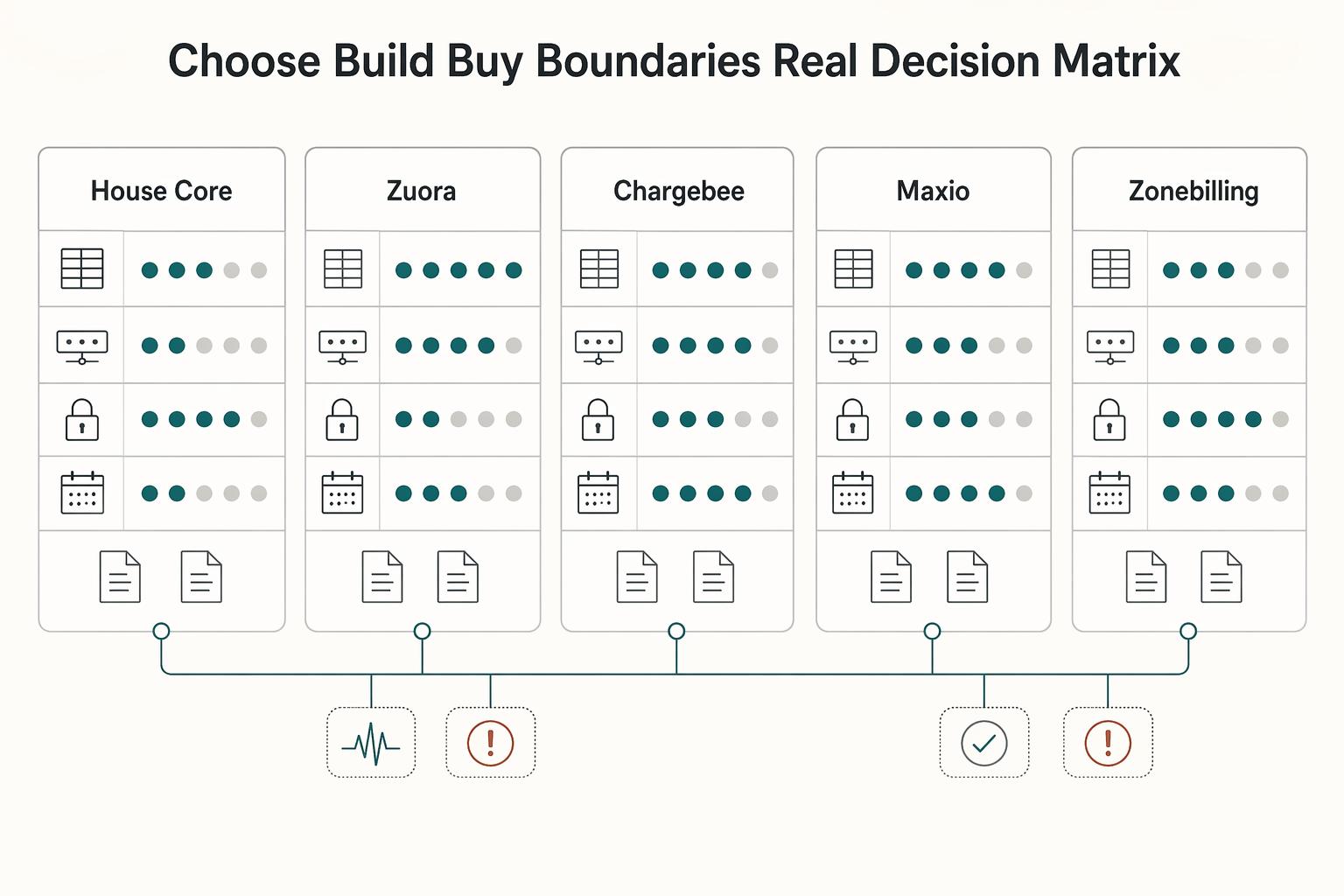
Choose Build vs Buy Boundaries With a Real Decision Matrix#
Use a scored matrix to set build-vs-buy boundaries before implementation. If phase one must hold up at close in your ERP, weight journal and export behavior above faster UI setup.
| Option | Best fit when | Documented accounting or migration signal | Main lock-in question |
|---|---|---|---|
| In-house core + vendor rails | You need tight control over contract terms, posting logic, and exceptions | Stripe documents staged subscription migration from third-party and in-house billing systems | How much pricing and posting logic lives only in custom code or one engineer's head? |
| Zuora | You want platform-led billing plus stronger export and NetSuite revenue handoff evidence | Zuora Data Exports can export predefined tenant data, and the Zuora Revenue GL Connector for NetSuite automates transfer of revenue journal entries to the NetSuite general ledger | How much accounting behavior depends on Zuora-specific objects and connectors? |
| Chargebee | You want packaged billing with documented migration scope and NetSuite accounting support | Chargebee migration includes customers, subscriptions, credit notes, and historical invoices; its NetSuite integration is positioned for accounting, reporting, and revenue recognition | Can you move pricing logic and invoice history out cleanly later? |
| Maxio | QuickBooks is central and consolidated month-end posting is acceptable | Maxio states it generates a consolidated journal entry at month end that is recorded in QuickBooks' general ledger | Will consolidated posting give finance enough detail for investigations and reconciliations? |
| ZoneBilling | You are still evaluating and need to prove close behavior directly | Require a live sample before you score it | What depends on proprietary invoice history, pricing rules, or ERP mappings? |
Step 1: Score the close, not the feature catalog. Score each option on ERP posting/export depth, migration scope, lock-in risk, and phase-one fit. Keep it simple (for example, 1-5), but require a note and a document for every score.
Step 2: Prioritize ERP evidence when close controls are strict. NetSuite automatically generates journal entries when posting transactions, so billing behavior must align with that flow. Ask vendors for the exact journal/export artifact your finance team will reconcile, then validate one sample transaction end to end.
Step 3: Treat lock-in as a migration risk. Score migration difficulty across pricing logic, event contracts, historical invoices, and downstream ERP dependencies. Chargebee's documented migration scope (including historical invoices) gives you a concrete benchmark for what to require from any option.
If migration is on your roadmap, this guide on moving billing platforms is a useful companion.
Step 4: Add a defer column to protect phase one. Defer edge cases until baseline reconciliation and incident handling are stable. Finance should be able to trace one invoice from billing record to export/journal output to ERP posting result without spreadsheet patching.
The common failure mode is choosing the fastest setup, then discovering close depends on manual exports, opaque journal logic, or partial invoice history. If your matrix shows that risk, reweight before you commit.
For a platform-side view of how billing systems handle plans, add-ons, coupons, and dunning, see Subscription Billing Platforms for Plans, Add-Ons, Coupons, and Dunning.
Design the Ledger and Reconciliation Backbone First#
After you choose the build-versus-buy boundary, lock your ledger model before adding product behavior. If posting logic is vague, close quality will drift even when invoice screens look fine.
Step 1: Define atomic posting primitives and keep them separate. Post separate events for invoice issue, payment success, payment failure or incomplete payment, credit issuance, refunds, and other internal settlement events. Do not collapse credits and refunds into one adjustment bucket. A credit note reduces the amount due without recording payment, while failed or incomplete payment leaves an invoice open, so they need different accounting effects and operator handling.
Use explicit invoice lifecycle states. Stripe documents five statuses: draft, open, paid, uncollectible, and void. A practical checkpoint is to trace one invoice end to end and confirm each state transition maps to specific posting IDs. If a refund rewrites the original invoice record instead of creating a reversing entry, reconstruction gets harder later.
Step 2: Implement three reconciliation layers with in-period checks and a period-close check. Treat reconciliation as a layered control, not one report.
| Layer | What you compare | Evidence to retain |
|---|---|---|
| Provider to subledger | Provider transactions and invoice references vs internal postings | Provider object IDs, internal posting IDs, mismatch notes |
| Bank to subledger | Bank deposits and withdrawals vs cleared cash postings | Bank statement line references, cash posting IDs, unresolved cash items |
| Subledger to ERP | Open receivable or payable balances vs corresponding GL accounts for the accounting period | Export artifact, import result, variance analysis, period sign-off note |
The subledger-to-ERP layer is the close gate. If you cannot explain a variance without a side spreadsheet, controls are still weak.
Step 3: Document consistency rules before volume increases. Derived balances can lag slightly, but posting order, replay behavior, and close outputs must stay deterministic. The same inputs should produce the same ending balances, and ledger history should remain reconstructable. In practice, that means append-only postings, stable ordering keys, idempotency keys on mutating calls, and a deduplication window for retries.
Test this directly: replay the same webhook batch twice and confirm ending balances, invoice states, and ERP export totals are identical. If they differ, you have a sequencing problem, not a reporting problem.
Step 4: Require a close evidence pack for every period. Keep provider references, internal posting IDs, export files, and written variance explanations tied to that close cycle. For provider evidence, store the original object identifier (for example, invoice IDs). For exports, retain the exact file finance used.
Recurring manual explanation is the red flag. Finance should be able to start from one balance, pull the period evidence pack, and reconstruct why it moved without engineering intervention.
If you are weighing what to build versus buy, see The Best Tools for Managing Subscription Billing.
Implement Contract to Cash and Usage Billing in One Controlled Flow#
Keep contract-to-cash and usage billing in one traceable sequence: once a quote is accepted, each downstream action should add a new recorded state rather than reinterpret the deal.
Step 1: Turn one accepted quote into one versioned billable contract. In sales-led flows, the process typically starts from a finalized quote and then moves into billing deal shaping. HubSpot quotes can bundle terms, acceptance, billing, and payments, and recurring line items can auto-create subscription records. Use that handoff boundary: capture approved commercial terms in Salesforce or HubSpot, then hand billing a versioned contract payload.
At minimum, carry:
- quote ID, customer account ID, acceptance timestamp, product and pricing terms, billing cadence, contract dates, and amendment version
- one stable external reference shared by billing, ledger records, and ERP-facing exports
Operational check: trace one accepted quote to its contract or subscription record, invoice schedule, and first ledger-linked billing event without manual lookup.
Step 2: Keep commercial approval and accounting control separate. Salesforce CPQ can run quote and order steps, and Salesforce Billing can take over invoicing, payment, and revenue recognition. Keep posting rules and ERP-facing accounting outputs controlled in billing/finance systems, with CRM changes flowing through explicit versioned handoffs.
Store the consumed handoff artifact: approved quote or order snapshot, contract version, invoice ID, payment object ID, and posting IDs.
Step 3: Split usage ingestion from invoice finalization. Record usage during the billing period, then calculate invoice totals from a finalized billing window. Stripe also documents asynchronous meter-event processing, so recently received usage may not appear immediately.
Use separate stages:
- ingest usage events with event ID, contract reference, meter/feature key, event timestamp, quantity, and received timestamp
- finalize invoices from the accepted window only
- route late usage to controlled adjustments instead of rewriting finalized invoice basis
If you report usage on intervals, Stripe's legacy guidance gives every 24 hours as an example and notes a 100 calls per second per account rate limit.
Step 4: Enforce replay safety before go-live. Use event IDs for inbound usage and webhooks, and idempotency keys for mutating API calls. Stripe warns webhook endpoints can receive duplicate events and retries undelivered events for up to three days.
Pre-launch tests:
- deliver the same invoice or payment webhook twice
- send contract activation before and after invoice scheduling
- inject delayed usage after invoice finalization
- replay a three-day webhook backlog and confirm no duplicate postings
Track with an operator scorecard:
| Checkpoint | What to watch | Trouble signal |
|---|---|---|
| Quote to invoice cycle time | Time from accepted quote to scheduled or issued invoice | Manual approvals, missing contract version, CRM-to-billing mapping gaps |
| Failed invoice rate | Share of invoices that fail collection or remain unresolved | Weak dunning, poor payment method capture, bad start-date handling |
| Usage dispute volume | Disputes tied to metered quantity or timing | Late ingestion, unclear meter definitions, silent corrections |
| Contract to cash exception count | Records needing manual intervention across quote, billing, payment, or posting | Broken handoffs, duplicate events, amendment handling gaps |
If exceptions cannot be explained from stored quote snapshots, contract versions, event IDs, and ledger postings, the flow is still too loose.
Wire Settlement and Payout Operations With Exception Queues#
Treat settlement and payout as separate recorded states, not one generic "paid out" outcome. If you collapse them, you can mark funds complete before provider status, bank movement, and ledger evidence agree.
Model settlement and payout as distinct recorded states#
Use one explicit chain: collection posted -> allocation -> settlement release -> payout batch creation -> payout status updates -> final resolution. Each step should write a new state and reference rather than overwrite the prior state.
For batch-oriented rails, this supports reconciliation. Stripe's payout reconciliation model is built around transactions grouped within each payout as a settlement batch. On each payout-related record, keep: internal batch ID, provider payout ID, provider account or recipient reference, amount, currency, created timestamp, current status, and ledger posting IDs for release and any reversal.
Checkpoint: trace one collected payment through allocation to the exact settlement release posting and payout batch. If that still needs spreadsheet reconstruction, reconciliation is not production-ready.
Create named exception queues before volume forces you to#
Stand up exception queues early, with clear ownership and response targets, so incidents do not become ad hoc workflows. A practical starting set is:
| Queue | Handling note |
|---|---|
| Returned funds | Capture provider payout ID, failure or return reason, original batch ID, and reversal posting ID |
| Unmatched deposits | Keep queue logic type-specific; an unmatched deposit should not share the same handling path as a returned payout or a compliance hold |
| Partial batch failures | Avoid batch-wide reversals unless provider status and batch evidence show full cancellation; reverse the failed item by default |
| AML review holds | Keep queue logic type-specific, and keep AML review holds visible in the same investigation flow |
For returned payouts, capture provider payout ID, failure or return reason, original batch ID, and reversal posting ID. Stripe Global Payouts distinguishes processing, posted, failed, returned, and canceled, defines returned payouts as payouts that failed to arrive, and notes returns are typically seen within 2-3 business days.
For partial failures, avoid batch-wide reversals unless provider status and batch evidence show full cancellation. Reverse the failed item by default.
Process cross-border status changes from webhooks, not assumptions#
For cross-border flows, process state from webhook events and event timestamps. Do not advance status from timers, UI polling, or submission assumptions.
Stripe notes payout notifications often arrive over multiple days, while instant payouts typically send payout.paid within 30 minutes. Wise also warns events can arrive out of order and should be sequenced using data.occurred_at. Stripe further notes that posted does not guarantee beneficiary receipt.
Stress test this before launch: replay payout events out of order and deliver duplicates. Final state should still be correct, with only one release or one reversal posted in the ledger.
Give ops one investigation view before funds are marked complete#
Before marking funds complete, ops should have one view that joins provider status, provider references, and ledger postings. Include payout ID, recipient or connected account, batch ID, current status, failure code when present, occurred-at timestamps, and linked release/reversal/return entries.
This is critical for two common edges: payout.failed handling with failure_code, and compliance-driven pauses before funds leave. Adyen documents pre-release policy analysis with pending/manual review behavior, so AML review holds should remain visible in the same investigation flow.
A useful incident packet stays compact: payout request record, provider event history, provider reference, batch membership, ledger posting IDs, and reversal/return entries.
Add Compliance and Tax Gates by Market Program#
Default to fail-closed: if compliance state is missing or stale, block payout and tax-sensitive actions until the state is resolved. This avoids creating money movement and tax outcomes you cannot defend later in audit.
| Item | Article note |
|---|---|
| W-9 | Supports correct TIN collection for payer information returns |
| W-8 BEN | Submitted when requested by the payer or withholding agent |
| 1099-NEC | Covers nonemployee compensation reporting |
| FBAR (FinCEN Form 114) | Separate concept and should not be treated as a default payout gate for every account |
| FEIE | Separate concept and should not be treated as a default payout gate for every account |
Step 1: Gate by program and market, not one global compliance flag. Tie KYC, KYB, and AML checks to the specific market/program path. If your provider expects onboarding data, collect the required KYC/KYB details during onboarding and pass them through. Treat AML logic as versioned policy input, not static code, and keep an audit trail with program, jurisdiction, outcome, rule version, timestamp, provider account reference, and decision actor.
Step 2: Keep tax-document workflows separate from reporting status. Do not collapse W-8, W-9, and information-return readiness into one tax_verified field. W-9 supports correct TIN collection for payer information returns, W-8 BEN is submitted when requested by the payer or withholding agent, and 1099-NEC covers nonemployee compensation reporting. FBAR (FinCEN Form 114) and FEIE are separate concepts and should not be treated as default payout gates for every account. Store document type, collection status, effective date, masked identifiers, and access logs with tight role-based access.
Step 3: Validate VAT where supported, and record fallback when not supported. Use VAT validation in onboarding and invoicing paths where coverage exists (for example, EU cross-border checks via VIES) and keep reverse-charge decisions explicit. Also record when validation is unavailable and why, because coverage is not universal (including GB VAT handling after 01/01/2021 in VIES, and product/jurisdiction gaps in tax engines). Keep validation_source, checked_at, and fallback_reason on customer/invoice records, and route unresolved cases to manual review instead of auto-marking zero VAT or reverse charge.
Step 4: Keep overrides controlled and auditable. When a required compliance/tax state is missing, block the action by default. If you allow an exception, require named approver, reason, expiry, linked evidence, and post-incident review when money movement occurred. Test this directly: submit a payout or tax-sensitive invoice with missing state and confirm no payout batch, ledger release, or final tax treatment is created before approval.
Related: Education and eLearning Platform Billing: How to Manage Subscriptions Cohorts and Course Access.
Prove Readiness With Go Live and Incident Checkpoints#
Go live only when you can show that retries, delayed events, reconciliation breaks, and payout failures resolve to one controlled outcome, not duplicate side effects.
Step 1: Validate pre-launch behavior with evidence, not screenshots. In Stripe test mode, test every mutating call tied to money movement or posting. Then retry with the same idempotency key and confirm you get the original result rather than a second side effect.
For webhooks, replay the same event twice and verify your consumer logs the event ID, skips already processed deliveries, and creates no duplicate ledger entry. Also test delayed and out-of-order payloads, since webhook delivery is asynchronous and ordering is not guaranteed. Keep a verification pack with request IDs, event IDs, internal posting IDs, and the API version used in testing.
Step 2: Prove reconciliation paths can be investigated end to end. Before launch, trace a payment, refund, and payout from provider reference to ledger posting to ERP export. If cash is unmatched, your team should be able to drill down to transaction detail and follow a defined troubleshooting path instead of manual CSV comparison.
Step 3: Prepare an incident checklist for known failure modes. Include duplicate-charge risk, delayed webhooks, unmatched cash, rollback or replay method, and finance communication protocol. Delayed delivery must be explicit in the runbook because undelivered events can be retried for up to three days in live mode.
Step 4: Set hard launch gates in policy terms. Define reconciliation variance tolerance, maximum open exception backlog, and a payout-failure recovery target before real traffic starts. Keep recovery as an explicit RTO (maximum allowed restoration time for a single incident), and track MTTR separately as an average over incidents.
Step 5: Run a first-30-day control loop. Review ERP export defects, payout failures, duplicate-event handling, and recurring exception root causes. When the same cause repeats, fix the underlying posting or event logic instead of adding another manual workaround.
Related reading: Choosing Between Subscription and Transaction Fees for Your Revenue Model.
Conclusion#
A strong billing engine earns trust by making the ledger explainable, keeping exceptions visible, and making close behavior boring. If finance still has to reconstruct invoice, payment, and payout history from CSVs, the product is not finished, even if the pricing catalog looks complete.
-
Start with the decision matrix before you start wiring features. The real design choice is who owns pricing, subscriptions, usage, invoicing, and payments as one connected billing backbone. The first verification point is not a demo invoice. It is whether you can point to the system of record for each domain and show how approved contract terms turn into subscription generation, rating, and billing data preparation without manual rekeying or side spreadsheets.
-
Prove go-live readiness before production cutover. Your checklist should explicitly test delayed, duplicate, and out-of-order webhook delivery, and every mutating API call should be retry-safe with idempotency keys. Run those tests in test mode so you are not touching live data, and exercise the webhook endpoint handler locally with a CLI before launch. The failure mode is predictable: teams validate the happy path, then get hit by duplicate deliveries or late events that create double side effects or rewrite assumptions after finance has already moved on.
-
Implement the posting backbone before adding edge-case packaging. One workable pattern is to define core posting and export behavior before expanding product complexity. The checkpoint is traceability: starting from a provider reference or internal event ID, you should be able to reach the relevant posting records, invoice state, adjustment history, and close artifacts. If you cannot assemble that evidence pack quickly, reconciliation pain will show up long before scale does.
-
Wire payout controls as part of close, not as a payments afterthought. Reconciliation becomes more predictable when your payout design preserves the association between each transaction and the payout it is included in. Treat each payout as a settlement batch with artifacts your team can review, not just a bank movement you hope matches later. If ops cannot move from a payout record to the included transactions and related ledger postings, exception queues become your month-end backlog.
-
Add required policy and compliance gates where applicable, and make them fail closed. Required checks should sit on the operating path for sensitive actions, with logged decisions and documented overrides. The tradeoff is speed versus control. Lighter gating feels faster early on, but missing compliance state creates expensive manual review and cleanup later.
The practical recommendation is simple: use the decision matrix and readiness checklist first, then build in this order if it fits your environment: posting backbone, contract-to-cash flow, payout reconciliation, and required compliance gates. That sequence will not solve every architecture choice, but it gives you a stronger chance of a ledger your finance team can trust and a close process your ops team can sustain.
Frequently Asked Questions
What is a subscription billing engine for a B2B platform?
For a B2B platform, the billing engine is the core component that computes charges and automates invoicing, not just the screen where someone clicks send invoice. In practice, it should own recurring charges, usage-based billing, and negotiated contract terms, then hand finance a traceable record of what happened. If it cannot link contract and invoice actions to downstream financial records, it is still too UI-heavy to trust.
Which components are table stakes at launch, and which can wait?
Table stakes are the pieces that prevent finance pain later: billing logic, invoice generation, replay-safe payment and webhook handling, reconciliation paths, and visible exception queues for unmatched cash or payout issues. You can usually defer nicer packaging such as broader lifecycle automation, as long as launch still covers recurring, usage-based, and sales-negotiated contract paths. A good checkpoint is simple: can you trace one invoice, one payment, and one payout from provider reference to internal records without manual stitching?
When should we build in-house instead of using Zuora, Chargebee, or Maxio?
Build when you truly need deep control over infrastructure and billing logic, and are willing to own the event model, audit behavior, and long-term maintenance. Buy when speed and broader subscription lifecycle automation matter more than custom internals. The red flag is pretending you want flexibility when what you really need is a working contract-to-cash product quickly, not maximum ownership burden.
What failure modes cause the most reconciliation pain in real operations?
The ugliest ones are duplicate side effects from retries, weak payout mapping, and asynchronous events being processed as if they were final and in order. Payout reconciliation gets especially painful when manual payouts are involved, because you still have to match payouts against transaction history. If ops cannot start from a payout or event reference and reach the included transactions plus internal posting IDs, month end turns into investigation by spreadsheet.
Which metrics best prove billing health for finance and ops?
For finance, start with MRR, ARR, and churn visibility so you can see whether billing output matches the revenue story you report. For operations, pair that with exception counts: open reconciliation items, payout mismatches, and usage dispute volume. The useful rule is to review growth metrics and control metrics together, because revenue can look fine while close quality is quietly getting worse.
How do we support usage-based billing without creating replay and dispute chaos?
Separate usage ingestion from invoice finalization, and never let late events silently rewrite a closed result. Store the usage event ID, keep writes idempotent, and manage subscription state through webhooks because activity is asynchronous and deliveries can repeat for up to three days. For provider-facing retries, reuse the same idempotency key within 24 hours; for your own evidence pack, keep the event ID, customer, meter period, invoice ID, and adjustment record so disputes can be resolved from facts instead of estimates.
Try a related tool
Researched and edited by the Gruv editorial team. Gruv builds cross-border billing, payouts, and finance-operations software for global businesses.
Sources
Includes 1 external source outside the trusted-domain allowlist.
- docs.stripe.com/webhooks/process-undelivered-eventstrusted
- docs.stripe.com/webhookstrusted
- ec.europa.eu/taxation_customs/vies/vatRequest.htmltrusted
- europa.eu/youreurope/business/taxation/vat/check-vat-n...trusted
- federalreserve.gov/frrs/regulations/section-1020220-customer-id...trusted
- irs.gov/individuals/international-taxpayers/foreign-...trusted
- irs.gov/privacy-disclosure/meeting-irs-safeguards-au...trusted
- docs.adyen.com/reporting/settlement-reconciliationexternal
Educational content only. Not legal, tax, or financial advice.
Related Posts
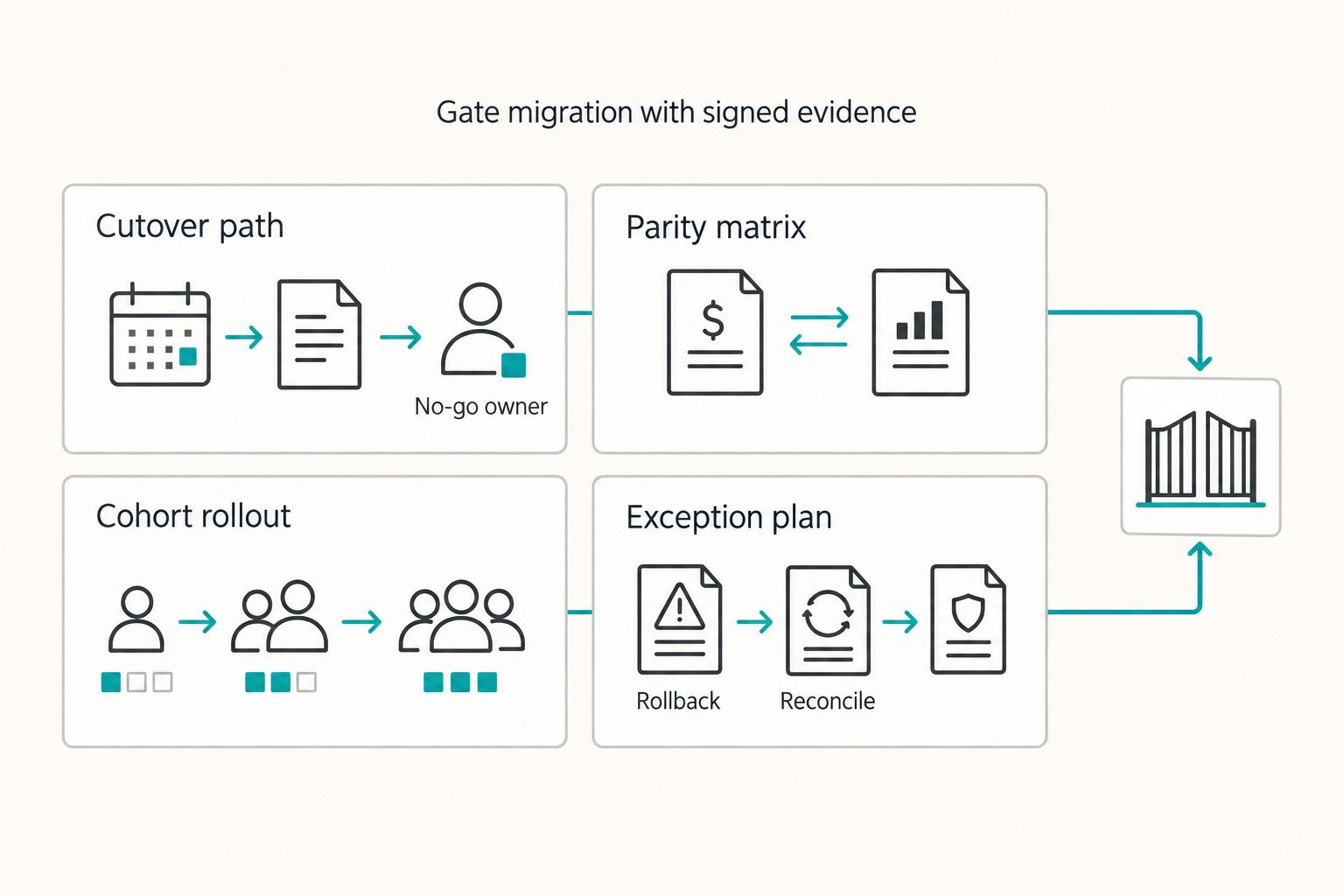
How to Migrate Your Subscription Billing to a New Platform Without Losing Revenue
If you need to **migrate subscription billing platform without losing revenue**, treat it as a revenue operations change, not a simple software swap. Billing migrations sit close to renewals, revenue reporting, and payment credentials, so mistakes rarely stay technical. They can show up as duplicate records, inaccurate revenue reporting, failed renewals, or customer-facing downtime.
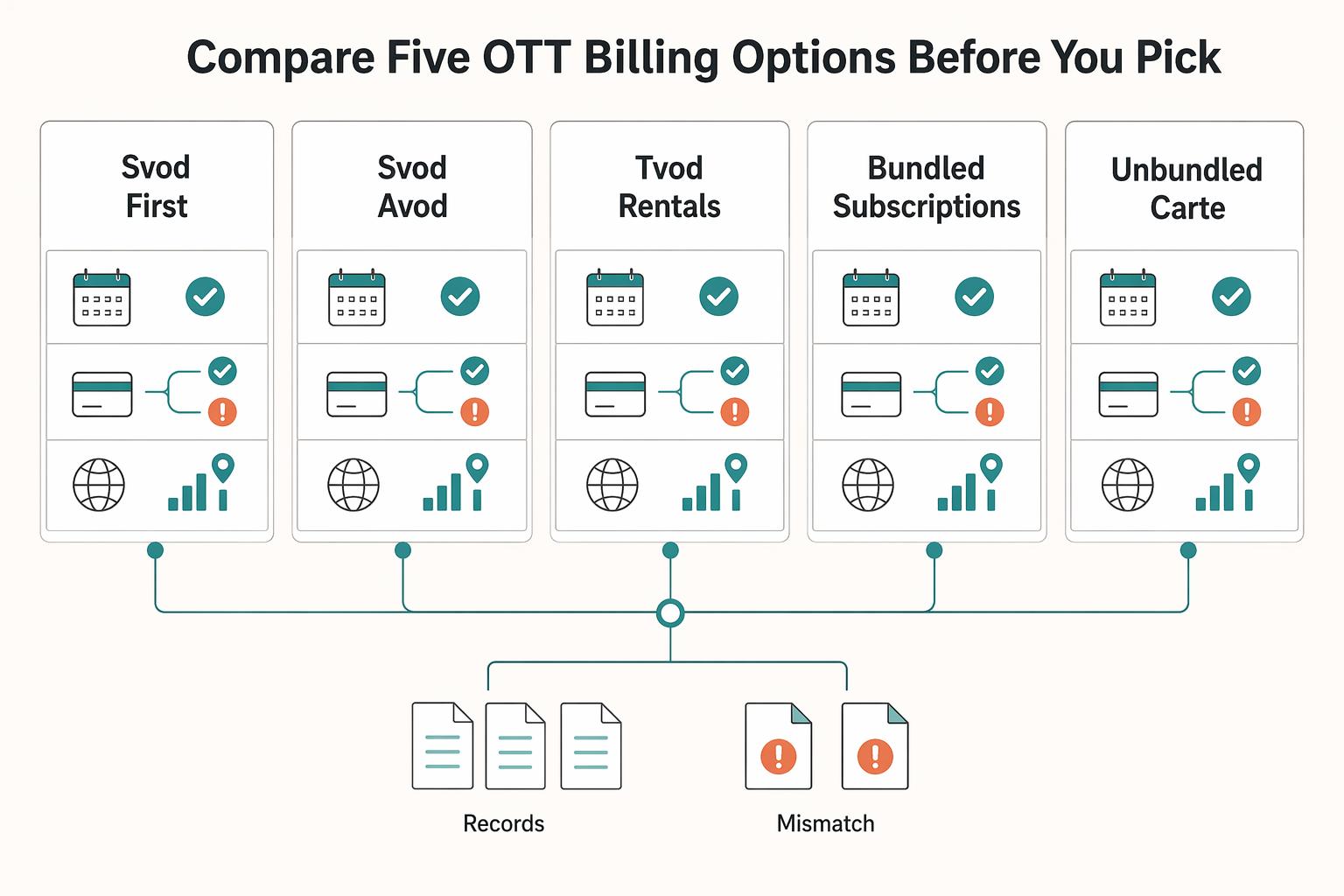
How OTT Platforms Handle Billing Trials and Churn in Streaming Subscriptions
Start with the monetization model. Choose your monetization path before a product demo starts steering the decision. For a streaming offer, the real question is not which vendor can show subscriptions on a checkout page. It is whether your business is built around recurring access, ad-supported reach, one-off transactions, or a direct-to-consumer mix that may vary by market.
Education and eLearning Platform Billing for Cohorts and Course Access
Start with three linked decisions: what you are selling, how access is granted, and whether your payout setup can support the currencies you plan to offer. Make those calls in the wrong order, and you can end up rebuilding pricing, enrollment logic, and finance operations at the same time.