
Quick Answer
Choose the model that matches the charge trigger you can prove in product data. Use subscription when customers buy ongoing access and you can reconcile Monthly recurring revenue (MRR) to real entitlements; use transaction fees when each paid event is discrete and traceable. Before scaling, run two checks: can support explain one bill on one screen, and can finance separate recurring and variable revenue without manual patching. If either fails, simplify or postpone hybrid.
How Each Model Triggers Revenue#
The real mistake in choosing between subscription and transaction fees is usually not picking the wrong label. It is choosing a model your customers do not naturally fit, or one your team cannot bill, explain, and reconcile without frequent exceptions. That is when a revenue plan looks good in a deck and bad in operations.
At the simplest level, a revenue model is how a business earns money and from which sources. Within that, a subscription business model centers on recurring need and recurring access or fees. A transaction model works differently: customers make separate, often one-time payments for each purchase or event. Traditional ecommerce checkout is the familiar example, where someone picks an item, adds it to cart, and pays for that single transaction.
Neither model wins by default. The choice is not between two pricing buzzwords. You are deciding what kind of customer behavior you want to monetize and what operating model your product, finance, and payments teams can realistically support.
A useful early check is simple. Can you point to the exact customer action that should trigger a charge, and can you show that charge clearly on one checkout screen or invoice? If the answer is fuzzy, the model is not ready. Subscriptions tend to fit recurring need. Transaction charging tends to fit discrete purchases. Problems start when the pricing logic says one thing, but the customer experience feels like the other.
That mismatch can show up in boring but expensive places. Finance may struggle to forecast when revenue does not track how customers actually buy. Product may keep adding edge cases to force the model to fit usage. Support may get pulled into billing questions when customers cannot tell what they are paying for. These are not side issues. They can be early signs that the model and the operating reality are out of alignment.
This article stays focused on one outcome: choosing a model you can run reliably across product, finance, and payments operations, not just one that sounds good in a sales narrative. We will connect unit economics, billing complexity, and execution constraints so you can make the call with fewer blind spots and less rework. If usage is steady and ongoing, recurring fees are often the first model to evaluate. If value shows up in isolated events, start with per-transaction charging and test from there.
At-a-glance comparison for subscription, transaction, and hybrid#
Start with demand shape. If usage is steady and ongoing, lean toward a Flat recurring fee. If usage is uneven, event-driven, or seasonal, lean toward Usage-based pricing or Pay-per-use pricing. Use a hybrid only when you can clearly separate recurring and variable charges in both billing and reporting.
| Criteria | Subscription model | Transaction fee model | Hybrid pricing model |
|---|---|---|---|
| Predictability | Higher predictability when customer need is recurring | Lower predictability because revenue moves with purchase volume | Moderate: recurring baseline plus variable upside or downside |
| Conversion friction | Can be higher upfront because customers commit before repeated use is proven | Often lower at first purchase because payment is tied to an event | Mixed: works best when access fees and volume fees are clearly separated |
| Margin volatility | Usually steadier when usage is consistent | More exposed to swings in customer activity | More stable than pure transaction, but still exposed to usage swings |
| Implementation effort | Simpler when one recurring charge covers most cases | Simpler when each paid event is discrete and countable | Highest complexity because two charge logics must be defined and reconciled |
| Best fit by demand pattern | Ongoing, habitual, repeat need | Sporadic, bursty, or one-off demand | Mixed demand, or ongoing access plus variable throughput |
| Sensitivity to Churn | Direct exposure: cancellations and downgrades hit recurring revenue | Less about classic subscription churn; more about declining order or usage volume | Exposed to both retention risk and activity risk |
| Monthly recurring revenue (MRR) visibility | Strongest MRR visibility because recurring fees are the core signal | Weak MRR visibility because most revenue is non-recurring | Partial MRR visibility for the subscription layer only |
| Downside when customer usage drops | Customers may question value and cancel or contract seats or tier | Revenue drops with lower transaction volume | Base revenue may hold, but usage and expansion revenue can fall |
| Best fit rule | If customers buy continuity and usage is stable, lean here | If value is tied to each event or order, lean here | If you need a base commitment plus variable upside, use only with clear reporting lines |
| What this model hides | Expansion and contraction can make headline recurring revenue look healthier than underlying customer value | Planning can look stable in growth, then become unstable when volume softens | Complexity often hides in invoice logic, reporting clarity, and customer bill explanations |
A short decision rule#
Choose based on what customers are actually buying: ongoing access or separate events. A subscription business model fits ongoing access because customers pay recurring fees rather than making one-time purchases. Transaction pricing fits event-based value because charges are tied to each purchase or usage event.
Hybrid is a deliberate mix, not a default compromise. When subscriptions sit alongside transaction or usage-linked components, your revenue is no longer purely recurring, so reporting must separate those streams.
What to verify before you commit#
Verify that finance can report recurring and variable layers separately from day one. If dashboards, invoices, or ledger views collapse both into one number, visibility drops fast when usage changes but base fees do not.
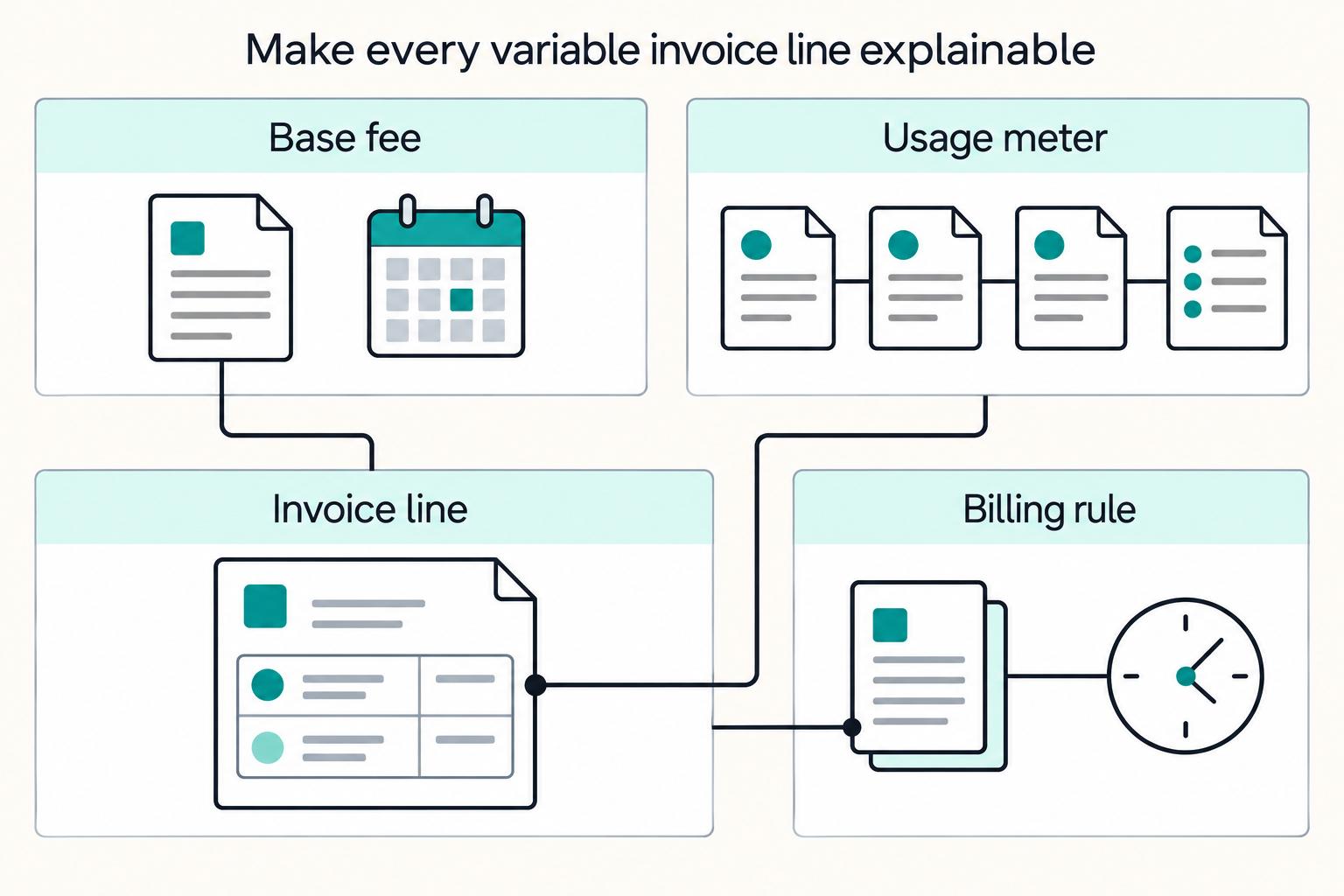
Then test customer clarity. Ask support or sales to explain one bill on one screen: what is the access fee, what is the usage charge, and what action triggered each line item? If that explanation is hard, the model is harder to run than it looks.
Where teams get fooled#
Subscription pricing can hide softness when customers keep paying but shrink seats, tiers, or engagement. A pure transaction model can hide planning risk because revenue depends directly on activity levels. Hybrid can hide operational risk when pricing logic is not explicit across invoicing and reporting.
If you are unsure, start with the single charge trigger that best matches real demand. Add a second component only when you can track, invoice, and reconcile both cleanly.
Demand shape and value metric should drive the first decision#
Start with the value trigger you can observe in your own product data, then price around that trigger. The goal is not to force a universal rule; it is to align the charge with what customers repeatedly perceive as value.
Review recent invoices, usage logs, and event histories across a sample of accounts. If the recurring promise is clear, a Flat recurring fee is usually easier to defend; if each billable event is clear, Pay-per-use pricing or a Transaction fee model is usually easier to defend. If neither trigger is clear in your records, the model is not ready yet.
The same test protects execution quality. If you cannot explain recurring entitlement during a quiet month, the subscription design is weak. If you cannot point to the exact action that triggers each variable charge, the transaction or usage design is weak.
Subscription operators often need broader reporting than traditional software metrics, and revenue recognition is one of the first areas that has to hold up. Use that as an operating check: choose the model your finance and support teams can explain, invoice, and reconcile without exceptions.
Where one-time charges still fit#
One-time charges still fit when the work is truly one-time, such as setup or add-on services, and should stay separate from recurring access or per-event charges. Clear labels on order forms and invoices help reduce disputes about what the customer already paid for.
Unit economics and forecasting mechanics that decide if the model survives#
If the model cannot hold margin and cash logic in a bad month, it does not survive. As a working rule, recurring revenue is usually easier to forecast, while transaction-linked revenue is more exposed to payment mix, payout behavior, and volume swings.
| Finance question | Recurring revenue design | Transaction-linked revenue design |
|---|---|---|
| Revenue predictability | Usually higher, because booked revenue follows active subscriptions and contract terms more than daily volume | Usually lower, because revenue moves with payment volume, order count, or payout activity |
| Gross-margin volatility | Usually steadier when service cost is relatively fixed and entitlement is clear | More exposed to mix shifts, fee changes, and lower-value transactions with the same fixed per-event cost |
| Recovery levers under a demand shock | Reduce churn, tighten renewals, push expansion or seat growth, revisit package design | Improve take-rate consistency, improve payment-method mix, increase volume, reduce loss-making transaction paths |
| First forecast check | Can you reconcile Monthly recurring revenue (MRR) to real billable entitlements? | Can you trace every variable charge to a counted event and its direct cost stack? |
Use KPIs that match the model. In subscription-heavy designs, MRR and Churn show whether the base is holding or leaking. In transaction-heavy designs, focus on take-rate consistency, margin sensitivity to volume drops, and what happens when customers shift to a more expensive payment mix.
That cost-stack detail matters. Stripe’s US Standard pricing lists 2.9% + 30¢ per successful domestic card transaction, plus +0.5% for manually entered cards, +1.5% for international cards, and +1% when currency conversion is required. ACH Direct Debit is listed at 0.8% with a $5.00 cap. If your model assumes one blended cost while mix shifts to international or cross-border volume, gross margin can move even when your headline take rate does not.
What finance should verify before approval#
For transaction-heavy pricing, build forecasts from actual cost triggers, not a single average. Stripe Connect shows why: on the US "you handle pricing" schedule, Stripe charges $2 per monthly active account and 0.25% + 25¢ per payout sent, and an account is active in any month payouts are sent to its bank account or debit card. That means economics can depend on payout behavior and active-account count, not only successful payments.
| Approval item | What to check |
|---|---|
| Sample invoice | Each fee component labeled |
| Event-to-ledger mapping | What creates revenue vs direct cost |
| Downside case | Where volume falls or payment mix worsens |
| Revenue recognition memo | For the proposed billing logic |
Model additive services separately. Stripe’s US pricing lists Managed Payments merchant-of-record services at 3.5% per successful Managed Payments transaction, in addition to Payments fees. This applies to that product, rather than every Stripe payment. Use the country-specific schedule and your contracted configuration for the final cost model.
Directional evidence is not a neutral benchmark#
Treat competitor and vendor material from GoCardless, Stripe, Orb, or SubscriptionFlow as directional, not a neutral benchmark. It can help frame recurring, metering, or fee mechanics, but it is not a market baseline for your margins and may vary by country, payment method, contract, or negotiated plan.
Before rollout, check contribution margin and revenue recognition. Finance should explain when each fee is earned and distinguish recurring-revenue metrics from recognized accounting revenue. Use LTV/CAC as an assumption to monitor until renewal history supports it; a short pilot cannot prove lifetime value. Related: Subscription Revenue Forecasting: How Platforms Model MRR Growth Churn and Expansion.
Hidden costs and failure modes competitors gloss over#
If your team cannot explain invoice math on one screen, simplify the model before scaling acquisition. The hidden cost is usually not the headline price. It is the operating drag from billing questions, exception handling, reconciliation work, and pricing rules that keep multiplying.
| Model shape | Hidden cost that shows up later | Typical failure mode | What to verify before scaling |
|---|---|---|---|
| Usage-based pricing | High support load from charge questions, invoice review, and metering reconciliation | Bill shock when usage spikes faster than expected | Can your team trace each usage line from metering event to final invoice total on one screen? |
| Flat recurring fee | Ongoing exception handling as real usage drifts from the package | Growth stalls when one fixed fee fits neither light nor heavy users well | Are entitlement limits and upgrade/overage triggers clear enough to explain without custom logic? |
| Pure transaction fee model | Cash-planning noise, dispute handling, and constant margin checks | Unpredictable cash periods when customer volume swings | Can finance show when each fee is earned and how margin changes as throughput shifts? |
Assumption risk is the common thread across all three. Plans often assume customer behavior, market response, and pricing fit are stable; when those assumptions are wrong, teams miss targets, burn cash, and watch a clean plan unravel in execution.
Stress-test usage-heavy models with an explicitly hypothetical case, such as a customer consuming ten times its normal volume. Check whether metering, included allowances, and invoice review still produce the agreed total. This exposes capacity and billing limits before a real usage spike.
Flat recurring fees fail differently: they stay simple until usage patterns diverge, then exceptions and custom terms creep in. Pure transaction models invert the problem: less precommitted access friction, but more revenue and cash volatility when customer activity moves month to month.
Use a blunt gate before launch: stress-test your critical assumptions and run the hardest invoice path end to end. If customer-facing and finance reviewers cannot independently reproduce the same total from the same evidence, the model is too complex to scale cleanly.
This pairs well with our guide on How Interchange Fees Change the Price You Need to Charge.
When hybrid pricing is the right call and how to avoid a messy design#
Hybrid pricing is the right call when you need a stable recurring base and a variable charge that scales with usage or transaction volume. It is usually a fit when customer segments are mixed and usage is uneven. If metering is weak or Revenue recognition treatment is not defined, do not launch hybrid yet.
| Hybrid pattern | Best fit | What the recurring fee pays for | What the variable fee pays for | Main risk |
|---|---|---|---|---|
| Platform subscription + transaction fee | Access has clear value, but throughput varies by customer | Access, support, admin seats, core platform rights | Processed transactions or volume | Perceived double-charge if both fees map to the same value event |
| Minimum commit + Usage-based pricing expansion | Customers need a baseline plus room to grow | Reserved capacity or included usage | Overage above the commit | Bill shock when overage rules are unclear |
| Recurring platform fee + overage + one-time setup | Onboarding-heavy or more complex implementations | Ongoing service access | Variable overages | Catalog sprawl when setup, subscription, and usage are split into unrelated SKUs |
Use one primary value metric per fee component. The recurring fee should pay for access or entitlement, and the variable fee should pay for throughput. If both fees charge the same event, the design is too messy.
A practical check: product, finance, and support should each be able to explain the same invoice from the same contract terms and metering events, without interpretation gaps. If you use catalog logic, a helpful structure is a clear split between Product (value), Rate Plan (context), and Charge (price) so these layers do not get tangled.
Most hybrid failures come from implementation, not the model itself. Flat-fee tools often break on variable usage, and forcing hybrid logic into legacy billing can fragment pricing and billing data. Avoid "Frankenstein SKU" design by keeping components in one coherent rate plan instead of scattering them across disconnected SKUs.
Use hybrid only when every charge has a distinct job you can prove with telemetry. If you cannot reliably meter the variable component or define recognition handling clearly, keep the model simpler for now and revisit once your data and catalog are ready.
If you want a deeper dive, read How to Price Your Payment Platform: Transaction Fees Subscription and Hybrid Models Compared.
Execution sequence across product, finance, and payments operations#
After you choose a model, execution quality determines whether pricing works in the real world. A practical sequence is to define pricing logic, validate event instrumentation, shape invoice presentation, align exception handling, and then launch with clear rollback triggers.
Start with the value metric, not the billing tool#
The value metric is the control point for everything that follows. If teams are not aligned on what creates a charge, billing, reporting, and customer communication drift quickly.
| Spec element | Include |
|---|---|
| Charge trigger | What triggers each charge |
| Billed unit | The unit being billed |
| Timing and exclusions | Timing and exclusions |
| Invoice label | Customer-facing invoice label |
| Source event | The source event that proves the charge |
Leave time for product, finance, and customer testing. A pricing change needs a working meter, clear contract terms, and at least enough billing cycles to reveal errors and customer objections; configuring a price in the billing tool is only one part of that work.
If you cannot trace contract term -> event -> invoice line, tighten the spec before launch.
Model choice changes operational workload#
Model choice affects day-to-day operating load, not just revenue shape.
| Model | Main operating pressure before launch | Typical failure mode |
|---|---|---|
| Subscription pricing | Plan/entitlement clarity, renewal timing, proration behavior, and invoice readability | Customer confusion when invoice timing or proration does not match expectations |
| Transaction fee model | Event integrity and reliable handling of reversals, refunds, and edge cases | Charges tied to events that later change state, creating cleanup work |
| Hybrid pricing | Clear separation of recurring and variable value metrics on one invoice | Double-charging the same activity or splitting logic across disconnected records |
Use this table as an operating checklist, not a universal standard.
Set ownership and rollback rules before go-live#
Weak ownership is a common path to revenue leakage. The exact split varies by company, but accountability should be explicit across product, finance, and revops before rollout.
Two documents cut avoidable rework:
- An exception policy that defines who can waive, refund, or override charges
- A reconciliation review pack that helps teams explain charge logic consistently during launch and support escalations
Define rollback triggers in advance so the team can pause quickly when rollout quality drops. Typical triggers include rising event mismatches, reconciliation breaks, or dispute volume above your threshold.
A 90-day validation checklist before full rollout#
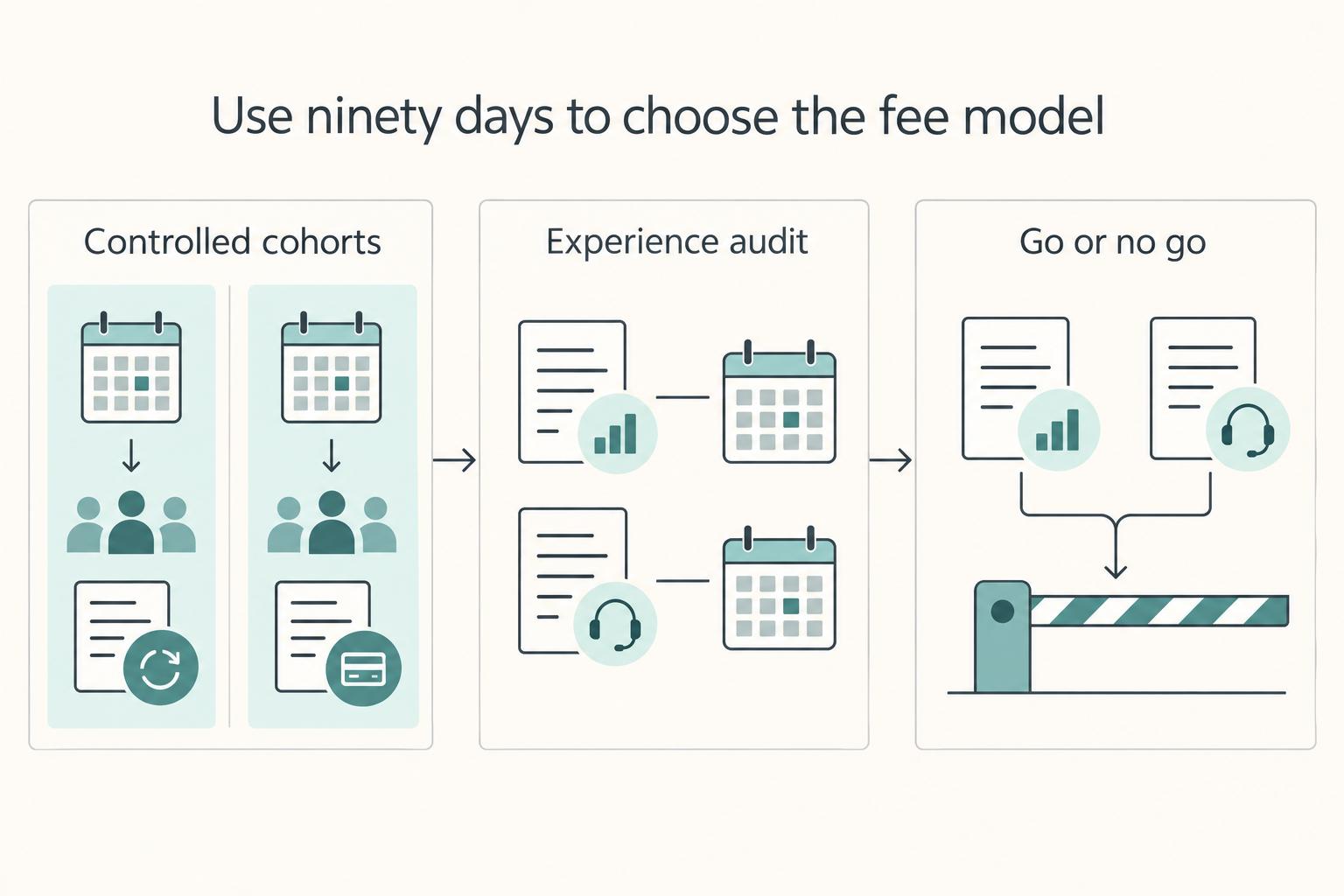
Use 90 days as an example planning window, then adjust it to your billing interval and demand cycle. Test both models in controlled cohorts and use billing, reporting, and support evidence to decide. Annual renewal and seasonal retention effects need a longer observation period.
| Phase | Main action | Checks |
|---|---|---|
| Phase 1 | Run a controlled pilot with separate Subscription model and Transaction fee model cohorts | Lock your scorecard before invoicing starts; track charge logic, support-contact patterns, and whether billed lines can be traced to underlying billing records |
| Phase 2 | Audit what customers and operators actually experience, account by account | Review invoice clarity, support tickets, and early Churn signals; check that reported Monthly recurring revenue (MRR) aligns with booked billing activity; confirm CRM, billing, and finance records stay in sync |
| Phase 3 | Make the go/no-go call | Compare contribution margin, early retention, and billing incidents; treat LTV/CAC as provisional until enough renewals support it. Expand only with clear invoices and traceable revenue treatment |
Phase 1. Run a controlled pilot and lock your scorecard#
Run a controlled pilot with separate Subscription model and Transaction fee model cohorts, and lock your scorecard before invoicing starts. Define what you will track upfront, including charge logic, support-contact patterns, and whether billed lines can be traced to underlying billing records. If your data foundation is weak, treat early results as directional; clean tracking and reporting are needed for dependable MRR and retention reads.
Phase 2. Audit what customers and operators actually experience#
Audit what customers and operators actually experience, account by account. Review invoice clarity, support tickets, and early Churn signals, then check that reported Monthly recurring revenue (MRR) aligns with booked billing activity without spreadsheet-heavy workarounds. Confirm CRM, billing, and finance records stay in sync so commercial metrics remain decision-useful.
Phase 3. Make the go/no-go call, then scale or revert#
Make the go/no-go call using contribution margin, early retention signals, and billing incident rates together. Treat LTV/CAC as provisional when the pilot has not observed enough renewals to estimate lifetime value. Scale the model that stays clear for customers and traceable for finance. If variable charging produces unresolved reconciliation or dispute pressure, narrow scope and repair the meter before adding a hybrid layer; if neither cohort is stable, revert and retest.
Conclusion#
In this decision, the winner is usually not the model with the neatest pitch. It is the one your team can explain on an invoice, bill correctly, reconcile without guesswork, and defend when demand shifts or a customer challenges the charge.
If customers get value continuously, a subscription business model often gives you a strong operating base. The logic is straightforward: subscriptions are built on recurring fees for ongoing access, and they are associated with more predictable, stable revenue and cash flow. That can mean weekly, monthly, bi-monthly, or annual payments. The real test is not the billing interval. It is whether you can keep retention and churn under control, because predictable revenue stops being predictable fast when renewals weaken.
A transaction fee model earns its keep when value shows up in discrete events instead of steady access. Some marketplaces clearly work this way and charge commission on each sale rather than a recurring fee. If buyers are intermittent, seasonal, or hesitant to commit before they see value, tying price to each event can be easier to justify. The tradeoff is operational and financial: billing and reconciliation still need to hold up when transaction volume moves around.
That is also the checkpoint before you scale. Review billing output, support questions, and reconciliation effort under normal load and under a messy month. If finance has to patch results manually or support needs custom explanations for routine invoices, simplify before you grow acquisition. A model that only works in a clean demo environment is not ready.
Hybrid pricing should be a next step, not a reflex. Hybrid pricing models combine two or more pricing logics, such as subscription plus usage, and they can better match different value and cost patterns when one metric is too blunt. Use that route when you truly have two distinct value layers, not when you are trying to hide uncertainty behind extra pricing components. The rule worth keeping is simple: start simple, prove the economics with real operating data, then move to a Hybrid pricing model only when your pricing logic is mature enough to stay understandable and defensible.
So the practical recommendation is clear. Match pricing to demand shape, validate it in the real world, and scale only once your finance and operations checks show the model works under stress, not just in a spreadsheet. Related reading: How to Build a 3-Statement Financial Model.
Frequently Asked Questions
Is Usage-based pricing the same as a Transaction fee model, or are they different in practice?
Not always. Usage-based pricing means customers pay for actual consumption, and a transaction fee is one version of that when the unit of consumption is a transaction or payment event. The practical difference is the meter: in a transaction-fee setup, each transaction is the usage unit. As with other usage-based models, billing and revenue-recognition hurdles can show up if usage records are hard to reconcile.
When does a Subscription model hurt conversion even if it improves Recurring revenue?
It usually hurts when customer usage is uneven, sporadic, or hard to predict. A flat recurring fee can feel like a bigger commitment when value is uncertain. Subscription pricing fits better when usage is consistent and customers want predictable costs. A practical checkpoint is early objections: repeated requests for pay-per-use can signal a mismatch.
When do transaction fees make planning too unstable for finance teams?
They become harder to plan around when revenue moves with transaction volume. Usage-linked models can also create operational hurdles in billing and revenue recognition, so the risk is not only revenue swings but operational complexity.
Should B2B platforms default to a Hybrid pricing model from day one?
Start with the charge trigger customers can understand and your team can measure. Subscription can fit ongoing access; transaction fees can fit discrete events. Combine them when the access and usage components each have a clear job, and show included usage and overages so the same activity is not charged twice.
What should we measure first: Monthly recurring revenue (MRR), Churn, or LTV/CAC?
Check billing correctness and usage visibility first, then measure the economics of the chosen model. Track MRR and retention for the subscription layer, and contribution margin and activity for variable charges. Estimate LTV/CAC over enough renewal history to support the assumptions rather than treating a short pilot as a lifetime-value result.
How long should a pilot run before we trust the result and commit?
Use the 90-day plan as an example, then adjust it to your billing and demand cycles. Confirm invoice clarity, reconciliation between billed lines and recorded usage, and customer feedback before expanding. Extend the test for seasonal demand or annual renewals; a short pilot can validate billing mechanics before it validates long-term retention.
Try a related tool
Researched and edited by the Gruv editorial team. Gruv builds cross-border billing, payouts, and finance-operations software for global businesses.
Sources
Includes 5 external sources outside the trusted-domain allowlist.
- stripe.com/pricingtrusted
- stripe.com/connect/pricingtrusted
- support.stripe.com/questions/managed-payments-pricingtrusted
- altexsoft.com/blog/revenue-model-typesexternal
- chargebee.com/blog/subscription-business-modelexternal
- chargebee.com/pricing-labs/transition-to-usage-based-pricingexternal
- eleken.co/blog-posts/subscription-vs-usage-based-prici...external
- johnolivant.com/2025/05/30/the-five-business-planning-assump...external
Educational content only. Not legal, tax, or financial advice.
Related Posts
Choosing Transaction, Subscription, or Hybrid Pricing for a Payment Platform
**Step 1. Treat pricing as a revenue-model decision, not a packaging exercise.** If you are choosing between transaction fees, subscription, and hybrid models, ask three questions: How does revenue behave against usage? How buyable is the model? Can Finance reconcile what Product and Sales sell?
Subscription Revenue Forecasting for Platform Teams Modeling MRR Churn and Expansion
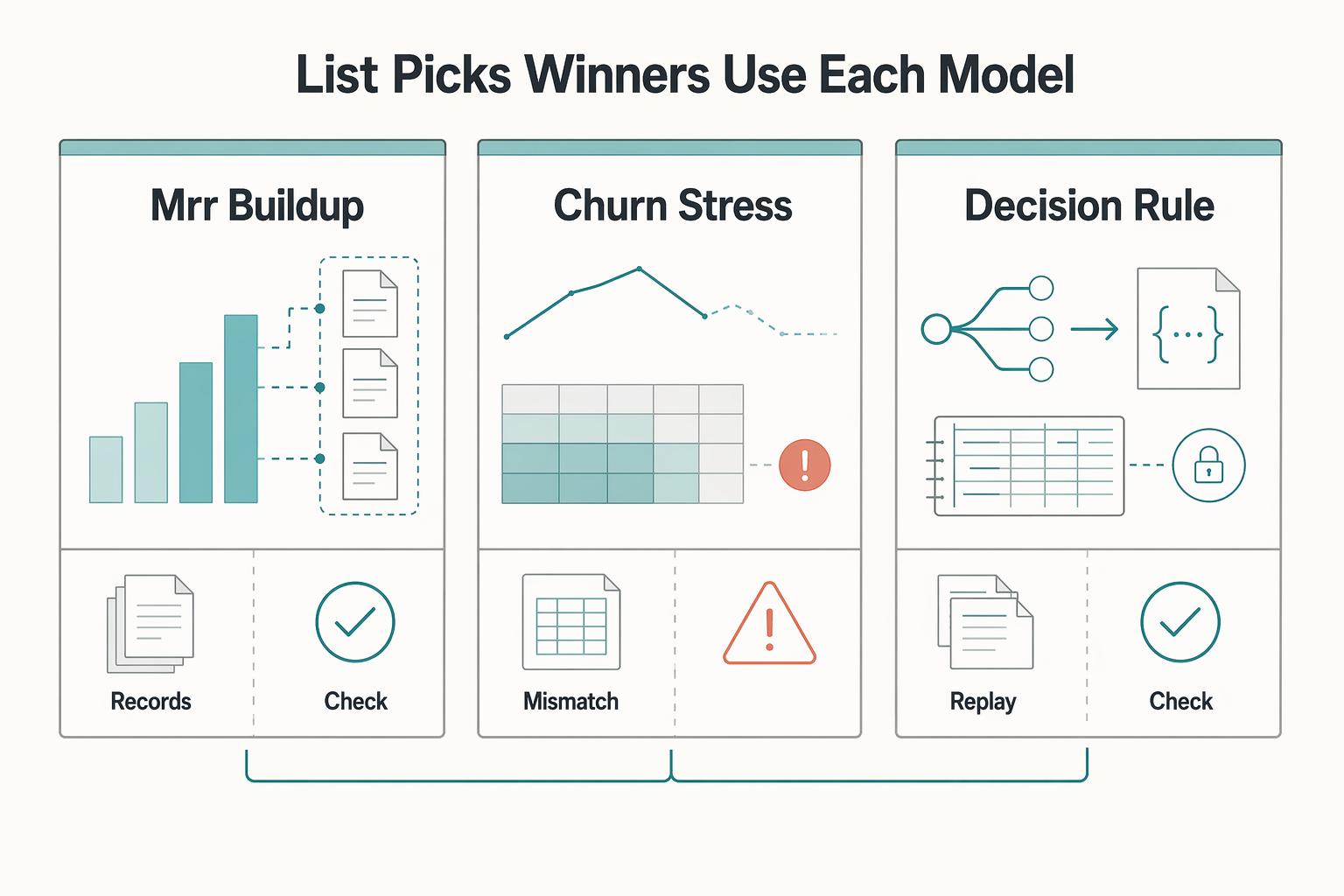
A usable forecast starts with shared definitions, not sharper formulas. If finance, ops, and product define MRR, Expansion MRR, or churn differently, the model can look precise and still fail the first serious review.
Hybrid Pricing Models for One Subscription and Usage Invoice
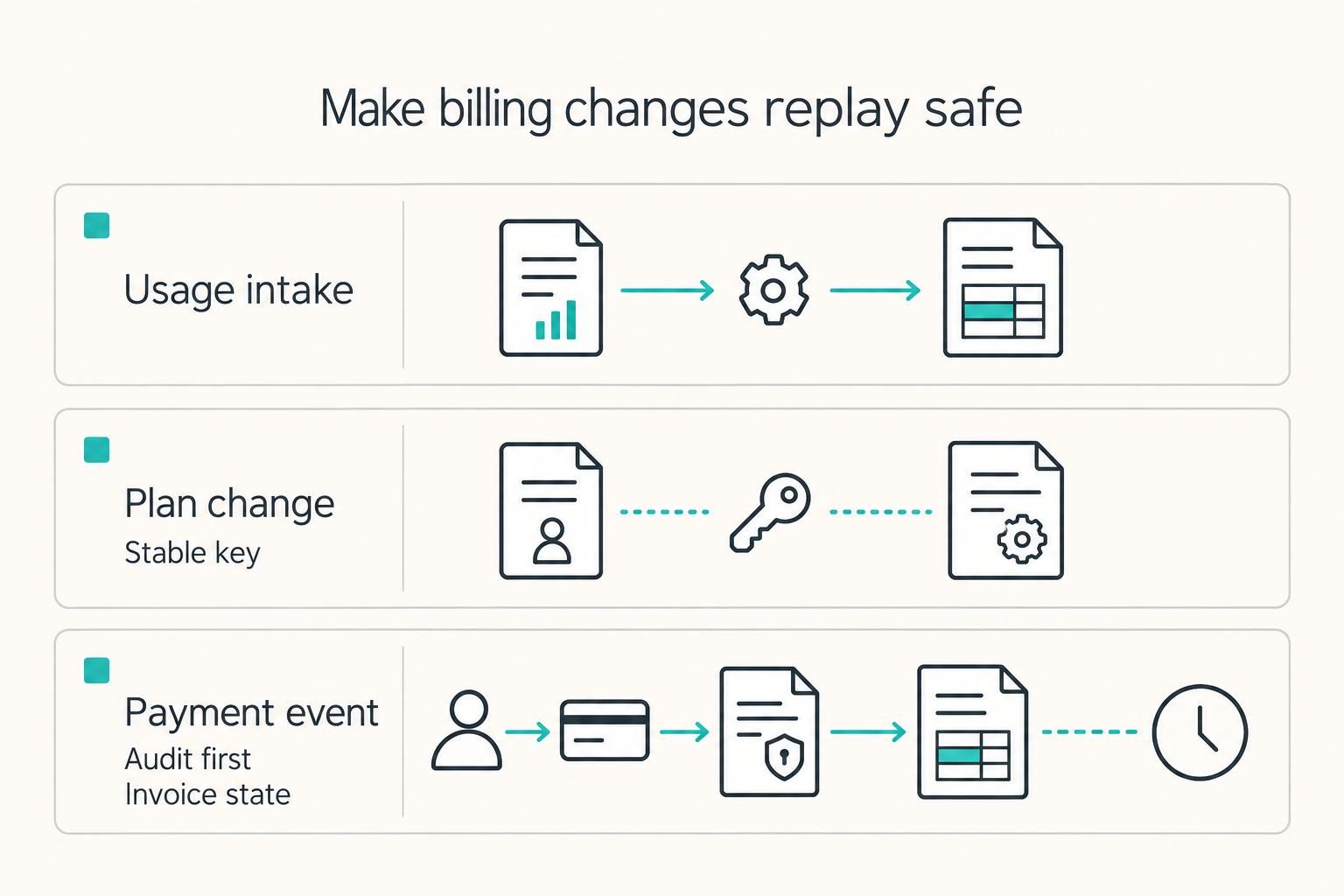
Treat this as a billing and operations project, not just a pricing exercise. A hybrid pricing model can be commercially strong. The real test is whether you can put a recurring subscription fee and usage-based charges on a single invoice without forcing Finance to stitch things together at month-end.