
Quick Answer
Yes - subscription and usage charges can appear on one bill when you configure unified invoicing and validate line behavior before finalization. In Stripe Billing, that means testing invoice previews, confirming proration rules, and checking that recurring fees, usage, credits, and adjustments read clearly as separate lines. The article also flags platform constraints you must account for early, including subscription item limits and draft renewal timing, so Finance is not left reconciling fragmented outputs at month-end.
Align Product, Billing, and Finance Early#
Treat this as a billing and operations project, not just a pricing exercise. A hybrid pricing model can be commercially strong. The real test is whether you can put a recurring subscription fee and usage-based charges on a single invoice without forcing Finance to stitch things together at month-end.
Hybrid pricing combines more than one charging structure, commonly recurring access plus measured usage. It can preserve a base revenue stream while charges reflect consumption, but the commercial model and billing configuration need to agree.
The operational catch is where teams get into trouble. Mixed pricing looks simple on a pricing page, but billing architecture often lags behind the business model. Many billing systems were built for either recurring billing or usage billing, not both together. When that gap shows up in production, customers get fragmented charges, and finance teams end up doing manual month-end stitching across line items or even separate invoices.
Before you start#
Use this guide if your goal is specific: launch a commercial model where the bill reflects both access and usage, and where those charges appear clearly on one invoice. That means you are not just choosing a recurring base fee or a usage tier. You are also deciding how usage is measured, when it is rolled up, how invoice line items should read, and who verifies that posted charges match the underlying billing events.
Use a simple checkpoint before you move ahead. If you cannot explain the model in one sentence as "base fee for access, variable charge for measured usage," and point to how both will appear on the same invoice, you are not ready to launch. That is not a strategy problem. It is an execution warning.
What this guide is built to help you do#
This guide is for platform builders who need coordinated decisions across product, engineering, and finance. You will work through whether hybrid pricing fits your business, what commercial inputs to lock before pricing, how to design invoice lines, and what controls you need for reconciliation and month-end close.
If you are already committed to a single-invoice model that combines subscription and usage, read this with three owners in mind: the person defining the value metric, the person implementing billing logic, and the person responsible for close. If any of those roles is missing from rollout, rework is more likely later. For a broader look at combining subscriptions, usage-based pricing, and one-time charges, see Hybrid Billing Models: How to Combine Subscriptions with Usage-Based and One-Time Charges.
Decide if hybrid pricing fits your business model#
Use hybrid pricing when you have both a steady baseline of value and a usage-driven layer; if usage is mostly flat and predictable, a plain subscription is usually simpler.
Step 1. Confirm the value structure first#
Confirm the value structure first. Hybrid works when you can clearly separate a recurring access fee from a usage-linked charge. When consumption rarely fluctuates, subscription billing is often a better fit because revenue is easier to forecast and the model is easier for customers to follow.
Step 2. Match pricing to buyer tolerance for variability#
Match pricing to buyer tolerance for variability. For finance-led buyers who prioritize predictability, a common pattern is a fixed recurring fee with included usage and overage charges for additional usage at period end. Keep overage rules explicit so customers can tell when they move past the included amount.
Step 3. Choose flat or tiered usage math and collection timing#
Pay-as-you-go describes charging for actual consumption; tiering describes how unit prices change with volume. They can coexist. Choose a flat or tiered usage calculation, then decide whether collection is in arrears, prepaid or based on a commitment.
If your team cannot explain the value metric and pricing logic plainly and consistently, simplify before launch.
Gather prerequisites before you set prices#
Set these prerequisites before you discuss rates: the billable model, the evidence trail, the platform limits, and the approval flow. If you skip this, single-invoice hybrid pricing usually turns into reconciliation work later.
| Prerequisite | What to define | Operational note |
|---|---|---|
| Billable shape | Value metric tied to a metered action; exact event source; usage tiers; proration policy; invoice line-item detail | Document which mid-cycle plan changes trigger prorations and how they appear on the invoice. |
| Evidence pack | Source of truth for usage rollup; reconciliation ownership; handoff into close | Label internal views as near-real-time estimates or finalized billing views. |
| Platform boundaries | Single-invoice support; subscription product limit; renewal invoice timing | Stripe can combine recurring and metered charges when currency and billing configuration support it. Verify the billing mode’s item limit, periods, invoice grouping and finalization timing. |
| Governance | Approvers for pricing changes; validators for billing outputs; sign-off on invoice wording | Use invoice preview across low-, mid-, and high-usage test accounts before publishing pricing. |
Step 1. Lock the billable shape first#
Lock the billable shape first. Define a value metric tied to a metered action you can actually record, and confirm the exact event source engineering will use for each billing period's usage rollup.
Freeze usage tiers, proration policy, and invoice line-item detail together. Because prorations are created only for changes that affect the current billing cycle amount, document which mid-cycle plan changes trigger them and how they appear on the invoice.
Step 2. Build the evidence pack finance uses for reconciliation#
Build the evidence pack finance will use for reconciliation and month-end close. Define the source of truth for usage rollup, assign reconciliation ownership, and specify what gets handed off into close.
Also set expectations about timing. Aggregated usage in summaries and upcoming invoices might not immediately reflect recently received meter events, so label internal views clearly as near-real-time estimates or finalized billing views.
Step 3. Confirm platform boundaries before promising a single invoice#
Confirm platform boundaries before promising a single invoice. In Stripe Billing, fixed recurring and usage-based charges can be combined on one invoice so the customer makes one payment.
Check the actual Stripe billing mode: classic subscriptions allow up to 20 items, while flexible subscriptions support up to 100. Align currency and billing periods or confirm the intended grouping behavior. Renewal invoices often remain draft for roughly an hour, but event acknowledgments, settings and invoice type affect timing; first invoices can finalize immediately.
Step 4. Set governance before exceptions start#
Set governance before exceptions start. Define who approves pricing changes, who validates billing outputs, and who signs off on customer-facing invoice wording.
Use invoice preview as a pre-send checkpoint. Preview pending renewal and invoice-item charges across low-, mid-, and high-usage test accounts; if the preview cannot be traced back to the value metric, usage rollup, and proration rules, do not publish pricing. Related: Usage-Based Pricing for Payment Platforms: Per-Transaction vs. Subscription.
Set the metric, allowance, and overage math#
Once billing inputs are frozen, make the math easy to read and hard to dispute: one billable metric, one included allowance, and one overage trigger.
Step 1. Choose a value metric your system already records#
Choose a value metric customers already recognize and your system already records. Meter events are customer actions in your product, for example API requests, so the metric should map to an event engineering can capture, finance can roll up by billing period, and customers can match to their own usage view.
Use API requests, tokens, GB, or another unit only if it tracks how customers experience value. If your team cannot state in one sentence what counts and which billing period it belongs to, the metric is not ready.
Step 2. Choose a charging pattern that matches how buyers interpret spend#
Pay-as-you-go can use either flat or tiered unit rates. Tiering changes the calculation at usage thresholds; it does not by itself make a variable bill predictable. For predictable spend, separately consider included usage, commitments, alerts or agreed caps.
| Criterion | Flat usage rate | Tiered usage rate |
|---|---|---|
| Predictability | Bill still varies with measured consumption | Bill still varies; thresholds change the rate calculation |
| Buyer comprehension | Simple calculation: billable units times the rate | Specify volume or graduated tier math and show boundary examples |
| Expansion behavior | Captures usage growth directly. | Captures growth and lets you shape it with non-linear pricing. |
If you use tiers, define the method up front:
volume-based: the period-end tier rate applies to all usage.graduated: usage is charged per tier segment and then summed.
Step 3. Set the base fee, allowance, and overage rule#
Set the recurring base fee for baseline value, then define the included allowance and overage rule in explicit pricing fields. Hybrid pricing usually combines a fixed recurring fee with a variable usage charge, so customers should be able to see exactly when usage moves from included to billable.
Keep the configuration concrete: unit cost, currency, billing period, included amount, and overage rate. Then test invoice outcomes below, at, and above the allowance so the output matches the commercial story. If most deals need custom exceptions, simplify tier design before launch.
Design a single invoice that reduces disputes#
Design the invoice so a reviewer can trace every amount to the final total without extra explanation. Each line should have one billing purpose and one visible period.
Step 1. Separate line items by billing meaning#
Separate line items by billing meaning, not internal implementation. In practice, keep distinct lines for the recurring base fee, included usage, billable usage above allowance, and any credits or discounts before the final total.
Use customer-readable descriptions and summaries where supported by your invoicing product. Verify the actual rendered invoice and keep underlying billable quantities, rates and periods available for review.
Step 2. Show the usage rollup period on the invoice#
Show the usage rollup period on the invoice so the service window is unambiguous. Stripe line items include period context for subscription charges, and proration lines also have defined period bounds.
A reviewer should be able to identify the usage dates from the invoice. Define a metering cutoff and explicit late-event correction policy; posting an invoice does not mean every provider will add later usage to that same bill automatically.
Step 3. Publish proration behavior in plain language#
Publish proration behavior in plain language before customers see it on a bill. State when it applies, where the line appears, and which period it covers.
Keep the rule clear: proration lines are created when changes affect billable amounts in the current billing cycle. If a mid-cycle change creates an adjustment line with no clear date range, tighten your invoice wording before finalizing.
Step 4. Finalize only after the pre-send checks pass#
Use invoice previews as a review step, then control finalization for the actual invoice type. A preview is not a reservation of the final amount; later usage, changes or time-dependent prorations can alter the result. For automatically finalized invoices, configure the workflow so required checks finish before finalization.
Review low-, mid-, and high-usage samples together. Product should verify usage rollups and metric logic; finance should verify line order, period labels, credits, and adjustment presentation. If either team needs manual narration to explain the math, hold finalization.
Implement billing logic and event flow safely#
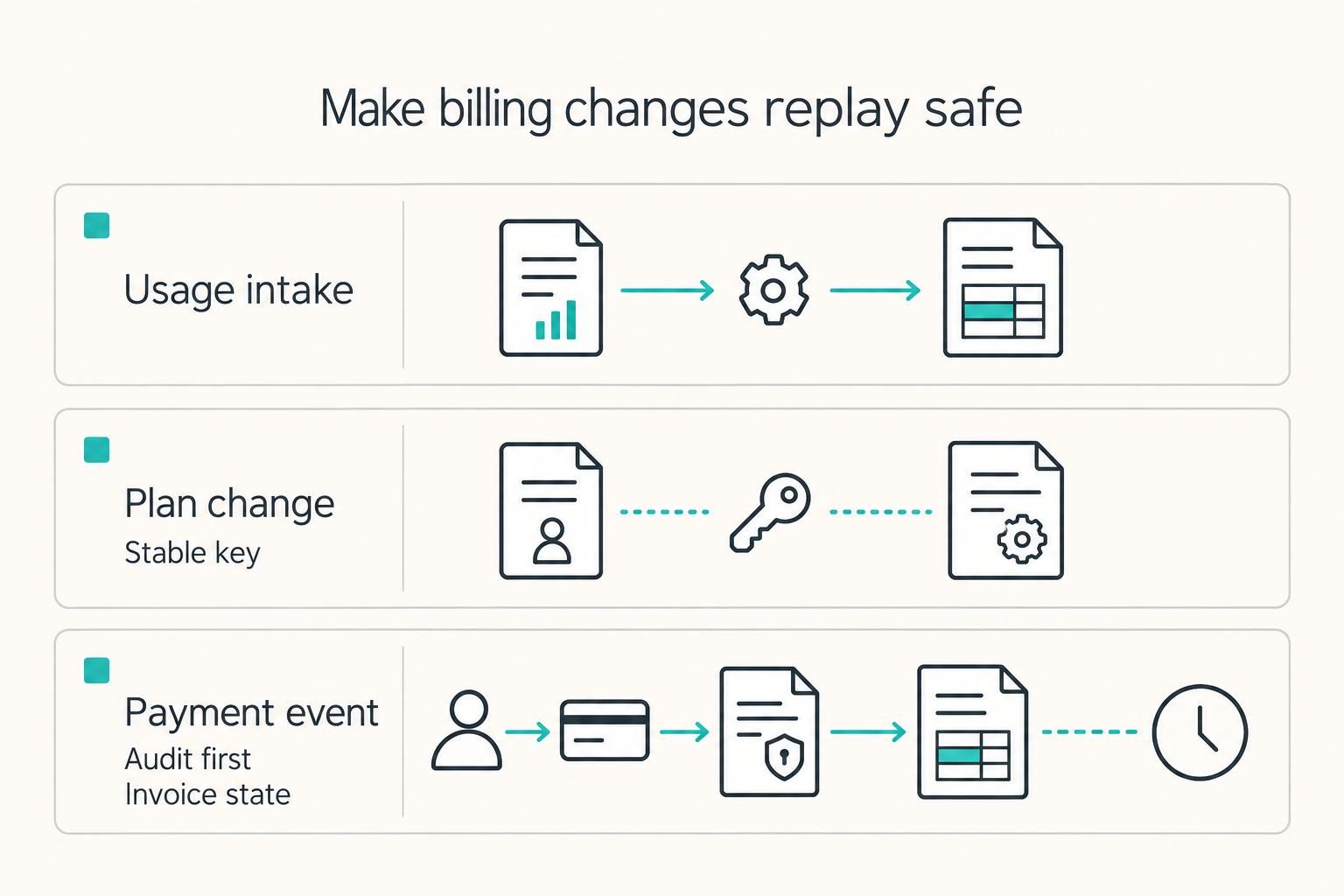
In a single-invoice model that combines subscription and usage, duplicate execution is the main implementation risk. Run recurring and usage actions through one pipeline, and make every mutating step idempotent and auditable before customer-facing invoice state is updated.
| Action | Control | Check |
|---|---|---|
| Usage ingestion | Use a unique business identifier for each usage ingestion action. | Replay the same usage action and confirm one billable outcome. |
| Subscription change | Send a client-generated idempotency key on every Stripe POST that can create or change billable state; use one key per business action. | Resend the exact same request in test mode and confirm the same Stripe result. |
| Payment confirmation | Write the audit record first, then update customer-visible invoice state; use webhook handling for asynchronous outcomes. | Do not treat an initial client-side success signal as final truth. |
| Invoice finalization | Use a separate idempotency control for finalization. | Replay finalization and confirm one state transition. |
Step 1. Use one idempotency key per business action#
Send a client-generated idempotency key on every Stripe POST that can create or change billable state. Stripe states that all POST requests accept idempotency keys, and retries with the same key return the same result, including 500 responses.
Use a stable key for the same business action and request parameters, not a fresh key for every HTTP retry. Keep a separate internal action record. For meter events, use a stable event identifier as well and confirm its provider-specific duplicate window.
Replay the same request within the provider’s supported window and confirm one intended effect. Stripe may prune request keys after at least 24 hours; resolve an uncertain original before a fresh request and retain your own duplicate controls after expiry.
Step 2. Write the audit record before updating invoice state#
When payment confirmation arrives, write the audit record first, then update customer-visible invoice state. Stripe recommends webhook handling for asynchronous outcomes, including bank confirmation events, so do not treat an initial client-side success signal as final truth.
Retain event ID, invoice or payment ID, receipt timestamp and relevant provider request linkage. Classic Stripe Event objects can expose request.id and request.idempotency_key when applicable; fields vary by event model and may be null. Verify the actual payload rather than assuming universal reason.request fields.
If you show "paid" before the audit write succeeds, you can end up with visible state but incomplete reconciliation evidence.
Step 3. Apply duplicate protections to ingestion and finalization separately#
Test duplicate protection for usage ingestion and invoice finalization separately. Replaying a delivery must not add usage or charges twice; payment-request idempotency alone does not protect every downstream write.
For Stripe meter events, preserve a unique event identifier and use request idempotency as appropriate. Stripe documents identifier uniqueness over a rolling 24-hour window; retain longer-lived internal deduplication for delayed replays. Test both usage ingestion and invoice finalization for one intended outcome.
Idempotency at the payment API layer is necessary, but it is not full end-to-end exactly-once behavior across all downstream systems. Keep your own duplicate checks in downstream writes.
Run reconciliation and month-end controls from day one#
Once billing execution is safe, the next risk is proof: you still need to show that posted invoices match what you intended to bill. Treat reconciliation as a launch requirement, not post-launch cleanup.
| Control area | What to verify | Required support |
|---|---|---|
| Invoice traceability | Each invoice ties back to billing events, the usage rollup, and the accounting records used at close. | Spot-check sample invoices and trace each invoice line item to its source. |
| Close-blocking queues | Exception queues, disputed overage items, and unresolved invoice line item mappings each have one accountable owner. | Define owner, review cadence, escalation contact, and required evidence. |
| Variance checks | Expected charges match posted invoice and accounting charges; current-period balances are reviewed against the prior period. | Pause close if unresolved variances exceed the documented tolerance. |
| Support dispute handling | Support can produce billing period context, the invoice line item, the usage rollup, and the escalation path. | Support should answer "what produced this charge?" without reconstruction work. |
Step 1 Before go-live, make every invoice traceable to source records. Reconciliation means comparing records across sources and resolving discrepancies before close, so each invoice should tie back to billing events, the usage rollup that aggregated usage under the correct meter, and the accounting records used at close. Spot-check sample invoices and trace each invoice line item to its source; if you cannot explain an overage charge from rollup and billing records, the process is not close-ready.
Step 2 Assign explicit owners to close-blocking queues. Your owner map can vary by company, but exception queues, disputed overage items, and unresolved invoice line item mappings each need one accountable owner for month-end close. For each queue, define owner, review cadence, escalation contact, and required evidence to mark an item resolved.
Step 3 Run variance checks before close and gate close on your agreed tolerance. Compare expected charges from billing calculations and usage rollups against posted invoice and accounting charges, and review current-period balances against the prior period to surface unexpected deltas. If unresolved variances exceed your documented tolerance, pause close until they are explained or corrected.
Step 4 Give support a dispute playbook built around traceable evidence. For any usage dispute, support should be able to produce billing period context, the relevant invoice line item, the usage rollup used for billing, and the escalation path when metering or mapping is in question. If support cannot answer "what produced this charge?" without reconstruction work, controls are still too fragile for month-end. Related reading: ASC 606 Revenue Recognition Decisions for Subscription Pricing.
Common failure modes and how to recover#
Most breakdowns in hybrid pricing show up in four places: the value metric, partial-period billing behavior, month-end controls, or pricing drift. Recover in that order so you fix root cause before cleanup.
Step 1 Tighten the value metric when customers cannot tell what they were charged for. The metric should reflect how customers get value, not just what is easiest to count. If disputes keep coming back to what a unit means, rewrite the definition in one sentence and publish clearer usage-tier examples in pricing copy and invoice help text. Verification point: support should be able to explain a disputed line item using only the published metric definition and examples.
Step 2 Centralize proration rules for partial-period changes before you correct invoices. Mid-period updates are supported, but not every update creates proration invoice items. For example, subscription-level coupon or discount updates by themselves do not create proration invoice items. If an invoice is still draft, correct and reissue it; if it is finalized, use adjustment workflows such as credit notes instead of trying to edit restricted amount/customer fields. Red flag: different plans apply different adjustment logic for the same change event.
Step 3 Add a pre-close reconciliation gate if close keeps slipping. Set a close-window policy for late pricing changes, run variance checks, and require signoff before posting. Verification point: each exception over tolerance has an owner, resolution note, and invoice reference.
Step 4 Enforce one source of truth for pricing rules across docs, product config, and billing logic. Then run monthly billing QA samples across low-, mid-, and high-usage accounts to catch drift early.
Conclusion#
The workable version of this model is simple in principle and demanding in practice: keep the subscription fee clear, keep usage pricing defensible, and treat invoice clarity plus reconciliation as launch requirements, not cleanup work. If you cannot explain the bill in one short conversation and tie it back to recorded usage, you are not ready to roll it out widely.
Use this copy-and-paste launch checklist before general release of a single-invoice setup that combines subscription and usage:
- Confirm the value metric and usage tier rules.
Choose a value metric customers already monitor, then write the included allowance and overage trigger in customer-readable language. Verification point: support and finance should both be able to explain the billable unit in one sentence without engineering help. Red flag: if sales keeps asking for exceptions, your tier design is still doing too much.
- Validate the recurring base fee and overage math with sample invoices.
Test low-, mid-, and high-usage accounts, and make sure the recurring base fee, included usage, billable usage, credits, and final total all reconcile line by line. Check mid-cycle proration behavior explicitly, because only changes that affect billable amounts for the current billing cycle create prorations. One failure mode is assuming every subscription change should create those invoice items when the billing platform does not behave that way.
- Verify single-invoice rendering with traceable invoice line item detail.
Your goal is unified invoicing, not just charging two different things in the same month. The invoice should show separate line items for the base subscription, included usage if you display it, metered charges, and any adjustments, with the usage rollup period stated clearly enough for finance to trace. Verification point: a reviewer should be able to match the invoice total back to the underlying usage recording for that billing period.
- Test idempotent billing ingestion and duplicate prevention for API retries.
If your metered events can be retried, you need idempotent requests so the same operation is not performed twice by accident. Test both usage ingestion and invoice finalization paths with repeated calls, then confirm you do not get duplicate usage or duplicate charges from retry behavior alone. Important tradeoff: idempotency protects retried request paths, but it does not solve every duplicate-charge scenario outside those paths.
- Run pre-close reconciliation and a dry run of month-end close.
Do this before broad rollout, not after your first billing cycle goes wrong. Month-end close includes recording, reconciling, and reviewing transactions, so your dry run should tie posted invoice totals back to billing events and usage-rollup artifacts, then assign an owner and resolution note to every unexplained delta. Verification point: finance can complete the close review without manual guesswork or missing evidence.
That is the real test. If the pricing is easy to sell, the invoice is easy to read, and the close process still holds up under real usage volume, you are in a strong position to launch.
Frequently Asked Questions
What is a hybrid pricing model in plain terms?
It is one offer that combines more than one pricing structure. In practice, that usually means a recurring base fee plus a variable charge tied to usage or another value driver. Use it when you need one offer to cover both recurring value and variable consumption.
Can subscription and usage charges appear on a single invoice?
Yes, but only if you configure your billing catalog and invoicing flow to support unified invoicing. The invoice should show separate component lines for the subscription and usage components, plus credits and totals. Do not assume your billing stack will do this by default.
How do I choose between pay-as-you-go pricing and tiered pricing?
These choices can overlap: pay-as-you-go describes charging for consumption, and tiered pricing changes rates at quantity thresholds. Choose flat, volume or graduated rates, then separately define collection timing, allowances and any spending commitments.
What should be included in a recurring base fee versus overage charge?
Put recurring, always-included value in the base fee. Put variable consumption in the overage charge, especially usage above any included amount. Keep usage metrics and line-item definitions explicit so invoices map clearly to each component.
How should proration appear on invoice line items to reduce disputes?
Show the partial-period adjustment as its own invoice line item, with a plain description of what changed and which billing period it affects. One common failure mode is assuming every subscription change creates these items. In Stripe, updating subscription-level promotion codes, coupons, or discounts by themselves does not create them.
What is the minimum reconciliation process needed before month-end close?
At minimum, reconcile posted invoice totals to billing events and recorded usage for that billing period. Review transactions and resolve or document exceptions before close. Month-end close is a review-and-reconciliation process, not just invoice posting.
Which teams should own metric definition, billing logic, and invoice approvals?
There is no universal split. Treat pricing and packaging as cross-functional work across product, engineering, sales, finance, and customer success, with clear handoffs for metric definition, billing logic, invoice behavior, and close readiness. Use retry protection such as idempotency keys where API operations may be retried.
Try a related tool
Researched and edited by the Gruv editorial team. Gruv builds cross-border billing, payouts, and finance-operations software for global businesses.
Sources
Includes 1 external source outside the trusted-domain allowlist.
- docs.stripe.com/billing/subscriptions/usage-based/implementa...trusted
- docs.stripe.com/subscriptions/pricing-models/tiered-pricingtrusted
- stripe.com/resources/more/hybrid-pricing-modelstrusted
- stripe.com/resources/more/pay-as-you-go-pricing-model-w...trusted
- ifrs.org/issued-standards/list-of-standards/ifrs-15-r...external
Educational content only. Not legal, tax, or financial advice.
Related Posts
Hybrid Billing Model for Subscription and Usage on One Invoice
**A hybrid billing model combines a recurring base fee with variable charges, giving you a stable revenue floor while customer spend can rise with usage.** The appeal is straightforward. The hard part is not the pricing idea itself. It is whether your contracts, invoices, and finance records can support mixed charges without creating confusion or cleanup work later.

Choosing Per-Transaction or Subscription Pricing for Payment Platforms
For a payment platform, the right pricing model is the one your unit economics and billing operations can actually support, not the one that looks cleanest on a pricing page. In practice, teams usually choose among three mechanics: usage-based billing, per-transaction pricing, and recurring subscriptions, or combine usage-based and recurring charges where supported. Each one changes revenue behavior, invoice logic, and margin risk.

Hybrid Billing Models for One Invoice and Clean Reconciliation
**Hybrid billing combines recurring subscription fees, usage-based charges and one-time fees in the same offer.** Design the catalog, usage controls and invoice traceability together so finance can reconcile what customers buy and use.