

Quick Answer
Define each recurring, usage and one-time charge in a shared catalog. Preserve source-event and contract links through rating, invoicing, ledger posting and ERP export. Test late usage, duplicate delivery and corrections before finalization. Where seller payouts are involved, check their eligibility separately from customer billing.
How to Combine Fixed, Usage, and Service Charges on One Invoice#
Hybrid billing combines recurring subscription fees, usage-based charges and one-time fees in the same offer. Design the catalog, usage controls and invoice traceability together so finance can reconcile what customers buy and use.
That mix can work well for customers. A base subscription adds predictability, usage charges let you bill for actual consumption, and one-time charges keep non-recurring work out of the monthly fee. The catch is operational. These charges are hard to reconcile without shared records. If different teams each keep their own version of what was sold, what was used, and what should be invoiced, duplicate records show up fast. From there, you get slow closes, error-prone reporting, and audit headaches.
Start with one source of truth#
Before you touch pricing rules, get your teams aligned on one Single source of truth. That means one unified, accurate dataset where financial transactions and revenue events live, rather than a billing UI showing one thing, a spreadsheet showing another, and the ledger being fixed later by hand. Use a simple verification point: when an invoice is created, you should be able to trace each line back to the same underlying financial record set your accounting team relies on.
The rest of this guide assumes that discipline is already in place. You are not just trying to put different charges on one invoice. You are trying to preserve a clean connection between contract or usage events, billing records, and finance records, without creating reconciliation debt that has to be cleaned up at month end.
What a workable setup looks like#
A workable setup has three parts. First, the customer gets one invoice experience instead of a confusing spread of separate bills. Second, your internal teams work from one data backbone instead of reconciling parallel truths. Third, there are explicit checkpoints between the events that create charges and the records finance closes against.
If you only optimize the pricing page, you will miss the real failure mode. The common break is not that customers do not understand the plan. It is that teams cannot prove why a charge exists, where it came from, or whether the ledger matches the invoice. Keep the contract simple for the customer. Make internal traceability strict enough that subscription fees, usage lines, and one-time charges can be explained, verified, and exported without manual repair.
For credit-based billing, see Credit-Based Billing Models: How AI Platforms Monetize Compute.
Set the operating design before you touch pricing#
Before you change price points, define how billing and finance decisions are owned and recorded. Hybrid offers usually fail operationally when ownership is unclear, approvals are loose, and accounting treatment is decided after billing is already moving.
Assign explicit owners#
Name who owns catalog structure, who approves each Rate Plan change, and who reviews revenue-recognition treatment with ASC 606 in mind. Keep it lightweight, but make each handoff written and explicit.
Use one quick test for control quality: for any invoice line, can you identify who created the catalog item, who approved the plan logic, and who reviewed the revenue treatment? If not, your approval flow is too loose.
Choose one record of truth#
Pick one authoritative financial record and keep billing and accounting aligned to it. When systems drift, teams end up with double entry, manual reconciliation, mismatched records, slower closes, and audit friction.
Watch for the early warning sign: billing shows one version while finance repairs numbers in spreadsheets before ERP sync. If CPQ and ERP are on different platforms, check early for shadow-accounting workarounds. That is where hidden cost and reconciliation risk often start.
Model the catalog as Product, Rate Plan, and Charge#
Use a shared catalog structure that distinguishes products, commercial plans and individual charges. Zuora calls these Product, Rate Plan and Charge; other platforms use different objects. Preserve the same traceability without requiring every system to copy one vendor’s hierarchy.
Treat "Frankenstein SKU" patterns as a red flag, especially when subscription, setup, and usage that belong together are split into disconnected SKU rows. Validate the design with one end-to-end bundle test: if the offer cannot produce clean charge lines without spreadsheet mapping, fix the catalog before changing packaging.
Related: Hybrid Pricing Models: How to Combine Subscription Fees Plus Usage Charges on a Single Invoice.
Build packaging rules your finance team can enforce#
Set packaging rules before price approval so finance can review and enforce them consistently. Use this default mapping inside a hybrid offer: predictable repeat fees go to recurring Charges, variable consumption goes to usage Charges, and non-recurring setup goes to one-time Charges. This keeps pricing decisions aligned with the Product-Rate Plan-Charge catalog structure.
Classify each fee by billing behavior#
A Rate Plan can hold recurring, usage, and one-time charges, so model each fee there instead of splitting logic across separate SKU families. One contract can include a platform fee, data overage, and setup fee without disconnected billing objects.
Use the draft invoice plus the catalog record as your checkpoint. For each fee, confirm one catalog item, one Rate Plan, and one charge type, then confirm the customer-facing line label is still clear.
| Bundle element | Recommended Charge type | Rate Plan behavior | What to verify |
|---|---|---|---|
| Platform access fee | Recurring | Keep as a predictable recurring line in the main Rate Plan | Base fee appears clearly each billing period |
| Overage or metered consumption | Usage | Attach as a usage Charge in the same offer when possible | Usage period and quantity tie back to rated usage records |
| Onboarding or setup | One-time | Add as a one-time Charge tied to implementation start | Appears once and does not recur on later invoices |
Keep the bundle readable on one invoice#
Unified invoicing works only when customers can read each line and finance can trace each line back to the catalog. Keep fixed recurring and usage charges together on one invoice where your platform supports it, without obscuring what changed period to period.
The failure mode is fee sprawl. As line items fragment, billing clarity drops and finance ends up stitching revenue together manually at month end. If invoice lines require spreadsheet mapping to explain, packaging is already too complex.
Set red lines before complexity creeps in#
Define complexity red lines early, then enforce them in plan design reviews. If customer-visible line items become hard to explain each cycle, collapse internal complexity behind fewer visible charges. If an offer only works by scattering charges across separate SKU systems, redesign it in one coherent Rate Plan structure.
Use platform limits as guardrails, not targets. Stripe supports up to 20 subscription items in classic billing mode and 100 in flexible mode. Even below the applicable limit, simplify when customers or finance cannot explain the invoice.
For usage-based pricing, see SaaS Usage-Based Pricing for Predictable Cashflow and Fewer Disputes.
Design usage ingestion and rating with failure controls#
Hybrid billing usually breaks first at usage ingestion, so treat meter data as a controlled accounting input, not just an engineering stream. If an event can create a Charge, define the sequence, enforce evidence gates before Usage rating, and keep a correction path that preserves what was originally billed.
- Lock the sequence before launch.
Use a fixed flow: event capture, normalization, usage rating, invoice draft, dispute window, final posting. This matters because meter-event aggregation is asynchronous, so upcoming invoice totals can lag recently received events. Your reconciliation should account for that lag instead of treating every temporary mismatch as an error.
Keep invoice finalization as the control point. Stripe’s default delay is one hour, with configurable delays up to 72 hours that must fit the service period; the first automatically collected subscription invoice finalizes immediately. Late metered usage is included only for eligible cycle or phase-transition invoices, with additional limitations after mid-cycle price changes. Test the exact flow rather than assuming every draft accepts late usage.
- Require evidence before an event is billable.
At minimum, a ratable event should include the meter event name, customer mapping, numeric value, and timestamp metadata. Keep a stable event identifier from the source when available, or generate one at ingestion and persist it before rating.
Validate these fields at ingestion, not at invoice time: customer mapping must resolve to the billing account, timestamp must be acceptable, and units must match rating rules. In Stripe, timestamps must be within the past 35 days and no more than 5 minutes in the future. Route failures to an exception queue instead of allowing them to create a Charge.
- Separate correction paths for duplicates, late events, and re-rating.
Handle duplicates with idempotency keys plus event-ID dedupe records. Stripe enforces meter-event identifier uniqueness for at least a rolling 24-hour window, but keep your own accepted/rejected/replayed record for auditability.
Handle late events under an explicit correction policy. Check whether the current draft can include them; otherwise record how an adjustment or later invoice will bill the usage. Do not assume the provider automatically carries every late event forward.
Handle re-rating through replay with lineage. When pricing logic changes, contract terms change, or a bug is fixed, keep original events, original rating outputs, and corrected outputs linked so any invoice line can be traced back to underlying events.
| Failure mode | Required control | Owner checkpoint |
|---|---|---|
| Duplicate events | Idempotency key plus event-ID dedupe | Ops confirms one accepted event per source action |
| Late events | Grace-period rule and explicit next-cycle handling | Billing owner reviews items arriving after draft cutoff |
| Re-rating | Replay history with original and corrected rating results | Finance reviews correction impact before posting |
- Reconcile rated totals against raw totals before posting.
Before finalization, reconcile accepted raw usage with meter aggregates and expected rated amounts at a defined cutoff. Some providers update usage lines only at finalization, so use their meter APIs and a separate expected-invoice calculation rather than relying on draft line totals alone. Assign persistent mismatches to an exception owner.
Final check: you should be able to explain each usage invoice line back to raw events and explain why excluded events were excluded. If you can't, stop before final posting.
Related reading: How to Use Harvest for Time Tracking and Invoicing in a Small Agency.
Assemble one invoice without hiding line-item logic#
Build one customer-facing invoice, but keep each charge type as its own line so the bill stays readable and auditable. Keep base subscription, usage overage, and one-time setup as separate Charge lines, even when they appear on one document.
Step 1. Define invoice composition rules by charge type. A line item should represent one specific charge, not a blended description. Show each line with description, quantity, rate, and total so the charge logic stays visible.
Use your catalog structure as the control point. When lines map back to Product, Rate Plan, and Charge, support and finance can trace what was billed without relying on invoice wording alone.
Step 2. Consolidate the document, not the underlying logic. One invoice can improve customer clarity, but each row still needs traceability to its source Charge. For usage rows, keep the link to the rated usage set or source event group that produced the amount.
Use a simple check: start at any invoice line and trace back to the catalog entry and usage input. If that path breaks, consolidation is hiding billing logic.
Step 3. Set proration and correction rules before automating updates. Handle proration explicitly by update type: bill now, include on the next invoice, or no billing change. Many subscription updates do not generate prorations, and created prorations are not always automatically invoiced.
Handle corrections as distinct adjustment items instead of rewriting original lines. In systems that support credit/debit memo workflows, memo items can be used for documented corrections, including zero-amount cases in specific setups.
Step 4. Standardize line labels and correction memos for dispute prevention. Line labels should answer three questions quickly: what it is, what period it covers, and why it changed. Clear, specific line items make charges easier to understand.
Define one internal memo format for corrections, such as reason, affected period, original invoice reference, and approver. The goal is consistent internal evidence, not a universal industry format.
This pairs well with our guide on Subscription Billing Platforms for Plans, Add-Ons, Coupons, and Dunning.
Reconcile to close with a clean handoff to ERP#
Close stays clean when you enforce one sequence: invoice finalization -> ledger posting -> ERP sync -> variance review -> Revenue recognition checks before period-state changes.
| Step | Focus | Check |
|---|---|---|
| 1 | Lock the period and confirm ledger posting | Verify each in-scope finalized invoice has a ledger posting status and no required items are left draft or unposted |
| 2 | Sync to ERP with reconciliation artifacts | Produce a charge-level export, an exception log, and a settlement status summary |
| 3 | Enforce journal-entry controls for manual adjustments | Require a linked billing event, supporting documentation, and owner approval |
| 4 | Review variances before advancing period status | Do not advance period status until revenue checks, variance review, and export exceptions are explicitly cleared |
Step 1. Lock the period and confirm ledger posting#
After invoices are finalized, lock posting areas so late transactions do not drift into the close window. Then verify that each in-scope finalized invoice has a ledger posting status and that no required items are left draft or unposted.
Step 2. Sync to ERP with reconciliation artifacts finance can use#
Treat the ERP handoff as a controlled export, not a black box. If your setup uses summary GL integration, keep support detail outside the summary so finance can trace what sits underneath.
Each cycle should produce:
- A charge-level export that ties invoice lines back to the originating
Charge - An exception log for posting, mapping, or export failures
- A settlement status summary for payout or settlement-batch reconciliation
Step 3. Enforce journal-entry controls for manual adjustments#
Use an internal hard rule: no manual journal adjustment without a linked billing event, supporting documentation at submission, and owner approval. This keeps manual entries tied to real transaction evidence instead of patching over process gaps.
For each adjustment, capture the source invoice or billing event, reason, affected period, and approver.
Step 4. Review variances before advancing period status#
Review and clear variances after internal reconciliation and ledger posting, then move to external reconciliation. Assign named, SLA-backed owners for breaks between billing, ledger, and ERP export so exceptions do not age unowned.
If you use Oracle E-Business Suite 12.1 Receivables, Close Pending is a useful control reference: it is similar to closed status but does not validate unposted items, and Revenue recognition must run first for transactions with accounting rules. The general decision rule is the same across stacks: do not advance period status until revenue checks, variance review, and export exceptions are explicitly cleared.
Add compliance and tax gates before payout execution#
Where the platform pays sellers or other payees, keep payout eligibility separate from billing completion. Apply the provider’s capability restrictions and your approved compliance and tax treatment before release.
| Item | Role | Handling |
|---|---|---|
KYC / AML / KYB and processor-required business verification | Payout-release criteria | Check actual payout capability, verification deadlines and active restrictions; record any stricter internal hold policy separately |
Form W-9 | Tax document | Used to provide the correct TIN to a payer that may file an information return |
Form W-8BEN / W-8BEN-E or other applicable form | Tax documentation | Determine the correct form for the payee; W-8BEN is for foreign individuals, W-8BEN-E generally for foreign entities |
| Information-return obligations | Tax reporting | Determine the form, filing owner and deadline for the actual payment type; this is separate from collecting a payee certificate |
Step 1. Gate payout eligibility on verification status. Treat KYC, AML, and any processor-required business verification, including KYB where applicable, as payout-release criteria. Providers can require verification before enabling charges and payouts, and can disable payouts if required information is not provided by their deadline. Operationally, that means balances can be settled in billing but still held from payout when verification is incomplete or overdue.
Before each payout batch, check the provider’s actual payout capability and restrictions. Required information can have a future deadline without immediately disabling payouts; decide whether an internal risk policy imposes an earlier hold and record that decision separately.
Step 2. Apply the approved tax-document and withholding rules. Form W-9 documents U.S. payee taxpayer information. For foreign payees, select the applicable W-8 form for their status; W-8BEN is for individuals and W-8BEN-E generally for entities. Missing documentation may require withholding or a contractual hold, depending on the payment and governing rules. Record the decision rather than treating every missing form as a universal legal payout ban.
Keep information-return preparation separate from certificate collection. Determine whether the payment requires Form 1099-NEC, 1099-MISC, 1099-K or another return, who files it, and which records support it. A form-filing workflow is not the same as a payee’s W-9 or W-8 status.
Step 3. Document where payout execution can be blocked. For virtual accounts, verify the supported payout route and beneficiary details rather than assuming a special failure rate. If a Merchant of Record is involved, document its contractual responsibility for customer transactions and the separate responsibility for seller verification, tax documentation and payout holds.
Treat compliance and tax status as first-class operational states. Your dashboard should show why a payout is blocked, what is missing, who owns the next action, and whether the hold is at payee, account, or payout-method level.
Plan for the failures competitors skip#
The safest way to run hybrid billing is to treat common failure points as planned operations, not surprises. Stale usage feeds, incorrect Usage rating, missing invoice lines, and failed ERP syncs should each have a named owner and a stop action.
Define the checkpoint for each break before you define the fix#
Require event evidence before rating. Reconcile accepted event values to the configured meter aggregates, then compare independently expected rated amounts with invoice amounts. Account for asynchronous processing and for providers that add usage lines only at finalization.
| Break | Checkpoint | Response |
|---|---|---|
Usage rating | Validate event fields and reconcile accepted values with configured meter aggregates; compare expected rated amounts with invoice amounts | Quarantine incomplete events and investigate mismatches using consistent units |
| Stale feeds | Reject or quarantine events outside the supported freshness window | The example given is older than the past 35 calendar days where that rule applies |
| Missing invoice lines | Check draft charge families where supported; otherwise use meter aggregates and independently expected rating | Investigate unexplained differences without demanding usage lines before the provider adds them |
ERP sync failure | Stop close at posted-ledger state | Replay export from that state, not from spreadsheet patches |
Quarantine stale feeds under the supported timestamp policy. Check draft invoice lines where the provider supports them; where usage appears only at finalization, reconcile meter aggregates and independently expected rating first. If ERP export fails, replay the controlled export from posted-ledger state.
Build retry rules around idempotency#
Build retries around idempotency, because queues and APIs with at-least-once delivery can redeliver the same message. Replays should submit the same operation with the same idempotency key so the system recognizes a retry instead of creating a new Charge. Your verification is straightforward: the replay returns the original result and does not mint a second Charge.
One caution: this protection can expire. If idempotency keys are pruned after 24 hours, older replays need a second business-identifier check.
Write separate recovery paths for disputes and close delays#
Keep customer-facing disputes separate from close exceptions. Assign a response owner, evidence pack and the actual processor or network deadline for each dispute. Missing that deadline can forfeit the chance to respond; use the case record rather than a universal number of days.
Internal month-end delays need a different path: define who can declare close blocked, who reruns failed handoffs, and when late usage is routed into a later billing cycle instead of reopening a closed period where your setup supports it.
Maintain an exception register with root-cause tags like stale feed, duplicate delivery, mis-rating, invoice composition, and ERP export failure. Review trends, not just incidents. Repeated tags should trigger product and process fixes, not permanent manual work.
Conclusion#
Hybrid billing works when the design is explicit and testable, not just commercially clever. If you keep a shared catalog model, enforce Product, Rate Plan, and Charge rules, and trace every charge event through invoicing, reconciliation, and payout checks, you end up with something finance can actually close.
- Confirm ownership before catalog changes go live.
Name one owner for the catalog, one for pricing and Rate Plan approval, and one for usage ingestion and invoice signoff across finance ops and engineering. The failure mode is split ownership, where the commercial team edits packaging, finance patches invoices, and engineering quietly changes event logic. A quick verification check is simple: for any invoice line, you should be able to identify the owner, the source rule, and the last approved change.
- Approve pricing to Charge rules in writing.
Use one rule set for all new deals: predictable recurring fees go into subscription charges, measured consumption goes into usage charges, and setup or implementation fees stay one time. That lines up with the Product, Rate Plan, Charge hierarchy. The Product defines value, the Rate Plan defines commercial context, and the Charge defines price mechanics. Red flag: if a fee needs frequent credits because it was forced into the wrong charge type, the packaging rule is wrong, not the customer.
- Validate usage ingestion and Usage rating controls before first bill.
Require source identity, customer mapping, timestamp and value before accepting a billable event. Reconcile accepted values to meter aggregates and calculate expected rated amounts. Check draft lines where supported, then reconcile the finalized invoice; route duplicates, malformed and late events under the explicit correction policy.
- Test Unified invoicing against reconciliation and ERP requirements.
A readable customer invoice is not enough. You also need charge-level traceability into ledger posting, ERP export, and revenue recognition checks, including mapping to the chart of accounts used in your general ledger. Verify this with a dry run: base subscription, usage, and one-time items should appear as distinct lines on the invoice and as reconcilable records in the ERP-connected billing flow. If anyone is planning manual journal entries without a linked billing event, stop and fix the export design first.
- Verify compliance and tax gates before live payout flows.
For live payout flows, test the actual processor restrictions and approved tax treatment. Collect the appropriate payee certificate where required, record withholding or hold decisions, and confirm the workflow applies those decisions before releasing funds.
Need the full breakdown? Read Building Subscription Revenue on a Marketplace Without Billing Gaps.
Frequently Asked Questions
What is a hybrid billing model in practical finance operations terms?
It is one billing setup that combines recurring subscription charges with measured usage charges, and it can also include one-time items under the same catalog and invoice logic. In practice, that usually means a shared Product, Rate Plan, and Charge structure so finance can trace invoice lines back to defined commercial rules instead of stitching together ad hoc SKUs.
How do subscription, usage, and one-time items appear on one invoice without confusing customers?
Keep them as separate line items with plain labels: base subscription, usage for a stated period, and any one-time setup or correction. That works because subscription invoicing can coexist with manually generated off-cycle or one-time invoices through the Dashboard or API, but the cleaner pattern is still one readable invoice where each line maps to a distinct Charge type. A good check is whether a customer can tell what repeats, what varies, and what will not return next cycle.
What systems are required before launch to avoid reconciliation issues?
You need the core pieces working together before go-live: a catalog, a usage capture and rating path, and invoice generation. The failure mode to avoid is conflicting records across systems that force manual corrections. If your setup cannot represent subscription, usage, and one-time monetization in one catalog, Rate Plan, Charge model, fix that first.
What are the biggest operational risks in hybrid billing, and how do we detect them early?
High-impact risks include inaccurate usage inputs and unexpected consumption. Validate accepted event values and meter aggregates, calculate expected rated amounts, and check draft invoices where supported. Where usage lines appear only at finalization, use the meter API and expected-invoice calculation rather than requiring those lines on a draft.
When should a fee be one-time versus recurring versus usage-based?
If it repeats predictably, put it in the subscription. If it depends on measured consumption, use usage-based billing because the charge should follow actual service use. If it is a setup, implementation, or other non-recurring event, make it one-time. Forcing that into recurring logic can create credits and exceptions later.
How do we verify usage rating accuracy before invoices are finalized?
Reconcile accepted usage and meter aggregates with expected rated amounts before finalization. Where usage lines appear only at finalization, use the meter API and an independent expected-invoice calculation. Review late or malformed records under the configured correction policy.
How do compliance gates like KYC/KYB/AML affect billing-to-payout timing?
Billing completion does not establish payout eligibility. For connected accounts, check the processor’s actual payout capability, verification deadlines and restrictions. Verification requirements can change during operation. Apply internal KYB or AML review gates separately and record the owner and reason for any hold.
Try a related tool
Researched and edited by the Gruv editorial team. Gruv builds cross-border billing, payouts, and finance-operations software for global businesses.
Sources
Includes 2 external sources outside the trusted-domain allowlist.
- controller.ucsf.edu/reference/general-accounting/supporting-docu...trusted
- docs.stripe.com/billing/subscriptions/usage-based/recording-...trusted
- docs.stripe.com/billing/subscriptions/quantitiestrusted
- irs.gov/forms-pubs/about-form-w-9trusted
- irs.gov/forms-pubs/about-form-w-8-bentrusted
- stripe.com/resources/more/hybrid-pricing-modelstrusted
- chargeover.com/blog/billing-accounting-single-source-truthexternal
- docs.oracle.com/cd/E18727_01/doc.121/e13522/T355475T355481.htmexternal
Educational content only. Not legal, tax, or financial advice.
Related Posts
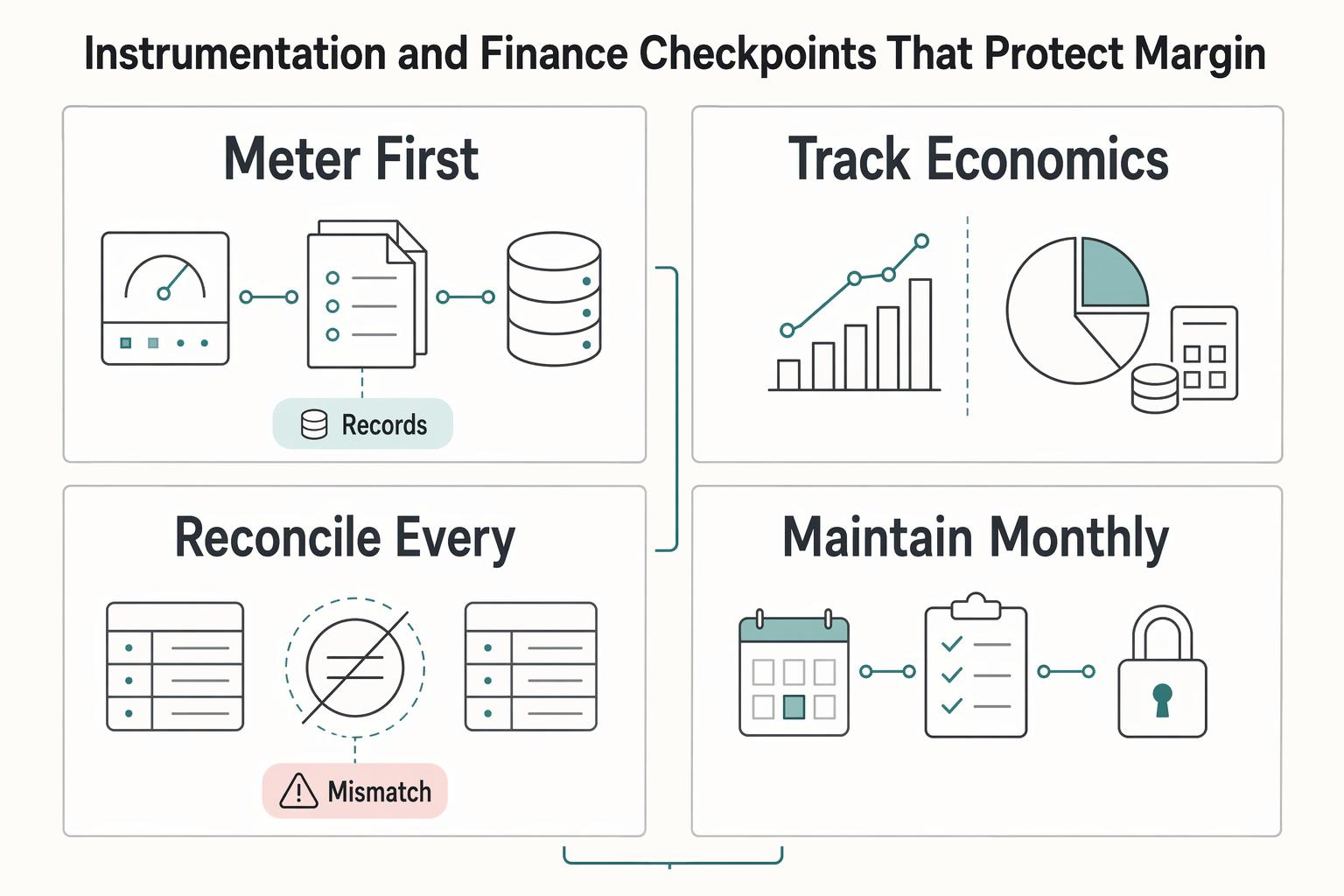
How AI Platforms Should Use Credit-Based Billing Models
Credit-based pricing can be a useful launch model for AI, but it is not a pricing identity. Customers prepay for a pool of credits and consume them as they use the product. That works especially well in AI, where LLM consumption can swing wildly and cost is easier to observe than customer value early on. The advantage is straightforward: you get a predictable prepayment layer for an unpredictable workload. The catch matters just as much. For many teams, credits are a bridge model, not the thing that should define pricing forever.

Usage-Based Billing for B2B SaaS Platforms That Teams Can Operate
Usage-based billing works best when customer value rises with measurable consumption rather than with a fixed license. It can improve pricing fit, but only if pricing logic, billing data, and finance controls are designed together from the start.
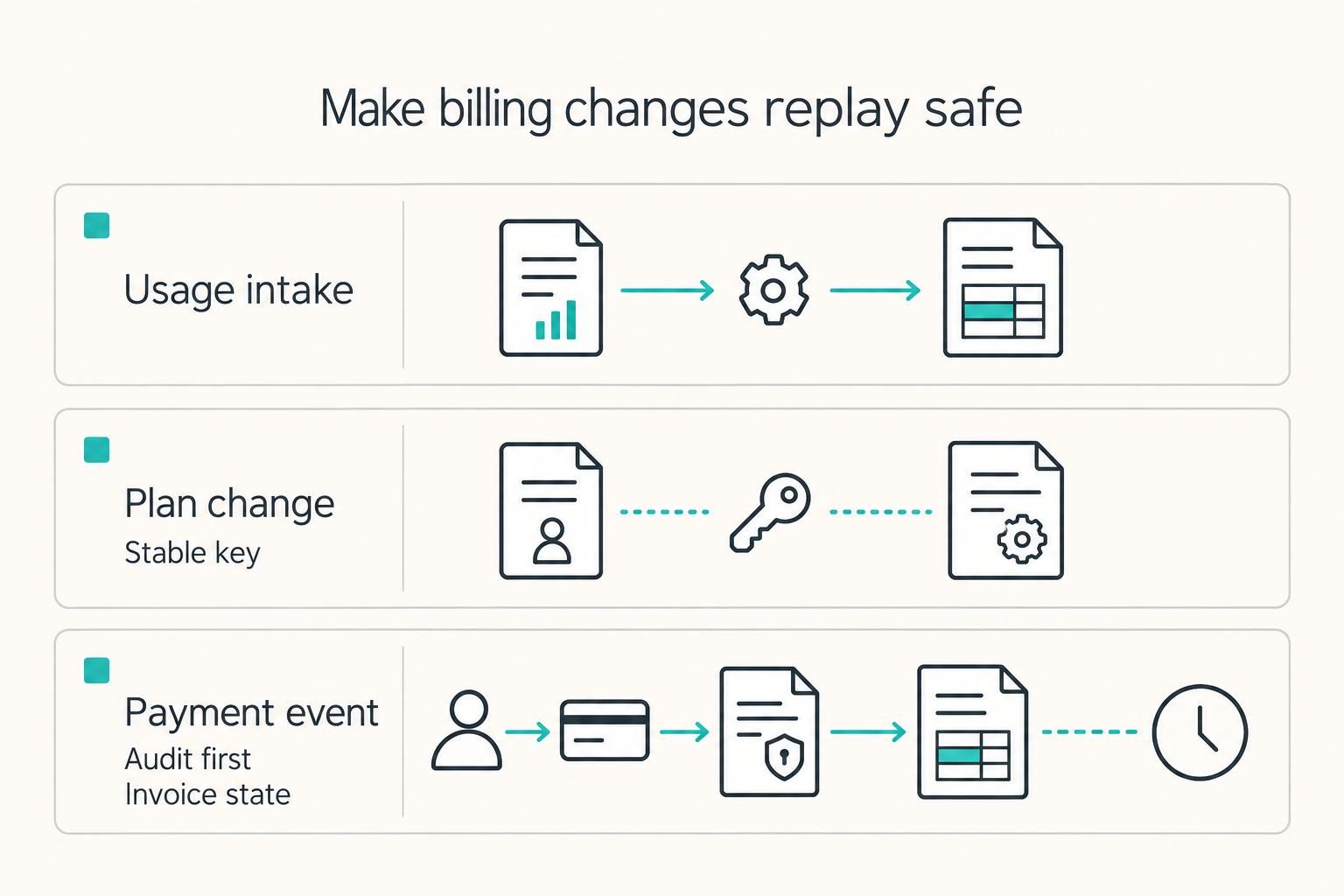
Hybrid Pricing Models for One Subscription and Usage Invoice
Treat this as a billing and operations project, not just a pricing exercise. A hybrid pricing model can be commercially strong. The real test is whether you can put a recurring subscription fee and usage-based charges on a single invoice without forcing Finance to stitch things together at month-end.