
Quick Answer
Start by treating subscription billing platforms plans addons dunning as one controlled operating flow, not separate features. Define owners, map the full event path from invoice to provider result to reconciliation output, and set explicit account states for failure, retry, restriction, and final outcome. Then choose native or dedicated dunning based on workload, and verify every retry updates the same canonical records. If finance, ops, and engineering cannot trace one failed renewal to a single final state, tighten the model before scaling.
What a Subscription Billing Platform Needs to Handle#
Treat subscription billing as an operating discipline, not just a pricing setup. A subscription is the billing object used to charge a customer for a selected plan. Every choice around Plans, Add-ons, and Coupons has downstream effects once renewal time arrives.
Step 1. Keep the chain of billing decisions clean after checkout#
Think of billing as a chain of decisions that has to stay clean after checkout. In some platforms, subscription setup starts with the Product, Plan, Add-ons, and Coupons. That can make billing look like a packaging problem. It is also an exception-handling problem, because recurring charges keep running on a schedule after the initial sale, and failures happen when cards expire, funds are insufficient, or authentication fails.
A useful opening checkpoint is simple. Can your team explain what should happen after a failed renewal without opening three tools and a spreadsheet? If the answer is no, you do not have a clean operating model yet. You have a product catalog plus a set of manual fixes.
Step 2. Define dunning as automated recovery when a renewal fails#
Define dunning management as automated payment recovery, not email copy. Dunning management is an automated payment recovery process triggered when a subscription renewal payment fails. Good dunning notifies the customer, but the message is only one part of the response. The real control is whether the failure changes account state, schedules the next retry, and records the outcome consistently.
One early decision matters more than it seems. Do not assume the same recovery path fits every subscription. Some billing products let you configure dunning separately for subscriptions with autocharge and subscriptions without autocharge. That split is worth keeping in your own design, because the failure mode is different when you can retry a stored payment method versus when you need the customer to act first.
Step 3. Name owners for retry policy, notices, and the exception queue#
The goal is fewer payment surprises and less involuntary churn. That only happens with clear ownership and verification. Dunning can help retain customers and reduce involuntary churn, and it works best when someone owns the retry policy, the customer notices, and the exception queue. When nobody owns those pieces, teams usually optimize the visible layer first and miss the operational one. They rewrite reminder emails while expired cards and authentication errors keep aging in the queue.
Your first verification standard should be operational, not aspirational. You should be able to point to the retry count, the retry intervals, and the customer notification tied to each failed payment. If you cannot show that chain clearly, your billing setup is still too loose for scale.
That is the lens we use here. We are not treating plans, add-ons, and dunning as separate features to switch on. We are treating them as connected controls that finance, ops, and product owners need to design, verify, and keep honest over time.
What to prepare before you change billing logic#
Before you change retry timing or cancellation rules, lock three things first: who decides, how systems hand off data, and what your current failure baseline looks like. SaaS billing is more complex than traditional billing, and subscriptions, usage charges, and plan changes create edge cases quickly when ownership and verification are unclear.
| Preparation area | What to prepare | Verification point |
|---|---|---|
| Owners by decision type and by checkpoint | Define who approves it, who executes it, and who verifies that downstream records still align. | For any proposed change, you can point to those three owners without ambiguity. |
| Actual billing flow and tool boundaries | Include where pricing rules are applied, where usage is tracked, where invoices are generated, and how billing state syncs across systems. | Trace one failed renewal from payment attempt to invoice status, customer communication, and final billing-state outcome. |
| Baseline evidence pack | Pull failed-payment reasons, current dunning outcomes, reconciliation breaks, and support escalations tied to billing confusion, and capture the current sequence and timing. | Use it to compare before and after behavior. |
Step 1. Assign who approves, executes, and verifies each billing change#
Assign owners by decision type and checkpoint, with names attached. For each billing change, define who approves it, who executes it, and who verifies that downstream records still align.
Your checkpoint is simple: for any proposed change, you can point to those three owners without ambiguity. If you cannot, the change usually spills into support tickets and manual fixes.
Step 2. Map your billing flow and tool boundaries end to end#
Map your actual billing flow and tool boundaries end to end. Include where pricing rules are applied, where usage is tracked, where invoices are generated, and how billing state syncs across systems.
Verification point: trace one failed renewal from payment attempt to invoice status, customer communication, and final billing-state outcome. This matters even more if you run more than one model, such as recurring, usage-based, and sales-negotiated contracts.
Step 3. Build a baseline evidence pack before you modify logic#
Build a baseline evidence pack before you modify logic. Pull failed-payment reasons, current dunning outcomes, reconciliation breaks, and support escalations tied to billing confusion.
Because dunning is a scheduled sequence, not a one-off notice, capture the current sequence and timing so you can compare before and after behavior. You might also find this useful: Deferred Revenue for Subscription Platforms: How to Account for Prepaid Plans and Annual Contracts.
Map billing models to packaging and contract rules#
Use separate rule tracks for Recurring billing, Usage-based billing, and Sales-negotiated contracts so packaging and dunning rules match how revenue is actually sold and billed.
| Billing track | Behavior noted | Rule implication |
|---|---|---|
| Recurring billing | Often more standardized. | Keep its packaging and dunning rules separate from the other tracks. |
| Usage-based billing | Charges can vary month to month. | Do not force one retry, coupon, or cancellation path across all tracks. |
| Sales-negotiated contracts | Can add exceptions such as multi-year terms, ramp pricing, and discount approvals. | Document exceptions instead of squeezing them into default flows. |
Step 1. Split monetization tracks before changing packaging rules#
Split monetization tracks before changing packaging rules. Usage-based charges can vary month to month, while recurring billing is often more standardized. Sales-negotiated contracts can add exceptions such as multi-year terms, ramp pricing, and discount approvals, so forcing one retry, coupon, or cancellation path across all tracks creates avoidable exceptions.
Keep one principle clear: your subscription management layer is the control point between pricing and product access, and it must work for both self-serve and sales-led flows.
Step 2. Define plans, add-ons, coupons, and discounts as explicit objects#
Define lifecycle rules for Plans, Add-ons, Coupons, and Discounts as explicit objects. For each, document who approves creation, when changes take effect, how mid-cycle billing treatment is handled, and how rollback is recorded.
Use a written checkpoint for each object: approver, effective timing, impacted customer or billing records, and rollback record.
Step 3. Choose your operating bias based on billing complexity#
Choose your operating bias based on billing complexity. If contract and revenue handling are getting more complex, prioritize stronger finance controls and tighter approvals. If self-serve is dominant, optimize for checkout clarity and lower support load.
This is a fit question, not a one-size-fits-all benchmark: some systems are better for high-volume standardized B2C invoicing, while others are better for lower-volume, more complex B2B invoicing.
Step 4. Document edge cases and overrides before launch#
Document edge cases before launch, especially annual prepaid changes, add-on removals mid-cycle, and negotiated terms that override default dunning behavior.
For each edge case, keep one traceable chain: approved contract or pricing note, billing configuration, and customer-facing notice. Related: Streaming Media Subscription Billing: How OTT Platforms Handle Billing Trials and Churn.
Build the money trail from invoice to ledger to settlement#
If finance cannot trace a charge from invoice creation to the reconciliation row used at close, the billing operation is not reliable. After splitting rules for recurring billing, usage-based billing, and negotiated contracts, make every money event observable and replay-safe.
Step 1. Define one explicit event order for each billing track#
Define one explicit event order for each billing track, and mark which state is official at each step. Your subscription billing platform can automate signups, renewals, and mid-cycle plan changes, but that automation only helps when your team agrees on when a customer event becomes a payment event, and when that becomes an accounting event.
Start with one successful charge path and one failed charge path. Keep the sequence consistent: invoice created, payment attempt sent, provider response received, ledger posting decision made, customer balance view updated (if used), and settlement or payout status updated later when applicable. The key decision is which event changes access, which event creates or reverses a journal, and which event is informational only.
Run a simple check: have ops, finance, and engineering each trace the same recent invoice. If they identify different "final" states, your flow is still implicit and needs to be documented before you tune retries or dunning.
Step 2. Keep one reference chain from invoice to reconciliation output#
Make traceability part of the records, not analyst memory. At scale, spreadsheet handling of recurring invoices becomes impractical, so handoff evidence has to be linked across systems.
You do not need a universal schema, but you do need a consistent reference chain your teams can follow from invoice to provider result to internal transaction record to reconciliation output. If tools use different labels, keep one versioned mapping so the trail stays usable during close.
For each trace, keep:
- the invoice record or export line
- the payment result for that attempt
- the internal transaction or journal reference
- the reconciliation extract finance used
Apply the same standard to failed payments. Failed subscription payments are both a revenue-risk issue and a traceability issue once retries, reversals, and manual fixes accumulate.
Step 3. Treat replay safety as a hard requirement before scaling#
Treat replay safety as a hard requirement before you scale volume. If the same retry or webhook event is processed twice, it should confirm the same outcome, not create duplicate ledger entries or customer-facing status changes.
Test this with deliberate replays: resend one provider event, rerun one retry path, and verify ledger, invoice state, and reconciliation output remain unchanged except for audit history. If replays create new financial movement, fix that before expanding throughput.
Handle cross-border tax logic in the same trail. If buyer location drives VAT or sales-tax treatment, capture that decision in the billing record because it changes invoice totals and downstream reconciliation expectations.
For a step-by-step walkthrough, see The Best Tools for Managing Subscription Billing.
Set dunning policy as a controlled lifecycle#
Treat dunning as a controlled account-state lifecycle tied to your invoice and ledger records, not as a bundle of templates. If you cannot name the state, next action owner, customer message, retry decision, and accounting effect at each stage, the process is not controlled.
Step 1. Define states from account outcome, not vendor defaults#
Start with business states, then map tooling to them. A practical sequence is initial failure, retry window, restricted service, and final cancellation or escalation.
| State | Operational meaning | Customer treatment | Record that must change |
|---|---|---|---|
| Initial failure | First payment attempt failed, outcome not final | Notify customer that payment did not complete and what they can update | Payment attempt result, invoice status, account risk/status flag |
| Retry window | Further attempts allowed under policy | Keep service unchanged or warn of restriction, depending on your product rule | Next retry schedule, notification log, account state |
| Restricted service | Access is limited pending recovery or review | Show clear in-app and email notice, allow payment method update | Account access status tied to the failed invoice or subscription |
| Final cancellation or escalation | Automated recovery stops, or case moves to human review | Cancel, suspend, or route to contract/compliance owner | Subscription or account status, final dunning outcome, any write-off or escalation reference |
Do not force one default flow across all billing tracks when service or contract consequences differ. Define each state by service and risk outcome, then confirm the state is visible in canonical records, not Slack threads or spreadsheets.
Step 2. Pair retry logic with communication and exception rules#
Retry logic should always ship with communication and status updates. Each retry attempt should have a matching customer-facing message, or an explicit no-message decision, and an internal state change.
Use explicit "if X, do Y" rules:
- If the failure reason looks transient, keep the account in retry window, schedule the next attempt, and send a clear customer update.
- If the failure reason suggests compliance, identity mismatch, or account mismatch risk, pause retries and route to ops review.
- If the customer updates payment details during retry, log the update on the same invoice or account entities and continue from the current state.
- If the account is restricted, keep that status visible to support and product until a recorded policy action changes it.
Dunning tools are often positioned around retry logic, customer outreach, and automation, but those operator rules still need to be explicit in your policy.
Step 3. Keep dunning inside the billing and accounting records you already trust#
Dunning actions should write back to the same invoice, payment attempt, subscription, and ledger-adjacent entities you already treat as official. If dunning runs outside those records, recovery and reconciliation drift apart.
For each failed-payment path, keep evidence for: failed attempt result, current account state, retry-or-pause decision, customer notice ID or template version, and final outcome. Then check two things: ops can explain why the next action happened, and finance can confirm whether the event changed access only or also affected posting, reversal, or write-off decisions.
Use comparison pages for discovery, not policy design. If a tool cannot map outcomes into your canonical records, it will not produce a controlled dunning lifecycle.
If you want a deeper dive, read A Guide to Dunning Management for Failed Payments.
Decide between built-in dunning and dedicated dunning software#
Once your states and evidence pack are defined, make this a workload decision, not a tooling debate: stay native when billing logic is simple and team capacity is tight; evaluate dedicated dunning software when segmentation, retry tuning, and recovery reporting become a weekly ops burden.
Step 1. Score each option on the same four axes#
Score each option on the same four axes (for example, Stripe Billing vs Chargebee Retention):
| Axis | Stay native when... | Move to dedicated when... |
|---|---|---|
| Control depth | One main self-serve model and a small retry policy set is enough. | You need frequent policy differences by segment, billing model, or contract type. |
| Integration cost | Invoice, payment, and subscription records already live in one system. | Extra connector work is acceptable to get needed dunning behavior. |
| Reporting quality | "Did this recover?" answers most decisions. | You need recurring analysis by failure reason, segment, retry stage, or policy variant. |
| Operational overhead | Fewer systems and reconciliation points keeps ops stable. | Added admin and monitoring overhead is justified by better control and visibility. |
If failed payments are still occasional exceptions, native is usually the cleaner path. If they are now a standing operating queue, test dedicated options seriously.
Step 2. Cost your native path before assuming it is cheaper#
Cost your exact native path before assuming it is cheaper.
Stripe standard pricing states no setup or monthly fees and lists 2.9% + 30¢ per successful domestic card transaction. It also lists additional fees such as 0.5% for manually entered cards, 1.5% for international cards, and 1% when currency conversion is required.
For Stripe Connect, model choice changes platform economics: in "Stripe handles pricing," Stripe states no fees for your platform; in "you handle pricing," Stripe lists $2 per monthly active account plus 0.25% + 25¢ per payout sent. Stripe support also states Managed Payments adds 3.5% per successful transaction on top of standard processing fees, and subscription payments can include additional charges.
Step 3. Validate connector behavior with scenario tests before committing#
Validate connector reality with scenario tests before committing.
Use G2, Reddit, and vendor comparison pages to build a shortlist, then test whether outcomes write back cleanly to your canonical billing records, ERP (NetSuite), and revenue reporting.
Run three scenarios for each candidate: transient failure that later recovers, payment method update during retry, and final cancellation or escalation. In each case, confirm the invoice or subscription state is correct in the source record, the ERP receives usable outcomes, and reporting reflects recovery or failure once, not twice.
Implement event-driven retries and monitoring checkpoints#
Make retries event-first so ops can act quickly and finance can still reconcile cleanly. Use dashboards to operate, but anchor decisions to the same canonical invoice and subscription records.
Step 1. Translate dunning policy into named, recorded events#
Translate your dunning policy into named events, then record those events against canonical billing records. A practical set is: failed charge, retry scheduled, customer notified, payment recovered, and final write-off or cancellation.
If your billing stack automates invoice creation, delivery, and tracking, and supports hybrid models across subscription, usage-based, one-time, and tiered charges, event traceability becomes non-negotiable. For any failed payment, you should be able to follow provider result, invoice status, and ledger impact through shared identifiers.
Step 2. Run a weekly checkpoint that stays narrow and repeatable#
Run a weekly checkpoint that stays narrow and repeatable. Review: failed-payment queue age, recovery by segment or billing model, exception backlog, and billing-to-ERP reconciliation mismatches.
The goal is operational clarity, not extra reporting volume. Each exception class should have a named owner and a current status.
Step 3. Treat customer-facing balances as operational projections#
Treat wallets, collector views, and customer-facing balances as operational projections. They are useful for action, but they should not replace ledger-confirmed outcomes in close workflows.
This matters even more when ERP integrations and workflow automation handle proration, amendments, renewals, or multi-entity consolidation, where timing differences can surface. Use regular trace checks to confirm recovered or reversed outcomes post once, not twice.
Step 4. Define handoffs before exceptions pile up#
Set handoffs before policy changes go live. Product approves policy changes, ops executes and documents exceptions, and finance signs off that recoveries and reversals reconcile in ERP records.
Keep the evidence pack lightweight: policy version, affected segments, sample event traces, and finance sign-off. That keeps policy updates from turning into silent cleanup work later.
Related reading: Best Platforms for Creator Brand Deals by Model and Fit.
Common mistakes that break trust and how to recover#
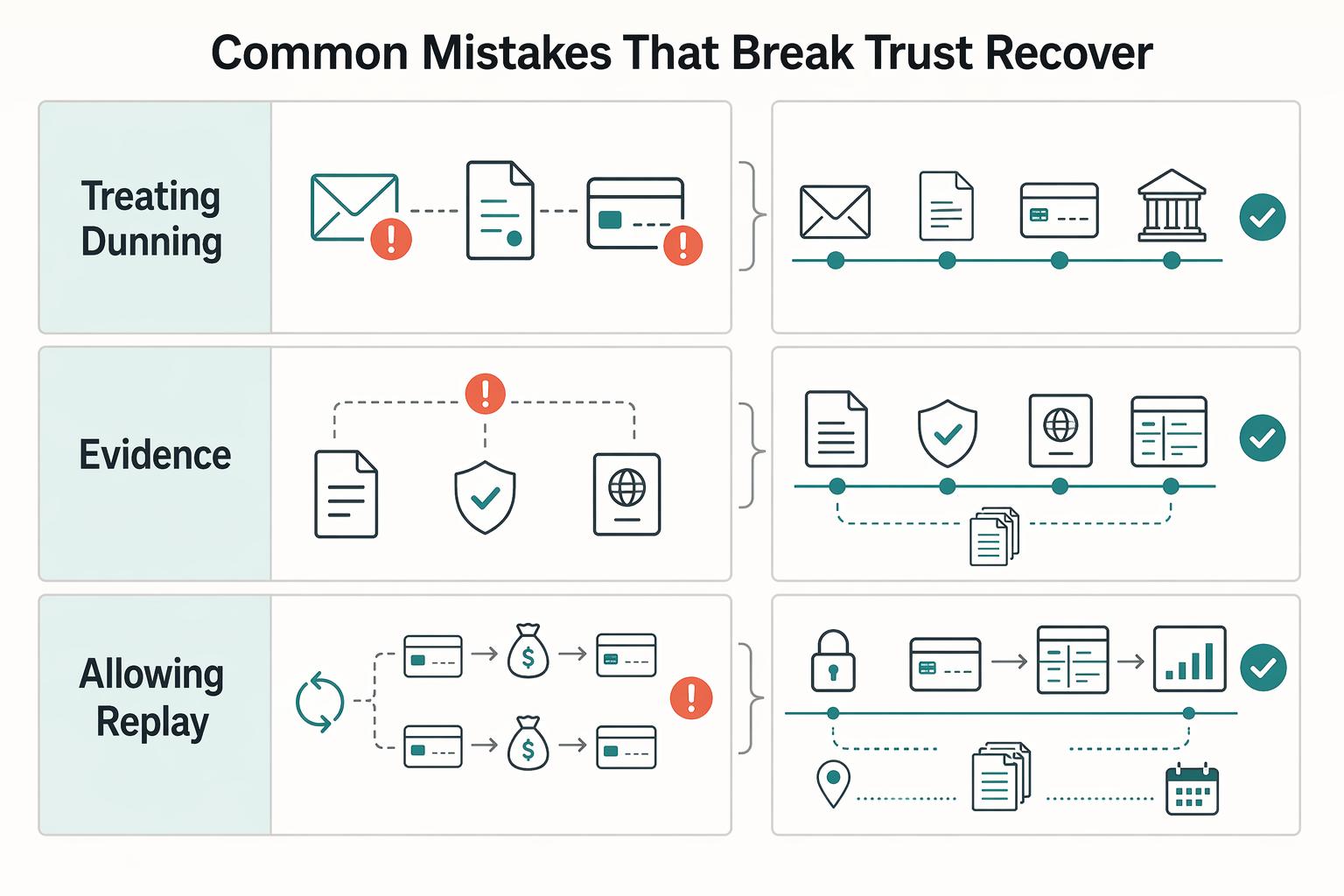
Trust usually breaks when customer-facing actions are not anchored to the same billing and ledger state. Recovery is to make every retry, price change, and compliance-sensitive step traceable to one record path.
| Mistake | Recovery |
|---|---|
| Treating dunning as email copy only. | Run dunning from status transitions, and treat emails as outputs. If a case is marked recovered, cancelled, or written off, the invoice state and ledger trail should show the same outcome under the same identifiers. |
| Changing Coupons or Discounts without a clear record. | Require an approval log for in-cycle pricing changes, including who approved, when, and why, plus a rollback note. If that trail is missing, pause retries until the intended treatment is confirmed. |
| Allowing replay-driven duplicates into accounting. | Make retry and webhook handling replay-safe with idempotency controls, then verify replays do not create extra ledger postings. |
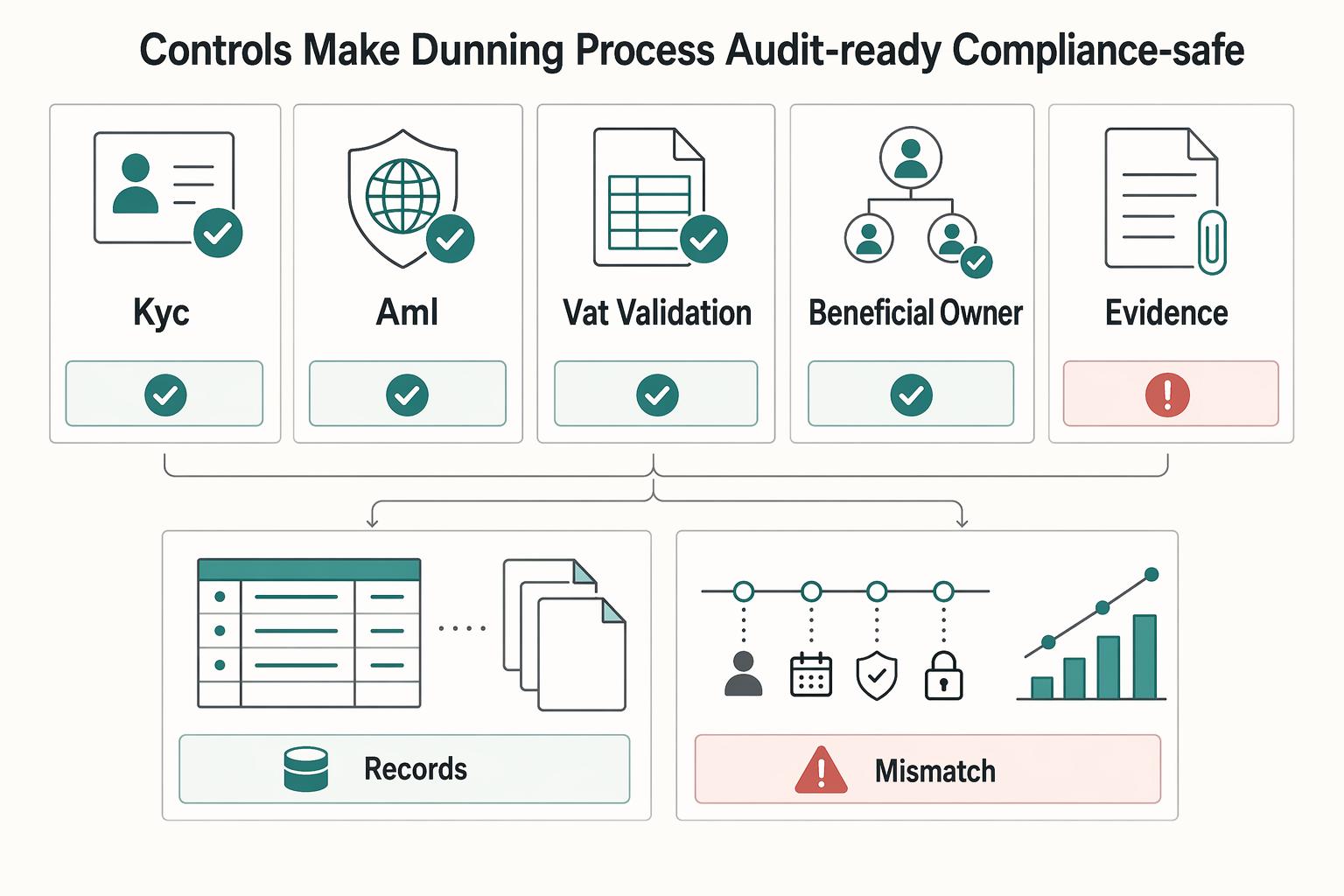
| Treating compliance and tax records as an afterthought. | Gate sensitive flows with KYC/KYB/AML where your program requires it, keep W-8/W-9 artifacts retrievable where supported, and for FBAR records value each account separately, record maximum account value in U.S. dollars rounded up to the next whole dollar, and use the Treasury year-end rate for non-U.S. currency accounts. |
For compliance and tax-sensitive flows, gate KYC/KYB/AML where your program requires it, and keep W-8/W-9 artifacts retrievable where supported. For FBAR records, value each account separately, record maximum account value in U.S. dollars rounded up to the next whole dollar, and use the Treasury year-end rate for non-U.S. currency accounts. If someone has signature authority but no financial interest, note the April 15, 2027 extension; for other FBAR filers, the due date remains April 15, 2026.
This pairs well with our guide on How to Calculate and Manage Churn for a Subscription Business.
Conclusion and copy-paste rollout checklist#
Do not roll out billing or dunning changes until each item below has an owner, a proof point, and a fallback. A practical risk is a clean-looking process that still leaves invoice status, payment outcome, and accounting records out of sync.
-
Confirm prerequisites. Write down who owns each decision before you touch logic: product for plans and add-ons, finance for revenue and reconciliation, and ops for retries and exceptions. Map handoff points between your billing system, ERP, payment provider, and any tax or compliance checks in scope. Before changes, capture a baseline pack with relevant metrics (for example, failed-payment reasons, queue age, recovery rate, reconciliation mismatches, and support escalations). Your verification check is simple: one pre-change account should be traceable from invoice to payment result to final record without cross-team guesswork.
-
Confirm design. Separate rules for recurring billing, usage-based billing, and negotiated contracts instead of forcing one retry pattern across every account. Make dunning states explicit: initial failure, retry window, restricted service, and final cancellation or escalation. Keep a money trail that holds up under review, including request ID, provider ID, internal transaction ID, and the reconciliation export row used later. If usage charges depend on billable event metrics, confirm the usage feed is complete before retrying. In practice, payment failures can be mixed with invoice or dispute issues, so validate both.
-
Confirm the native versus dedicated decision. Put the choice in writing, including why native billing features are enough today or why dedicated dunning management is worth extra integration work. Name tradeoffs, not just preference: control depth, reporting quality, connector effort, and ownership of exceptions. Then test with real scenarios. A passing result is not only a clean dashboard; it is evidence that a recovered payment updates the same invoice, account state, and ERP-facing record set cleanly.
-
Confirm controls. Validate idempotent retries and replay-safe webhook handling before volume goes up. Re-send the same failed charge event and verify you do not create duplicate postings, duplicate notices, or inflated recovery counts. If compliance or tax gates apply in your program, make those gates visible in the process and confirm evidence can be exported without manual reconstruction.
-
Confirm operations. Start the weekly review cadence before launch, not after the first incident. Review failed-payment queue age, recovery by segment, exception backlog, and reconciliation mismatches, then assign each open action to a named owner. Document top failure modes with the trigger, reviewer, pause condition, and final account state. If your team cannot quickly answer "who owns this stuck account and what happens next," you are not ready to ship.
Frequently Asked Questions
What is dunning in subscription billing, and where does it start in the payment lifecycle?
Dunning is the recovery process that starts after a payment attempt fails. In practice, it typically moves through retry logic, customer outreach, and automated workflows to recover failed-payment revenue.
Do we need built-in dunning from our billing platform or a dedicated dunning tool?
Start with native billing capabilities when your needs are simple. Move to dedicated dunning management software when retries, outreach, and recovery workflows become a larger operational burden or when core billing features are no longer enough.
What core features are required to manage Plans, Add-ons, Coupons, and failed payments reliably?
At minimum, your subscription billing platform should automate invoicing and payments, calculate recurring charges from pricing, discounts, and product metadata, and support customer self-service for account changes such as payment information and seats. For coupon control, you need creation or import, edit permissions, availability rules, usage tracking across subscriptions and invoices, and a clear Redemption Type so you know how many times a coupon can apply to a subscription.
How should retry timing differ for Recurring billing versus Usage-based billing?
Exact retry timing rules by billing model are not established. For usage-based invoices, confirm usage data sync is complete (real time or batch) before treating a failure as only a payment issue, then apply your internal retry policy.
What should finance and ops review every week to catch billing issues early?
Review recovery outcomes from retries, outreach, and automated workflows, plus exceptions where payment outcomes and billing records do not align. A small weekly spot check of failed and recovered accounts can help catch workflow breaks early.
What happens after all retry attempts fail, and how should account status change?
After retries are exhausted, move the account to a clear, policy-defined final state and apply that state consistently across billing and operations records. The exact state names and access changes depend on your internal policy.
How do negotiated enterprise contracts change dunning and recovery rules?
Treat contract exceptions as an internal policy and workflow decision, and document approved terms where billing and ops can execute them consistently.
Try a related tool
Researched and edited by the Gruv editorial team. Gruv builds cross-border billing, payouts, and finance-operations software for global businesses.
Sources
Includes 3 external sources outside the trusted-domain allowlist.
- bsaefiling.fincen.gov/docs/XMLUserGuide_FinCENFBAR.pdftrusted
- fincen.gov/reporting-maximum-account-valuetrusted
- fincen.gov/system/files/2025-12/FBAR-FBAR-Filing-Requir...trusted
- stripe.com/pricingtrusted
- stripe.com/connect/pricingtrusted
- chargebee.com/blog/top-7-subscription-payment-gateways-guideexternal
- chargezoom.com/blog/what-is-a-dunning-sequenceexternal
- checkoutchamp.com/media/top-7-subscription-billing-platforms-a...external
Educational content only. Not legal, tax, or financial advice.
Related Posts
A Guide to Dunning Management for Failed Payments
If you run recurring invoices, failed payments are not back-office noise. They create cashflow gaps, force extra follow-up work, and increase **Involuntary Churn** when good clients lose access after payment friction.
How OTT Platforms Handle Billing Trials and Churn in Streaming Subscriptions
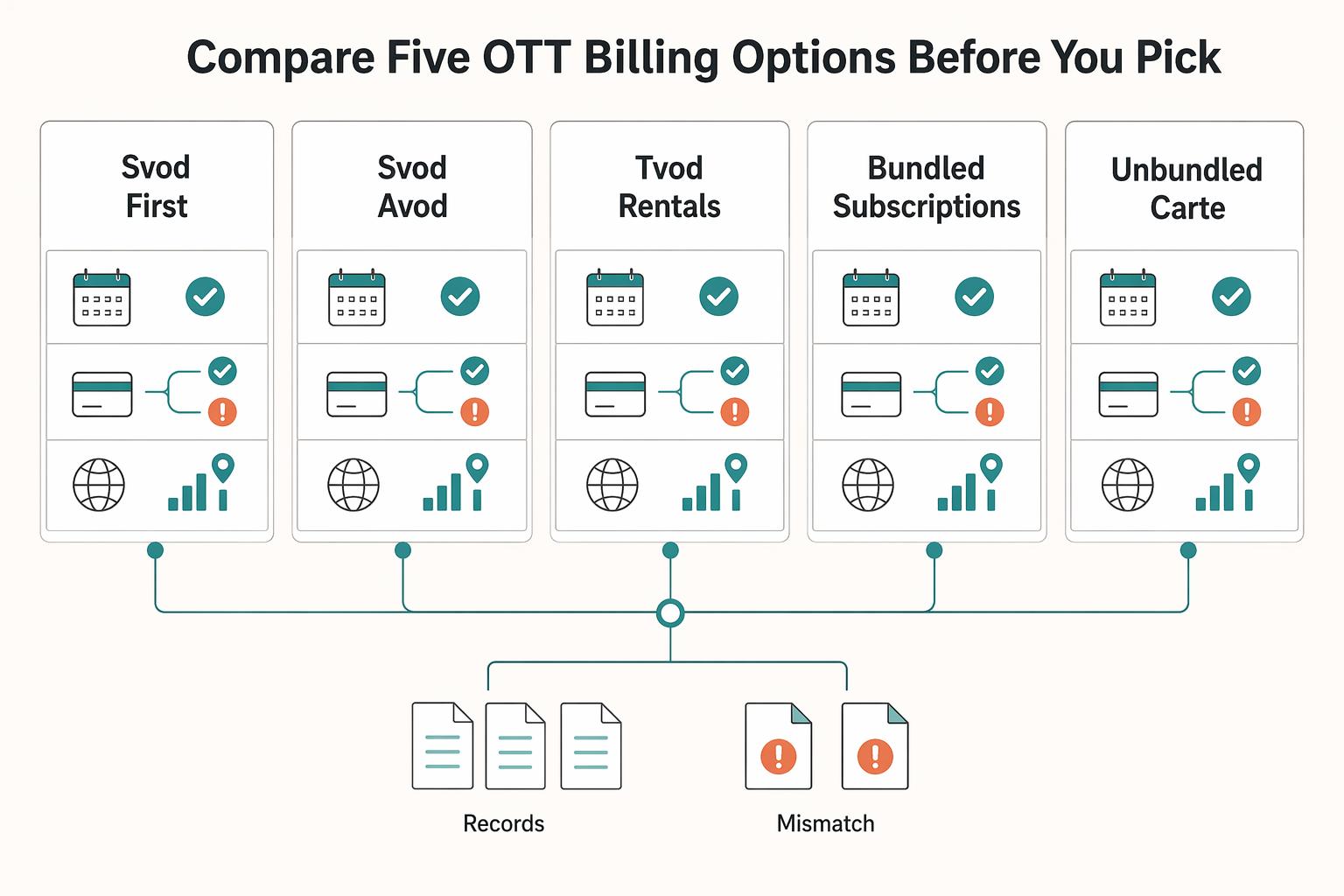
Start with the monetization model. Choose your monetization path before a product demo starts steering the decision. For a streaming offer, the real question is not which vendor can show subscriptions on a checkout page. It is whether your business is built around recurring access, ad-supported reach, one-off transactions, or a direct-to-consumer mix that may vary by market.
Deferred Revenue for Subscription Platforms: How to Account for Prepaid Plans and Annual Contracts
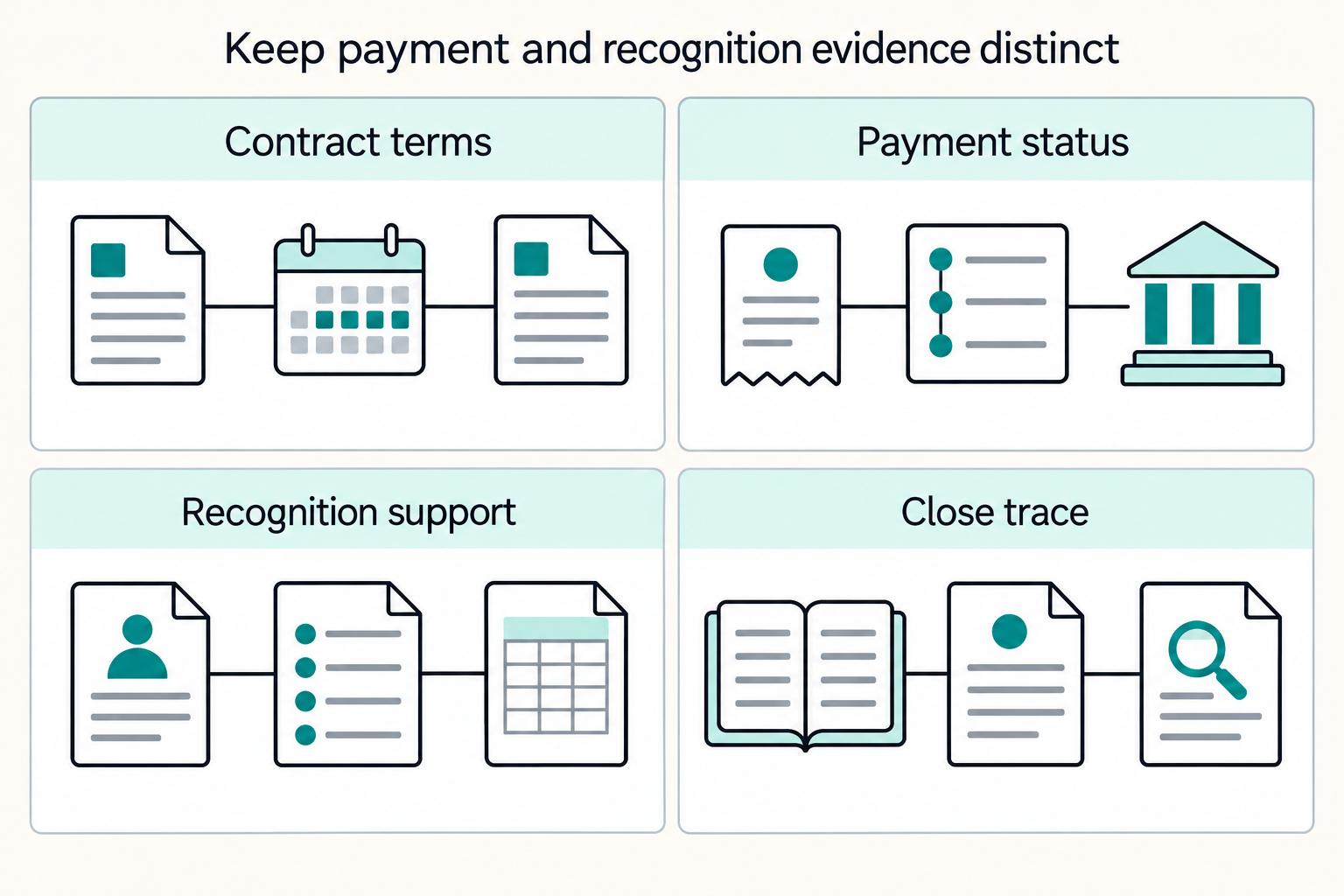
If you collect cash upfront for an annual plan, you have not automatically earned revenue. For a platform selling prepaid subscriptions across markets, the gap between cash receipt and service delivery is a control issue, not just an accounting entry.