
Quick Answer
For the opening-base method, customer churn is paying accounts active at the start but inactive at the end divided by opening paying accounts, multiplied by 100. Define same-period returns and early exits separately. Calculate gross and net MRR churn alongside it; new customer revenue does not offset the churn numerator.
Calculate Customer and Revenue Churn With Consistent Inputs#
Customer churn measures account loss; revenue churn measures lost recurring value. Calculate both for the same period, then investigate the accounts and billing events behind the result. Monthly recurring revenue (MRR) is a normalized subscription measure, not cash collected or bank payout.
Choose the decision the metric should support#
A churn rate is a lagging measure of loss that has already occurred. Renewal dates, engagement and collection exceptions can provide earlier signals, but none proves why a customer will leave. Use churn with those records to choose a testable response.
A growing customer count can hide exits when new accounts replace old ones. Similarly, expansion can offset lost MRR without resolving the underlying cancellations. Keep the loss components visible instead of inferring retention from topline growth.
A useful control loop starts with unified customer data across behavior, transactions, and operations. If cancellations sit in billing, engagement sits in product data, and save attempts sit in support notes, you will miss the pattern. A common failure mode is treating all exits as one bucket when voluntary and involuntary churn should be tracked separately.
| Guessing behavior | Control-system behavior | Immediate business consequence |
|---|---|---|
| You debate the definition every cycle. | You lock one churn definition and reuse it. | Trend lines become comparable, so renewal risk is easier to trust. |
| You wait for revenue to dip. | You track churn alongside leading signals before the dip. | You can act before acquisition pressure becomes unsustainable. |
| You look at churn in isolation. | You review it with CLTV, repeat purchases, and time-to-churn. | You can judge whether the loss is shallow, concentrated, or compounding. |
| You use churn as a dashboard number. | You forecast churn impact on subscription revenue and cash runway. | You can see whether retention issues threaten operating flexibility. |
Build a repeatable control loop#
Choose a compact metric set and one owner. Record the calculation window, account unit, loss event, input sources and change history. Churn should lead to a documented investigation and a follow-up decision, rather than a required improvement every period.
Before you start#
Before you calculate anything, use these checkpoints:
| Checkpoint | Ready when |
|---|---|
| Define recurring revenue scope | Your customer list clearly separates recurring or renewal-based revenue from one-off project work. |
| Assign metric ownership | One named owner can pull the same inputs each cycle and explain any change in source data. |
| Lock the rules | Your team can state, in writing, what counts as churn, what does not, and how voluntary versus involuntary exits are tagged. |
If your KPI baseline is still messy, clean that up first with How to Set and Track KPIs for Your Freelance Business.
What should you prepare before calculating churn?#
Prepare one reporting period, one account unit and a written method. This guide uses opening-base customer loss at period end for customer churn, plus recurring-revenue movement measures for gross and net MRR churn. A dashboard can use a different denominator or loss timing; reconcile those definitions before comparing numbers.
| Setup item | What to prepare | Article note |
|---|---|---|
| Owner and period | Choose one person to pull the data and explain any source changes; lock one reporting window (monthly, quarterly, or annual). | Keep period comparisons consistent; renewal-specific cohorts are a separate view. |
| Metric dictionary | Document exactly what each metric means in your business and what counts as a loss. | There is no universal churn definition. |
| Minimum dataset and governance | Save opening customer IDs/MRR, dated movements, closing records and stable segment tags. | Comparisons do not drift between runs. |
| Segment economics and currency | Use margin, acquisition cost, renewal exposure and an explicit currency/FX basis where relevant. | Prioritize investigation without turning payout destination into a churn definition. |
Choose one owner and a fixed reporting window with a timezone and exact start/end boundaries. Track monthly churn where useful even for annual subscriptions; separately show renewal-eligible cohorts when you need a renewal conversion rate. Those two rates answer different questions.
Write the metric dictionary before comparing periods. Define a customer as one paying account, not each subscription or user seat, unless another unit is explicitly chosen. In the opening-base method here, an account is lost when it was active at the start and inactive under your documented rule at the end.
| Metric | What to document | What it answers | When it should drive action |
|---|---|---|---|
| Customer churn | Opening paying accounts inactive at closing; same-period return rule | Account loss, with new-join early exits separate | Investigate changes in that population |
| Revenue churn | Normalized recurring value, cancellation/contraction and gain components | Recurring-value movement rather than cash | Review concentrations and period changes |
| Gross MRR churn | Cancellation plus contraction MRR, divided by opening MRR | Loss before gain offsets | Inspect unoffset loss even when total MRR grows |
| Net MRR churn | Loss minus specified expansion/reactivation, divided by opening MRR | Existing-business movement after defined offsets | Review together with gross; exclude new business |
If you cannot explain each label in one sentence, stop and finalize definitions first.
Save the opening customer IDs and MRR, then the period’s dated loss, contraction, expansion, reactivation and new-business events. Retain closing values for reconciliation. Opening and closing counts alone cannot identify churn, because joins and returns can offset losses.
Use segment contribution margin, acquisition cost and renewal exposure to prioritize investigations. Keep only relevant country/currency metadata and a documented FX method; payout destination does not define whether a customer churned. Do not delay a collection correction while waiting for a perfect lifetime-value model.
Readiness gate: pass only if you can reproduce the same churn output from the same inputs. If you cannot, fix setup first. If your KPI baseline is still messy, clean it up with How to Set and Track KPIs for Your Freelance Business.
How do you set the right churn scope and timeframe?#
Set scope before any calculation or review meeting: lock one reporting window and one loss definition, then keep both fixed until you formally change the metric.
Choose a reporting interval suited to trend and decision needs. Record effective cancellation and renewal dates separately from request dates: a cancellation requested in June for a subscription active until July is not necessarily a June account loss under your active-through-period-end rule.
Write one canonical scope statement and use it every cycle. Keep it short and repeatable:
Example policy: “For June in UTC, customer churn is the percentage of paying accounts active at 1 June that are inactive at 1 July. Exclude free plans and trials. An opening account that leaves and returns before the end is not a period-end account loss; record its interruption separately. New accounts that both join and leave during June go in a separate early-life loss report.”
Publish the chosen policy beside the result. If definitions change, version them and restate comparable history where feasible. Unresolved material records should be flagged with their likely effect; do not present an unverified total as final.
Decide which churn lens triggers action. Track customer churn and revenue churn together, then escalate to segment-level review when they disagree.
| Decision question | Primary lens | Act first on |
|---|---|---|
| Are too many accounts leaving? | Customer churn | Segment-level account loss patterns, even if revenue impact looks small |
| Is recurring income dropping faster than account count? | Revenue churn | High-value account loss, contraction patterns, and revenue concentration risk |
| Do account and revenue signals conflict? | Both, then cohort view | Segment-level diagnosis before choosing interventions |
Use acquisition cohorts to compare customers at the same age and behavioral segments to test possible causes. Show each segment’s opening denominator and loss count; a rate based on two accounts should not be treated as equally precise as a rate based on hundreds.
Specify the boundary cases before calculating
- Pause: record whether the account is still active and how MRR is represented; do not silently drop paused accounts.
- Downgrade: contraction reduces MRR but does not count as customer loss while the account remains active.
- Mid-period change: retain effective dates and avoid double counting one loss across subscription events.
- Failed collection: record attempts, recovery and the effective unpaid/canceled status under your policy; failure alone is not final churn.
- Reactivation: distinguish an opening account returning in-period from a previously inactive account; preserve the separate movement and avoid changing the opening denominator.
- Voluntary/involuntary/unknown: tag supported reasons and leave unresolved cases unknown.
Document how each case changes customer status, MRR and cash records. These may change on different dates. A provider payout hold is a cash-availability issue; it is not an account loss while the subscription remains active.
Calculate churn correctly and make the result decision-ready#
Keep one fixed calculation sequence every cycle so your churn output stays comparable and practical.
Map the opening population and period movements before running formulas. Avoid double-counting multiple subscription cancellations for the same paying account. Use a consistent currency basis and keep FX movement separate from retention loss.
- Start-of-period customer base
- Approved loss events in that same period
- Recurring revenue field used for loss measurement
- Documented treatment of expansion and reactivation
Sample opening accounts counted as lost and inspect their effective status at the closing boundary. Also sample joins, pauses, downgrades, reactivations and failed payments. A first failed attempt may still be recoverable and does not itself mean the account has met your churn rule.
Calculate customer loss, gross MRR churn and net MRR churn separately:
- Customer churn (%) = opening paying accounts inactive at closing ÷ opening paying accounts × 100, under the period-end method here.
- Gross MRR churn (%) = (cancellation MRR + contraction MRR) ÷ opening MRR × 100.
- Net MRR churn (%) = (cancellation + contraction − existing-customer expansion − specified reactivation MRR) ÷ opening MRR × 100.
- Report new-business MRR and FX movement separately. If an opening denominator is zero, show not applicable rather than zero percent.
| Metric | Action trigger | Owner | Likely misread |
|---|---|---|---|
| Customer churn | Account loss exceeds the account-loss threshold set in your churn policy | Retention or customer success lead | Assuming account count alone explains cash impact |
| Revenue churn | Recurring revenue loss exceeds the recurring-revenue threshold set in your churn policy | Finance owner | Missing concentration risk in larger accounts |
| Gross churn | Gross leakage rises versus prior cycle | Finance + retention | Assuming expansion fully cancels loss |
| Net churn | Net result improves while gross still elevated | Revenue leader | Treating net improvement as full retention recovery |
Hypothetical MRR example: start at $20,000, lose $2,000 to cancellations and $500 to downgrades, gain $1,000 expansion and $300 from returning customers. Gross MRR churn is $2,500 ÷ $20,000 × 100 = 12.5%; net MRR churn is ($2,500 − $1,300) ÷ $20,000 × 100 = 6%. If new customers add $4,000, ending MRR is $22,800. That new-business growth belongs in the roll-forward, not as an offset in the churn numerator.
Reconcile customer growth without hiding loss#
Hypothetical month: 100 paying accounts open the period. Eight leave, one of those returns before closing, 20 new accounts join and two of the new accounts leave. Opening-base loss is seven accounts, so customer churn is 7%. Closing accounts are 100 − 8 + 1 + 20 − 2 = 111. Growth to 111 does not remove the seven opening-account losses; the two new-account exits belong in the early-life report.
Stripe Billing analytics documents a subscriber churn denominator that includes new subscribers in its past-30-day calculation. That differs from the opening-base method here. Its MRR also includes active and past-due subscriptions and uses monthly normalization. Compare definitions and underlying accounts before trying to make a dashboard and this worksheet show the same percentage.
ChartMogul documents the gross and net recurring-revenue movement formulas. If reactivation comes from accounts inactive at the opening boundary, show it explicitly; a movement report including those returns is not a pure opening-cohort retention measure. A $1,200 annual recurring fee contributes $100 normalized monthly value before any specified adjustments; a $1,200 bank receipt is a different measure.
Check the inputs before sharing results, then assess intervention costs and likely benefit. CLV/LTV estimates depend on their revenue or margin basis and assumptions; use segment economics as context rather than a universal gate that delays every fix.
- Reconciliation check: tie reported losses back to source records
- Reproducibility check: rerun the same period and confirm the same result
- Exception log: record overrides, exclusions, and late status changes with reason and owner
You might also find this useful: How to Calculate Customer Acquisition Cost (CAC).
What does high churn mean for your cashflow system?#
Rising churn can weaken future recurring income, but the rate alone does not describe cashflow. MRR, billed amounts, client payments, refunds, fees and bank payouts are different records. Review actual payment timing and near-term obligations alongside recurring-value loss.
Triage the signal before you react. Use your locked reporting window (month, quarter, or year), then classify what moved. Customer-count loss and revenue-value loss can point to different failures, so review both before choosing a fix.
| Signal | Candidate explanation | First containment action |
|---|---|---|
| Customer churn rises, revenue churn stays muted | Smaller-account exits, onboarding friction, weak early value | Review cancellation timing and first-value milestones |
| Revenue churn rises faster than customer churn | Large-account loss or downgrades | Build an at-risk account shortlist and contact high-value accounts first |
| Churn follows failed collections or payment failures | Payment friction may contribute; customer intent and final status still need review | Audit dunning, retries, invoice status, and recovery steps |
| Gross churn worsens while net looks stable | Expansion is masking leakage | Inspect the lost-value accounts even if gains offset the headline net result |
Verification artifact for each spike: a shortlist of at-risk or lost accounts, stated reason, and next experiment. Without that diagnostic step, teams often guess and over-invest in the wrong fix.
Split confirmed voluntary and involuntary losses, but leave uncertain reasons marked unknown. A failed collection and dissatisfaction may coexist. Inspect retry outcomes, support records and effective subscription status before assigning a cause or changing pricing.
Escalate spikes with one owner. When churn breaks your trigger criteria (using the threshold set in your churn policy), assign:
- owner
- working hypothesis
- corrective action for this week
- review checkpoint for next week
Pass if every spike has an accountable owner and a documented next action. Fail if the team can describe the trend but cannot name who is fixing what now. This pairs well with our guide on How to Set Sales Quotas for a SaaS Team.
Run each churn review as a fixed operating loop#
Make churn review a fixed operating loop, not a one-off analysis. Each cycle, separate retention risk from payment-ops risk, prioritize accounts with the biggest cashflow impact, and assign one owner with one due date for each action.
If you run monthly, use this loop monthly. If you run quarterly, keep the same loop and change only the window. Consistency is the control: when definitions, fields, or handoffs keep moving, your churn number stops supporting decisions in day-to-day business terms.
Run the cycle in the same order every time#
Unify inputs before diagnosis. Start from one locked view that combines churn outputs with your operating fields: invoice state, payout status, collections exceptions, renewal timing, segment, account value, and stated cancellation or downgrade reason. If you use dashboards or health scoring, keep the underlying account-level records visible.
Verification point: You should be able to trace every at-risk or lost account from the headline metric to its latest billing, payment, or renewal event. If you cannot, fix the data model and handoffs before debating causes.
Reconcile collections before treating their correlation with churn as a cause. Review failed attempts, successful recovery and final account status. A payout delay after the client paid belongs in a treasury/provider exception queue; do not classify it as involuntary customer churn or collect the invoice again.
| Risk lane | Signal pattern | What to investigate | First action |
|---|---|---|---|
| Retention risk | Cancellations cluster near renewal while payment records are clean | Possible value, fit or pricing issue; confirm reasons | Review cancellation reasons and contact highest-value upcoming renewals first |
| Retention risk | Customer churn rises while revenue loss stays muted | Smaller-account exits are driving account loss | Review early-value milestones and onboarding friction before pricing changes |
| Payment-ops risk | Collections exceptions or overdue invoice patterns rise before churn | Whether recovery failures contributed to actual account loss | Review retry logic, invoice follow-up, and exception handling first |
| Provider payout risk | Client paid but provider or bank payout is delayed | Cash availability is affected; this alone is not subscriber churn | Trace provider and bank references; do not recollect the paid invoice |
Keep separate retention, collection and provider-payout cases where needed. An account can need more than one investigation; record the shared evidence and responsible owners.
Prioritize by near-term cashflow impact. Work highest-value renewals, large downgrades, and near-term billing events first. Then handle lower-value loss patterns. This keeps response order aligned to cashflow risk, not just account count movement.
If large accounts have unresolved collection failures, investigate payment recovery and customer intent together. If payments are current but new users leave before reaching value, test onboarding. A hypothesis is a reason to inspect evidence, not proof of the cause.
Assign owner, due date, and handoff for every action. For each flagged account or segment, log owner, next action, due date, and escalation path if the first action fails. Use journeys, tasks, and alerts to enforce follow-through, not just to notify.
Verification point: Every item ends the cycle with a named owner and next review date. If ownership is unclear, the loop is not ready for the next cycle.
Set policy gates and keep records#
Define governance roles in plain terms. Name who owns communication permissions, consent/preference handling, and audit-trail records. Separately, name who owns merchant-side operational checks such as refunds, dispute handling, and payment exceptions. If you use a payment partner or Merchant of Record, document what they handle and what your team still owns.
| Area | What to document |
|---|---|
| Communication permissions | Name who owns communication permissions, consent/preference handling, and audit-trail records. |
| Merchant-side operational checks | Name who owns refunds, dispute handling, and payment exceptions. |
| Payment partner or Merchant of Record | Document what they handle and what your team still owns. |
Keep a compact evidence pack each cycle:
- locked input export
- payment and collections exception log
- ranked at-risk account list
- owner, action, due date, and handoff log
- outreach and approval record, including consent/preference checks and final outcomes
Retain the input version and event references so later corrections can be explained. A rerun can legitimately change after corrected source data; preserve the old result, new result and reason rather than treating every change as process failure.
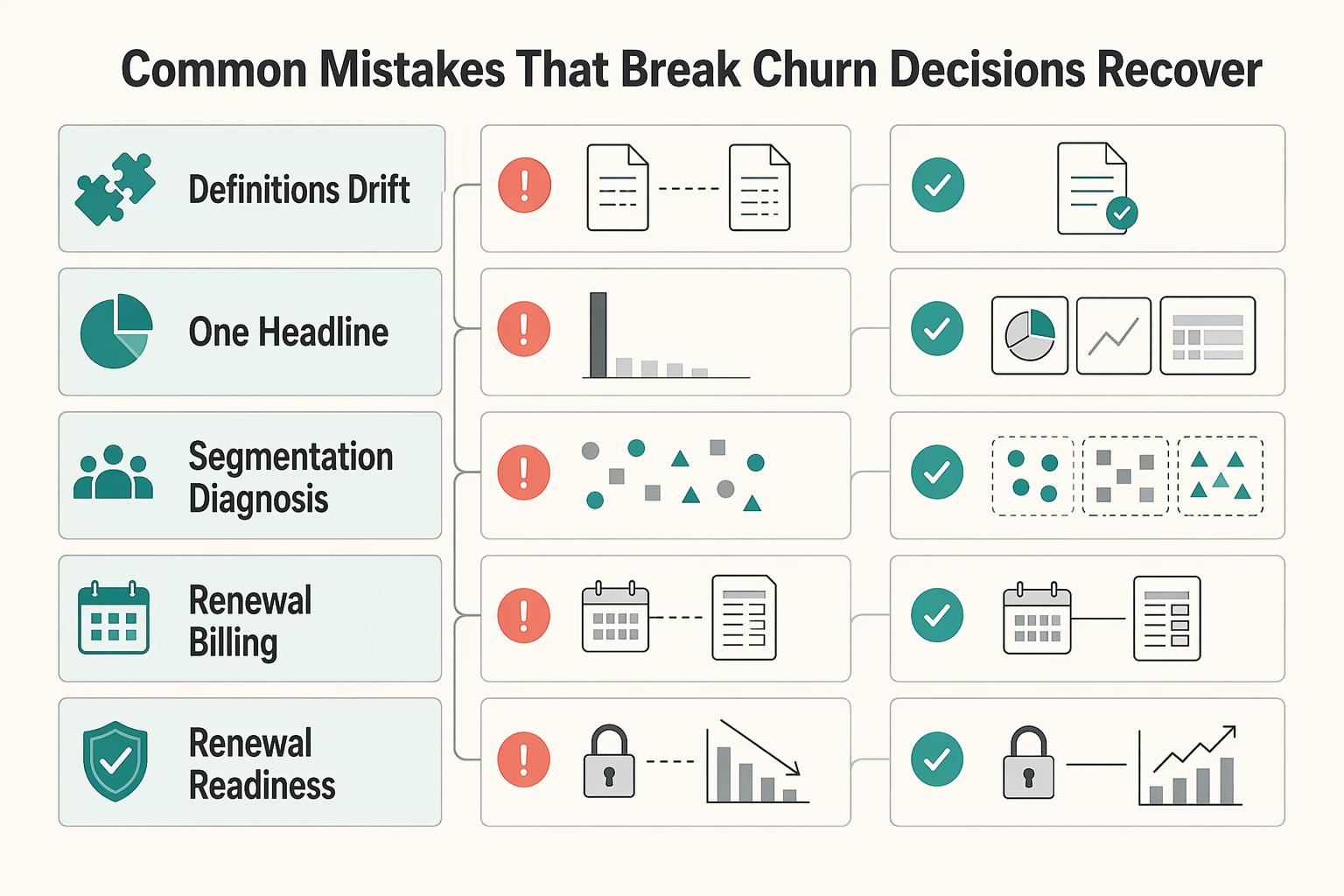
Common mistakes that break churn decisions and how to recover#
Definition drift, cohort mixing and untested cause assumptions can misdirect decisions even when arithmetic is correct. Review the error and affected periods before changing the retention process.
Use this as an operating decision table, not a theory list.
| Mistake | Operational signal | Likely root cause | Immediate recovery action | Owner |
|---|---|---|---|---|
| Definitions drift across teams | Finance, product, and growth show different churn results for the same period | Customer churn, revenue churn, CLV, and CAC are documented in different places or updated informally | Publish one shared metric dictionary and lock one cadence (monthly, quarterly, or yearly) for comparisons | Finance lead or analytics owner |
| One headline number drives every action | Customer churn looks stable while cash or margin pressure worsens | Account loss is reviewed without revenue impact or acquisition-cost context | Review customer churn with revenue impact, CLV, and CAC before selecting interventions | Finance lead with growth owner |
| No segmentation in diagnosis | Broad fixes launch, but losses keep repeating in the same subset | Voluntary and involuntary churn, revenue tiers, or behavior groups are blended | Segment review by revenue, behavior, and churn type before assigning work | Retention or operations lead |
| Renewal and billing friction is treated as product churn | Losses cluster around billing events, failed collections, or overdue invoices | Payment and renewal operations are breaking continuity before value is re-evaluated | Audit billing exceptions, retry flow, renewal notices, and invoice follow-up first | Finance or billing operations owner |
| Renewal readiness checks are incomplete | Renewals stall while records are corrected | Required customer, tax, permission, or renewal data is missing from pre-renewal workflow | Confirm applicable renewal, communication and provider requirements, with an owner; do not obstruct cancellation or promise a metric improvement. | Operations owner with finance review |
Use one versioned dictionary for customer units, loss timing, MRR treatment and economics. Keep gross and net results separate and make dashboard differences visible.
Compare the same interval and population. Do not multiply a monthly churn percentage by 12 to obtain annual loss. Under a hypothetical constant 5% monthly loss with no reactivation, a starting cohort retains 0.95^12, about 54.04%, so annual loss is about 45.96%; real annual results require the actual cohort history.
Check account size, contribution margin and acquisition source before choosing a costly intervention. A small loss count can contain your largest customer; a high count loss can contain low-value accounts. Neither alone settles the response.
Use documented reasons and billing outcomes to route work. Payment friction can be a candidate cause, but a failed payment does not establish product satisfaction and a clear payment record does not rule out service problems.
Record only applicable renewal, communication, contract and payment-provider requirements. Assign owners for unresolved questions, but keep them separate from metric definitions. An internal review does not authorize obstructing cancellation, extending a renewal or withholding an agreed refund.
Hypothetical diagnosis: customer churn remains 7%, while revenue churn rises because one large account leaves. That account has a failed renewal payment and a support complaint. Investigate both before attributing the exit to payment processing. Record the intervention and compare later eligible cohorts rather than promising the next cycle will improve.
Before closing the cycle, verify:
- one shared dictionary is active for customer churn, revenue churn, CLV, and CAC
- all comparisons use one fixed window only (monthly, quarterly, or yearly)
- losses are segmented by revenue, behavior, and voluntary vs involuntary churn
- each billing, renewal, or compliance exception has a named owner and due date
- the proposed fix, cost and follow-up measure are recorded, including unknown or unchanged outcomes
For the operating dashboard, see freelance KPI definitions.
Build your churn control loop and execute it every cycle#
Close each review with measured inputs, a supported hypothesis, an accountable action and a follow-up date. Keep financial and customer-service exceptions moving while the analysis is refined.
Lock one method and keep it fixed.#
Use a fixed reporting period and opening customer base for the account-loss method. Track gross and net MRR movement separately, using the stated formula and handling reactivations explicitly. Exclude new-business MRR from the churn offset.
Rerun a saved closed-period export to test reproducibility. If fresh source records contain a correction, version the restatement and explain it instead of expecting the old output to remain unchanged.
Add value context before you choose what to fix.#
Review margin-based value, acquisition cost and near-term exposure where available. If an estimate is immature, state the limitation and use observable losses and service costs rather than treating a model as certain.
| Metric | What it signals | What it can mask | First action |
|---|---|---|---|
| Customer churn | How many accounts left in the period | Revenue impact when higher-value accounts leave | Segment losses by cohort, plan, or channel |
| Revenue churn | Lost normalized recurring value; separate from cash receipts | Whether account count changes match value loss | Review lost revenue by customer tier and renewal month |
| LTV | Estimated lifetime value, with an explicit revenue or margin basis | Near-term acquisition pressure | Prioritize retention work for high-value segments |
| CAC | Cost to acquire customers | Whether acquired customers stay long enough | Check if high-churn channels are also high-cost channels |
Diagnose one cause at a time and assign one owner.#
Use evidence, not guesswork. Check customer data, cohort analysis, and direct feedback such as surveys and reviews. For the next cycle, document one owner, one testable cause hypothesis, and one intervention so the follow-up is clear.
Re-measure and keep an audit trail.#
Review the same definition and comparable segment after the intervention. Log inputs, cause hypothesis, action, owner, cost and outcome. Use a control group or comparable cohort where feasible; changing rates alone cannot isolate the intervention from mix, seasonality or other changes.
Use this cycle checklist each time:
- Fixed period and fixed start-of-period base confirmed
- Customer churn and revenue churn tracked separately
- Segment economics and any model limitations reviewed
- One owner, one cause hypothesis, one intervention assigned
- Next-cycle follow-up check scheduled
- Inputs, corrections, actions and applicable requirements logged
Frequently Asked Questions
How do you calculate churn rate?
For the opening-base method here, divide paying accounts active at the start but inactive at the end by opening paying accounts, then multiply by 100. Exclude new joins from that denominator and report their early exits separately. State how same-period reactivation is treated; if the opening base is zero, the rate is undefined.
What rules keep the number consistent?
Use the same account unit, timezone, period boundaries, loss timing, MRR basis and boundary rules. Save input versions and distinguish source corrections from definition changes. Reconcile your method with the dashboard before treating a difference as real movement.
Should you measure churn monthly, quarterly, or annually?
Choose a stable interval for trends and use cohorts for renewal-specific questions. Monthly measurement can be useful for annual subscriptions, but monthly and renewal-eligible loss rates are different measures. Calculate annual results from actual cohort history instead of multiplying a monthly percentage by 12.
What is the difference between customer churn and revenue churn?
Customer churn counts lost opening accounts; revenue churn weights cancellations and downgrades by recurring value. Gross MRR churn excludes offsets; net MRR churn subtracts specified existing-customer expansion and reactivation, never new-business MRR. Neither is the same as cash received.
What should you do after you calculate a high churn rate?
Verify the denominator and movement records, then segment the losses and investigate candidate causes. Assign an owner, intervention and follow-up measure. Compare suitable cohorts and costs; a lower next-period rate alone does not prove that the intervention caused the change.
Try a related tool
Researched and edited by the Gruv editorial team. Gruv builds cross-border billing, payouts, and finance-operations software for global businesses.
Sources
Includes 2 external sources outside the trusted-domain allowlist.
Educational content only. Not legal, tax, or financial advice.
Related Posts

How to Set and Track KPIs for Your Freelance Business
Better decisions matter more than more metrics. The practical goal is to finish each review knowing what to change next, who owns that change, and when you will verify whether it worked.

The Freelance Payment Penalty: A Modeled Audit of Platform Fees, FX Spreads, and Payout Delays
The money rarely disappears through a single, easy-to-spot fee. The real loss is stacked. A marketplace takes its commission, a processor adds a charge for international cards, a bank or payment company converts the currency at a spread, a platform holds the funds before release, and a wire sheds a little to intermediaries on the way in. Each layer looks defensible on its own, but the worker feels the combined result as a smaller deposit and a later payday.
How to Respond to a Subpoena for Business Records
Move fast, but do not produce records on instinct. If you need to **respond to a subpoena for business records**, your immediate job is to control deadlines, preserve records, and make any later production defensible.