
Quick Answer
Choose the OTT revenue model first, then connect trial eligibility, first-charge results, retries, and viewing access. Measure paid conversion separately from subscription status and distinguish deliberate cancellation from payment-failure churn. Test the selected payment methods and entitlement rules in the first market before expanding.
What OTT teams need from billing during trials and churn#
Start with the monetization model. Choose your monetization path before a product demo starts steering the decision. For a streaming offer, the real question is not which vendor can show subscriptions on a checkout page. It is whether your business is built around recurring access, ad-supported reach, one-off transactions, or a direct-to-consumer mix that may vary by market.
OTT means streaming delivered over the internet across devices. Its billing design depends on how viewers buy access: recurring subscriptions, ad-supported tiers, or individual titles and events. Evaluate model fit and payment reliability together.
- SVOD
Audiences pay a monthly or yearly fee for ongoing access, typically without ads. The advantage is predictable recurring billing, which can make forecasting and subscriber management easier. The tradeoff is exposure to involuntary churn when cards expire or payments are declined.
- AVOD
Viewers get access for free, or at a lower price, in exchange for watching ads. The advantage is reach. If your market responds well to free viewing, AVOD can widen the funnel, but it shifts pressure onto ad yield and upgrade design rather than subscription retention alone.
- TVOD
Users pay per title or event. The advantage is that revenue ties to each transaction instead of a renewal cycle. That can reduce dependence on long-term retention, but it can also make revenue less predictable from release to release.
- D2C subscriptions
You sell the relationship directly. The tradeoff is that you also own trial policy, billing communications, failed-payment recovery, cancellation handling, and the trial-to-paid experience.
Trials are often where teams first discover whether their billing logic is actually ready. Google Play states that when a trial ends, the first billing period begins automatically and the customer is charged according to the subscription terms. Apple structures free trials and discounted starts as introductory offers for auto-renewable subscriptions. If you cannot verify the exact handoff from trial end to first paid charge, you do not yet know whether a weak conversion rate is a pricing problem, a policy problem, or a billing execution problem.
That distinction matters because churn is not one thing. Stripe defines churn as subscribers stopping service within a period, and involuntary churn as subscriber loss caused by payment problems such as expired cards, declined transactions, and bank errors. Before you commit GTM or expansion resources, separate voluntary cancellation from failed-payment loss. Also confirm that you have event evidence for trial start, trial end, first payment attempt, payment outcome, and cancellation reason. That is the baseline for choosing the right OTT billing model and pressure-testing it before launch.
For a step-by-step walkthrough, see Building Subscription Revenue on a Marketplace Without Billing Gaps.
Choose your OTT billing stack with selection criteria that prevent rework#
Pick for rework risk first, then feature breadth. For OTT or VOD launch and expansion, set your selection criteria before demos shape the shortlist.
| Criterion | What to confirm | Why it matters |
|---|---|---|
| Model coverage | Support for the monetization mix you plan to run, including mixed one-time, recurring, and usage-based billing where needed | Avoids splitting subscriptions, metered or tiered options, and rentals or purchases across separate billing logic |
| Cross-border payment fit | PSP fit and local payment method support early, plus gateway and method breadth across currencies and geographies | Country payment preferences differ, and local methods through local connections are more likely to be approved by issuers |
| Trial controls | Clear control over trial setup and the handoff into paid billing | Helps separate offer performance from billing execution issues |
| Recurring billing recovery | Evidence of payment retries after a failed first attempt | Failed-payment recovery is common in subscriptions and recurring models |
Compare each shortlisted vendor against the same subscriber scenario, including a failed first charge and access recovery. Get current pricing, integration scope, and implementation responsibilities before scoring the offer.
- Model coverage (SVOD/AVOD/TVOD/MVOD)
Confirm the stack supports the monetization mix you plan to run, including mixed one-time, recurring, and usage-based billing where needed. Coverage should be explicit for subscriptions, metered or tiered options, and rentals or purchases, rather than split across separate billing logic.
- Cross-border payment fit
In fragmented markets, prioritize PSP fit and local payment method support early. Country payment preferences differ, and local methods processed through local connections are more likely to be approved by issuers. Stripe's April 10, 2025 experiment reported average lifts of 12% revenue and 7.4% conversion when businesses offered at least one relevant payment method beyond cards. For broader rollout, gateway and method breadth across currencies and geographies is a practical screening metric (for example, Zuora publicly cites 40+ gateways and 20+ payment methods).
- Trial controls
Require clear control over trial setup and the handoff into paid billing so you can separate offer performance from billing execution issues. If a platform can demo trial signup but cannot show how trial and first-charge outcomes are exposed operationally, treat that as a risk signal.
- Recurring billing recovery
Treat failed-payment recovery as core recurring-billing functionality, not an edge case. Payment retries are attempts to process a payment after a failed first attempt, and they are common in subscriptions and recurring models. Prioritize stacks that can show recovery evidence, not just recovery claims.
If a platform change is on the table, How to Migrate Your Subscription Billing to a New Platform Without Losing Revenue covers the migration handoff in more detail.
Compare the five OTT billing options before you pick a platform#
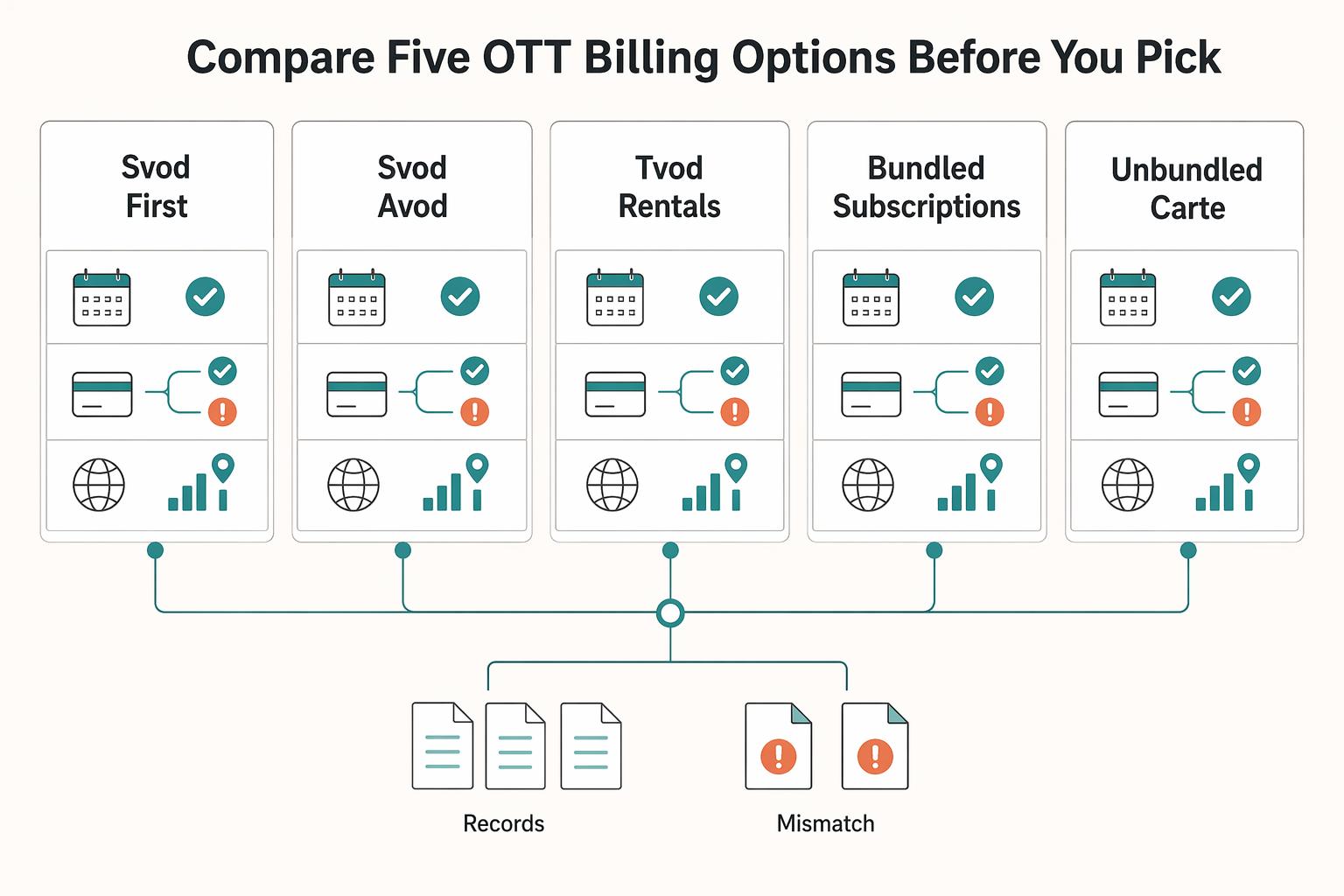
Compare monetization options before vendors: the right model is the one you can operate cleanly across trials, failed payments, and country rollout in your first markets. Public OTT materials consistently cite SVOD, AVOD, TVOD, and hybrid models, and MPP Global also explicitly lists bundled and unbundled (a la carte) offers for broadcast and OTT.
| Option | Best for | Key pros | Key cons | Trial complexity | Churn risk | Country expansion friction | Subscriber management checkpoint | Payment optimization checkpoint | PCI-DSS Level 1 evidence checkpoint |
|---|---|---|---|---|---|---|---|---|---|
| SVOD-first | Recurring-value catalogs and D2C subscriptions | Recurring revenue model and clearer renewal lifecycle | More sensitivity to recurring payment failures | Rises when free trials or intro pricing are part of launch | Recurring-payment recovery directly affects retention | Depends on local recurring payment-method fit | Verify lifecycle events across trial, renewals, pauses, cancels, and reactivations | Confirm failed subscription/invoice payments can be retried automatically and reported clearly | Request current PCI Service Provider Level 1 documentation when payment data handling is in scope |
| SVOD + AVOD hybrid | Free entry with paid upsell path | Broader acquisition path across free and paid tiers | More moving parts across identity, entitlement, and upgrade logic | Higher when free-to-paid transitions must be tracked precisely | Churn signals can blur if free audience movement masks paid issues | Free-to-paid payment behavior can vary by country | Confirm one subscriber record can move from free to paid without account fragmentation | Check retry controls and visibility into failed paid upgrades | Same evidence request, plus clear boundaries for payment-data scope |
| TVOD/rentals-first | Premieres, events, or one-off access | Clear per-transaction economics | Less recurring baseline and more repeat-purchase dependency | Often simpler when trials are not central | Less recurring churn exposure; repeat purchase becomes the risk | Checkout acceptance quality matters in each country | Verify title-level entitlement start/end events per purchase | Prioritize acceptance and checkout completion signals | Same evidence request where cards are used |
| Bundled subscriptions | Tiers, add-ons, or multi-service packaging | Packaging flexibility and upsell potential | Proration, bundle rules, and entitlement sync can add operational load | Increases as bundle rules and exceptions grow | Failed payments can affect multiple entitlements at once | Country-by-country pricing and recovery behavior needs validation | Confirm plan/add-on/entitlement changes appear in a single subscriber history | Treat recovery controls as critical because one failure can impact multiple services | Same evidence request, with explicit compliance-scope explanation |
| Unbundled (a la carte) content | Title-level merchandising and low-commitment buying | Flexible pricing and offer control at content level | More frequent checkout dependency and weaker recurring habit loops | Typically centered on access-rule logic, not long trial flows | Less classic subscription churn, more repeat-buyer risk | Frequent checkouts raise payment-method fit pressure by market | Verify purchase history, access windows, refunds, and entitlement revocation at title level | Optimize acceptance and relevant payment-method coverage before advanced dunning depth | Same evidence request if the provider stores, processes, or transmits cardholder data |
If two options tie on growth potential, use lower failed-payment recovery complexity in your first two target countries as the tie-breaker. This is an operator rule for early rollout decisions, not a universal law.
In demos, require three proofs: real subscriber-management event trails, concrete payment-optimization behavior for failed recurring charges, and documented PCI Service Provider Level 1 evidence where relevant. PCI DSS is a baseline for protecting payment account data, not a blanket guarantee for every integration pattern.
Related: How to Build a Subscription Billing Engine for Your B2B Platform: Architecture and Trade-Offs.
Pick SVOD-first when retention and billing predictability matter most#
Choose Subscription Video on Demand (SVOD) first when recurring access is your core value and you need a cleaner recurring-revenue model than title-by-title purchases.
- Best fit: SVOD is recurring-fee access to a content library, and it fits best when you have a deep catalog or frequent releases that build viewing habits.
- Why operators choose it: It is usually easier to run and read operationally because subscriber lifecycle events center on renew, fail, recover, cancel, and reactivate, with less purchase-by-purchase noise.
- Main risk: SVOD is more exposed to involuntary churn from payment failures or banking issues; recovery quality matters because many failed payments are recoverable and automatic retries can reduce that loss.
- Behavioral pressure: A viewer can subscribe for a specific release and cancel afterward. Compare retention by catalog and release cohort rather than assuming recurring fees create predictable viewing habits.
A practical rollout is to launch D2C subscriptions in one country, stabilize retry and reactivation workflows, then expand. That is not a universal rule, but it helps you validate recurring-billing recovery before adding more country-level payment variation.
If your audience mostly wants occasional access to specific events or titles, TVOD or a hybrid can align better than forcing monthly plans.
Use a hybrid SVOD and AVOD model when acquisition cost is high#
When paid-only entry is limiting growth, a hybrid Ad-supported Video on Demand (AVOD) plus Subscription Video on Demand (SVOD) model can widen acquisition while keeping a paid path for deeper access. The tradeoff is execution complexity, so use it only if you can reliably track users across free and paid states in billing and entitlements.
- Best fit
Use this model when you need free or lower-price discovery but still have premium depth that supports recurring billing. AVOD can include both free access and hybrid subscription-plus-ads offers, which gives you an entry path without making the full catalog free. In practice, AVOD broadens the top of funnel while SVOD monetizes ongoing use.
- Why operators use it
A paid tier with ads can lower the entry price while preserving a recurring relationship. Test whether that price and ad load fit the launch audience, and track upgrades into premium access or bundles separately.
- Where it gets messy first
The first failure point is usually operations across free and paid states, not the model itself. Entitlements, billing records, and subscriber data can fragment across disconnected systems, which makes attribution and support harder. If you cannot keep free-to-paid transitions and later payment outcomes tied to one subscriber journey, churn analysis becomes less reliable.
- How to use it without losing control
Validate the handoff from free viewing to paid access before launch, and confirm your team can see that path end to end. Keep AVOD focused on discovery and treat SVOD as the primary retention engine if ad revenue in your launch market is volatile. If visibility into user state changes is incomplete, simplify packaging until tracking is stable.
Use TVOD or rentals when demand is event-led, not habit-led#
Use Transactional Video on Demand (TVOD) when viewers want one specific moment or title, not an ongoing catalog relationship. In OTT, that usually means one-time rent, buy, or pay-per-view (PPV) access instead of starting with recurring billing.
Best fit: TVOD is strongest when demand is discrete, such as a premiere window, a single live PPV event, or a title users expect to rent or buy once.
Why operators use it: Each transaction stands on its own, so performance is evaluated per purchase rather than through subscription retention behavior.
Where to be careful: Revenue can be release-driven, and promotion needs can rise when there is no major event or launch. Operationally, validate entitlement mapping for rent, buy, and PPV offers so paid viewers get the correct access by product type.
A practical rollout is to start with TVOD plus unbundled (a la carte) content, then test a subscription upsell only after repeat purchase behavior is visible.
Expand cross-border only after payment operations pass these checks#
Treat cross-border expansion as a payments-operations decision, not a catalog decision: if market-one payment failure handling and reconciliation are still mostly manual, delay market two.
- Confirm local method fit before country count.
Cross-border readiness means the right currency and payment types for each target market, not just a generic "international payments" claim. Public platform positioning can indicate broad coverage, but launch readiness depends on configuration: you need a clear record of which methods are enabled per market, what customers see at checkout, and how settlement maps to finance.
- Use a decline taxonomy your team can act on.
"Card declined" is not enough for recovery. Your operations view should separate network/issuer decline reasons, capture next-step guidance when available, and include a fallback path for unresolved declines because some failures return without a specific bank reason. If a large generic-decline bucket hides prepaid balance depletion or short card-expiry issues, recovery work will stay reactive.
- Require subscriber-event auditability before launch.
You should be able to trace one subscriber timeline from payment attempt to entitlement and stream outcome. At minimum, your evidence pack should show decline categories, retry outcomes, and linked transaction/entitlement/stream events so support can explain what happened without stitching systems together by hand.
- Run vendor diligence by country, not by homepage promise.
Use the same country-specific checklist with Zuora, Zype, OneBill, and MPP Global eSuite, even when global messaging sounds strong. Ask what local methods are live in each country, what decline detail is exposed, what reconciliation artifacts you get, and who owns PSP escalation when failures spike after launch. If resolution still depends on people comparing gateway logs, finance exports, and subscriber records manually, pause expansion until automation is proven.
Configure trials and churn controls in the right order#
Set the order first: define trial policy, instrument conversion and churn separately, then tune retries and exception handling. If you optimize retries before trial rules are clear, recovery metrics will be noisy and hard to trust.
| Step | Key setup | Evidence or note |
|---|---|---|
| Lock trial policy first | Decide trial duration, eligibility, upfront payment-method collection, and the plan at trial end | Stripe Checkout free trials and item-level Trial Offers use different APIs and restrictions; confirm the integration in use |
| Track conversion and churn separately | Instrument trial-to-active transitions, payment failures, and status changes as distinct events | Lets you measure involuntary churn apart from voluntary churn |
| Attach retry policy to messaging | Document method-specific retry behavior and add trial-expiry and retry messaging | Smart Retries publishes a default recommendation of 8 tries within 2 weeks as a starting point, not a universal cadence |
| Audit exceptions before scaling | Keep an audit trail for trial extensions, courtesy credits, paused subscriptions, manual reactivations, and first-charge failures | Your evidence pack should capture conversion event, invoice outcome, retry timestamps, end action, and any policy exception note |
-
Lock the trial policy before automating recovery. Set duration, eligibility, payment-method collection, post-trial price, consent and reminders, and the missing-payment-method outcome. Stripe’s item-level Trial Offers require API version 2026-09-30.endive or later and flexible billing; their duration cannot be modified after creation. Checkout uses the separate legacy free-trial flow instead. Do not apply one API’s restrictions to every trial.
-
Track paid conversion and access separately. Link trial start/end, invoice and payment attempts, cancellation, and entitlement changes. An active subscription status is not proof of a paid first invoice. Set a documented grace period or access restriction for failed payments, then restore access after confirmed recovery.
-
Attach retry policy to customer messaging. Stripe Smart Retries recommends eight tries within two weeks for eligible flows. It does not retry without a payment method, after a hard decline without a new method, or on India-issued cards. Scheduled attempt counts can increase without a charge executing. Treat an unknown outcome as an unresolved original attempt, not permission to submit a fresh charge.
-
Audit exceptions before scaling volume. Keep an audit trail for trial extensions, courtesy credits, paused subscriptions, manual reactivations, and first-charge failures, tied to dunning end actions (cancel or pause). Philo reported depleted balances and short expiration windows on some cards as rejection drivers, which is the kind of failure pattern this audit should surface early. Your evidence pack should capture conversion event, invoice outcome, retry timestamps, end action, and any policy exception note. If support cannot explain one failed conversion from a single timeline, fix that before scaling trials.
For example, suppose a seven-day trial converts to a $10 monthly plan. On day eight the first invoice fails. Under an illustrative three-day grace policy, access remains available while the invoice stays unpaid; this subscriber has not yet converted to paid. If payment succeeds on day nine, record the paid conversion and keep access. If the grace period ends without payment, restrict access under the disclosed policy. A later successful recovery restores it once, even if its webhook is delivered twice.
For a closer look at dunning, plan setup, and coupon logic, see Subscription Billing Platforms for Plans, Add-Ons, Coupons, and Dunning.
Conclusion#
The choice is simpler than most vendor shortlists make it seem. Back the model you can verify under real payment pressure, not the one with the strongest brand. For most teams, that means proving recurring billing recovery, local checkout fit, and churn visibility in one market before adding countries, bundles, or hybrid packaging.
- Match the revenue model to customer behavior
Match the model to how viewers buy: SVOD for repeat catalog value, TVOD for event-led demand, and hybrid offers when free and paid access are distinguishable. Compare deliberate cancellation with confirmed payment-failure loss before changing packaging. Keep attempts, invoice outcomes, and access state linked so a billing failure does not look like lack of interest.
- Scale only after payment recovery works in market one
Expansion should be earned through evidence, not scheduled because a launch date exists. Stripe notes that many failed payments are recoverable, and its Smart Retries use data points to time retries more effectively than fixed schedules. That makes retry quality a real operating lever, not a billing setting you can ignore. Your checkpoint here is concrete: confirm decline reasons are categorized, retry outcomes are visible, and support is not manually reconciling failed renewals one by one. A common failure mode is pushing into market two while recovery is still manual in market one, which can compound support load and obscure preventable churn inside a generic cancel bucket.
- Use vendor claims as inputs, then decide from telemetry
Well-known names can help you build a shortlist, but they do not prove launch readiness. The differentiator that matters most is measurable execution evidence: payment method share by country, plus analytics on authentication, disputes, and card acceptance. That shows you whether local payment methods are being adopted and where checkout friction sits. Adyen's guidance is useful here because local methods improve trust and convenience, but that only matters if your own payment method share reports show customers are choosing them over time. If a vendor says it supports your target markets, ask for country-specific behavior on retries and payment-method adoption, then verify that against your first-market data before you widen the footprint.
If you keep those three rules in order, you will make better launch decisions than teams that optimize for feature breadth first. That is the practical test for a streaming business: prove payment execution, then grow packaging and geography from evidence.
Frequently Asked Questions
What does an OTT billing platform need to handle for trials and churn?
Connect trial eligibility, post-trial price, first-charge results, and viewing access. Keep free-trial starts outside paid customer churn cohorts. Track voluntary cancellation and payment-failure loss separately, and use invoice payment evidence to confirm trial-to-paid conversion. One subscriber timeline should show the trial, attempts, recovery, and corresponding access changes.
When should we choose SVOD over AVOD or TVOD for a new market?
Pick SVOD when your offer depends on predictable recurring revenue. A practical heuristic is simple: choose SVOD for predictable recurring revenue, TVOD for high-value exclusive content, and AVOD for maximum reach. If your first market already looks hard on payment recovery, SVOD can still work if you are ready to manage retries, reminders, and reactivation cleanly. If the content is event-led rather than habit-led, TVOD may be a better starting point than forcing subscription behavior.
How do bundled subscriptions compare with unbundled (a la carte) content in churn risk?
There is no universal churn ranking here, so do not assume a bundle is automatically stickier than a la carte access. Bundles can reduce cancellation risk when the value is obvious across multiple entitlements, but they also make churn attribution harder because price, access, and content fit are bundled together. Unbundled offers lower commitment and may fit transactional demand better, but revenue can become more episodic. The operator check is cohort-based: compare repeat purchase behavior, deliberate cancels, and failed-payment exits by package type before you expand the packaging model.
What should we validate with Payment Service Providers (PSPs) before cross-border launch?
Validate local payment methods first, because region-familiar methods affect trust and convenience, and relevance at checkout matters. Stripe's testing across 50-plus global payment methods found that showing more relevant methods increased the likelihood of purchase completion. Ask each PSP for method-by-method behavior, not generic coverage claims: retries, decline codes, refund handling, reconciliation output, and escalation paths in your first target countries. If those answers are still manual in market one, consider delaying market two.
Which metrics separate trial design issues from payment failure issues?
Track trial-to-paid conversion when the first required payment is confirmed; an active subscription status alone does not prove payment. Split non-conversions into customers who declined to continue and customers whose first payment failed. Measure paid-customer churn separately, using a starting cohort of paying subscribers: a failed renewal becomes payment-related churn only when recovery ends in a lost paid subscription under your stated definition. Keep invoice results, attempt and recovery timestamps, subscription status, and viewing access on the same subscriber timeline.
How should we compare vendors like Zuora, Zype, OneBill, and MPP Global eSuite when public details are incomplete?
Use Zuora, Zype, OneBill, or other candidates as a shortlist until they demonstrate the same scenario: trial end, failed first payment, customer update, recovery, cancellation, and entitlement changes. Compare current contracted product scope and country payment support, then record who owns each integration and exception. A brand or homepage claim does not establish those behaviors.
Try a related tool
Researched and edited by the Gruv editorial team. Gruv builds cross-border billing, payouts, and finance-operations software for global businesses.
Sources
Includes 3 external sources outside the trusted-domain allowlist.
- assets.publishing.service.gov.uk/media/65411ad0d36c910012935b21/VoD_Regulatio...trusted
- docs.stripe.com/billing/revenue-recovery/smart-retriestrusted
- docs.stripe.com/payments/checkout/free-trialstrusted
- stripe.com/resources/more/involuntary-churn-101-what-it...trusted
- stripe.com/blog/testing-the-conversion-impact-of-50-plu...trusted
- advertising.amazon.com/library/guides/avod-svod-tvod-video-on-demandexternal
- adyen.com/en_SG/payment-methodsexternal
- aws.amazon.com/blogs/media/build-and-scale-direct-to-consum...external
Educational content only. Not legal, tax, or financial advice.
Related Posts
Media Subscription Billing Decisions for Paywalls, Metering, and Bundling
**A metered paywall is only a good business decision if your billing operations can support it.** For platform founders, the real question is not whether reader revenue sounds attractive. It is whether digital publishing subscription billing and paywall metering can survive the messy parts of launch: failed renewals, entitlement sync, invoicing, tax treatment, and local payment movement.
How to Build a Subscription Billing Engine for Your B2B Platform
If you are designing a B2B subscription billing engine, get the close and reconciliation model right before you chase product flexibility. A durable sequence is to define recurring billing scope (plans, billing periods, usage, and trials), then map settlement and payout reconciliation to transaction-level settlement outputs, and finally tie that discipline into month-end close controls. The real test is simple: finance should be able to trace invoices, payments, and payouts from source events through settlement records into reconciled close outputs without ad hoc spreadsheet rescue.
How to Migrate Your Subscription Billing to a New Platform Without Losing Revenue
If you need to **migrate subscription billing platform without losing revenue**, treat it as a revenue operations change, not a simple software swap. Billing migrations sit close to renewals, revenue reporting, and payment credentials, so mistakes rarely stay technical. They can show up as duplicate records, inaccurate revenue reporting, failed renewals, or customer-facing downtime.