
Quick Answer
Use a hybrid billing model when you need a predictable subscription base but also need revenue to rise with customer consumption. The workable setup is one invoice with clearly separated recurring, usage, overage, and adjustment lines, backed by explicit contract triggers. Before scaling, validate invoice reproducibility so finance can trace each amount from usage records through rating to payment reconciliation. If customers cannot estimate charges from plan language, simplify first.
Why combine subscription and usage charges on one invoice#
A hybrid billing model combines a recurring base fee with variable charges, giving you a stable revenue floor while customer spend can rise with usage. The appeal is straightforward. The hard part is not the pricing idea itself. It is whether your contracts, invoices, and finance records can support mixed charges without creating confusion or cleanup work later.
At the pricing level, the logic is familiar. Stripe describes hybrid pricing as a way to keep a recurring base while letting charges scale with usage. In practice, that can mean a subscription paired with usage-based billing, overage charges, one-time fees, or add-on services on the same bill. Zuora makes the same point from a contract angle: one contract might combine a platform fee, a usage fee, and a setup fee. That mix can help you capture expansion revenue without relying on a larger flat fee from day one.
A recurring base and measured variable charges can suit uneven customer adoption. Evaluate that fit using your own usage distribution, costs and customer ability to predict charges; industry adoption statistics do not establish whether it is right for your product.
Still, adoption alone is not a recommendation. If your product value is hard to meter, or customers cannot predict what will trigger extra charges, a mixed approach can damage trust faster than it grows revenue.
That is why the scope here is wider than pricing. You are deciding how to structure the contract, what appears on a single invoice, how usage is measured, and how payment reconciliation works when fixed and variable charges land together. A useful early checkpoint is invoice reproducibility. Can finance trace every line item back to source records before the bill goes out? If not, your pricing design is ahead of your billing reality.
There is also a common failure mode worth naming early. Pricing complexity can arrive before billing complexity is fully understood. Many billing tools were built for either recurring charges or variable monetization, not both. That is why mixed models can create edge-case pressure around credits, overages, or adjustments. Treat the commercial design and the operational design as one decision, not two separate projects.
From here, we move from definitions and decision rules into charge architecture, invoice design, metering, and reconciliation, with a practical eye on what has to be true before you scale. Where requirements vary, the goal is not to guess. It is to know where the local check belongs before your billing design turns into a compliance problem.
For a broader look at combining recurring, usage-based, and one-time charges, read Hybrid Billing Models: How to Combine Subscriptions with Usage-Based and One-Time Charges.
Define the model before debating tactics#
Define the hybrid billing model up front: a fixed recurring subscription plus variable charges, with clear rules for what triggers each line item.
An illustrative structure is USD 50 per month with 1,000 included API calls, plus USD 0.01 for each additional call. At 1,500 billable calls, the pre-tax invoice is USD 50 base plus USD 5 overage. Store the period, allowance, accepted quantity and price version so finance can reproduce it. A separately priced monthly add-on is another recurring charge, not automatically usage-based.
Keep the boundary explicit. A hybrid pricing model is the strategy for what you charge and why. Billing operations are the mechanics: invoice generation, collections, and payment reconciliation back to source records.
Use one shared mental model:
- fixed floor for predictability
- variable lane for expansion
- explicit trigger rules for when each charge appears
Before you discuss tools, run a plain-language alignment check with product, sales, and finance. If those teams cannot describe the same trigger rules, you do not have a workable model yet, and disputes or manual adjustments are likely later.
Decide when hybrid is the right commercial choice#
Consider hybrid billing when a recurring commitment and a measurable consumption charge both match how customers receive value. Compare it with subscription-only and pay-as-you-go using your own usage distribution, costs and tolerance for invoice variability.
This is a tradeoff between forecastability, fairness, and monetization risk. Finance teams typically want subscription predictability, while product and growth teams want usage-linked upside. The practical question is how closely your price tracks value creation without creating invoice volatility customers will reject.
| Model | Forecastability | Margin protection | Customer fairness | Operational complexity |
|---|---|---|---|---|
| Hybrid | Medium to high because a recurring base creates a revenue floor | Strong when usage can rise without seat growth | Usually strong when variable charges map to real consumption | Highest of the three because you operate recurring and variable charges together |
| Subscription billing | Highest because pricing is tied to defined plans, tiers, or seats | Can weaken when consumption grows inside the same plan | Strong for consistent recurring use, weaker when light users subsidize heavy users | Lowest because billing is more uniform |
| Pay-as-you-go model | Lowest because revenue follows consumption | Strong when cost and value both track per-unit usage | Strong for unpredictable or infrequent use because customers pay for what they consume | Medium because metering is required but recurring-plan logic is simpler |
When do variance and value timing point to hybrid?#
Stable usage can favor subscription simplicity. Variable usage can support hybrid billing when the unit tracks value and customers can forecast charges. Variance alone does not make it the safer commercial choice.
Use your own account-level data as the gate:
- If consumption expands without matching seat or tier changes, fixed-only pricing may be under-monetizing.
- If usage-only invoices would swing hard month to month, bill shock and revenue volatility are real risks.
- If both signals appear, hybrid is often the more balanced choice.
A common failure mode is seat-only pricing that stays easy to forecast but misses upside when usage grows without seat growth.
How do B2B SaaS and B2C subscription differ here?#
Apply the same pricing logic differently by segment. In B2B SaaS, expansion often comes from deeper adoption or higher transaction volume, so a base subscription plus a usage lane can be easier to justify. A structure with included usage and clear overage triggers can work well when the value metric is easy to explain.
In B2C subscription, tolerance for billing complexity is often lower. A simple recurring price can reduce confusion, while usage-only can feel fair for infrequent users. But if variable charges are unexpected, bill shock risk rises quickly, so clarity matters more than pricing elegance.
The unit-economics tradeoff stays the same: subscription-only can under-monetize, usage-only can increase revenue volatility and surprise charges, and hybrid sits between them with higher operational complexity. If your trigger rules and usage signals are not yet clear, do not force hybrid yet.
Related: B2B SaaS vs. B2C Subscription: How Billing Models and Churn Drivers Differ.
Choose the charge architecture that matches product value#
Choose the simplest structure that still tracks how customers get value, and simplify it before launch if customers cannot predict charges from plan language.
Which architectures are usually the best fit?#
| Architecture | Strong when | Weak when | Familiar example |
|---|---|---|---|
| Subscription billing + usage-based billing | Value rises with measurable consumption, and customers may scale up or down | The usage unit is hard to measure or not clearly tied to value | Cloud computing, where resource use changes with demand |
| Subscription + overage charges | You want a predictable base fee with included usage, then pay-as-you-go above the allowance | Customers cannot tell when they cross the included threshold | Telecom-style plans with included usage and extra charges above it |
| Subscription + one-time fees | Part of value happens at a distinct event, not only ongoing usage | One-time charges start to blur the core recurring value | Recurring service plus a separate activation or project fee |
| Tiered pricing with add-ons | You want package clarity, with optional extras for variable needs | Tier rules, add-ons, and usage logic overlap and make invoices hard to explain | Plan bundles with optional extra capacity or features |
In practice, the first two patterns are often the cleanest: a recurring base fee creates a revenue floor, and the variable lane handles either direct usage pricing or above-allowance charging. If your plan includes allowances like 1,000 API calls or 10 GB of storage, customers can usually forecast the bill more easily than pure metering from unit one.
Pressure-test the architecture before launch#
- Value metric clarity: the usage unit should be something customers understand and see value in.
- Measurability: your product layer needs reliable usage signals for included vs billable units.
- Customer comprehension: a buyer should be able to estimate charges from plan language.
- Finance auditability: keep billing records and balances in the commerce/billing system, and keep entitlements and usage signals in the product layer.
Cloud examples are strongest when consumption is the value driver, and telecom is a strong analogy for allowance-plus-overage behavior. Utilities can be a useful metering analogy, but do not treat it as a direct architecture benchmark without domain-specific evidence.
If you're evaluating systems to support this model, see our guide on Subscription Billing Platforms for Plans, Add-Ons, Coupons, and Dunning.
Design one invoice customers can trust#
Trust comes from traceability: every amount should map back to plan terms and product activity. If support, finance, and the customer cannot explain the same bill the same way, hold release.
How do you keep the line items legible?#
Make the invoice readable in one pass.
| Invoice element | What to show |
|---|---|
| Recurring base fee | Its own line with the billing period |
| Usage charges | Separate lines with unit, billed quantity, rate, and subtotal |
| Included allowance | Included units and excess units shown separately |
| Credits and adjustments | Distinct positive or negative lines with a short reason |
| Tax | Its own charge element |
| One-time fees | Clear labels so they do not blur recurring value |
In practice, that means separating the recurring base fee, usage, included allowances, credits or adjustments, tax, and any one-time fees so a customer can immediately see what is fixed and what changed. If one-time charges make the subscription harder to read, that is a signal to separate or relabel them more clearly.
What dispute evidence should be ready before release?#
Have the evidence pack ready before invoices go out.
| Evidence item | What it covers |
|---|---|
| Usage snapshot | The billed period |
| Event timestamps | When billed activity occurred |
| Data aggregation source | Where the billed quantity came from |
| Invoice calculation trace | From raw events to aggregated quantity to applied rating rule and final amount |
Set ownership boundaries clearly: the commerce system owns money, balances, and invoices; the product or entitlement layer owns entitlements, runtime enforcement, and usage signals. Finance should be able to match commerce-side invoice records to period-specific product usage without hand edits.
How do you give customers time to spot problems?#
Give customers visibility before billing closes. Provide real-time usage visibility where possible, threshold alerts, and plain-language overage explanations that cover what counted, what was included, and what rate applies after the limit.
Before release, have finance reproduce a sample invoice from system records using plan terms, rated usage, credits, adjustments, and tax treatment. If the rebuilt amount does not match, stop and fix it before sending.
Build the metering and reconciliation backbone#
Your backbone is ready when every charge can be replayed from activity to cash outcome, not just viewed on a dashboard.
What order should the billing operations follow?#
Use a fixed order and keep it consistent across systems:
| Step | Billing operation |
|---|---|
| 1 | Capture usage in real time or at defined intervals |
| 2 | Track usage and milestone records for the billing period |
| 3 | Aggregate and rate those records against the active price model |
| 4 | Generate invoices from rated outputs |
| 5 | Reconcile invoice status with payment or settlement status |
Keep the sequence explicit: accepted usage, aggregation, rating, invoicing and settlement matching. Define cutoff and late-event correction rules; immutable billed quantities and price versions let you reproduce an issued invoice even when a later adjustment is needed.
Real-time metering improves threshold alerts and pre-bill visibility. Interval capture can be simpler operationally. Either way, you need explicit handling for late-arriving data and clock skew, with acceptance windows and compensation logic so valid events are not dropped at period boundaries.
Why should traceability be the source of truth?#
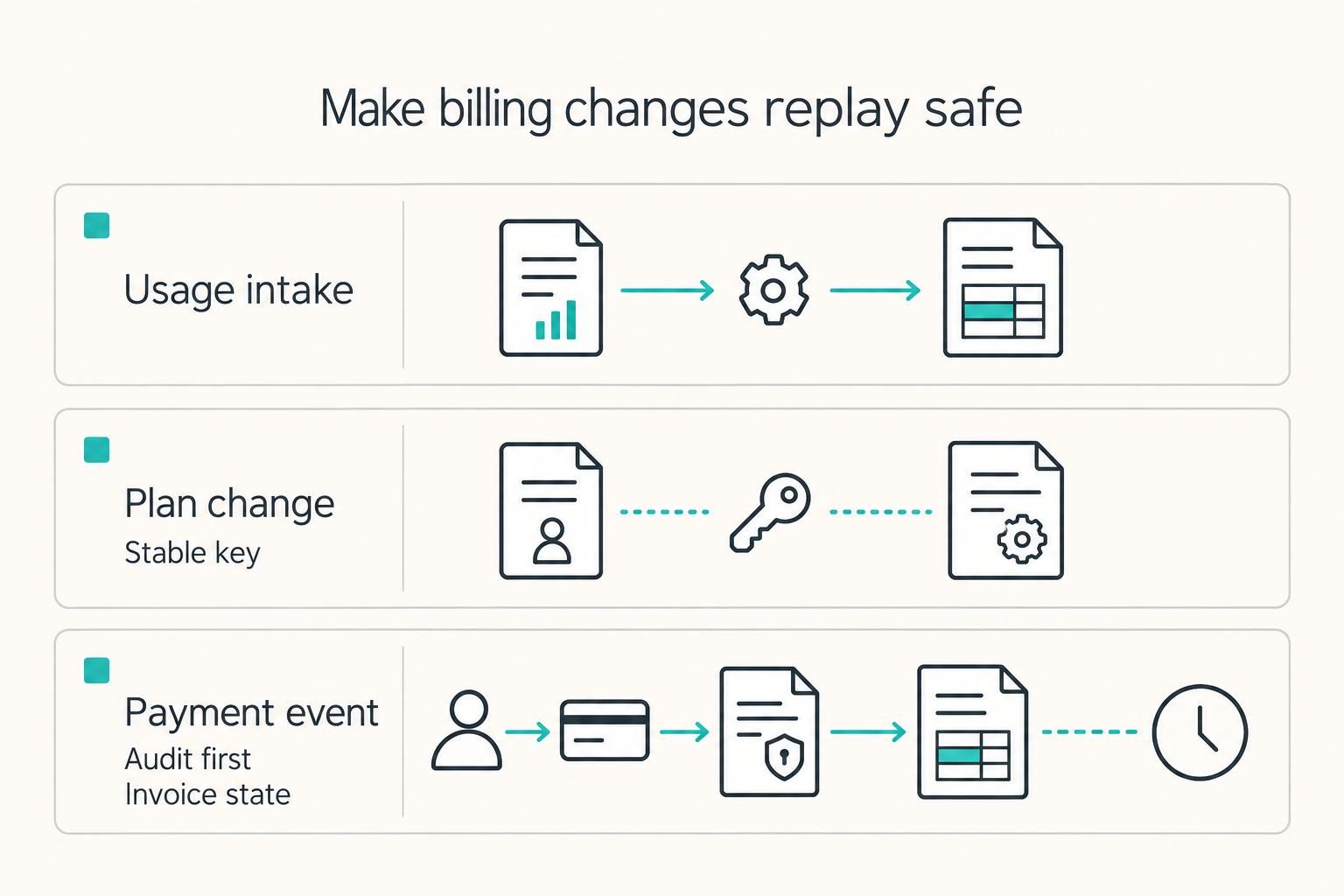
Treat traceability as the source of truth: source event, aggregated quantity, applied pricing rule, invoice line, then payment outcome. Those records need to be trustworthy, replayable, and finance-grade if you expect invoices to hold up under dispute.
Idempotency is non-negotiable because retries are normal in ingestion and payment updates. Without it, duplicate charging is a predictable result, not an edge case.
If you ingest usage or payment updates through API events or webhooks, retain metadata that proves what arrived, when it arrived, and whether it was already processed. Your audit trail should answer, quickly: was it received, accepted into aggregation, rated under which price version, included on which invoice, and what happened at payment.
When records are missing or contradictory, route exceptions for human review instead of patching silently. Exception queues for missing usage, duplicate detections, or payment mismatches are cheaper than releasing invoices you cannot defend.
Which ugly failures show up first?#
The first failures are usually system joins, not arithmetic. Usage tracking, recurring plans, and invoice generation often sit in disconnected tools, so timing and consistency drift before anything looks "down."
Watch for:
- delayed usage ingestion that pushes valid activity into the wrong billing period
- duplicate events from retries without idempotent handling
- mismatched totals when aggregation, rating, and invoice lines use different assumptions
Before release, replay one customer period: rebuild accepted quantity, apply the stored price version, then match the invoice calculation. Reconcile payment and settlement separately because an unpaid, partial or refunded invoice need not equal cash received. Investigate unexplained differences and preserve legitimate timing, fee and credit adjustments.
Roll out without breaking revenue or trust#
Once your invoice logic is replayable, the next risk is change management. Roll out in controlled slices, with explicit contract effective dates and a dual-calculation pilot before broader exposure.
How should you sequence the migration?#
Segment legacy contracts first, then define transition rules before launch. A practical structure is to separate accounts by transition path, set a clear grandfathering policy, and tie each move to a specific contract change or renewal date.
Lock these decisions in writing:
- Which contract segments move first.
- What is grandfathered, for how long, and under which conditions.
- The exact date the new pricing becomes effective.
- Whether old and new calculations run in parallel for a pilot cohort.
Use a dual-calculation dry run as a release gate. Rate the same pilot accounts under both legacy and new logic for one cycle, compare line-level outcomes, and pause rollout if differences are not explainable account by account.
Which team should own what?#
Hybrid pricing is usually a balance between subscription predictability and usage-based upside, so ownership has to be explicit:
- Product defines the value metric and customer-facing rules.
- Finance owns controls and invoice reproducibility.
- Engineering owns metering reliability and calculation integrity.
- Rev ops owns customer communication and field readiness.
Clear ownership prevents a common failure mode: pricing changes ship before finance and rev ops can validate and explain invoice impact.
How should you treat pilot friction?#
Treat customer comprehension as a rollout KPI, not a nice-to-have. If billing support tickets spike after pilot invoices, pause expansion and fix invoice clarity before moving wider.
In practice, that usually means tightening invoice labels, clarifying allowance and overage behavior, and improving pre-bill visibility. Do not scale confusion.
For a step-by-step walkthrough, see Building Subscription Revenue on a Marketplace Without Billing Gaps.
Spot red flags before they hit margin#
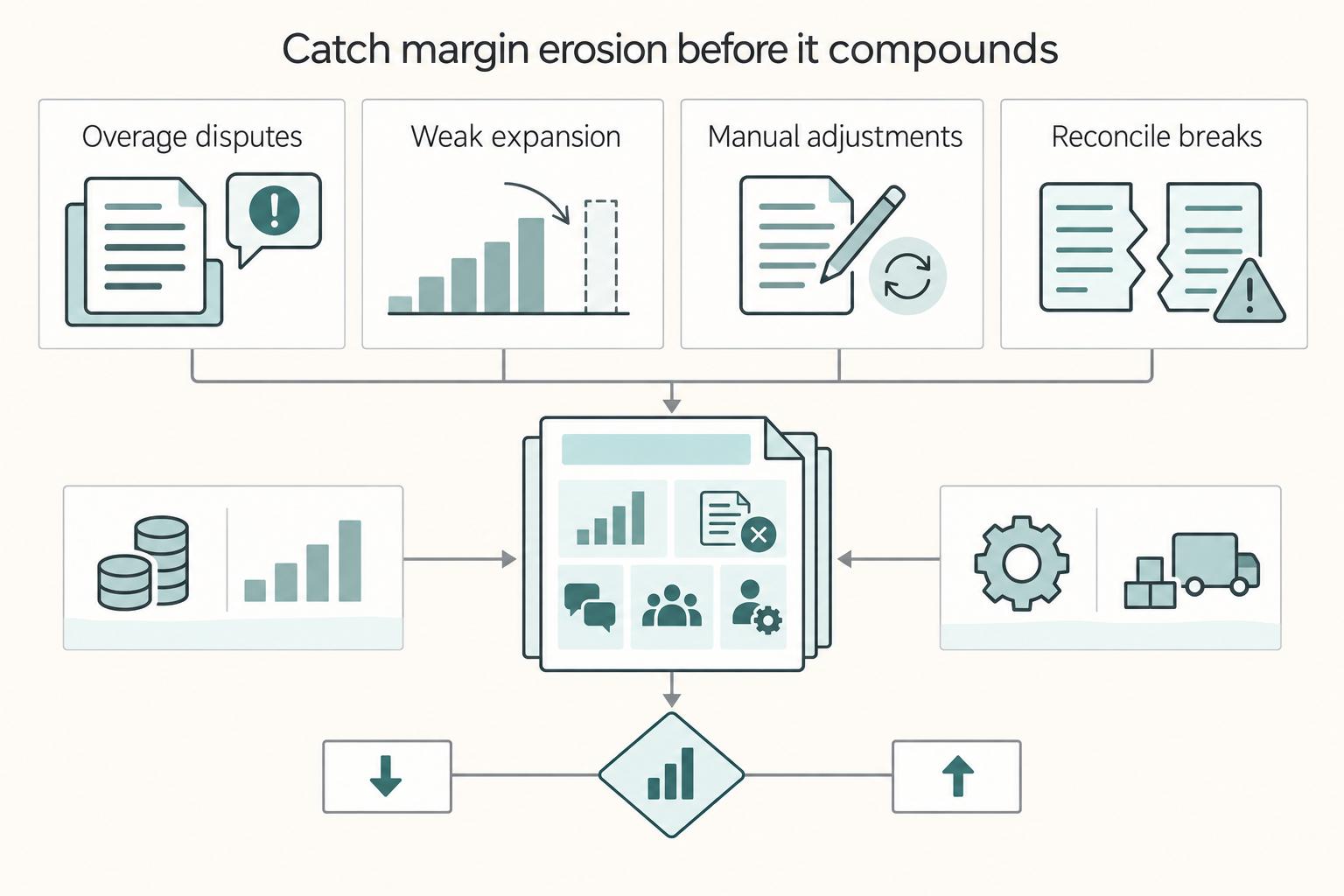
Your biggest post-rollout risk is usually silent margin erosion, not whether invoices go out. Treat commercial friction and manual cleanup as early warning signals.
Commercial red flags
- Overage disputes keep rising.
- Expansion slows even as usage increases.
- Discounting keeps renewals alive but masks weak unit economics.
If customers use more but do not pay more, re-check plan language, allowance thresholds, and invoice labels before assuming the value metric is working.
Operational red flags
- Manual adjustments become routine.
- Reconciliation breaks stay unresolved.
- Exceptions in payment reconciliation repeat month after month.
If finance cannot reproduce an invoice from records without unexplained edits, investigate the control gap. Retain the usage snapshot, aggregation version, price terms, adjustment approvals and invoice lines together so corrections remain traceable.
Keep a monthly review pack that includes:
- variance by segment, including billed usage versus contracted expectations
- failed invoice events and unresolved exception counts
- dispute root causes, not just dispute volume
- manual adjustment totals and approvers
- remediation owners and due dates
Before expanding, verify tax treatment, invoice requirements and contract changes for the applicable markets. Review revenue recognition separately with finance; collecting or invoicing an amount does not by itself determine when revenue is recognized.
Conclusion#
A strong hybrid billing model is not a pricing slogan. It is a commercial choice backed by the operating discipline to make each charge understandable, reproducible, and defensible.
A recurring commitment and consumption component can balance revenue predictability and usage-linked charges. Test that balance on your customers and cost structure rather than treating industry adoption as a recommendation.
What separates a workable design from a messy one is alignment. Your value metric should reflect how customers actually receive value. Your invoice should show that logic in plain line items. Your reconciliation process should show that totals come from system records, not finance cleanup after the fact. If any one of those breaks, the commercial upside can get buried under disputes, manual adjustments, and loss of trust.
One practical move is to narrow scope before you scale:
- Pick one customer segment where usage variance is real and easy to explain.
- Test one charge architecture first, not a stack of subscription fees, overage charges, one-time fees, and add-ons all at once.
- Validate invoice traceability end to end before broad rollout.
That validation step matters more than most teams expect. You should be able to take a sample invoice and trace billed amounts back to usage snapshots, event timestamps, the aggregation source, and a calculation trace that finance can reproduce from system records. If you cannot do that on a pilot account, do not assume more automation or more volume will fix it.
The main red flag is not that customers ask questions. It is that the same questions keep turning into manual corrections. Delayed usage ingestion, duplicate events, and invoice totals that do not match underlying records can indicate that the design and billing execution are out of sync. If pilot invoices trigger support tickets or repeated reconciliation breaks, pause expansion and simplify the charge logic or invoice presentation first.
A practical path is often less ambitious than teams want at launch. Start with one segment, one structure, one invoice format, and one evidence pack. Scale after reconciliation and support patterns are stable. That is how you keep the model flexible enough for growth without turning finance and billing into a constant repair job.
Frequently Asked Questions
What is a hybrid billing model in plain terms?
It is a way to bill multiple charge types together, usually a recurring fee plus variable components such as usage or overage charges, and sometimes one-time fees. In plain terms, the customer gets one commercial offer with a fixed base and a variable part that moves with usage.
Hybrid billing model and hybrid pricing model are they different in practice?
Yes. Hybrid pricing is the commercial design, meaning how you combine subscriptions, pay-as-you-go, tiered, or add-on elements into one offer. Hybrid billing is the execution side: applying that charge logic and generating invoices from recurring, usage, and one-time components.
When should a company choose hybrid over subscription-only pricing?
Choose hybrid when a recurring commitment and a measurable usage charge both fit customer value and your costs, and customers can predict charges. Compare invoice variability and operating effort with subscription-only and pay-as-you-go. Stable usage and an appropriate flat fee can favor subscription simplicity.
How do you combine subscription and usage fees on a single invoice without confusing customers?
Keep recurring, usage, overage, and one-time components clearly separated and labeled so customers can see what is fixed versus variable. A clear catalog structure, often framed as Product, Rate Plan, and Charge, helps keep what you sell aligned with what you bill.
What are the biggest implementation risks in usage-based billing and overage charges?
A major risk is tool mismatch. Some simple subscription tools are strong on flat fees but weak on variable usage metering, and some ERP setups are not designed for subscription lifecycle logic plus rated usage out of the box. Treat this as a system-fit issue early in implementation.
Which teams should co-own rollout decisions across product, finance, rev ops, and engineering?
Treat rollout as cross-functional across product, finance/rev ops, and engineering. A useful checkpoint is shared sign-off on the catalog structure, often framed as Product, Rate Plan, and Charge, before broad rollout.
How should global teams handle country and program differences in tax, compliance, and payout operations?
For global rollout, validate country-specific tax, compliance, and payout requirements market by market with finance and legal before scaling.
Try a related tool
Researched and edited by the Gruv editorial team. Gruv builds cross-border billing, payouts, and finance-operations software for global businesses.
Sources
Includes 3 external sources outside the trusted-domain allowlist.
Educational content only. Not legal, tax, or financial advice.
Related Posts

Hybrid Billing Models for One Invoice and Clean Reconciliation
**Hybrid billing combines recurring subscription fees, usage-based charges and one-time fees in the same offer.** Design the catalog, usage controls and invoice traceability together so finance can reconcile what customers buy and use.
B2B SaaS vs B2C Subscription Billing and Churn Differences That Drive Operations
Treat B2B SaaS and B2C subscription as different operating models, not just two versions of recurring revenue. Both rely on repeat payments, but when you choose between charges on saved payment methods, recurring invoices, or a mixed collection setup, you also choose a different level of billing effort, ledger reconciliation work, and churn risk.
Hybrid Pricing Models for One Subscription and Usage Invoice
Treat this as a billing and operations project, not just a pricing exercise. A hybrid pricing model can be commercially strong. The real test is whether you can put a recurring subscription fee and usage-based charges on a single invoice without forcing Finance to stitch things together at month-end.