
Quick Answer
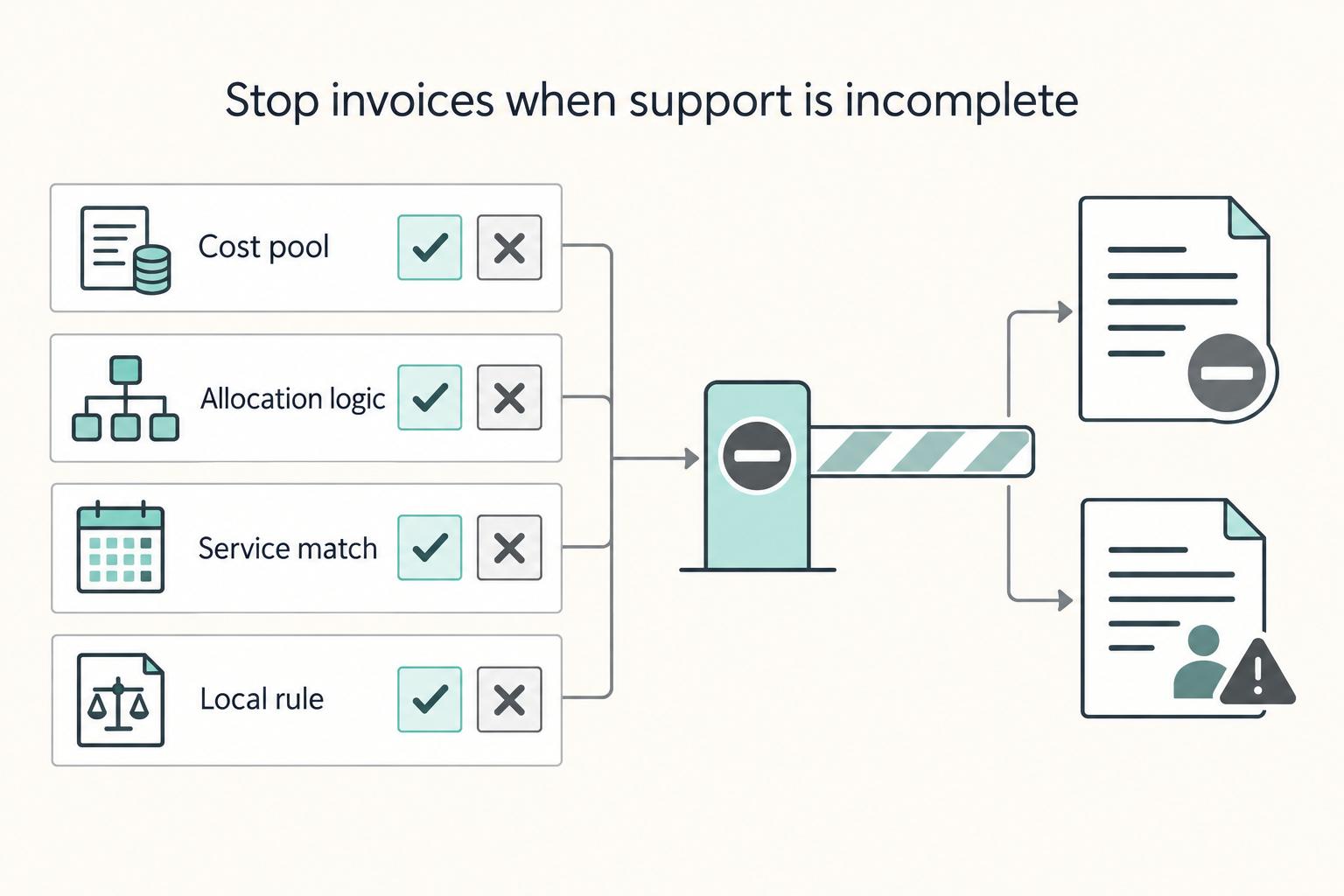
Yes, but use the cost-plus model transfer pricing approach only when your file is reproducible without live explanation. Confirm entity roles, service scope, and period first; rebuild the billed amount from records with consistent allocation logic; then assess markup support against the provider’s real function. If a charge combines services with financing-type items such as loans or guarantees, pause and escalate before invoicing. Final gate: contract terms, workings, and billed text should all describe the same transaction.
Set inter-company service fees that survive a cold read#
Before you use this playbook, note the evidence limit for this section: the grounding available here does not establish technical rules for cost-base construction, arm’s-length legal tests, comparables screening, defensible markup ranges, or jurisdiction-specific thresholds. Treat the steps below as an internal execution checklist, and escalate technical transfer-pricing positions to a qualified advisor.
If you are using a cost-plus model transfer pricing approach for inter-company service fees, use it only when another reviewer can rebuild your fee from the records and reach the same result. If the charge blends services with loans, guarantees, or other items that are hard to separate, pause and escalate before you invoice.
The point of this playbook is consistency and testability. Your service story, cost build, and markup logic should line up across the agreement, calculation support, and invoice. If those pieces only make sense after a call, a chat thread, or a long verbal explanation, the file is likely not ready. A defensible charge should survive a cold read by someone who did not help create it.
That is the standard to keep in mind all the way through. You are not just trying to reach a number that feels reasonable. You are trying to create a file that another person can pick up later, follow in sequence, and reproduce. The more your process depends on memory, custom exceptions, or hidden assumptions, the more likely the fee will break down under review. Use this playbook by asking three questions in order:
- What service was actually provided, by whom, to whom, and for what period?
- How was the billed amount built from source records and allocation logic?
- Why does the markup fit the provider’s actual role rather than a target result?
If you cannot answer those questions in that order, the fee is likely not ready to bill. Do not jump to markup support when the service itself is still fuzzy. Do not try to solve a weak cost build with a cleaner benchmark memo. And do not let the invoice become more specific than the underlying file can support.
| Decision point | Use cost-plus when | Avoid cost-plus when |
|---|---|---|
| Service definition | You can state the service clearly, name provider and recipient, and tie it to a specific period | The label is broad, but the underlying work is vague or keeps changing |
| Cost traceability | You can trace costs to records and explain shared-cost allocations | The fee depends on estimates, catch-all pools, or costs you cannot trace |
| Transaction mix | The service can be separated from other intercompany dealings | Services are bundled with financing, guarantees, or other mixed items |
| Functional profile | The provider’s role is clear and consistent with the service billed | The role, responsibilities, or economics changed materially without clear support |
The table is not a theory check. It is a stop-go check. If you are landing in the right-hand column on more than one point, the issue is often not memo wording. The transaction may not be stable enough to price with a simple cost-plus approach at that moment. That is exactly when defensive discipline matters most.
Step 1. Test fit before you build anything#
Start with a one-page fact summary before you touch the calculation. Name the provider, the recipient, the service period, the work performed, and the delivery evidence already in the file.
This first step is a gate, not a formality. The service is either identifiable and separable, or it is not. If your billing lines do not tie back to a service description, a defined period, and a cost category, stop and fix the facts before you price anything.
That one page should do more than repeat a broad label like “management support” or “IT services.” It should describe the transaction at the level the rest of the file will use. If the agreement, cost schedule, and invoice are all going to refer to one service description, draft that description now and test whether the records actually support it. If your evidence points to several different activities that do not belong under one clean label, you have identified a pricing problem early.
A good fact summary also forces timeline discipline. Write down the service period first, then check whether the records you have actually relate to that same period. Period drift can create cleanup work: work performed in one period, captured in another, and billed in a third, with no note explaining the difference. You do not need a long narrative to fix that. You do need a clear explanation that a later reviewer can follow. When you test fit, check the file in this sequence:
- Who provided the service? Make sure the entity and role are stated consistently.
- Who received the service? The recipient should be identifiable from the file, not implied.
- What was the service? Use wording specific enough that the cost schedule can map to it.
- When was it provided? Match the service period to the period used in the calculation and invoice.
- What evidence shows delivery? Confirm that the support already in the file matches the service description.
If you hit friction at any of those points, do not push forward and hope the pricing step will sort it out. It may not. For example, if the description keeps shifting as you review the records, the service may not yet be defined tightly enough to support a clean charge. If the provider’s role sounds simple in the agreement but the work papers show a broader or different role, the file already has a consistency issue before markup is discussed.
This is also the step where you separate stable service work from mixed transactions. If a charge appears to include services plus something else, or if people inside the business describe the arrangement in more than one way, treat that as a warning sign. A cost-plus approach is easier to document when the charge is a clearly defined service. It is harder to document when one line item combines different intercompany items that should first be sorted out.
The one-page summary should therefore act as a practical gate memo. It does not need to be polished. It does need to answer the basic questions clearly enough that someone else can understand the transaction without chasing side explanations. If you cannot get that page into a stable form, do not start building the number.
Step 2. Build a cost base someone else can recalculate#
Your cost base should be rebuildable from the source records up. You can use practical buckets such as direct, shared, and capability-building costs, but the real test is whether you apply those buckets the same way throughout the file.
Recalculability is the standard here. Another person should be able to follow the source trail and see what went into the pool. They should understand the allocation driver and land on the same total without relying on memory or verbal explanation. That means documenting shared-cost pools, keeping the driver stable, and being clear about period treatment when the billed period and the underlying cost period do not line up perfectly.
In practice, this means building the cost base in layers rather than as one final number. Start from the source records, group the costs into the categories you are using, note what is included in each category, and then show how any shared amount is allocated. If there is an adjustment between raw records and billed cost, make that adjustment visible. Hidden netting and undocumented overrides make later review difficult.
Consistency matters more than complexity. A simple cost build with clearly documented inclusion discipline is usually easier to defend than a sophisticated model that changes logic when the result feels off. If you treat one type of cost as part of the pool in one period but outside the pool in another, you need a clear operating reason. Without that, you create a comparability problem inside your own file.
Build it in this order:
- Pull the source records for the billed period.
- Sort costs into the buckets used in your file.
- Mark which amounts are direct and which enter a shared pool.
- State the allocation driver for each shared pool.
- Apply the same driver the file says you are using.
- Reconcile the build to the billed amount.
Use that sequence as an internal workflow, not as a legal formula. It helps avoid a failure mode where teams start with a target fee and then adjust the pool until the final number works. Defensive files move the other way: records to pool, pool to allocation, allocation to billed amount.
Be especially careful with shared costs. A shared pool is not defensible just because it exists in a worksheet. A reviewer should be able to see why the costs were grouped together, why the chosen driver fits the way the services were delivered, and whether that driver was applied consistently. A driver that changes by outcome rather than by operating facts is a weak signal, even if the spreadsheet still ties mathematically.
Period treatment deserves its own check. Sometimes the service period and the cost-capture period will not align perfectly. That does not automatically break the file, but the rationale has to be written down. If your schedule includes costs recorded outside the invoice period, explain why they belong. If you exclude costs that appear in the same accounting period, explain that too. The goal is not artificial neatness. The goal is intelligible and repeatable treatment.
Another useful discipline is to assume that someone will recalculate only from what is saved in the file. If a key step depends on knowing that “we always handle this line manually” or “finance knows not to include that account,” then your method is not fully documented. Write down the rule where the reviewer will actually need it.
| Testability check | Defensible signal | Weak signal |
|---|---|---|
| Source trail | Each billed amount ties to records | Amounts rely on memory or undocumented adjustments |
| Allocation logic | Shared pool and driver are documented and applied consistently | Driver changes by outcome, not by operating facts |
| Period treatment | Costs align to the billed period with clear rationale | Period boundaries are unclear or inconsistently applied |
Use the table as a working control, not as a final presentation tool. Run through each row before the markup discussion starts. If you cannot get to the “Defensible signal” column on the cost build, the markup step should wait.
One more practical point: if more than one person is involved, have a second reviewer try to rebuild the pool using only the saved support. Do not brief them first. Where they stop is where your file likely needs tightening before you bill.
Step 3. Set markup only after the cost build is stable#
Do not pick the markup first and backfill the support later. Lock the cost base, then document why the markup fits the provider’s actual service role.
If you use comparables, document at least three things: what you compared, when you checked it, and why you believe it matches the provider’s functional profile. Treat this as internal documentation discipline, not a claim about mandatory legal standards. Then run a consistency check against prior periods and any similar external work you already have. If the role or deliverables changed during the year, explain that before you reuse older support. For deeper role-mapping context, compare your file against the OECD Transfer Pricing Guidelines, the IRS transfer pricing documentation FAQs, and functional analysis for transfer pricing.
The order here matters. A stable cost base gives you something concrete to price. Without that, the markup discussion can drift toward result management. That is why this playbook treats markup as a later step, not the opening move.
When you document the markup, focus on the provider’s actual role in the service being billed. Ask what the provider did, what responsibilities it carried, and whether that role is described the same way across the agreement, memo, and invoice support. If the file presents the provider as routine in one place but the work papers suggest something more specialized or mixed elsewhere, your markup support and your factual support are already moving apart.
Keep the markup memo to the essentials:
- What you compared
- When you checked it
- Why it fits this provider role
That structure does not oversimplify the work. It keeps the memo from turning into disconnected points that never tie back to the actual service line on the invoice. If a reviewer cannot tell, in plain language, why this markup was selected for this provider role in this period, the memo is carrying too much noise and not enough reasoning.
Consistency against prior periods is useful, but only if the underlying role stayed consistent. Reusing older support without checking for changes can create a file that looks complete but does not fit current facts. A role can drift even when the service label stays the same. Deliverables may change, the provider may take on a different level of responsibility, or the service may become more mixed than before. If that happened, say so directly.
The same caution applies to similar external work. Similarity can help with the story, but only if the comparison really matches the service profile you are billing. Do not let the existence of another arrangement shortcut the role analysis.
A useful internal check is to separate the markup memo from the spreadsheet and ask whether the memo still makes sense on its own. Could a reviewer read the memo and understand why the markup fits, without you filling gaps orally? If not, the memo likely needs a clearer link back to the facts in Step 1 and the cost build in Step 2.
Also watch for false precision. If support is weak, stale, or not clearly tied to the current role, do not treat an exact decimal result as reliable by default. Where support is still being verified, note that openly and escalate rather than overstate confidence.
Step 4. Assemble a lean evidence pack and run pre-invoice checks#
Once the price is set, the next job is making sure every document tells the same story. Keep the file lean, but make it internally consistent. If you use an agreement, cost schedule, and markup memo, all three should describe the same service, billing period, and pricing logic. Before invoicing, confirm:
- Service scope in the agreement matches activities in the schedule.
- Schedule period matches invoice period.
- Allocation driver documented is the driver actually used.
- Markup memo reflects the same provider role shown elsewhere.
- Invoice wording is specific and does not conflict with the file.
Final gate: either the file tells one coherent story, or it does not. Escalate to an advisor before invoicing if the facts are mixed, the amount is material under your internal risk criteria, or you cannot explain the service, cost build, and markup clearly on one page.
This final step is where avoidable issues often show up because the file is assembled from pieces created at different times by different people. Each piece may look acceptable on its own, but together they reveal drift. The agreement may use a broad service label. The schedule may show costs tied to narrower activities. The markup memo may describe a routine provider role while the invoice implies something else. Those conflicts are easier to resolve before the invoice goes out.
A lean evidence pack does not mean a thin file. It means a file with only the documents needed to support the transaction, arranged so a reviewer can move through them in the right order. In practical terms, that usually means the agreement first, then the cost schedule, then the markup support, then the invoice draft or issued invoice. If the reader has to jump around to work out the logic, the file is harder to defend than it needs to be.
A simple pre-invoice review sequence is:
- Read the agreement description of the service.
- Read the schedule and confirm the activities and period match that description.
- Check that the allocation rule described in the file is the one used in the numbers.
- Read the markup memo and confirm it reflects the same provider role.
- Read the invoice wording last and see whether it still fits the rest of the file.
Doing this in order matters because the invoice should be the last expression of an already supported position, not the place where the service is defined for the first time. If you find yourself rewriting the agreement summary or restating the role because the invoice wording now feels too broad or too narrow, the file is telling you the underlying story is not fully aligned.
Mismatch patterns to watch for:
- Same service name, different underlying scope
- Same period label, different actual period coverage
- Same pricing method label, different operational logic
Those inconsistencies are exactly the kinds of issues that trigger follow-up questions your file should be able to answer directly.
The one-page explanation test is useful here too. Try to summarize the service, cost build, and markup logic on one page without cutting corners. If that summary cannot be written clearly, the file is likely still carrying unresolved ambiguity. That is the point to pause, document assumptions, and escalate before invoicing rather than after questions arrive.
If you want a deeper dive, read the digital nomad tax guide. Once your cost-base and markup rules are stable, you can standardize invoice wording and line-item structure with the Free Invoice Generator.
Conclusion: Bill only when the file can stand on its own#
Keep this simple: only bill when the file can stand on its own. The practical focus each cycle is the same: a rebuildable cost record, a pricing rationale you can explain plainly, and documents that describe the same transaction.
Priority 1#
Rebuild the fee before invoicing. If you cannot trace amounts to source records and show what you included, excluded, and allocated, pause.
Do not assume that because the total looks right, the build is defensible. The test is whether another reviewer could start from the records, apply the documented logic, and arrive at the same result. If not, the issue is still in the file, even if the final number seems commercially sensible.
Priority 2#
Test the pricing logic before you lock it. If the support is weak, stale, or hard to match to the service profile, do not force precision. Document the gap and escalate.
This is where discipline beats confidence. A clearly documented gap that is escalated is usually easier to defend than a highly precise answer built on support that no longer matches the role actually performed. Keep the pricing story tied to current facts, not just prior practice.
Priority 3#
Keep your working documents and invoice language aligned. If the file only works when explained verbally, it is not ready to bill.
Alignment is the last practical control. Read the documents in sequence and check whether they still describe one coherent transaction. If the wording drifts as you move through the file, stop there. The mismatch will not become easier to explain once invoicing is complete.
Pre-invoice control list (Yes/No)#
- Can you rebuild the current cost pool from source records?
- Does the allocation logic match what you actually applied?
- Does the pricing rationale still fit the current service profile?
- Do the working documents and invoice describe the same service and period?
- Have you checked whether a local rule or threshold applies? If this is unresolved, treat the invoice as pending until the local rule or threshold is confirmed.
Treat this list as a real gate, not a closing formality. A single "no" may be enough to justify a pause if it affects the service definition, the cost build, or the consistency of the file. The aim is not to create paperwork for its own sake. The aim is to avoid issuing a charge that you already know would be hard to reconstruct later.
When you are unsure, pause billing, write your assumptions on one page, and escalate if service scope, allocation logic, or key support is unclear.
For a broader refresher, see A Guide to Transfer Pricing for Small International Businesses. If you want to review the primary benchmark framework directly, keep the OECD Transfer Pricing Guidelines and the EY Worldwide Transfer Pricing Reference Guide 2025 in your review pack. If you want to review payout flow, controls, and audit-readiness assumptions for cross-border operations, you can contact Gruv.
If your structure includes mixed cross-border services across multiple countries, get a practical review of payout flow, controls, and audit-readiness assumptions where supported by contacting Gruv.
Frequently Asked Questions
How do you choose a markup without guessing?
There is no verified method, range, or rule you can rely on for choosing a cost-plus markup. Do not treat this source as authority for markup selection. If your file does not already include support from primary guidance and qualified review, pause and escalate.
What records do you actually need to defend the price?
No specific documentation checklist or authority-required tie-out standard is settled here. Because of that gap, avoid claiming that any fixed record set is sufficient. If documentation requirements affect invoicing or filing decisions, confirm them from primary jurisdiction-specific guidance before proceeding.
Can you use this if you are a freelancer or a very small group?
This guide does not provide a verified small-entity exception, threshold, or alternate rule. Do not assume freelancer or small-group status changes the standard without separate confirmed guidance.
How should you think about internal IT services?
There are no reliable rules here for classifying internal IT services, defining cost pools, or applying markups to mixed services. Treat any internal-IT pricing approach as unverified here and escalate for jurisdiction-specific review.
What are the biggest risks if you get this wrong?
The clearest risks to weigh are evidence-quality risks: The captured page content is mostly consent controls, not substantive guidance.. The page explicitly warns that declining consent may reduce functionality.. Repeated technical warnings (including a warning tied to line 39) indicate extraction noise. When source quality is this limited, the main risk is presenting assumptions as settled rules. Keep conclusions conservative until you have verified primary support.
Try a related tool
Researched and edited by the Gruv editorial team. Gruv builds cross-border billing, payouts, and finance-operations software for global businesses.
Sources
Includes 4 external sources outside the trusted-domain allowlist.
- academia.edu/143545238/Transfer_Pricing_A_Tax_Avoidance_T...trusted
- gao.gov/assets/gao-20-195g.pdftrusted
- irs.gov/businesses/international-businesses/transfer...trusted
- medpac.gov/wp-content/uploads/2023/03/September-2023-me...trusted
- academyoftaxlaw.com/cost-plus-method-transfer-pricingexternal
- assets.kpmg.com/content/dam/kpmg/xx/pdf/2016/11/global-trans...external
- ey.com/content/dam/ey-unified-site/ey-com/en-gl/tec...external
- keglerbrown.com/transactionaltaxplanning/publications/strate...external
Educational content only. Not legal, tax, or financial advice.
Related Posts

Digital Nomad Taxes in 2026 With a Defensible Filing Plan
With digital nomad taxes, the first move is not optimization. It is figuring out where you may be taxable, where filings may be required, and what proof supports that position.

Transfer Pricing for Small International Businesses with Related Entities
For a business of one operating across related entities, transfer pricing is mostly about execution. Document each related-party charge when it happens, choose the most reliable method you can actually support, and have the file ready before you file your return. If you wait until year-end, the evidence can be harder to rebuild and your method support can be easier to challenge.
How to Get a German Tax ID as a Freelancer Without Mix-Ups
Define the task before you open any form. In Germany, mix-ups usually start when a request goes out for the wrong number type or to the wrong office.