
Quick Answer
Start with three ordered decisions: offer shape, entitlement behavior, and payout constraints. For education elearning platform billing subscriptions cohorts, the reliable path is to launch one simple model per cohort, map billing events directly to access states, and prove recovery flows for failed renewals before adding complexity. Country expansion should wait until payment rails, settlement accounts, and tax ownership are confirmed. This prevents rework across pricing, enrollment logic, and finance operations.
Choose a Billing Model for Cohorts and Course Access#
Start with three linked decisions: what you are selling, how access is granted, and whether your payout setup can support the currencies you plan to offer. Make those calls in the wrong order, and you can end up rebuilding pricing, enrollment logic, and finance operations at the same time.
Before you start#
Bring a short input set to the table before you touch plan design: your first offer types, your first target markets, and the exact way learners move into courses. On the enrollment side, cohorts matter because they are site-wide or category-wide groups that make bulk enrollment easier, and cohort sync is the mechanism that synchronizes cohort membership with course enrollment. That becomes the operational link between payment status and a learner seeing the right course.
-
Map the access promise before the billing model. A recurring plan only works cleanly if it maps to recurring access. Coursera is a useful reference point here: monthly subscription access can unlock all included courses, while some individual courses can also be sold as a one-time purchase with access for 180 days. Your checkpoint is simple: write the exact access result for paid, failed renewal, canceled, and reactivated states before you create plans. If your team cannot explain what happens to cohort membership after a failed payment, pricing is ahead of product logic.
-
Check currency and payout constraints before you localize pricing. Multi-currency settlement can be attractive because it lets you accrue balances and get paid out in additional currencies. In Stripe's case, that can happen without foreign exchange fees. The catch is easy to miss: you must provide a separate supported bank account for each settlement currency you configure. Verify that before launch, not after the first sales push. One failure mode is enabling extra checkout currencies while finance can only receive or reconcile one of them cleanly.
-
Implement the minimum viable billing shape first, then defer complexity. What you need first is one clear access rule, one clear enrollment rule, and one payout path that finance can verify end to end. What can wait is the tempting stuff: extra plans, hybrid packaging, or wide currency coverage. Prove that one cohort can buy, enroll, renew, lose access when appropriate, and settle cleanly before you multiply offers or countries.
By the end of this guide, you should be able to make launch calls that hold up under scale pressure. You should know when to use subscriptions, when one-time access is cleaner, where multi-currency settlement is worth the extra setup, and which checks need to pass before product and go-to-market spend become hard to unwind.
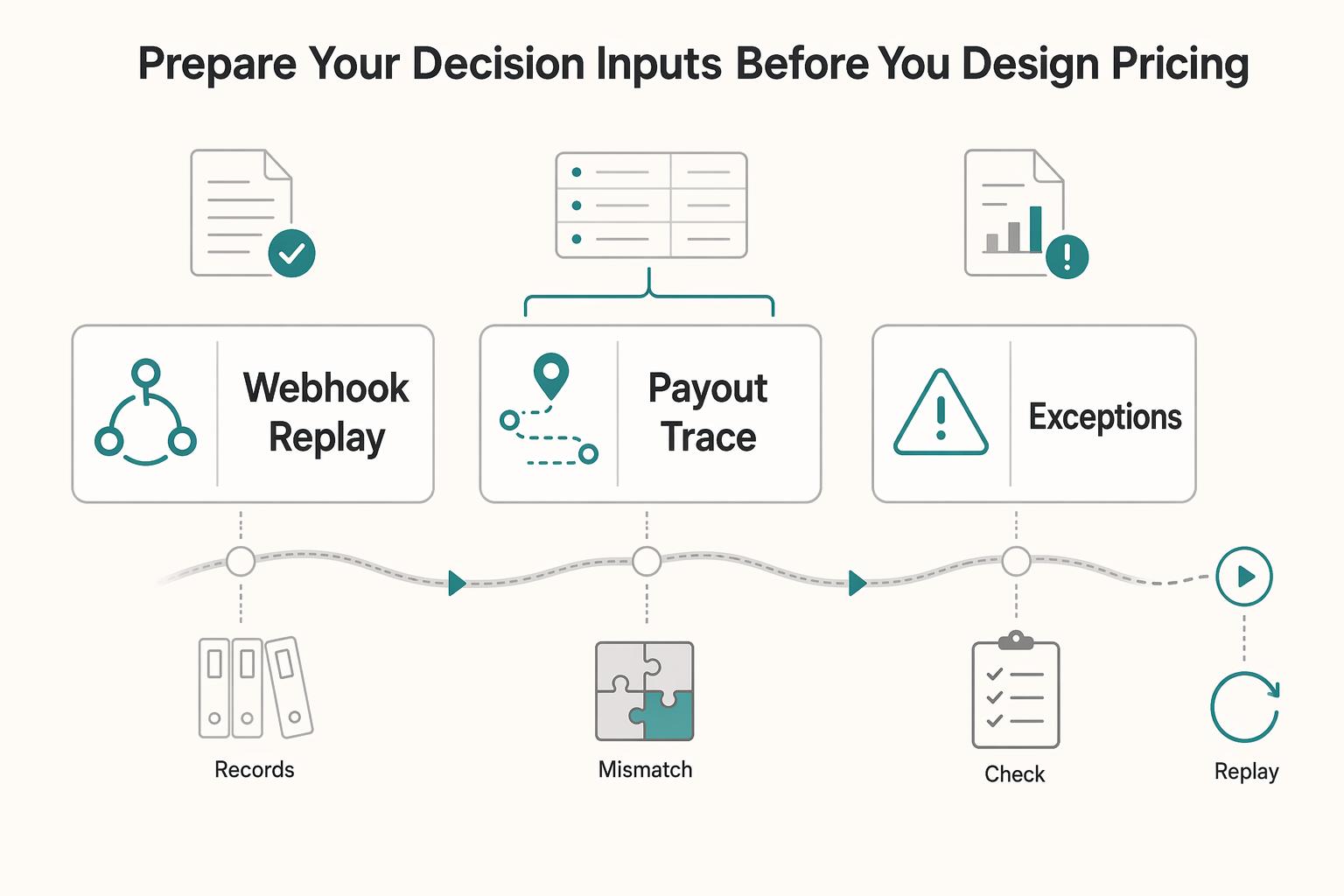
Prepare your decision inputs before you design pricing#
Do the operational work before you name plans: lock launch markets, supported rails, and clear ownership for the first failure points.
Step 1 Define the first country cohort list before plan names. Put each launch market on one line with expected payment methods, refund exposure, and dispute risk. If bank debit is part of local acceptance, mark it explicitly as ACH Direct Debit (US) or Australia BECS Direct Debit (Australia). Plan for delayed confirmation, not instant success: ACH can take up to 4 business days for success or failure acknowledgment, and BECS can take up to three business days, so include failed payments and disputes in your risk assumptions.
Step 2 Inventory payment and settlement constraints now. Confirm which Payment Gateways you can use by country, where Merchant of Record coverage starts and stops, and whether Virtual Accounts are enabled for the combinations you need. If MoR scope is unclear, pricing is premature. The MoR is the entity responsible for processing payments and handling refunds and chargebacks, so if you expect provider-managed tax handling, confirm that before finance treats VAT ownership as external.
Step 3 Assign owners to the exact items most likely to break first. Set one product owner for the Cohort Enrollment Workflow, one finance owner for VAT and reconciliation, and one ops owner for payout exceptions and Payout Batches. Require named deliverables, not general ownership: enrollment state map, reconciliation file spec, payout exception queue, and tax-form intake rules for W-8BEN, W-9, and 1099-NEC.
Step 4 Set launch gates that can block go-live. Treat KYC/AML readiness as payout gates, and include KYB and beneficial-owner checks where your program requires them. Require webhook replay tests and idempotency coverage: providers can resend undelivered webhook events for up to three days, and repeated requests with the same idempotency key should return the same result. If those tests are not passed, do not launch recurring access yet.
For Australia, see BECS Direct Debit for Australian Subscriptions: How to Add ACH-Equivalent Billing in Australia.
Choose your billing model with explicit cohort decision rules#
Pick the model based on how value is delivered to each cohort, then confirm your billing stack can support that behavior. A practical starting lens is simple: one-time for immediate cash inflow, subscription for predictable recurring revenue, and hybrid for a premium cohort payment plus lower-tier ongoing access.
Step 1 Match the model to the cohort shape#
For a fixed-term cohort, default to one-time when value is mostly front-loaded and finite. If you also offer ongoing community or library access, add that as a separate subscription instead of bundling everything at launch.
| Offer shape | Default model | Notes |
|---|---|---|
| Fixed-term cohort | One-time | Use a separate subscription only for ongoing community or library access |
| Rolling cohort | Subscription | Pause and resume controls are core requirements; resume behavior can include prorations |
| Library-plus-cohort offer | Hybrid | Use a premium one-time fee for live cohort access plus a lower-tier subscription for continued access; keep cancellation and refund behavior clear |
For a rolling cohort, subscription is usually the better default when delivery is paced and support is ongoing. In that setup, pause and resume controls are core requirements because service and invoicing may need to stop together, and resume behavior can include prorations.
For a library-plus-cohort offer, hybrid can fit well if entitlements are explicit. The supported pattern is a premium one-time fee for live cohort access, plus a lower-tier subscription for continued access, each with clear cancellation and refund behavior.
Step 2 Gate the model by required billing capability#
Do not approve a model until its required billing behaviors are implemented and tested.
| Model | Best-fit cohort type | Proration need | Pause/resume | Dunning tolerance | Entitlement granularity | Refund handling across Payment Gateways |
|---|---|---|---|---|---|---|
| One-time | Fixed-term, front-loaded value | Low | Usually not required | Low | Coarse (single cohort entitlement) | Must support cancellation before completion where available and post-success refunds |
| Subscription | Rolling, paced delivery with ongoing support | Medium to high when plan or quantity changes mid-cycle | Required when learners stop and later rejoin | High (failed payments should be retried) | Medium (active, paused, canceled states) | Keep cancellation and refund behavior consistent across gateways |
| Hybrid | Library plus cohort | High | Required for recurring portion | High for recurring portion | Fine-grained (cohort and library access separated) | Highest complexity because one-time and recurring components can resolve differently |
Run a simple test before launch: make an in-cycle subscription change and verify proration behavior, pause and confirm service and invoicing stop, then resume and verify the resulting billing behavior matches finance expectations.
Step 3 Simplify first when bank rails are part of market entry#
If market entry depends on ACH Direct Debit (US) or BECS Direct Debit (Australia), prioritize model simplicity first. Both rails support bank-debit billing, and BECS is a delayed-notification method, so fewer moving parts reduce operational risk.
Decision rule: if bank rails are a launch requirement, start with the simplest fitting model, one-time for finite offers or a plain subscription for paced offers, then add hybrid layers after acceptance, retries, and refund handling are stable in your Payment Gateways.
Use a one-page offer matrix per SKU covering payment success, payment failure, pause, cancel, and refund outcomes. If product and finance cannot review that matrix line by line, the model is not ready.
For a step-by-step walkthrough, see Subscription Billing Platforms for Plans, Add-Ons, Coupons, and Dunning.
Tie billing states directly to course access states#
Set one rule: billing state drives access state. Use a single entitlement map so your app does not drift from billing logic over time.
Step 1 Define one entitlement map and make billing the trigger#
Use entitlements as the translation layer between what was sold and what the learner can access. If your billing system sends provision and de-provision signals based on subscription status, treat those signals as the source of truth for course, community, and post-cohort library access.
| Billing state | Access state | Operator rule |
|---|---|---|
| Active | Active | Provision access after a valid success event |
| Payment failure on renewal | Grace | Keep temporary access while dunning and retries run |
| Paused | Paused | Pause access tied to the subscription |
| Canceled | Canceled | Remove future access using your re-enrollment policy |
| Failed renewal after retries exhausted | Failed renewal | De-provision access and require customer action |
| Reactivated after successful retry or card update | Reactivated, then active | Restore the same entitlements automatically |
The failure mode to avoid is app-side exceptions that redefine states like "active" or "canceled" differently from billing.
Step 2 Handle renewal failures and recovery without manual cleanup#
When a recurring charge fails, move the learner to grace and start dunning from webhook events, not manual support steps. Stripe supports failure and retry updates through invoice.payment_failed, and Smart Retries includes a documented recommended default of 8 tries within 2 weeks.
Recovery should stay automated. Successful retries can restore recurring revenue without manual operator action, and card updater behavior can replace outdated card details when issuers provide updates. Keep one recovery path so "billing recovered" and "course restored" do not split into separate, inconsistent jobs.
For re-enrollment, define one policy per cohort window and apply it consistently. The goal is to prevent unintended access changes after cancellation, failed renewal, or later recovery.
Step 3 Verify replay, retries, and auditability before launch#
Test webhook replay locally, then confirm handlers are idempotent so repeated deliveries do not create duplicate grants or revocations. Use idempotency keys for retry-safe POST behavior.
Then verify traceability in logs: billing event received, handler outcome, entitlement change, and final learner access state should connect in one chain. If support cannot answer why access changed from event and request logs, this link is still fragile.
Build a country rollout sequence that prevents payment rework#
Launch order should be set by payment fit and compliance overhead first, not TAM alone. Payment acceptance, currency handling, tax ownership, and settlement design are what usually force rework.
Step 1 Rank countries by operational fit before revenue upside. Screen each market on three points: expected local payment acceptance, presentment and settlement practicality, and clear tax accountability. If presentment currency and settlement currency differ, treat that as an explicit FX exposure point and plan reconciliation for it upfront.
Local-currency capability is part of launch readiness, not a marketing add-on. Stripe supports processing in 135+ currencies, and multi-currency settlement can allow balances and payouts in additional currencies without FX fees. If local presentment or settlement handling is unclear, that market is not a strong anchor launch.
Step 2 Choose the launch path per country, not once for the whole expansion. A practical sequence is one anchor market, then one adjacent market with a similar payment and tax profile, then higher-friction markets after metrics are stable.
| Market profile | Sensible first launch path | Payment rail question | Tax posture to confirm | Settlement and reconciliation impact |
|---|---|---|---|---|
| Card-first market with manageable ops | MoR if you want less direct operator burden for payment liabilities, tax collection, refunds, and chargebacks; direct setup if you already have tax and finance capacity | Confirm local card acceptance and local-currency presentment where needed | Confirm legal seller and tax filing ownership | Verify payout reporting maps cleanly to orders, refunds, and entitlements |
| EU market for electronically supplied services | Often simpler to begin with MoR unless you already run EU tax operations | Test local currency presentment and failed-payment handling | For these services, tax is tied to where the customer belongs (rule in effect since 1 January 2015) | Expect more review when presentment and settlement currencies differ |
| Market where bank-account billing matters for acceptance | Defer until bank-account rail behavior is proven in your stack | Validate mandate/authorization flow, renewal failures, and retries (for example on ACH in the US) | In PayFac-style setups, do not assume tax calculation and filing move off your team | Plan for more exception handling on returns, retries, and payout matching |
A Merchant of Record can reduce direct burden, but it does not remove the need for clear internal handling of refunds, disputes, learner communications, and ledger mapping.
Step 3 Sequence rollout by similarity, then add complexity. Use an anchor market that matches your current stack, then choose an adjacent market with similar operating assumptions. Avoid choosing a second market that simultaneously introduces new payment rails, new tax handling, and new settlement complexity.
Step 4 Set hard go/no-go checks before each launch. Treat a country as launch-ready only when all checks pass:
- Payment acceptance is proven with live local transactions, including one successful charge in intended presentment currency and one captured failure path.
- Decline and retry behavior is validated so failed renewals enter grace, retries run, and successful recovery restores access without manual fixes.
- FX quote expiry is handled if quoted FX is used; verify expiry behavior and recovery flow for supported quote windows (including 1-hour and 24-hour windows).
- Support playbooks are ready for disputes, refunds, expired quotes, and seller-of-record questions before the first cohort opens.
If any check fails, defer that country. Reordering is cheaper than rebuilding payments, tax, and reconciliation after launch.
Related reading: How Freelance Developers Use Linear to Control Scope and Billing.
Set revenue protection controls before scaling acquisition#
Do not scale paid acquisition until payment recovery and fraud controls are stable. Treat dunning, Account Updater, and fraud response as core product infrastructure so renewal failures follow a defined path instead of turning into ad hoc cleanup.
Step 1 Build recovery paths by failure class#
Classify renewal failures into soft declines, hard declines, and suspicious payments, then map each class to one next action.
| Failure class | Default response |
|---|---|
| Soft decline | Route to automated retry logic |
| Hard decline | Route to customer action to update payment details |
| Suspicious payment | Place on hold and send to manual review |
For card renewals, Smart Retries with a documented default of 8 tries within 2 weeks is a practical baseline. Use it as a starting point, then tune by payment method and gateway behavior instead of forcing one retry pattern across every rail.
Before scaling, verify that events branch correctly in test or controlled live cases: soft declines enter dunning and retries, hard declines trigger the customer update flow, and successful recovery restores access automatically.
Step 2 Turn updater and fraud tools into explicit operator controls#
Account updater coverage is a direct protection control for subscriptions. If you support Visa Account Updater, confirm updated card details flow into your subscription records before the next renewal attempt.
For fraud response, define score-based actions rather than ad hoc decisions. With a 0-99 risk score model and default boundaries of 65+ elevated and 75+ high, set clear hold and review rules tied to those thresholds and route high-risk payments into a manual fraud review queue.
Keep rules tight enough to catch risk, but avoid over-tuning early. Aggressive rules can block legitimate renewals and create preventable access and support issues.
Step 3 Instrument the few metrics that show real protection#
Track the metrics that show whether controls are working, not just total declines:
- Recovered renewals after dunning or updater events
- Retry success rate by gateway and payment method
- Fraud false-positive rate
- Time-to-resolution for failed renewals
Review these before increasing spend in a new market. If recovery is flat, retry performance varies sharply by rail, or fraud reviews remain unresolved, fix those controls before adding volume.
Establish compliance and tax evidence packs for cross-border cohorts#
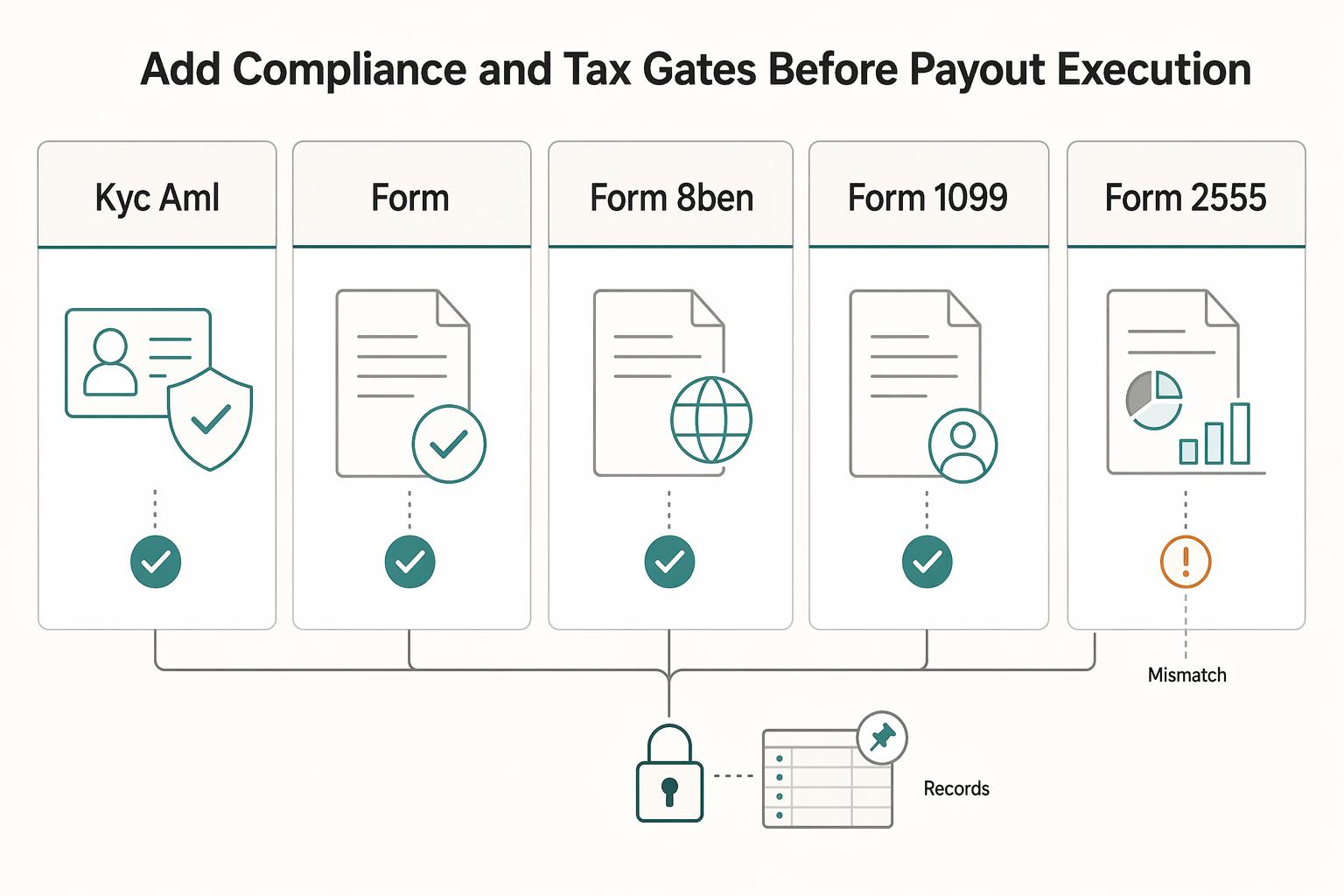
Payout compliance is a scale gate: do not release payouts until identity, tax, and audit evidence are complete.
Step 1 Document payout gating by market and account type#
Define payout rules per market and account type, not as one global checklist. Verification requirements vary by country and capabilities, and required data must be collected and verified before charges or payouts are enabled.
For individual KYC/CIP intake, capture name, date of birth, address, and identification number. Where KYB applies, require beneficial ownership data that is adequate, accurate, and up to date. If a required check is incomplete or fails, hold payout and route it to a named escalation owner.
Run a blocked-payout test: confirm missing required identity data prevents payout and that operators can see the block reason. Also treat provider verification as one control, not a substitute for your own legal KYC/verification obligations.
Step 2 Define tax artifacts by persona and jurisdiction#
Separate tax intake by payee type and track thresholds continuously, not just forms on file.
| Artifact | Who or when | Key condition |
|---|---|---|
| Form W-9 | U.S. persons | Collect for TIN and certifications |
| Form W-8BEN | Foreign individuals | Collect to establish foreign status |
| Form 1099-NEC | Nonemployee compensation tracking | $600 threshold, changing to $2,000 for payments made after December 31, 2025 |
| FEIE | Conditional | Based on qualification checks, including foreign earned income and a foreign tax home |
| FBAR | Conditional | When aggregate foreign account balances exceed $10,000 at any point in the calendar year; due April 15 with an automatic extension to October 15 |
Use that table as your default intake matrix, and monitor the listed thresholds continuously rather than only at payout time.
Step 3 Require an audit-ready payout evidence pack#
For each payout cycle, keep one repeatable evidence bundle: approval trail, provider reference, ledger linkage, and an export package finance can review quickly. The objective is end-to-end traceability from approval through reconciliation.
Validate this with spot checks on completed payouts. Finance should be able to trace approval, provider reference, and ledger entry without manual reconstruction.
Step 4 Restrict and mask sensitive compliance data#
Tax and compliance artifacts should be limited to authorized, need-to-know users. Apply role-based access control and mask unnecessary identifiers, such as full SSNs where full display is not required.
Test this in production roles, not only in policy docs. If support, finance, and ops can all see full tax records by default, controls are not operating as designed.
Common mistakes that break cohort billing and how to recover#
Most cohort-billing failures come from system mismatch, not payment rails. Recover by reducing moving parts and restoring one operational source of truth before you scale.
Step 1 Freeze offer changes until entitlement mapping is complete. If access is controlled by ad hoc app logic instead of subscription status, new subscriptions multiply reconciliation work. Document how each subscription state maps to course access, then run an access backfill for active learners. Verify with canceled, failed-payment, and reactivated subscriptions that provisioning and de-provisioning follow billing status, not manual overrides.
Step 2 Collapse plan sprawl before it hardens into policy. Recurly-style flexibility can create unlimited plan growth, which is useful early but risky without governance. Reduce to a core plan set, retire low-volume variants, and only add new variants when you can measure uplift against a baseline. If support needs a lookup sheet to explain which plan to buy, governance is already behind.
Step 3 Run enrollment and subscription lifecycle from the same event stream. Payment failures and subscription status changes happen asynchronously, so cohort access must be synchronized from webhook events, not checkout success alone. Treat failure, retry, pause, and reactivation events as first-class operations, and include replay handling for undelivered events. Test recovery by replaying undelivered events and confirming the learner record converges to the same final state without duplicate enrollments.
Step 4 Pause country rollout until local payment fit and tax monitoring are proven. Available payment methods depend on country, currency, and integration setup, and tax thresholds are jurisdiction-specific. Complete a per-market checklist before launch: local payment method fit, decline and retry behavior, and tax-threshold monitoring. Relaunch in staged cohorts so you can inspect acceptance and support load before opening the next country.
Related: Hybrid Billing Models: How to Combine Subscriptions with Usage-Based and One-Time Charges.
Conclusion#
The practical order is straightforward: decide the offer shape, tie billing states to access, then expand countries only when payments, tax, and payouts can support what you sold. Many costly failures come from doing that in reverse and treating entitlement logic, country constraints, or revenue protection as post-launch cleanup.
- Confirm the pricing model by cohort type and payment-rail fit.
Choose one-time, subscription, or hybrid based on how the cohort delivers value, then verify the payment methods you need are actually supported for that country, currency, product setup, and API option. If a target market expects local payment methods, treat that as a go or no-go check, not a later optimization.
- Lock the billing-to-access state map before selling.
Write the exact transitions for active, grace, paused, canceled, failed renewal, and reactivated learners, then test each against real billing events. Your checkpoint is simple: you should be able to trace every access change back to the invoice or subscription event that caused it. A clear red flag is support making manual access exceptions because billing and course access still drift apart.
- Check country readiness across payment methods, multi-currency settlement, tax handling, and support.
Do not approve a new country on demand alone. Confirm that your payment setup covers the right methods, that multi-currency settlement works for how you collect and pay out, and that your VAT/tax handling is defined well enough for finance and support to answer customer questions consistently. The practical test is not just checkout success. It is renewals, refunds, disputes, and settlement behavior in that market.
- Prepare KYC and tax-document evidence packs before payout scale.
KYC requirements must be fulfilled before connected accounts can accept payments and send payouts, and missing or unverified information can pause charges or payouts. If your model involves payees, instructors, or connected accounts, define how you collect and store KYC evidence, plus tax forms such as W-8 and W-9 during onboarding, and related KYB/AML evidence where required. If 1099-NEC reporting applies, make sure finance can tie TIN data and payout records together without chasing documents after the fact.
- Test revenue protection and reconciliation end to end.
Dunning, automated failed-payment recovery, fraud controls, and reconciliation reporting should all be proven with test scenarios, not assumed because the feature exists. Finish with a payout reconciliation report and verify that finance can match recovered renewals, refunds, disputes, and settled payouts at the payout-batch level. If that matching breaks, pause expansion until it is fixed.
Copy this checklist into your launch doc and require a green status on every line before you open a new cohort or country. That is the practical path to scaling without creating avoidable cleanup work later.
Frequently Asked Questions
What is the best billing model for cohort-based eLearning offers?
There is no universal best model for every cohort. If the value is front-loaded and finite, a one-time payment usually keeps the offer simpler and brings in cash immediately. If learners stay because of paced delivery, recurring support, or an ongoing library, a subscription is usually the better fit. Add hybrid pricing only after your entitlement rules are stable, because mixing one-time and recurring access can get messy first.
How should course access change when a learner pauses, cancels, or misses a renewal payment?
Treat billing state as the source of truth for access. A subscription pause should suspend both service delivery and invoice generation, so access should move to a paused state, not remain fully active. A cancellation often means access ends at the paid-term boundary, but exact timing depends on your billing setup. A missed renewal can enter grace while automated retries run. Remove access if recovery ultimately fails under your policy.
What minimum capabilities should be in place before launching subscriptions in a new country?
At minimum, confirm payment-method fit for that country, currency, and the products you integrate with, because available methods vary across all three. If the market expects local methods, avoid launching with cards alone and hoping conversion catches up later. Keep a country checklist that names supported methods, failed-payment handling, and who owns customer support when renewals or refunds go wrong.
How do operators reduce involuntary churn without harming learner experience?
Start with automated recovery before you add more messaging. Smart Retries can automatically retry failed subscription and invoice payments, and Card Updater can refresh expired or reissued card details when issuers provide updates, so avoidable failures may recover without forcing the learner through a manual fix. A common mistake is cutting off access on the first failed renewal instead of using a grace state while retries and updater events do their work.
What is the operational difference between a Cohort Enrollment Workflow and a billing workflow?
A Cohort Enrollment Workflow is about placing grouped learners into courses, while billing manages invoices, payment outcomes, and subscription state. They need to stay connected, but they are not the same thing: cohort placement is not proof that someone should still have access today. If your enrollments only get created at checkout and never re-evaluated after renewal failures, cancellations, or reactivations, you can overgrant access.
When should an eLearning platform add freemium, discounts, gift subscriptions, or prepaid options?
There is no fixed timing rule that works for every platform. Add these after the core plan catalog, access rules, and recovery logic are working cleanly. Freemium only makes sense when free versus paid entitlements are sharply defined, and discounts only make sense when you can measure whether they improve conversion without creating plan sprawl. Gift and prepaid options need written rules for redemption, recipient access, and refunds before launch. If support is still making manual exceptions, wait, and if gifting is next on your roadmap, this guide on gift subscriptions and prepaid plans is the right next read.
Try a related tool
Researched and edited by the Gruv editorial team. Gruv builds cross-border billing, payouts, and finance-operations software for global businesses.
Sources
Includes 1 external source outside the trusted-domain allowlist.
- bsaaml.ffiec.gov/manual/AssessingComplianceWithBSARegulatoryR...trusted
- csrc.nist.gov/glossary/term/role_based_access_controltrusted
- ecfr.gov/current/title-31/subtitle-B/chapter-X/part-1...trusted
- ecfr.gov/current/title-31/subtitle-B/chapter-X/part-1...trusted
- irs.gov/forms-pubs/about-form-w-9trusted
- irs.gov/individuals/international-taxpayers/forms-fo...trusted
- taxation-customs.ec.europa.eu/system/files/2016-11/information_microbusine...trusted
- docs.moodle.org/en/Cohortsexternal
Educational content only. Not legal, tax, or financial advice.
Related Posts
Gift Subscriptions and Prepaid Plans for Platform Billing Without Cleanup Chaos
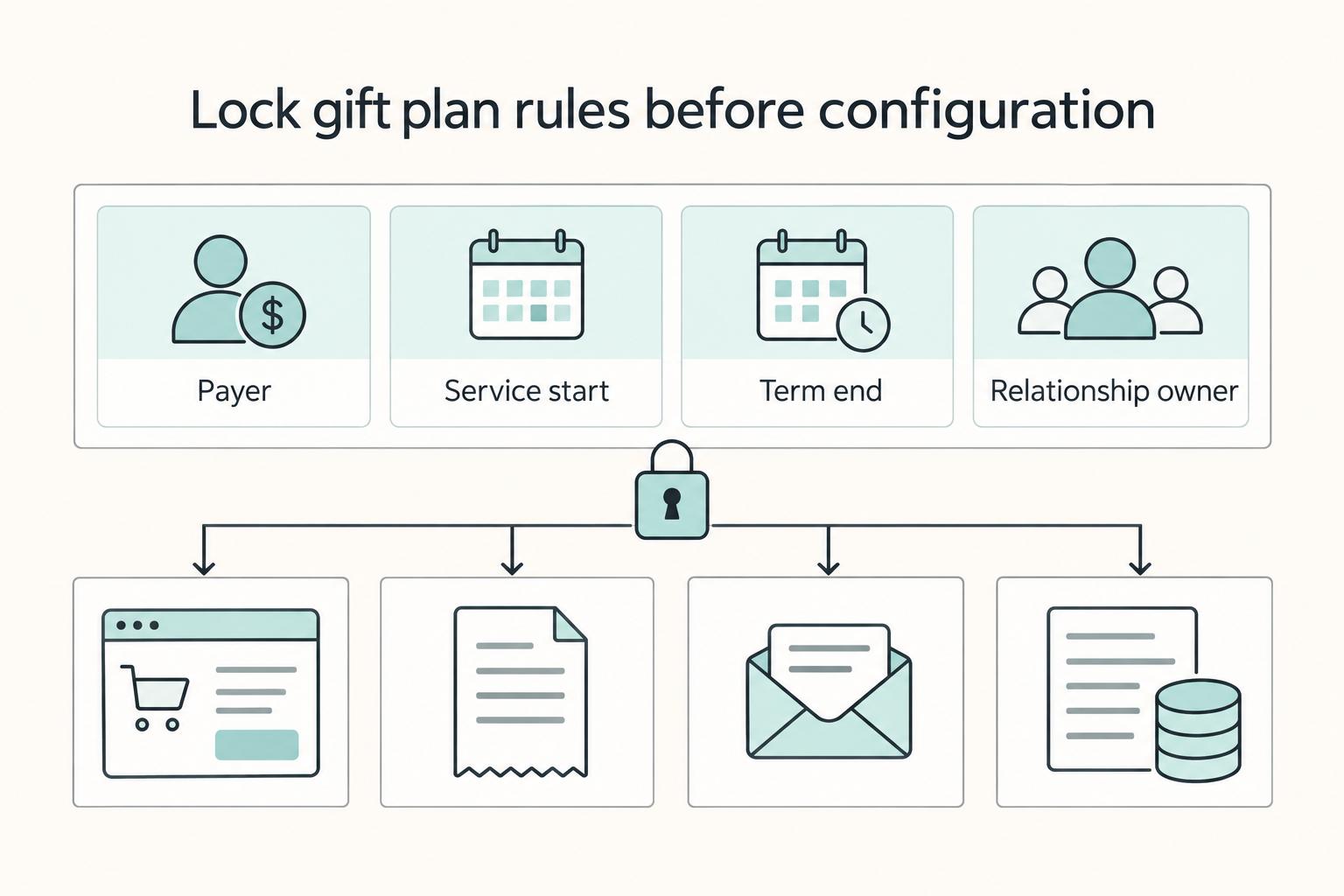
Gift offers look simple on the storefront, but the billing choice underneath them affects cash flow, customer clarity, and how much cleanup lands on Support and Finance. Prepaid subscriptions can work well because the customer pays the full subscription cost upfront, often with a discount. The catch is that gifting breaks the normal pattern of scheduled recurring transactions on a fixed billing cycle, so small design mistakes can show up later as preventable tickets, refunds, and reconciliation noise.
Should Your Platform Add BECS Direct Debit for Australian Subscriptions
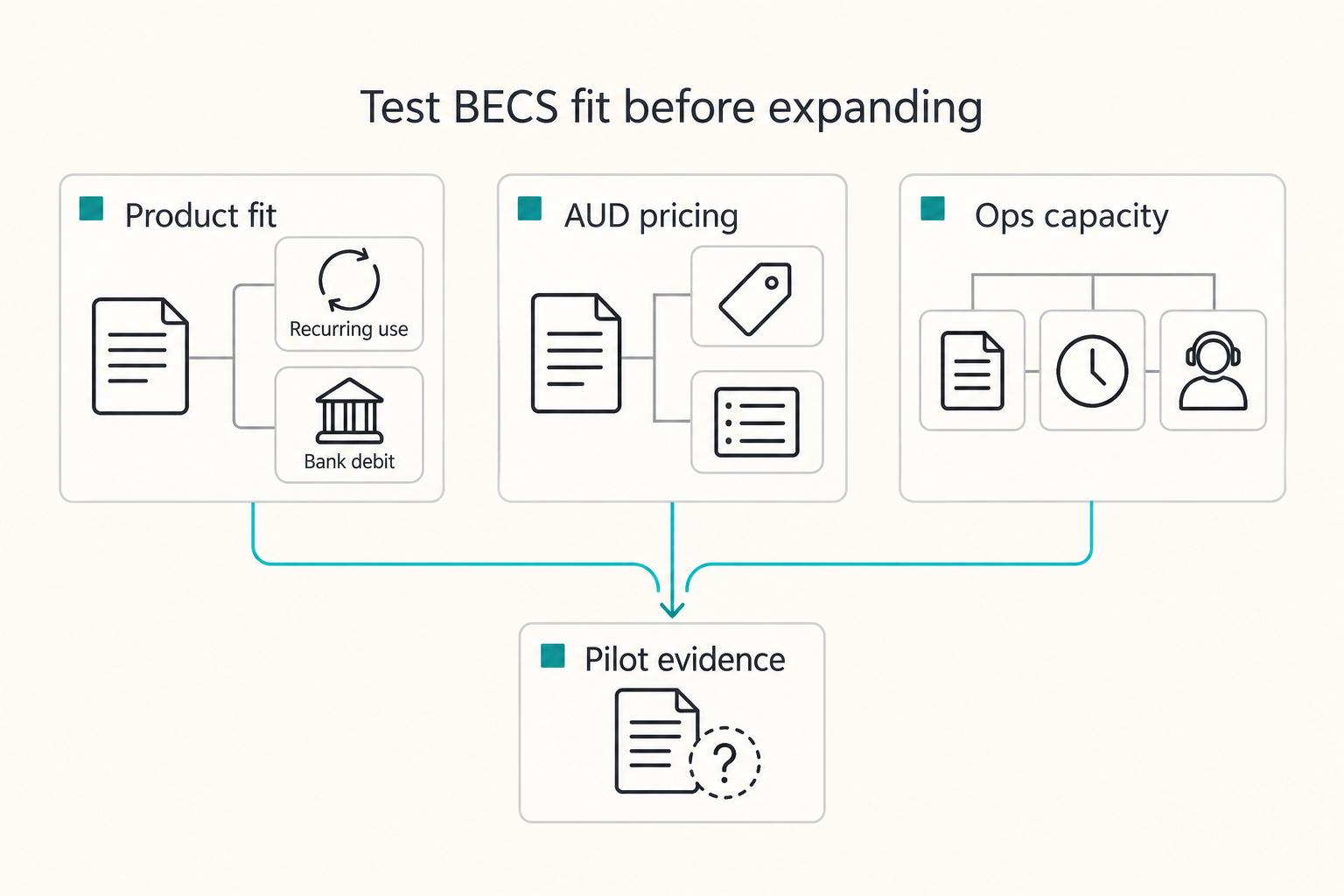
If you are deciding whether to add **becs direct debit australia subscriptions platform** support to an Australia launch, ask a narrower question first. Should it be in scope now, delayed until key terms are verified, or skipped for this launch?
Hybrid Billing Models for One Invoice and Clean Reconciliation
**Hybrid billing means combining recurring subscription fees, usage-based charges, and one-time fees in the same offer.** Treat **hybrid billing models subscriptions usage-based one-time charges platform** as an operating design problem, not just a packaging choice. In practice, many SaaS teams put subscriptions, metered overages, and one-time fees in the same contract.