
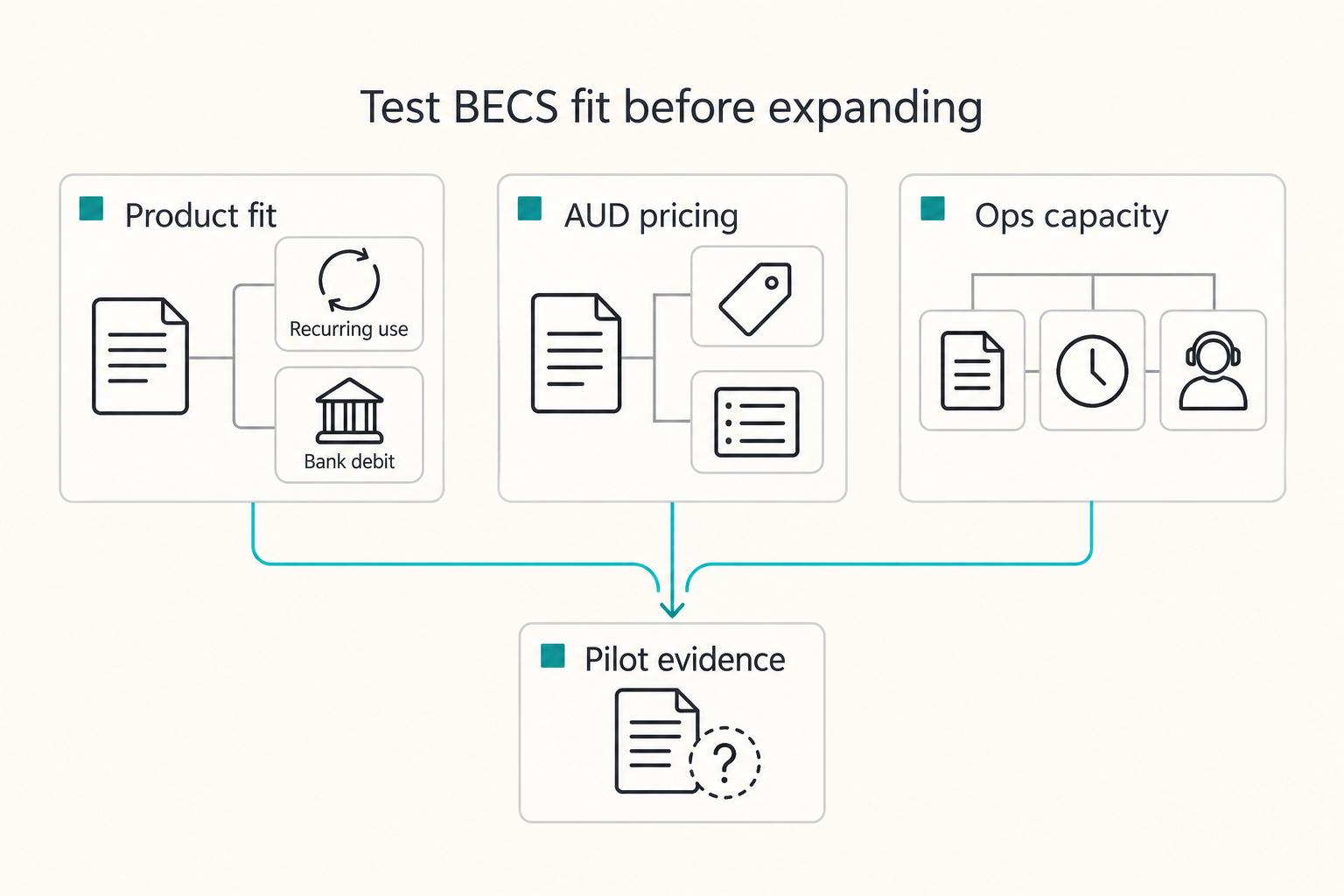
Quick Answer
Add BECS when customers accept bank collection and you can manage valid DDR authorization, AUD billing and delayed outcomes. An active subscription is not proof of paid cash. Pilot the actual integration, including permanent failure, cancellation, disputes and payment-to-bank reconciliation.
When BECS Direct Debit makes sense for your platform#
BECS Direct Debit can suit Australian subscriptions when customers accept bank collection and your service can tolerate delayed payment confirmation. Check authorization, AUD billing and recovery operations before adding it to checkout.
What BECS Direct Debit solves and where it is limited#
Define the rail clearly. The Bulk Electronic Clearing System (BECS) is Australia's primary account-to-account system for direct entry, and in subscription planning it is often treated as the local ACH-like recurring bank-debit rail.
Match your billing flow to authorization requirements. BECS Direct Debit is built for scheduled recurring collection after customer authorization. Customers complete a Direct Debit Request (DDR) with the collecting business, and mandate capture is required, including bank account details. It can also support variable amounts and frequencies, which is relevant for usage-based or invoice-linked billing.
Stripe describes AU BECS as delayed notification: success or failure can take up to three business days. Initiation, payment success, funds available at the provider and a payout credited to your bank are separate milestones. Compare cash timing using your account schedule and actual bank receipts.
Confirm market fit before you build product surface area#
If Australia is still a learning market for you, start narrow. Validate that recurring bank collection fits your product behavior, AUD pricing model, and operating capacity before you expand tenant-wide.
Step 1: Map each target vertical to payment behavior, not just TAM. For SaaS, streaming, and other recurring models, the key question is whether merchant-initiated bank collection is operationally acceptable for your use case. In Australia, direct entry is commonly used for recurring, automated payments, and direct debit is used for recurring payments including subscriptions and instalments. That confirms rail relevance for recurring billing, not buyer preference over cards.
Keep bank debit and card logic separate in your planning. Australian usage distinguishes direct debit from recurring card payments (CPAs), so card-style assumptions should be tested explicitly.
Step 2: Confirm AUD and billing cadence before any UX or API work. Treat this as a hard gate: Stripe BECS Checkout requires all line items in Australian dollars (aud). If your Australia GTM still depends on non-AUD pricing or unresolved currency behavior, pause build.
Verification should be concrete: confirm subscription prices, invoice line items, and proration scenarios can all be expressed end to end in AUD.
Step 3: Define success in operator terms before you optimize conversion. Set launch success criteria around approval readiness, reconciliation overhead, and support load, not just checkout completion. Document ownership for DDR/mandate flow review, exception handling, and finance reconciliation between provider records and internal subscription state.
A practical minimum evidence pack should include authorization-flow proof, AUD pricing proof, and representative invoice cadence scenarios.
Step 4: Roll out through a controlled cohort first. If Australia is a test market, release BECS Direct Debit to a limited tenant or plan cohort before broad exposure. Use early cycles to confirm the rail fits your packaging and operations, then expand only after reconciliation and support outcomes are clear.
Related: SEPA Direct Debit for European Subscriptions: Lower Churn and Higher Approval Than Cards.
Choose your provider path with explicit tradeoffs#
Choose the path with the fewest operational handoffs for your first Australia rollout, unless specialized direct debit control is your primary goal.
Step 1 Compare provider paths by ownership, not feature labels#
Start with a side-by-side view of checkout, subscription billing, and finance operations. The key question is not whether BECS is supported, but where customer authorization, recurring billing state, invoice updates, and reconciliation will live after launch.
| Path | What to verify | Operating tradeoff |
|---|---|---|
| Stripe Billing | AU BECS eligibility, AUD prices, reusable mandate and payment events | May reduce billing handoffs in an existing Stripe stack; active subscription is not payment proof. |
| GoCardless with your billing stack | Current integration support, mandate status, retry eligibility and reconciliation exports | Specialist collection controls can add a separate provider state to reconcile. |
| Current stack | Contracted BECS support, authorization handling and AUD invoice behavior | Preserves familiar ownership only if the actual integration passes these checks. |
Checkpoint: document ownership for five objects before launch: checkout UX, customer authorization, subscription state, collection events, and reconciliation. If ownership is fragmented, expect higher support and finance coordination.
If you use Xero, Chargebee or Maxio, verify the exact gateway, account configuration and release you will use. Test the path from a changed invoice to the resulting collection and ledger entries; a partner logo does not establish those behaviors.
Step 3 Decide with one explicit rule#
Prefer the path that keeps checkout, billing and collection ownership clear. Existing Stripe Billing may reduce handoffs; a specialist provider may offer controls you need. Compare both against a sample renewal, failed debit and cancelled mandate in your actual stack.
Before kickoff, require a short evidence pack from each provider: AUD support, authorization timing, ownership map, and written responses on fees, settlement windows, disputes, and failure recovery. If key items are unclear, keep that option in pilot scope only.
Prepare prerequisites and evidence before kickoff#
Do not start engineering until prerequisites and evidence ownership are locked. For Australia, that means confirmed BECS Direct Debit capability, AUD commercial setup, and a customer authorization flow you can defend in review.
First, confirm launch blockers in writing. If you are using Stripe, treat Australia BECS identity verification and AUD-denominated line-item pricing (aud) as hard prerequisites. If you will capture a Direct Debit Request (DDR) electronically or by phone, include prior financial-institution approval as an explicit dependency.
Next, define the authorization evidence pack before UX or API build. A DDR is the customer authorization required before collecting future payments, and you must retain records and be able to access them later.
Then align legal, compliance, and product on policy gates before implementation. Public documentation informs requirements, but it does not replace internal sign-off on DDR language, record-retention expectations, and customer notification behavior.
Test both delayed success and permanent failure before widening rollout. Stripe suggests pre-debit notice at least 14 calendar days ahead, rather than making that a universal mandatory period; implement your agreed DDR notification requirements. Trace payment outcome, provider balance availability and bank payout separately.
Implement the subscription flow in production order#
Implement this flow in the same order money and authorization evidence move: billing objects first, mandate setup second, subscription creation third, event handling and operations controls after that.
| Order | Action | Check |
|---|---|---|
| 1 | Create AUD product and price | Record the price ID. |
| 2 | Collect reusable authorization | Complete mandate acknowledgment and attach the method to the customer. |
| 3 | Create subscription | Track the invoice and payment separately from subscription status. |
| 4 | Protect writes | Durable local action record plus scoped provider idempotency keys. |
| 5 | Process events | Atomic local effects, duplicate control and current-state recovery. |
| 6 | Operate exceptions | Stop inactive mandates; distinguish recoverable from permanent failures. |
| 7 | Pilot | Reconcile payment, fees, reversals and bank payout. |
After setup, create the subscription using the saved customer and price IDs. Stripe can mark it active before the first payment completes; verify invoice.paid or a succeeded underlying payment as well as subscription status before fulfillment. Any provisional access needs an explicit loss policy.
Keep a durable record for each subscription change or debit instruction. Provider idempotency keys protect retries only within that API’s documented scope and lifetime; an expired key is not a permanent business-action lock. Query unknown outcomes before issuing a replacement.
Keep subscription, invoice, mandate, payment, provider-balance and bank-payout states separate. A processing payment is not received cash, and a later dispute can reverse a previously successful debit.
Stripe BECS payments are never automatically retried, even when an invoice retry schedule exists. Give operators a failure-specific recovery path and customer message; confirm any other provider’s retry behavior for the deployed integration.
Design failure handling and reconciliation from day one#
Design failure handling before launch, not after go-live. AU BECS is a delayed-notification method, and Stripe notes payment success or failure can take up to three business days to confirm, so your operating model needs explicit pending, failure, and exception states from day one.
Step 1 Classify failures and assign an owner#
Use a fixed four-part taxonomy, and assign each class a named owner and response window your team can actually meet:
| Failure class | Owner | First check |
|---|---|---|
| Authorization failure | payments or compliance ops | Can you retrieve DDR or mandate evidence for the exact debit attempt? |
| Bank debit failure | billing ops | Is the payment still within the up-to-three-business-day pending window, or has a failure event arrived? |
| Webhook delay or delivery failure | engineering or platform ops | Check endpoint health, receipt logs, and whether the same event was already processed on retry |
| Internal posting mismatch | finance systems or data ops | Do payment, fee, refund, dispute and payout effects reconcile without duplicates? |
The customer did not complete the Direct Debit Request, or you cannot prove they did. Invalid DDR handling is explicitly tied to claims exposure, including cases where "the customer's account has been debited without a valid DDR." Owner: payments or compliance ops. First check: can you retrieve DDR or mandate evidence for the exact debit attempt?
The debit was initiated but later failed, including insufficient-funds outcomes. Owner: billing ops. First check: is the payment still within the up-to-three-business-day pending window, or has a failure event arrived?
Your platform did not receive the event needed to advance state. Stripe states it automatically resends undelivered webhook events for up to three days in live mode. Owner: engineering or platform ops. First check: endpoint health, receipt logs, and whether the same event was already processed on retry.
One payment may have several related fee, refund, dispute and reversal entries. Reconcile each distinct economic effect once, with its own durable identifier; do not force all related entries into a single posting.
Step 2 Reconcile in a fixed order#
Reconcile in the same order every time:
- Link the payment and mandate to the correct customer, invoice and subscription.
- Reconcile gross payments, fees, refunds and disputes as distinct effects.
- Bridge provider balance activity and payout batches to actual bank receipts.
- Investigate unmatched or contradictory items without inventing a receipt.
For an invented example, a 100 AUD payment and 1 AUD fee produce 99 AUD net proceeds before any other adjustments. A bank payout may combine this with many other payments. Match the gross payment and fee separately, then explain the batch-to-bank bridge; do not book a second receipt when the payout arrives.
Step 3 Add replay, duplicate control, and customer comms#
Persist webhook receipt and its local state or ledger effect atomically, with a unique effect identifier. Deduplicate repeat deliveries, handle older events without regressing state, and retrieve the current provider object after gaps. Use provider API idempotency keys within their documented scope and retention window alongside a durable local business-action record. After an unknown request outcome, query the original before submitting a new attempt.
A cancelled or permanently failed mandate must stop future debits. Obtain fresh authorization before resuming bank collection; cancelling debit authority does not by itself settle or cancel the underlying service contract. For an eligible recoverable failure, decide a new attempt only after the original outcome is known and authorization remains valid.
Keep customer messaging precise: if a payment is still pending, say it is awaiting bank confirmation; if it failed, state the next action clearly and avoid implying funds were received.
Set launch gates and unknowns you must validate commercially#
Public docs are a starting point, not launch approval. For an AU BECS rollout, your commercial risk is the gap between published guidance and what your signed terms actually commit to.
Step 1 Build a launch gate table before you book rollout spend#
Use one shared table across finance, payments, and your account owner. Its job is to separate what is publicly documented from what is contractually confirmed.
| Item | Confirmed from public docs | Confirmed in your signed provider terms | Still unverified |
|---|---|---|---|
| Pricing model | Stripe notes custom pricing may be available based on volume, scale, and business needs. GoCardless says fees vary by business location and domestic/international context, and custom pricing is available by contract. | Exact per-transaction fees, fixed fees, minimums, volume tiers, dispute fees, and plan commitments. | Whether your domestic/cross-border mix changes fee outcomes enough to alter unit economics. |
| Settlement timing | Stripe standard settlement is T+2 business days from submission, subject to cutoffs; balance availability is not bank receipt. | Actual payout timing, reserves, cutoff behavior, and exceptions for weekends, returns, or account configuration. | Whether timing remains predictable enough for your cashflow model under live failure rates. |
| Dispute workflow | Stripe AU BECS bank disputes are final and cannot be appealed. | Reversal accounting, customer communication, double-refund prevention and applicable fees. | Your live incident volume and recovery workload. |
| Support escalation timelines | Public docs indicate some thresholds are support-mediated (for example, Stripe notes higher limits require contacting support). | Named escalation path, response targets, severity handling, and launch-period coverage. | Whether support latency is acceptable during first-month incidents. |
Verification check: if a value in the signed-terms column cannot be tied to an order form, MSA, pricing addendum, or support commitment, keep it unverified.
Step 2 Force answers on the four commercial unknowns#
Force written confirmation for pricing, settlement certainty, dispute handling, and support response timelines before broad rollout. These are the details most likely to look clear in public docs but shift in contract language or operations.
Keep the DDR retrievable for customer queries and investigations. In Stripe AU BECS, a bank dispute is final and cannot be appealed through a card-style evidence process. Account for later reversals and check the dispute state before refunding, so the customer is not reimbursed twice.
Step 3 Set go and no-go rules for expansion#
Move beyond pilot only when production shows stable authorization capture, predictable exception handling, and a finance workload your team can sustain. If you cannot reliably retrieve DDR evidence, explain pending versus failed outcomes, and reconcile provider references without frequent manual cleanup, expansion risk is still high.
A practical internal gate is to stay pilot-only when multiple commercial unknowns remain unresolved in your table. Use that as a risk-control heuristic, not a universal rule.
Frequently Asked Questions
Is BECS Direct Debit the Australian equivalent of ACH for subscriptions?
Broadly, yes in role, not in legal identity. BECS Direct Debit is Australia's bank-to-bank direct debit infrastructure for recurring collection, while ACH Debit is the US bank debit scheme. If you are explaining it internally, "Australia's ACH-like recurring bank debit rail" is a fair shortcut, but do not assume the rules, timing, or dispute treatment are identical.
Can we collect variable subscription amounts with BECS if we have customer permission?
Yes, provided your direct debit terms and customer authorization support it. The grounded point here is the Direct Debit Request (DDR) or mandate: it is the evidence that gives you authority to debit the account, and public BECS guidance states merchants can vary payment amounts and frequencies. A practical check is whether your support team can retrieve that authorization record quickly if a customer disputes a debit.
What must be true before we can offer BECS in production for Australia?
You need more than a checkout toggle. At minimum, you must collect valid customer authorization through a DDR or equivalent mandate flow, and you need status handling that copes with delayed notification because AU BECS outcomes can take up to three business days to confirm. If your operating model depends on direct scheme participation, AusPayNet says a business must be approved as a direct entry user by a financial institution before collecting direct debits.
How should we compare Stripe and GoCardless for platform use cases?
Compare the provider and billing integration you will actually deploy: who captures and stores the DDR, stops collections on cancellation, reports payment outcomes and produces reconciliation detail? Test a renewal, permanent failure, invoice change and dispute before choosing.
Which businesses most commonly use BECS for recurring billing, such as SaaS or streaming platforms?
SaaS, streaming and other recurring services are fit candidates when their customers accept bank debit and delayed confirmation. Pilot with your own buyers; global direct-debit brand examples do not establish Australian BECS preference.
What key details are still unknown from public material and must be validated directly with providers?
Confirm your fees, account limits, payout schedule and escalation contacts. Stripe publishes default new-user limits of 10,000 AUD per transaction and per week, with higher limits arranged through support. Public BECS dispute behavior is already documented: Stripe disputes cannot be appealed. Test retrieval of the DDR and the full payment-to-bank reconciliation path.
Try a related tool
Researched and edited by the Gruv editorial team. Gruv builds cross-border billing, payouts, and finance-operations software for global businesses.
Sources
Includes 2 external sources outside the trusted-domain allowlist.
- docs.stripe.com/billing/subscriptions/au-becs-debittrusted
- docs.stripe.com/payments/au-becs-debittrusted
- stripe.com/resources/more/becs-direct-debit-for-recurri...trusted
- auspaynet.com.au/network/direct-debit-electronic-transfersexternal
- auspaynet.com.au/sites/default/files/2025-09/Guidelines%20for...external
Educational content only. Not legal, tax, or financial advice.
Related Posts
Choosing Visa Direct or Mastercard Send for Debit Card Push Payouts
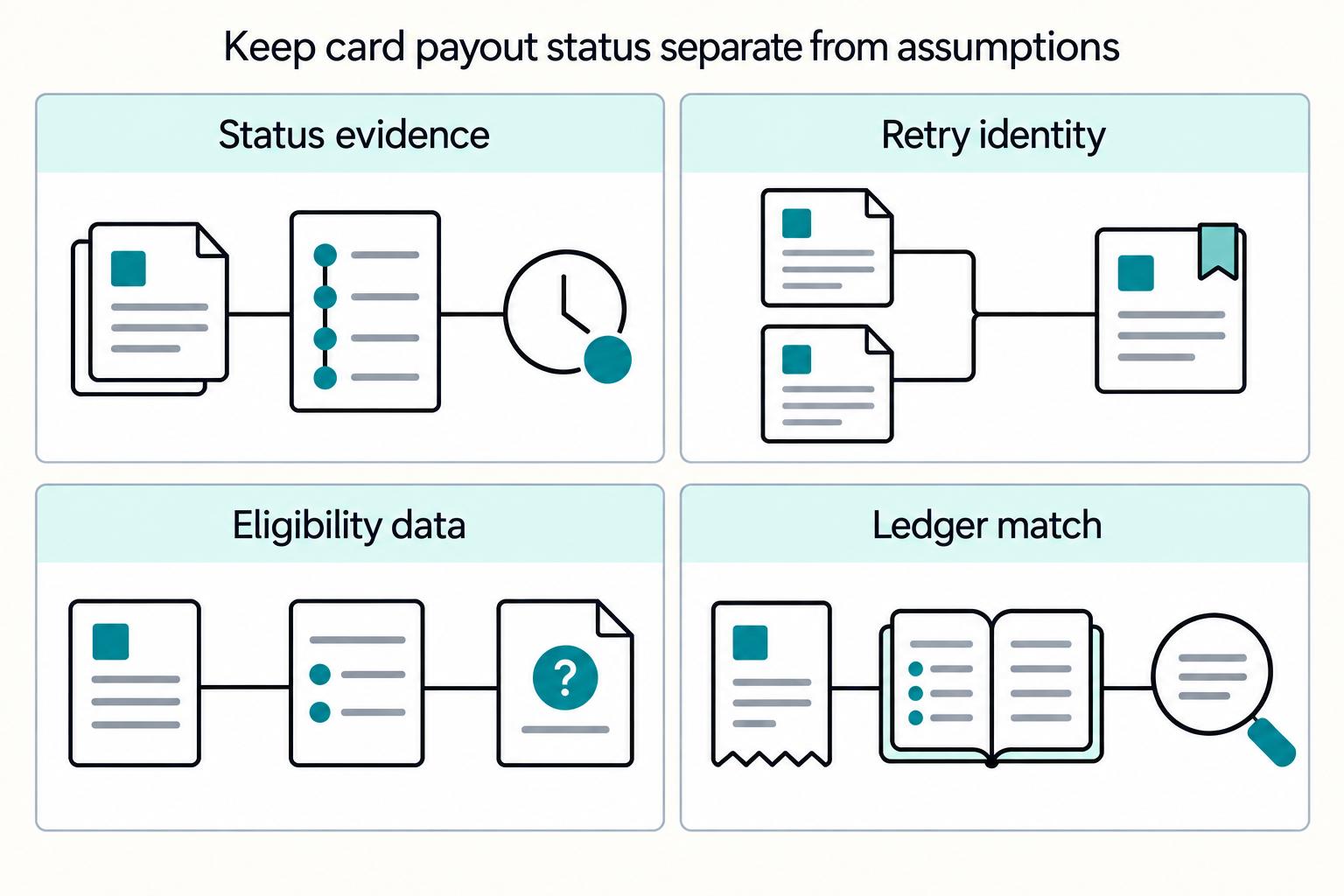
The core decision is usually not "Visa Direct or Mastercard Send?" in isolation. Start with your recipient card mix, your tolerance for payout exceptions, and how much integration and operational complexity your team can absorb right now.
SEPA Direct Debit for European Subscriptions With Clear Approval and Rollout Checks
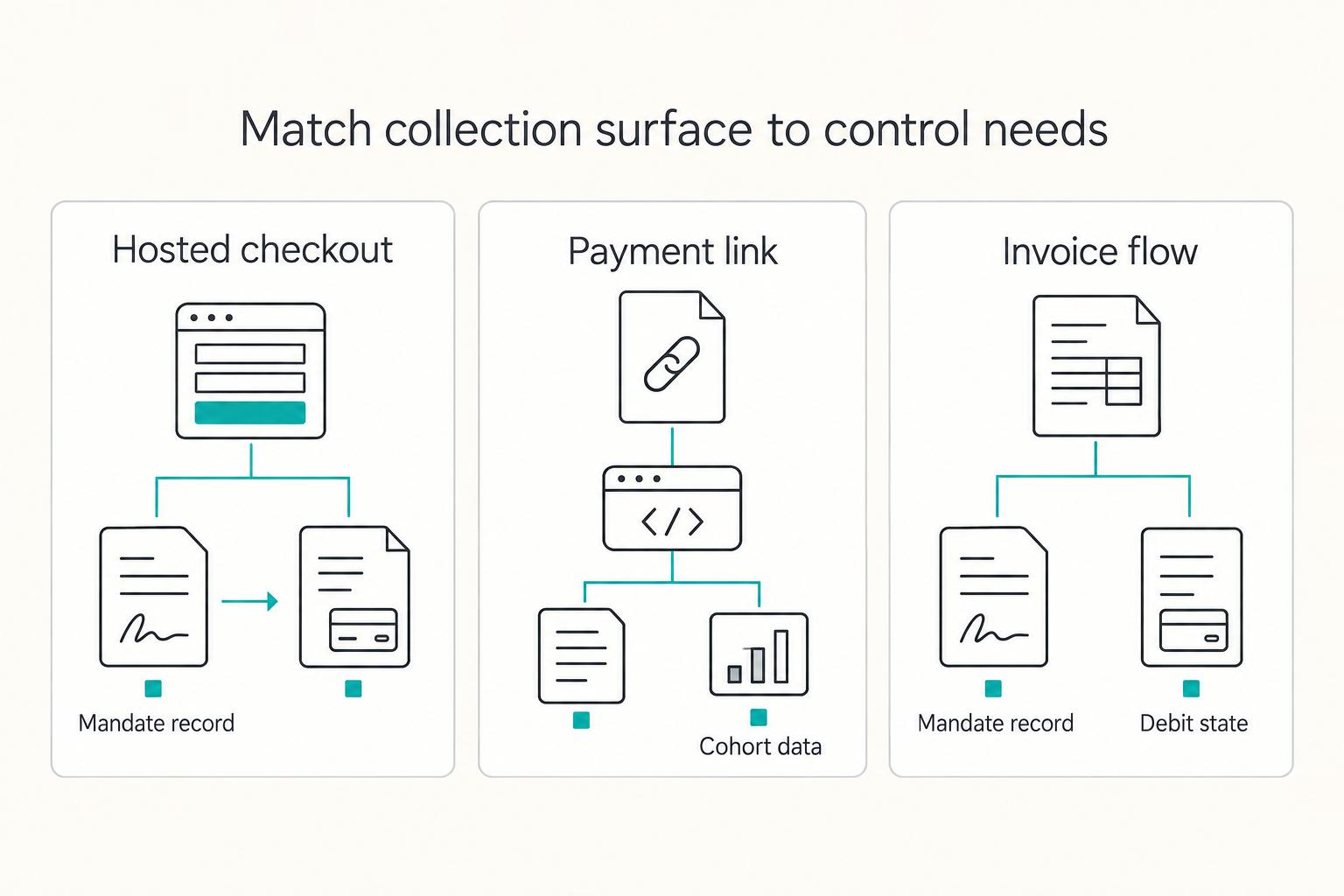
**SEPA Direct Debit can support subscriptions, but only if your mandate flow, country scope, and async handling are solid.** It is easy to treat it like just another European checkout option. That is where expansion plans start to drift. For subscriptions, it is an operating model built around prior customer approval, mandate capture, delayed payment status, and post-initiation exception handling.
Choosing SEPA Payment Rails for Platform Compliance and Recurring Billing
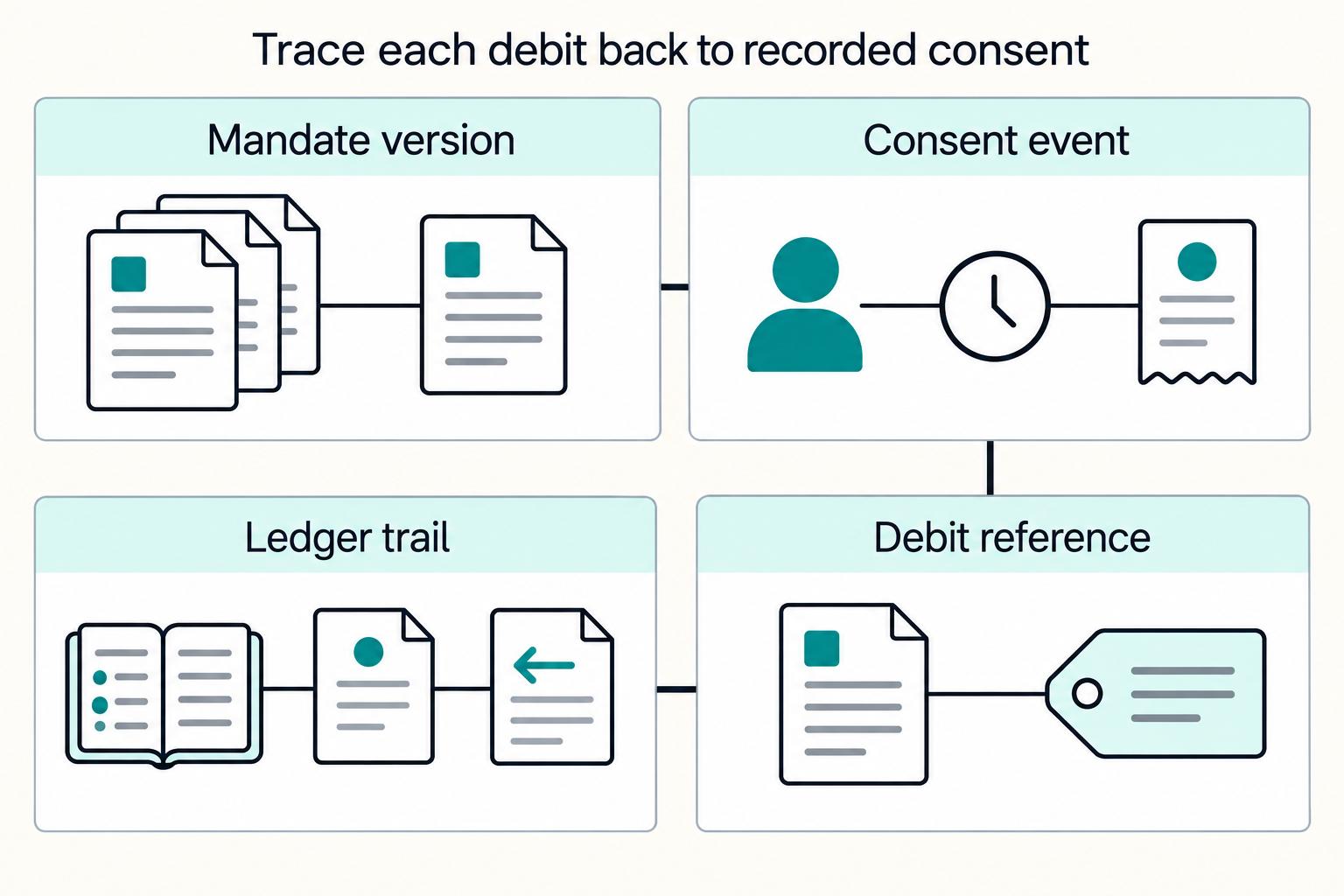
A platform collecting a monthly service fee needs a different payment instruction from a platform paying a contractor. SEPA Direct Debit pulls a permitted collection from the payer’s account under a mandate. SEPA Credit Transfer and SEPA Instant Credit Transfer are payer-initiated transfers. A recurring schedule does not by itself make a payment a direct debit: a customer can also pay regularly by standing order or another authorized transfer.