
Quick Answer
Yes. SEPA Direct Debit can improve recurring collection performance, but only when you treat approval as two checks: mandate accepted and first debit successful. Use it as a delayed-notification rail, not an instant card flow. The article recommends validating country scope with dated references, then piloting against your current card cohort before scaling. It also flags Stripe’s documented 10,000 EUR transaction cap as a practical limit for higher-value invoices.
When SEPA Direct Debit Fits a Subscription Rollout#
SEPA Direct Debit can support subscriptions, but only if your mandate flow, country scope, and async handling are solid. It is easy to treat it like just another European checkout option. That is where expansion plans start to drift. For subscriptions, it is an operating model built around prior customer approval, mandate capture, delayed payment status, and post-initiation exception handling.
Start with scope. SEPA is not the same thing as the European Union. The European Central Bank describes it as supporting euro payments across the EU and a number of non-EU countries, and reports a SEPA region of 41 European countries (status 22 May 2025). If your pricing page, sales copy, or launch plan says "available across the EU" when your target list is actually "SEPA countries," you create avoidable legal, support, and go-to-market confusion. That can happen before the first debit is even attempted.
Then get the approval mechanics right. This is payee-initiated, but only after the payer has given consent. The European Payments Council is explicit that the payer has to sign a mandate prepared by the biller, in paper or electronic format. That mandate is not admin trivia. It is the record that turns a checkout choice into a collectible recurring payment. If your team measures only checkout starts, or even "payment method selected," you can fool yourselves about approval quality. In practice, the checkpoint that matters is whether the mandate was actually accepted and the first debit was successfully set in motion.
That is also why you should not read this as a promise that it will automatically lower churn or improve approval for European subscriptions. Some market claims are directionally plausible, especially for recurring billing where bank debits can behave differently from cards, but hard numbers are often missing or too generalized to guide a launch. The useful distinction is between what is confirmed, what is inferred, and where you need your own pilot baseline instead of vendor marketing language.
One operating detail matters early. SEPA Direct Debit is commonly handled as a delayed-notification payment method. You do not always get an instant, card-style success-or-fail answer at checkout. That affects customer messaging, revenue recognition timing, retry logic, and support scripts. A common failure mode is launching it without a clear path for asynchronous updates and returns, then discovering that finance and support classify the same event differently.
So the practical question is not whether to add SEPA in the abstract. It is whether your subscription billing stack, mandate flow, and country checks are solid enough to support a pilot without creating more operational drag than payment benefit. The rest of this guide is about making that call with eyes open.
For related reading, see Best Corporate Debit Cards for Global Spending in Small Teams.
Build the mental model before discussing performance#
Start with mechanics, then evaluate performance. SEPA Direct Debit is a pull-based bank debit method for recurring payments: the biller requests funds only after the payer has approved a SEPA mandate.
| Basic | What to lock | Why |
|---|---|---|
| Target countries | Lock target countries before you compare results | SEPA spans the EU and a number of non-EU countries |
| Scheme choice | Lock whether you are using Core or B2B | SEPA runs separate Core and B2B schemes, so setup and handling can vary |
| Mandate records | Use mandate records you can verify | A common failure mode is comparing checkout starts to card authorizations and calling the gap "approval" |
That framing changes what "approval" should mean. Instead of treating approval like a card-style checkout signal, measure whether the mandate was completed and whether the first debit was successfully set up and moved forward. Tracking only "payment method selected" can overstate real setup quality.
Use the same discipline for churn claims. The defensible claim is directional: compared with cards, bank account details are generally less exposed to card expiry and some decline patterns, which can reduce payment failure and involuntary churn in recurring billing. It is not a guaranteed uplift versus Visa or Mastercard across every segment, price point, or country.
Also treat SEPA as a cross-border environment, not a single operating context. It spans the EU and a number of non-EU countries, and it runs separate Core and B2B schemes, so setup and handling can vary. SEPA Direct Debit is also a delayed-notification method, so performance analysis should account for asynchronous outcomes rather than instant card-style assumptions.
Before you compare results, lock three basics: target countries, scheme choice (Core or B2B), and mandate records you can verify. A common failure mode is comparing checkout starts to card authorizations and calling the gap "approval."
Related: SEPA Payments for Platforms: Direct Debit Instant Transfer and Recurring Billing.
What the current evidence can and cannot prove#
Use the current evidence as directional, not forecast-grade. Stripe and SubscriptionFlow support a credible mechanism for recurring billing with bank debits, but they do not provide defensible uplift benchmarks for approval or churn.
| Claim area | Status | Detail |
|---|---|---|
| Recurring payments | Supported | Stripe documents SEPA Direct Debit as reusable, delayed notification, and supported for recurring payments |
| Customer approval | Supported | SubscriptionFlow says recurring SEPA payments require explicit customer approval |
| Mandate collection | Supported | Stripe documents mandate collection in the authorization flow |
| Per-transaction limit | Supported | Stripe documents a 10,000 EUR per-transaction limit |
| Approval or churn benchmarks | Not proved | Sources do not prove benchmark deltas for approval rate or churn reduction across SEPA countries |
| Forecasted lift | Use internal pilot baseline | Treat vendor statements as mechanism evidence, and treat your own cohort results as forecast input |
What the findings support#
They support a qualitative thesis. Stripe states that, compared with cards, bank account details are less likely to expire or be declined, which can reduce payment failure and involuntary churn for recurring revenue businesses. Stripe also documents SEPA Direct Debit as reusable, delayed notification, and supported for recurring payments, with mandate collection in the authorization flow. SubscriptionFlow reinforces that recurring SEPA payments require explicit customer approval.
You can also use concrete implementation facts from provider docs, including Stripe's documented 10,000 EUR per-transaction limit.
What these details do not prove#
They do not prove benchmark deltas for approval rate, churn reduction, or segment-level outcomes across SEPA countries. They also do not isolate the impact of factors like mandate UX, retry logic, pricing, or support operations.
What to do when leadership asks for a forecast#
If leadership needs a forecasted lift, require an internal pilot baseline instead of relying on vendor copy or secondary commentary. Treat vendor statements as mechanism evidence, and treat your own cohort results as forecast input.
This pairs well with our guide on How to Calculate and Manage Churn for a Subscription Business.
Resolve country and governance ambiguity before launch#
Resolve scope first: treat country coverage as a governed, dated input before you make any approval or churn claims. Keep one reference table that reconciles EU membership, SEPA scheme scope, and provider availability so teams do not market SEPA as a generic "EU payment method."
The same term can point to different scopes:
- EU official count: 27 member states
- ECB SEPA framing: 41 countries (status 22 May 2025), including non-EU and non-euro-area countries
- Vendor snapshot (for example Stripe): provider coverage such as 34 countries
These are different definitions, not necessarily contradictions.
| Source | What it defines | How to use it |
|---|---|---|
| EU official countries page | 27 EU member states | Any copy or contract language that says "EU" |
| ECB SEPA page | SEPA region scope (41 countries, dated snapshot) | Distinguish SEPA coverage from EU-only coverage |
| EPC country list | Scheme governance split across EU, EEA, and non-EEA countries | Canonical scheme-side country reference |
| Vendor page | Provider-specific operational footprint | Operational availability for that provider only |
Treat scope as time-based too. The Commission's 2025 update ties additions to specific dates (Albania and Montenegro in November 2024; North Macedonia and Moldova in March 2025), so avoid undated "SEPA covers X countries" language.
Before pricing pages go live, verify each target country on three points:
- coverage: in current scheme scope and supported by your chosen provider
- mandate format: your flow supports the required paper or electronic mandate format
- return handling: finance and support can classify and handle SDD R-transactions (Refusals, Rejects, Returns, Refunds, Reversals)
Keep a country-by-country assumptions log as an operating artifact, not a one-off note. Track country, public label used ("EU" vs "SEPA country"), source link, provider confirmation, mandate format, R-transaction handling notes, owner, and last review date.
For a step-by-step walkthrough, see A Guide to SEPA Transfers for European Freelancers.
Compare SEPA Direct Debit and cards by operating risk#
For recurring subscriptions, compare these rails by repeat-failure risk after signup, not just first-checkout speed. Cards usually win on familiarity at the first payment attempt, while SEPA Direct Debit can be more stable over time if mandate capture and return handling are strong.
| Operating area | SEPA Direct Debit | Visa / Mastercard |
|---|---|---|
| Approval mechanics | Requires prior payer approval through an SDD mandate before collection. | Payment depends on card credentials and the issuer's response on each attempt. |
| Common failure pattern | Risk centers on mandate completion plus delayed status and return handling. | A recurring risk is card expiry, which can cause hard declines. |
| Retry reality | This is a delayed notification method, so retry logic must follow asynchronous status updates. | Retrying the same expired card does not fix the decline. |
| Reconciliation effort | More setup discipline: mandate records plus tracking of asynchronous outcomes. | Lower friction at charge time, but recurring programs still need decline recovery workflows. |
| Expected involuntary churn pressure | Can lower some repeat-failure exposure when mandate completion and return operations are mature. | More exposed to expiry-driven passive churn if credentials are not updated in time. |
The tradeoff is timing versus downstream stability. SEPA Direct Debit adds setup friction because the mandate is central to collection, and payment availability is not immediate. If first-session familiarity is critical, cards may still be the better default.
If your model depends on low-ticket, high-frequency recurring payments, prioritize the rail that reduces repeat payment failures, even when first-use UX is heavier. For one-off or infrequent purchases, mandate overhead may not pay back.
For cross-border B2B subscriptions, weigh operational certainty after mandate setup against slower payment visibility. In Stripe's implementation, SEPA Direct Debit is delayed notification, payments typically arrive in about 5 business days, and each transaction is limited to 10,000 EUR. That matters for higher-value invoices and cash-timing planning.
Keep cards where instant familiarity matters, and test bank debits where repeat collections drive revenue. Judge the pilot on both mandate completion rate and first-debit success rate, not top-of-funnel checkout starts alone.
If you want a deeper dive, read BECS Direct Debit for Australian Subscriptions: How to Add ACH-Equivalent Billing in Australia.
Design mandate and checkout flows that protect approval#
For SEPA Direct Debit, protect approval by designing and measuring the full sequence, not just checkout starts. The goal is a clean path from mandate acceptance to first successful debit, with event handling that keeps support and finance aligned when outcomes arrive days later.
Stripe's documented flow is sequential: the customer selects SEPA Direct Debit, provides full name and IBAN, authorizes the mandate, and then you submit for processing. Stripe uses a PaymentIntent to track state changes through completion, which fits a delayed-notification method rather than instant card-style finality.
- Customer chooses SEPA Direct Debit at checkout.
- You collect payment details and mandate acknowledgement.
- You initiate the debit for processing.
- You track asynchronous status changes instead of assuming success at submit time.
- You notify the customer based on the actual payment outcome.
If you define approval at checkout start or form completion, you can miss where performance actually breaks. A practical internal metric is mandate accepted + first successful debit, tracked separately from generic conversion.
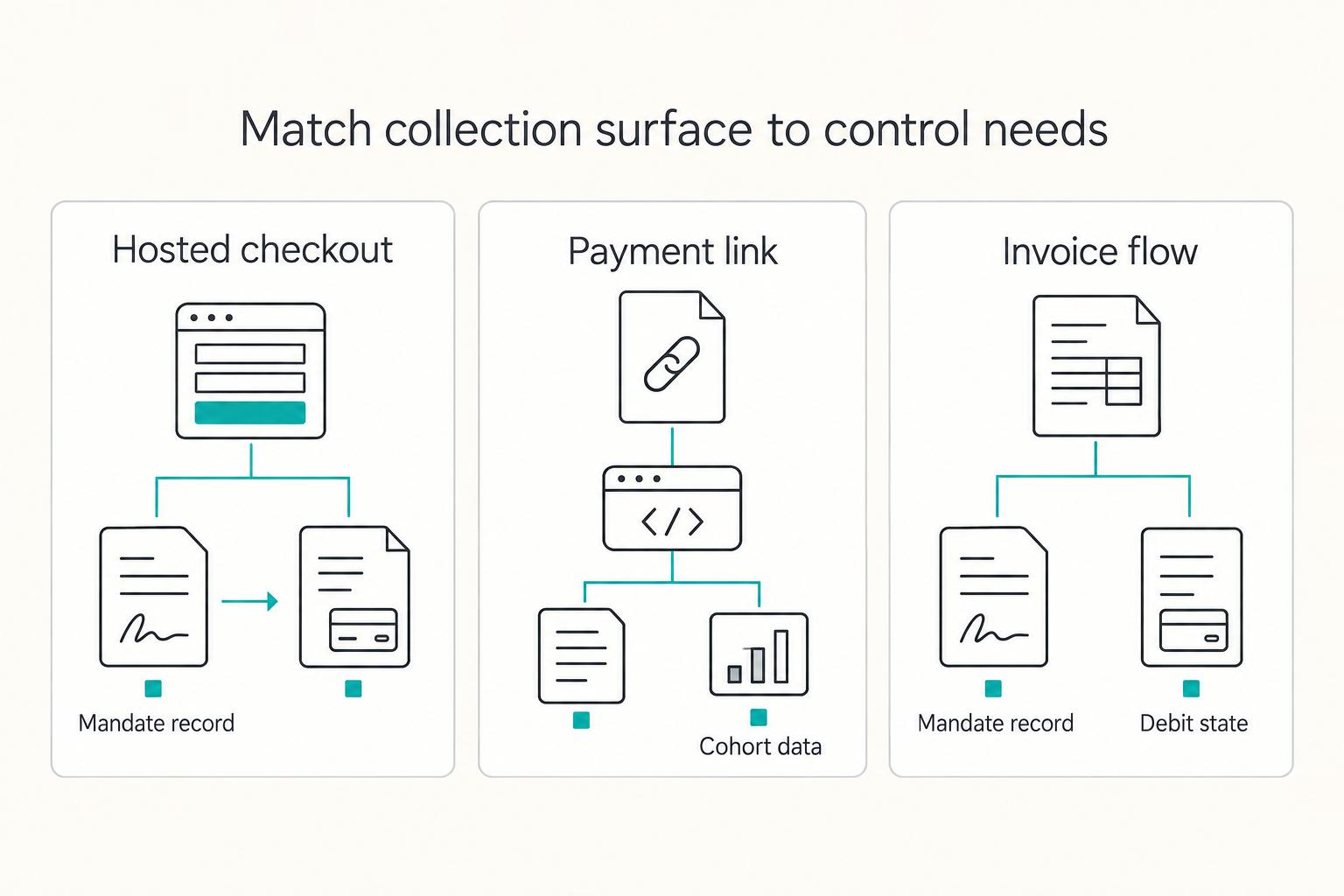
Choose the surface that matches your control needs#
Choose the surface based on control and instrumentation needs. Hosted surfaces can speed launch and standardize collection, while custom flows give tighter UX and event control but require stronger async handling and customer messaging.
| Pattern | What it gives you | What to verify |
|---|---|---|
| Stripe Checkout | Prebuilt hosted checkout page. Can use dynamic payment methods and keeps the collection flow standardized. | Verify that you log mandate acceptance separately from session creation and separately from first successful debit. |
| Stripe Payment Links | Low-code path you can enable from the Dashboard. Useful for simple offers or tests without full checkout build work. | Check whether link-level reporting is enough for cohort analysis across starts, mandate completion, and downstream success. |
| Stripe Invoicing | Useful when billing starts from an invoice flow rather than product checkout. Supports hosted invoice payment collection. | Watch Hosted Invoice Page timing: invoice URLs expire 30 days after the due date, and the window is never longer than 120 days. |
There is no grounded basis to claim one surface always converts better. The core tradeoff is operational fit: launch speed and standardization versus deeper customization and instrumentation.
Build async handling and exception rules before volume arrives#
Because SEPA debit is delayed, webhook-driven handling is required for off-flow events. Stripe explicitly points to webhooks for asynchronous events such as bank confirmations, disputes, and recurring payment success.
| Checkpoint | Grounded detail | Why it matters |
|---|---|---|
| Webhook handling | Webhook-driven handling is required for off-flow events | Stripe explicitly points to webhooks for asynchronous events such as bank confirmations, disputes, and recurring payment success |
| Debit traceability | Tie each debit attempt to a mandate record, a payment state, and a customer-visible notification | The goal is to keep support and finance aligned when outcomes arrive days later |
| Payment arrival timing | Stripe says a payment typically takes 5 business days to arrive | Cash timing should reflect the rail |
| Payout timing | Stripe lists payout timing at 6 business days | Finance planning should reflect payout timing |
| Exception playbooks | Set dispute and return playbooks early | Support should classify mandate questions, debit returns, and disputes consistently |
Your checkpoint is simple: tie each debit attempt to a mandate record, a payment state, and a customer-visible notification. Cash timing should also reflect the rail: Stripe says a payment typically takes 5 business days to arrive, and lists payout timing at 6 business days.
Set dispute and return playbooks early. Support should classify mandate questions, debit returns, and disputes consistently, and finance should map which events affect cash timing or require follow-up before suspension decisions.
Execute with Gruv controls instead of patchwork ops#
Once your mandate flow works, the next choice is operational: centralize collection and posting, or keep reconciling asynchronous bank events manually. Where enabled, use Gruv invoicing and payment links as the collection surface, then let confirmed payment outcomes drive journals instead of fixing records later in spreadsheets.
Keep the mandate tied to the money movement#
For SEPA Direct Debit, the mandate is central to the payment and collections rely on prior payer approval. Because mandates can be paper or electronic, keep the mandate record linked to the invoice or payment reference for each debit attempt.
Your core checkpoint: for any debit attempt, you can show the authorizing mandate and the related ledger or journal state. If that trace is weak, disputes, authorization checks, and finance reviews become slow and error-prone.
Treating checkout submission as the accounting event is a common mistake. For bank debits, post only from confirmed payment state, not from form completion, so later async outcomes do not force avoidable rework.
Use webhook-driven posting with idempotent retries#
Webhook-driven handling is required here because most payment events are asynchronous. Your Gruv-side logic should assume delayed delivery and retries, and apply idempotency controls so retries do not create duplicate side effects.
Apply idempotent behavior anywhere duplicates would cause operational damage:
- Journal posting
- Customer notifications
- Payout release logic
- Reconciliation exports
Connect wallet projections, payout eligibility, and finance exports to the payment state that actually determines outcome, not to invoice creation or checkout completion. If ops cannot trace a balance change back to event history, you still have patchwork operations.
Put compliance gates in front of country expansion#
Do not treat "in SEPA" as a complete launch check. Euro direct debit operations are governed by Regulation (EU) No 260/2012, and AML customer due diligence obligations are set under Directive (EU) 2015/849 (20 May 2015).
Before you scale in new SEPA countries, require a written market gate that covers:
- Collection support
- Mandate format
- Evidence retention
- Required KYC/AML checks for the program
Enabling volume before these controls are in place usually leads to paused collections, weak mandate evidence, or expensive reconciliation after launch.
Use a pilot scorecard with hard go and no-go thresholds#
Do not roll SEPA Direct Debit out on headline claims alone. Define pass/fail thresholds before launch, then evaluate the pilot against your existing Visa/Mastercard baseline in the same customer segment and billing cadence.
Broader adoption should happen only when payment outcomes improve without increasing operational burden. If one improves while the other worsens, treat that as a learning result, not rollout proof.
Track the four metrics that decide the case#
Keep the scorecard tied to production checkpoints you can verify.
| Metric | What to measure | Why it matters |
|---|---|---|
| Mandate completion | Customers who start the bank-debit path and complete the SDD mandate step | The mandate is central to SDD authorization, so weak completion can make early funnel interest look stronger than real collection readiness |
| First-debit success | Customers with a completed mandate whose first recurring debit succeeds | Confirms setup translated into collected funds |
| Repeat payment failure | Failure rate on later recurring attempts after an initial success | Subscription payment failure rate is a core recovery KPI |
| Recovered vs unrecovered involuntary churn | Of customers affected by failed payments or banking issues, how many are recovered through retries versus lost | Involuntary churn is tied to payment failures, and retries are a documented recovery lever |
For each failed or recovered case, make sure you can trace the timeline to both the mandate record and payment-attempt history. If that evidence is weak, the scorecard is weak.
Compare against Visa and Mastercard on matched cohorts#
Use like-for-like cohorts only: same segment, country set, billing cadence, and ideally price point. Filtered/grouped subscription analytics is the right structure for this comparison.
This avoids false conclusions from cohort mix. For example, recurring card billing can fail when saved cards expire, so mismatched cohorts can make method differences look larger or smaller than they are.
Keep mandate completion separate from first-debit success. A single blended "approval" metric can hide where the real drop-off happens.
Make the rollout call on payments and ops together#
Expand only when support load and reconciliation effort improve alongside payment recovery outcomes. Better collection with heavier manual handling is not a broad-rollout result yet.
If results are mixed, keep SEPA Direct Debit as an optional rail while you improve mandate UX and retry logic.
Conclusion#
The right move is usually a controlled rollout, not a box-checking launch just because competitors already offer SEPA Direct Debit. Add it only in the markets where your mandate flow is proven, your country scope is verified, and your finance and support teams can handle delayed payment events without guesswork.
That means treating vendor claims as directional, not as permission to scale. The grounded standard is closer to this: run a payment method A/B pilot on a percentage of buyers, compare it against your current baseline in the same segment, and look for two wins at once. Payment outcomes need to improve, but operational load also needs to stay flat or get better. If payment success rises but support tickets, exceptions, or reconciliation time jump, you have not really improved billing operations.
The Europe-specific trap is scope confusion. SEPA scheme coverage is not the same thing as European Union or EEA legal coverage, and the ECB explicitly notes that some rules stemming directly from EU legislation do not apply outside the EU/EEA. Use a dated source when your team defines market availability. The ECB SEPA region reference cited earlier is status dated 22 May 2025. That is exactly the kind of timestamp you want in your assumptions log. A practical checkpoint before any pricing-page or sales-copy update is a country record with owner, source URL, and last review date for coverage, mandate requirements, and return handling.
The durable edge is boring but valuable: auditability. The European Payments Council states that the biller is responsible for storing the original mandate, so mandate custody is not an optional cleanup task after launch. If your team cannot retrieve the mandate record, the payment attempt history, and the resulting reporting entry for a disputed or failed collection, your controls are not ready for broader rollout.
The other non-negotiable is event handling. Bank debits are asynchronous, so your operations need webhook-driven state changes rather than assumptions based on checkout completion. Stripe also documents that undelivered webhook events may be resent for up to three days. That creates a common failure mode: duplicate posting or duplicate customer actions when handlers are not deduplicated. If you scale before that is fixed, any apparent approval gains can get erased by messy recovery work.
So the conclusion is simple: test first, verify scope precisely, store the mandate evidence, and make async events duplicate-safe. If those controls are in place and your pilot scorecard improves on both payment quality and operating effort, scale. If not, keep it as an optional rail and tighten the weak points before expanding further. Related reading: Best Creative Brief Templates for Scope Approval and Invoicing.
Frequently Asked Questions
Does SEPA Direct Debit actually lower churn for subscriptions?
Sometimes, but treat that as a testable outcome, not a promise. The grounded claim is narrower: involuntary churn is often caused by payment issues, and retry logic can reduce churn caused by temporary failures. If you want a real answer for your business, compare recovered versus unrecovered failed payments in a pilot rather than assuming bank debits will beat cards everywhere.
What counts as approval for SEPA Direct Debit in subscription billing?
For subscriptions, the useful definition is not "customer picked bank debit at checkout." A stronger checkpoint is mandate accepted plus first successful debit, because SEPA Direct Debit requires customer consent through a mandate and is a delayed notification payment method. One failure mode is counting checkout starts as approvals and only discovering later that mandate completion or first collection is weak.
How is SEPA Direct Debit different from paying by Visa or Mastercard for recurring charges?
SEPA Direct Debit is a payee-initiated bank debit, not a card network transaction. It runs bank to bank, collects bank-account identifiers such as IBAN (and in some flows BIC), and confirmation is delayed rather than following the familiar instant card authorization pattern. For recurring billing, that means you are trading some setup and event-handling complexity for a bank-to-bank rail with delayed confirmation.
How many countries does SEPA Direct Debit cover, and why do sources disagree?
Use a dated source and define scope every time. The European Central Bank states that the SEPA region consists of 41 European countries with status dated 22 May 2025, while the European Payments Council scope artifact explicitly lists countries and territories, which can change how a source counts. Another reason for confusion is that SEPA scheme coverage is not the same thing as European Union or EEA membership, and some legislative effects do not apply outside the EU/EEA.
What should we verify before launching SEPA Direct Debit in a new European market?
At minimum, verify four things before your pricing page goes live. Confirm that the target market is in your provider's supported SEPA scope, what customer bank details you must collect, how mandate acceptance is recorded, and how delayed status updates are handled in support and finance. If you use Stripe's SEPA Direct Debit flow, also note the documented 10,000 EUR each transaction limit in that integration context. A good operator check is an assumptions log with owner, source URL, and last review date for each country.
What key metrics should a founder track in a SEPA Direct Debit pilot?
Keep the pilot scorecard tight: payment failure rate, recovery rate on failed recurring charges, mandate completion, and first debit success. Those map to the real question, which is whether payment-failure-driven involuntary churn improves without creating more operational drag. If you cannot trace a failed or recovered case back to the mandate record and payment attempt history, your metric is not solid enough to justify rollout.
Try a related tool
Researched and edited by the Gruv editorial team. Gruv builds cross-border billing, payouts, and finance-operations software for global businesses.
Sources
- docs.stripe.com/payments/sepa-debittrusted
- docs.stripe.com/payments/sepa-debit/accept-a-paymenttrusted
- ecb.europa.eu/paym/retail/sepa/html/index.en.htmltrusted
- enlargement.ec.europa.eu/news/commission-welcomes-albania-moldova-mon...trusted
- eur-lex.europa.eu/EN/legal-content/summary/single-euro-payment...trusted
- eur-lex.europa.eu/eli/dir/2015/849/2018-07-09/engtrusted
- european-union.europa.eu/principles-countries-history/eu-countries_entrusted
- stripe.com/payments/sepa-direct-debittrusted
Educational content only. Not legal, tax, or financial advice.
Related Posts
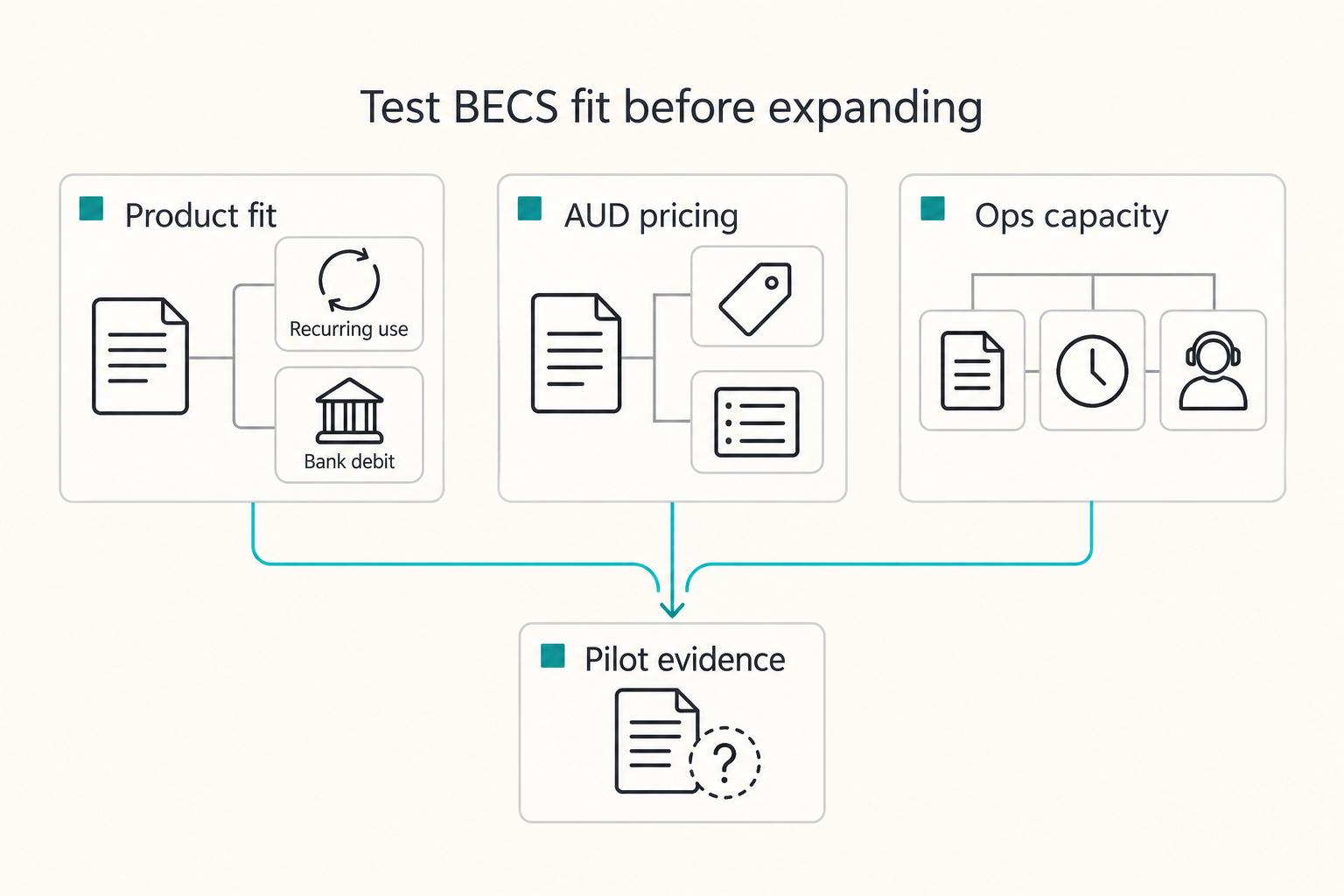
Should Your Platform Add BECS Direct Debit for Australian Subscriptions
If you are deciding whether to add **becs direct debit australia subscriptions platform** support to an Australia launch, ask a narrower question first. Should it be in scope now, delayed until key terms are verified, or skipped for this launch?
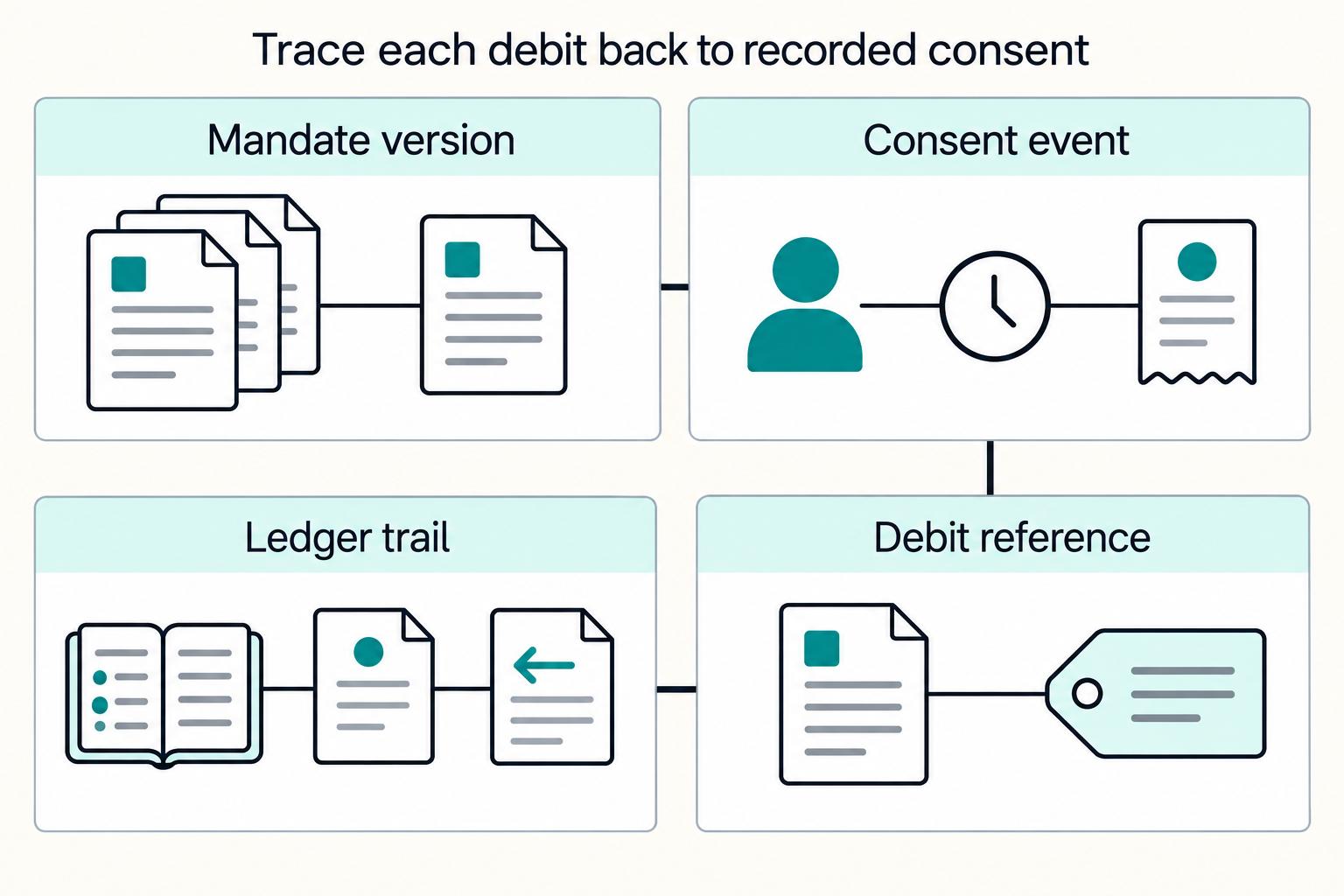
Choosing SEPA Payment Rails for Platform Compliance and Recurring Billing
If you own compliance, legal, finance, or risk, classify each euro flow by rail, evidence artifact, and legal boundary before you compare provider feature lists.
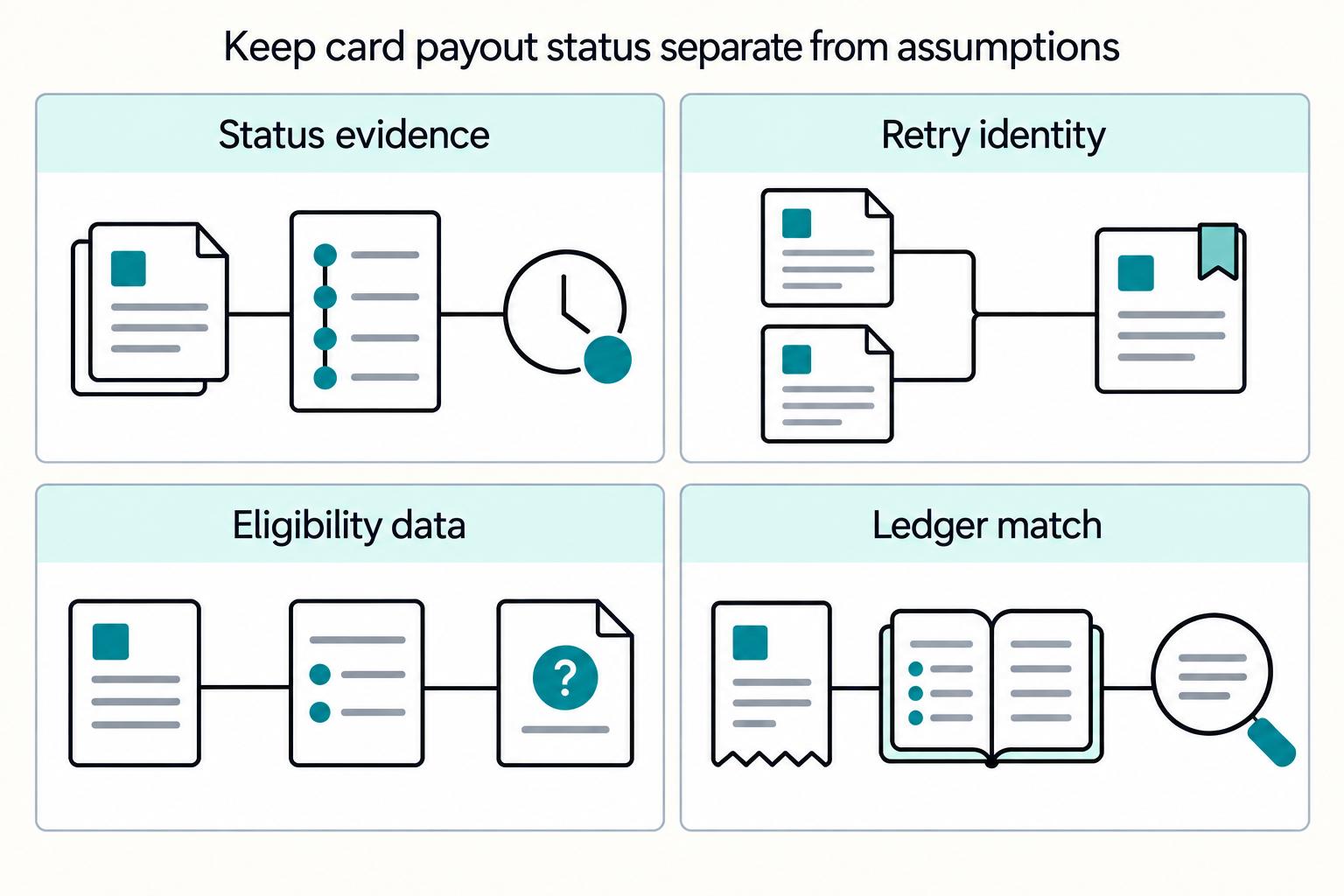
Choosing Visa Direct or Mastercard Send for Debit Card Push Payouts
The core decision is usually not "Visa Direct or Mastercard Send?" in isolation. Start with your recipient card mix, your tolerance for payout exceptions, and how much integration and operational complexity your team can absorb right now.