
Quick Answer
Use Core or eligible B2B direct debit for creditor-initiated collections under a mandate; use SCT or reachable SCT Inst for payer-initiated payouts. Check scheme-specific bank support, cutoff/limits and outcome recovery. Core collection receipts remain exposed to refunds. The EPC lists 41 countries and territories, but country inclusion does not guarantee every scheme is offered by every bank.
Choose the scheme for the direction of the payment#
A platform collecting a monthly service fee needs a different payment instruction from a platform paying a contractor. SEPA Direct Debit pulls a permitted collection from the payer’s account under a mandate. SEPA Credit Transfer and SEPA Instant Credit Transfer are payer-initiated transfers. A recurring schedule does not by itself make a payment a direct debit: a customer can also pay regularly by standing order or another authorized transfer.
This guide uses EPC and ECB sources checked on October 3, 2026. It compares four schemes for recurring collections and euro payouts, explains mandate and refund controls, and walks through a collection followed by an independent contractor payment. Scheme rules, applicable legislation and your PSP’s service terms each affect the result.
SEPA scope is broader than the EU and euro area#
The EPC’s current scope page lists 41 countries and territories: the 27 EU Member States plus the United Kingdom, Iceland, Norway, Liechtenstein, Switzerland, Monaco, San Marino, Andorra, Vatican City State/Holy See, Montenegro, Albania, North Macedonia, Moldova and Serbia. The total is dated here because older lists can predate accessions. Geographic inclusion does not mean every bank participates in every scheme or that your PSP offers every service there.
SEPA payments are denominated in euro. A participating payment account can involve currency conversion if it is held in another currency; confirm the bank’s conversion and charges. SEPA membership is distinct from euro-area membership and EU/EEA legal coverage. EU legislation does not automatically apply identically to every non-EEA SEPA country.
SEPA is a harmonization initiative and set of payment schemes, not a single bank, clearing system or provider license. The EPC administers scheme rules and is separate from EU institutions. Your bank or PSP supplies the account and payment service, often through clearing/settlement arrangements or another participant. Choose the actual supported scheme rather than relying on a broad “SEPA enabled” label.
Four schemes compared#
| Scheme | Direction and suitable use | Distinct control |
|---|---|---|
| SDD Core | Creditor-initiated euro collections from consumers or businesses | Mandate and pre-notification; Core refund rights |
| SDD B2B | Creditor-initiated collections from eligible business payers | Optional bank service; debtor-bank mandate checks; different refund regime |
| SCT | Payer-initiated one-off, standing-order or bulk transfers | Bank cutoff, execution date, item-level results and reconciliation |
| SCT Inst | Payer-initiated instant transfers on reachable accounts | Rapid outcome handling, pre-send checks and duplicate-safe recovery |
Direct debit can support a recurring fee that the creditor initiates after obtaining the appropriate mandate. A standing order instead remains a payer-arranged transfer. For contractor and seller payables, use a credit transfer service suited to the required timing. You may offer more than one payment method; the important decision is who initiates each instruction and what authorization it needs.
Core and B2B direct debit are materially different#
The EPC direct-debit overview identifies Core as usable by consumers and businesses and B2B as restricted to business payers. B2B is an optional service for PSPs. A business customer is not automatically reachable through B2B simply because its account can receive or send SEPA transfers.
Under the current Core rulebook, the payer has an eight-week no-questions-asked refund right after debit; an unauthorized-transaction claim can be presented within 13 months. A successful collection or a valid mandate therefore does not make the proceeds universally irreversible. Maintain a refund process and funding policy appropriate to the actual exposure.
The B2B rulebook excludes the refund right for authorized collections and requires debtor-bank verification against confirmed/stored mandate data. Unauthorized transactions are a different legal and recovery question; “no authorized refund” does not mean all errors or fraud are immune from challenge. The EPC overview describes a three-business-day return period for specified reasons after the debit.
Choose B2B because the payer is eligible, the relevant banks support it and the authorization/checking process fits the relationship. It is not a workaround for consumer refund rights. Before collecting, establish the creditor identifier, scheme-specific mandate, payer/account details, unique mandate reference and PSP onboarding requirements. A normal transfer account alone does not grant collection privileges.
Build a retrievable mandate lifecycle#
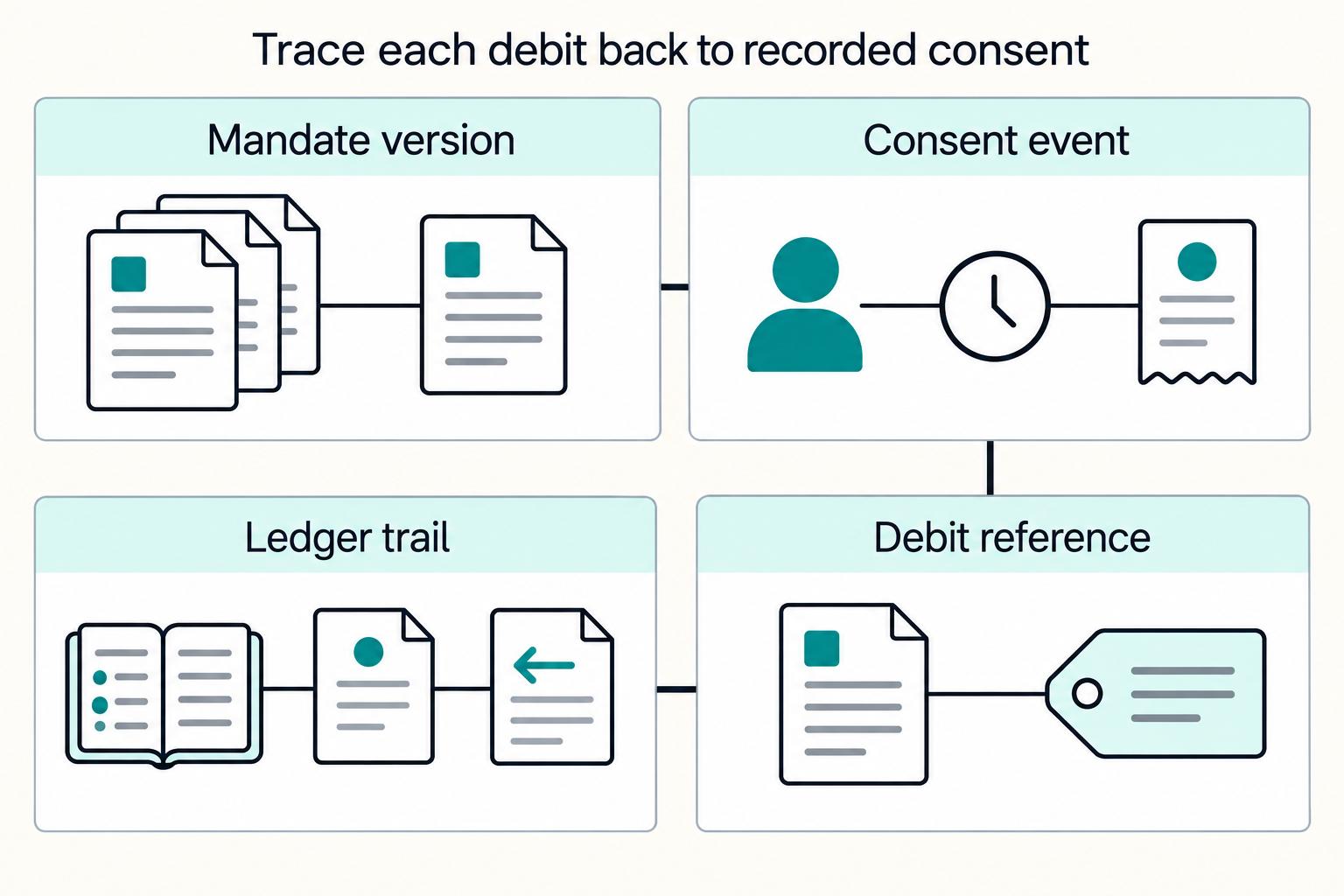
The EPC mandate guidance allows paper or electronic mandates. Keep the wording accepted, signature/authorization evidence, scheme, creditor identifier, mandate reference, payer/account details, amendments and cancellation history. A product checkbox or successful bank-account validation alone is not necessarily a scheme-compliant mandate.
Link each collection to the version and references it relied on. Restrict access to bank and consent records while keeping them retrievable for permitted investigations. Preserve a readable historical mandate rather than replacing it with the latest template. Retention must cover the actual scheme, applicable national requirements and provider obligations; one universal “14 months” claim is inadequate for every record and jurisdiction.
Core requires pre-notification at least 14 calendar days before the due date unless creditor and debtor agree another timeline. Its inactivity rule requires cancellation after 36 months without a presented collection, measured from the latest presentation even if rejected, returned or refunded; a later collection then needs a new mandate. Track actual cancellation separately: an actively revoked mandate must not remain usable merely because it has not reached that inactivity limit.
A pre-notification identifies the amount and due date. Agree and record any shorter timeline rather than treating all subscriptions as automatically exempt. Validate the next collection against the mandate and current account references before submission, and handle amendments through the supported procedure. Changing a displayed subscription price is separate from preserving the right authorization and notice for its next debit.
What instant-transfer timing means#
The EPC instant-transfer description explains the 2025 scheme’s nine-second processing timeline within the regulation’s ten-second maximum. That clock starts at receipt of the authorized instant-payment order, not when your staff first drafts or approves a payout. Service availability is generally 24/7, with permitted short, foreseeable maintenance notified in advance.
There is no longer a scheme-level transaction maximum, but a PSP may set its own limits. Do not reuse an old universal €100,000 cap or assume unlimited access through your bank’s application. Check the specific channel’s limit, available funding and recipient reachability. An account in a SEPA country is not automatically reachable for an instant payment.
The instant rulebook describes account restoration when confirmation has not arrived within ten seconds, and the possibility of a later positive confirmation. An application timeout or restored balance is therefore not sufficient evidence to initiate a new transfer blindly. Use the PSP’s status and investigation procedure for the original instruction before deciding whether another instruction is appropriate.
A recall is a request handled through the scheme and banks, not a guaranteed undo button for a completed transfer. If fraud or an incorrect beneficiary is suspected, contact the PSP promptly with the original references. Keep the business payable and any recovery separate until the financial outcome is established.
Standard transfers, cutoffs and recurring orders#
The EPC SCT overview supports single, bulk and recurring payments. SCT is suitable for scheduled payouts when immediate availability is unnecessary. A provider’s batch submission and acknowledgment should still produce traceable outcomes for each beneficiary; acceptance of a file does not establish that every item was executed.
Record when your provider receives the order, its business-day cutoff and the agreed execution date. Weekend, holiday, after-cutoff and future-dated instructions can change the customer-visible timeline. Use the applicable execution rules and provider service information for the actual transaction; do not combine scheme execution, onboarding time and a merchant’s delayed release of funds into one “SEPA takes 5–10 days” answer.
A service that routes a particular payment over SWIFT or another rail should label that route clearly. It is not simply a slower SCT because the destination happens to be a SEPA country. Separate FX, correspondent routing and recipient charges from the euro scheme comparison. Confirm delivery estimates using the actual product and instruction rather than country coverage alone.
Instant-payment law has staged deadlines and provider exceptions#
The ECB implementation table lists euro-area receiving and sending deadlines of January 9 and October 9, 2025 respectively, with different deadlines for payment/e-money institutions and non-euro-area Member States. Euro-area PIs and EMIs have an April 9, 2027 instant sending/receiving deadline. Do not present October 2025 as requiring every type of PSP in all 41 countries to offer the same service.
For other PSPs in non-euro-area Member States, the principal receiving deadline is January 9, 2027 and sending is July 9, 2027. The table separately identifies PI/EMI and account/currency cases. Check the provider’s legal category and jurisdiction before relying on a deadline; future obligations do not establish the service is currently available in your channel.
The regulation caps instant-transfer charges at those for corresponding standard transfers; this does not mean every SEPA payment is free. Verification of Payee applies to standard as well as instant credit transfers, with euro-area and non-euro-area implementation dates. It compares the intended name and account before authorization, rather than certifying that the underlying invoice or recipient business is legitimate.
Article 5c of the instant-payments amendment says verification must not prevent the payer from authorizing the transfer. A mismatch is a warning and decision point, not a universal legal ban on proceeding. The law also permits non-consumer users to opt out for multiple orders submitted as a package, with an opt-in right. Set your organization’s review policy and preserve results or the authorized opt-out; do not silently treat a warning as a match.
Worked example: a fee collection and an independent payable#
Assume a platform bills a business customer a €200 monthly fee under a valid Core mandate and separately owes a contractor €150 for completed work. Taxes and provider fees are excluded. The platform collects €200 and pays the €150 using the supported SCT or SCT Inst channel. Those are two distinct obligations and instructions; the contractor’s entitlement is not defined by whether the customer’s debit later remains settled.
| Event | Record to preserve | Financial distinction |
|---|---|---|
| €200 Core collection | Invoice, mandate/reference, collection ID and receipt | Customer collection can still be refunded |
| €150 contractor transfer | Approved payable, bank details, transfer ID and outcome | Payment fulfills the contractor obligation when established |
| Customer later obtains a €200 Core refund | Original collection plus refund/return reference | Outflow does not automatically reverse the contractor’s already-completed payment |
| Uncertain €150 transfer outcome | Original instruction and investigation history | Do not create a second payout merely because a callback was missing |
If both initial movements complete, cash from these two movements is net +€50 before fees. A later €200 refund makes the total net −€150. That arithmetic demonstrates collection risk, not a required revenue journal or permission to recover contractor wages. Determine whether the customer still owes the fee under the contract and whether collection activity is appropriate; a payment refund and the underlying debt are separate questions.
Do not solve the risk by imposing an automatic eight-week wait on every contractor payment. Set funding and reserve arrangements consistent with obligations, contracts and law. For a failed collection, check the actual reason and authorization before retrying. If you arrange another payment method, confirm the original collection’s status to avoid collecting the same invoice twice.
Maintain scheme versions and usable exception records#
The current 2025 SCT, SCT Inst, SDD Core and SDD B2B rulebooks are version 1.2, replacing version 1.1 on September 30, 2026. The update postponed the planned November 2026 end date for unstructured addresses; a replacement date remains to be determined. See the SCT rulebook page and the SCT Inst rulebook page. Use the current rulebook and provider guidance rather than treating a superseded address deadline as an active universal cutoff.
Keep scheme, provider account, internal instruction ID, provider reference, amount/currency, receipt/execution timestamps, current status and status history. Add mandate and collection references for debits, and link any rejection, return, refund or recall to the original item. Preserve the actual reason code and financial disposition. These are practical control records; they do not imply every PSP exposes the EPC’s interbank dataset names through its customer API.
Finance should reconcile completed and exception items to the bank/provider statement and relevant payable or receivable, including fees and timing. An incident owner can coordinate an unresolved case while the bank handles scheme investigation. Missing webhook evidence does not necessarily mean missing money. Obtain the authoritative outcome, update records and communicate the confirmed status to the affected customer or payee.
Keep VAT and regulatory responsibilities distinct from rail support#
SEPA execution does not determine whether your platform is a VAT deemed supplier, qualifies for OSS or has a particular tax filing schedule. Assess those questions from the actual supply and entity role, then retain the transaction records needed for that assessment. A PSP’s payment export can support the record; it cannot by itself decide the platform’s tax treatment.
Likewise, mandate capture does not replace customer due diligence or the provider’s regulatory duties. Identify the licensed service provider and your contractual responsibilities, including who handles bank access, screening, customer support and permitted data access. Do not require a platform to perform every bank obligation merely because it integrates SEPA, or mistake scheme participation for authorization to provide a regulated service.
Frequently Asked Questions
What are SEPA payments platforms, and how are they different from SEPA itself?
SEPA is the euro-payment harmonization initiative and schemes. A bank or payment platform provides account access and execution services through the supported schemes. It is not one network or bank, and a provider’s SEPA label does not prove support for Core, B2B, SCT and SCT Inst equally.
Which rail should a platform choose for recurring billing: `SEPA Direct Debit` or `SEPA Credit Transfer`?
Use direct debit when the creditor will initiate authorized recurring collections under the appropriate mandate. A payer can also make recurring credit transfers, such as a standing order. Choose based on initiation, authorization, bank support and recovery rights; a recurring schedule alone does not define the scheme.
When should a platform use `SEPA Instant Credit Transfer` instead of standard credit transfer?
Use SCT Inst when immediate availability matters and the accounts and selected channel are reachable, funded and within provider limits. Standard SCT can suit scheduled payments. Track the original outcome before retrying an uncertain instruction; an instant transfer is not guaranteed reversible.
How fast are SEPA payments in practice, and what timing is actually guaranteed?
SCT Inst has a nine-second scheme processing timeline within the statutory ten-second maximum from receipt of the authorized instruction. Standard transfers depend on the applicable execution rules, receipt time, business-day cutoff and scheduling. Direct debit has its own due-date/submission cycle and later return/refund exposure. Onboarding or merchant release delays are separate.
How many countries are in SEPA, and why do sources show different totals?
The EPC scope page checked October 3, 2026 lists 41 countries and territories. Older totals can predate geographic additions. Country inclusion differs from individual bank scheme participation and your PSP’s actual service coverage, especially for B2B and instant transfers.
Do you need a special SEPA bank account to run SEPA payments?
There is no separate universal account type called a SEPA account. You need an account and service compatible with the intended scheme. Receiving or sending a transfer does not automatically enable creditor direct-debit collection. Confirm euro handling, creditor onboarding, identifiers, mandates and bank/channel support as relevant.
What minimum compliance controls should exist before launching SEPA recurring billing?
Keep a compliant mandate and its amendments/cancellation, collection references, agreed notice, traceable payment outcomes and a refund/exception process. For B2B, confirm business-payer eligibility and debtor-bank mandate verification. Assign responsibility for reconciliations, uncertain results and regulatory duties; payment records alone do not determine VAT treatment.
Try a related tool
Where Gruv fits
Researched and edited by the Gruv editorial team. Gruv builds cross-border billing, payouts, and finance-operations software for global businesses.
Sources
Includes 2 external sources outside the trusted-domain allowlist.
Educational content only. Not legal, tax, or financial advice.
Related Posts

The Freelance Payment Penalty: A Modeled Audit of Platform Fees, FX Spreads, and Payout Delays
The money rarely disappears through a single, easy-to-spot fee. The real loss is stacked. A marketplace takes its commission, a processor adds a charge for international cards, a bank or payment company converts the currency at a spread, a platform holds the funds before release, and a wire sheds a little to intermediaries on the way in. Each layer looks defensible on its own, but the worker feels the combined result as a smaller deposit and a later payday.

How to Respond to a Subpoena for Business Records
Move fast, but do not produce records on instinct. If you need to **respond to a subpoena for business records**, your immediate job is to control deadlines, preserve records, and make any later production defensible.

A US Expat's Guide to Investing in UCITS ETFs to Avoid PFIC Issues
The real problem is a two-system conflict. U.S. tax treatment can punish the wrong fund choice, while local product-access constraints can block the funds you want to buy in the first place. For **us expat ucits etfs**, the practical question is not "Which product is best?" It is "What can I access, report, and keep doing every year without guessing?" Use this four-part filter before any trade: