

Quick Answer
SEPA is the Single Euro Payments Area, a framework for harmonized euro credit transfers and direct debits across 41 countries and territories as of October 2026. SCT suits scheduled payouts, SCT Inst supports eligible urgent transfers, and SDD collects under a payer mandate. Confirm geography, PSP participation and product/account enablement separately; an unknown instant-transfer result must be resolved before another payout.
SEPA Means Single Euro Payments Area#
SEPA is a framework for harmonized euro credit transfers and direct debits within its geographical scope. It lets a platform use common payment schemes for domestic and cross-border EUR transactions. It is not a bank, a payment provider or a promise that every account supports every scheme.
This guide is for product, engineering, and finance ops teams. The goal is to turn a vague label into clear implementation choices and reduce preventable operational mistakes.
The European Payments Council (EPC) manages the main SEPA credit-transfer and direct-debit schemes; EU legislation sets additional obligations for payment service providers. EPC guidance lists 41 countries and territories as of this October 2026 review, including the 27 EU Member States and non-EU jurisdictions such as the United Kingdom and Switzerland. Scheme geography, PSP participation and your provider's enabled product are three separate checks.
SEPA payments are denominated in euro. An account may be denominated in another currency, but conversion and account eligibility depend on the bank/provider. A platform billing USD and paying EUR must account for its FX and funding stages separately; choosing SEPA does not eliminate them.
How to choose a SEPA setup for your platform#
Choose the scheme from the direction of money and required timing. Paying a seller is a credit transfer; collecting a subscription under a mandate is a direct debit. Decide who owes whom, which entity holds the obligation, and who is authorized to initiate the payment before mapping the API.
| Platform task | Scheme/workflow to evaluate |
|---|---|
| Scheduled seller/contractor payout | SCT for planned EUR credit transfers; confirm cutoff and arrival |
| Urgent approved payout | SCT Inst where account/PSP eligibility and controls support it |
| Recurring customer collection | SDD Core or eligible B2B, with mandate and refund/return handling |
| Liability and bank close | Link obligation, approval, attempt, settlement and any return independently of scheme |
For each route, confirm the actual account/provider, scheme participation, currency, amount eligibility, initiation authority, required fields and status/recovery behavior. A provider's broad Europe coverage does not establish your precise payout or collection capability.
Keep tax decisions in the relevant tax workflow. VAT OSS and cross-border tax rulings concern VAT administration; they neither define SEPA nor prove participation. An environmental-law document also called SEPA is unrelated to the Single Euro Payments Area.
For a payout-focused companion piece, see SEPA Payments for Platforms: How to Send Euro Disbursements with the Right Scope, Rail, and Controls.
What SEPA is and what it does not guarantee#
SEPA standardizes payment rules and data across participating jurisdictions. Standard SCT is payer-initiated; SDD is creditor-initiated after a mandate; SCT Inst is an instant payer-initiated transfer. None of these replaces a contract, payroll obligation, tax decision or reconciliation policy.
A payment scheme defines rules between participating providers. Your integration still needs a bank or licensed PSP product that exposes the scheme, account access, funding, reporting and exception handling. Assess the provider's contracted responsibilities and your platform's regulated role rather than treating SEPA as a license.
- Geography: a country in SEPA scope can contain PSPs with different scheme participation and product availability.
- Currency: the transaction is EUR; any funding or account-currency conversion is a separate step.
- Operational state: submitted or accepted is not proof that a recipient has been credited; preserve authoritative outcome evidence.
- Commercial obligation: a rail failure does not itself remove what the platform owes its supplier or seller.
Worked platform case: a seller is owed €900 for an approved order. Keep that €900 payable linked to the invoice/order regardless of route. A scheduled payout can use SCT; an urgent payout may use SCT Inst after eligibility and approval checks. If instant submission times out, investigate that attempt before sending €900 by SCT. A separate €100 customer subscription collected by SDD needs its own mandate, receivable and refund handling; it is not a seller payout.
Compare SEPA rails before you integrate#
Compare the schemes by initiation, availability and recovery. Standard electronic SCT commonly reaches the beneficiary bank by the next business day after receipt of the order, with cutoffs and provider timing relevant. SCT Inst makes funds available within the ten-second execution framework around the clock. SDD follows the agreed collection date, submission requirements and refund/return rules, not an instant-payout clock.
| Rail | Best for | Settlement expectation | Payer consent requirement | Reversibility risk | Operational caveats |
|---|---|---|---|---|---|
| SCT | Scheduled EUR supplier/seller disbursement | Normally next business day after order receipt; verify cutoff and account endpoint | Payer authorizes credit transfer | Recall/return processes; no blanket Core-style eight-week refund | Preserve remittance and attempt references; investigate unknown result before replacement |
| SDD Core | One-off/recurring authorized EUR collection from consumers or businesses | Agreed debit date with provider submission schedule | Creditor stores payer mandate and amendments | Eight-week no-questions refund; unauthorized debit claim up to 13 months | Track mandate, creditor ID, unique mandate reference and R-transactions |
| SDD B2B | Eligible business-payer collections | Agreed date; confirm both PSPs offer B2B | Business payer; payer PSP verifies mandate data | No refund right for authorized debit; specific returns remain | Do not select B2B simply because the biller is a company |
| SCT Inst | Urgent eligible EUR transfer | Ten-second execution framework, 24/7 | Payer authorizes transfer; applicable VoP before initiation | Fast execution does not make a wrong destination recoverable on demand | Unknown response requires original-attempt resolution before any fallback |
Before build freeze, use a short routing checklist for each rail: corridor, speed and cost target, cut-off and holiday sensitivity, and data-quality checks. Clear routing usually means fewer returns, better arrival expectations, and cleaner reconciliation. Wrong-rail choices usually mean more overhead and more customer friction.
As of October 2026, the EPC lists 41 countries and territories. This geographical count does not mean every bank has adhered to SCT Inst or every provider supports your account. Check the applicable participant register and provider product for your destination.
For a step-by-step walkthrough, see What Is ACH? The Automated Clearing House Explained for Platform Operators.
Best for payout batches and standard disbursements#
For scheduled EUR payouts, SEPA Credit Transfer (SCT) is often a practical starting rail. It usually fits teams that care more about predictable batch operations than urgent delivery windows.
- Good fit for planned payout cycles
SCT can fit weekly or monthly payout runs for contractors, creators, suppliers, or marketplace sellers. It is usually easier to operate when payouts are queued, reviewed, approved, and released through a finance-controlled batch flow.
- Operationally cleaner for batch-led teams
If you prioritize approval controls, reconciliation, and consistent references, SCT can be a strong default. Define your SCT remittance information early: what reference you will send, how stable it should be, and which internal record it maps to, such as a payout batch ID, payee ID, or invoice ID.
- Separate rail for urgency-sensitive cases
Do not treat standard SCT routing as your only urgent-money path. If payout timing is highly time-sensitive, evaluate SEPA Instant Credit Transfer as a separate use case.
- Concrete model for weekly creator payouts
Before you submit, validate IBAN and confirm whether your provider requires BIC for the corridor. At submission, attach stable remittance data, store provider references, and tag transfers to a payout batch so exceptions stay isolated.
After submission, link provider polling/webhook evidence to the payout attempt and reconcile bank settlement to the payable-clearing entry. Recognize the underlying liability under your accounting policy before settlement where required; do not postpone all accounting until the transfer completes.
Keep an exception queue for payouts that are rejected or returned, with a complete review packet: submitted account details, remittance value, payout batch ID, status timestamps, and provider transfer identifier.
Best for recurring euro collections with mandate control#
Use SEPA Direct Debit (SDD) when you need to pull recurring euro payments after customer approval. The upside is more predictable collection. The tradeoff is tighter mandate control and more exception handling.
- SDD fits recurring collections with prior consent
SDD lets the creditor request EUR funds under prior mandate consent. It supports one-off and recurring collections. Keep each collection linked to its mandate and receivable, because successful collection can later be followed by a return or refund.
- Choose the scheme based on who pays you
SDD Core supports consumer and business payers. SDD B2B requires a business payer and participation by the relevant PSPs; it is not mandatory for PSPs to offer it. The biller's company status alone does not make a collection B2B. Choose from payer eligibility, mandate verification and refund requirements.
- Mandate control is the main implementation risk
The payer must sign a mandate, paper or electronic, before collection. The biller is responsible for storing the original mandate plus any change or cancellation records. In eMandate flows, at least some providers require creditor details to be shown to the customer, and missing required mandate wording can increase reversal risk.
- Plan for returns and timing before scale
EPC direct-debit guidance gives Core payers an eight-week refund without justification and up to thirteen months to claim an unauthorized debit. B2B has no refund right for an authorized transaction, but specific returns and authorization controls remain. Do not treat the eight-week Core right as limited to errors, or apply a provider's four-day schedule as a universal scheme rule.
For a monthly €100 subscription, store creditor ID, unique mandate reference, consent and amendment/cancellation history. Notify the payer of the amount and date under the applicable pre-notification terms and submit by the provider deadline. A later Core refund must update the receivable/refund and bank records under policy; it does not automatically authorize another debit. Review the reason and mandate status before any permitted recollection.
Best for urgent time-sensitive payment moments#
Use SCT Inst for an approved urgent EUR payout when the relevant providers and account support it. Define how to investigate failed or unknown attempts before launch. Standard SCT is a possible alternative when instant is unavailable before submission or the first attempt is conclusively unsuccessful; an uncertain result is not a fallback trigger.
Use it when waiting is the bigger risk#
In supported SEPA paths, instant transfers are designed to credit the payee account within 10 seconds, any time, any day. That speed can help protect trust and unblock operations during same-day payout escalations.
The ECB's implementation table lists euro-area receiving and sending deadlines of 9 January 2025 and 9 October 2025 for relevant PSPs, with distinct later PI/EMI and non-euro-area dates. PI/EMI receiving and euro-area sending deadlines are 9 April 2027; non-euro-area sending is 9 July 2027. Scope and provider type matter; SEPA geography outside the EU does not itself impose the same EU deadline.
Treat availability as conditional, not guaranteed#
Do not assume instant availability across every bank, corridor, or PSP connection. Coverage has varied in practice, so your payout flow should attempt instant only when eligibility is confirmed, with a clear internal decision policy for unresolved responses.
If instant is unsupported before submission, select an approved alternative and disclose timing. If a submitted instant request has an unknown outcome, retrieve the original attempt and provider/bank evidence. Send SCT only after confirming no successful credit or otherwise obtaining the provider's documented safe-resolution path; elapsed internal timeout alone cannot prevent a duplicate.
Add Verification of Payee before send#
Verification of Payee compares account identifier and intended payee name before initiation; it is not a guarantee of the underlying invoice or a substitute for independent bank-change verification. The ECB describes it as free to the payer and applicable to standard and instant credit transfers, with the euro-area deadline 9 October 2025 and non-euro-area 9 July 2027.
Use a practical pattern:
- Primary route: select SCT Inst only when funding, eligibility and authorization are confirmed.
- Verification: apply the relevant VoP workflow before initiation; preserve result and the authorized response to any mismatch.
- Known unavailability: use an approved SCT alternative before money has been initiated.
- Unknown submission: retrieve and reconcile the original instant attempt; do not start a second rail because an internal timer expired.
Around-the-clock execution requires provider coverage, incident ownership and status recovery. Applicable EU rules place periodic, at-least-daily targeted sanctions screening obligations on PSPs offering instant transfers; they do not assign the identical duty to every marketplace merely because it uses SEPA. Confirm fraud, AML and screening responsibilities with the provider and legal owner.
Verify country and legal scope before launch#
Verify scheme geography, participating PSP and enabled account separately. The UK and Switzerland are within SEPA geographical scope, although EU obligations do not automatically apply identically there. Record the actual provider terms and legal model for the launch.
- Map only the countries you actually plan to launch
Document the exact jurisdictions in scope for this launch and tie that list to your real rollout footprint, not a generic regional label.
- Verify scope at go-live using authoritative scheme sources
Confirm participation and legal scope using SEPA-authoritative sources, then log what you checked, when, and who approved it. If checks conflict, treat that as a launch blocker until it is resolved.
- Do not assume legal parity from operational reach
A country appearing reachable in a payment setup should not be treated as proof of identical legal treatment across jurisdictions. Require legal or compliance sign-off on the assumptions used for launch and keep the supporting record.
A common failure mode is reusing an old scope decision during expansion. Re-verify country and legal scope as a named pre-production checkpoint every time launch scope changes. Related reading: What Is KYB? Know Your Business Verification for Marketplace Onboarding.
Implement SEPA in the right order#
Implementation can break when eligibility and data standards are checked too late. Use this as a practical checklist: confirm eligibility, validate required data standards, and define fallback paths when SEPA does not apply.
| Step | Grounded detail |
|---|---|
| Gate eligibility before submission | SEPA transfer flow requires euro transactions; non-EUR payments should route to a national or non-SEPA payment system; verify that the bank or institution supports SEPA |
| Validate account and bank data | Use IBAN and required beneficiary fields; collect BIC only when the actual provider/program needs it |
| Use SDD Core build inputs | Current 2025 SDD Core rulebook v1.2 published 30 September 2026; unstructured-address end date postponed, new date pending; 2019 ISO 20022 guideline message version |
| Define fallback conditions | Differentiate unsupported-before-send or confirmed failure from unknown submitted outcome; resolve original attempt before another rail |
| Treat checks as launch artifacts | Before go-live, confirm eligibility checks, IBAN/BIC validation, SDD Core rulebook alignment, and fallback routing are documented and tested |
- Gate eligibility before submission
Confirm EUR transaction and the relevant account/PSP's scheme support. Another account currency can require conversion; a non-EUR payment is not an SCT/SDD transaction merely because the bank is in SEPA. You need a suitable provider/account product, not a special universal 'SEPA account' type.
- Validate account and bank data as structured fields
Use IBAN and the fields required by the active provider and scheme. EPC standards guidance explains that end users generally need not supply BIC for SEPA transactions where IBAN suffices; do not make it an unconditional onboarding field. For addresses, the current SDD Core materials show 2025 rulebook v1.2 replacing v1.1 on 30 September 2026. The old 15 November 2026 unstructured-address cutoff has been postponed and a new date is pending as of this review. Continue structured/hybrid migration using current provider specifications.
- Define fallback conditions explicitly
Document separate paths for unsupported routes, known failures and unknown submitted attempts. Fallback changes timing and references; preserve approval and economic-obligation linkage across attempts. A new transfer requires evidence that it will not duplicate a completed one.
- Treat these checks as launch artifacts
Before go-live, confirm eligibility checks, IBAN/BIC validation, SDD Core rulebook alignment, and fallback routing are documented and tested.
For Gruv-specific implementation details, use the Gruv docs before build kickoff.
Prevent the failures that break trust at scale#
Keep operational evidence and accounting effects linked, while applying the correct policy to each event. A submitted transfer, a settled transfer and an accrued payable have different meanings; a mismatch requires investigation, not a blanket ban on recognizing liabilities or actual bank activity.
- Use strict upfront validation where the risk justifies it
In cross-border flows that pass through more institutions and checkpoints, validate required payment data before submission when possible.
- Make retries safe by default
Persist a business payment ID and its attempt/request/provider mappings. Reuse the request key only for an allowed retry of that request under the provider's idempotency rules. A timeout means the result may be unknown; retrieve before replacing. Deduplicate and verify webhook events separately, and retain mappings beyond provider key-retention windows.
- Reconcile the full transaction journey, not just the latest label
A payment can pass through multiple rails and internal systems, and fragmented records make anomalies harder to detect. Reconcile timestamps, amounts, provider reference, and internal payment ID before state transitions like pending to posted or posted to returned.
- Escalate by scenario with explicit stop conditions
Define when automation can continue, when humans review, and when batch release must pause.
| Scenario | Auto path | Manual review trigger | When to halt payout batches |
|---|---|---|---|
| Unknown submission or duplicate event | Retrieve original attempt; deduplicate event and reconcile authoritative status | Conflicting result or missing provider evidence | Pause affected releases until duplicate risk is isolated |
| Return or reject without clean match | Reconcile against pending items using timestamps, amounts, and references | One return can map to multiple internal records, or none | Halt until mapping is resolved |
| Stale or conflicting status across systems | Keep item in a non-final state and continue reconciliation | Status history remains inconsistent across provider, ledger, and ops tools | Halt releases that depend on that state path |
| Instant flow under time pressure | Submit only when required checks are completed; reconcile any submitted attempt | Unknown result, mismatch or a required check still open | Pause affected flow; use another rail only before submission or after safe confirmed resolution |
SCT Inst's ten-second execution framework does not mean your provider's API timeout proves failure. Keep approval, original submission, provider result and bank/account evidence together. Record liabilities, settlements and returns according to policy while resolving operational exceptions.
For rail context, see What Are Payment Rails? ACH, Wire, SEPA and Real-Time Networks Compared.
Keep an evidence pack that passes audit and procurement review#
If you want audit and procurement review to move cleanly, keep one evidence pack per payment flow and make each decision traceable from intent to final ledger effect.
| Evidence item | What to keep |
|---|---|
| Scheme choice | Scheme-choice rationale |
| Consent | Any consent artifact your legal or provider setup relies on |
| Status and events | Status and event logs |
| ID linkage | Internal-to-provider ID linkage |
| Reconciliation | Reconciliation files |
| Exceptions | Exception outcomes |
| Policy gates | Rule version, decision timestamp, blocked or allowed result, override reason, and approver role |
| Dependencies and scope | Provider dependency and the exact jurisdiction assumptions the flow uses, including any EU or EEA labels used in the operating model |
| Separate tax evidence | Applicable invoice/VAT analysis in its own records; payment scheme choice does not determine tax treatment |
- Define the minimum pack
For each flow, keep: scheme-choice rationale, any consent artifact your legal or provider setup relies on, status and event logs, internal-to-provider ID linkage, reconciliation files, and exception outcomes. Keep gaps explicit. If a requirement is provider- or legal-dependent, say so instead of implying this section establishes SEPA-specific mandate fields or retention standards.
- Show policy gates and override ownership
Record which policy gate ran before submission, what decision it produced, and who can approve overrides when exceptions are configured. Keep this concrete with rule version, decision timestamp, blocked or allowed result, override reason, and approver role. Treat this as your control model, not as something defined by SEPA itself.
- Document provider dependencies and jurisdiction assumptions
Keep the EPC scope/participant check, provider account/product confirmation and applicable rulebook version with the launch record. EU/EEA labels and SEPA scope are related but different; recheck when the account, country, scheme or commercial model changes.
- Separate payment evidence from VAT evidence when both apply
Where VAT applies, retain the tax analysis and invoice evidence separately from the SEPA payment/mandate record. A payment's currency, bank country or rail does not decide the VAT treatment. The tax workflow can link to the same commercial transaction without replacing payment-scheme evidence.
Use the same commercial transaction ID to connect invoice/tax, customer collection and supplier payable records while keeping their obligations and reconciliation paths distinct.
Conclusion#
-
Choose from the task: credit transfer for approved payout, direct debit for mandate-based collection, instant transfer for eligible urgency.
-
Verify participation and product: 41-country scope does not enable every PSP/account; record the dated scheme/provider check.
-
Implement current fields and recovery: validate required account/mandate data, apply relevant VoP, preserve attempts and resolve unknown outcomes before fallback.
-
Close both obligations and cash: reconcile receivable/payable, transfer, settlement and refund/return effects under the appropriate policy.
-
Keep the launch record current: confirm provider responsibilities, rulebook version, pending address-migration date and exception owners before changing scope.
If SEPA planning overlaps with EU platform reporting, see What Is DAC7? EU Platform Reporting Directive Explained.
Frequently Asked Questions
What is SEPA in simple terms for a platform team?
SEPA means Single Euro Payments Area: common euro credit-transfer and direct-debit schemes across participating jurisdictions. A platform uses a bank or PSP to access the relevant scheme; geography, PSP participation and product enablement must all fit.
Is SEPA only for EU countries?
No. EPC scope includes the 27 EU Member States and non-EU jurisdictions such as the United Kingdom and Switzerland. As of October 2026 the official scope lists 41 countries/territories. Scheme scope does not prove every PSP/account supports every product or shares identical EU legal obligations.
What is the difference between SEPA Credit Transfer, SEPA Direct Debit, and SEPA Instant Credit Transfer?
SCT pushes EUR funds under payer authorization. SCT Inst is the instant credit-transfer scheme with a ten-second execution framework around the clock. SDD pulls EUR funds under a creditor-held payer mandate; Core and B2B have different payer eligibility, mandate checks and refund rules.
How long do SEPA payments take in practice?
Standard electronic SCT commonly reaches the beneficiary bank by the next business day after order receipt; cutoffs and provider/account timing matter. SCT Inst operates around the clock within the ten-second framework. SDD uses an agreed debit date and provider submission schedule, with later returns/refunds possible. Confirm which endpoint your status describes.
How many SEPA countries are there right now?
The EPC lists 41 countries and territories as of this October 2026 review. Use its dated list and the relevant participant/provider check before promising coverage; geography alone is insufficient.
Do platforms need a separate SEPA account setup?
Not necessarily. The implementation guidance here says you do not need a special SEPA-only bank account type, but you still need to verify that your bank or institution supports SEPA, especially in SEPA-supported countries outside the EU. Document the setup you expect, the jurisdictions it covers, and where official confirmation is stored.
What are the main SEPA implementation risks for marketplaces?
Main risks include wrong scheme or account eligibility, weak mandate controls, ignored Core refund exposure, beneficiary mismatch, duplicate release after an unknown result, lost attempt references and incorrect liability/settlement accounting. Confirm current rulebook/address requirements and provider scope; keep tax administration separate from payment-scheme decisions.
Try a related tool
Researched and edited by the Gruv editorial team. Gruv builds cross-border billing, payouts, and finance-operations software for global businesses.
Sources
Includes 2 external sources outside the trusted-domain allowlist.
Educational content only. Not legal, tax, or financial advice.
Related Posts
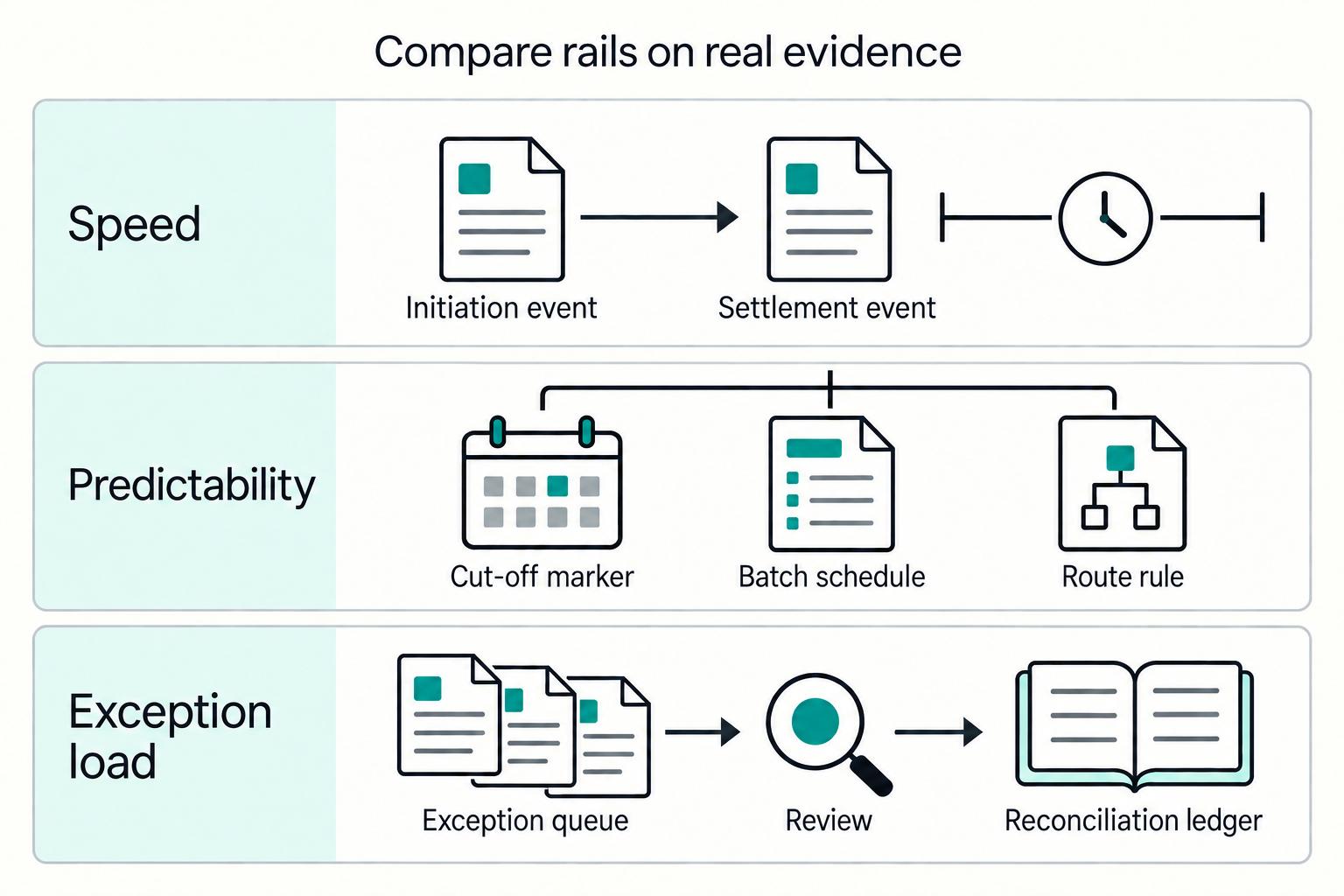
What Are Payment Rails? ACH Wire SEPA and Real-Time Networks Compared
For platform operators, rail choice is an operating decision, not just a glossary term. It affects payout speed, exception handling, and how much cleanup your support and finance teams inherit.

The Freelance Payment Penalty: A Modeled Audit of Platform Fees, FX Spreads, and Payout Delays
The money rarely disappears through a single, easy-to-spot fee. The real loss is stacked. A marketplace takes its commission, a processor adds a charge for international cards, a bank or payment company converts the currency at a spread, a platform holds the funds before release, and a wire sheds a little to intermediaries on the way in. Each layer looks defensible on its own, but the worker feels the combined result as a smaller deposit and a later payday.

How to Respond to a Subpoena for Business Records
Move fast, but do not produce records on instinct. If you need to **respond to a subpoena for business records**, your immediate job is to control deadlines, preserve records, and make any later production defensible.