
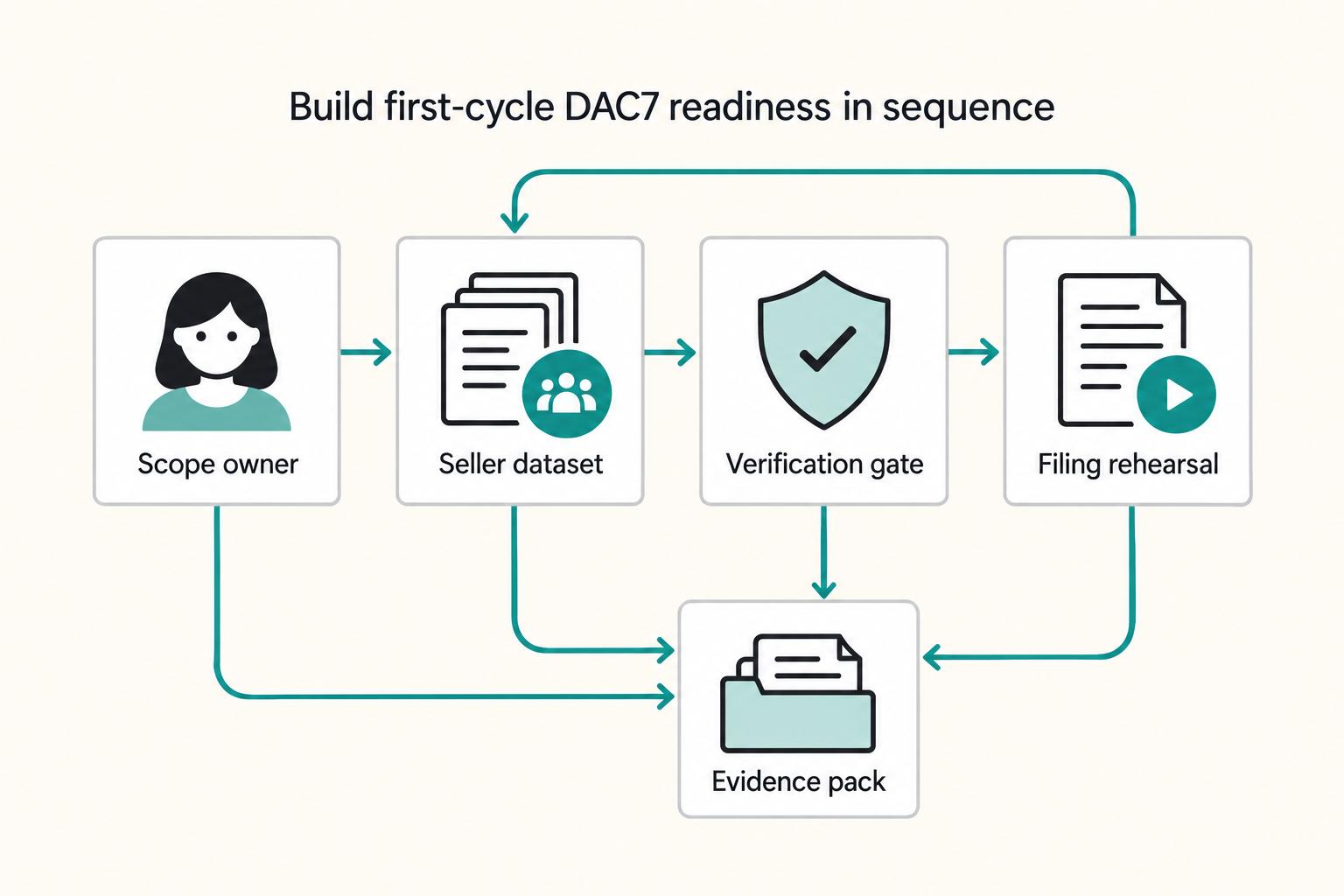
Quick Answer
DAC7 is Council Directive (EU) 2021/514, which extends EU tax cooperation to require reporting platform operators to collect, verify, and annually report information about reportable sellers and their platform earnings. The rules apply from 1 January 2023; DAC7 creates reporting obligations, not a new tax on sellers.
DAC7 at a glance#
DAC7 is Council Directive (EU) 2021/514, which extends EU tax cooperation to require reporting platform operators to collect, verify, and annually report information about reportable sellers and their platform earnings. The rules apply from 1 January 2023; DAC7 creates reporting obligations, not a new tax on sellers.
The European Commission’s DAC7 overview identifies four covered activity categories: rental of immovable property, personal services, sale of goods, and rental of any mode of transport. The reporting obligation covers domestic as well as cross-border activity.
For scope, test the legal operator and relevant activities, then identify reportable sellers and applicable exclusions. Keep unresolved classification questions separate from settled collection and verification requirements.
Keep a written scope log with the legal entity, activity, EU connection, exclusion basis, source, reviewer and decision date. Confirm the national filing process with the competent authority; a VAT registration or OSS decision is not a DAC7 scope determination.
Use the definition and scope tests first, then the operating controls below to build a repeatable seller-data and reporting cycle.
What DAC7 requires from platform operators#
Reporting platform operators must collect and verify reportable seller information and report annually by 31 January after the calendar year being reported. Preserve filing evidence and seller-level support for corrections or authority follow-up.
The reporting contains identification and financial information, including consideration paid or credited through the platform. The Commission overview explains the operator’s due-diligence role and the annual reporting deadline.
Use this as a practical baseline:
- assign one owner for the full reporting cycle
- map country steps and local filing channels
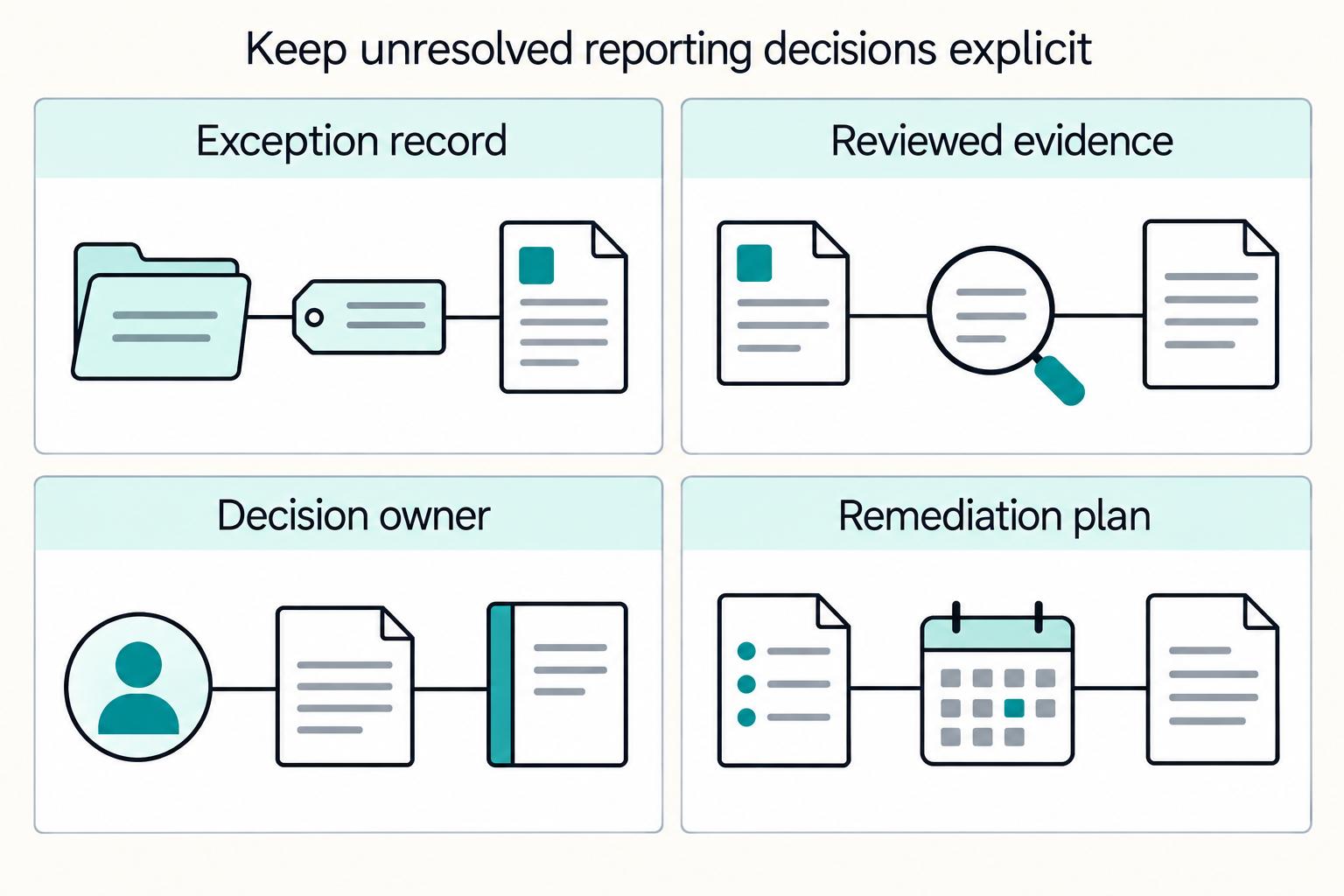
- keep a decision log for open interpretation issues
- retain records so you can explain what was filed if a tax authority follows up
If you want a deeper dive, read DAC7 Deep Dive: What It Means That EU Tax Authorities Will Now See Your Platform's Seller Data.
Who is likely in scope and where legal uncertainty remains#
EU operators can be covered through tax residence, incorporation, management, or a permanent establishment in a Member State. Non-EU operators can also be covered when they facilitate relevant activities for EU reportable sellers or rental of EU immovable property. Confirm the responsible operator and any qualifying equivalent-reporting arrangement; non-EU incorporation alone is not an exemption.
Separate operator scope from seller reportability. A covered operator does not automatically report every user or every transaction: identify active sellers, the relevant activity, the EU residence or property link, and applicable seller exclusions.
A practical scope matrix#
| Activity | EU connection to test | Scope checkpoint |
|---|---|---|
| Rental of immovable property | Property located in an EU Member State | Identify reportable sellers, property records and applicable exclusions. |
| Personal services | EU-resident reportable seller | Test platform facilitation and seller eligibility. |
| Sale of goods | EU-resident reportable seller | Apply the specific goods-seller exclusion test; it is not a tax-free allowance. |
| Rental of transport | EU-resident reportable seller | Test activity and seller eligibility, rather than buyer location alone. |
For covered non-EU operators, the Commission describes registration in a single Member State and reporting there. Assess qualified non-Union arrangements that exchange equivalent information before deciding whether duplicate registration or reporting is required.
Where uncertainty usually sits#
Most uncertainty is factual, not theoretical:
- Which legal entity is the operator for reporting purposes
- Whether the product is facilitating monetized activity or only providing supporting software
- Whether an exemption position is available and supportable in each member state involved
Use DAC7-specific law and national guidance for scope decisions. VAT Cross-border Rulings and OSS govern different obligations and should not determine whether a seller or platform is reportable.
Keep a scope log with a jurisdiction column from day one, then narrow only after source-document review.
Seller exclusions require a separate check. Irish Revenue’s excluded-seller guidance covers government entities, listed entities and their related entities, qualifying high-volume property-rental entities, and qualifying low-volume goods sellers. The goods test applies only to sale of goods: fewer than 30 activities and total consideration not exceeding €2,000 in the reportable period. Both conditions must be met; it does not apply as a general exemption for services or rentals, and it is not a tax-free threshold.
What seller data to collect and when to verify it#
If a seller group may be in scope, collect and verify core seller data during onboarding, not at filing time. DAC7 is described as requiring platform operators to collect, verify, and report seller information, so late backfill usually creates avoidable reporting risk.
The reporting requirements come from DAC7 and its national implementation; an XML schema specifies how data is represented and validated. Confirm the filing authority’s schema and additional submission rules. For individuals, Irish Revenue’s DAC7 guidance lists place of birth in the absence of a TIN. That is an individual-seller field, not a replacement identifier for entities. The DAC7 seller data checker can help identify missing fields in your export; a schema pass does not establish legal reportability.
A minimum seller record#
For individuals, collect name, primary address, all issued TINs with each issuing jurisdiction, date of birth, and VAT number where available; place of birth is relevant where no TIN is available under DAC7. For entities, collect legal name, address, all issued TINs with each issuing jurisdiction, VAT number where available, business registration number, and relevant EU permanent establishments. Apply the applicable TIN-collection exceptions. Irish Revenue distinguishes these two seller types.
| Data area | Practical minimum to store | Why it matters |
|---|---|---|
| Identity | Full name or legal entity name, address, date of birth for individuals | Confirms who the seller is and reduces mismatched profiles |
| Tax and registration | All issued TINs with each issuing jurisdiction, subject to applicable exceptions; VAT number where relevant; company registration number for entities | Keeps the core tax and business identifiers you are likely to need for reporting |
| Control metadata | Verification status, verification date, source of evidence, exception reason | Shows whether a record is only collected or actually defensible |
| Financial activity | Quarterly net consideration and relevant activity counts; operator fees/commissions/taxes reported separately by quarter; financial account details where required | Consideration is compensation paid or credited in connection with the relevant activity, net of fees, commissions or taxes withheld or charged by the reporting platform operator. Report those operator amounts separately by quarter. Reconcile seller totals to payment records and retain correction history. |
| Property rental | Property address and other required rental details | Tie property records to seller and activity reporting. |
Do not stop at field capture. Track whether each key field is uncollected, collected pending review, verified, or accepted under an exception, and record why anything is missing.
Verify early while the seller is still reachable#
The first reportable period was 2023. Annual reporting is due by 31 January of the following year; for calendar-year 2026, plan for 31 January 2027. Collect and verify data early enough to resolve missing or conflicting records before the annual filing gate.
For each key identifier, keep the capture timestamp, collection method, and current verification state. If seller details change, re-check the record instead of leaving an old value marked complete.
Add a pre-filing gate before anything goes out#
Before filing, run a pre-filing review across all reportable sellers. Focus on:
| Focus | Review item |
|---|---|
| Missing identifiers | Records marked reportable but missing core identifiers. |
| Unverified status | Records collected but never moved to verified or exception-approved. |
| Stale details | Records that became stale after seller details changed. |
The main failure mode is "collected but unverified." It can look complete in operations reporting but fail under scrutiny if you cannot show how data was verified. Keep an evidence trail from each reported field to capture event, verification state, and any approved exception reason. For a deeper reporting workflow, see EU DAC7 Reporting: What Every Marketplace Platform Must Do by January 31.
How reporting flows through EU exchange channels#
The operator reports to the competent national tax authority through the applicable registration and filing channel. Tax authorities then exchange information with the relevant Member States; the platform does not submit directly to every seller’s residence authority. Confirm the correct filing Member State and rules preventing duplicate reporting for your operator.
Keep registration, submission, acknowledgement, and correction responsibilities assigned to one internal owner. Confirm the authority’s file format, credentials, deadlines, and correction process before the reporting rehearsal.
| Stage | Main inputs | Validation checks | Correction loop |
|---|---|---|---|
| Build the report population | Final seller list, scope decisions, reporting period, seller identifiers | Reconcile seller counts, confirm in-scope status, flag missing required identifiers | Send exceptions to Product, Ops, or Compliance before file generation |
| Generate the filing package | Structured report file, schema version, internal approval, evidence references | File passes schema checks, required codes/fields are valid, totals reconcile to source data | Regenerate the file and preserve version history when mapping or formatting fails |
| Submit to the filing authority | Final file, submitter credentials, submission log | Confirm transmission, capture receipt/acknowledgement, store timestamp | Resubmit when the authority returns a rejection or partial acceptance |
| Handle authority feedback | Rejection notice, clarification request, accepted filing record | Classify issue as data defect, mapping defect, or interpretation issue | Route to the owning team, correct source records, and submit an amendment when required |
| Feed defects into next cycle | Jurisdiction-level defect log, recurring rejection reasons, updated guidance | Check repeat errors across prior cycles/jurisdictions | Convert repeats into onboarding, verification, or mapping fixes before the next annual cycle |
Make ownership explicit at each handoff: Tax/Finance for submission and authority contact, Product/Engineering for fields and export logic, and Ops/Compliance for seller follow-up when new evidence is needed. If ownership is vague, defects stall between teams until deadline pressure returns.
Keep proof of filing, not just the file you intended to send. Retain the exact submitted version, submission timestamp, receipt or acknowledgement, and any rejection/acceptance messages from the filing authority.
Track defects by filing jurisdiction and feed repeat failures back into source-data and mapping controls before the next cycle.
Ownership and build-versus-buy decisions#
Decide ownership before technology: name one accountable owner for the filing relationship, submission calendar, and correction loop, then choose build, buy, or hybrid based on whether you can keep records complete, traceable, and easy to defend.
Start with ownership before technology#
You do not need every task in one team, but you do need one clear decision owner for DAC7 operations. Use that owner to set decision lines for incomplete records, disputed classification, and rejected submissions, while Product, Engineering, Finance/Ops, and Legal/Tax execute their parts.
Own the full DAC7 cycle: scope, seller due diligence, reporting, seller communication, corrections and record retention. Filing software can execute agreed steps, but it does not replace your operator’s classification decisions.
A practical checkpoint: the owner should be able to quickly produce the current reporting population, current scope rules, the submitted file version, and related authority acknowledgements or rejection messages.
Compare tooling on proof, not feature lists#
Use build, buy, or hybrid as operating models, not labels. The key question is where judgment and control sit, and whether your process stays reliable when submissions are questioned or corrected.
| Model | Where control sits | What to prove before go-live |
|---|---|---|
| Internal build | More control stays in-house | You can preserve source-to-filing traceability, regenerate corrections, and retain filing evidence cleanly |
| Vendor tool | More process is delegated to the vendor | Your data can be ingested without manual workarounds, and filing/rejection evidence can be exported clearly |
| Hybrid | Judgment-heavy controls stay internal; filing mechanics are externalized | Internal teams still own classification, reconciliations, and exceptions while the external engine handles agreed execution steps |
Hybrid is often the practical answer#
If capacity is limited, hybrid is often the most workable path: keep classification, reconciliations, and exception handling internally, and use an external engine for transformation or submission steps.
Confirm which national authority receives your report and which country requirements affect registration, submission or corrections. Keep approvals and the defect log accessible to your team even when a vendor handles the file.
The evidence pack that survives audits#
Your evidence pack needs to do one thing well: let an external reviewer trace any reported seller record back to its source data, checks, filed output, and later corrections. If that trail breaks, you are left defending process by narrative instead of evidence.
Retain the source and verification records supporting each filed seller row, the exact output submitted, and the authority response. Define retention against the applicable DAC7 rules and national implementation.
What the pack should contain#
Keep one evidence set per reporting cycle, organized so seller-level questions are easy to answer. At minimum, include:
| Evidence item | What to retain |
|---|---|
| Seller-data lineage | Each reported field traced back to product, payments, or onboarding records. |
| Verification logs | What was checked, when, and with what result. |
| Filing artifacts | The exact submitted output version and related acknowledgement or rejection messages. |
| Correction history | Reason, approval, old value, new value, and whether a filed record changed. |
The practical test is reproducibility: can you rebuild a reported row from source data using the logic version active at filing time?
Make jurisdiction differences explicit#
Keep national registration, file-format, submission and correction requirements visible in the evidence pack. Resolve local mechanics using DAC7 authority guidance rather than VAT ruling procedures.
Design for cross-border scrutiny#
If a national tax authority asks how a record was produced, answer with version history, approvals, and a reproducible extract. Avoid "fixed in the file" edits that bypass source records and approval trails; corrections should flow back to the underlying record and then into regenerated output.
A 90-day implementation sequence for first-cycle readiness#
Use this 90-day plan as an internal delivery cadence, not a legal DAC7 deadline. By day 90, the target is a defensible process, a tested seller dataset, and no unresolved issue that could change who is reportable or what is submitted.
| Window | Focus | Actions |
|---|---|---|
| Days 1-15 | Lock scope and open interpretation risk | Set scope against Council Directive (EU) 2021/514; log unresolved interpretation points with a Member State tag, owner, and decision date; treat any issue that could change seller inclusion as filing-critical. |
| Days 16-45 | Finalize data model and ownership | Implement the minimum model for reportable sellers; assign ownership for collection, verification, corrections, and signoff across Product, Engineering, and Finance/Ops; check verification state and traceability, not just whether fields are populated. |
| Days 46-75 | Run dry reports and reconciliation | Test cross-border sales outputs against product events, payment records, and finance exports; for sampled sellers, recreate reported rows from source records; fix rows that are not reproducible end to end before file-format concerns. |
| Days 76-90 | Enforce the pre-filing gate | Freeze reporting logic; sign off the evidence pack; escalate unresolved exceptions for executive review before submission; keep buffer time. |
For a step-by-step walkthrough, see EU DAC7 Directive for Freelancers Using Digital Platforms.
Conclusion#
Start from the actual DAC7 tests: covered operator, relevant activity, reportable seller and exclusions. Once the reporting population is established, assign owners to collection, verification, annual reporting and correction handling.
The right mental model is cross-functional. Even when the legal hook sits in a directive and local implementing law, the work lands across Product, Engineering, Finance or Ops, and Legal or Tax: scope decisions, data capture, verification evidence, reporting output, and correction handling. Your first checkpoint should be blunt and testable: can you reproduce one record end to end from source data to report output, and point to the identifier or address trail that supports it? If not, you are not ready, no matter how polished the policy note looks.
Keep jurisdiction-specific registration and submission requirements in the operating runbook. Use the national DAC7 authority’s guidance and preserve a dated decision record for unresolved classification questions.
A working cycle should reproduce a seller row from onboarding and payment records to filed output. Confirm seller exclusions, annual deadlines and national enforcement rules, preserve acknowledgements, and escalate unresolved classification questions before the filing decision.
Frequently Asked Questions
What is DAC7 in one sentence?
DAC7 is Council Directive (EU) 2021/514, which extends EU tax cooperation to require reporting platform operators to collect, verify, and annually report information about reportable sellers and their platform earnings. The rules apply from 1 January 2023; DAC7 creates reporting obligations, not a new tax on sellers.
Who must comply with DAC7 if the company is outside the European Union?
A non-EU platform operator can be covered when it facilitates relevant activities for reportable EU sellers or rental of EU immovable property. Covered non-EU operators generally register and report in a single Member State; assess any qualifying equivalent-reporting arrangement before claiming an exemption.
Which activities are usually in scope for DAC7 reporting?
The four activity categories are rental of immovable property, personal services, sale of goods, and rental of any mode of transport for consideration. Then test seller reportability and exclusions; a category being covered does not mean every seller in it must be reported.
How is DAC7 different from DAC6?
DAC7 concerns platform operators’ reporting of sellers and platform activity. DAC6 concerns reportable cross-border arrangements assessed against tax-risk hallmarks. They have different reporting populations and triggers, so a DAC6 review does not satisfy DAC7 seller reporting.
How does information move through the Automatic Exchange of Information system?
The platform submits its report to the applicable national tax authority. The competent authorities exchange the information with relevant Member States through the EU administrative-cooperation framework. Keep the submitted version, receipt, seller support and correction history so you can answer authority questions.
What remains uncertain without country specific legal advice?
Confirm local registration and filing channels, technical formats, correction procedures, enforcement and penalties with the competent authority. The EU activity categories and reporting framework remain the starting point; do not replace them with VAT rules.
What should teams implement first to reduce first cycle risk?
Start with scope decisions, a minimum seller data model, and verification status tracking. Your first checkpoint is not whether every field exists, but whether you can reproduce one reportable seller record end to end from source data, with a clear exception reason where something is missing. If you need one concrete operating rule, do this first: build the jurisdiction risk log before you build the filing output. A common risk is a seller profile that looks complete in onboarding but cannot be defended later because country treatment, verification evidence, or correction history was never captured.
Try a related tool
Researched and edited by the Gruv editorial team. Gruv builds cross-border billing, payouts, and finance-operations software for global businesses.
Sources
Includes 2 external sources outside the trusted-domain allowlist.
- taxation-customs.ec.europa.eu/taxation/tax-transparency-cooperation/admini...trusted
- taxation-customs.ec.europa.eu/taxation/tax-transparency-cooperation/admini...trusted
- revenue.ie/en/companies-and-charities/international-tax...external
- revenue.ie/en/tax-professionals/tdm/income-tax-capital-...external
Educational content only. Not legal, tax, or financial advice.
Related Posts
DAC7 for Platform Operators: Scope, Seller Data, and Controls for EU and Non-EU Platforms
Treat DAC7 as an operating model problem, not a definitions exercise. If your platform handles income from reportable activities, you need to make defensible scope decisions, collect the right data, and keep evidence that can stand up to questions from national tax authorities.

The Freelance Payment Penalty: A Modeled Audit of Platform Fees, FX Spreads, and Payout Delays
The money rarely disappears through a single, easy-to-spot fee. The real loss is stacked. A marketplace takes its commission, a processor adds a charge for international cards, a bank or payment company converts the currency at a spread, a platform holds the funds before release, and a wire sheds a little to intermediaries on the way in. Each layer looks defensible on its own, but the worker feels the combined result as a smaller deposit and a later payday.

How to Respond to a Subpoena for Business Records
Move fast, but do not produce records on instinct. If you need to **respond to a subpoena for business records**, your immediate job is to control deadlines, preserve records, and make any later production defensible.