
Quick Answer
Check your seller residence, activity and platform relationship, then supply the correct individual or entity information through the operator’s secure route. DAC7 covers personal services, goods sales, property rental and transport rental. Review the annual statement and reconcile consideration, charges and bank receipts. Keep tax filing deadlines separate and escalate unresolved scope or correction questions promptly.
What DAC7 means for freelancers using digital platforms#
A platform asks for your tax details, then sends an annual seller statement that differs from your bank receipts. DAC7 explains why the request arrived; reconciliation explains the difference. Your task as a freelancer is to supply accurate seller information, understand which activities the operator reports, and keep your own tax records complete.
DAC7 places reporting and due-diligence duties on reporting platform operators. Sellers supply the information those operators need. The European Commission’s DAC7 overview covers domestic and cross-border activity and makes clear that DAC7 introduces no new tax. A platform report is not your tax return or a calculation of taxable profit.
This guide follows the seller workflow: map channels, classify activity, identify the operator, prepare information, review dates, and reconcile statements. Keep VAT administration in a separate file. A common data schema can support reporting, but it does not make national filing requirements, validation rules or tax treatment identical.
- Channel map: record the platform, account, seller residence, activity, and any EU property link; keep buyer location separately for relevant tax analysis.
- Line classification: use one label system across invoices, platform exports, and books so reconciliation is matching, not relabeling.
- Evidence pack: keep one year folder with account records, platform summaries, and dated submissions or correction requests.
- Reconciliation: compare platform totals against accounting records before filing pressure builds, so missing rows, duplicates, or mixed labels are caught early.
- Escalation: route unresolved activity, residence, operator or amount questions to the appropriate platform contact or adviser before the request or filing deadline.
For broader residency planning, start with the digital nomad tax guide. For a country-level tax baseline example, see Taxes in Germany for Freelancers and Expats. If you want a clean baseline on the directive before applying these steps, use What Is DAC7? EU Platform Reporting Directive Explained.
How to Use This List and Who It Fits#
Use the register to identify missing information and conflicting records early. Follow each platform request’s deadline while resolving questions; an internal checklist is not a reason to postpone an accurate response.
This fits independent freelancers and consultants earning through platforms, including domestic work. DAC7 reportable sellers are generally active, non-excluded sellers resident in an EU Member State, or sellers renting immovable property located there. Buyer location alone does not determine seller reportability. Non-EU operators may also have duties, subject to the applicable equivalence arrangements.
Keep open questions in the tracker with evidence, an owner and a due date. Resolve material classification issues promptly, while continuing routine records and meeting other filing deadlines.
1) Confirm Your DAC7 Exposure Before You Do Anything Else#
Confirm the seller, activity and platform relationship for each channel. Reporting scope is different from whether the income is taxable: a reportable amount may include proceeds that need adjustments in a tax calculation, and unreported income may still need to be declared.
Start with a clean channel map. Mixed rows tend to break classification and reconciliation later, even when the totals still look fine.
- Split mixed channels into separate rows
Split platform-facilitated work from independently arranged work, but do not assume an off-platform payment makes a facilitated activity non-reportable. Record how the buyer was connected, what the platform arranged, and whether consideration is known or reasonably knowable to the operator.
- Capture seller, activity and platform fields
Record seller identity and residence, platform involvement, relevant activity, and any EU immovable-property location. Add the operator entity, account ID and review flag. Retain buyer location where needed for VAT or other tax analysis, rather than using it as the DAC7 residence test.
- Apply the appropriate exclusion tests
Apply the exclusion tests to the appropriate activity. For sale of goods, the low-volume exclusion requires fewer than 30 relevant activities and consideration not exceeding EUR 2,000 for the period; both conditions must hold. It is not a general EUR 2,000 exemption for freelance services. Other excluded-seller categories include government entities, specified listed entities and related entities, and qualifying entities with more than 2,000 rentals of a property listing. See the Spanish tax authority’s seller guidance.
Escalate as soon as you see repeated multi-jurisdiction ambiguity, an unclear platform role, or conflicts between platform exports, invoices, and your books. Every open issue needs an owner and a next action.
If you move during the year, preserve dated profile changes and residence evidence. Tax residence, billing address and work location can differ. Ask the operator how its residence determination applies to your account rather than substituting the buyer’s country.
Attach platform terms, profile details and a sample transaction export to each flagged channel. Keep the classification question and the evidence that resolves it in the same record. Do not force an excluded or reportable label simply to make the register look complete.
Verification checkpoint#
Use this checkpoint before moving on.
Check these four items:
- Every income path has a separate row and records how the activity was facilitated.
- Seller residence, activity and any EU property link are recorded; buyer-location tax notes are separate.
- DAC7 classification and VAT analysis have separate fields.
- Each unresolved scope or exclusion question has an owner, next action and deadline.
Resolve or escalate these issues:
- Platform and direct work are bundled without evidence of how each was arranged.
- VAT registration or buyer location is being treated as the DAC7 scope answer.
- The responsible operator or seller identity is unclear.
- Exports and books use incompatible labels or omit the activity behind a payment.
Continue collecting records and answering accurate portions of requests while gaps are reviewed. Avoid a final scope conclusion on the affected row until its material question is resolved.
2) Classify Every Income Stream by Relevant Activity#
Classify each income line before you total anything. Line-level labels are a practical way to keep reporting mapping, platform summaries, and VAT documentation aligned.
DAC7 covers four relevant activities for consideration: personal services, sale of goods, rental of immovable property, and rental of any mode of transport. Ireland’s DAC7 overview explains these categories and the operator’s annual reporting process.
Personal services include time- or task-based work requested by a user and facilitated through a platform, whether performed online or offline. A custom consultation or commissioned design may fit. A non-customised digital download is not automatically a personal service. Keep the delivery and customisation facts for ambiguous bundles rather than treating every digital product as a sale of physical goods.
- Activity label: assign one activity label per line using your reporting or platform documentation.
- Tax note: add a short note for possible VAT impact under local rules, and keep any direct-tax follow-up note separate. This is documentation, not a final determination.
- Cross-border marker: tag each line as domestic or cross-border and note the EU Member State link when present.
- Evidence reference: attach a record ID, such as invoice number, platform transaction ID, or payout batch reference.
Keep a short label dictionary with two fields: the plain-English activity and its DAC7 category or review status. Link the platform’s labels to your accounting labels through a mapping table; you do not need to rewrite immutable exports or already issued invoices just to make wording identical.
For example, separate a buyer-requested advisory call from a standard downloadable template in your tracker. Keep the original invoice and transaction IDs. If the sale includes both components, record what can be separately identified and ask the operator how it classified the bundle.
VAT categories serve a different purpose. The Commission’s OSS guide describes optional schemes, supplies declared through them and domestic returns that remain additional. The EUR 10,000 place-of-supply threshold applies to qualifying B2C electronic/telecom/broadcast services and intra-Community distance sales of goods under specific establishment and current/prior-year conditions. IOSS’s EUR 150 consignment limit is separate again. Neither is a DAC7 exclusion threshold. OSS returns are quarterly for the Union and non-Union schemes and monthly for the import scheme. Separately, the Member State of identification rules can bind a permitted Union-scheme election for the current calendar year plus the two following years—for example, certain non-EU-established traders choosing among EU fixed establishments or goods-dispatch states. Confirm the applicable conditions and exceptions before changing that election.
Split components in working records where their amounts and activities can be supported. If a bundle cannot readily be separated, ask for the applicable treatment rather than inventing an allocation. Save the explanation and leave the original invoice intact.
Before item 3, confirm the following:
- Every invoice line has one activity label.
- Every line has one tax note and one cross-border marker.
- Every line has an evidence reference.
- No line remains tagged as miscellaneous if it combines distinct activities.
Record unresolved bundles with a clear review status and due date. You can continue mapping the operator and preparing seller details while that particular classification is being resolved.
3) Identify the Reporting Platform Operator in Each Channel#
Once you know what each revenue line is, identify the legal entity operating each channel you use. This is a record-mapping step that keeps requests, corrections, and profile updates aligned with account records.
If you use two marketplaces plus direct invoicing, keep three separate channel records. For each platform channel, store the legal entity name shown in platform documents, the stated jurisdiction, and the support contact path. For direct invoicing, mark that no platform is involved for that revenue line. Do not merge channels just because the brand looks related. Different channels under one brand can still point to different legal entities, and that distinction matters when you are asked to confirm details or correct a profile.
| Channel | Record this now | Why it matters |
|---|---|---|
| Marketplace A | Legal entity name, stated jurisdiction, support channel, account ID | Keeps requests and corrections aligned with account records |
| Marketplace B | Same fields, kept separate even if the brand is related | Prevents merged records when related brands use different legal entities by channel |
| Direct invoicing | For independently arranged work, mark no platform involvement and retain invoice evidence; record any platform-facilitated work separately even if paid directly. | Separates non-platform revenue lines while preserving tax evidence |
Identify the contracting operator and the entity responsible for reporting. A payment processor is not automatically that operator: software exclusively processing payments, advertising/listing, or redirecting users without further intervention is outside the platform definition. See Ireland’s platform definitions and examples, sections 2 and 3.
Before item 4, confirm the following:
- Every platform income line links to one channel record ID and one legal entity name.
- One document proof is saved per channel.
- Operator jurisdiction and stated DAC7 filing jurisdiction are recorded where available; OSS registration is recorded separately if relevant.
- Support route is recorded with a ticket ID or message log.
If documents name different entities, ask which entity contracts with you and which reports your seller data for the period. Save the response. A service provider preparing a report does not necessarily become the accountable operator, and a payment-provider name on a bank statement may be a different entity again.
Use the formal seller agreement as a working reference, log conflicting labels, and seek written clarification. If you are helping an operator prepare data, the DAC7 hub and seller data checker can help find common schema and missing-field issues. The checker does not determine seller scope or exclusions, validate every national TIN format, or certify a complete operator filing.
If a platform updates legal notices during the year, log the change date and keep both old and new snapshots. You do not need a long memo. A dated note plus saved documents is usually enough to explain why a channel record changed. Once every channel points to the right legal entity, build the evidence pack around those records.
For a step-by-step walkthrough, see Digital Platform Reporting for Online Marketplaces: MRDP, DAC7, and UK HMRC Duties.
4) Build a Reportable Seller Evidence Pack Before Platforms Ask#
Build the evidence pack before any request arrives. In practice, that is the difference between a routine document request and a scramble.
| File | What to keep | When relevant |
|---|---|---|
| Seller identity file | Individual: name, primary address, date of birth, TINs and issuing jurisdictions; VAT ID if available. Record the permitted place-of-birth fallback where applicable. | Individual seller account; follow the operator’s lawful information request. |
| Entity file | Legal name, address, TINs and jurisdictions, business registration number, VAT ID where available, and relevant EU permanent establishments. | Seller is a company or other entity, rather than the individual behind it. |
| Account and activity file | Account ID, payout account identifier and holder where requested, activity descriptions, quarterly statements, fees and transaction references. | Platform income; property rentals require additional property records. |
| Submission and correction file | Dated request, response, secure submission receipt, correction ticket and statement versions; keep VAT/OSS records in a separate tax folder. | Every platform request or correction. |
Prepare the fields appropriate to your seller type. Ireland’s seller-information guidance distinguishes individuals from entities and describes when information must be checked again. Your tax residence may require more than one identification record; do not replace an entity TIN with its owner’s personal identifier without confirming the account classification.
Use a calendar-year DAC7 folder, channel subfolders and a separate tax folder for income-tax and VAT records. Protect raw identity documents and bank information with restricted access. Send them only through a verified platform route, and save a submission receipt rather than putting sensitive data in every shared tracker.
A common failure mode is treating the pack as static after onboarding. Avoid that by keeping a dated submission log that records what you sent, to which entity, and when. If a mismatch appears later, that log can shorten resolution time because you can point to the exact document bundle instead of trying to rebuild it from memory.
Update the pack when legal name, address, tax residence, TIN, entity status, payout-account holder or activity changes. Record the effective date and notify the operator through its documented route. Do not wait for the annual statement to discover an outdated profile.
Archive discipline matters too. When details change, move superseded files into a clearly marked archive subfolder instead of deleting them. Current files should be obvious at a glance, and historical versions should remain searchable if a platform or advisor asks what was on file earlier in the year.
Before item 5, confirm the following:
- Required seller fields and supporting records match the actual individual or entity account.
- Activity and account records support the platform’s requested information.
- Income-tax and any VAT/OSS records remain separately identifiable.
- Submission and correction logs record date, receiving entity, secure route and document version.
Related: DAC7 for Platform Operators: Scope, Seller Data, and Controls for EU and Non-EU Platforms.
5) Run a Yearly DAC7 Calendar With Three Checkpoints#
Keep three internal reviews, then add every actual platform request and statutory filing date. Under the general annual process, the operator reports the preceding calendar year and supplies the reportable seller’s information by 31 January. Seller requests may arrive earlier; a personal tax-return deadline is separate.
| Checkpoint | When | DAC7 review | Separate tax review |
|---|---|---|---|
| Profile and channel baseline | Start of year and after material changes | Confirm seller identity/residence, activity, operator and open questions. Review the preceding year’s statement when received. | Check income-tax and any VAT registration changes. |
| Profile and transaction check | Mid-year, plus platform request deadlines | Compare profile fields, quarterly consideration/activity counts and fee records; address missing-data requests promptly. | Maintain domestic returns and any applicable OSS cadence. |
| Year-end and statement reconciliation | Before operator reporting and again when the statement arrives | Prepare the calendar-year tie-out, check the statement and send documented correction requests; track the 31 January operator deadline. | Prepare tax working papers under their own deadlines; retain unresolved-item treatment. |
For 2026 activity, the usual operator reporting date is 31 January 2027. Schedule your preparation early enough for profile corrections, then review the statement actually supplied. Confirm any national submission arrangements with the operator; your internal three-review plan does not change the applicable deadline.
Increase review frequency when a platform request, residence change, new entity, high volume or unexplained variance requires it. Routine updates need not wait for a calendar checkpoint.
Put each checkpoint on your calendar with a short agenda, an owner and a link to the evidence folder. Confirm the channel map, profile changes and reconciliation bridge, then assign follow-up for new questions.
Assign an owner to each checkpoint, even if that owner is you. Define completion criteria before the year gets busy, including where outputs are saved and how open issues are tracked. A review is not complete because you thought about it. It is complete when the file, log, and open items are updated where you said they would be.
Before item 6, confirm the following:
- Three internal reviews and the relevant request/statement dates are on the calendar.
- Each review has a short agenda and evidence-folder link.
- Personal tax filing and any VAT/OSS deadlines are separately tracked.
- Every open variance has an owner, due date and evidence reference.
6) Reconcile Platform Reports Against Your Books Before Filing#
Treat the platform’s DAC7 statement as a reporting record to reconcile. It may differ from invoice revenue, taxable profit and cash received in your bank. Do not copy its total directly into a tax return without applying the relevant tax rules.
Start from a frozen year-end file for each platform. Include the annual statement export, monthly payout reports, refund logs, fee summaries, your FX conversion method, and a chart-of-accounts mapping table. Then build one reconciliation table per platform and one consolidated view across all channels. If you keep working from live dashboards, it becomes much harder to explain why totals changed between review and filing.
Use this method:
- Track gross customer amounts, operator fees/commissions/taxes, reported consideration, refunds, credited amounts, actual bank payouts and ledger totals, preserving currency and quarter.
- Post reconciliation adjustments separately with source IDs and reasons such as refund timing, off-platform invoice, FX treatment or classification correction. Preserve original totals.
- Build distinct bridges to the DAC7 statement, income-tax working papers and any VAT working papers; their bases may differ.
- Record unresolved differences, owner, due date and filing treatment. Continue meeting deadlines with the appropriate adviser-supported approach.
Start with source transactions and their paid-or-credited quarter, then trace deductions, refunds, transfers and accounting adjustments. DAC7 consideration is net of operator fees, commissions or taxes withheld or charged, while those charges are also reported separately. Crediting a platform balance is not the same event as arrival in your bank.
Illustrative quarter: clients pay EUR 1,000, the operator charges EUR 100, credits EUR 900 to your balance, and transfers EUR 800 to your bank. The bridge shows EUR 900 credited consideration, EUR 100 charges and EUR 100 remaining on-platform. A EUR 1,000 invoice or revenue entry and EUR 800 bank receipt can therefore coexist without a missing sale. Check the operator’s actual refund, tax and timing treatment before applying this example.
Add independently arranged direct revenue once in your tax reconciliation, without adding it again to a platform statement or counting both a platform credit and its later bank transfer as separate income. A genuine unexplained difference needs investigation; an explained difference in reporting basis needs a documented bridge.
Retain the DAC7 tie-out beside the statement and correction record. Keep tax-return adjustments in the relevant tax working papers. If a correction remains pending near a filing deadline, ask how to file accurately on time and whether an amendment is needed later; waiting for perfect platform records is not a general extension.
Finish with a sign-off note: what matched, which reporting bases differed, what was adjusted, and what remains open. Preserve both the original and corrected statement with the platform’s acknowledgment.
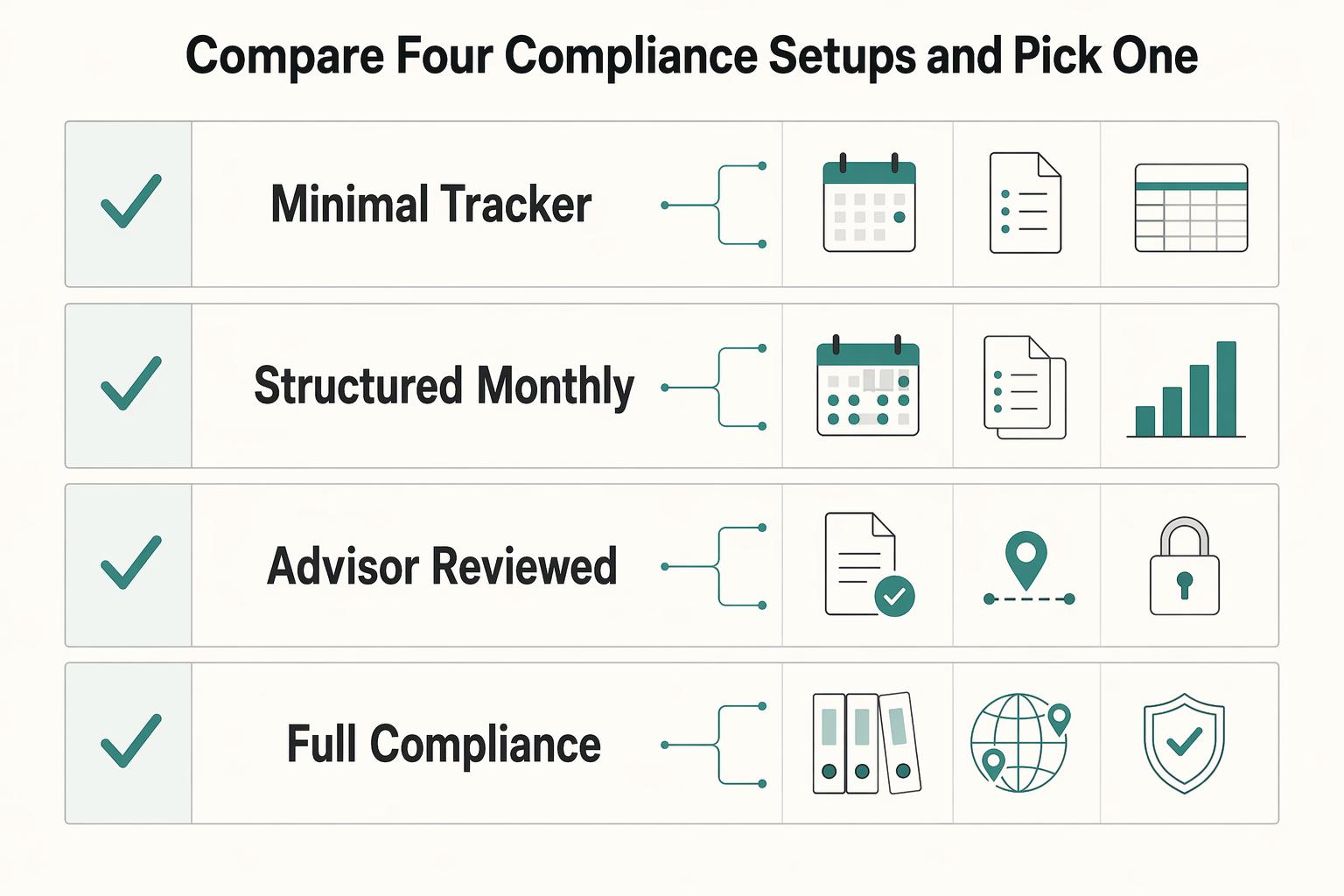
7) Compare Four Compliance Setups and Pick One#
Pick the setup that matches your current complexity, then move up only when the facts justify it. Choosing a setup is an operating decision, not a legal shortcut.
The real question is how much structure you need to keep records consistent without creating overhead you will not maintain. A setup that is too light can break once channels, countries, or currencies multiply. A setup that is too heavy can get abandoned mid-year. The right choice is the lightest option that still gives you clean evidence, workable reconciliation, and a clear escalation path when the facts turn.
Choose the amount of recordkeeping and adviser review that fits your channels and unresolved questions. These are internal operating options, not different legal reporting regimes.
| Setup | Best for | Pros | Cons | Use-case trigger |
|---|---|---|---|---|
| Minimal tracker | One platform, one tax residence | Lowest admin load | Higher error risk if facts change | One platform, one-country tax position, and no unresolved variances after reconciliation |
| Structured monthly close | Multiple platforms or currencies | Better reconciliation history and audit trail | More monthly maintenance | Several platforms, currencies or recurring payout/fee differences need a monthly bridge. |
| Advisor-reviewed quarterly | Multi-country activity with recurring VAT judgment calls | Stronger control when treatment is less clear | Advisory cost and quarterly prep time | Residence, entity, activity or recurring tax-treatment questions need scheduled specialist review. |
| Full compliance stack | High-volume, high-complexity cross-border footprint | Strong defensibility across jurisdictions | Highest process overhead | High volume and multiple reporting relationships require integrated records, access controls and exception tracking; a seller does not automatically need operator filing software. |
- Confirm platform accounts, activity types, seller identity and residence for the year.
- Check that profile data, quarterly statements, fees and bank movements are traceable.
- Confirm who owns correction requests and actual deadlines.
- Keep income-tax and any VAT/OSS requirements under their own schedules.
- Identify the unresolved question that needs professional review before buying more tooling.
Do not treat the setup as permanent. Re-run the lock-in check when your country footprint, channel count, or transaction profile changes. Moving up one tier early can be cheaper than repairing a low-control setup after complexity has already increased.
If two setups are viable, choose one you can maintain that provides the required records and reliable follow-up. More software or a heavier monthly review does not, by itself, resolve an ambiguous legal classification.
8) Use Clear Escalation Triggers for Professional Advice#
Use trigger-based escalation, not stress-based escalation. Bring in professional advice when the facts get complex, not when the deadline is already too close.
Use platform support for account fields, reporting entity and statement corrections. Use a tax adviser for residence, tax-return treatment or legal scope questions that the platform cannot resolve. Give each question a deadline and a practical next action.
Escalate when any of these are true:
- Seller residence, entity identity or a permanent-establishment record conflicts across documents.
- A mixed activity or exclusion question could change what is reported; do not apply the goods-only low-volume exclusion to personal services.
- Quarterly consideration, fees, refunds or activity counts differ from the transaction trail without an explained bridge.
- The operator is unclear, a correction is unanswered, or a missing-data request threatens account access or payouts.
- Separately, a VAT question involves an uncertain place of supply, registration, OSS scope or complex planned cross-border transaction.
For a VAT issue, a cross-border ruling may be relevant to planned complex transactions involving participating countries. The Commission’s archived guidance describes a request in the participating country where the applicant is VAT-registered, subject to national conditions; one company acts for multiple applicants. Confirm current availability locally. It does not determine DAC7 scope or extend a deadline. For DAC7 advice, send:
- The seller identity/residence facts and dated platform terms or profile records.
- Relevant quarterly statement, transactions, fees, payout records and reconciliation bridge.
- The platform request or correction correspondence, with the requested deadline.
- A one-page question stating the activity, affected countries, unresolved point and filing impact; add separate VAT/OSS records only where needed.
Before contacting an advisor, write the issue in one paragraph with the facts, the open point, and the filing deadline. That makes the first conversation more productive and reduces the chance of getting a vague answer that still leaves you uncertain about the next step.
Ask what action is required now, what assumptions support it, what evidence is still missing, and how to meet the deadline if that evidence arrives later. A yes-or-no answer without its scope can create another mismatch.
Keep the Seller File Ready for the Next Request#
Keep one current seller profile per account, a supported activity map and a bridge from the platform statement to your books. Preserve submission and correction records so the next request starts from known facts.
At each review:
- Confirm your exposure before you start.
- Classify income lines consistently so reconciliation stays clean.
- Verify the platform legal entity in each channel and save dated evidence.
- Reconcile early, not under filing pressure.
- Escalate unresolved items before they harden into a filing position.
Tax reporting continues on its own schedule. Maintain domestic returns and, if you use an OSS scheme, declare its covered supplies through the scheme while keeping the additional domestic obligations. A pending DAC7 correction is not permission to postpone tax filing.
If a question remains unresolved, record the supported facts, owner, deadline and next step. Use a qualified adviser for the filing decision and the platform’s secure process for correcting its records.
Frequently Asked Questions
Do I need to think about DAC7, VAT, or both?
Consider both where relevant, using separate tests. DAC7 concerns operator reporting and seller information; VAT concerns the supplies and applicable national or cross-border rules. OSS registration, the EUR 10,000 VAT threshold and a DAC7 seller exclusion answer different questions. Neither a platform report nor an exclusion determines your taxable income.
If a platform processes the sale, is it automatically the reporting platform operator?
No. The operator is the entity contracting with sellers to provide the platform, and reporting status depends on the applicable conditions. A service exclusively processing payments without further intervention is excluded from the platform definition. Record the contracting entity and ask who reports your account; a VAT deemed-supplier role is a separate classification.
How should I label my freelance activity when public summaries use different categories?
Use the four DAC7 activity categories: personal services, sale of goods, immovable-property rental and transport rental. Map your plain-English invoice descriptions to them without altering source records. Keep custom requested work separate from standard digital content and document ambiguous bundles for review.
Why do online explanations use different start dates and deadlines?
DAC7 platform reporting applies from 1 January 2023; the first 2023 information exchange occurred in February 2024. The usual annual operator report and seller-information date is 31 January after the calendar year. Earlier platform requests, transitional due-diligence arrangements and separate VAT milestones explain some differences. Check the actual reporting period and operator instructions.
When should I stop researching and ask a professional?
Ask when an unresolved residence, activity, operator or amount question could change your response or tax filing. Send the evidence and actual deadline. A missing-data request deserves prompt attention because national implementation can require account restrictions or withheld payouts after prescribed reminders and waiting periods. Do not infer a universal grace period or route around a restriction; ask for the lawful correction path.
Try a related tool
Tax residency day counter
Track days in countries with configurable thresholds (informational only).
EU VAT number validator
Validate EU VAT IDs and keep evidence for invoicing (informational only).
DAC7 seller data checker
Check a seller export against the OECD DPI XML Schema in your browser and get a chase list of the gaps.
Researched and edited by the Gruv editorial team. Gruv builds cross-border billing, payouts, and finance-operations software for global businesses.
Sources
Includes 2 external sources outside the trusted-domain allowlist.
- sede.agenciatributaria.gob.es/Sede/en_gb/todas-gestiones/impuestos-tasas/d...trusted
- taxation-customs.ec.europa.eu/taxation/tax-transparency-cooperation/admini...trusted
- taxation-customs.ec.europa.eu/archives/taxable-persons/vat-cross-border-ru...trusted
- vat-one-stop-shop.ec.europa.eu/one-stop-shop_entrusted
- vat-one-stop-shop.ec.europa.eu/one-stop-shop/register-oss_entrusted
- revenue.ie/en/companies-and-charities/international-tax...external
- revenue.ie/en/companies-and-charities/international-tax...external
Educational content only. Not legal, tax, or financial advice.
Related Posts

Digital Nomad Taxes in 2026 With a Defensible Filing Plan
With digital nomad taxes, the first move is not optimization. It is figuring out where you may be taxable, where filings may be required, and what proof supports that position.
Taxes in Germany for Freelancers and Expats
Low-stress compliance in Germany comes from decision order, not tax tricks. Use this sequence: confirm core facts, apply conservative temporary assumptions, verify the few points that can break invoices or filings, and keep one evidence file that explains each decision.

The Freelance Payment Penalty: A Modeled Audit of Platform Fees, FX Spreads, and Payout Delays
The money rarely disappears through a single, easy-to-spot fee. The real loss is stacked. A marketplace takes its commission, a processor adds a charge for international cards, a bank or payment company converts the currency at a spread, a platform holds the funds before release, and a wire sheds a little to intermediaries on the way in. Each layer looks defensible on its own, but the worker feels the combined result as a smaller deposit and a later payday.