
Quick Answer
DAC7 makes platform operators responsible for reporting seller data when the platform facilitates rental of immovable property, personal services, sale of goods, or rental of transport for consideration. In practice, platforms need defensible scope decisions, complete seller identity and quarterly consideration data, clear exception handling, and country-by-country confirmation of local filing mechanics for both EU and potentially in-scope non-EU operators.
What DAC7 Requires From Platform Operators#
Treat DAC7 as an operating model problem, not a definitions exercise. If your platform handles income from reportable activities, you need to make defensible scope decisions, collect the right data, and keep evidence that can stand up to questions from national tax authorities.
| Milestone | Date | Article detail |
|---|---|---|
| Member State implementing laws | 31 December 2022 | Member States were required to adopt and publish implementing laws |
| Member State rules applied | 1 January 2023 | Member States generally applied the DAC7 platform-reporting rules from this date |
| First exchange for calendar year 2023 | end of February 2024 | The first exchange of information for calendar year 2023 took place |
At EU level, the legal base is settled. Council Directive (EU) 2021/514 entered into force 20 days after its publication on 25 March 2021; Member States generally applied its platform-reporting rules from 1 January 2023. The first exchange for calendar year 2023 took place at the end of February 2024, so this is already a live reporting obligation.
For platform teams, the risk is cross-functional. Compliance needs defensible interpretations. Legal needs to separate EU-level requirements from local procedure. Finance needs payout and reconciliation data tied to reportable activity. Risk needs controls for missing records, weak classification, and potential breaches under Member State sanction regimes. One point is explicit in DAC7: the reporting obligation sits with platform operators.
That distinction, what is settled at EU level and what still needs local confirmation, should shape your controls.
- Settled at EU level: platform operators are the reporting party, scope covers rental of immovable property, personal services, sale of goods, and rental of any mode of transport, and Non-Union Platform Operators can be required to register and report in one EU country.
- Confirm with the selected authority: domestic submission channel, file validation, registration steps, correction process, and any national procedural requirements. DAC7 itself sets a 31 January reporting deadline after the reportable year.
This is where execution usually breaks down. Member States were required to adopt and publish implementing laws by 31 December 2022, but domestic application still needs country-by-country validation. EUR-Lex tracks national transposition measures and makes clear that Commission verification of completeness and correctness still matters.
In practice, validate each reporting position against both Council Directive (EU) 2021/514 and the relevant local transposition or tax authority guidance. If a national authority gives a date or procedure, treat it as local execution detail, not an EU-wide rule.
This article focuses on the operational side of that reality: scope decisions, control ownership, exception handling, and an evidence checklist you can use as an audit file. The goal is not just to understand DAC7. It is to run a process you can defend.
DAC7 changes who owns seller tax reporting#
Under DAC7, seller tax reporting sits with the platform operator. Council Directive (EU) 2021/514, within the Directive on Administrative Cooperation framework, places the reporting obligation on platform operators and frames them as better placed to collect and verify seller information.
That legal ownership has operational consequences. If your platform can identify the seller, see the activity, and reconcile related revenue, those are the records DAC7 reporting relies on. The same logic also reaches certain non-Union Platform Operators, which may still need to register and report in one EU country.
In practice, interpretation and execution can split apart. A scope memo does not help much if seller data capture is incomplete or if revenue and payout records cannot be tied back to the seller account that generated them. The obligation starts in law, but readiness depends on complete seller, activity, and transaction data.
Use one practical checkpoint for each in-scope seller journey. Confirm a traceable chain from source records to reportable output:
- seller identity record
- activity record
- revenue or payout record
If you cannot show that chain, your reporting position may be hard to defend.
For cross-border seller onboarding and documentation decisions, see Creator Platform Tax Reporting for 1099 and W-8 Expansion Decisions.
Scope map for EU and non-EU platform operators#
Decide scope with two separate tests: entity nexus and activity type. If a non-EU entity facilitates in-scope activity in the Union, treat it as potentially reportable until local counsel confirms otherwise.
Start with two gates, not one#
Legal domicile alone is not enough. Under Council Directive (EU) 2021/514, first classify the operator's nexus, then test whether the platform facilitates a relevant activity.
| Scope case | Establishment or nexus test | Activity test | What to do |
|---|---|---|---|
| Union platform operator | Resident for tax purposes in an EU country, or incorporated, managed, or having a permanent establishment in an EU country | Check whether the platform facilitates relevant activities | Treat as potentially reportable unless you can support an exclusion position |
| Non-Union platform operator | Outside those EU nexus tests, but performing commercial activity in the Union | Check whether it facilitates a relevant activity by reportable sellers | Treat as potentially reportable, and confirm registration and reporting position in one EU country |
| Any operator with no relevant activity | EU or non-EU status does not by itself create reportable activity | No facilitation of rental of immovable property, personal services, sale of goods, or rental of any mode of transport | Do not assume reporting applies; document why activity is outside the four DAC7 categories |
Union platform operators include entities resident for tax purposes in an EU country, and entities incorporated, managed, or having a permanent establishment in an EU country. Non-Union platform operators sit outside that nexus, but can still be in scope when they perform commercial activity in the Union.
Activity scope is its own test#
Once you place the operator in an entity bucket, run the activity test on its own facts. The four relevant activities are rental of immovable property, personal services, sale of goods, and rental of any mode of transport. The reporting obligation covers both cross-border and non-cross-border activity, so domestic-only flows are not automatically out of scope.
A common failure is marking an entity "non-EU, therefore out," while the platform is facilitating in-scope seller activity in the Union. Keep entity scope and activity scope in separate fields in your decision log: one field for nexus, one for relevant activity.
For foreign operators, treat the Italian tax authority guidance as a warning sign, not a universal shortcut. It states that a non-Union reporting operator without nexus to a Qualified Non-Union jurisdiction may need to register in a Member State to obtain an individual identification number. It also states that non-Union operators are in scope when they facilitate relevant activity by reportable sellers. Use that to trigger early escalation, not as a blanket conclusion for every model.
Verification checkpoint for every scope call#
Every scope decision needs evidence, not just an outcome. Record at least:
- the legal anchor used, for example Council Directive (EU) 2021/514, CELEX
32021L0514, ELIdir/2021/514/oj - the nexus or activity language relied on
- the business owner who approved the classification
- the owner responsible for annual re-validation
Treat scope as a living classification. Re-check it annually and whenever markets, products, or seller models change.
For a broader view of platform reporting regimes, see Digital Platform Reporting: What Every Online Marketplace Must Report to Tax Authorities Worldwide.
In-scope activities and exclusions you must classify correctly#
Classify scope at the product flow level, not the company label. For DAC7, the practical question is whether the platform facilitates one of four reportable activities, and whether any claimed exclusion applies.
Start with one simple test: does the platform connect sellers with customers for a relevant activity for consideration? If yes, map the flow to one of the four DAC7 activity families below. Do this for domestic and cross-border flows alike.
| Activity family | What you are classifying | Exclusion pattern, requires legal sign-off | What to verify before coding |
|---|---|---|---|
| Rental of immovable property | Platform-facilitated paid rental of immovable property | Listing or advertising only software | Whether the product only displays listings, or also supports the seller-customer transaction flow |
| Provision of personal services | Platform-facilitated paid services performed by a person | Redirect or transfer only software | Whether the product enables the service transaction, not just traffic routing |
| Sale of goods | Platform-facilitated paid sale of goods | Payment-processing only software | Whether the product only processes payment, or also facilitates the underlying sale |
| Rental of any mode of transport | Platform-facilitated paid transport rental | Solely listing-only, redirect-only, or payment-only layers | Whether the rental is facilitated on-platform rather than only advertised or paid through a narrow utility layer |
Treat exclusions narrowly. "Solely" payment processing, "solely" listing or advertising, and "solely" redirect or transfer can be excluded from the platform concept in DAC7-related guidance. That is not a product call you should make on your own. Require legal sign-off and store the reasoning.
One red flag is worth making hard in your process. If a launch blends marketplace and payment functions, force reclassification before go-live. That blend does not, by itself, decide scope, but a historic "out of scope" label should not survive feature changes without a fresh review.
For each product or seller flow, keep the checkpoint hard to skip: chosen activity family, confirmation that activity is for consideration, any exclusion position, and the legal or compliance approver. That matters downstream because reporting platform operators submit seller information to their Member State tax authority and are expected to run due-diligence checks on data accuracy.
A failure mode can start at onboarding. If you miscoded the activity type, for example goods versus personal services, or a facilitated flow versus payments only, that error can flow into due diligence, data mapping, and reporting files sent to national tax authorities. Late fixes can be costly because you may need to unwind classification logic, seller populations, and supporting evidence.
What seller data moves to national tax authorities#
Once scope is settled, the next question is the data model. Under DAC7, in-scope platform flows require reporting seller identity data and consideration-related activity data, not just proof that an account exists. The report is filed with the tax authority in the Member State of single registration, and that information is then shared with relevant EU Member State authorities.
DAC7 Annex V sets the information to collect and report. The OECD DPI XML Schema represents that information for exchange and distinguishes fields needed for XML validation from fields mandatory when the law's conditions are met; it does not make every national submission channel identical. For an individual seller with no TIN, the directive calls for place of birth, subject to its collection exceptions. DAC7 and DPI reporting for platforms maps the elements, and the DAC7 seller data checker can flag gaps in a seller export before filing.
Split the data model into operator details, seller identity, payment-account details, and activity by quarter. Annex V Sections II and III provide the EU requirements. Keep national submission mappings configurable because validation and filing procedure belong to the selected authority.
| Data area | DAC7 data to map | Why it matters operationally |
|---|---|---|
| Individual seller identity | First and last name, primary address, TINs and issuing Member States, date of birth, VAT ID where available; place of birth when no TIN is available, subject to Annex V exceptions | Needed to identify the seller correctly across jurisdictions |
| Entity seller identity | Legal name, primary address, TINs and issuing Member States, VAT ID where available, business registration number, and relevant EU permanent establishments where available | Prevents entity records from being reduced to contact-level data only |
| Income and activity data | Consideration paid or credited and number of relevant activities in each quarter; fees, commissions, or taxes withheld or charged in each quarter | Gives tax authorities an economic reporting picture, not just seller enrollment |
| Payment account and property | Financial account identifier when available unless the seller-residence Member State's competent authority has published that it does not intend to use it; account-holder details when different and available; for property rentals, listing address, available land registration number, quarterly activity by listing, and available rented days and property type | Captures conditional fields that a seller-only export can miss |
Before each reporting run, apply a quality gate in your own control framework. If a record is missing identity data or quarter-level consideration data needed for reporting, route it to exception handling with an owner, reason, and remediation date instead of letting it pass silently. Silent omission can create gaps in the reported seller population that are difficult to reconcile later.
Keep evidence tied to the data model. Where your compliance process needs provenance, retain versioned mapping notes, correction logs, and the source references used in your interpretation.
Build a minimum control system before you automate#
Before you wire up API filing, assign owners and prove your controls on a small, reviewable population. DAC7 puts the reporting obligation on platform operators and expects due diligence on collection and accuracy, so automation should come after scope, completeness, and correction handling are working.
Put named owners on the minimum controls#
DAC7 does not prescribe your org chart, but it does make the operator accountable. A workable minimum split is below.
| Control area | Suggested owner | What that owner must decide or check | Evidence to retain |
|---|---|---|---|
| Legal interpretation | Legal or tax counsel | Whether the entity is a Reporting Platform Operator or, for a non-EU group entity, a Non-Union Platform Operator that may need to register in one single EU country | Written scope memo citing Council Directive (EU) 2021/514 and any country implementation notes |
| Product and data mapping | Product, data, or engineering with compliance input | Which product flows map to relevant activity categories and which fields are captured at onboarding, payout, and correction stages | Versioned field mapping, activity classification notes, change log |
| Reporting operations | Finance or tax operations | Whether reported totals reconcile, whether required records are complete, and whether the filing pack is ready by the local deadline | Reconciliation file, exception list, filing approval record |
| Oversight and challenge | Risk, compliance, or internal control | Whether exceptions are aging, whether control checks found repeat failures, and whether periodic revalidation happened | Control test results, issue register, remediation tracker |
If your structure is small, one person can hold more than one role. What matters is clear accountability and retained records for each decision.
Use the order of operations that limits rework#
Use this sequence to avoid unnecessary rework:
| Step | Action | Key detail |
|---|---|---|
| 1 | Classify entity scope | Identify which group entity operates the platform and whether it is in the reporting population; for non-EU operators, confirm whether single-country EU registration is required |
| 2 | Classify activity scope | Map product flows to rental of immovable property, personal services, sale of goods, or rental of any mode of transport |
| 3 | Map required fields | Bind seller identity and other reportable data to the reporting model only after scope is clear |
| 4 | Validate record completeness | Route missing seller or reportable records into tracked exceptions with an owner and remediation date |
| 5 | Run pre-submission checks | Reconcile totals, review outliers, and confirm the report population matches the in-scope population |
| 6 | File and retain evidence | Keep submission records, correction logs, and supporting documentation for the required retention window |
Prove the controls manually before you wire them into tooling#
For many teams, especially non-EU platform operators, a manual phase can be a safer starting point: legal scope attestation, operations sign-off on the reporting population, and targeted QA before automated submission. This is a control choice, not a DAC7 legal requirement.
Keep the EU rule and national filing path distinct. Member States generally applied the DAC7 platform-reporting rules from 1 January 2023, while the selected filing authority defines its submission channel and validation. If your group includes a non-EU operator, test the qualified non-Union exception before fixing a registration path. See DAC7 for Non-EU Platforms: Does Your Marketplace Owe Tax Data to European Authorities?.
Use 31 January after the reportable year as the DAC7 reporting and seller-information checkpoint under Annex V Section III. For example, an operator filing in Ireland should confirm Revenue's current upload instructions and correction route. If exceptions remain unresolved near filing, API speed will not fix data quality.
Choose tooling for evidence and corrections, not just transmission#
When you evaluate tooling, compare it on defendability:
- Audit trail depth: can you show who changed a seller classification, when, and why?
- Correction handling: can you correct incomplete or incorrect records without losing history?
- Replay safety: can you rerun the same reporting population with the same logic and reproduce the output?
- Logic separation: can you keep EU and non-EU reporting paths distinct enough to avoid scope cross-contamination?
These are operational controls, not a prescribed software architecture. Design for retention from day one: Annex V Section IV requires due-diligence and reporting records to remain available for at least five and no more than ten years after the reportable period. For operators reporting in Finland, Finnish Tax Administration guidance specifies a minimum of six years.
Related: GDPR for Marketplace Platforms: How to Handle Contractor and Seller Personal Data Compliantly.
Before you automate filings, map your control owners to concrete system behaviors (policy gates, status handling, and audit trails) in one implementation checklist: Review the docs.
Decision rules for seller onboarding and ongoing monitoring#
Once owners are in place, make onboarding decisions based on relevant activity carried out for consideration and profile completeness, not account creation alone. Classify a seller for reporting when they start, or are enabled to start, in-scope activity and you have the data needed to support that decision.
Gate sellers on activity and data completeness#
Your onboarding gate should stop in-scope status from going live without both a mapped activity type and the required identity and tax fields. Under DAC7 implementation, Reporting Platform Operators are expected to run due diligence and report accurately, and national guidance makes clear that required data can include fields like address and tax identification number.
| Seller state | Action | Rule |
|---|---|---|
| Only creating an account | Do not set a final DAC7 classification | Unless intended activity is already known |
| Enabled for reportable activity | Require completion of the identity and tax profile before full activation or payout | Your onboarding gate should stop in-scope status from going live without both a mapped activity type and the required identity and tax fields |
| Required data is missing or the seller does not cooperate | Route the case to exception handling | Published guidance states this can lead to removal or withholding of outstanding consideration |
Use a simple rule set:
- If the seller is only creating an account: do not set a final DAC7 classification unless intended activity is already known.
- If the seller is enabled for reportable activity: require completion of the identity and tax profile before full activation or payout.
- If required data is missing or the seller does not cooperate: route the case to exception handling; published guidance states this can lead to removal or withholding of outstanding consideration.
This avoids the common failure mode where transactions and payouts start before classification data is complete.
Reclassify when seller behavior changes#
Classification should change when seller behavior changes. If a seller moves from excluded or non-reportable behavior into an in-scope activity category, trigger reclassification and record the effective date.
Keep that review concrete: check the activity code used and the seller terms in force at that time. For edge cases, route decisions through a defined internal approval path before changing production labels, and retain the approval record, supporting facts, and effective date.
Monitor the parts that change across EU Member States#
Monitoring should track where exposure actually shifts: seller residence, activity mix, and unresolved classification exceptions. At minimum, run an annual checkpoint in January, when prior-year data summaries surface errors. If your platform changes quickly, run more frequent internal checks.
Prioritize three questions:
- Which EU Member States are implicated by seller residence? Filed data is exchanged with the seller-residence Member State tax authority.
- Has activity mix changed? New features or categories can move sellers into reportable scope.
- Which exceptions remain unresolved? Aging exceptions close to filing windows are a control risk.
Keep the evidence tight: submitted seller profile, classification rationale, reclassification date, and an exception log showing owner, status, and aging.
GDPR boundaries when collecting DAC7 data#
Do not respond to missing seller data by collecting everything. Use a narrower rule: collect only the fields you can map to a documented DAC7 reporting purpose under Council Directive (EU) 2021/514 and the relevant Member State implementation layer.
That boundary matters because both obligations apply at once. DAC7 is part of EU tax-authority information exchange and expects platform operators to collect and verify seller information. GDPR requires data to be collected for specific purposes and limited to what is necessary. A collect-now, justify-later approach can become a control failure, not a safe fallback.
A field register is the practical control here. Require one before schema or workflow changes. For each seller-data element in reporting, record:
- reporting purpose
- legal or local implementation basis used internally
- whether use is mandatory or conditional in your process
- who can access it
- retention trigger
Apply GDPR by-default controls to amount, processing extent, storage period, and accessibility. In practice, that supports restricting default access to seller tax data and using a bounded retention schedule instead of open-ended storage.
Because Member State transposition is a distinct implementation layer, treat schema updates as a joint privacy and tax decision. Have privacy counsel test purpose limitation and minimisation. Have tax compliance confirm reporting need by jurisdiction. Keep that approval record with the field register.
For a step-by-step walkthrough, see What Is DAC7? EU Platform Reporting Directive Explained.
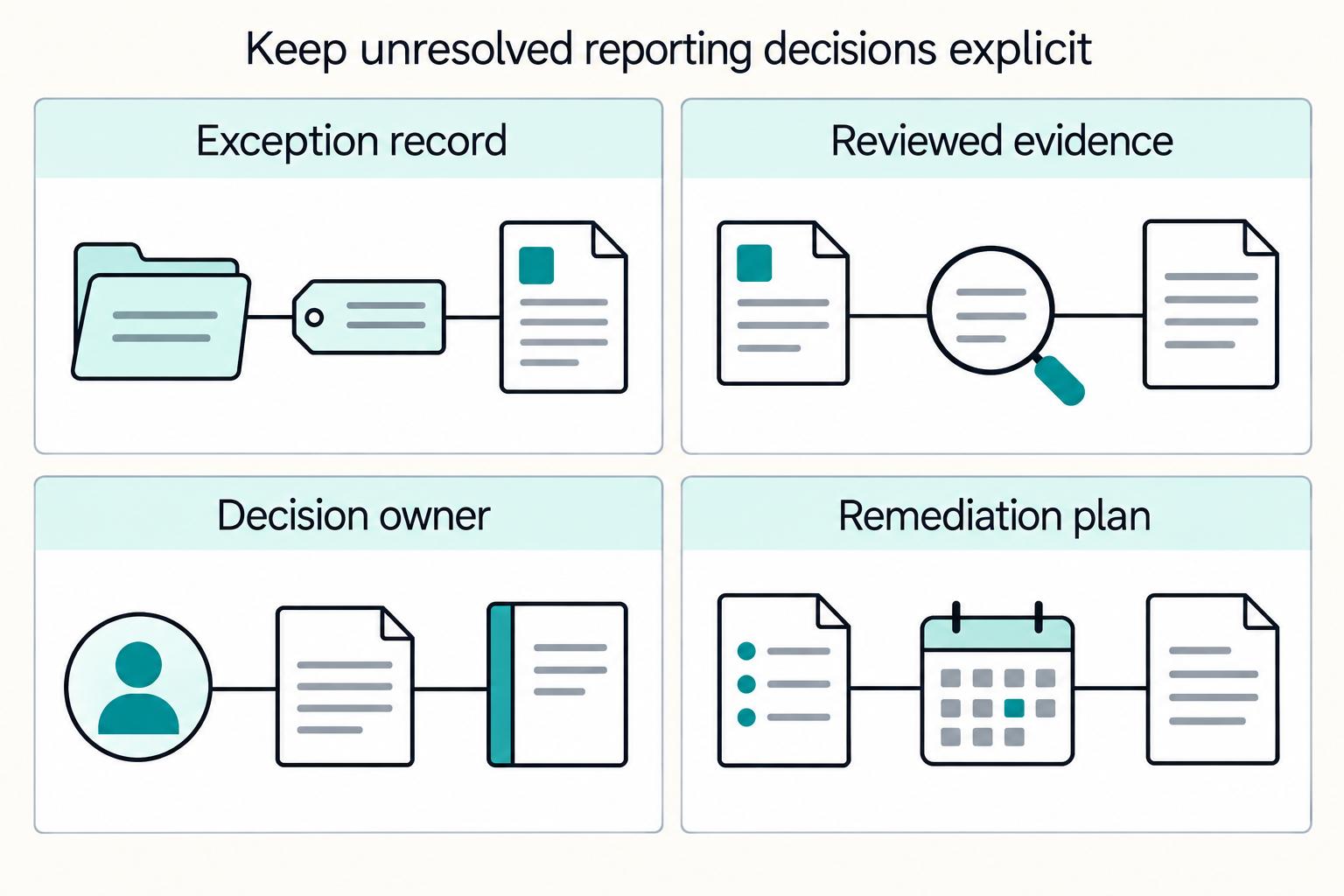
Exception queue and escalation triggers for legal finance and risk#
Use a formal exception queue for items that are still unresolved at reporting time. That keeps decisions explicit and auditable instead of letting them disappear into silence.
Use internal categories that separate different failure types#
Keep DAC7 cases separate so each reaches the right decision owner:
- Seller identity or tax-data gaps, including a missing TIN or conditional place of birth
- Unclear operator, activity, seller, or property-listing classification
- Quarterly consideration, activity-count, fee, or payout reconciliation differences
- File validation, late seller updates, or authority feedback requiring a corrected DAC7 record
These are internal queue labels, not statutory categories. Tie each case to the seller, reportable year, relevant activity, evidence, and proposed filing treatment.
Route by trigger, not by who noticed first#
| Trigger | Primary owner | Decision output |
|---|---|---|
| Unclear operator, seller, activity, or property scope | Named compliance owner | Documented inclusion or exclusion decision, or further fact-finding |
| Missing seller identity, tax, or conditional account data | Named operations owner | Seller chase, due-diligence evidence, and reporting treatment |
| Quarterly totals or activity counts fail reconciliation | Named finance owner | Source-to-file reconciliation and corrected extract |
| Submission rejected or a filed seller record changes | Named filing owner | Authority-specific resubmission or correction decision with version history |
This keeps interpretation, reporting operations, and control-risk issues from being mixed into one workflow.
Escalate unresolved items before filing pressure forces a weak call#
If 31 January is close and a seller record remains unresolved, escalate to a named approver instead of quietly omitting it. Record whether the issue changes the reportable population, a quarterly amount or count, a conditional field, or a filed record; confirm any correction route with the selected filing authority.
Keep an audit-ready exception register#
At minimum, record:
- exception category and record reference
- rationale and evidence reviewed
- approver and function
- remediation owner and target date
- reporting impact and follow-up actions
Keep the original classification and submitted file version alongside later corrections, so an authority query can be traced back to the decision made at filing.
Related reading: Real-Time Reporting Metrics Platform Finance Teams Can Actually Control.
Annual operating calendar and evidence pack#
A workable DAC7 process can use one annual calendar with one accountable owner. That helps keep timing, versions, and correction handling auditable across legal, compliance, and finance.
Build the calendar around jurisdiction and filing stage#
Track the chosen filing Member State and any other jurisdictions relevant to seller residence or property location. Use the DAC7 31 January reporting date as the annual anchor, then record the selected authority's opening window, file format, submission route, and correction procedure.
| Calendar stage | Anchor | Gate before moving | Evidence to retain |
|---|---|---|---|
| Period close | Internal year-end reporting cut-off by jurisdiction | Seller activity extract complete, exceptions tagged, scope decisions locked | Locked extract reference, exception register snapshot, scope approval log |
| Pre-submission review | Jurisdiction filing date confirmed for that jurisdiction | Completeness review passed, unresolved items have documented approver decisions, draft output reconciles to source totals | Review checklist, reconciliation file, approver sign-off |
| Submission | Actual filing event by jurisdiction | Final file version approved, submission channel details recorded | Final version ID or hash, submission receipt, confirmation record |
| Correction handling | Late seller updates, reconciliation findings, or authority feedback | Change, rationale, approver, and resubmission decision documented | Correction memo, before and after comparison, decision log, resubmission evidence |
| Post-filing review | Annual retrospective window after submission | Submitted totals reconcile to retained records, open issues assigned | Post-filing reconciliation, control-failure log, remediation tracker |
For each in-scope jurisdiction, record the local confirmation source, named internal owner, submission route, and correction path, not just a due date.
Define a minimum evidence pack you can defend#
Treat the evidence pack as the file you would use to explain how reporting decisions were made. At minimum, include:
- scope decisions and annual re-validation notes
- activity classification logs for edge cases and product changes
- control test results for completeness, reconciliation, and exception handling
- submission records, including the exact file version sent
- change history for corrections, policy updates, and schema or process changes tied to your DAC7 controls
Keep version history explicit. A dated trail of what changed, who approved it, and which seller population was affected is stronger than a generic reference to the latest file.
Add three fixed verification checkpoints#
Run three checks every year:
- Pre-submission completeness review: confirm each in-scope seller is either handled by your inclusion rules or routed into the formal exception queue with a documented decision.
- Post-submission reconciliation: match what was submitted to the retained output, then reconcile that output back to source populations and totals.
- Annual policy refresh: check your scope, data fields, exclusions, and correction process against current DAC7 guidance and local implementation, with jurisdiction-specific confirmation where needed.
EU requirements and local filing details#
Set by DAC7 Annex V
- Operator and excluded-seller definitions, due-diligence fields, and reportable seller information.
- Quarterly consideration, activity counts, fees, commissions, and taxes; conditional account and property fields.
- Annual reporting and seller information by 31 January after the reportable year; records available for five to ten years.
Confirm with the selected filing authority
- Registration, domestic submission channel, file validation, and opening window.
- Correction channel, supporting evidence, and any local response deadline.
- National implementation details and treatment of conditional fields in that filing channel.
- Retention procedure and seller-contact process in the chosen jurisdiction.
Give calendar integrity to one owner#
Assign one accountable owner for calendar integrity. Legal, compliance, and finance can each contribute, but one owner should maintain the master calendar, ensure local date confirmations are attached per jurisdiction, and confirm the evidence pack is complete before submission.
This pairs well with our guide on How to Handle Currency Gain and Loss Reporting for a Multi-Currency Platform.
What to do in the next 30 days#
Focus this month on four controls: scope, evidence, data readiness, and country confirmation. The goal is to defend your DAC7 decisions before the next filing cycle, not to automate uncertain logic.
Start with a live scope decision, not a slide deck#
Run one workshop across legal, compliance, product, and finance, and force a yes or no answer per entity on two questions: are you a platform operator, and do you facilitate a relevant activity? At EU level, relevant activities are rental of immovable property, personal services, sale of goods, and rental of any mode of transport.
Do not treat geography as the only scope test. Non-Union platform operators can still be in scope and may need to register and report in one EU country if they perform commercial activity in the Union. For each conclusion, record the entity, activity, decision owner, and source. If local interpretation is still open, mark it provisional and assign a recheck date.
Stand up a minimum evidence pack before you improve tooling#
Create one lean internal evidence pack now so decisions survive regulator or audit review. Keep it consistent:
- scope decisions by entity and activity
- decision log for edge cases and interpretation changes
- exception register for incomplete seller records or disputed classifications
- approval trail showing who approved what, and when
- local memo or adviser note where country interpretation was unclear
This matters because DAC7 places reporting obligations on platform operators, and due-diligence procedures are expected to confirm information accuracy.
Check your data model against the reporting outcome#
Validate whether your current data can produce the annual return required in your reporting jurisdiction before you add automation. Test real seller records, including messy cases, and confirm you can identify reportable sellers, map activity type correctly, and explain inclusions, exclusions, and reclassifications.
If your team cannot explain difficult records manually, automation will only scale errors. Fix onboarding and monitoring gaps first, especially where classifications may need to be revisited.
Confirm local interpretation in each relevant country#
DAC7 Annex V sets 31 January after the reportable year for the operator's return and seller information. For an Irish filing, verify the current Revenue Online Service instructions, validation, and correction process. For any other selected filing Member State, document that authority's procedure instead of copying Ireland's route.
Build a country list for seller residence and property locations, record the selected filing authority and any qualified non-Union position, and attach the authority page or adviser note used. Keep EU-level exclusions separate from local evidence and submission procedure.
If your team needs a jurisdiction-by-jurisdiction readiness check before the next reporting window, talk to Gruv to validate rollout assumptions and operating controls.
Frequently Asked Questions
What does DAC7 require platform operators to report in practice?
Reporting Platform Operators file annual information on reportable sellers, including identity data, quarterly consideration and counts of relevant activities, and quarterly fees, commissions, or taxes withheld or charged. A financial account identifier is reported when available unless the seller-residence Member State's competent authority has published that it does not intend to use it; property rentals require additional listing information. DAC7 Annex V sets 31 January after the reportable year for reporting and providing the reported information to sellers; confirm the selected authority's submission route.
Do non-EU platform operators have obligations to EU Member States tax authorities?
Yes, they can. Non-Union Platform Operators can be required to register and report in one EU country, and cited Member State guidance says a non-EU operator may choose a Member State to register and file for DAC7. If the platform facilitates a relevant activity by a reportable seller in a Member State, treat the operator as potentially in scope until local advice confirms the position.
Which activities count as reportable commercial activities under current guidance?
Current guidance groups reportable activities into four categories: rental of immovable property, personal services, sale of goods, and rental of any mode of transport. Platforms should map onboarding and transaction logic to those categories before finalizing reporting. If a launch blends models, run a classification review before go-live.
What is excluded from DAC7 reporting, and where do teams commonly misclassify scope?
DAC7 Annex V defines an Excluded Platform Operator whose entire business model has no reportable sellers, subject to an upfront and annual demonstration to the relevant authority. Its EU-level excluded-seller categories include governmental and listed entities, entities with more than 2,000 rentals for one property listing, and goods sellers with fewer than 30 sales where total consideration does not exceed EUR 2,000 in the reportable period. Confirm the evidence and filing procedure in the selected Member State.
How should we handle conflicts between GDPR minimization and DAC7 reporting needs?
Use a both-and approach: collect what DAC7 reporting requires and keep the processing GDPR-compliant. Document the reporting purpose for each field, restrict access, and apply bounded retention. The article also recommends a field register and joint privacy and tax review for schema changes.
When did Council Directive (EU) 2021/514 take effect, and what does that mean for current-year operations?
The directive is dated 22 March 2021 and entered into force 20 days after its Official Journal publication on 25 March 2021. Member States generally had to adopt implementing laws by 31 December 2022 and apply them from 1 January 2023. The first exchange for 2023 information took place at the end of February 2024. Track the current reportable year and the selected authority's filing process.
Try a related tool
Researched and edited by the Gruv editorial team. Gruv builds cross-border billing, payouts, and finance-operations software for global businesses.
Sources
- agenziaentrate.gov.it/portale/web/english/foreign-platform-operato...trusted
- ec.europa.eu/commission/presscorner/api/files/document/pr...trusted
- eur-lex.europa.eu/eli/dir/2021/514/oj/engtrusted
- eur-lex.europa.eu/legal-content/EN/NIMtrusted
- op.europa.eu/en/publication-detail/-/publication/935ecf13...trusted
- sede.agenciatributaria.gob.es/Sede/en_gb/todas-gestiones/impuestos-tasas/d...trusted
- taxation-customs.ec.europa.eu/taxation/tax-transparency-cooperation/admini...trusted
- taxation-customs.ec.europa.eu/taxation/tax-transparency-cooperation/admini...trusted
Educational content only. Not legal, tax, or financial advice.
Related Posts

The Freelance Payment Penalty: A Modeled Audit of Platform Fees, FX Spreads, and Payout Delays
The money rarely disappears through a single, easy-to-spot fee. The real loss is stacked. A marketplace takes its commission, a processor adds a charge for international cards, a bank or payment company converts the currency at a spread, a platform holds the funds before release, and a wire sheds a little to intermediaries on the way in. Each layer looks defensible on its own, but the worker feels the combined result as a smaller deposit and a later payday.

How to Respond to a Subpoena for Business Records
Move fast, but do not produce records on instinct. If you need to **respond to a subpoena for business records**, your immediate job is to control deadlines, preserve records, and make any later production defensible.

A US Expat's Guide to Investing in UCITS ETFs to Avoid PFIC Issues
The real problem is a two-system conflict. U.S. tax treatment can punish the wrong fund choice, while local product-access constraints can block the funds you want to buy in the first place. For **us expat ucits etfs**, the practical question is not "Which product is best?" It is "What can I access, report, and keep doing every year without guessing?" Use this four-part filter before any trade: