
Quick Answer
Set each entity’s functional currency and accounting measurement rules, then reconcile foreign units and carrying amounts through recognition, remeasurement and settlement. Calculate settlement FX from the carried balance; report relabelling must not create another journal.
Set Up a Reliable Currency Gain and Loss Reporting Process#
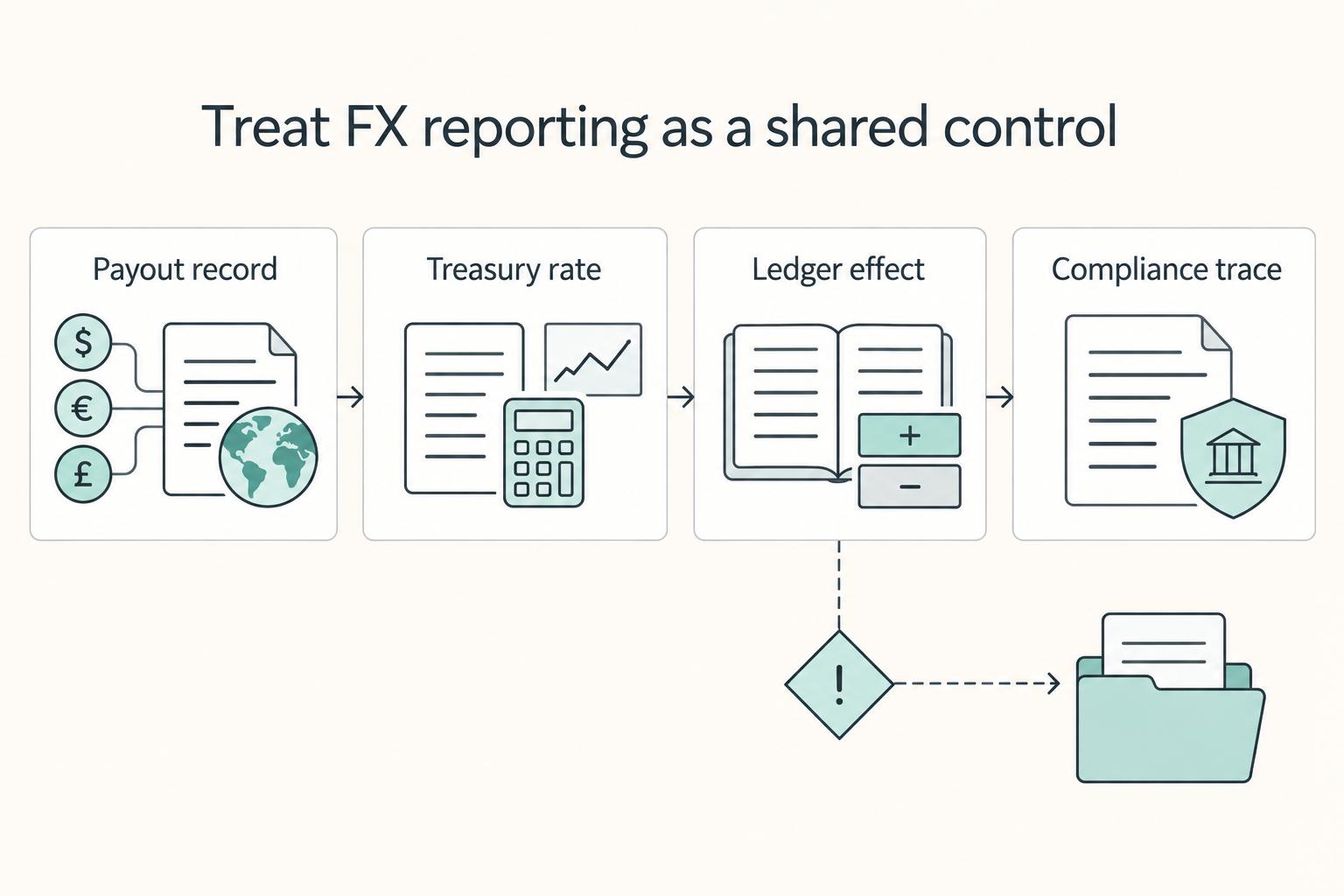
Currency gain and loss reporting can break down when treasury owns the rates, accounting owns the journals, and no one owns the full trail from transaction to close package. On a multi-currency platform, this has to operate as a shared control across finance, compliance, risk, and platform operations, not as a side task for the team booking conversions.
Step 1 Treat FX reporting as a shared control#
Start with the entity and its functional currency: the currency of its primary economic environment, not whichever currency the dashboard displays. A foreign-currency payable or receivable can change in functional-currency value before settlement. Translating financial statements into another presentation currency is a separate job.
That shared-control view matters because the same reporting output can support close-support review, exception handling, and compliance follow-up. Treasury may supply the rate logic, but accounting still has to reconcile the effect, and compliance may need the platform record trail underneath it. Design the process around those handoffs first.
Step 2 Define realized and unrealized positions before you build reports#
This guide uses ordinary foreign-currency monetary receivables and payables under IAS 21 as its accounting illustration. Initial recognition uses the transaction-date spot rate; open monetary balances use the reporting-date closing rate. Settlement recognizes the difference from the balance carried immediately before settlement. A partial payment settles only its portion. Non-monetary items, hedges, net investments, hyperinflation and non-exchangeable currencies need their own treatment.
“Realized” and “unrealized” are useful reporting labels, but an open monetary balance can already have exchange differences recognized in profit or loss. When it settles, do not book its entire lifetime difference again on top of previous remeasurement. Your report must explain both the period journal and any relabelling of lifetime amounts.
Step 3 Set the scope and evidence standard early#
Treat this as a phased setup sequence, but do not assume the timing is automatic. The real dependency is data quality, ownership, and whether reviewers can reproduce the numbers. A practical verification point is simple: can finance trace one aggregate variance down to transaction-level postings fast enough to support close review?
Store rate direction explicitly: USD per EUR is different from EUR per USD. Retain the source, effective date and calculation precision; round the final posting under the entity policy. A formatted display rate should not be the input to a calculation.
The example assumes freely exchangeable currencies, no hedge and no foreign-operation or presentation-currency translation. Apply the accounting framework adopted by the entity; U.S. tax rules do not replace financial-reporting measurement rules.
What to prepare before you start#
Set the accounting scope before building the report: entity, functional currency, monetary balances and reporting dates. Then assign the owners who provide source data, rates, journals and review.
| Preparation step | What to set | Article checkpoint |
|---|---|---|
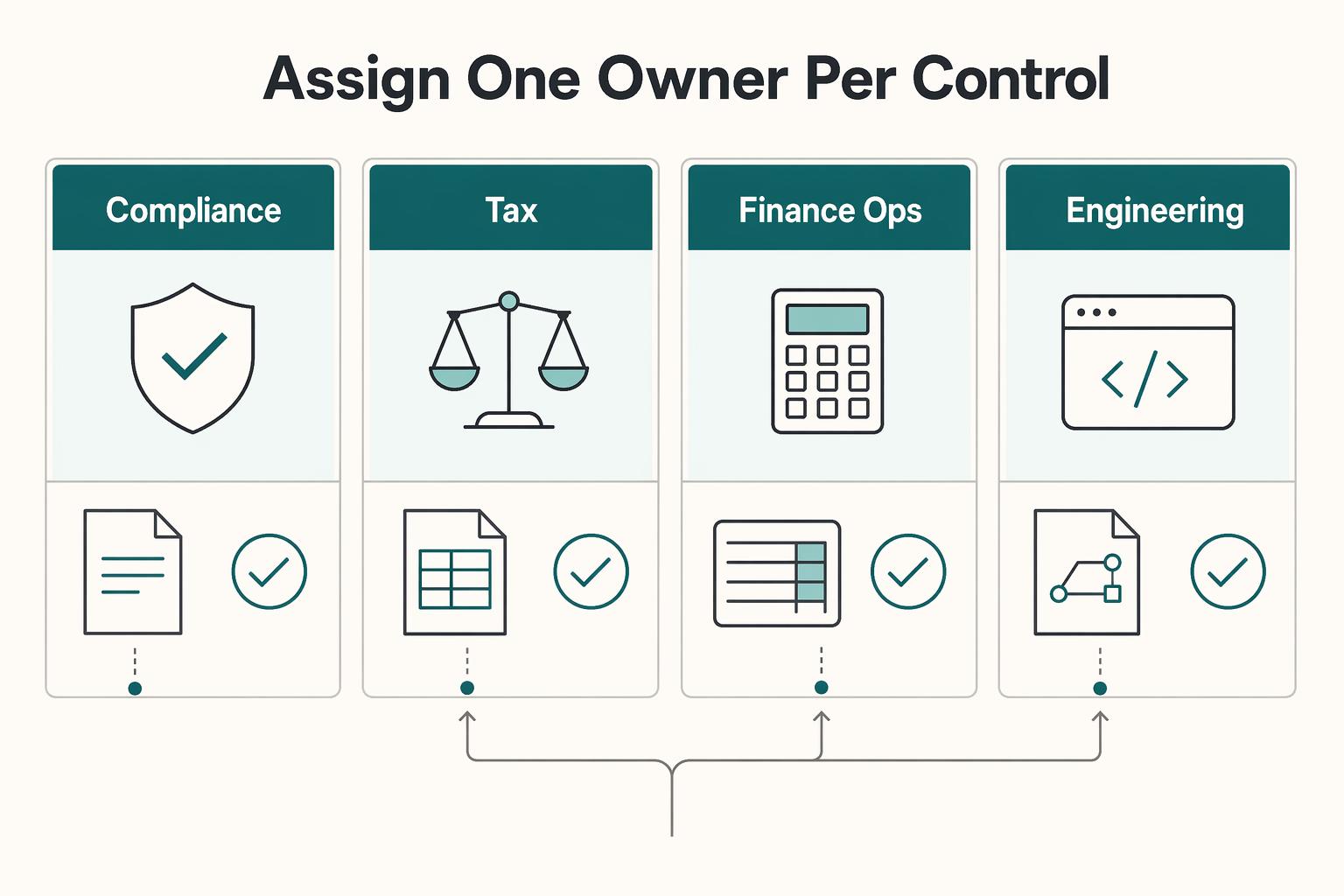
| Assign named owners and one exception approver | Name a person for treasury, accounting, compliance, and platform ops, and appoint one escalation approver above the materiality threshold | Each owner should be able to state their input and output in one sentence |
| Confirm scope and inventory the records you will reconcile | Identify functional and presentation currencies separately, monetary balances, reporting dates and the accounting framework; inventory transaction, settlement and remeasurement postings. | Test one legal entity and one currency pair end to end from source transaction or payout to posting reference |
| Separate financial reporting from tax | Keep tax valuation and filing rules in their own workstream | Do not use a foreign-account filing threshold to choose an accounting rate. |
Step 1 Assign named owners and one exception approver#
Assign a named person, not a team label, for treasury, accounting, compliance, and platform ops. Then appoint one escalation approver for exceptions above your materiality threshold so unresolved variances do not stall close.
Use one quick checkpoint: each owner should be able to state their input and output in one sentence. If they cannot, your control boundary is still unclear.
Step 2 Confirm scope and inventory the records you will reconcile#
For each legal entity, identify its functional currency, reporting currency and relevant receivables, payables or foreign-currency cash. A platform’s customer-money obligations can differ from its own revenue and expenses; preserve the asset and liability records rather than reporting all held balances as platform income.
Inventory the records you must tie together:
- ledger journals
- FX conversions
- exposure feeds
- payout data
- entity-level currency pair activity
Before you scale, test one legal entity and one currency pair end to end from source transaction or payout to posting reference. If the trace fails, your evidence standard is not ready.
Step 3 Separate accounting measurement from tax reporting#
Tax and regulatory reports can need the same transaction population with different valuation dates or conversion rules. Give those reports their own specification and owner. The financial close must follow the entity’s accounting framework, not an IRS foreign-asset reporting threshold.
Set policy boundaries before you pick tools#
Start with policy, then evaluate tools against it. If tool behavior defines your process first, rate assumptions, exception handling, and evidence standards can drift without clear ownership.
| Policy step | Main rule | Article check |
|---|---|---|
| Document rate-policy choices and ownership | Write down when each rate approach is allowed, who approves it, and how exceptions are escalated | If two owners give different answers on which approach applies, the policy is not ready |
| Separate close-support reporting from monitoring views | Close-support reporting should use reproducible rate-source logic, stable inputs, and review; intramonth monitoring can use faster provisional views | If a provisional view is reused for close support, recalculate it under the close-support rules before relying on it |
| Enforce a hard auditability standard | No number should enter reporting unless it can be traced to a source record, rate source, and posting reference | Pressure-test one reported variance from summary output back to transaction, rate, and posting |
| Score tools against controls, not demos | Evaluate tools against control requirements first and ask vendors to show how reported numbers are built and how exceptions are captured | At minimum, cover traceable source linkage, visible rate source, posting references, approval capture, and clear labeling of provisional versus close-support outputs |
Step 1 Document rate-policy choices and ownership#
The rate policy should specify initial transaction measurement, reporting-date remeasurement and settlement. IAS 21 permits an average that approximates transaction-date rates, but significant fluctuations can make it inappropriate. A single monthly rate must not replace a required closing rate simply because daily monitoring is expensive.
Confirm the quote direction, applicable dates and approved source for one entity and currency pair. Keep evidence of rate corrections and how affected postings were recalculated. Monitoring cadence and recognition rules are separate choices.
Step 2 Separate close-support reporting from monitoring views#
Define decision rules by report purpose, not just format. For close-support reporting, require reproducible rate-source logic, stable inputs, and review. For intramonth monitoring, allow faster provisional views, but mark them clearly and surface missing records or timing gaps.
If a provisional view is reused for close support, recalculate it under the close-support rules before relying on it.
Step 3 Enforce a hard auditability standard#
Every reported number needs a source record, applied rate and journal reference. That is an internal traceability standard for this reporting process; it does not imply every platform is subject to a bank’s recordkeeping regime.
Pressure-test this with one reported variance. If you cannot trace from summary output back to transaction, rate, and posting, fix evidence integrity before improving presentation.
Step 4 Score tools against controls, not demos#
Evaluate tools against your control requirements first, then compare features. Ask each vendor to show, in product outputs you can retain, how reported numbers are built and how exceptions are captured.
At minimum, your controls list should cover traceable source linkage, visible rate source, posting references, approval capture, and clear labeling of provisional versus close-support outputs.
For a step-by-step walkthrough, see How to Handle Multi-Currency Pricing for Your SaaS Product.
Build the minimum data model and evidence pack#
Once policy is set, make every reported FX number reconstructable. The goal is a small, linked dataset plus a repeatable close pack that lets finance explain variance without rebuilding logic from memory.
Step 1 Define the minimum linked record for traceability#
Keep entity, functional currency, foreign-currency amount, initial recognition date/rate, outstanding units, previous carrying amount, settlement date/amount, rate source and journal ID together. Distinguish the obligation from each partial settlement and remeasurement event. That lets a reviewer reproduce the remaining balance without treating a whole invoice as settled.
Add the report period and calculation version to each extract. For customer-money balances, retain the ownership and corresponding liability mapping so an FX report cannot turn held funds into platform revenue.
Step 2 Capture hedge context only when it is explicit and linked#
A hedge identifier alone does not establish hedge accounting. If it applies, retain the designation and link it to the exposure and approved accounting treatment. Keep those calculations separate from the ordinary unhedged monetary-item example below.
If hedges are not used for a given flow, keep that state explicit and consistent. The failure mode to avoid is narrative-only explanation that cannot be traced in the data.
Step 3 Standardize the close evidence pack#
Use the same evidence pack each close cycle so reviewers can follow a stable review path and spot exceptions quickly.
| Evidence item | What it should show | Common failure mode |
|---|---|---|
| Variance summary | Aggregated FX movement by legal entity and currency pair | Summary totals with no drill path |
| Top drivers | Largest contributors to period movement | Driver labels not tied to source postings |
| Exception log | Missing records, stale rates, mapping breaks, policy overrides | Exceptions handled only in chat/email |
| Approvals | Reviewer and approver sign-off for close-grade output | Sign-off not tied to final reviewed version |
| Unresolved items with owners | Open items, owner, next action | Open issues left in meeting notes |
Step 4 Run a traceability drill against a team-defined review window
Before close pressure, test whether a reviewer can trace one aggregated variance from the close pack to underlying source postings, rate timestamps, and posting references within your internal review target. Use a reviewer who did not build the report.
If the trace breaks, tighten the data links or the evidence pack before scaling reporting.
If you want a deeper dive, read How to Handle Realized and Unrealized Gains/Losses on Foreign Currency.
Choose daily or close-cycle analysis with explicit decision rules#
Choose monitoring cadence for operational visibility. Daily review can find exposure or data changes earlier; month-end review can be lighter to run. Neither choice changes the accounting rates required for transactions, settlement and reporting dates.
Step 1 Set your default cadence with explicit criteria#
Define in policy which conditions move you to daily review, for example sustained volatility, heavier payout runs, or expanding currency-pair exposure, and which conditions keep you on close-cycle review. Consistency is what matters: the same conditions should trigger the same cadence decision across periods.
State the tradeoff plainly in your operating standard. Daily analysis usually finds issues earlier but increases review load; close-cycle-only is lighter to run but increases surprise risk at close.
| Approach | Cadence | Staffing cost | Detection speed | Error-recovery burden |
|---|---|---|---|---|
| Daily operational monitoring | Intramonth, often each business day | Higher | Faster | Lower per issue when caught early |
| Close-cycle operational review | Month-end or quarter-end close | Lower day to day | Slower | Higher when issues accumulate |
Step 2 Trigger intramonth investigation when materiality is crossed#
Document your materiality threshold by entity, currency pair, or reporting output, and assign an owner. If intramonth variance crosses that threshold, investigate immediately instead of waiting for month-end reporting.
Keep the first check focused: confirm whether the movement reflects a real business event or a control/data break. If the variance cannot be traced quickly from summary output to supporting exposure and posting records, escalate the data issue at once.
Step 3 Mark incomplete inputs as provisional and block executive conclusions#
If your source completeness is below your minimum standard, classify the output as provisional and block executive conclusions until inputs are complete or formally accepted under policy. Label the report clearly, list affected entities or currency pairs, and log what is missing.
We covered this in detail in How to Choose a Presentation Currency for Financial Reports.
Run month-end and quarter-end close without surprises#
At close, reconcile foreign-currency units and functional-currency carrying amounts. Separate additions, settled portions, incremental remeasurement and corrections. This rollforward prevents a settlement journal from repeating an exchange difference already recognized at the previous close.
| Illustrative event | Foreign payable left | USD carrying amount | Incremental FX loss |
|---|---|---|---|
| Recognize EUR1,000 at USD1.10/EUR | EUR1,000 | $1,100 | $0 |
| First close at USD1.12/EUR | EUR1,000 | $1,120 | $20 |
| Pay EUR400 at USD1.15/EUR; remove its $448 carrying amount | EUR600 | $672 | $12 |
| Next close at USD1.13/EUR | EUR600 | $678 | $6 |
These are assumed rates for one unhedged payable in a USD-functional entity. Initial recognition credits the payable $1,100. The first close adds $20 to that liability and records a $20 FX loss. Paying EUR400 costs $460: debit the payable $448, debit FX loss $12 and credit cash $460. The remaining EUR600 stays at $672 until its next measurement.
At the next close, EUR600 × USD1.13/EUR equals $678, so add another $6 to the liability and record that loss. The carrying-amount rollforward is $1,100 opening recognition − $460 cash paid + $20 + $12 + $6 FX losses = $678. The foreign-unit check is EUR1,000 − EUR400 = EUR600.
The settled portion’s lifetime loss is EUR400 × (1.15 − 1.10) = $20. Of that, $8 was recognized at the first close and $12 at settlement. A realized/unrealized report can relabel the $8 as belonging to the settled portion; it must not create another $20 journal. The remaining balance’s lifetime unrealized loss is EUR600 × (1.13 − 1.10) = $18. Lifetime loss totals $38, matching the three incremental journals.
Record separately charged transfer fees outside this FX rollforward. If a $2 fee accompanies the $460 principal payment, cash is $462 in total, but only $460 settles the illustrated payable. A combined net-bank line needs that split before it can explain the carrying amount.
Escalate exceptions with a materiality matrix#
Route exceptions by the record that is wrong: accounting measurement, rate data, settlement mapping or a separate tax report. Materiality guides investigation and review; it does not justify labelling missing movement as exchange-rate loss.
Step 1 Build the matrix around three inputs#
For each exception, record the amount, affected entity and root cause. Check whether the issue changes foreign units, functional-currency carrying value, period FX or a separately specified tax output.
| Trigger | Likely owner | What to check before routing |
|---|---|---|
| Breach of internal materiality threshold and root cause is posting logic | Accounting systems owner | Journal references, posting rules, entity mapping, and realized vs unrealized tagging |
| Exception tied to rate-source integrity or timestamp mismatch | Treasury data owner | Rate source, timestamp, fallback-rate logic, affected currency pairs, and whether management/compliance views used the same source |
| Difference between the accounting and tax report | Owner of the affected reporting specification | Compare population, valuation date and rate rules before deciding either output is wrong. |
If one exception affects both booking logic and filing impact, route both tracks in parallel.
Step 2 Route by root cause, then confirm filing sensitivity#
Route to the owner of the root cause, not the team that found the issue. Posting logic goes to accounting systems; rate-source integrity goes to treasury data; any filing impact goes to compliance/legal.
If a tax output changes, assess that output under its own rules. Keep the correction tied to the relevant filer and reporting period without assuming an accounting FX journal automatically creates a foreign-account filing obligation.
Step 3 Enforce time-bound states and preserve closure evidence#
Require four states for every exception: identified, investigated, corrected, and prevention action assigned. Each state needs an owner, timestamp, and due date.
Retain the original variance, source records, root cause, correction journal, reviewer and affected periods. A closed exception should show how the foreign units and carrying amount reconcile after the correction.
Need the full breakdown? Read Choosing Functional Currency for Your Business.
Avoid common implementation mistakes and recover fast#
Implementation failures usually come from sequencing, not intent. If one appears, contain it first, then restart from the smallest control set that restores ownership and traceability.
| Common mistake | Fast recovery |
|---|---|
| Launching FX gain/loss dashboards before policy boundaries are defined | Pause use of the affected output, map its entity/currency/measurement policy and recalculate from the retained transaction population. |
| Rebooking the lifetime settlement difference after prior remeasurement | Calculate the incremental settlement difference from the carried balance; relabel report categories without creating a duplicate journal. |
| Mixing data from unlinked systems | Recover the missing movement and preserve actual money records. Do not discard unlinked bank activity or use FX as a balancing plug. |
| Overbuilding premium workflows too early | Start with minimum viable controls, then expand only when exception patterns repeat enough to justify more automation or approvals. This fits the broader risk pattern in automated FX tooling: benefits can come with risks that require close monitoring. |
Close with a rollforward the next reviewer can reproduce#
A useful FX report explains how foreign units and carrying values moved. Establish the entity and measurement rules, link each partial settlement and remeasurement, and preserve a reproducible close extract. Dashboards become useful once the underlying rollforward is right.
Start with one payable or receivable that spans a close and a partial payment. If its units, carrying amount and incremental FX reconcile, use the same record model for the wider population. Keep presentation translation, fees and tax outputs distinct so they cannot conceal a duplicate or missing posting.
Frequently Asked Questions
What is the practical difference between Realized FX gain/loss and Unrealized FX gain/loss for a multi-currency platform?
For monetary items in this illustration, settlement moves the relevant portion into a settled reporting category. Open balances remain exposed and are remeasured at reporting dates. Prior recognized differences carry forward: the settlement journal uses the remaining carrying amount rather than rebooking the full lifetime movement.
What must be included in a Currency Realised Gain/Loss report to satisfy audit and compliance review?
Include entity and functional currency, foreign amount, recognition and settlement references, previous carrying value, applied rates and incremental journals. Reconcile summary totals to both foreign units and functional-currency balances, and keep any report-category relabelling separate from new postings.
When should we use a Daily rate environment instead of a Single rate environment?
Treat those product labels as configuration options, then check what rates the tool actually applies. Monitoring frequency does not choose the accounting measurement method. Transaction-rate approximations, closing-rate measurement and settlement rates serve different jobs.
What should trigger escalation before month-end if variance is still under investigation?
Investigate material unexplained changes, missing settlements, stale or inverted rates and duplicate remeasurement journals before sign-off. Route each case to its data or accounting owner and retain the correction evidence.
How do FATCA and Foreign account holder reporting interact with FX gain/loss controls?
Tax reporting uses its own scope, valuation and conversion rules. The FX subledger can supply account and transaction evidence, but FATCA or foreign-asset filing rules do not determine IAS 21 recognition or replace the applicable financial-reporting policy.
What records should be retained to support 1099-K or other IRS-related reviews linked to FX activity?
Keep the transaction population, currency amounts, applicable tax conversion inputs and any corrections for the specific report. Reconcile it to the financial ledger, then explain intentional rule differences. A 1099-K output and a foreign-account report do not have interchangeable scopes.
Researched and edited by the Gruv editorial team. Gruv builds cross-border billing, payouts, and finance-operations software for global businesses.
Sources
Includes 2 external sources outside the trusted-domain allowlist.
Educational content only. Not legal, tax, or financial advice.
Related Posts

How to Handle Realized and Unrealized Gains/Losses on Foreign Currency
When a foreign-currency payment lands, make one immediate split: lock the receipt in USD first, then track any later exchange-rate movement separately until a relevant realization event occurs. That helps you avoid mixing ordinary business income with currency gain or loss.

FATCA Compliance for Marketplace Platforms: Identifying and Reporting Foreign Account Holders
For marketplace teams handling cross-border payouts, FATCA work is mostly a control-design problem. You need to decide what to implement first, what evidence to keep, and what to escalate before a payout creates avoidable reporting or withholding risk. The practical question is not whether FATCA exists, but which controls actually reduce reporting errors and potential 30% withholding outcomes.
1099-K Reporting Threshold After the IRS Delay: Control Updates for Platform Operators
For federal third-party network reporting, a TPSO generally must file Form 1099-K for a payee who exceeds both $20,000 in gross reportable payments and 200 transactions in the calendar year. The 2025 law restored that threshold retroactively. Update the rules built for the earlier phase-in, while keeping payment-card reporting, backup withholding and state rules separate.