
Quick Answer
Under IAS 21, prioritize currencies influencing sales prices and core operating costs. Use financing and retained receipts as supporting indicators, document the conclusion, and apply consistent foreign-currency measurement. Presentation, settlement and tax-reporting currencies can differ.
What Is Functional Currency?#
Your functional currency for business is the currency of your business's primary economic environment. It is the base currency you use to measure performance. Use the wrong base, and results can look weaker or stronger because of translation noise rather than real operating change.
IAS 21 is the core rule set here. It covers foreign-currency transactions and balances, and it allows financial statements to be presented in a different currency. For day-to-day decisions, the practical point is simpler: functional currency is a business measurement decision based on underlying economics, not a personal spending preference, and it does not automatically follow where you live.
The three currencies people mix up#
These labels are related, but they do different jobs.
| Currency type | What it controls | Common confusion | What to set in your systems |
|---|---|---|---|
| Functional currency | How you measure operating results and treat other currencies as foreign | Treated as the same as your residence or bank-app default currency | Accounting base currency, internal performance tracking, and profit trend review |
| Presentation currency | The currency used to present financial statements | Assumed to always match functional currency | Financial statement output and reporting format |
| Local or spending currency | The currency you use for day-to-day payments where you operate or live | Assumed to define the business currency | Cards, wallets, and payment rails for practical spending |
Review invoices, contracts and recurring core costs to identify the currencies influencing sales prices and delivery costs. Give those primary economic indicators priority under IAS 21.
Use this, not that#
When you decide, separate business economics from personal geography.
| Use | Not that |
|---|---|
| the currency that mainly drives revenue and core operating costs | the currency you use most for household spending |
| primary sales-price and delivery-cost indicators, supported by financing and retained receipts | the currency of a recent move or travel base |
| evidence from pricing, contracts, invoices, and recurring supplier payments | a default based on where your debit card is used most |
If signals are mixed, IAS 21 does not give you a fixed formula. It requires judgment to select the currency that most faithfully represents your underlying transactions, events, and conditions.
Apply the Criteria to Your Business#
Corporate guidance still helps, but only the part that fits. IAS 21 determines functional currency at the entity level, and different entities can have different functional currencies. So for a solo business, you do not need a group-style answer. You need a defensible answer for your own entity.
Get this wrong and the problem is practical, not theoretical. Reported results can be materially distorted, and performance trends can become harder to interpret. Functional currency also should not be changed casually. Under IAS 21, a change is tied to a real change in underlying transactions, events, and conditions. Related: How to Choose a Presentation Currency for Financial Reports.
Collect the evidence, weigh it together, and record your judgment#
Use the IAS 21 criteria in priority order. Paragraph 9 gives primary weight to currencies influencing sales prices and labour, materials and other delivery costs, including the competitive and regulatory pricing environment. Financing and the currency in which operating receipts are retained are supporting indicators under paragraph 10; foreign operations have additional considerations under paragraph 11.
| Step | Focus | Key inputs | Output |
|---|---|---|---|
| 1 | Document your revenue currency | invoices, contracts, and payout statements; keep pricing or invoice currency separate from settlement currency and recurring conversion steps | a short revenue summary by income stream showing invoice currency, settlement currency, and where conversions happen |
| 2 | Document your core operating cost base | expense ledger, business card statements, recurring vendor bills, and contractor invoices; focus on recurring operating costs, not one-off spikes | a categorized cost summary showing currency patterns in your recurring operating base |
| 3 | Document supporting indicators | Financing records and where operating receipts are retained | A note on how these support the primary sales-price and cost evidence |
If indicators conflict, IAS 21 paragraph 12 prioritizes the paragraph 9 sales-price and cost indicators. Document the reasoning and review a mixed case with your accountant. Personal preferences or a desired reporting result do not determine functional currency.
Step 1: Document your revenue currency#
Start with how you sell the work and how cash actually arrives. Pull invoices, contracts, and payout statements for a period that reflects your current business model.
As a practical check, keep pricing and settlement separate:
- pricing or invoice currency
- settlement currency, meaning what lands in your account
- recurring conversion steps between the two
Your output here should be a short revenue summary by income stream that shows invoice currency, settlement currency, and where conversions happen.
Step 2: Document your core operating cost base#
Next, map core operating cash outflows from your business records. Use your expense ledger, business card statements, recurring vendor bills, and contractor invoices. Focus on recurring operating costs, not one-off spikes.
Your output here should be a categorized cost summary showing currency patterns in your recurring operating base. If you need cleaner records first, How to Manage Bookkeeping for Your Freelance Business is a useful companion.
Step 3: Document Supporting Indicators#
Record the currency of financing and the currency in which operating receipts are usually retained. These support the primary indicators; they do not replace the currencies influencing sales prices and core delivery costs.
Write a brief note explaining how the supporting indicators relate to the sales-price and cost evidence. Keep tax-reporting requirements separate from this accounting determination.
| Evidence area | What to collect | Stronger evidence looks like | What to do if mixed |
|---|---|---|---|
| Revenue currency | Invoices, contracts, payout statements | Sales prices are mainly influenced by one currency and its competitive environment | Distinguish currencies influencing prices from settlement or automatic conversion |
| Core operating costs | Expense ledger, recurring vendor bills, contractor invoices | Recurring operating costs cluster in one currency | Remove one-offs, then recheck only essential recurring costs |
| Supporting indicators | Financing records and retained operating receipts | Consistent evidence supporting the primary indicators | Give sales-price and core-cost evidence priority when indicators conflict |
Keep the evidence pack together: invoices, payout exports, expense summaries, and a one-page decision memo.
If the answer is still unclear#
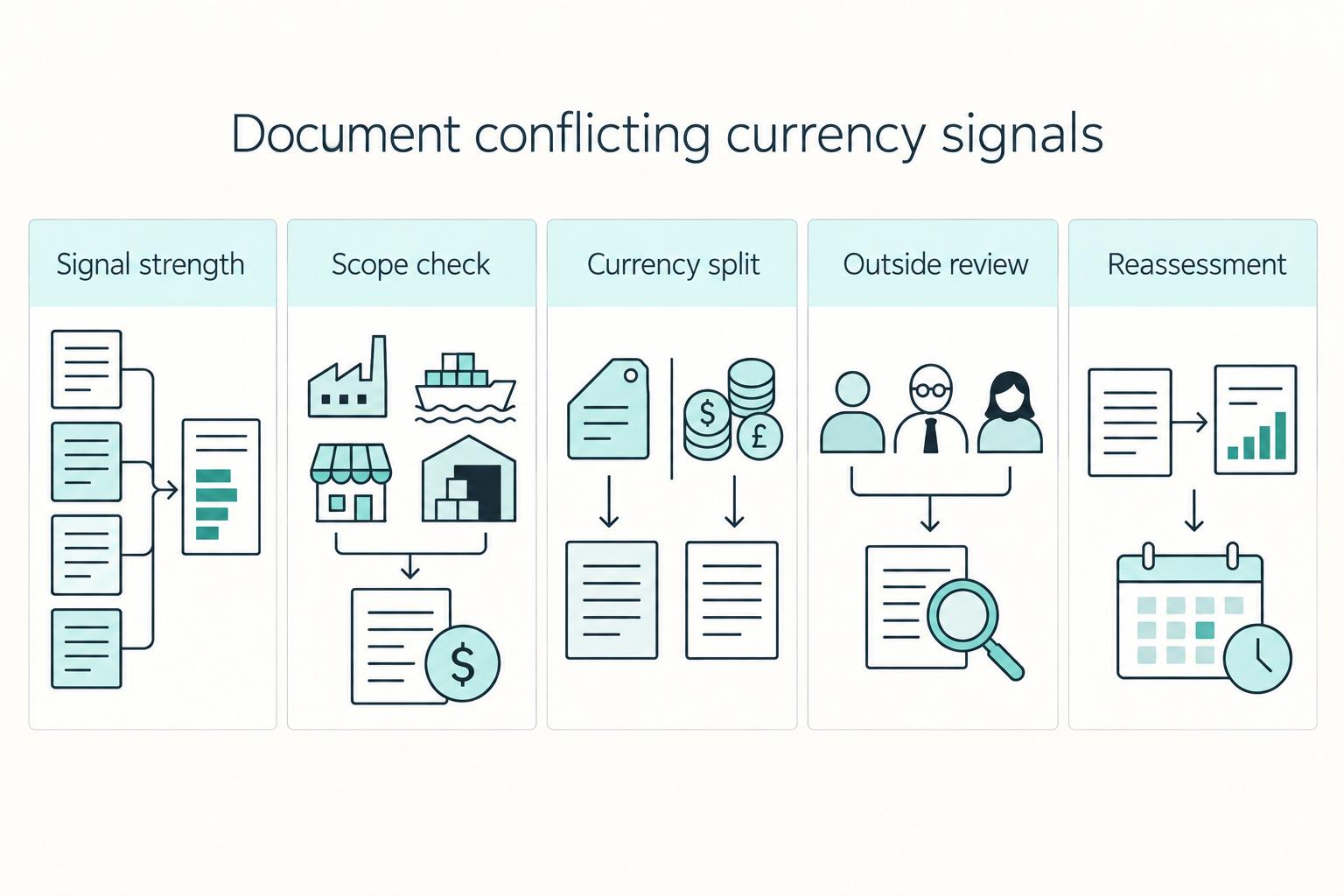
If the signals conflict, do not force certainty. The goal is not a perfect formula. It is a documented judgment you can explain and revisit if the business changes, using this internal review process:
| Check | Action |
|---|---|
| Conflicting signals | List conflicting signals on one page and label each as strong, moderate, or weak |
| Scope | Recheck that your scope is consistent and documented, for example business cash flows vs personal cash flows |
| Pricing vs settlement | Recheck that pricing currency and settlement currency were not merged |
| Outside review | Review the file with your accountant or bookkeeper and ask them to challenge your assumptions |
| Business-model change | Reassess after a material business-model change, such as client mix, vendor mix, or payment setup |
If you want a deeper dive, read Hiring Your First Subcontractor: Legal and Financial Steps. Before you finalize your working decision, run a quick scenario check on invoice currency, conversion path, and withdrawal costs with the payment fee comparison tool.
Example: A U.S. Developer in Portugal#
For this kind of fact pattern, do not let household EUR spending outweigh the business evidence. Your business functional currency follows the business's primary economic environment, not your personal spending pattern.
If you are a U.S. developer living in Portugal, your household life may be mostly EUR because Portugal is in the euro area. Keep that separate from business signals unless those costs are true recurring business expenses. Also keep pricing currency and payout currency separate. Clients can be charged in one currency (presentment) while your bank receives another (settlement).
| Observed fact | Why it matters | Practical decision signal |
|---|---|---|
| Majority client currency, based on contracts, invoices, and payout exports | Revenue evidence helps show the currency environment your business actually sells into and collects from. | USD pricing can support USD if that currency mainly influences sales prices. Automatic EUR settlement does not itself change that pricing environment. |
| Core operating costs, based on your ledger and recurring bills | Recurring operating costs show which currency your business depends on to run. | If recurring costs also cluster in USD, that supports USD. If costs cluster in EUR, treat it as a mixed case and weigh cost and revenue evidence together. |
| Personal living costs are mainly EUR because you live in Portugal | Physical location can matter, but it is not always decisive for a distinct operation. | Use this as context, not the lead signal, unless those local EUR costs are truly business operating costs. |
| You file a U.S. tax return and must report amounts in U.S. dollars | U.S. reporting is an operational constraint you must plan around. | Meet the USD tax-reporting requirement separately; it does not determine the IAS 21 accounting result. |
Before you lock the decision, write a one-page memo and attach the source files. Mark where invoice currency, presentment currency, and settlement currency differ so you do not collapse different signals into one.
If the evidence points to USD, set your accounting base currency to USD. Align primary business accounts where practical, and treat EUR transactions as foreign-currency items in your process. Revisit only if underlying business conditions change. Then move to realized and unrealized FX gains and losses for execution.
You might also find this useful: A guide to currency options for 'hedging' against forex risk.
Apply one documented currency rule across records, accounts, and reporting#
The low-risk move here is consistency in documentation. If you reach a working functional-currency conclusion, apply that same documented rule across your books, account setup, and reporting checks, and log exceptions when facts differ.
| Area | Mismatched currency setup | Aligned setup |
|---|---|---|
| P&L clarity | Records may reflect different currency assumptions, which can make interpretation less consistent. | You document one currency assumption across records and flag where a different assumption is required. |
| Account setup | Different tools may default to different currencies across invoices, payouts, and expenses. | Where supported, you can set a primary base currency and document any platform-level exceptions. |
| Reporting consistency | Ledger records, account activity, and reporting references may point to different assumptions. | You keep one documented logic path across evidence, bookkeeping, and reporting prep, then validate legal interpretation separately. |
Set your bookkeeping base currency to the documented accounting conclusion. Record each transaction in its original currency and convert it under your accounting policy. Contracts, invoices and payouts can remain in other currencies; functional currency does not require one settlement currency for every transaction.
Keep business and personal flows separate in your records where feasible. A practical setup is a primary business account for operating receipts and expenses, with transfers to personal accounts tracked distinctly.
For a step-by-step walkthrough, see A Guide to GAAP for Small Businesses.
Conclusion: You're in Control of Your Financial Narrative#
Functional currency follows the business's primary economic environment. Use it to measure transactions consistently. Presentation currency can differ, and U.S. tax reporting follows its own rules.
Keep measurement and conversion consistent across your books. Invoices and payouts may use other currencies; preserve those amounts and the conversion records rather than changing commercial terms merely to match the accounting currency.
You will still handle transactions in other currencies, but those amounts need to be converted into your functional currency for reporting. One clear core currency can make reporting more consistent across periods, even though FX effects still need to be managed.
Next steps:
- Confirm the chosen currency in your accounting settings.
- Document your rationale in your records.
- Record original invoice and payout currencies and convert consistently for bookkeeping.
Revisit the decision when your underlying transactions, events, and conditions materially change, and record that update before you change reporting processes.
When you're ready to operationalize the decision, map it to collection, conversion, and payout workflows with clear status tracking in the Gruv docs.
Frequently Asked Questions
How do you choose a functional currency for business when clients are in multiple countries?
Start by mapping pricing currency and collection currency from contracts, invoices, and payout reports. Then weigh the currency that mainly influences sales prices and the currency that mainly influences labour, contractor, software, and other delivery costs, since those are primary indicators. If the answer is still mixed, document how financing currency and retained operating receipts support the final call.
Which records should you check before deciding?
Build one evidence pack before you lock the decision. Include invoices, signed client agreements, payout exports, business bank statements, recurring software bills, contractor invoices, and a note showing where operating receipts are usually retained. If indicators conflict, weigh pricing and core cost evidence more heavily than supplementary factors.
What if you live in one country but your business runs in another currency?
Separate residence facts from business facts first. Your physical location does not automatically determine functional currency if your business is mainly priced, paid, and run in another currency. Base the decision on business indicators and keep that reasoning in your files.
What should you align after you decide?
Set the bookkeeping base currency to the documented conclusion and apply consistent foreign-currency measurement. Preserve original invoice and payout currencies and record conversion details. Contract denomination and settlement choices can differ. For transaction execution, see realized and unrealized FX gains and losses.
What if your books are already set up in a different currency?
Pause and reconcile the mismatch against your evidence pack before changing settings. Decide whether you are correcting an earlier setup error or documenting a later change in underlying business facts. Keep a dated note with the effective date and supporting records so your accountant can follow the logic.
Can you change it later, and when should you call a professional?
Under IAS 21, change functional currency only when underlying transactions, events and conditions change; apply the change prospectively. U.S. tax rules are separate: the IRS generally requires USD unless a qualifying QBU meets the applicable foreign-currency rules. Bring in an accountant when entities, separate foreign books or conflicting indicators make the determination complex.
Try a related tool
Researched and edited by the Gruv editorial team. Gruv builds cross-border billing, payouts, and finance-operations software for global businesses.
Sources
Includes 2 external sources outside the trusted-domain allowlist.
Educational content only. Not legal, tax, or financial advice.
Related Posts

Hiring a Subcontractor for the First Time Without Costly Surprises
Hiring your first subcontractor works best when you can describe the job, review the result and afford the coordination time. Agree on scope, authority and payment terms before handing over client work, then pay according to those terms.

Freelance Bookkeeping: Invoices, Receipts, and Month-End Close
Freelance bookkeeping connects what you earned, what a client owes, what a provider received, and what reached your bank. It also records expenses and the evidence behind them. Clear records help you identify missing payments and resolve mismatches; they cannot guarantee faster payment or prevent every dispute.
How to Handle Realized and Unrealized Gains/Losses on Foreign Currency
When a foreign-currency payment lands, make one immediate split: lock the receipt in USD first, then track any later exchange-rate movement separately until a relevant realization event occurs. That helps you avoid mixing ordinary business income with currency gain or loss.