
Quick Answer
CRS is account-information reporting, not a tax. Give an accurate self-certification with all required tax residences and applicable TINs, explain legitimate address differences and communicate changes promptly. The institution assesses reportability and exchange arrangements. U.S.-linked FATCA onboarding and your own Form 8938 or FBAR filings need separate analysis.
What CRS reports and what you need to declare#
The Common Reporting Standard (CRS) is a financial-account reporting framework, not a separate tax. Accurate declarations help an institution report the right account to the right jurisdiction; they do not determine your tax bill or replace your returns.
A reporting financial institution identifies reportable accounts under its local CRS rules and sends the required account information to its tax authority. That authority exchanges it with relevant partner jurisdictions. Reporting and onward exchange depend on account scope, reportable-person status and applicable exchange arrangements; merely holding an overseas account does not prove that every country will receive a report.
For a new individual account, self-certification is a key part of due diligence. The institution checks whether the declaration is reasonable against other onboarding evidence. Reported data can include identity and tax residence, TINs, account identifiers, year-end balance or value and specified income or proceeds according to account type. Those amounts are not necessarily taxable income or profit.
Determine your tax residence under the applicable jurisdiction’s rules and disclose all residences required by the self-certification. A nomad visa, citizenship or a short stay does not by itself settle that answer. If the facts are unresolved, seek advice promptly and tell the institution; do not submit a convenient guess or ignore its response deadline.
For a deeper dive, read our guide to a defensible 2026 filing plan.
Inventory accounts and identify outdated declarations#
First distinguish a legitimate cross-border account from stale or incorrect information. The bank’s country need not match your tax residence. The useful check is whether the declaration accurately reflects your circumstances for the relevant date.
| Scenario | First-pass label | What to do now |
|---|---|---|
| Account country differs from tax residence | Normal cross-border holding; assess reportability | Confirm the declared residence is accurate and ask how local reporting rules apply. |
| Account and declared residence are in the same country | Not proof of exemption or correct data | Check for other tax residences, stale data and applicable rules. |
| You moved countries and did not update account records | High mismatch risk | Notify the institution as required, document the change date and resolve the residence position promptly. |
| You hold non-U.S. accounts and are a U.S. taxpayer | Parallel U.S. review needed | Review account data consistency and run FATCA/Form 8938 and FBAR checks in parallel. |
The table identifies what to review, not a legal residency decision or an exemption from reporting.
Build one row per account#
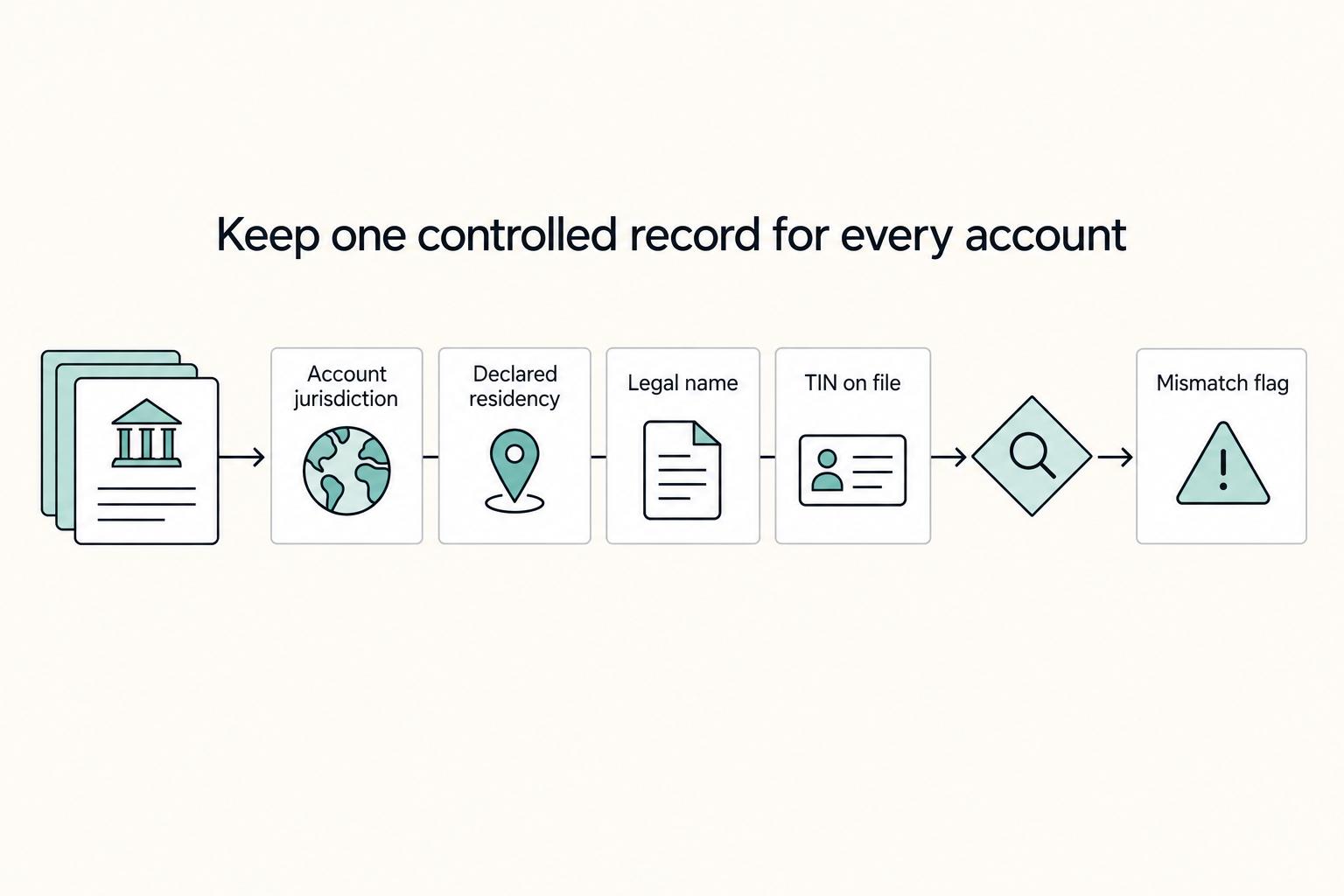
The fastest way to find real risk is to inventory each account, one by one. Build a simple row for each bank, broker, payment platform, or similar account and capture the fields that tend to drift:
| Field | What to capture |
|---|---|
| Account jurisdiction | Where the account is maintained. |
| Declared residency | What you told the institution. |
| Legal name format | Exact name string in the institution's records. |
| TIN on file | Whether a TIN is recorded, which country issued it, and whether it matches your tax records. |
| Mismatch risk flag | Mark red if anything is stale, incomplete, or inconsistent. |
The highest-value check is also the most basic: compare your current account profile and onboarding record against your current tax document and government ID. A common source of problems is drift across institutions, such as old residency at one, an updated address at another, and a different or missing TIN somewhere else.
If a declaration is outdated, record the relevant change date and contact the institution promptly. Gather the evidence needed to resolve the position, but do not wait for a scheduled quarterly review or assume uncertainty extends the institution’s deadline.
Keep U.S. reporting analysis separate#
A U.S. person with a foreign account may face FATCA-related onboarding and separate U.S. filing duties. Someone who also has non-U.S. tax residences can have CRS questions too. The institutional declaration and the individual’s returns are separate obligations.
Complete self-certification from the actual facts#
Your self-certification is where many avoidable problems start or get prevented. It is what the institution records, and it must be reasonable against your onboarding file. If your declaration conflicts with documents already on file, that conflict can make the form look incorrect or unreliable.
UK HMRC guidance for new individual accounts requires self-certification at opening. Its limited exceptions allow collection as soon as possible and within 90 days after the institution learns that an account exists; this is not a blanket customer grace period. Procedures elsewhere follow the relevant local implementation.
Field-by-field error prevention (before you submit)#
Check each field against its purpose. A mailing address, actual residence address and tax residence can legitimately differ; explain the distinction rather than forcing identical text into every record.
| Form field | Common mismatch | Safe default action |
|---|---|---|
| Jurisdiction(s) of tax residence | Listing where you currently live instead of where you are tax resident under local rules | Confirm your residency basis first, then list the jurisdiction(s) that match your actual tax position. |
| TIN | Wrong jurisdiction, old number, or invalid format | Match each TIN to the correct jurisdiction and verify current validity. Use OECD portal information as preliminary guidance, then confirm with the relevant tax administration if needed. |
| Legal name | Different name strings across institutions and tax records | Use the accurate legal name; explain transliteration or documented name changes rather than hiding them. |
| Residence address | Confusing mailing, current residence and tax residence | Answer the field asked; give accurate current details and explain legitimate differences. |
| Date of birth | Entry mistakes or format inconsistencies | Check against your onboarding file before submission. |
| Check | What to confirm |
|---|---|
| Tax residency basis | Confirm the declared tax residency basis you are using. |
| Jurisdiction(s) of tax residence | Confirm each listed jurisdiction of tax residence matches that basis. |
| TIN by jurisdiction | Match each TIN to the right jurisdiction and your filing records. |
| Identity details | Verify legal name, date of birth, and residence address against account records. |
| Return comparison | Explain differences between CRS residence declarations and treaty or other return positions; do not force them to be identical. |
The OECD tax-residency guidance says account holders must disclose all tax residences in self-certification. Do not assume a treaty position used on a tax return permits omitting another residence from a bank form. Ask about the applicable CRS instructions when the two analyses differ.
Keep a dated record of each tax residence, its basis, TINs or valid missing-TIN explanation, current residence and mailing addresses, and past declarations. Preserve earlier versions: a form accurate at opening may differ legitimately from one completed after a move.
Illustrative example: an individual is tax resident under domestic rules in countries A and B and opens an account in C. The account’s location does not make C a tax residence. Declare A and B as required, with their respective TINs or permitted explanations. The institution assesses reportability and the applicable exchange arrangements; the customer should not select one country simply to make the form easier.
A change of circumstances can make an existing self-certification unreliable. Notify the institution as required and respond to its request for a replacement or evidence. A changed address can require explanation without automatically proving a new tax residence.
- Copy of the submitted self-certification, or PDF/export.
- Submission date and portal confirmation or screenshot.
- Master-record version used at submission time.
- Any explanation or supporting documents provided.
- Change log for later updates that could affect the original declaration.
If a country does not issue a TIN or none has been issued in circumstances covered by the rules, use the institution’s permitted explanation rather than inventing a number. An unexplained missing TIN and a recognized exception are different cases; confirm the basis with official guidance.
For a broader warning on residency ambiguity, see The Tax Resident of Nowhere Myth and the Real Risk in 2026.
Distinguish CRS, FATCA and your U.S. filings#
FATCA is a U.S.-linked reporting regime for covered foreign institutions and U.S. accounts, sometimes using an intergovernmental reporting route. CRS generally follows tax residence under local implementing rules and exchange agreements. A combined onboarding form may ask both sets of questions, but a citizenship answer cannot substitute for all required tax residences.
FATCA status screening concerns U.S.-person facts. CRS self-certification concerns tax residences and related identifiers. For your own U.S. filings, Form 8938 covers specified foreign financial assets when its conditions are met; FBAR covers specified foreign financial accounts under separate rules.
| Decision point | FATCA | CRS / AEOI track |
|---|---|---|
| Main basis | U.S.-linked status and covered institutional accounts | Tax residence and reportable account/person status under local rules |
| Institutional reporting route | To the IRS directly or through an applicable intergovernmental route | To the local tax authority, then relevant partner authorities under exchange arrangements |
| Data to check | U.S.-person facts and identifiers requested for FATCA | Tax residences, applicable TINs, identity and account data |
| Your separate filings | Assess Form 8938 and FBAR independently | Bank reporting does not replace tax returns or other personal filing duties |
A U.S. citizen abroad should assess U.S. status, all relevant tax residences and personal filing duties separately. Institutional reporting does not relieve the individual of an applicable filing requirement.
| Your situation | FATCA track | CRS/AEOI track | Safe action |
|---|---|---|---|
| U.S. citizen, also tax resident outside the U.S., account in a third country | U.S.-status onboarding applies as required | Declare all tax residences required by local CRS rules | Assess institutional declarations and personal filings separately |
| Only U.S. tax residence, non-U.S. account | Confirm FATCA status and applicable documentation | Complete the requested residence declaration; bank collection does not itself prove a CRS exchange | Ask how the bank reports under its local rules |
| Dual residence or unclear status | Confirm U.S.-person facts independently | Resolve and disclose all required residences | Seek prompt advice and communicate unresolved fields rather than guessing |
Form 8938 thresholds depend on filing status and whether the taxpayer meets the IRS living-abroad conditions. For an unmarried taxpayer living in the United States, they are more than $50,000 at year end or $75,000 at any time. For an eligible taxpayer living abroad who is unmarried or files separately, they are more than $200,000 at year end or $300,000 at any time. Joint-return thresholds are $100,000/$150,000 in the United States and $400,000/$600,000 for eligible living-abroad filers. Travel alone does not establish eligibility for the higher thresholds.
FBAR generally applies to a U.S. person with a financial interest in or signature authority over foreign financial accounts whose aggregate value exceeds $10,000 at any time during the calendar year, subject to exceptions. It is separate from Form 8938. A taxpayer can be below the relevant 8938 threshold and still need an FBAR; compare the applicable assets and accounts, not just one bank balance.
Maintain records when your circumstances change#
Use one dated fact record to support declarations and filing analysis. Record why different forms legitimately differ, such as a mailing address, a treaty position or a form asking about citizenship rather than residence.
Do not require every account name or address to be an identical string. Transliteration, earlier names and distinct address purposes can be legitimate. Resolve unexplained contradictions and preserve supporting evidence. Keep sensitive identity and TIN records in secure storage and provide them through the institution’s protected submission channel.
| Framework | Main reporting actor | Data that overlaps with your records | Your control point | Escalate to a qualified advisor when |
|---|---|---|---|---|
| CRS / AEOI | Reporting financial institution under local rules, then tax administrations exchange annually | Legal name, residence address, TIN(s), date of birth, place of birth where requested, account number, account balance or value | Reconcile each self-certification against AML/KYC documents and your current residency position | You have dual residency, no TIN for a declared jurisdiction, or the institution form does not match your facts |
| FATCA / Form 8938 | Certain foreign financial institutions and certain U.S. taxpayers | U.S.-linked status facts, foreign asset list, account identifiers, balances | Check institutional FATCA status separately from the taxpayer’s Form 8938 asset and threshold tests | You are unsure whether Form 8938 applies or your bank's U.S.-status record conflicts with your return position |
| FBAR / FinCEN Form 114 | U.S. person filer | Foreign account inventory, account numbers, balances, ownership or signature-authority facts | Test covered foreign financial accounts and aggregate value against the separate FBAR rules | You are missing historical account data, have signature-authority questions, or cannot confirm which accounts are in scope |
A periodic review can catch stale records, but it does not replace prompt notice after a relevant change. Track each institution’s requested update deadline and confirmation.
| Review area | What to check |
|---|---|
| Identity fields | Exact legal name, date of birth, place of birth if previously provided, residence address, and TIN(s). Confirm your institution profile matches source documents. |
| Declared residencies by institution | What you declared to each institution, when you signed, and whether anything has changed. |
| Account inventory | Institution name, account number, opening date, closing date, and statements needed to support balances or values. |
| Filing-status notes | Document each Form 8938 and FBAR analysis using the applicable profile, covered assets/accounts and current instructions. |
Refresh a declaration when the underlying facts change and explain apparent contradictions. A move is a reason to reassess; it is not a substitute for the tax-residency test. Keep the previous form and the effective date of the update.
Keep a dated declaration and a clear update path#
For each account, retain what you declared, when it was accurate, why the tax-residence position applies and how later changes were communicated. Use those records to answer clarification requests and support separate filing decisions.
Frequently Asked Questions
What exactly triggers a CRS report?
A reporting institution identifies an account as reportable when the account and holder meet its local CRS criteria, including residence in a reportable jurisdiction. Excluded accounts, due-diligence rules and exchange arrangements can affect treatment. Accurate records do not prevent a valid report, and an overseas account is not itself a data mismatch.
Does CRS apply to you as a digital nomad?
There is no separate CRS exemption or residency test for digital nomads. An institution applies the relevant account and tax-residence rules. Determine your residence under domestic law, disclose all residences required by the form and update genuine changes; do not assume staying below one day count everywhere removes all residence.
How is CRS different from FATCA if you are a U.S. person?
CRS follows tax-residence and reportable-account rules under participating jurisdictions’ implementations. FATCA focuses on U.S.-linked institutional reporting. Your own Form 8938 and FBAR duties are separate from either bank process. If you do not have to file an income-tax return, you generally do not file Form 8938, while FBAR must still be assessed independently.
What should you do if your bank asks for CRS information?
Provide a complete, accurate declaration through the institution’s secure process. List the required tax residences and TINs, or a permitted reason for a missing number. Explain relevant address differences and respond promptly to clarification requests. Seek advice on unresolved residence facts without signing an answer you know is unsupported.
Can you legally avoid CRS reporting?
Excluded accounts or other local scope rules may mean a particular account is not CRS-reportable. That is a legal classification, not a benefit created by omitting residence or using an old address. Ask for the applicable basis and fulfill any tax-return or other reporting obligations separately.
Try a related tool
Researched and edited by the Gruv editorial team. Gruv builds cross-border billing, payouts, and finance-operations software for global businesses.
Sources
Includes 2 external sources outside the trusted-domain allowlist.
- fincen.gov/report-foreign-bank-and-financial-accountstrusted
- irs.gov/businesses/corporations/foreign-account-tax-...trusted
- irs.gov/businesses/corporations/summary-of-fatca-rep...trusted
- oecd.org/en/networks/global-forum-tax-transparency/re...trusted
- oecd.org/en/topics/sub-issues/international-standards...trusted
- gov.uk/hmrc-internal-manuals/international-exchange...external
- gov.uk/hmrc-internal-manuals/international-exchange...external
Educational content only. Not legal, tax, or financial advice.
Related Posts

Digital Nomad Taxes in 2026 With a Defensible Filing Plan
With digital nomad taxes, the first move is not optimization. It is figuring out where you may be taxable, where filings may be required, and what proof supports that position.
The Tax Resident of Nowhere Myth and the Real Risk in 2026
A "tax resident of nowhere" position may be possible in narrow cases, but it can be hard to defend when your records are inconsistent. The practical target is simpler and stronger: choose one tax residency position you can defend across filings, contracts, and account reviews.

The Freelance Payment Penalty: A Modeled Audit of Platform Fees, FX Spreads, and Payout Delays
The money rarely disappears through a single, easy-to-spot fee. The real loss is stacked. A marketplace takes its commission, a processor adds a charge for international cards, a bank or payment company converts the currency at a spread, a platform holds the funds before release, and a wire sheds a little to intermediaries on the way in. Each layer looks defensible on its own, but the worker feels the combined result as a smaller deposit and a later payday.