
Quick Answer
Start by booking each foreign-currency receipt in USD when it arrives, then track later conversions or spending as separate events. Gain or loss is generally realized when that currency is disposed of, while amounts still held remain unrealized. For U.S. filers, keep the workflow tied to Section 988 analysis, preserve event-level support, and reconcile annual settled totals before filing.
Your Foreign Income Has a Hidden Tax Story. Here's How to Control It.#
When a foreign-currency payment lands, make one immediate split: lock the receipt in USD first, then track any later exchange-rate movement separately until a relevant realization event occurs. That helps you avoid mixing ordinary business income with currency gain or loss.
For most U.S. taxpayers, the functional currency is USD, unless a qualified business unit exception applies. Amounts on a U.S. return must be stated in USD, using the prevailing rate when you receive, pay, or accrue the item. So from day one, set up the basics: a USD anchor for your records, realization-event tracking, a reporting trail, and clean multi-currency account records.
- Record the receipt value at intake.
- Separate holding-period movement from any later realized currency result.
- Keep records that let you prove each step later.
On receipt day, capture the foreign amount, date, account, and USD value using a posted exchange rate you apply consistently. Treat that USD amount as your anchor, then preserve the trail: invoice, payment confirmation, statement, and saved rate. The rest of this article builds from that starting point so tax time does not turn into reconstruction. Related: How to Manage Bookkeeping for Your Freelance Business.
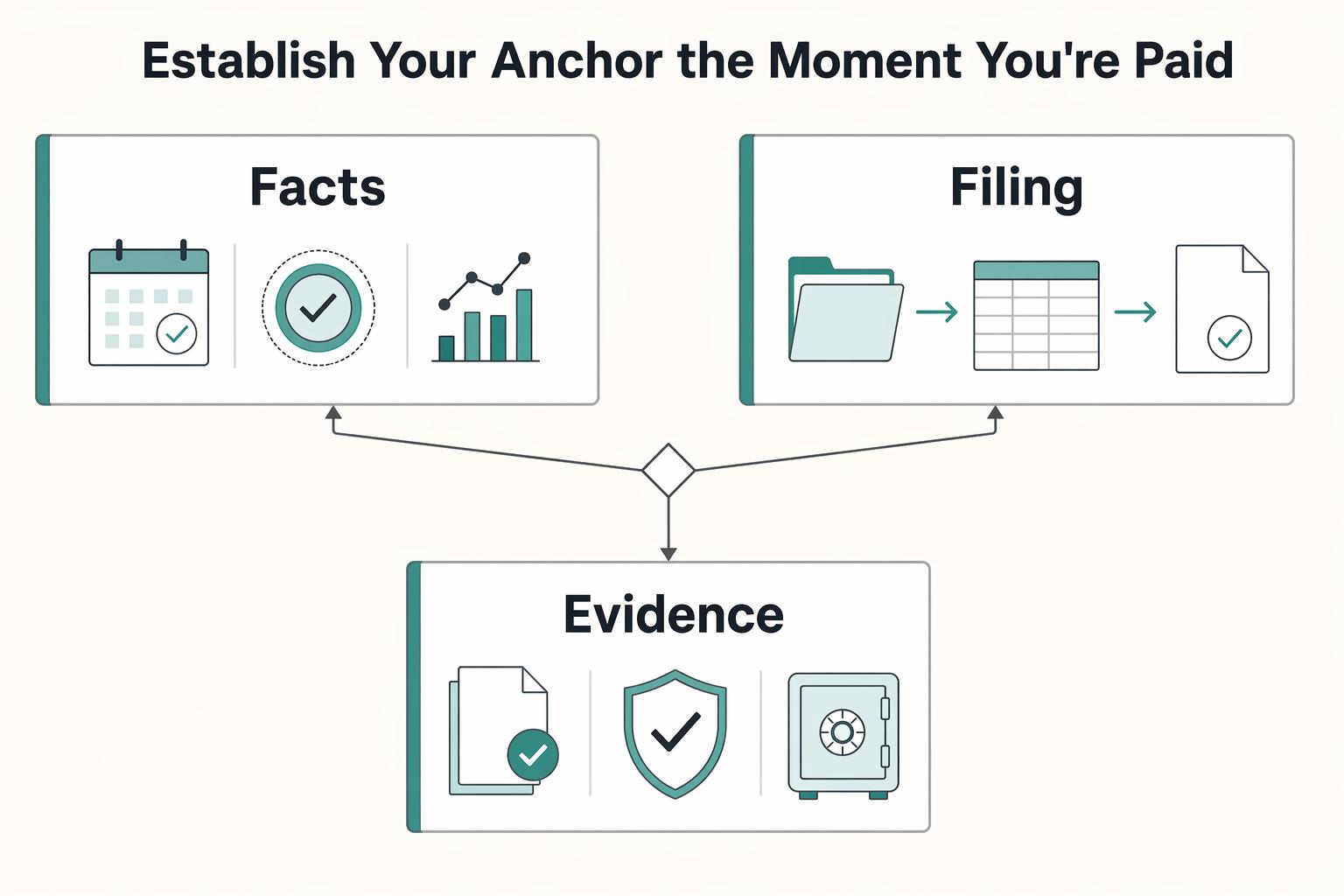
Control Point 1: Establish Your Anchor the Moment You're Paid#
The first control point is simple: when funds hit your account, fix one receipt-day anchor in your functional currency and save the proof right away. That keeps intake tracking separate from any later measurement.
Use these as practical labels in your process, not jurisdiction-specific legal or tax definitions:
- Receipt-day anchor amount: the functional-currency value you record for the receipt on the day it arrives.
- Later value movement: any subsequent change in value while you still hold that currency, based on your accounting framework.
- Evidence trail: the linked records that show receipt details, the rate used, and the bookkeeping entry.
The key setup decision is your functional currency. Because that determination comes before transaction accounting, confirm it first and then apply one consistent intake method.
Use this as alignment context, not legal advice. Check it against your facts, the underlying accounting literature, and any professional or technical advice you rely on. Guidance can change, including major guide editions such as May 2022, so confirm current guidance before filing.
Step 1. Record receipt facts first#
Start with the facts that do not move. Capture:
| Field | What to capture |
|---|---|
| Receipt date | Date shown by your bank or payment platform |
| Foreign-currency amount | Foreign-currency amount received |
| Payer and receiving account | Payer and receiving account |
| Invoice or contract reference | Invoice or contract reference |
If settlement timing creates date differences, note that at intake so your records still reconcile later.
Step 2. Record one documented exchange rate#
Next, translate the receipt using one documented rate source you can identify later and apply consistently in your process. Record:
- rate value
- source name
- source date used
- resulting functional-currency amount booked
If your software auto-fills rates, check that its rate date matches your receipt-date logic and document any override.
| What to capture at receipt | What to calculate later under your accounting framework |
|---|---|
| Receipt date, amount, payer, account, invoice reference | Date of the later measurement event (as applicable) |
| Rate used, source, and source date | Value at that later date in your functional currency |
| Receipt-day functional-currency anchor amount | Difference from the original anchor amount |
| Link to supporting documents and ledger entry | Any subsequent entry required by your books |
Step 3. Keep the proof with the transaction#
Do not leave support scattered across apps and folders. Store or cross-link the invoice, payment confirmation or statement line, rate record, and ledger reference in one retrievable trail. The test is straightforward: you should be able to trace invoice -> receipt -> rate -> booked amount quickly, without rebuilding the file from memory. If you want a deeper dive, read Hiring Your First Subcontractor: Legal and Financial Steps.
Control Point 2: Pinpoint the "Realization Event" to Master Your Taxes#
This is where most confusion starts. Use one starting rule for every movement in a U.S. tax workflow: if you are still holding the same foreign currency, treat it as unrealized. If you convert it or use it to settle a payment, test it for Section 988 recognition. For U.S. taxpayers with USD as functional currency, that is a practical trigger for Section 988 analysis. Also check whether a movement is a listed nonrecognition transaction before you book gain or loss, especially for internal transfers.
Step 1. Classify each movement before posting gain/loss#
Before you post anything, label the ledger event by what actually happened.
- Hold
You still control the same foreign-currency balance. Value may change, but under this working rule no realized gain or loss is booked yet.
- Dispose or settle
You convert the nonfunctional currency to USD, or use it to pay an expense or liability. This is where you test for realized gain or loss.
Quick check: did currency actually leave your hands through conversion or settlement, or did it only move between accounts you control?
Step 2. Calculate realized gain/loss in USD at the event date#
Once you have a real conversion or payment event, calculate the result in USD. If your functional currency is USD, translate items when received, paid, or accrued using the prevailing spot rate. If multiple rates exist, use a rate that properly reflects income and apply the posted source consistently.
Use this formula:
USD value at conversion/payment - original USD anchor when first recognized = realized gain or loss
For a quick example:
- Receive FCY 1,000
- Receipt-day USD anchor: $1,100
- Later conversion or spend of the same FCY 1,000
- Later USD value: $1,140
Result: $40 realized gain. If the later USD value is $1,070, the result is a $30 loss.
Reconcile both ends. The later USD value should tie to the conversion or payment record, and the original anchor should tie back to the first recognition entry, for example, your receipt entry from Control Point 1.
Step 3. Pick one tracking method and apply it consistently#
Choose the lightest method that still lets you reconstruct every realized movement.
| Tracking method | When to use | Operational tradeoff | Audit-readiness implication |
|---|---|---|---|
| Single-transaction tracking | Lower volume, larger receipts, meaningful partial conversions | Most manual work, least ambiguity | Strongest line-by-line trail from receipt anchor to realization event |
| Batched tracking by day | Many same-day conversions in one currency account | Faster posting, needs clean batch mapping | Reliable if each batch has included entries, rate source, and reconciliation note |
| Batched tracking by statement cycle | High-volume, smaller routine conversions | Easiest operations, highest mapping risk | Acceptable only if your conversion log can reconstruct each included movement |
If you batch, document the method once: rate source, event-date rule, batch ID structure, and how batches map back to receipt anchors. Then use that same method across periods.
Step 4. Run a conversion log and monthly close check#
Your conversion log is what keeps the whole process defensible. Maintain it with the event date, currency, foreign amount, USD amount, rate source, receipt IDs, and reconciliation notes, including partial uses. For direct foreign-currency spending, keep the payment or expense support in that same record trail.
| Log field | What to keep | Related note |
|---|---|---|
| Event date | Event date | Maintain it in the conversion log |
| Currency | Currency | Do not net different currencies in one line item |
| Foreign amount | Foreign amount | Include partial uses in reconciliation notes |
| USD amount | USD amount | Tie it to the conversion or payment record |
| Rate source | Rate source | Avoid mixing rate sources without a documented reason |
| Receipt IDs | Receipt IDs | Map them back to original receipt anchors |
| Reconciliation notes | Reconciliation notes | Include partial uses |
Common control failures to avoid:
- Mixing rate sources without a documented reason.
- Netting different currencies in one line item.
- Leaving partial conversions unreconciled to original receipt anchors.
Coordinate conversion timing with cash flow and payment schedules, but do not assume timing guarantees a better tax result. Confirm treatment with current local rules before filing.
We covered this in detail in A Guide to Functional Currency for Your Business.
Control Point 3: Report with Confidence for Total Compliance#
At filing time, treat this as a controlled summary. Report your net realized currency result on the income-tax return as required, keep foreign-account checks on a separate track, and retain records that let you support every number.
Step 1. Report the annual realized result on your income-tax return#
For tax reporting, focus the annual net figure on realized gains and losses. Translate the foreign-currency transactions you are reporting into USD and total only the realized items. In cross-border activity, gain or loss can come from exchange-rate movement alone, so your file should show that the result came from currency movement, not invoicing errors.
Use classification as a practical check. If gains or losses came from business-related currency movements, such as invoicing, collections, conversions, or foreign-currency payments, verify how current rules classify that net, for example, ordinary income rather than capital gain. Confirm the current form location and labeling with official instructions or a tax advisor before using them.
Before filing, confirm the annual net on the return matches the sum of realized items in your conversion log. If it does not, reconcile partial conversions, batches, and direct foreign-currency spending first.
Step 2. Keep income-tax reporting separate from foreign-account reporting#
Do not collapse these into one question:
- Did you realize reportable currency gain or loss?
- Do you have a separate foreign-account reporting obligation under current rules?
| Item | Purpose | Filing destination | Records to retain |
|---|---|---|---|
| Annual realized currency result (income tax) | Report net reportable gain or loss from realized currency movements | Current-year income-tax return; confirm the current form location and labeling with the tax authority or your tax advisor. | Conversion log, receipt anchors, rate source, conversion or payment proof, annual net summary |
| Separate foreign-account reporting obligation | Address foreign-account disclosures when current rules require them | Confirm the current filing destination and form name with the tax authority or your tax advisor. | Statements, ownership or signatory records, institution details, and other support required by applicable rules |
| Year-end translation for books/reports | Show reporting-date value of foreign-currency balances for accounting or management reporting | Books or financial reports, not automatically the tax return | Reporting-date rate support, trial balance, reconciliations |
Use a separate verification step for account reporting. Confirm current thresholds and jurisdiction-specific requirements with official guidance or a tax advisor before filing.
Step 3. Keep an evidence pack that supports your treatment#
If a number on the return depends on a rate, a receipt, or a later conversion, keep the support together even if you do not submit it with the return. At minimum, retain the receipt-day USD anchor, the conversion or payment record, the exchange-rate source at each event, and reconciliation notes for partial uses.
| Support item | What it covers |
|---|---|
| Receipt-day USD anchor | Receipt-day amount |
| Conversion or payment record | Later conversion or payment |
| Exchange-rate source at each event | Rate used at each event |
| Reconciliation notes for partial uses | Partial uses |
| Year-end summary sheet | Groups realized items by currency account and ties to the annual net reported |
Also keep a year-end summary sheet that groups realized items by currency account and ties to the annual net reported. Flag balances still held at year end so unrealized movement is not mixed into taxable realized results. Reporting-date translation can affect current-period accounting income, but a period-to-period decline may still have no realized tax consequence.
If books and tax reporting differ for that reason, document the reason clearly.
Step 4. Run a short verify-first checklist each year#
Before filing, use this checklist:
- Confirm your basis file is complete for all realized receipts.
- Recalculate realization only from actual conversions or settlements and tie each one to its original anchor.
- Summarize the yearly realized net in USD and keep unrealized balances separate.
- Validate filing labels or locations and any separate foreign-account obligations under current rules.
- Retain statements, rate support, batch notes, and the year-end summary together.
If treatment depends on judgment, especially ordinary-versus-capital classification or account-reporting applicability, get fact-specific professional review before filing.
You might also find this useful: How to Use QuickBooks Online to Manage Multiple Currencies as a Freelancer.
Before you close the period, pressure-test your conversion and withdrawal timing against total costs so your cash-planning assumptions are explicit: Compare payment fees.
Conclusion: Run receipt, conversion, and reporting checks each cycle#
What changes now is execution. Each cycle, you keep a complete receipt record, tie later movements back to it, and verify reporting positions against current official guidance before filing.
Receipt. Lock the starting record#
When money comes in, keep the receipt-date anchor, the exchange-rate source, and the source payment or invoice record together. That gives you a traceable starting point instead of forcing you to rebuild events later from statements and memory.
Conversion. Keep the trail intact#
For each later conversion, spend, or settlement, keep proof and note any partial uses or batched activity when it happens. If currency is still held at period end, keep it clearly separate from settled activity until you verify current treatment.
Reporting. Verify before you rely#
Build a year-end summary that ties back to your records and flags amounts still held. If books and tax treatment differ, document the reason. If judgment calls remain, escalate for fact-specific tax review before filing.
Keep the settled-versus-still-held boundary plain: track settled movements separately from currency you still hold, and confirm treatment and reporting approach from current verified guidance before you file.
| Before this system | After this system |
|---|---|
| You rely on statements and memory | You retain a receipt anchor, rate source, and source record |
| Later movements are hard to trace | Each movement is tied to its original record |
| Settled activity and held balances blur together | Held balances are flagged and kept separate |
| Filing depends on assumptions | Reporting is verified against current official guidance |
Close each cycle with this checklist:
- Confirm every receipt has a date, source record, and rate support.
- Match each later movement to its original anchor and document partial uses.
- Prepare a year-end summary and flag currency still held.
- Verify current guidance using official sources before finalizing treatment.
- Escalate edge cases before filing.
For a step-by-step walkthrough, see How to Choose a Presentation Currency for Financial Reports.
If you want one operational flow to collect funds, track balances, convert when needed, and pay out with clear records, see Gruv for freelancers.
Frequently Asked Questions
When is a foreign currency gain "realized" for you?
For most U.S. taxpayers, the functional currency is USD, and recognition is generally tied to a sale or other disposition of nonfunctional currency under Section 988 rules. In practice, you generally realize gain or loss when you convert, spend, or otherwise dispose of that currency, while amounts you continue to hold are usually treated as unrealized until disposition. Record each movement when it happens so you can tie it back to the original receipt. | Scenario | Tax treatment | What to log now | |---|---|---| | Convert EUR to USD | Usually a realization event | Conversion date, amount, rate actually used, fees, linked original receipt | | Spend EUR directly on a business cost | Usually a realization event | Payment date, vendor, amount spent, USD value, linked original receipt | | Keep EUR in the account at period end | Usually unrealized until later disposition | Balance date, statement, rate source used for your books, note that funds remain held |
Is holding foreign currency in a Wise or Revolut account a taxable event?
Usually not by itself, because recognition is generally tied to disposition rather than simply holding a balance. Separate account-reporting rules can still apply, so verify the current filing threshold and due dates for your filing year before you submit. Export your balance history and save your year-end statement now.
How do you calculate realized foreign currency gains for your taxes?
Start with cost basis, which is the USD value when you acquired the foreign currency. Then compare it to the USD value when you later convert or spend that same currency. Keep a clean link between the receipt date, receipt amount, rate source, and the original invoice or payout record.
Are foreign currency gains ordinary income or capital gains?
Section 988 generally treats qualifying foreign currency gain or loss as ordinary income or loss, not capital. Do not assume that applies in every case, because elections and exceptions can apply, including for some forwards, futures, and options. If derivatives are involved, verify treatment before filing and keep those records separate from routine client receipts.
How do you report foreign currency gains on your U.S. tax return?
Report the net amount in the current tax-year location for Section 988 items after you verify the form and field for that year. Do not reuse prior-year line references without checking, because form locations can change. Keep your support pack: transaction log, exchange-rate source, statements, and notes for partial uses.
What’s the best way to track exchange rates for your records?
Use one reputable source consistently and keep evidence of the exact rate used on the date you received, paid, or accrued the item. Avoid mixing a benchmark rate with a platform settlement rate, because that breaks your audit trail. Save the screenshot or source record at the time of each transaction.
Does this apply if you’re paid through Deel or Upwork?
Yes. Deel, Upwork, Wise, and similar tools are payment rails, but your tax analysis still centers on when you acquired the currency and when you later disposed of it. Because Upwork payout conversion can differ from benchmark rates, use the platform’s own record for what actually happened. Save the payout notice, conversion detail, and transfer confirmation together as one record set.
Try a related tool
Researched and edited by the Gruv editorial team. Gruv builds cross-border billing, payouts, and finance-operations software for global businesses.
Sources
- ecb.europa.eu/pub/pdf/fsr/financialstabilityreview200806en...trusted
- ecfr.gov/current/title-26/chapter-I/subchapter-A/part...trusted
- ecfr.gov/current/title-26/chapter-I/subchapter-A/part...trusted
- federalregister.gov/documents/2022/01/04/2021-27887/guidance-rel...trusted
- flcourts.gov/content/download/633407/file/voices-in-the-c...trusted
- irs.gov/individuals/international-taxpayers/foreign-...trusted
- irs.gov/individuals/international-taxpayers/yearly-a...trusted
- law.cornell.edu/uscode/text/26/988trusted
Educational content only. Not legal, tax, or financial advice.
Related Posts

Hiring a Subcontractor for the First Time Without Costly Surprises
**Start with a risk-control sequence, not an ad hoc handoff.** As the Contractor, your goal is simple: deliver cleanly, control scope, and release payment only when the work and file are complete.

Freelance Bookkeeping for Faster, Safer Client Payments
Control over cash starts with records you trust. When entries are current, categorized, and easy to trace, you spot risk earlier and make calmer decisions about follow-up, spending, and month close.
How to Use QuickBooks Online to Manage Multiple Currencies as a Freelancer
Treat **quickbooks online multi-currency** as an operations decision, not a settings exercise. The real benefit is cleaner client invoices, fewer manual conversions, and less month-end repair work when exchange rates move or a payment settles differently than expected.