
Quick Answer
A TPSO generally files federal Form 1099-K when annual gross reportable payments exceed $20,000 and transactions exceed 200 for a payee. Both conditions apply. Keep payment-card reporting, backup withholding and state requirements separate. Identify the responsible filer, count unique qualifying transactions and reconcile gross amounts before generating returns.
Why platform operators should revisit 1099-K controls now#
For federal third-party network reporting, a TPSO generally must file Form 1099-K for a payee who exceeds both $20,000 in gross reportable payments and 200 transactions in the calendar year. The 2025 law restored that threshold retroactively. Update the rules built for the earlier phase-in, while keeping payment-card reporting, backup withholding and state rules separate.
The planning baseline changed. In IR-2025-107 (issued Oct. 23, 2025), the IRS released Fact Sheet 2025-08, which says the One Big Beautiful Bill retroactively reinstated the reporting threshold that applied before ARPA. For third party settlement organizations, IRS FAQs say filing is not required unless both tests are exceeded: more than $20,000 and more than 200 transactions. The same fact sheet says these FAQs supersede FS-2024-03.
That creates a practical risk for teams that implemented to the delay path. The IRS had announced a tax year 2023 delay of the new $600 threshold and a planned $5,000 threshold for 2024. Notice 2024-85 then described 2024 and 2025 as a final transition period with phased amounts of $5,000 (2024), $2,500 (2025), and $600 (2026 and after). If your policy docs, monitoring rules, or reporting specs still point to that sequence without reconciling the later IRS update, your controls can drift out of alignment.
Before you touch code, run a governance check. The goal is operational clarity, not theory.
- confirm which IRS sources and dates your current policy, specs, and tickets cite
- flag stale anchors, such as unreconciled FS-2024-03 or transition-phase thresholds
- pause net-new automation changes until the legal baseline is reapproved internally
You should come away with:
- decision checkpoints to confirm the current federal baseline before workflow changes
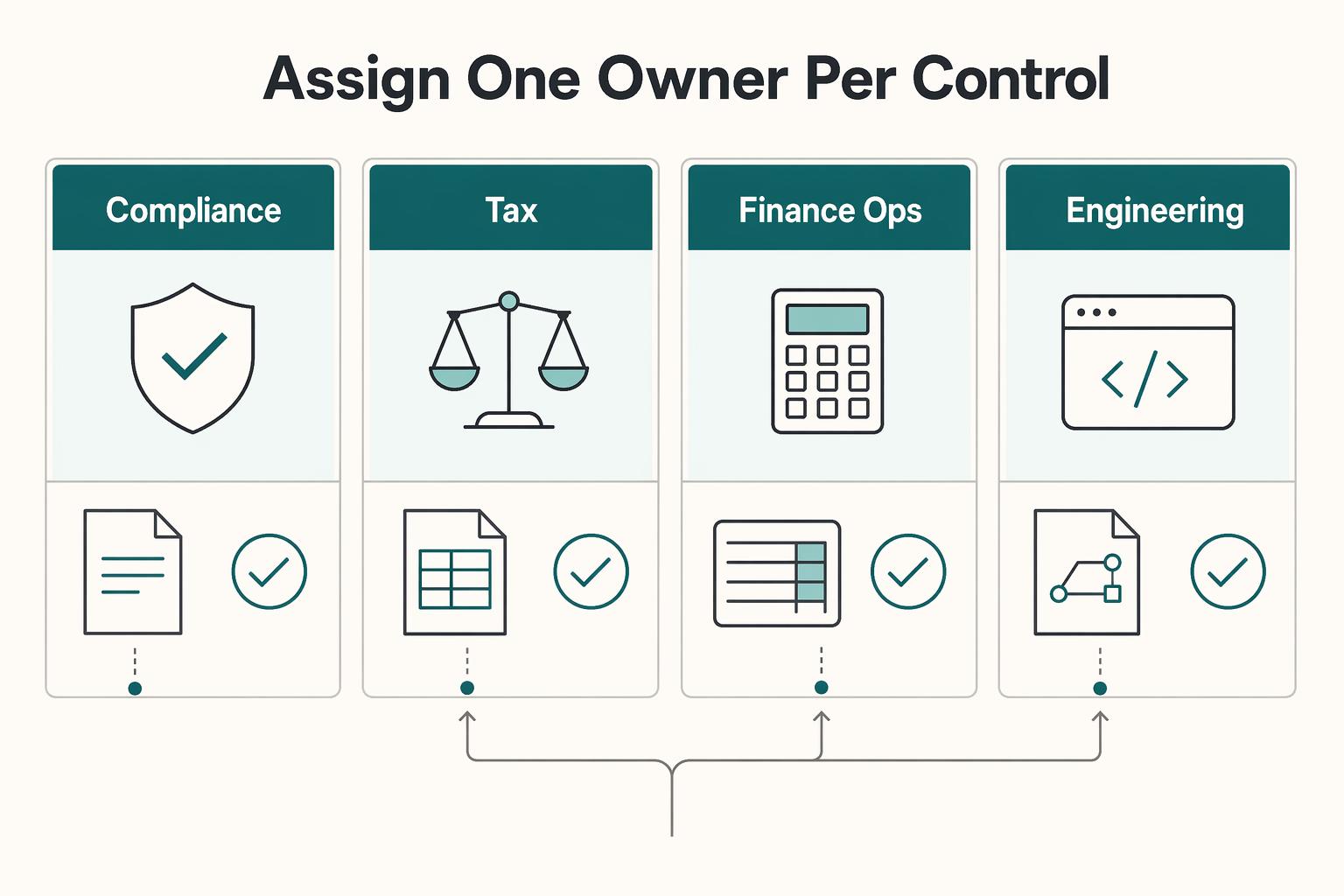
- ownership boundaries across compliance, tax, finance ops, and engineering
- a quarter-by-quarter checklist for thresholds, exceptions, approvals, and filing readiness
These IRS materials define the Form 1099-K reporting baseline and the PSE filing role; they do not spell out your internal ownership model or release controls. If you want a quick exposure check before redesigning controls, use 1099 Reporting Threshold Checker: Does Your Platform Need to File?. For related planning issues, see Creator Platform Tax Reporting for 1099 and W-8 Expansion Decisions.
Lock the legal baseline before changing any workflow#
Lock your legal source of truth before you change workflow or automation. As an internal control rule, not an IRS mandate, if your policy, specs, or tickets conflict with current IRS wording, pause net-new automation changes and issue a controlled policy update first.
Form 1099-K is an IRS information return for certain payment transactions, and a payment settlement entity (PSE) files it for reportable payment transactions, including payment card and third party network transactions. Confirm that filing framework first, then tune threshold logic.
Use IRS Fact Sheet 2025-08 for the restored federal TPSO baseline and the Form 1099-K instructions for filing mechanics. Preserve the version used for the relevant reporting year. The restored rule requires both thresholds to be exceeded; a payment-card reporting path has no corresponding de minimis threshold.
Put dates on every source before you rely on it. The IR-2025-107 newsroom page says news items may not be updated and tells readers to verify dates. Fact Sheet 2025-08 says FAQs may be updated or modified, and if FAQ text is inaccurate for a taxpayer's situation, the law controls.
Keep the reporting-year source version with the policy and rule specification. The March 2024 instructions contain historical $600 language; treat that archived version as history rather than evidence that the restored threshold remains unresolved. Check later legislation and the applicable instructions when updating the production rule.
Reconcile the timeline so your controls match today not last year#
Use one dated timeline for threshold logic, or old transition assumptions will leak back into current controls. If Tax Ops and Engineering are using different source dates, pause the release and reconcile first.
Maintain a dated history table so operators can distinguish retired transition rules from the restored federal rule. Historical returns may need separate correction analysis; do not silently rewrite prior filings when you change current logic.
| Period | Key development | Source tier | Status for current controls |
|---|---|---|---|
| Mar. 11, 2021 onward | IRS later described the ARPA-era rule as requiring TPSO filing once payments to a payee exceeded $600 | IRS primary guidance | Superseded |
| Calendar year 2022 | IRS treated 2022 as a transition period | IRS primary guidance | Superseded |
| Nov. 21, 2023 update for tax year 2023 | IRS treated 2023 as an additional transition year and said reporting was not required unless payments were over $20,000 and transactions were over 200 | IRS primary guidance | Historical 2023 relief; retain for prior-year analysis |
| Nov. 26, 2024 relief and Notice 2024-85 phase-in | IRS used a planned phase-in of $5,000 for 2024, $2,500 for 2025, then $600 for 2026 | IRS primary guidance | Superseded |
| July 4, 2025 law change reflected in Fact Sheet 2025-08 | IRS says OBBB retroactively reinstated the pre-ARPA threshold, so TPSOs are not required to file unless both $20,000 and 200 transactions are exceeded | IRS primary guidance | Confirmed |
For current controls, use the latest IRS baseline. Fact Sheet 2025-08 supersedes FS-2024-03 and states the TPSO trigger as exceeding both $20,000 and 200 transactions. If your specs still treat the 2024 to 2026 phase-in as active authority, mark that logic superseded and update it.
Require each row to carry the source title, publication date, saved artifact, source tier, and an internal note explaining why it is active or no longer controlling. Before any threshold-related release, have the compliance lead approve the exact timeline version used by Tax Ops and Engineering. That is an operational control, not a legal requirement, and it helps keep policy-code mismatches out of production.
Decide whether your entity is the filer before counting transactions#
Decide the filing entity first, then apply threshold counting. Counting belongs to the entity with the Form 1099-K reporting duty, because a payment settlement entity must file for reportable payment transactions.
Review contractual payment obligations alongside the actual settlement instructions. If multiple entities qualify as PSEs for a transaction, the entity submitting the transfer instruction generally files. Electronic payment facilitators, written filing designations and aggregated-payee arrangements have additional rules. Record the applicable arrangement instead of inferring ownership solely from a marketplace or processor label.
Start with contracts, then confirm operations#
For each affiliate, align these facts to the same legal entity:
- who has the contractual obligation to pay participating payees
- who submits the settlement instruction to transfer funds to the participating payee account
- who can produce the information needed for Form 1099-K reporting
If those answers split across entities, treat filer status as unresolved and escalate. No single operational factor is a universal test.
Do not generalize filer status across affiliates#
Run the analysis affiliate by affiliate. Legal structure can change TPSO treatment, and entities with similar services may still land in different positions.
Use exclusions carefully. IRS instructions state that healthcare networks, in-house accounts payable departments, and automated clearing houses do not qualify as TPSOs.
Document the filer rationale before implementation#
Create a short filer memo before you lock reporting logic. Include the contracting entity, settlement-flow mapping, the reporting inputs, and which entity can produce the filing artifact.
Record the relevant reporting-year instructions, payment agreements and any written filing designation in the filer memo. A contractor that merely prepares a return does not automatically become its responsible filer. Specify whose name and TIN appear on the form and who remains responsible if submission fails.
Standardize payee and transaction classification logic#
Once you confirm the filing entity, lock classification logic in one place. Use a canonical ruleset for payee documentation and a separate ruleset for Form 1099-K transaction scope, and treat missing or contradictory records as unresolved until internal review.
Use one canonical payee taxonomy#
Use one canonical payee taxonomy so Compliance, Tax, and Engineering are working from the same document status.
| Payee profile | Canonical document state | What the state establishes |
|---|---|---|
| U.S. person payee | Form W-9 on file | Payee provided documentation used to provide a correct TIN for information return filing |
| Foreign individual payee | Form W-8BEN on file | Payee represented foreign individual status to the payer or withholding agent |
| Foreign entity payee | Form W-8BEN-E on file | Payee represented foreign entity status |
Avoid loose labels like "tax form received" or "international seller." Anchor classification to the actual form state on file. If records are missing or contradictory, keep tax status unresolved and route the record to manual review before final reporting status is set.
Classify transactions first, apply thresholds second#
For Form 1099-K, classify in-scope transactions first, then apply threshold logic as a separate layer. IRS scope is based on payment card and third-party network transactions, and filing can be triggered when goods or services payments are received through a payment settlement entity.
Separate third-party network transactions from reportable payment-card transactions before applying thresholds. Do not apply the TPSO de minimis test to the card-reporting path merely because the platform uses one provider for both. Keep the settlement classification and filer rationale with each population.
Use gross reportable amounts rather than net payouts. Fees, refunds and credits do not simply reduce the amount reported in box 1a. Keep those adjustments in a separate reconciliation bridge so finance can explain why reported gross receipts differ from cash received.
Test both threshold boundaries and the gross-to-cash bridge#
| Hypothetical annual TPSO totals | Federal threshold result |
|---|---|
| $20,000 and 201 reportable transactions | Amount does not exceed $20,000: the ordinary federal TPSO test is not met. |
| $20,001 and 200 reportable transactions | Count does not exceed 200: the ordinary federal TPSO test is not met. |
| $20,001 and 201 reportable transactions | Both tests are met. Include the payee in the federal TPSO filing population. |
These examples assume no separate withholding or state reporting trigger. For a second reconciliation test, suppose a payee has $25,000 in gross reportable payments, $1,000 in refunds and $750 in fees, with 250 qualifying payment transactions. Net cash is $23,250 in this simplified example, while reported gross remains $25,000. Keep the refund and fee bridge separately, and count the payment transactions without treating a refund event as an additional sale.
Prevent duplicate counting and keep a defensible trail#
As an internal control, design counting logic so replayed or duplicated events do not inflate totals. Retries, webhook redelivery, and backfills should not create new reportable counts if the underlying event is the same. Keep machine-readable evidence for each classification update:
- rule version and effective date
- approver and owner
- prior and new classification outcomes
- reason for the change, including source reconciliation when IRS materials conflict
If you cannot reproduce which rule version produced a result, threshold and classification decisions become hard to defend later. For more on adjacent controls, see How to Handle Currency Gain and Loss Reporting for a Multi-Currency Platform.
Build a role-owned quarterly control checklist#
Review the Form 1099-K program quarterly, with named owners for the active rule, filer decisions, document quality and reconciliation. The operating cadence is an internal choice; filing and withholding duties still apply when their own conditions arise.
Check that the signed policy, deployed rule and draft outputs agree. A correct threshold constant is insufficient if payment-card transactions are suppressed, duplicate events inflate counts or withholding cases are dropped.
Assign one owner per control, not one team per problem#
A quarterly checklist works best when each control has one primary owner and a clear downstream consumer.
| Role | Core owner actions for 1099-K readiness | Evidence to retain |
|---|---|---|
| Compliance | Own the versioned rule set, source snapshots and exception policy; distinguish current federal thresholds from historical and state rules. | Dated source snapshots, policy memo version, approval record, exception taxonomy |
| Tax | Approve filer role and counting rules, review exceptions, and maintain the reporting-year statement, filing and correction calendar. | Threshold memo, deadline calendar, signoff log, escalation notes |
| Finance Ops | Reconcile gross payment totals to reporting outputs, monitor document-collection quality for Form W-9 and Form W-8 records, and manage queues for unresolved TIN or classification issues. | Reconciliation files, exception queue aging, document-quality checks, payee outreach logs |
| Engineering | Maintain versioned transaction and payee rules; test duplicate handling, boundary cases and raw-to-output reconciliation before approved changes. | Test results, rule version history, deploy approvals, raw-to-output reconciliation samples |
You do not need a large committee. You do need one policy owner who can state, in writing, which IRS source controls today and why.
Review threshold-near and exception cohorts every month#
Quarterly ownership is not enough on its own. A practical operating pattern is a monthly review of:
- payees approaching the threshold your policy currently applies
- records in exception queues because payee or transaction status is unresolved
Put the rule version, reporting year and source date on each cohort report. Separate federal TPSO eligibility, payment-card reporting, withholding cases and any state-required outputs so an operator can see why a payee is included.
Before you circulate the monthly report, confirm:
- threshold logic version matches the policy version in force
- counts are reproducible from raw ledger events without duplicate-event inflation
- exception queues separate missing documents, contradictory documents, and transaction-classification issues
If those checks fail, treat the report as not decision-ready.
Add internal release gates before any tax-logic deploy#
Treat release gates as an internal control choice. Do not ship production tax-logic changes without reconciliation evidence and policy-owner signoff, especially when threshold assumptions are changing over time. At minimum, require:
- expected results reproduced from a known sample set
- raw event totals, counted transactions, excluded transactions, and final reportable outputs tied to a specific rule version and effective date
- policy approval attached when threshold handling changes
Code defects and ungoverned cross-team changes can both create reporting errors. If reconciliation evidence or policy signoff is missing, hold the release.
Make W-9 and W-8 quality a cross-team handoff#
Document quality has to be shared across teams, not trapped in onboarding. Form W-9 supports correct TIN collection for information returns. Missing or incorrect TIN conditions can trigger 24% backup withholding in applicable cases. Form W-8BEN and Form W-8BEN-E support different foreign payee profiles, so a generic "W-8 received" state is not enough.
Use a simple handoff model across teams:
- Compliance defines acceptable document states.
- Finance Ops tracks missing, unreadable, or contradictory records.
- Tax reviews edge cases that can affect reporting or withholding treatment.
- Engineering ensures canonical states feed reporting logic and exception queues.
Each quarter, sample both "complete" and "exception" records against underlying documents or source data to verify the stored status is real. When rule language is moving, traceability at policy boundaries is what keeps control fixes from turning into filing problems.
Make the role matrix part of the reporting runbook. Each handoff should identify the input record, decision owner and output consumed by the next team.
Assemble a year-end evidence pack before filing season pressure#
A Form 1099-K filing position is only as defensible as the evidence behind it. Build the pack before January so an independent reviewer can see which rule you applied, which IRS sources you relied on, and how totals were produced from raw events. A minimum pack can stay compact, but it should be dated, versioned, and internally consistent.
| Evidence artifact | What it should answer | Minimum detail to retain |
|---|---|---|
| Policy memo | What rule did we apply, and why? | Current threshold assumption, source hierarchy, approval date, policy owner |
| Timeline version | Which guidance periods were treated as superseded vs current? | Version number, effective dates, source dates, signoff |
| Filer-role rationale | Why is this entity the filer, or not? | Entity analysis, operational facts, escalation notes if unresolved |
| Counting logic spec | How were transactions counted or excluded? | Rule version, inclusion and exclusion logic, duplicate-event treatment |
| Reconciliation outputs | Can totals be traced from raw events to final output? | Raw gross amounts, counted transactions, exclusions, final reportable totals |
Retain the actual source versions used in the decision, including dated IRS materials and the applicable instructions. Capture the retrieval date yourself; a webpage’s changing last-reviewed label is not a permanent version identifier.
Describe source authority carefully in the memo. FS-2025-08 says its FAQs supersede FS-2024-03, and it also says FAQs are not used by the IRS to resolve a case. Record that distinction directly: FAQs informed operations, while controlling law and higher authority remain separate. If a non-IRS summary conflicts with IRS primary guidance, treat the non-IRS summary as secondary until reconciled.
Add the filing calendar and unresolved exceptions#
Include statement, filing and correction deadlines in the calendar. The usual dates are January 31 for payee statements, February 28 for paper filing and March 31 for electronic filing, moving to the next business day when applicable. For 2026 transactions, January 31 and February 28, 2027 fall on Sundays, so the corresponding dates are February 1 and March 1; electronic filing is March 31, 2027. Check e-filing requirements and approved extensions separately.
IRS e-filing guidance generally requires electronic filing when the filer has at least 10 covered information returns in aggregate, not 10 of each type. Confirm the filing-season system and access in advance; IRS guidance identifies IRIS as the intake system for the 2027 filing season as FIRE retires. Assign an owner to retain submission acknowledgments, resolve rejected records and link corrections to the original return. Upload completion alone is not proof that every return was accepted.
Keep a live exception log with at least:
- case ID or payee ID
- issue type
- current owner
- target disposition date
- whether the case affects filing eligibility, classification, or totals
Avoid logs that only say "open" or "pending." You need enough detail to distinguish missing documentation, filer-role uncertainty, transaction-classification ambiguity, and reconciliation breaks.
Test whether the pack is actually defensible#
Run a mock walkthrough before filing season pressure hits. This is an internal control choice, not an IRS requirement, but it tells you whether the pack is usable. Give an independent reviewer the policy memo, source snapshots, counting spec, and sample reconciliation. If they cannot reproduce totals from raw ledger events, the pack is not audit-ready.
A common failure is misalignment across artifacts: the memo cites one threshold source, logic uses another rule version, and reconciliation outputs do not match the final population. Resolve those mismatches while records are still easy to trace.
Keep the file as long as it may be material to tax administration, rather than treating it as a one-time filing attachment.
For a step-by-step walkthrough, see 1099-NEC vs 1099-K Platform Filing Starts With Settlement Path.
Handle cross-border overlap without mixing regimes#
Form 1099-K and Form 1042-S are separate compliance tracks, not substitutes for each other. Form 1099-K is a payment settlement entity return for reportable payment transactions, while Form 1042-S is used by a withholding agent to report certain income and amounts withheld in foreign-person cases. If you collapse them into one decision tree, you risk the wrong document request, owner, or filing path.
Keep the $20,000-and-more-than-200 test confined to federal third-party network reporting. Foreign-payee exceptions, payment-card reporting and foreign-person withholding require their own analysis. A W-8 document is evidence of status, not a universal switch from Form 1099-K to Form 1042-S.
Separate document logic at intake#
Branch early between Form W-9 and Form W-8BEN states in onboarding and tax profiles.
- Form W-9: used to provide a correct TIN to a requester filing IRS information returns.
- Form W-8BEN: provided by a foreign beneficial owner to a withholding agent or payer for U.S. withholding and reporting purposes.
Avoid a single "tax form received" flag. Keep distinct states such as requested, received, validated, expired, conflicting, and override so reviewers can see why a profile moved between document paths and when.
Keep ownership clean#
Centralize shared controls, then keep filing rules modular.
- Centralize: identity checks, address normalization, audit logs, document storage.
- Modularize: W-9 and 1099-K logic and approvals separately from W-8 and 1042-S logic and approvals.
That gives you one audit trail without cross-jurisdiction contamination. Example: the March 15, 2027 due date for e-filing 2026 Form 1042-S belongs in the 1042-S calendar and queue, not inside 1099-K production planning.
If your foreign-payee volume is material, treat IRS Form 1042-S for Platform Operators: How to Report and Withhold on Foreign Contractor Payments as its own implementation track.
Keep other-country reporting requirements in their own rulebook and calendar. A US Form 1099-K threshold is not a rule for UK digital tax records or another jurisdiction’s platform reporting. Shared identity and document infrastructure can support several regimes while each keeps its own classification and filing logic.
Set explicit escalation triggers for specialist review#
Route a concrete unresolved issue to the responsible tax specialist: conflicting entity obligations, an unclear settlement classification, invalid foreign-status evidence or a state requirement not covered by the rule set. Attach the transaction facts and proposed treatment so review produces a usable decision.
Escalate entity-role ambiguity before assigning 1099-K ownership#
When marketplace, payment and treasury functions span affiliates, map their contractual obligations and settlement instructions before assigning responsibility. Record multiple-PSE, facilitator or aggregated-payee rules where relevant, including any written designation and remaining liability.
Use a document-based checkpoint, not a verbal one. Review payee terms, processor agreements, intercompany contracts, and settlement-flow maps to confirm who holds the payment obligation and who can produce 1099-K records. If more than one affiliate appears to act as filer, require specialist signoff before implementation.
Escalate when IRS primary guidance and summaries diverge#
For current-year operations, treat IRS.gov primary guidance as the baseline and escalate any material mismatch with vendor summaries, blogs, or older newsroom writeups. IRS Fact Sheet 2025-08 states its FAQs are general and may not fit a taxpayer's specific facts, and that the law controls if FAQ text is inaccurate for the case.
A rule that still suppresses or reports every federal TPSO payee using $600 needs reconciliation with the restored baseline. Correct the policy and code together, and test the affected reporting populations. Review a specific factual or legal conflict rather than reopening the whole program because an old newsroom page remains online.
For foreign-payee cases, send the reviewer the payer’s status, payee documentation, addresses, account location and payment facts. Determine whether a Form 1099-K reporting exception applies and whether a separate withholding or income-reporting duty exists. Foreign account reporting is a separate entity-specific issue; it should not determine a seller’s 1099-K threshold.
Escalate cases involving incomplete or inconsistent W-8 evidence, US address or account indicators conflicting with claimed foreign status, an uncertain settlement role, or an income payment whose source and withholding treatment need separate review.
Keep the reviewed classification and its conditions with the payee record, and reopen it when those facts change.
Repair counting, classification and filing failures#
Many failures here come from control design, not unclear law: stale threshold assumptions, spreadsheet-only counting, and tax-document status that never reaches payout decisions. If any of those exist, fix that control chain before tuning anything else.
Retire delay-era assumptions first#
Start with current IRS primary guidance, not delay-era summaries. FS-2025-08 (Oct. 2025) says the One, Big, Beautiful Bill retroactively reinstated the pre-ARPA TPSO trigger. It frames the trigger as exceeds $20,000 and the number of transactions exceeds 200, which differs from the ARPA-era description of more than $600 regardless of transaction count.
Retire the phase-in constants from the current federal TPSO rule and keep historical versions labeled by year. Test that the restored threshold has not accidentally changed payment-card inclusion, withholding handling or state filing populations.
Run one same-day alignment check across three artifacts: signed policy, production threshold logic, and outbound Form 1099-K logic. If those do not match, treat near-threshold reporting as unreliable until they do.
Move counting logic out of spreadsheets#
Make counting reproducible from source transactions. A controlled spreadsheet can support a small program if imports, formulas, approvals and reconciliation are preserved; a workbook without traceable inputs cannot establish that the reporting output is complete. Choose automation according to error risk and operating complexity.
The risk is not just arithmetic mistakes. Manual workflows can drift in scope by including retries, replayed events, duplicate adjustments, or mixed transaction types that were never meant to count, and workbook-only exclusions may never make it into reporting code.
The IRS also states some payees may still receive a Form 1099-K below the federal TPSO threshold. That is another reason to avoid single-constant suppression logic.
Make document status operational#
Incomplete Form W-9 and Form W-8 capture is a reporting and withholding control issue, not just onboarding friction. The IRS says Form W-9 provides the correct TIN to a requester that must file an information return. Backup withholding guidance says the payer must begin backup withholding immediately on reportable payments if no TIN is provided.
That does not create a universal payout-block rule for every missing form. It does mean payout workflows should flag missing or contradictory tax-document status as an exception before payment is treated as clean. For foreign persons, capture the relevant Form W-8 before defaulting into domestic documentation assumptions.
Repair in a controlled sequence#
The IRS materials here do not prescribe one universal remediation workflow, but fixes usually hold up better when you do them in a clear order instead of ad hoc:
- Pause nonessential tax-rule changes while you reconfirm IRS baseline assumptions and filer logic.
- Reconcile raw transaction data against prior Form 1099-K logic, especially near thresholds and in manually adjusted cohorts.
- Reclassify edge cases such as duplicate events, personal reimbursements that should not be on Form 1099-K, and unresolved W-9/W-8 status.
- Re-enable changes with policy-owner approval, tested rule evidence, and an exception log for unresolved items.
Skipping a defined sequence can hide defects and weaken the evidence trail you may need later.
Execute a 30-day implementation sequence#
Use the next 30 days as a controlled reset, not a tax-tech sprint. The objective is to align policy, code, and filing evidence to current IRS.gov guidance before filing deadlines turn small mismatches into filing defects.
Week 1. Fix your source-of-truth timeline#
Create one reporting-year policy using the restored threshold, applicable instructions and dated source snapshots. Preserve the earlier ARPA and transition-relief timeline as history so prior versions remain explainable.
Assign one owner each from Tax, Compliance, and Engineering, and require a signed timeline marked current or superseded. Flag any artifact that still cites the phased 2024 bulletin path, $5,000 for 2024, $2,500 for 2025, $600 for 2026 and after, without explaining why later OBBB-era guidance changed the operating baseline.
Week 2. Harden payee classification and transaction counting rules#
Harden payee classification and transaction counting rules, since reporting errors can start there. For Form 1099-K, the IRS currently states the TPSO trigger as exceeds $20,000 and the number of transactions exceeds 200, so your inclusion and exclusion logic should be tested against ledger or settlement events, not report exports.
Build an exception taxonomy for unresolved entities and contradictory tax-document states. At minimum, separate unclear filer role, duplicate or replayed events, unresolved domestic versus foreign documentation, and manual adjustments that move totals near threshold. If filer role is unclear, route it to counsel review before tuning thresholds.
Week 3. Run a dry run and assemble the evidence pack#
Run a dry run as if filing season starts today. Produce draft payee outputs, threshold cohort reports, and an evidence pack with the policy memo, rule version history, reconciliation results, and IRS.gov source snapshots.
Review foreign-status exceptions separately from income withholding. If a payment belongs in a Form 1042-S workflow, assign that regime’s form, withholding and deadline decisions to its owner. Use the dry run to catch aggregate totals that cannot be reproduced from source transactions. When Form 1042-S reporting applies, check the related Form 1042 filing duty in that separate workflow.
Week 4. Close with leadership signoff and an escalation matrix#
Close with leadership signoff, a documented escalation matrix and a quarterly control cadence. Name who sets policy, approves changes and owns exceptions. For 2026 transactions, plan for February 1, 2027 payee statements and March 31 electronic filing, subject to applicable extensions.
Document reliance and approval details before you finalize. IRS news releases say to verify publication dates, and IRS FAQs are not final legal authority if the law applies differently in a specific case. Record what you relied on, who approved it, and when.
What to do next to reduce surprises this year#
This is a controls update, not a one-time threshold announcement. Lock one approved record for your legal baseline, filer-role owner, and counting logic for Form 1099-K. If any of that still sits in email threads, slides, or ad hoc spreadsheets, you still carry avoidable filing-season risk.
Use the approved reporting-year sources and rule version to run the filing population. Preserve retrieval dates, signoff and historical rules so an operator can explain both the current output and any earlier return that needs correction.
Assign one named owner for filer-role determination and document the rationale. The IRS states a payment settlement entity must file Form 1099-K, but responsibilities can be split across marketplace, payments, and treasury entities. Where facts are mixed, get legal or tax review before you change automation.
Make counting logic reproducible from source records, not just report exports. A practical check is to have an independent reviewer trace one payee from source records to annual gross amount and transaction count using payment app reports, merchant statements, or equivalent records. If that result cannot be reproduced, the control is not ready.
Keep the evidence pack boring and complete#
Under review, a consistent artifact set matters more than polished narrative. At minimum, keep:
- policy memo with current IRS baseline and source dates
- filer-role rationale for each relevant entity
- rule version for payee classification and transaction counting
- reconciliation output showing totals can be rebuilt from source records
- exception log with owner, status, and deadline
Escalate ambiguity before filing season compresses choices#
Escalate early when regime boundaries are unclear. If a payee population may require Form W-8 and Form 1042-S treatment, keep that path separate from domestic Form W-9 intake and Form 1099-K logic. Escalate the same way if internal materials still cite older phase-in thresholds without reconciliation to current IRS language.
Be careful with vendor product claims#
Maintain state reporting decisions separately from the federal TPSO test. For each applicable state, record the reporting-year authority, threshold, covered payer and payee conditions, filing route and responsible owner. A provider’s state table is a discovery aid; verify the state tax authority’s rule before suppressing an output.
If your team needs a program-fit review for 1099-K, W-8/W-9, and payout control design before filing season, contact Gruv.
Frequently Asked Questions
What is the current Form 1099-K threshold after the IRS delay changes?
For federal third-party network reporting, a TPSO generally must file when a payee’s annual gross reportable payments exceed $20,000 and transactions exceed 200. Both conditions must be met. Payment-card reporting has no corresponding minimum, and backup withholding or state rules can require reporting below the federal TPSO threshold. These reporting thresholds do not determine whether the payee owes income tax.
Did the $600 rule get reversed, and what should operators rely on now?
The IRS says the One, Big, Beautiful Bill retroactively reinstated the pre-ARPA federal TPSO threshold framework. That is why current IRS FAQs point to the $20,000-and-200-transactions test for TPSOs, while ARPA had lowered the rule to more than $600 regardless of transaction count. Verify publication dates on the IRS pages you rely on, because older releases can remain live.
What changed between IRS delay phases and the later rollback signal?
IRS transition relief had described phased thresholds: more than $5,000 for 2024, more than $2,500 for 2025, and more than $600 for 2026 and after. The IRS later stated the 2025 FAQ package supersedes the earlier 2024 FAQ package after the OBBB-era reset. Keep one signed internal timeline marked current and treat prior phase-in timelines as superseded artifacts.
How should platform operators validate whether they are the filing entity?
Start from the IRS rule that a payment settlement entity must file Form 1099-K, then test your actual payment flow against that role. For payment card transactions, the IRS says the merchant acquiring entity that transfers funds to the participating payee reports the gross amount. Document role decisions and retain that memo in your filing evidence, especially when responsibilities are split across entities.
How should teams adjust controls this quarter without overbuilding?
Update the threshold baseline, validate counting from source transactions and monitor payees near the trigger. Preserve rule versions, approvals and exception decisions. For 2026 transactions, plan for February 1, 2027 payee statements and March 31 electronic filing, subject to applicable extensions.
What is still uncertain from public summaries and requires specialist review?
The IRS says these FAQs are informational and will not be relied on or used by the IRS to resolve a case. Use specialist review when filer role is ambiguous, when materials still cite older phase-in thresholds without reconciliation to 2025 IRS guidance, or when documentation is contradictory. If you cannot show which IRS.gov source you relied on and when, escalation is warranted.
When does a 1099-K workflow need coordination with IRS Form 1042-S processes?
Coordinate when foreign-payee facts affect reporting or a payment may have foreign-person withholding requirements. Valid W-8 evidence supports status, but a Form 1099-K exception also depends on the applicable payer, address, account and knowledge conditions. Form 1042-S concerns reportable income and withholding; it is not automatically required for every payment to a W-8 holder.
Researched and edited by the Gruv editorial team. Gruv builds cross-border billing, payouts, and finance-operations software for global businesses.
Sources
Educational content only. Not legal, tax, or financial advice.
Related Posts

The Freelance Payment Penalty: A Modeled Audit of Platform Fees, FX Spreads, and Payout Delays
The money rarely disappears through a single, easy-to-spot fee. The real loss is stacked. A marketplace takes its commission, a processor adds a charge for international cards, a bank or payment company converts the currency at a spread, a platform holds the funds before release, and a wire sheds a little to intermediaries on the way in. Each layer looks defensible on its own, but the worker feels the combined result as a smaller deposit and a later payday.

How to Respond to a Subpoena for Business Records
Move fast, but do not produce records on instinct. If you need to **respond to a subpoena for business records**, your immediate job is to control deadlines, preserve records, and make any later production defensible.

A US Expat's Guide to Investing in UCITS ETFs to Avoid PFIC Issues
The real problem is a two-system conflict. U.S. tax treatment can punish the wrong fund choice, while local product-access constraints can block the funds you want to buy in the first place. For **us expat ucits etfs**, the practical question is not "Which product is best?" It is "What can I access, report, and keep doing every year without guessing?" Use this four-part filter before any trade: